
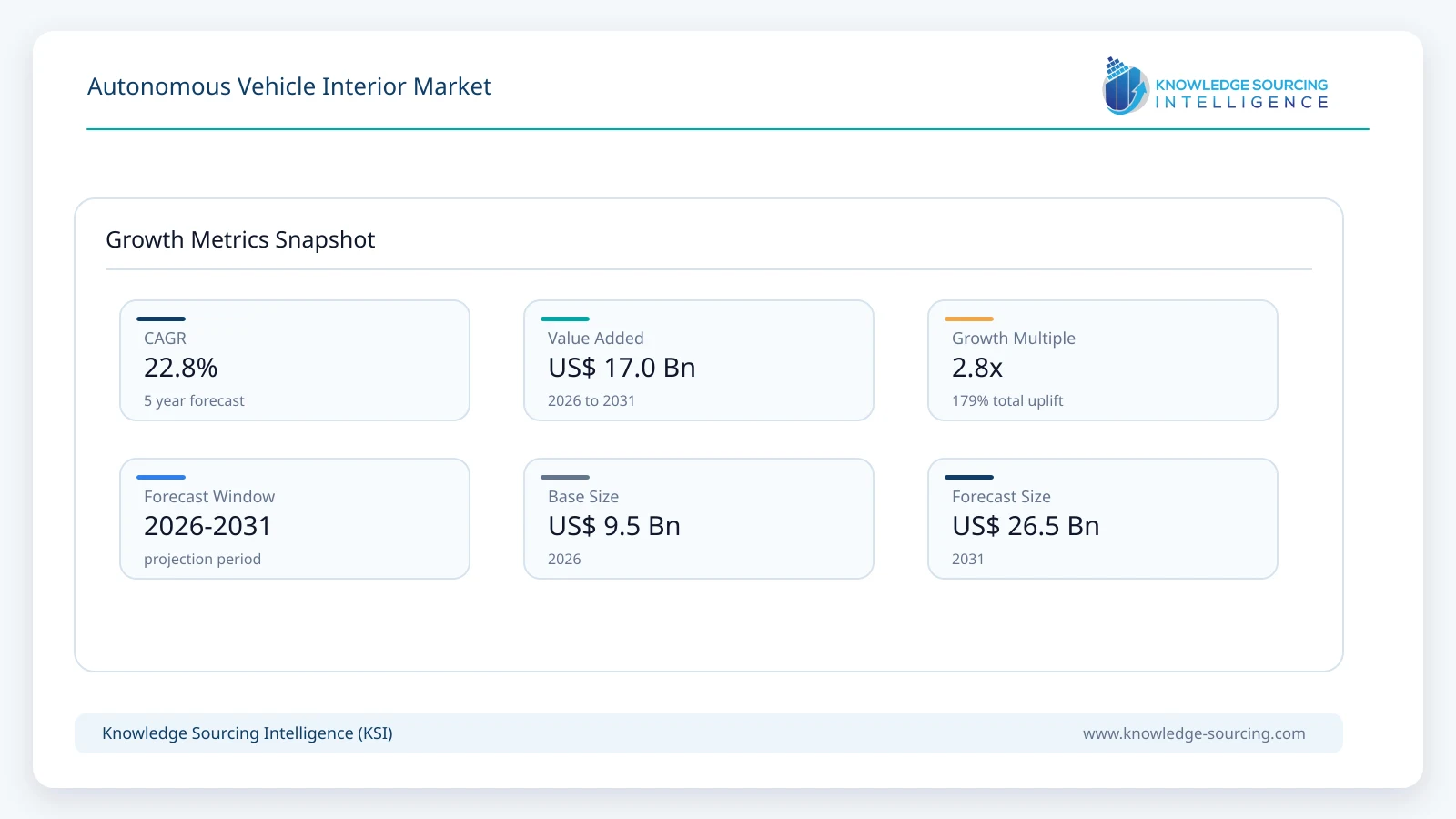
The Autonomous Vehicle Interior Market is forecast to grow at a CAGR of 22.8%, reaching USD 26.53 billion in 2031 from USD 9.50 billion in 2026.
Highlights:
- 1Seating and reconfiguration systems account for approximately 30% of global autonomous vehicle interior market value in 2026 because seats, rails, swivels, restraint integration and powered motion carry high mechanical, safety and electronic content.
- 2Cockpit, displays and HMI represent approximately 24% of market value in 2026 as panoramic displays, passenger screens, fold-away driving controls and multimodal interfaces become central to transitions between manual and automated driving.
- 3Comfort, wellness and adaptive-space functions account for approximately 34% of market value in 2026, supported by flexible layouts, localized climate, smart seating, lighting, acoustics and software-coordinated relaxation modes.
- 4SAE Level 3 applications represent approximately 61% of global market value in 2026 because conditional automation is the first production-scale environment requiring interiors to support both driver control and meaningful non-driving activities.
- 5Personally owned autonomous passenger vehicles account for approximately 63% of market value in 2026, while robotaxi and shared autonomous mobility applications are increasing demand for durable, easy-clean and highly accessible interiors.
- 6Asia Pacific represents approximately 42% of global market value in 2026, supported by rapid premium EV, smart-cabin and higher-automation development in China, Japan and South Korea.
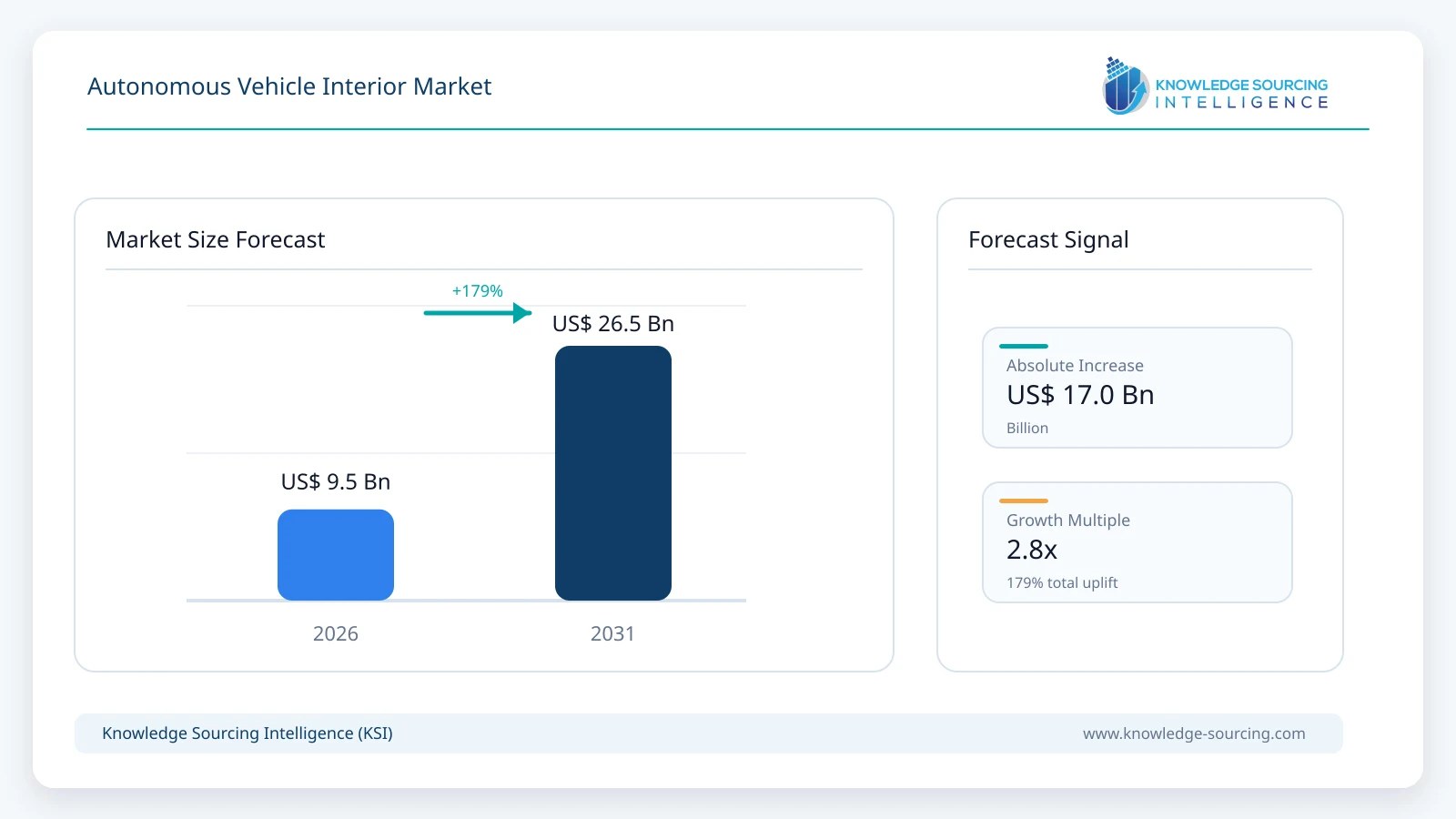
Interior content rises as automation changes the role of the cabin from a driving workspace into a multi-purpose environment that must safely support conventional driving, monitored automation, and increasingly passenger-centric travel modes.
Commercial development is moving from isolated concepts toward integrated interior platforms. Yanfeng describes XiM27 as a production-ready smart cabin for AD Level 3 and above, combining modular seating, ultra-long floor rails, movable consoles, displays, lighting, climate and a fold-away steering wheel under centralized cabin control. Waymo's Ojai provides a live Level 4 example with a flat floor, large passenger displays, personalized climate and media controls, and a cabin designed around riders rather than a conventional driver position.
The supplier value pool is also broadening. Toyota Boshoku is coordinating seats, door trims and console functions through LOUNZE+; FORVIA is developing modular consoles, deep-recline safe seating, smart displays and sustainable interior panels; Antolin integrates lighting, electronics, displays, consoles and smart surfaces into Level 4-oriented interiors; LG and HARMAN add AI-defined displays, sensing, audio and software-driven cabin intelligence. This convergence is increasing the importance of system integration, common electronics, interior sensing and software that can coordinate multiple interior domains in real time.
Market Overview
The autonomous vehicle interior is becoming a coordinated system rather than a collection of independent components. In conventional vehicles, seats, instrument panels, door trims, consoles, lighting, climate and infotainment are primarily designed around a fixed driver position. Higher automation introduces multiple cabin states, requiring these systems to change position, information flow and function according to whether the vehicle is being driven manually, operating conditionally under Level 3 automation or functioning as a Level 4 passenger environment.
Physical architecture is changing first. Flat-floor electric platforms and centralized electronics enable longer seat travel, powered rotation, deeper recline, movable consoles, fold-away tables and more open sightlines. Yanfeng XiM27 demonstrates this through ultra-long rails, AI-adaptive seating, a moving center console and a steering wheel that folds into the dashboard. Antolin similarly positions sliding floor consoles and integrated smart surfaces as tools for converting the interior between travel, work and leisure modes.
Digital architecture is changing in parallel. Panoramic displays, passenger screens, spatial audio, interior sensing and voice or gesture interaction increasingly share computing and data. LG is developing AI cabin platforms and windshield display concepts that change behavior during autonomous operation, while HARMAN is expanding production-ready visual, audio and occupant-aware technologies. These systems move interior differentiation from hardware alone toward coordinated software experiences.
Safety remains a structural requirement. Reclined or rotated occupants need restraints, airbags and sensing adapted to non-standard positions. Seat-integrated belts, occupant monitoring, seat-position validation and automatic safe-mode transitions therefore become part of the interior architecture. The most commercially viable designs are those that combine flexibility with clear physical constraints, reliable actuation and continuously verified occupant state.
Materials and sustainability are also becoming more important because autonomous cabins increase the visible and tactile role of interior surfaces. Suppliers are combining recycled and natural-fiber materials with lighting, touch interaction, displays, and sensor integration. This creates a larger opportunity for smart surfaces and modular interior components that can be updated without replacing the full cabin architecture.
Market Trends
Interiors Are Shifting from Driver-Centric Cockpits to Multi-Mode Living Spaces
Higher automation changes the purpose of the cabin. Interiors must support driving when required but also transition rapidly into lounge, work, entertainment, or rest configurations. This is increasing demand for movable seats, consoles, tables, screens, and storage systems that can change function without compromising access or safety.
Yanfeng XiM27 and Toyota Boshoku LOUNZE+ illustrate this direction by coordinating multiple interior elements rather than treating each component independently. The design priority is moving toward scenario-based cabin behavior in which hardware and software switch the interior as a complete environment.
Centralized Electronics Are Coordinating Previously Independent Interior Domains
Seats, displays, lighting, climate, sensing, and audio increasingly depend on shared compute and common software. Centralized cabin controllers reduce duplicated electronics and make it possible to synchronize multiple functions around occupant identity, automation state, and selected activity.
This supports faster scenario changes and over-the-air feature evolution. It also increases the value of suppliers that can integrate hardware, embedded software and domain control rather than supplying isolated components.
Smart Surfaces Are Replacing Conventional Decorative Trim
Instrument panels, door panels, headliners and consoles are becoming active interfaces. Backlit materials, hidden displays, touch-sensitive decorative surfaces and integrated lighting allow functions to appear only when needed, reducing visual clutter while preserving digital capability.
Antolin, Yanfeng and FORVIA are all developing interior surfaces that combine appearance with electronics and interaction. As automated driving reduces the need for a permanently visible driver interface, these surfaces can shift more strongly toward passenger-oriented information and ambience.
Comfort, Wellness and Entertainment Are Converging into Coordinated Cabin Modes
Autonomous travel increases the value of localized thermal comfort, adaptive lighting, spatial audio, personalized media and restorative seating. These functions are increasingly controlled as a coordinated experience rather than through separate switches and menus.
This creates additional value per vehicle because software can combine seat posture, airflow, light, audio and display behavior for work, sleep, entertainment or social modes. The same architecture can support recurring software and content services over the vehicle lifecycle.
Modular and Upgradable Interior Hardware Is Gaining Importance
Long vehicle lifecycles and fast-changing digital expectations are encouraging more modular interior design. Movable consoles, replaceable modules, standardized power and data interfaces, and configurable storage allow OEMs to update interior functionality without redesigning the entire structure.
FORVIA's on-demand center console and Yanfeng's mobile console direction show how interior hardware can become upgradeable. This approach also supports repairability, shared-mobility refurbishment, and more circular use of materials and components.
Segment Analysis
By Interior System: Seating and Reconfiguration Systems
Seating and reconfiguration systems represent the largest interior-system segment, accounting for approximately 30% of global market value in 2026. Seats carry high-value structures, power actuation, long rails, rotation, recline, integrated restraints, thermal features, sensing, and software-controlled movement.
The segment is expected to remain the largest through 2031 because higher automation directly expands the range of acceptable postures and cabin layouts. Production growth will favor architectures that combine flexibility with verified crash protection and reliable electrical routing across moving components.
By Primary Function: Comfort, Wellness and Adaptive Space
Comfort, wellness and adaptive-space functions account for approximately 34% of market value in 2026. The category includes lounge and relaxation modes, localized climate, seat comfort, ambient lighting, acoustic control, smart storage and other functions that make the cabin usable during periods when occupants are less engaged with driving.
Value growth is supported by the transition from passive comfort to context-aware adaptation. Interior systems increasingly use occupant profiles, seat position and activity state to adjust multiple domains automatically, making personalization a system-level capability rather than a single-feature option.
By Automation Level: SAE Level 3
SAE Level 3 applications account for approximately 61% of global market value in 2026. Conditional automation creates the first large production opportunity for interiors that must support both conventional driving and meaningful non-driving activities while preserving the ability to return the driver to a safe control position.
Level 3 therefore drives demand for retractable or reconfigurable driver interfaces, seat-position management, attention monitoring, passenger displays and cabin modes that can be enabled only when automation conditions permit. Level 4 interiors are expected to expand faster but from a smaller current base.
By Vehicle Application: Personally Owned Autonomous Passenger Vehicles
Personally owned autonomous passenger vehicles represent approximately 63% of global market value in 2026. Premium and upper-mid electric vehicles provide the strongest early commercialization route for high-content interiors because buyers already pay for advanced seats, displays, audio, lighting, and personalization.
As higher automation becomes more widely available, these vehicles can add reconfiguration and autonomous-mode features incrementally. Robotaxi and shared mobility remain strategically important because they can justify more radical layouts, but they require stricter durability, cleaning, accessibility, and fleet-maintenance economics.
By Propulsion: Battery Electric Vehicles
Battery electric vehicles account for approximately 76% of global autonomous vehicle interior market value in 2026. Flat floors, long wheelbases, fewer mechanical intrusions, and centralized electrical architectures give BEVs the strongest packaging foundation for reconfigurable seating, movable consoles, and digitally intensive interiors.
Electric platforms also have high overlap with software-defined vehicle development and premium smart-cabin positioning. This makes BEVs the principal architecture through which new autonomous interior technologies are being commercialized, particularly in China and premium global vehicle programs.
Market Drivers
Expansion of SAE Level 3 and Level 4 Automated Driving
Higher automation is the primary structural driver because it changes what occupants can do inside the vehicle. As attention can be redirected away from the road for longer periods, OEMs gain an incentive to add flexible seating, larger passenger displays, work surfaces, comfort modes and more adaptive cabin controls.
Interior value per vehicle therefore rises not only from additional hardware but also from the need to coordinate that hardware around automation state and occupant activity.
Growth of Software-Defined Vehicle Architectures
Centralized computing allows seating, infotainment, lighting, climate, sensing, and other interior functions to share data and software. This reduces the need for separate controllers and makes coordinated cabin modes technically feasible.
Software-defined architectures also support over-the-air upgrades, new personalization functions and recurring digital services, increasing the strategic importance of the interior over the vehicle lifecycle.
Demand to Reclaim Travel Time for Work, Rest and Entertainment
Autonomous mobility can convert travel time from an active driving task into usable personal time. This creates direct demand for interior layouts and systems that support reading, video, gaming, communication, meetings, social interaction and sleep.
The value proposition is strongest in longer commutes, premium vehicles, and autonomous mobility services where passengers spend substantial time in the cabin and are willing to pay for a differentiated environment.
Convergence of Occupant Sensing with Adaptive Safety and Personalization
Interior cameras, radar, seat sensors and identity recognition are increasingly used to understand who is in the vehicle, where they are positioned and what they are doing. This information can improve restraint deployment, prevent unsafe seat movement, and personalize comfort or content.
The same sensing layer therefore supports both safety and experience, improving the economics of integrated cabin-monitoring architectures and allowing more ambitious autonomous interior layouts.
Electric Vehicle Packaging and Premium Smart-Cabin Competition
EV platforms provide flat floors, flexible packaging and strong electrical capacity, while competition among premium EV brands increasingly centers on the cabin. This combination accelerates adoption of large displays, advanced seats, smart surfaces, lighting, audio and reconfigurable interior mechanisms.
China is particularly important because rapid EV product cycles are pushing interior innovation toward production at a faster pace, influencing global OEM expectations for smart-cabin content.
Market Restraints
Crash Protection across Reclined, Rotated and Reconfigured Occupant Positions
The more flexible the interior becomes, the more difficult it is to maintain predictable crash protection. Conventional airbags and belts are optimized around forward-facing seated occupants, while autonomous interiors can introduce rotation, deeper recline and larger seat travel.
Seat-integrated restraints, occupant sensing, adaptive airbags and strict motion-control logic add cost and validation burden. Safety constraints can also limit when certain layouts are permitted while the vehicle is moving.
High System Cost and Integration Complexity
Autonomous interiors combine mechanical structures, actuators, displays, sensors, electronics, thermal systems and software. The resulting bill of materials is significantly higher than for conventional interiors, particularly when redundancy and functional-safety requirements are added.
Integration failures can create noise, latency, electrical conflicts, or inconsistent user experience, increasing engineering and validation time for OEMs and suppliers.
Uneven Availability of Higher Automation
Level 3 and Level 4 operation remains limited by geography, road type, regulation, and operating domain. Interior features designed specifically for automated travel therefore cannot deliver their full value in every market or journey.
This can slow adoption of expensive reconfigurable hardware because OEMs must justify the content even when higher automation is available only for part of the vehicle's use.
Weight, Packaging and Energy Consumption
Long rails, powered swivels, reinforced seats, large displays and additional electronics increase mass and packaging demand. Interior systems must compete for space with batteries, HVAC ducts, airbags, structural members and storage.
Thermal comfort, displays and high-performance electronics also consume energy, creating pressure to improve efficiency in electric vehicles where cabin loads can affect driving range.
Durability, Cleaning and Lifecycle Requirements
Highly reconfigurable interiors introduce more moving interfaces and higher wear risk. Shared autonomous mobility adds frequent entry, contamination, spilled liquids and unpredictable user behavior, making durability and cleanability major design requirements.
Smart surfaces, touch interfaces, movable consoles and powered seats must therefore maintain performance over repeated cycles while remaining easy to service and cost-effective to refurbish.
Regional Outlook
Asia Pacific
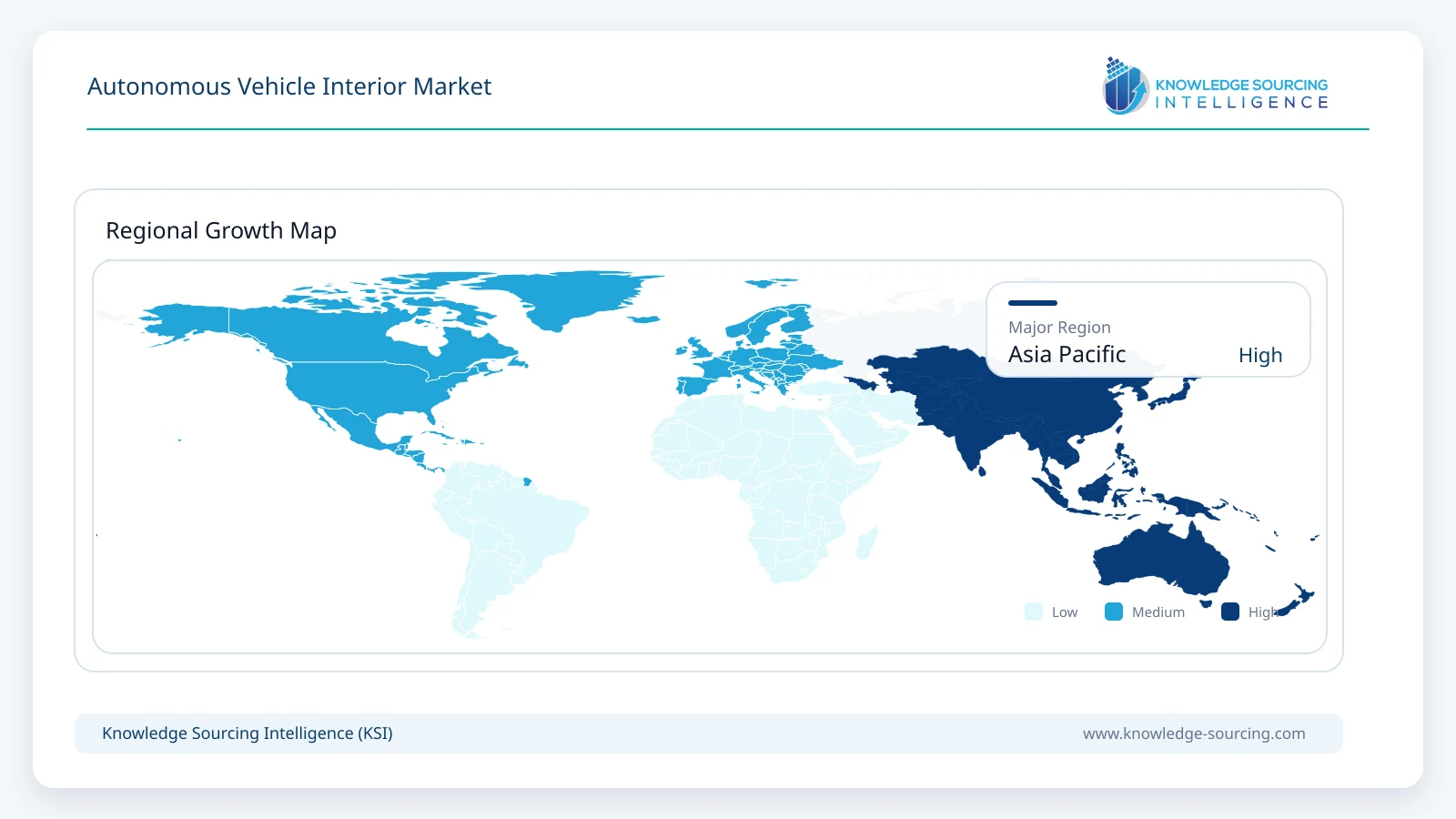
Asia Pacific is the largest regional market and is expected to remain the principal growth center through 2031. China combines rapid premium EV launches, strong smart-cabin competition and aggressive development of Level 3-capable vehicles, creating an early commercialization environment for high-content interiors.
Yanfeng XiM27 demonstrates the region's move toward production-ready integrated cabins, while Toyota Boshoku is advancing coordinated living-space concepts and South Korean suppliers such as LG are expanding AI-defined displays, sensing and in-vehicle computing. The region also benefits from established electronics, display, seating and interior-component supply chains.
Japan and South Korea contribute deep capabilities in seating, displays, materials and automotive electronics, while China is increasingly setting the pace for feature integration and rapid product iteration. These strengths support high adoption of adaptive seating, large displays, smart surfaces and software-coordinated cabin functions.
Europe
Europe remains a major high-value market because premium OEMs, safety regulation and established interior suppliers support advanced cabin engineering. The region is influential in seat safety, interior materials, smart surfaces, lighting, cockpit electronics and software-defined vehicle development.
FORVIA is combining seating, cockpit electronics and modular interior systems, while Antolin develops smart consoles, lighting, active surfaces and Level 4-oriented interior concepts. European OEMs are also important commercialization partners for advanced displays, occupant monitoring and premium cabin functions.
Growth will be shaped by the interaction between automation regulation, Euro NCAP requirements, EV adoption and premium-vehicle differentiation. Interiors that can prove safe transitions between manual and automated modes are expected to gain the strongest near-term adoption.
Competitive Landscape
The autonomous vehicle interior market spans complete-interior suppliers, seating specialists, cockpit electronics providers and digital cabin technology companies. Competitive advantage depends on the ability to integrate physical architecture with electronics, safety systems and software while maintaining automotive-grade cost, durability and manufacturability.
Yanfeng is differentiated by complete smart-cabin integration across interiors, seating, cockpit electronics and passive safety. FORVIA combines seating, electronics, modular interior systems and cockpit technologies, while Toyota Boshoku contributes strong seating and coordinated mobility-space development. Antolin remains a major interior integrator across overheads, cockpits, doors, lighting, HMI and electronic systems.
Magna contributes advanced seating and mechatronic reconfiguration, while LG Electronics Vehicle Solution and HARMAN provide the display, sensing, computing, audio and software layers that increasingly define smart interiors. The market is therefore converging around partnerships between traditional interior suppliers and electronics/software specialists rather than a single vertically integrated technology stack.
Recent Developments
10 July 2026: Yanfeng announced that XiM27 received the 2026 Red Dot Design Concept Award. The AD Level 3+ smart-cabin platform combines intelligent seat configuration, a mobile floor console, fold-away steering, adaptive lighting, spatial audio and AI-based emotion recognition.
29 June 2026: Yanfeng unveiled XiM27, a production-ready smart-cabin platform integrating seating, infotainment, climate, door panels, ambient lighting, ultra-long floor rails and centralized cabin control for work, rest, entertainment and social scenarios.
28 May 2026: Waymo began welcoming first public riders to the Ojai, a purpose-built Level 4 vehicle with elevator-style doors, a low step, completely flat floor, three large LED screens and personalized temperature and media controls.
23 April 2026: Toyota Boshoku presented LOUNZE+ at Auto China 2026, coordinating seats, door trims and console functions to create a living-room-like mobility space that adapts to different passenger activities.
24 February 2026: FORVIA detailed its 2026 technology roadmap, including intelligent seating that uses sensors, software and AI to adjust multiple comfort parameters according to occupant morphology and driving conditions.
13 January 2026: HARMAN introduced production-ready visual and audio technologies designed to create clearer displays, personalized listening and more expressive in-cabin experiences across the modern cockpit.
17 December 2025: LG Electronics announced CES 2026 AI-powered in-vehicle solutions combining advanced displays, in-cabin sensing and on-device AI to reshape the driver, front-passenger and rear-seat experience.
30 October 2025: FORVIA unveiled its On-demand center console, a modular interior platform using interchangeable modules for storage, tables, appliances and a retractable display through a standardized mechanical, power and data interface.
Market Outlook
The autonomous vehicle interior market is expected to expand rapidly through 2031 as cabin differentiation becomes a larger part of the economic value of higher automation. Seating and reconfiguration will remain the largest physical value pool, while displays, sensing, software, lighting, audio and smart surfaces will increase their share as interiors become more electronically integrated.
The strongest product architectures will combine flexibility with safety and simplicity. Interior systems that can shift between driving and non-driving modes without creating complicated user procedures are more likely to reach production. Centralized control, occupant sensing and automated return-to-safe-position logic will become important enablers of this transition.
Asia Pacific is expected to retain the largest regional share, while Europe remains a major premium engineering and safety-validation market. Competitive advantage will depend on system integration, packaging efficiency, software capability, occupant-aware safety, material sustainability, manufacturing scale and the ability to deliver a consistent experience across multiple automation states.
Autonomous Vehicle Interior Market Scope:
| Report Metric | Details |
|---|---|
| Total Market Size in 2026 | USD 9.50 billion |
| Total Market Size in 2031 | USD 26.53 billion |
| Forecast Unit | USD Billion |
| Growth Rate | 22.8% |
| Study Period | 2021 to 2031 |
| Historical Data | 2021 to 2024 |
| Base Year | 2025 |
| Forecast Period | 2026 – 2031 |
| Segmentation | Interior System, Primary Function, Automation Level, Vehicle Application |
| Companies |
|
Market Segmentation
By Interior System
Seating and Reconfiguration Systems
Cockpit, Displays and HMI
Instrument Panels, Door Panels and Trim
Consoles, Storage and Work Surfaces
Lighting, Audio and Acoustic Systems
Climate, Wellness and Air Management
Cabin Monitoring and Safety Integration
By Primary Function
Comfort, Wellness and Adaptive Space
Safety, Monitoring and Control
Entertainment and Digital Interaction
Productivity and Communication
Storage, Convenience and Accessibility
By Automation Level
SAE Level 3
SAE Level 4 and Above
By Vehicle Application
Personally Owned Autonomous Passenger Vehicles
Robotaxi and Shared Autonomous Mobility
Autonomous Shuttle and Commercial Passenger Mobility
By Propulsion
Battery Electric Vehicles
Hybrid Electric Vehicles
Internal Combustion Engine Vehicles
Fuel Cell Electric Vehicles
By Geography
North America
United States
Canada
Mexico
South America
Brazil
Argentina
Others
Europe
Germany
United Kingdom
France
Italy
Spain
Others
Middle East and Africa
Saudi Arabia
UAE
South Africa
Others
Asia Pacific
China
Japan
South Korea
India
Singapore
Others
Table of Contents
1. INTRODUCTION
1.1. Market Overview
1.2. Market Definition
1.3. Scope of the Study
1.4. Market Segmentation
1.5. Currency
1.6. Assumptions
1.7. Base and Forecast Years
1.8. Key Benefits to Stakeholders
2. RESEARCH METHODOLOGY
2.1. Research Design
2.2. Secondary Research
2.3. Primary Research
2.4. Market Estimation
2.5. Segment Modelling
2.6. Data Triangulation and Validation
3. EXECUTIVE SUMMARY
3.1. Key Findings
3.2. Autonomous Vehicle Interior Market Size, 2026-2031
3.3. Interior System Outlook
3.4. Primary Function Outlook
3.5. Automation Level Outlook
3.6. Vehicle Application Outlook
3.7. Propulsion Outlook
3.8. Regional Opportunity Summary
4. MARKET DYNAMICS
4.1. Market Drivers
4.1.1. Expansion of SAE Level 3 and Level 4 Automated Driving
4.1.2. Growth of Software-Defined Vehicle Architectures
4.1.3. Demand to Reclaim Travel Time for Work, Rest and Entertainment
4.1.4. Convergence of Occupant Sensing with Adaptive Safety and Personalization
4.1.5. Electric Vehicle Packaging and Premium Smart-Cabin Competition
4.2. Market Restraints
4.2.1. Crash Protection across Reclined, Rotated and Reconfigured Occupant Positions
4.2.2. High System Cost and Integration Complexity
4.2.3. Uneven Availability of Higher Automation
4.2.4. Weight, Packaging and Energy Consumption
4.2.5. Durability, Cleaning and Lifecycle Requirements
4.3. Market Opportunities
4.4. Porter's Five Forces Analysis
4.5. Industry Value Chain Analysis
4.6. Autonomous Interior System Economics
4.7. Regulatory, Passive-Safety and Functional-Safety Environment
5. TECHNOLOGY OUTLOOK
5.1. Reconfigurable Seating and Long-Rail Architectures
5.2. Swivel, Recline and Zero-Gravity Mechanisms
5.3. Panoramic Displays and Passenger HMI
5.4. Retractable Driving Controls and Adaptive Cockpit Architecture
5.5. Smart Surfaces, Instrument Panels and Door Trim
5.6. Modular Consoles, Tables and Storage Systems
5.7. Occupant Monitoring and Position-Aware Safety
5.8. Adaptive Lighting, Spatial Audio and Acoustic Control
5.9. Localized Climate, Wellness and Air Management
5.10. Centralized Cabin Control, AI and Personalization
5.11. Sustainable and Recyclable Interior Materials
6. AUTONOMOUS VEHICLE INTERIOR MARKET BY INTERIOR SYSTEM
6.1. Introduction
6.2. Seating and Reconfiguration Systems
6.3. Cockpit, Displays and HMI
6.4. Instrument Panels, Door Panels and Trim
6.5. Consoles, Storage and Work Surfaces
6.6. Lighting, Audio and Acoustic Systems
6.7. Climate, Wellness and Air Management
6.8. Cabin Monitoring and Safety Integration
7. AUTONOMOUS VEHICLE INTERIOR MARKET BY PRIMARY FUNCTION
7.1. Introduction
7.2. Comfort, Wellness and Adaptive Space
7.3. Safety, Monitoring and Control
7.4. Entertainment and Digital Interaction
7.5. Productivity and Communication
7.6. Storage, Convenience and Accessibility
8. AUTONOMOUS VEHICLE INTERIOR MARKET BY AUTOMATION LEVEL
8.1. Introduction
8.2. SAE Level 3
8.3. SAE Level 4 and Above
9. AUTONOMOUS VEHICLE INTERIOR MARKET BY VEHICLE APPLICATION
9.1. Introduction
9.2. Personally Owned Autonomous Passenger Vehicles
9.3. Robotaxi and Shared Autonomous Mobility
9.4. Autonomous Shuttle and Commercial Passenger Mobility
10. AUTONOMOUS VEHICLE INTERIOR MARKET BY PROPULSION
10.1. Introduction
10.2. Battery Electric Vehicles
10.3. Hybrid Electric Vehicles
10.4. Internal Combustion Engine Vehicles
10.5. Fuel Cell Electric Vehicles
11. AUTONOMOUS VEHICLE INTERIOR MARKET BY GEOGRAPHY
11.1. North America
11.1.1. United States
11.1.2. Canada
11.1.3. Mexico
11.2. South America
11.2.1. Brazil
11.2.2. Argentina
11.2.3. Others
11.3. Europe
11.3.1. Germany
11.3.2. United Kingdom
11.3.3. France
11.3.4. Italy
11.3.5. Spain
11.3.6. Others
11.4. Middle East and Africa
11.4.1. Saudi Arabia
11.4.2. UAE
11.4.3. South Africa
11.4.4. Others
11.5. Asia Pacific
11.5.1. China
11.5.2. Japan
11.5.3. South Korea
11.5.4. India
11.5.5. Singapore
11.5.6. Others
12. COMPETITIVE ENVIRONMENT AND ANALYSIS
12.1. Major Players and Strategy Analysis
12.2. Market Share Analysis
12.3. Autonomous Interior Technology Benchmarking
12.4. Integrated Cabin Platforms and Production Readiness
12.5. Competitive Dashboard
13. COMPANY PROFILES
13.1. Yanfeng
13.2. FORVIA
13.3. Toyota Boshoku Corporation
13.4. Antolin
13.5. Magna International Inc.
13.6. LG Electronics Vehicle Solution Company
13.7. HARMAN International
14. APPENDIX
14.1. Currency
14.2. Assumptions
14.3. Base and Forecast Years Timeline
14.4. Key Benefits for Stakeholders
14.5. Research Methodology
14.6. Abbreviations
14.7. Data Sources
Navigate
Trusted by the world's leading organizations











