
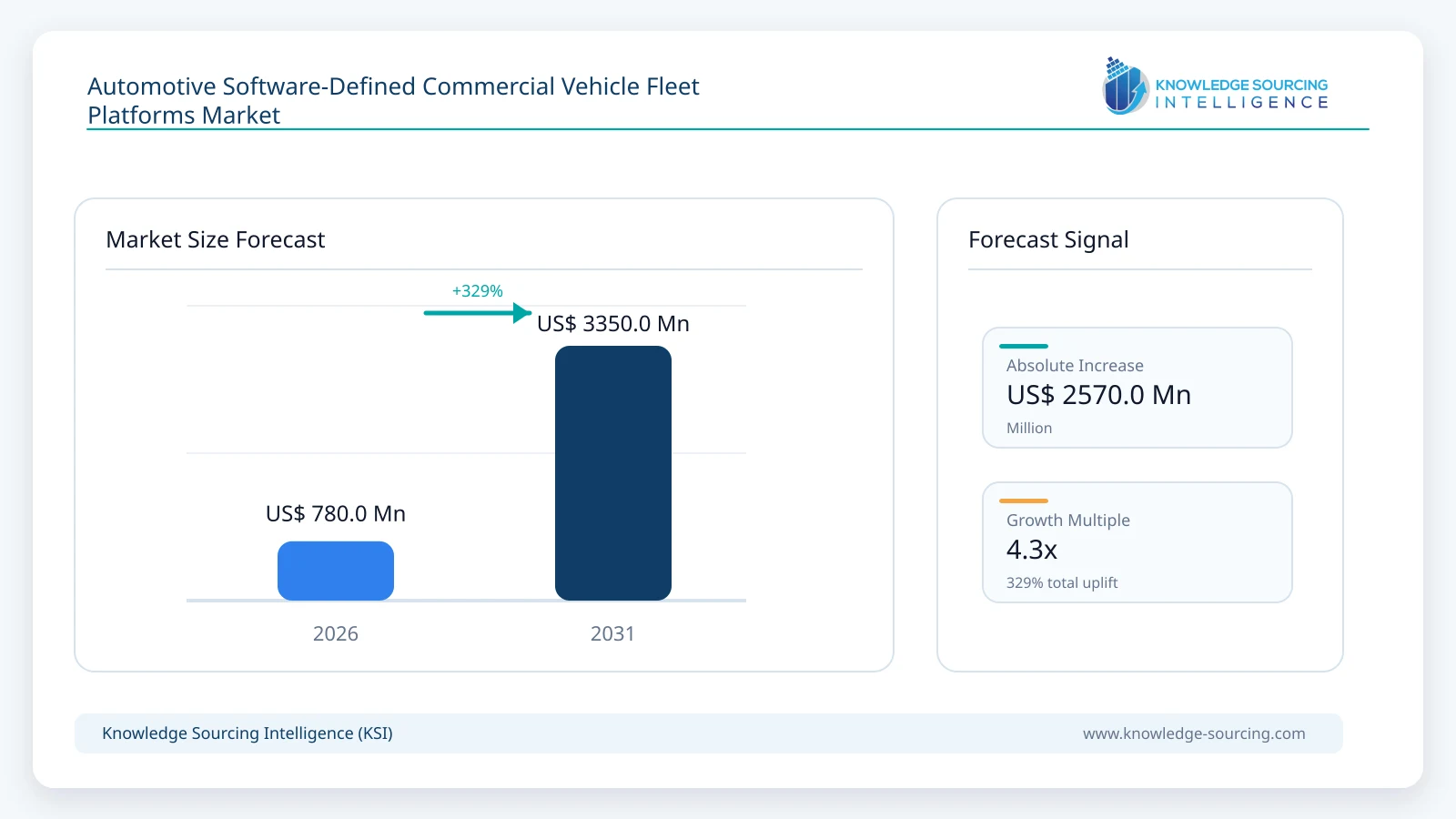
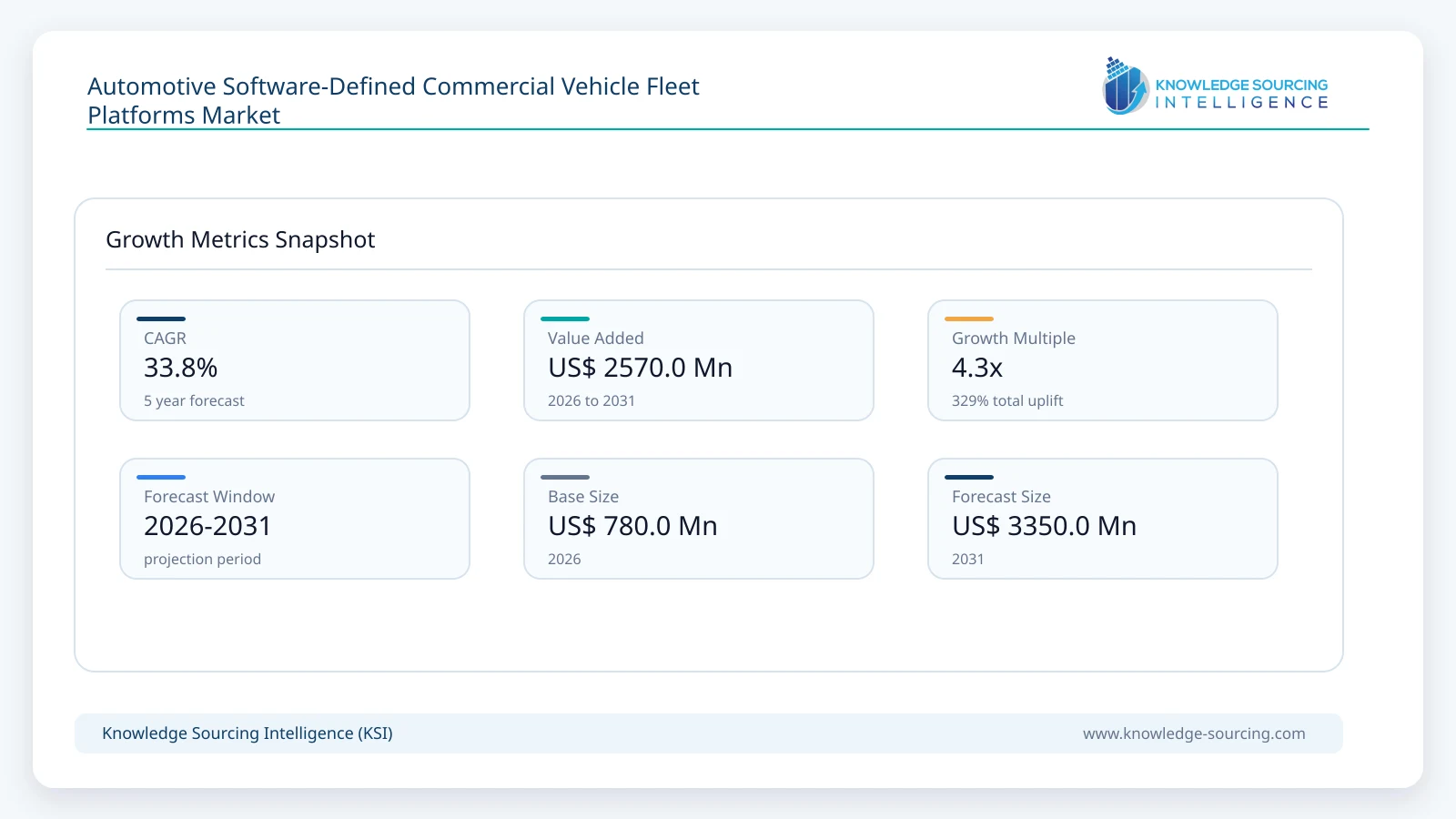
The automotive software-defined commercial vehicle fleet platforms market is anticipated to grow at a CAGR of 33.8%, from USD 780 million in 2026 to USD 3,350 million by 2031.
Highlights:
- 1Factory-integrated applications and secure software delivery are becoming core fleet-platform purchasing criteria, rather than optional telematics add-ons.
- 2OEM-embedded platforms represent approximately 44% of 2026 value; independent multi-brand platforms gain share as mixed-fleet integration expands.
- 3Medium and heavy commercial trucks account for approximately 48% of 2026 market revenue, reflecting uptime requirements and longer deployment cycles.
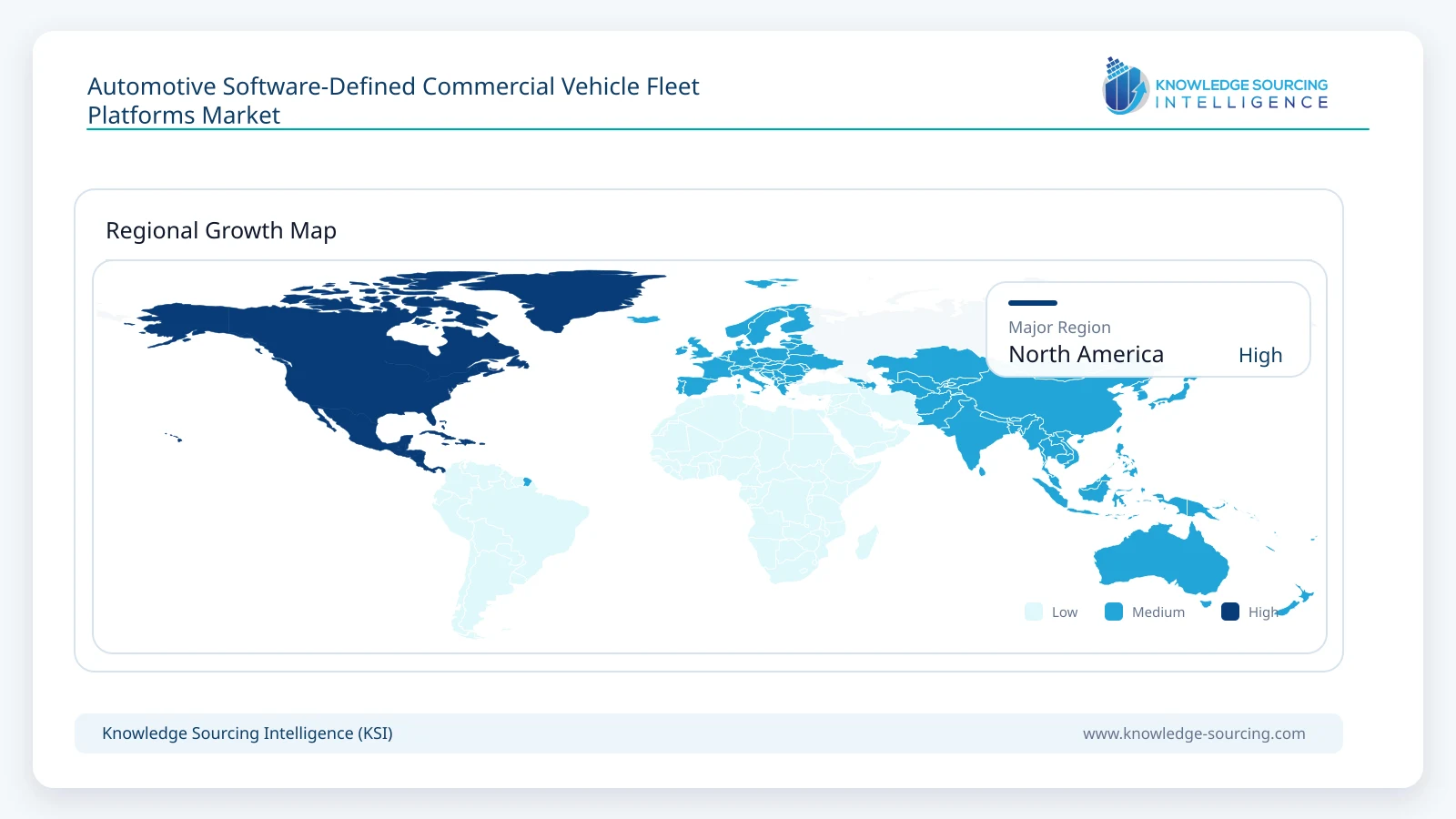
- 4North America leads the 2026 market, whereas Asia Pacific is projected to become the largest regional market by 2031.
- 5PACCAR Connect was announced in October 2026 with early-2027 availability planned; Volvo activated unattended truck updates in September 2026.
Software-defined fleet platforms combine connected vehicle access, application orchestration, feature configuration and secure software delivery within a consistent fleet workflow. Fleet operators use these services to manage vehicle health, configure approved functions, coordinate driver applications and connect commercial vehicles to enterprise systems. Purchases typically involve vehicle-linked licenses, enterprise platform access and implementation services rather than the full cost of a truck’s electronic architecture.
Daimler Truck’s Virtual Vehicle collaboration with Platform Science, PACCAR Connect and Volvo Connect illustrate how vehicle manufacturers are extending factory-installed connectivity into application ecosystems. Meanwhile, fleet-software providers such as Geotab, Samsara and ZF connect different makes and models through web platforms and integration interfaces. The commercial advantage lies in keeping software, vehicle data and operating workflows aligned across a changing fleet without maintaining separate hardware and applications for every brand.
Market Overview
An operationally useful fleet platform must control both what software is present on each commercial vehicle and how that software contributes to day-to-day transport operations. Its functions may include authenticated application provisioning, update scheduling, fault and service information, driver-interface modules and APIs for dispatch, maintenance and energy management. For asset owners, the platform’s value is tied to uptime, fleet standardization and the ability to introduce new workflows without repeatedly installing new hardware.
TRATON and Applied Intuition announced TRATON ONE OS in March 2026 as a shared software foundation for Scania, MAN, International and Volkswagen Truck & Bus. The partners describe unified data access and OTA-updated functions as key capabilities. TRATON subsequently announced a planned collaboration with Red Hat in September, extending the role of standardized software foundations and external technology partners in future commercial vehicles.
Fleet operators already buy related services from several types of participants. Volvo Connect and My Scania package OEM vehicle access and digital services; PACCAR Connect extends a factory integration and application marketplace approach; ZF SCALAR addresses fleet orchestration; and vendors such as Samsara provide cross-brand workflows. These offerings are not commercially interchangeable, because access rights, safety responsibilities, equipment lifecycles and platform licensing vary by buyer and vehicle program.
Market Trends
Factory-Installed Platforms Are Creating Vehicle Application Marketplaces
PACCAR’s October 2026 announcement links Kenworth and Peterbilt factory electronics with the Virtual Vehicle application ecosystem and PACCAR Connect Portal, with rollout planned from early 2027. The model lets fleets activate applications through vehicle-integrated software instead of installing separate telematics devices for every workflow. This reduces cab clutter and moves spending toward licensed modules, update support and centralized policy management.
Daimler Truck North America already identifies Virtual Vehicle and Geotab Integrated Telematics as complementary fleet offerings. Such partnerships show how vehicle makers can preserve safety-critical vehicle access while allowing third-party software to reach commercial operators. Distribution through the manufacturer may strengthen interoperability but also makes platform approval, developer permissions and commercial revenue sharing more important.
Over-the-Air Release Management Is Becoming a Fleet Operating Requirement
Volvo Trucks made unattended OTA updates available in North America in September 2026, allowing drivers to park, lock the vehicle and leave while updates run. Volvo reported a large improvement in latest-software coverage among connected trucks, together with fewer unplanned stops on the updated fleet. This demonstrates a measurable reason for fleets to support update scheduling and health monitoring across operating shifts.
Large transport fleets cannot treat software upgrades like ordinary passenger-car downloads because truck availability, cargo schedules and regulatory requirements constrain installation windows. Software-defined platforms consequently need vehicle eligibility checks, release history, rollback arrangements and communication with dispatch or workshop systems. Platform operators with dependable rollout controls can win enterprise programs even if their dashboard features resemble those of cheaper telematics products.
Cross-Brand Data Access Is Improving Mixed-Fleet Software Delivery
Samsara and Volkswagen Group Info Services announced an integration in October 2026 that brings supported Volkswagen Group vehicle data into connected fleet workflows. The cooperation covers multiple passenger and commercial brands, enabling vehicle performance and maintenance information to be used without another aftermarket connection where supported. Fleet operators can therefore standardize applications while retaining vehicles from different manufacturers.
Third-party platforms increasingly compete on coverage and control of application access, not only the number of live vehicle location points. OEM data rights, delayed sensor availability and inconsistent software controls still limit some functions. Successful providers will combine a consistent operator interface with transparent feature eligibility and device-level safeguards, rather than promising identical capability across every vehicle in a mixed fleet.
Unified Software Architectures Are Changing OEM Development Economics
TRATON ONE OS was announced for four commercial vehicle brands in March 2026, building on a 2025 development partnership with Applied Intuition. The shared architecture is intended to carry vehicle-level applications and software updates across future truck generations. Using common middleware can reduce duplicated software engineering while leaving vehicle-brand interfaces and customer services differentiated.
Volvo Group and Daimler Truck separately launched Coretura in June 2025 to develop a common software-defined commercial vehicle platform. These programs indicate that large OEM groups are treating embedded software as a long-term product system rather than a collection of truck-specific ECUs. For the fleet-platform value chain, shared architectures increase the potential fleet installed base per application while raising qualification requirements for software partners.
Connected Fleet Platforms Are Extending Into Energy and Workflows
IVECO presented an in-house vehicle app store and a broader digital-services ecosystem in July 2026, while the redesigned IVECO ON portal brings vehicle health, fuel use and operational data into a consolidated interface. Fleet customers increasingly need a common environment for diesel, electric and alternative-fuel vehicles, including remote health status, energy information and operational applications.
ZF’s SCALAR platform takes an orchestration approach by connecting transport decisions, asset use and real-time fleet information. As light commercial deliveries and electrified services expand, operators are likely to purchase software that coordinates charging, route restrictions, driver tasks and service availability with vehicle configuration. The highest-value programs will connect software-enabled vehicle control with a measurable operational process, rather than only aggregate more dashboards.
Segment Analysis
By Platform Architecture: OEM-Embedded Fleet Platforms
OEM-embedded solutions represent an estimated 44% of 2026 revenue because truck manufacturers control onboard gateways, diagnostic access, vehicle authorization and software compatibility. Volvo Connect, My Scania and Daimler Truck services illustrate how manufacturers tie connected operation to vehicle delivery and aftersales. Fleet buyers often favor these solutions when critical updates and warranty-related service records must remain within approved OEM workflows.
The OEM channel should remain commercially important even as independent providers gain share. PACCAR Connect’s planned 2027 availability and TRATON’s cross-brand architecture create further routes for onboard application access. However, fleets operating many brands frequently maintain a secondary platform to compare asset utilization and manage central business operations across their vehicle population.
By Software Function: Fleet Application Orchestration
Fleet application orchestration accounts for approximately 30% of modeled revenue in 2026 and is projected to reach about 34% by 2031. The segment includes app access controls, lifecycle activation, driver workflows and managed integrations between in-vehicle interfaces and fleet systems. It grows as operators combine dispatch, inspection, compliance and vehicle configuration within fewer software environments.
Daimler Truck’s Virtual Vehicle ecosystem and Volvo Connect’s digital services store demonstrate the move toward app-based service distribution. The commercial advantage is not the number of available applications alone; it is the ability to grant the correct functions to specified drivers and vehicles, deploy changes safely and keep business processes consistent over time.
By Commercial Vehicle Type: Medium and Heavy Trucks
Medium and heavy trucks generate approximately 48% of the 2026 market because their high utilization makes software availability, maintenance scheduling and remote diagnostics especially valuable. Their operators manage long service lives and use several vehicle generations within one fleet. Software configuration and OTA functions can reduce workshop visits and prevent deployment differences from fragmenting fleet operations.
Light commercial vehicles are expected to expand faster as last-mile operators add digitally connected vans and service vehicles. Their buying process is more cost sensitive, but the larger vehicle population supports software subscriptions that are easy to deploy at scale. Commercial fleet platforms therefore need distinct pricing, feature bundles and driver workflows for heavy trucks and lighter urban vehicles.
By Revenue Model: Vehicle-Linked Subscriptions
Vehicle-linked software subscriptions represent the majority of the revenue pool because the ongoing management of features, credentials and fleet workflows is generally charged against active vehicles. Subscriptions account for about three-quarters of modeled 2026 spending and continue to lead the business model through 2031. The approach lets platform suppliers expand income as a customer increases covered vehicles or adds services.
Enterprise licensing and integration charges remain relevant for multinational fleets that require bespoke identity controls, ERP interfaces, application distribution and security processes. Purchasers may receive some basic connected services free with new trucks, making their willingness to pay dependent on the incremental value of orchestration, secure updates and operational integration.
Market Drivers
Commercial-Vehicle Downtime Makes Remote Software Management Valuable
Transport operators lose earning hours when trucks are held for software upgrades, fault checks or workshop visits. Volvo Trucks’ September 2026 launch of unattended OTA delivery addresses this operational problem by allowing updates during parked periods and scheduled breaks. Software release coordination therefore has a clear economic role in fleets where vehicles operate over long shifts and cover high annual mileage.
Connected platforms that schedule valid updates, alert service teams and record software status can reduce the administrative workload around large fleet populations. Buyers still assess the function on actual uptime and workshop outcomes, which favors integrated fleet and vehicle platforms over disconnected update utilities.
Factory-Connected Vehicles Support Software Activation at Scale
PACCAR Connect, Daimler Truck’s Virtual Vehicle partnership and established OEM digital portals demonstrate how new trucks can deliver application access from the production line. The availability of authenticated vehicle connections reduces the need for separate onboard devices and can shorten the time between purchase and software service activation. It also makes fleets more likely to standardize one platform for a manufacturer-specific vehicle group.
Factory connectivity does not automatically translate into paid software revenue because many OEMs include basic telematics at no additional charge. Premium value arises when the fleet can activate managed applications, integrate commercial workflows or configure authorized functions that improve day-to-day operation.
Common Vehicle Software Foundations Expand Application Reach
TRATON’s March 2026 platform announcement and Volvo Group–Daimler Truck’s Coretura joint venture show vehicle makers investing in reusable software foundations across multiple commercial brands. Shared middleware and consistent interfaces reduce the engineering burden of delivering the same service to several truck models. For a fleet operator, this can mean fewer platform-specific applications and more consistent function behavior.
Cross-brand software architectures create a larger addressable market for independent developers, but programs must still satisfy the security, operational and warranty expectations of heavy-vehicle OEMs. Suppliers that can qualify functions once and maintain them across vehicle generations have a structural advantage in recurring fleet software sales.
Open Platforms Address Mixed-Fleet Workflow Complexity
Large distribution, construction and service companies commonly operate trucks and vans from several manufacturers, creating fragmented driver apps, asset records and service portals. Samsara’s October 2026 Volkswagen Group data integration illustrates how a cross-brand platform can reuse OEM connections to offer a common fleet workflow. Similar integrations make the business case for software layers that sit above brand-specific telematics.
Fleet customers pay for these platforms when consolidated controls, standardized operational reports and simpler driver training improve productivity. The trend encourages APIs and partner stores, although permissions and available vehicle functions still vary by brand and production year.
Electrification Adds Energy and Configuration Workflows
Commercial electric vans and trucks require coordinated charging status, energy use, route suitability and service information. IVECO ON and Volvo Connect already organize portions of these data within broader connected services. Software-defined fleet platforms can combine those operational views with application permissions and remotely activated functionality as electrified fleets diversify.
As fleets run diesel and battery-electric vehicles side by side, they need consistent user access and incident handling with propulsion-specific energy modules. Platforms that provide configurable energy services without requiring a separate system for every powertrain can justify higher-value enterprise contracts.
Market Restraints
Legacy Truck Electronics Limit Feature Availability
Older commercial vehicles often lack the standardized gateways, storage capacity and onboard software controls required for reliable remote activation. Mixed fleets therefore cannot assume that every truck supports the same software deployment process. Developers may need model-specific connectors or aftermarket gateways, which add testing and support costs.
The constraint is most visible when fleets retain vehicles for many years. Platform providers must offer transparent eligibility rules and avoid presenting a feature as fleet-wide when only recent vehicle generations can accept it. That uneven installed-base capability slows the conversion of connected accounts into premium software subscribers.
Cybersecurity and Safe Release Management Raise Operating Costs
Commercial vehicle software updates and connected applications touch systems that may affect driving performance, diagnosis and legal compliance. UNECE Regulation No. 156 establishes a framework for software-update management in jurisdictions applying it, while related cybersecurity rules add expectations around risk management and secure vehicle architecture. Fleet platforms must therefore document the software version and maintain controlled access to updates.
Security reviews, compatibility checks and safe rollback procedures create recurring validation work for OEMs and independent providers. Companies with weak release governance risk downtime, warranty disputes or loss of customer trust, making platform security an ongoing cost rather than a one-off development step.
Bundled OEM Services Make Monetization Uneven
DAF provides a long standard term of PACCAR Connect access with certain new trucks, and Daimler Truck has announced free initial periods for parts of its TruckLive offering. These approaches help manufacturers build connected user populations but make it difficult to sell a separate basic platform subscription when customers already receive an acceptable service.
Premium providers must demonstrate value in application governance, mixed-brand integration, energy management or enterprise workflows beyond the baseline OEM package. A broad subscription market can therefore grow more slowly than the total number of connected commercial vehicles.
Fleet Data Rights and Interoperability Differ Between Brands
Independent software vendors may access mileage, health events and approved operating signals from one manufacturer but receive fewer functions from another. The operational differences become material when a fleet manager expects to push applications, change settings or request diagnostic data across multiple vehicle brands. Public APIs do not automatically confer rights to safety-relevant vehicle functions.
Suppliers consequently face repeated interface maintenance and commercial negotiations with OEMs, reducing the economies of scale promised by one-platform fleet management. Cross-brand platforms must invest in data governance and transparent feature coverage to keep large customers satisfied.
Fleet Procurement and Change Management Can Delay Rollouts
Transport firms frequently have thin margins and cannot disrupt dispatch, driver procedures or maintenance schedules to adopt a new software environment. Replacing established telematics or workflow systems can require training, ERP integration and changes to operational rules. The return on investment may be strong but is often realized only after implementation is complete.
Large fleets therefore tend to adopt software-defined functions in stages, starting with a vehicle group or specific operating process. Commercial suppliers need to offer migration tools and implementation support, which increases delivery cost and may delay recognition of recurring subscriptions.
Regional Outlook
North America
North American commercial fleets provide the largest 2026 revenue pool because heavy-truck operators have adopted connected diagnostics, fleet software and remote service products across large vehicle populations. Daimler Truck North America offers Detroit Connect and partner integrations, while Volvo has deployed OTA update functions across its connected North American trucks. PACCAR’s October 2026 platform announcement adds another manufacturer-backed application ecosystem to the region.
The United States is the principal market, supported by long-haul logistics, large enterprise fleets and independent software vendors. North American operators place particular value on reducing downtime and managing drivers across broad service territories. The region should retain substantial spending through 2031, though its share declines as cloud and connected-truck adoption expands faster in Asia Pacific.
Asia Pacific
Asia Pacific is projected to become the largest regional market by 2031, supported by rising connected vehicle availability, commercial electrification and growing demand for configurable fleet software across China, India, Japan and Southeast Asia. The region includes large delivery fleets, expanding logistics networks and truck manufacturers investing in platform-based digital services. Differences in vehicle age, operator size and local cloud requirements create several parallel adoption paths.
China has the largest regional installed commercial vehicle population relevant to software-enabled fleet services, while India offers growth potential in connected light and medium-duty operations. Platform vendors that adapt pricing, language, data hosting and mobile-first workflows to each country will be better positioned than providers relying solely on a premium European or North American enterprise license model.
Competitive Landscape
The competitive landscape combines commercial-vehicle manufacturers that control onboard software access with independent fleet-platform suppliers that offer multi-brand workflows. Daimler Truck, Volvo Trucks, Scania, PACCAR and IVECO deliver manufacturer-linked digital services, while Platform Science, Geotab, Samsara and ZF address application ecosystems, cross-brand operations or fleet orchestration. Their products overlap, but ownership of vehicle software authorization remains a major distinction.
TRATON and Applied Intuition are building a common vehicle software architecture, and Volvo Group and Daimler Truck established Coretura for related development work. These partnerships show that OEMs increasingly treat operating software as shared infrastructure across brands. Independent suppliers can benefit if those platforms provide stable developer interfaces, yet vehicle makers still decide which functions and vehicle data are commercially exposed.
The principal competitive differentiators are secure software lifecycle control, vehicle coverage, approved app distribution, integration depth and the ability to document benefits to fleet operations. Platforms serving large mixed fleets can command higher enterprise contract values, while smaller operators often select software through an OEM bundle. Supplier rankings cannot be reliably inferred from fleet telematics subscriptions or consolidated corporate software revenue, because those totals include products outside this narrower market.
Recent Developments
19 October 2026: PACCAR – PACCAR announced PACCAR Connect for Kenworth and Peterbilt trucks, with early-2027 availability planned. Vehicle-integrated app activation and portal workflows expand the OEM distribution channel.
1 October 2026: Samsara and Volkswagen Group Info Services – The companies announced OEM data integration across Volkswagen Group brands for fleet operations, supporting multi-brand access to authorized vehicle information.
10 September 2026: Volvo Trucks – Volvo made unattended OTA software updates available on connected trucks across the United States and Canada, enabling updates during normal parking periods.
9 September 2026: TRATON and Red Hat – TRATON announced a planned Red Hat In-Vehicle OS collaboration for TRATON ONE OS, aimed at standard interfaces and a broader developer ecosystem.
3 July 2026: IVECO – IVECO presented new commercial vehicles and an internally developed app store designed for own and third-party in-cab digital services.
31 March 2026: TRATON and Applied Intuition – The partners announced TRATON ONE OS for four commercial vehicle brands, combining unified data access and OTA-delivered functionality in a common architecture.
Market Outlook
Commercial fleet software platforms will increasingly become a regular part of truck and van operating expenditure as OEM-connected vehicles replace separate onboard devices and workflows. The next stage will be driven by application management, fleet-specific release scheduling and consistent service access across model generations. Procurement will continue to favor platforms that link configuration changes to measurable uptime, utilization and compliance outcomes.
Growth opportunities will be strongest where vehicle manufacturers open approved application ecosystems and independent partners can integrate those functions into multi-brand fleets. The market is projected to expand from USD 780 million in 2026 to USD 3,350 million in 2031 as paid vehicle accounts and higher-value enterprise integrations increase. Security assurance, uneven legacy vehicle support and free basic services will continue to shape adoption and pricing.
Market Scope
| Report Metric | Details |
|---|---|
| Total Market Size in 2026 | USD 780 million |
| Total Market Size in 2031 | USD 3,350 million |
| Forecast Unit | Million |
| Growth Rate | 33.8% |
| Study Period | 2021 to 2031 |
| Historical Data | 2021 to 2024 |
| Base Year | 2025 |
| Forecast Period | 2026 – 2031 |
| Segmentation | Platform Architecture, Software Function, Commercial Vehicle Type, Propulsion Type, Fleet End User, Fleet Size, Revenue Model, Geography |
| Companies |
|
Market Segmentation
By Platform Architecture
OEM-Embedded Fleet Platforms
Independent Multi-Brand Platforms
OEM-Partner Hybrid Platforms
By Software Function
Vehicle Software and OTA Operations
Fleet Application Orchestration
Vehicle Health and Uptime Integration
Energy, Route and Driver Operations
By Commercial Vehicle Type
Light Commercial Vehicles
Medium and Heavy Commercial Trucks
Buses and Coaches
By Propulsion Type
Internal Combustion Engine
Battery Electric
Hybrid and Alternative Fuel
By Fleet End User
Transport and Logistics
Last-Mile and Field Service
Transit and Passenger Transport
Public and Utility Fleets
Other Commercial Operators
By Fleet Size
Small Fleets
Medium Fleets
Large Fleets
By Revenue Model
Vehicle-Linked Software Subscriptions
OEM and Enterprise Platform Licenses
Integration and Onboarding Services
By Geography
North America
United States
Canada
Mexico
Other North America
South America
Brazil
Argentina
Chile
Other South America
Europe
Germany
United Kingdom
France
Italy
Spain
Netherlands
Poland
Other Europe
Middle East and Africa
United Arab Emirates
Saudi Arabia
South Africa
Türkiye
Other Middle East and Africa
Asia Pacific
China
Japan
India
South Korea
Australia
Indonesia
Other Asia Pacific
Table of Contents
1. EXECUTIVE SUMMARY
1.1. Market Opportunity and Key Findings
1.2. Market Size and Forecast
2. MARKET SNAPSHOT
2.1. Market Definition
2.2. Scope and Exclusions
2.3. Market Segmentation
2.4. Revenue Framework
3. BUSINESS LANDSCAPE
3.1. Market Drivers
3.1.1. Commercial-Vehicle Downtime Makes Remote Software Management Valuable
3.1.2. Factory-Connected Vehicles Support Software Activation at Scale
3.1.3. Common Vehicle Software Foundations Expand Application Reach
3.1.4. Open Platforms Address Mixed-Fleet Workflow Complexity
3.1.5. Electrification Adds Energy and Configuration Workflows
3.2. Market Restraints
3.2.1. Legacy Truck Electronics Limit Feature Availability
3.2.2. Cybersecurity and Safe Release Management Raise Operating Costs
3.2.3. Bundled OEM Services Make Monetization Uneven
3.2.4. Fleet Data Rights and Interoperability Differ Between Brands
3.2.5. Fleet Procurement and Change Management Can Delay Rollouts
3.3. Market Opportunities
3.4. Porter’s Five Forces Analysis
3.5. Industry Value Chain Analysis
3.6. Policies and Regulations
3.7. Strategic Recommendations
4. TECHNOLOGICAL OUTLOOK
4.1. Vehicle Software Architecture
4.2. Fleet Application Orchestration
4.3. Secure Software Updates and Lifecycle Management
4.4. Data Access and Enterprise Integration
5. AUTOMOTIVE SOFTWARE-DEFINED COMMERCIAL VEHICLE FLEET PLATFORMS MARKET BY PLATFORM ARCHITECTURE
5.1. OEM-Embedded Fleet Platforms
5.2. Independent Multi-Brand Platforms
5.3. OEM-Partner Hybrid Platforms
6. AUTOMOTIVE SOFTWARE-DEFINED COMMERCIAL VEHICLE FLEET PLATFORMS MARKET BY SOFTWARE FUNCTION
6.1. Vehicle Software and OTA Operations
6.2. Fleet Application Orchestration
6.3. Vehicle Health and Uptime Integration
6.4. Energy, Route and Driver Operations
7. AUTOMOTIVE SOFTWARE-DEFINED COMMERCIAL VEHICLE FLEET PLATFORMS MARKET BY COMMERCIAL VEHICLE TYPE
7.1. Light Commercial Vehicles
7.2. Medium and Heavy Commercial Trucks
7.3. Buses and Coaches
8. AUTOMOTIVE SOFTWARE-DEFINED COMMERCIAL VEHICLE FLEET PLATFORMS MARKET BY PROPULSION TYPE
8.1. Internal Combustion Engine
8.2. Battery Electric
8.3. Hybrid and Alternative Fuel
9. AUTOMOTIVE SOFTWARE-DEFINED COMMERCIAL VEHICLE FLEET PLATFORMS MARKET BY FLEET END USER
9.1. Transport and Logistics
9.2. Last-Mile and Field Service
9.3. Transit and Passenger Transport
9.4. Public and Utility Fleets
9.5. Other Commercial Operators
10. AUTOMOTIVE SOFTWARE-DEFINED COMMERCIAL VEHICLE FLEET PLATFORMS MARKET BY FLEET SIZE
10.1. Small Fleets
10.2. Medium Fleets
10.3. Large Fleets
11. AUTOMOTIVE SOFTWARE-DEFINED COMMERCIAL VEHICLE FLEET PLATFORMS MARKET BY REVENUE MODEL
11.1. Vehicle-Linked Software Subscriptions
11.2. OEM and Enterprise Platform Licenses
11.3. Integration and Onboarding Services
12. GEOGRAPHICAL SEGMENTATION
12.1. North America
12.1.1. United States
12.1.2. Canada
12.1.3. Mexico
12.1.4. Other North America
12.2. South America
12.2.1. Brazil
12.2.2. Argentina
12.2.3. Chile
12.2.4. Other South America
12.3. Europe
12.3.1. Germany
12.3.2. United Kingdom
12.3.3. France
12.3.4. Italy
12.3.5. Spain
12.3.6. Netherlands
12.3.7. Poland
12.3.8. Other Europe
12.4. Middle East and Africa
12.4.1. United Arab Emirates
12.4.2. Saudi Arabia
12.4.3. South Africa
12.4.4. Türkiye
12.4.5. Other Middle East and Africa
12.5. Asia Pacific
12.5.1. China
12.5.2. Japan
12.5.3. India
12.5.4. South Korea
12.5.5. Australia
12.5.6. Indonesia
12.5.7. Other Asia Pacific
13. COMPETITIVE ENVIRONMENT
13.1. Competitive Landscape
13.2. Market Share Analysis
13.3. Strategic Developments
14. COMPANY PROFILES
14.1. Daimler Truck AG
14.2. Volvo Group
14.3. TRATON GROUP
14.4. PACCAR Inc.
14.5. Iveco Group N.V.
14.6. Platform Science, Inc.
14.7. Applied Intuition, Inc.
14.8. Geotab Inc.
14.9. Samsara Inc.
14.10. ZF Friedrichshafen AG
14.11. Red Hat, Inc.
14.12. Scania CV AB
15. APPENDIX
15.1. Research Methodology
15.2. Abbreviations and Definitions
15.3. Data Sources
Navigate
Trusted by the world's leading organizations











