
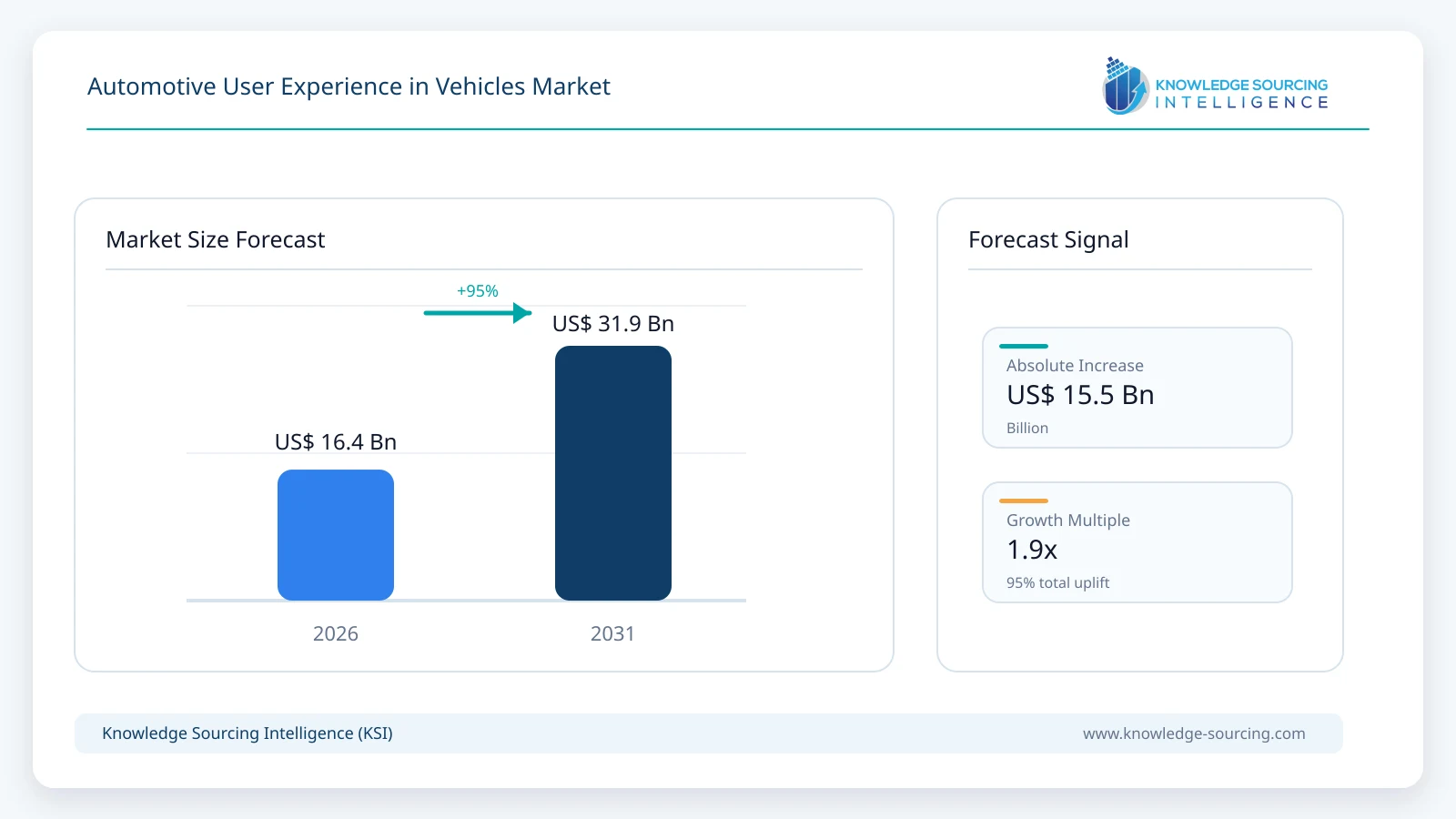
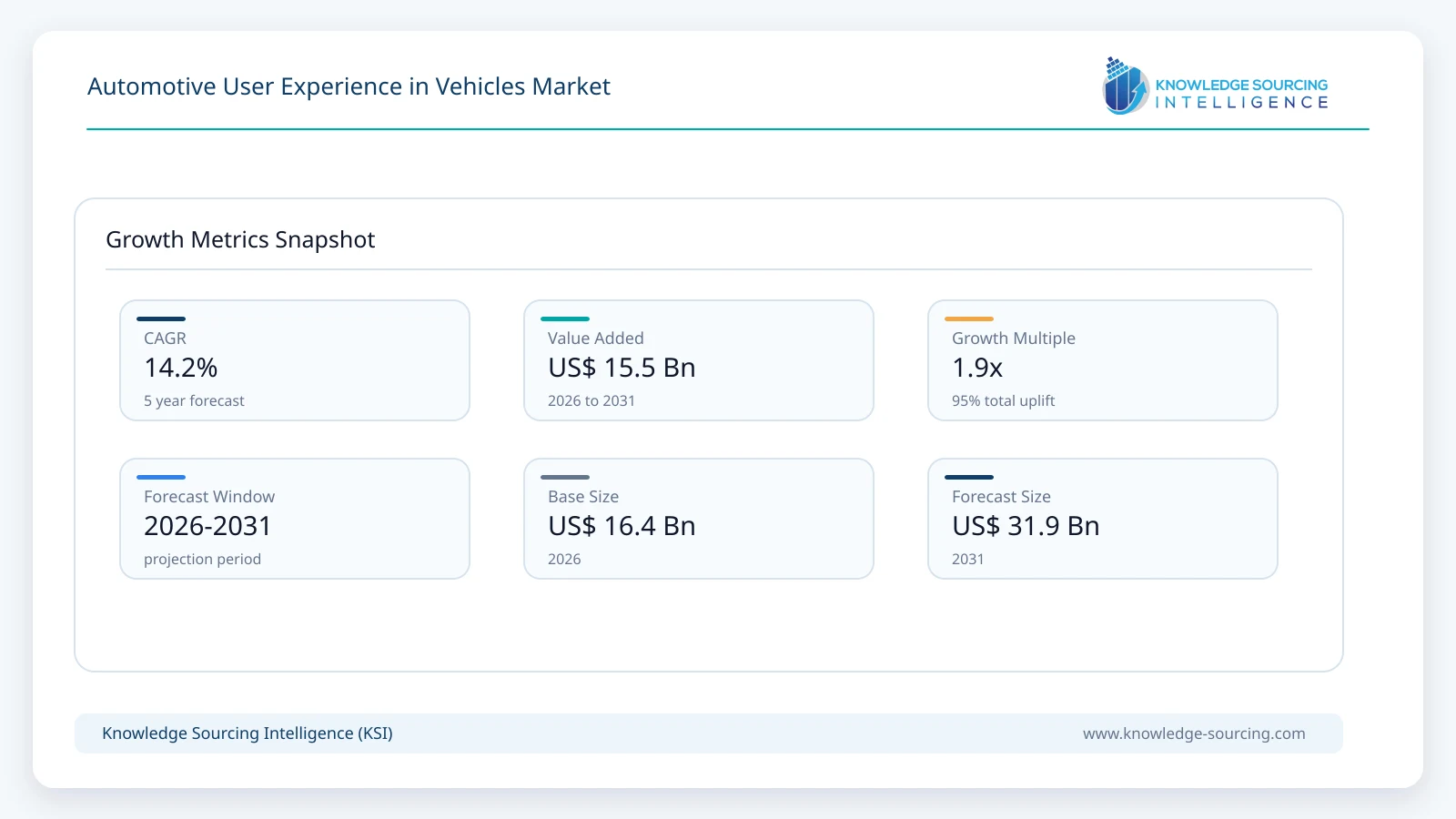
The Automotive User Experience in Vehicles Market is projected to expand at a CAGR of 14.2%, increasing from USD 16.4 billion in 2026 to USD 31.9 billion by 2031.
Highlights:
- 1UX software, HMI frameworks and middleware represent approximately 40% of market value in 2026, supported by reusable cockpit software development.
- 2Visual and graphical interaction represents approximately 31% of UX revenue in 2026, while voice and conversational AI gain share faster through 2031.
- 3Screen-centric UX accounts for approximately 46% of the market in 2026; coordinated multimodal and context-adaptive architectures gain ground.
- 4Passenger vehicles represent an estimated 92% of 2026 user-experience value, with wider adoption in mid-market connected models.
- 5Asia Pacific accounts for approximately 44% of 2026 revenue, reflecting Chinese smart-cockpit development and regional electronics supply capabilities.
- 6The category substantially overlaps existing HMI, Smart Cockpit, Cabin AI and In-Cabin Experience market values and must not be summed with those reports.
Automotive user experience spans how drivers and passengers discover, understand, and operate vehicle functions. The market encompasses graphical HMI, multimodal orchestration, conversational interaction, steering-wheel and console controls, haptic feedback, contextual interfaces, and the software engineering required to integrate those functions into a coherent product. Standalone sensing, infotainment processors and display panels are counted only to the extent that their price represents a distinct qualifying interaction or user-interface deliverable.
The broader digital cockpit provides the technology foundation, but a good user experience depends on task structure, information priority, response time and consistent feedback. BMW Panoramic iDrive coordinates a windshield information layer, central display, optional head-up display and physical steering-wheel controls. Mercedes-Benz's fourth-generation MBUX similarly connects user profiles, a graphical Zero Layer and a conversational assistant through MB.OS. These systems illustrate why UX has become an identifiable software and engineering workstream within vehicle development.
Market Overview
Across suppliers, commercial revenue is increasingly attached to reusable HMI frameworks, application layers, branded interface customization, input-device integration, test automation and post-launch software maintenance. HARMAN's September 2026 SDVerse offering specifically lists digital cockpit experience design, Figma-to-Code automation, and reusable HMI assets. Software content is growing, although physical controls and interaction-specific displays remain necessary to deliver reliable interfaces under automotive environmental and safety requirements.
Modern UX programs combine human-factors design, graphical interaction, tactile controls, and validation of everyday driver tasks. The cockpit screen provides a display surface, but software determines which information reaches the user, which action remains available, and how a response is confirmed. Vehicle manufacturers are investing in consistent interaction models that can serve drivers and passengers without presenting unnecessary visual complexity.
A common software foundation can serve several models, but vehicle programs differ in available inputs and content. Mainstream vehicles prioritize navigation, media, and convenient vehicle settings, whereas premium brands add more advanced head-up information, voice dialogue, and individualized experiences. Automakers and suppliers therefore balance reusable code with careful calibration for each vehicle architecture.
Market Trends
Cockpit Interaction Moves from Screen Design to Cross-Channel Coordination
Vehicle interface design increasingly manages a single task across more than one input or output channel. A navigation request can originate through voice, while maps remain on the central screen and the next maneuver appears in a head-up display. BMW's Panoramic iDrive integrates this type of information distribution with steering-wheel controls, illustrating how graphical consistency and task handoff become central engineering requirements. Reusable cross-channel frameworks give suppliers more opportunity to provide software value beyond a single device.
Conversational and Context-Aware UX Expands Beyond Commands
Mercedes-Benz's fourth-generation MBUX combines a conversational assistant with navigation context, recently used applications and individualized display behavior. Conversational UX differs from a basic speech command interface because the system must preserve context, interpret follow-up requests and return information in a form that is appropriate during driving. Automotive suppliers increasingly combine local inference for time-sensitive commands with cloud services for broader language tasks.
Design Systems and Validation Become Reusable Software Assets
HARMAN's Digital Cockpit Experience Design offering uses reusable components and automated design-to-code workflows, while the broader Ready CQuence toolchain addresses test and validation across software updates. These capabilities indicate that UX spending is moving beyond launch-specific graphics toward repeatable engineering that can support several vehicle platforms. Testing becomes particularly important when the same UI framework is displayed on different screen layouts or uses different voice and haptic devices.
Drivers Still Need Predictable Physical and Haptic Feedback
An expanding digital interface does not eliminate the importance of tangible controls. Frequently used cabin functions benefit from tactile location, clear state feedback and operation without extended visual search. Steering-wheel switches, haptic touch surfaces and selected physical controls therefore remain an important part of automotive UX design, particularly for functions used while the vehicle is in motion. Automakers must judge individual tasks rather than assume that a larger display is automatically more usable.
Segment Analysis
By Offering: UX Software, HMI Frameworks and Middleware
UX software, HMI frameworks and middleware account for approximately 40% of global value in 2026. This group includes graphical layers, voice interaction middleware, state management, UI application integration, and tools used to coordinate an interaction across cabin functions. Software-defined vehicle architectures allow these assets to be extended through new functions and updates, increasing the share of software relative to dedicated interface hardware through 2031.
HARMAN, Elektrobit, Visteon and Cerence serve different layers of cockpit software and user interaction. Commercial positions depend on vehicle-program integration, reusable code, speech performance and the ability to maintain a consistent experience across platforms rather than the appearance of one display alone.
By Experience Function: Voice and Conversational AI Interaction
Voice and conversational AI account for approximately 22% of the 2026 UX market and are projected to reach 29% in 2031. The shift reflects greater use of assistant software for navigation, infotainment and selected vehicle controls, as well as integration of contextual dialogue with other display and input modalities. Mercedes-Benz MBUX offers a current example of multi-agent assistance embedded in an automotive user interface.
The segment does not include all vehicle AI compute or general-purpose cloud infrastructure. Qualifying revenue is limited to the attributable speech, natural-language, context and interface integration layers. More capable assistants should increase software content even as the underlying hardware is shared among several cockpit workloads.
By Interaction Architecture: Coordinated Multimodal UX
Coordinated multimodal UX represents around 35% of 2026 revenue. Automotive HMI must maintain consistent task context across touchscreen, voice, steering-wheel control, head-up display and available haptic responses. BMW Panoramic iDrive demonstrates how the same navigation or communication task can be distributed across distinct interfaces, with the driver remaining aware of available actions.
By Application: Infotainment and Navigation
Infotainment and navigation comprise the largest application segment at approximately 38% in 2026. Frequent media selection, route guidance, communication, and vehicle app usage create substantial demand for graphical interfaces, voice input and consistent feedback. The Toyota RAV4 cockpit platform disclosed by Qualcomm in January 2026 illustrates continued expansion of intelligent, personalized interfaces into high-volume vehicles.
By Vehicle Type: Passenger Vehicles
Passenger vehicles generate approximately 92% of the 2026 UX market due to higher production volumes and stronger consumer expectations for connected infotainment, personalized displays and voice interaction. Premium vehicles establish new interaction patterns, while mainstream models supply the scale required to lower integration cost. Light commercial vehicles increasingly apply comparable HMI software for navigation, communication and operating information, but their average UX content remains lower.
By Propulsion: Battery Electric Vehicles
Battery electric vehicles represent about 30% of UX revenue in 2026 and are expected to account for 43% by 2031. Many new EV platforms employ highly integrated displays, charging-aware navigation, software updates, and centralized cockpit electronics that facilitate frequent UX upgrades. Electrification is an adoption correlate rather than a required condition; combustion and hybrid vehicles continue to use sophisticated graphical and voice interfaces.
By Geography: Asia Pacific
Asia Pacific accounts for an estimated 44% of the global UX market in 2026. China combines high vehicle production with rapid software-defined cockpit development, while Japan and South Korea provide strong electronics, display, and automotive-system supply capabilities. The region is expected to increase its global share through 2031 as Chinese OEM platforms push connected and context-aware UX into a broader range of price tiers.
Market Drivers
Higher Digital-Cockpit Function Density
Automakers now present a growing number of infotainment, navigation, driver-assistance, and comfort functions within a limited number of occupant interfaces. Additional functionality makes information architecture, menu structure, and clear feedback more valuable, particularly where connected services change after vehicle launch. BMW Panoramic iDrive and Mercedes-Benz MBUX show how coordinated interaction is developed around a common operating concept instead of isolated controls.
Software-Defined Architectures and OTA Lifecycle
Centralized cockpit software allows manufacturers to revise menus, voice experiences, and service interactions after production. HARMAN's Ready CQuence and UX engineering tools address development, testing, and repeated software deployment, while Qualcomm's automotive collaborations support shared cockpit compute across model lines. Maintaining a consistent interface across software versions creates recurring development and validation work.
Mainstream Deployment of Digital and Voice Interfaces
The Toyota RAV4's new cockpit implementation demonstrates that advanced UX is not confined to flagship luxury vehicles. As mainstream models adopt more capable displays and speech systems, suppliers can distribute software-development cost across larger production volumes. Higher feature penetration adds qualified interface revenue even if the average cost of an individual display falls.
Vehicle Personalization and Intelligent Assistance
Driver profiles, contextual recommendations and natural-language interaction increase the demand for software that can interpret preferences while retaining control of vehicle states. Mercedes-Benz's fourth-generation MBUX combines personalization with conversational AI and navigation context. Vehicle-specific security, identity management, and preference continuity also increase integration requirements.
Safety-Oriented Information Presentation
Larger software feature sets raise the importance of controlling visual demand, ensuring clear feedback and separating passenger activities from driver-critical information. Head-up information, context-sensitive alerts, and physical or haptic controls provide different routes to efficient interaction. HARMAN's 2026 cockpit display announcements emphasize legibility and appropriate information placement.
Market Restraints
Uncertain Valuation of UX within Integrated Electronics
Cockpit suppliers often sell display modules, processors, infotainment platforms, and software engineering as combined programs. The user-experience share of these contracts is rarely disclosed, making market-level revenue attribution sensitive to accounting boundaries. Counting the complete cockpit system would inflate the UX category and duplicate KSI Smart Cockpit and HMI markets.
Driver Distraction and Safety Validation
Complex menus, rapidly changing graphics, and unrestricted conversational interactions can increase workload if vehicle interfaces are poorly designed. Automakers must test information hierarchy, response times, and the suitability of each input channel during driving. Controls for important functions need predictable feedback and accessible fallback behavior.
Fragmented Operating Systems and Vehicle Platforms
Automakers use different cockpit processors, operating systems, display sizes, and electrical architectures. HMI software that runs well on one vehicle platform may require substantial adaptation for another, particularly when graphics performance or functional-safety boundaries change. Supplier engineering organizations therefore face porting, qualification and maintenance costs that are not always recovered through unit royalties.
Data Privacy and Cybersecurity Requirements
Personalized assistants and connected interfaces interact with location, preferences, accounts, and sometimes cabin sensing. Vehicle manufacturers need secure identity handling, controlled cloud access, and update processes across the product lifecycle. UNECE Regulations 155 and 156 reinforce cybersecurity and software-update management obligations in applicable vehicle approvals.
Feature Cost and Consumer Adoption Differences
A sophisticated UX stack is more economical in high-content vehicles that already include capable compute, large displays, and advanced input devices. Lower-cost platforms may use a simplified interface because each additional component, software license, or validation requirement raises program expenditure. Some consumers also prefer familiar switches and restrained graphics over novel interaction schemes.
Regional Outlook
Asia Pacific
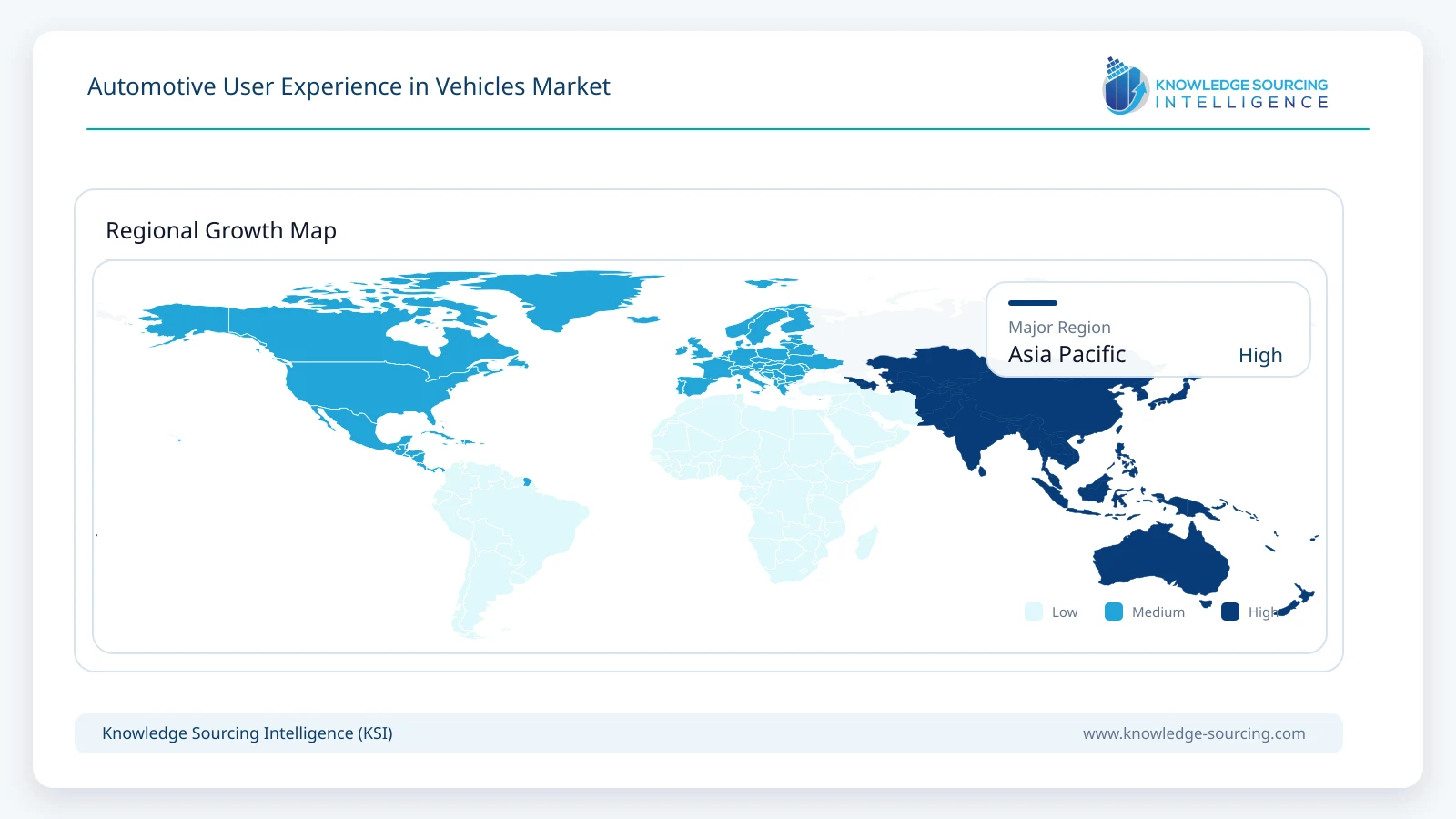
Asia Pacific leads automotive UX spending as Chinese automakers compete on digital cockpit features, intelligent assistants and frequent software upgrades. Qualcomm identified collaborations with several Chinese manufacturers in January 2026, highlighting the depth of demand for scalable cockpit platforms. Japanese and South Korean suppliers remain important contributors through electronics, infotainment, controls and displays. The region is estimated to represent 44% of UX revenue in 2026 and to expand further through 2031.
Chinese vehicle programs increasingly deploy connected UX across a wider price range than historically associated with premium HMI. India and Southeast Asia offer additional volume opportunities, although average interaction content is constrained by vehicle pricing and the availability of connected services. Regional suppliers that can offer reusable, lower-cost software architectures are positioned to benefit from wider vehicle adoption.
Europe
European automakers are prominent in integrated cockpit interaction and branded software interfaces. BMW Panoramic iDrive and Mercedes-Benz MBUX combine graphical design, personalization, voice and vehicle-function access through consistent software platforms. These programs involve extensive UX research, human-factors work and component validation, supporting higher attributable content per equipped vehicle in premium segments.
Europe accounts for approximately 27% of market value in 2026 and an estimated 25% in 2031, as Asia Pacific grows more quickly. European purchasing decisions place substantial emphasis on human-machine interaction quality, safety evaluation, data governance and the ability to maintain software across long vehicle service lives. Advanced interfaces remain important to brand differentiation even as software tools become more standardized.
Competitive Landscape
The automotive UX market combines Tier 1 cockpit integrators, specialized interaction-software providers and interface hardware suppliers. HARMAN, Visteon, Bosch, Panasonic Automotive Systems, LG Electronics Vehicle Solution Company, AUMOVIO, FORVIA and Aptiv supply overlapping cockpit electronics and software capabilities. Cerence concentrates on conversational automotive AI, Elektrobit on vehicle software and HMI engineering, while Preh and Valeo participate through configurable human-machine controls and interface modules.
Competitive advantage depends on production-program experience, reusable UX frameworks, brand-level customization, human-factors validation, secure software updating and integration across chipsets. Qualcomm supplies enabling cockpit compute and development technology, but total semiconductor revenue is not treated as UX revenue. Similarly, OEM-designed software and large technology partnerships provide evidence of adoption without automatically translating into attributable third-party supplier sales.
Recent Developments
15 September 2026: HARMAN joined SDVerse with Digital Cockpit Experience Design, intelligent cockpit middleware and validation services, establishing a directly described commercial channel for UX-specific engineering assets.
29 July 2026: Qualcomm and BMW announced a next-generation digital-cockpit compute relationship covering model programs beginning in the next decade; the announcement signals architecture planning rather than 2026–2031 volume sales.
21 May 2026: Stellantis and Qualcomm expanded their Snapdragon Digital Chassis collaboration to support next-generation shared cockpit, connectivity and ADAS compute across Stellantis vehicle architectures.
13 January 2026: HARMAN introduced new road-ready display and software offerings, including UX-relevant visual clarity and cockpit integration technologies.
5 January 2026: Qualcomm detailed additional Snapdragon Digital Chassis collaborations and agentic-AI capabilities for software-defined vehicles at CES 2026.
2 January 2026: Qualcomm announced use of its cockpit platform in the new Toyota RAV4 for personalized infotainment, touch interaction and voice-enabled features.
13 March 2025: Mercedes-Benz presented the production CLA with MB.OS and fourth-generation MBUX, including personalized graphical UX and conversational assistant integration.
Market Outlook
The Automotive User Experience in Vehicles Market is projected to reach USD 31.85 billion in 2031 as software frameworks, multimodal coordination and intelligent assistants become embedded in a larger share of vehicle programs. Visual HMI remains important, but incremental value shifts toward conversational functions, adaptive interaction and the software required to manage interfaces across several vehicle systems. Dedicated controls continue to serve important functions, particularly where predictable tactile operation is preferable to on-screen navigation.
Asia Pacific is expected to remain the largest revenue region, while Europe retains high-value premium development programs and North America contributes strong connected-vehicle and technology-platform demand. Suppliers with transferable software assets, mature validation methods and the ability to support long vehicle lifecycles should be better positioned than vendors offering stand-alone screens or isolated interface functions.
Automotive User Experience in Vehicles Market Scope:
| Report Metric | Details |
|---|---|
| Total Market Size in 2026 | USD 16.4 billion |
| Total Market Size in 2031 | USD 31.9 billion |
| Forecast Unit | USD Billion |
| Growth Rate | 14.2% |
| Study Period | 2021 to 2031 |
| Historical Data | 2021 to 2024 |
| Base Year | 2025 |
| Forecast Period | 2026 – 2031 |
| Segmentation | Offering, Experience Function, Interaction Architecture, Application |
| Companies |
|
Market Segmentation
By Offering
UX Software, HMI Frameworks and Middleware
User-Interface Hardware and Interactive Surfaces
UX Engineering, Integration and Validation
By Experience Function
Visual and Graphical Interaction
Voice and Conversational AI Interaction
Physical, Touch and Haptic Controls
Profiles, Personalization and Adaptive UX
Driver Information and Safety Interaction
By Interaction Architecture
Screen-Centric User Experience
Coordinated Multimodal UX
Context-Adaptive and AI-Orchestrated UX
By Application
Infotainment and Navigation
Vehicle Controls and Comfort
Safety and Driver-Assistance Interaction
Communication and Productivity
Passenger Digital Services
By Vehicle Type
Passenger Vehicles
Light Commercial Vehicles
Medium and Heavy Commercial Vehicles
By Propulsion
Battery Electric Vehicles
Hybrid and Plug-in Hybrid Vehicles
ICE and Other Propulsion Vehicles
By Geography
North America
United States
Canada
Mexico
South America
Brazil
Argentina
Others
Europe
Germany
United Kingdom
France
Italy
Spain
Others
Middle East and Africa
Saudi Arabia
UAE
South Africa
Others
Asia Pacific
China
Japan
South Korea
India
Indonesia
Thailand
Others
Table of Contents
1. EXECUTIVE SUMMARY
2. MARKET SNAPSHOT
2.1. Market Overview
2.2. Market Definition
2.3. Scope of the Study
2.4. Market Segmentation
3. BUSINESS LANDSCAPE
3.1. Market Drivers
3.1.1. Higher Digital-Cockpit Function Density
3.1.2. Software-Defined Architectures and OTA Lifecycle
3.1.3. Mainstream Deployment of Digital and Voice Interfaces
3.1.4. Vehicle Personalization and Intelligent Assistance
3.1.5. Safety-Oriented Information Presentation
3.2. Market Restraints
3.2.1. Uncertain Valuation of UX within Integrated Electronics
3.2.2. Driver Distraction and Safety Validation
3.2.3. Fragmented Operating Systems and Vehicle Platforms
3.2.4. Data Privacy and Cybersecurity Requirements
3.2.5. Feature Cost and Consumer Adoption Differences
3.3. Market Opportunities
3.4. Porter’s Five Forces Analysis
3.5. Industry Value Chain Analysis
3.6. Policies and Regulations
3.7. Strategic Recommendations
4. TECHNOLOGICAL OUTLOOK
4.1. Graphical UX and HMI Frameworks
4.2. Voice and Conversational AI
4.3. Multimodal and Context-Aware Interaction
4.4. Haptic and Physical Control Interfaces
4.5. Software-Defined UX Engineering and Validation
5. AUTOMOTIVE USER EXPERIENCE IN VEHICLES MARKET BY OFFERING
5.1. Introduction
5.2. UX Software, HMI Frameworks and Middleware
5.3. User-Interface Hardware and Interactive Surfaces
5.4. UX Engineering, Integration and Validation
6. AUTOMOTIVE USER EXPERIENCE IN VEHICLES MARKET BY EXPERIENCE FUNCTION
6.1. Introduction
6.2. Visual and Graphical Interaction
6.3. Voice and Conversational AI Interaction
6.4. Physical, Touch and Haptic Controls
6.5. Profiles, Personalization and Adaptive UX
6.6. Driver Information and Safety Interaction
7. AUTOMOTIVE USER EXPERIENCE IN VEHICLES MARKET BY INTERACTION ARCHITECTURE
7.1. Introduction
7.2. Screen-Centric User Experience
7.3. Coordinated Multimodal UX
7.4. Context-Adaptive and AI-Orchestrated UX
8. AUTOMOTIVE USER EXPERIENCE IN VEHICLES MARKET BY APPLICATION
8.1. Introduction
8.2. Infotainment and Navigation
8.3. Vehicle Controls and Comfort
8.4. Safety and Driver-Assistance Interaction
8.5. Communication and Productivity
8.6. Passenger Digital Services
9. AUTOMOTIVE USER EXPERIENCE IN VEHICLES MARKET BY VEHICLE TYPE
9.1. Introduction
9.2. Passenger Vehicles
9.3. Light Commercial Vehicles
9.4. Medium and Heavy Commercial Vehicles
10. AUTOMOTIVE USER EXPERIENCE IN VEHICLES MARKET BY PROPULSION
10.1. Introduction
10.2. Battery Electric Vehicles
10.3. Hybrid and Plug-in Hybrid Vehicles
10.4. ICE and Other Propulsion Vehicles
11. AUTOMOTIVE USER EXPERIENCE IN VEHICLES MARKET BY GEOGRAPHY
11.1. North America
11.1.1. United States
11.1.2. Canada
11.1.3. Mexico
11.2. South America
11.2.1. Brazil
11.2.2. Argentina
11.2.3. Others
11.3. Europe
11.3.1. Germany
11.3.2. United Kingdom
11.3.3. France
11.3.4. Italy
11.3.5. Spain
11.3.6. Others
11.4. Middle East and Africa
11.4.1. Saudi Arabia
11.4.2. UAE
11.4.3. South Africa
11.4.4. Others
11.5. Asia Pacific
11.5.1. China
11.5.2. Japan
11.5.3. South Korea
11.5.4. India
11.5.5. Indonesia
11.5.6. Thailand
11.5.7. Others
12. COMPETITIVE ENVIRONMENT AND ANALYSIS
12.1. Major Players and Strategy Analysis
12.2. Market Share Analysis
12.3. Mergers, Acquisitions, Agreements and Collaborations
12.4. Competitive Dashboard
13. COMPANY PROFILES
13.1. HARMAN International
13.2. Visteon Corporation
13.3. Robert Bosch GmbH
13.4. Panasonic Automotive Systems Co., Ltd.
13.5. LG Electronics Vehicle Solution Company
13.6. Cerence Inc.
13.7. Elektrobit Automotive GmbH
13.8. AUMOVIO SE
13.9. FORVIA
13.10. Aptiv PLC
13.11. Valeo SA
13.12. Preh GmbH
14. APPENDIX
14.1. Currency
14.2. Assumptions
14.3. Base and Forecast Years Timeline
14.4. Key Benefits for Stakeholders
14.5. Research Methodology
14.6. Abbreviations
Navigate
Trusted by the world's leading organizations











