
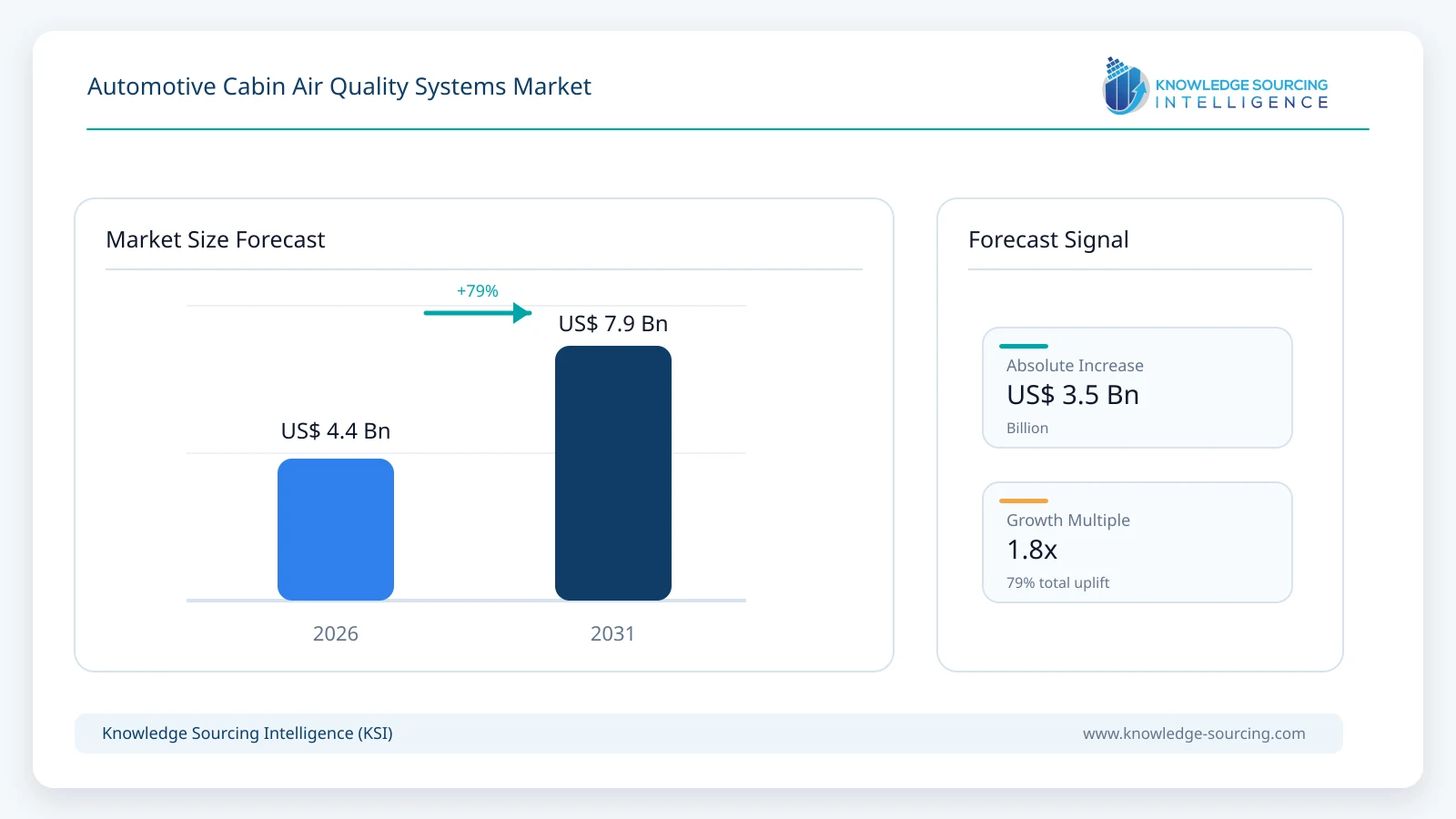
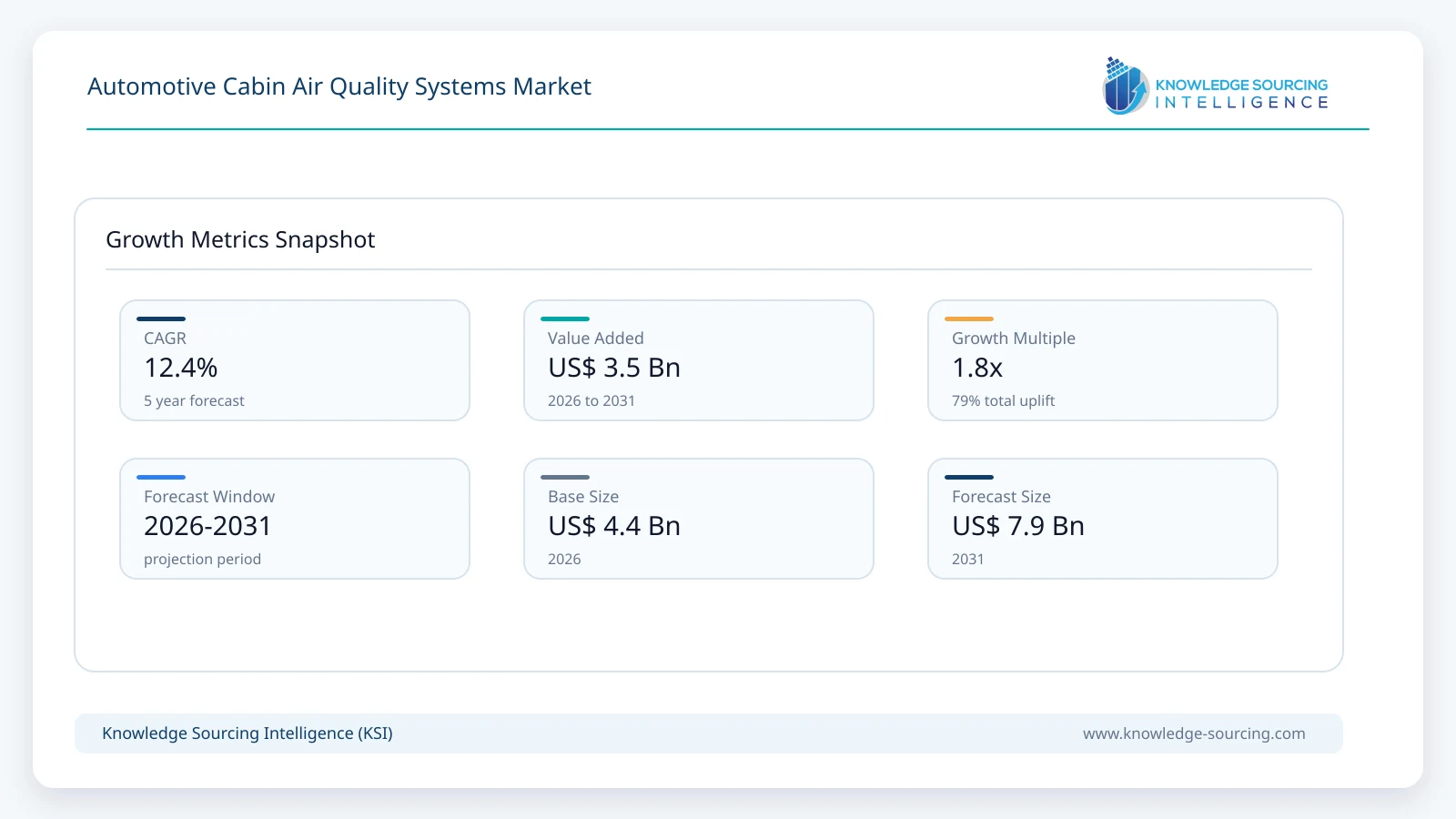
The automotive cabin air quality systems market is forecast to grow at a CAGR of 12.4%, reaching approximately USD 7.89 billion by 2031 from USD 4.40 billion in 2026.
Highlights:
- 1Filtration and adsorption hardware accounts for approximately 52% of global market value in 2026 because cabin filters, activated-carbon media and dedicated HEPA stages remain the principal physical barrier against particles, allergens and harmful gases.
- 2Particulate and ultrafine-particle control represents approximately 46% of market value in 2026, reflecting sustained concern around PM2.5, soot, brake and tire wear particles, pollen and sub-micron pollution in dense urban environments.
- 3HVAC-integrated smart air-quality systems account for approximately 64% of 2026 market value as OEMs increasingly connect sensing, recirculation, filtration and purification directly with the vehicle climate-control architecture.
- 4Passenger vehicles represent approximately 78% of global market value in 2026 because factory-fitted air-quality packages are expanding from premium vehicles into higher-volume SUVs, sedans and electric vehicles.
- 5Battery electric vehicles account for approximately 39% of market value in 2026 as EV platforms combine high-content digital cabins with stronger incentives to use sensor-controlled recirculation and on-demand filtration to reduce HVAC energy consumption.
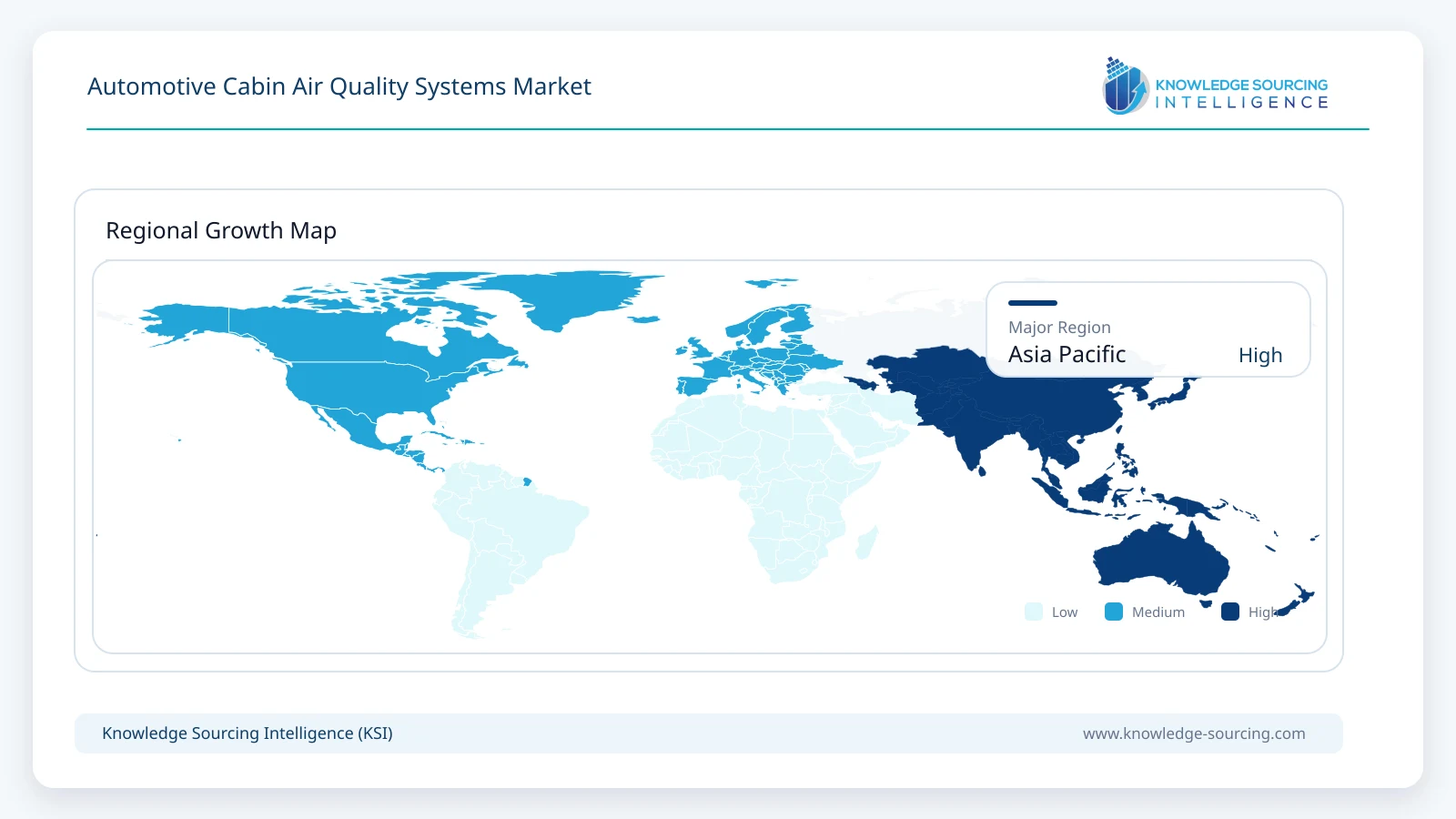
- 6Asia Pacific represents approximately 44% of global market value in 2026, supported by high vehicle production, severe urban air-quality challenges in several major cities and rapid adoption of smart-cabin features in China, Japan and South Korea.
Demand is moving beyond conventional pollen filters toward integrated systems that combine high-efficiency particulate filtration, gas adsorption, multi-pollutant sensing and software-controlled airflow or recirculation.
Commercial development is broadening across the supply chain. Freudenberg Filtration Technologies launched micronAir neo for automotive original equipment in 2026, MANN+HUMMEL is advancing smart multi-stage HEPA systems with on-demand activation, DENSO combines filters and PM2.5 sensing within automatic air-quality control, and Valeo integrates filters, air-quality sensing and purification technologies with cabin thermal management. Sensirion is expanding vehicle-interior air-quality sensing, while Panasonic Automotive applies nanoe X purification in production vehicle programmes.
Modern systems address both contaminants entering from outside and pollutants generated inside the cabin. Particulate matter, pollen, tire and brake dust, NOx, ozone and other external pollutants must be managed alongside carbon dioxide, humidity, volatile organic compounds and odours that can accumulate in a confined interior. The resulting architecture increasingly links filtration media, sensors, recirculation flaps, blowers and purification devices through a common control layer.
Market Overview
cabin air quality is becoming a defined vehicle-system function rather than a passive consequence of ventilation. Conventional cabin filters remain essential, but newer architectures add particulate and gas sensing, high-efficiency filter stages, active purification and software that determines when to admit outside air, recirculate cabin air or activate a higher-performance treatment stage.
The contaminant mix is broad. Incoming air can carry pollen, fine dust, soot, road-wear particles, nitrogen oxides, ozone and other gases, while interior materials and occupants can contribute VOCs, carbon dioxide, humidity and odours. Because these pollutants behave differently, no single technology provides complete control. Effective systems increasingly combine mechanical capture, adsorption, sensing and active air treatment.
Filtration technology is advancing toward lower pressure drop and more stable real-world performance. Freudenberg micronAir neo uses a deep-fiber structure designed for sustained efficiency under real operating conditions, while MANN+HUMMEL combines pre-filtration, gas adsorption and HEPA filtration in smart systems that activate the highest-efficiency stage only when required. MAHLE and DENSO also offer multi-layer filters targeting particles, gases, allergens and odours.
Sensing is becoming equally important because air-quality control must react to conditions that change rapidly by location and vehicle use. Sensirion vehicle-interior air-quality modules cover parameters including CO2, humidity, temperature, dew point and PM2.5, while integrated environmental modules are moving toward broader measurement of VOCs, NOx and formaldehyde. This enables control logic to respond differently to traffic pollution, elevated cabin CO2 or material emissions.
Active purification provides another layer of control where filtration alone is insufficient. Panasonic Automotive uses nanoe X hydroxyl-radical technology in cabin-purity systems, while other suppliers employ ionization, plasma, photocatalytic or antimicrobial approaches. As these systems expand, OEM validation increasingly considers treatment effectiveness, energy use, by-product control, service requirements and compatibility with cabin materials.
Market Trends
Smart Multi-Stage Filtration Is Replacing One-Stage Protection
Vehicle air-quality systems are moving from a single cabin filter toward layered architectures that separate pre-filtration, gas adsorption and high-efficiency particle removal. This allows each stage to be optimized for a specific contaminant class rather than forcing one medium to manage every pollutant.
On-demand HEPA activation is especially relevant for electric vehicles because high filtration efficiency can increase airflow resistance. Sensors and intelligent flaps can route air through the HEPA stage only during high pollution, tunnels or traffic congestion, preserving filter life and reducing blower energy.
Multi-Pollutant Sensing Is Expanding beyond PM2.5
Early vehicle air-quality displays focused heavily on particulate matter, but newer platforms are adding carbon dioxide, VOC, NOx, formaldehyde, humidity and temperature sensing. The broader sensor set allows the vehicle to distinguish external pollution from in-cabin accumulation and select ventilation or recirculation more intelligently.
Miniaturization is lowering the integration barrier. Compact environmental modules can combine several sensing elements and algorithms in one package, giving Tier 1 suppliers and OEMs a clearer path to factory-fit air-quality monitoring across more vehicle classes.
Active Purification Is Becoming a Complement to Filtration
Filters are strongest against particles and adsorbable gases, while active purification technologies can address odours, allergens and certain biological contaminants throughout the cabin volume or on exposed surfaces. Panasonic nanoe X is a production example of this broader treatment approach in automotive applications.
The next development phase will emphasize validated output, controlled by-products and coordinated activation. Purification is likely to be used selectively based on sensor input, cabin occupancy and vehicle state rather than operating continuously at maximum intensity.
Air-Quality Control Is Becoming Energy-Aware in Electric Vehicles
EV range sensitivity makes ventilation strategy economically important. Continuously conditioning large volumes of outside air can increase heating or cooling demand, while excessive recirculation can raise carbon dioxide and humidity. Smart systems therefore balance air quality with thermal energy use.
Sensor-controlled fresh-air intake, intelligent recirculation and selective HEPA activation can reduce HVAC load while maintaining acceptable pollutant levels. This creates a direct link between cabin air quality and vehicle energy management that is less important in conventional stand-alone filter systems.
Filter Health and Service Prediction Are Moving into the Digital Cabin
Cabin filters lose performance as dust loading increases, yet replacement remains calendar- or mileage-based in many vehicles. Connected systems can use pressure, airflow, pollution exposure, operating time and sensor performance to estimate remaining filter life and warn users before air quality deteriorates.
Predictive service can also support subscription and fleet-maintenance models. Ride-hailing, autonomous mobility and commercial fleets can use air-quality data to standardize cabin-condition targets across vehicles and document filter replacement or purification events.
Segment Analysis
By System Component: Filtration and Adsorption Hardware
Filtration and adsorption hardware represents the largest component segment, accounting for approximately 52% of global market value in 2026. The category includes particulate filters, activated-carbon and molecular layers, anti-allergen media, biofunctional filters and dedicated HEPA stages used to remove particles, gases and odours from incoming or recirculated air.
The segment is expected to remain the largest through 2031 because every advanced air-quality architecture still depends on a physical treatment stage. Growth will increasingly favour lower-pressure-drop media, ultrafine-particle capture, longer gas-adsorption life and filters that maintain performance under humidity and temperature variation.
By Air Quality Function: Particulate and Ultrafine-Particle Control
Particulate and ultrafine-particle control accounts for approximately 46% of global market value in 2026. The function targets pollen, soot, PM10, PM2.5, PM1 and smaller road-wear particles using high-performance filter media, nanofibers and HEPA-class stages.
This function leads because particulate pollution is easy for consumers to understand, can be measured in real time and is a major challenge in dense urban traffic. The growing contribution of non-exhaust brake and tire particles further sustains demand even as tailpipe emissions decline.
By Integration Architecture: HVAC-Integrated Smart Air-Quality Systems
HVAC-integrated smart air-quality systems account for approximately 64% of market value in 2026. These architectures combine filters, sensors, recirculation flaps, blowers, climate-control electronics and air-quality logic within or directly around the vehicle HVAC module.
Integration provides the strongest control authority because the system can change air source, flow rate and treatment path in response to pollutant readings. It also enables OEM-level calibration with thermal comfort, demisting, humidity management and energy consumption.
By Vehicle Class: Passenger Vehicles
Passenger vehicles represent approximately 78% of global market value in 2026. High production volumes, growing consumer awareness and the spread of digital climate-control interfaces are moving cabin-air-quality functions from luxury cars into upper-mid and mainstream passenger models.
SUVs and premium electric vehicles remain especially attractive because their higher content levels support multi-sensor monitoring, dedicated HEPA filtration and active purification. Simpler filter and PM-sensing packages are expected to expand more rapidly across higher-volume segments through 2031.
By Propulsion: Battery Electric Vehicles
Battery electric vehicles account for approximately 39% of global market value in 2026. EVs frequently combine premium cabin electronics with software-defined HVAC control and create a strong incentive to manage fresh-air intake efficiently because heating and cooling energy is drawn directly from the traction battery.
The segment is expected to gain share through 2031 as sensor-controlled recirculation, on-demand HEPA filtration and low-pressure-drop media become part of range-conscious thermal strategies. EV platforms also provide an early commercialization path for cabin air-quality displays and connected filter-health functions.
Market Drivers
Urban Air Pollution and Greater Awareness of In-Cabin Exposure
Vehicle occupants are exposed to fine particles, road dust, pollen and exhaust-related gases that can enter through ventilation openings or door use. Dense traffic and tunnels can create rapid changes in external air quality, increasing the value of systems that detect pollution and isolate the cabin automatically.
Consumer awareness has also increased as PM2.5 and AQI information becomes common in weather applications and vehicle displays. Air quality is therefore becoming a visible comfort and wellbeing feature rather than an invisible HVAC specification.
Vehicle Premiumization and Competition around Healthy Interiors
Automakers increasingly differentiate cabins through comfort, wellness and perceived cleanliness. High-efficiency filters, real-time AQI displays and active purification are features that can be demonstrated clearly to customers and bundled with premium climate or wellness packages.
Competition among premium EV and smart-cabin platforms is accelerating this trend, particularly in Asia, where air-quality challenges and high digital-content expectations combine to support faster feature adoption.
Electrification and the Need for Energy-Efficient Ventilation
Electric vehicles create a stronger trade-off between fresh-air ventilation and energy consumption. Conditioning very cold or hot outside air can reduce driving range, while excessive recirculation can allow carbon dioxide, humidity and odours to rise.
Air-quality sensing allows the HVAC controller to use the minimum fresh-air volume needed for acceptable conditions and to activate high-efficiency filtration only when required. This turns air-quality management into part of the EV energy strategy.
Advances in Compact Environmental Sensors and Connected Control
PM, CO2, VOC, NOx, humidity and formaldehyde sensors are becoming smaller and easier to integrate into automotive modules. Multi-sensor platforms reduce packaging and electronics complexity while onboard algorithms convert raw measurements into control signals or consumer-facing air-quality scores.
Connected architectures also allow vehicle software to combine cabin readings with external AQI, navigation and traffic data, enabling predictive recirculation before the vehicle enters polluted tunnels, industrial zones or congested roads.
Higher Expectations for Allergen, Odour and Pathogen Management
Cabin air quality increasingly includes more than fine dust. Consumers and OEMs are paying greater attention to pollen, mould, bacteria, odours and chemical emissions from interior materials, creating demand for activated carbon, biofunctional media and active purification.
This broader requirement increases system value because multiple treatment mechanisms must work together. It also supports regular filter replacement and aftermarket demand, especially in high-pollen and high-pollution environments.
Market Restraints
Pressure Drop, Blower Energy and Packaging Constraints
Higher-efficiency filters typically create greater airflow resistance and may require larger media area, stronger blowers or additional housings. Vehicle dashboards and HVAC modules have limited packaging space, making HEPA-class filtration difficult to add without redesign.
The engineering challenge is strongest in EVs, where extra blower power directly affects energy consumption. Suppliers must therefore improve media efficiency, pleating density, sealing and smart bypass control rather than simply adding more restrictive filter material.
Sensor Drift, Calibration and Cross-Sensitivity
Air-quality sensors operate in a demanding environment with temperature swings, humidity, aerosols, cleaning products and material emissions. Low-cost gas sensors can respond to multiple compounds, while particulate sensors require clean optical paths and stable airflow.
Long-term accuracy therefore depends on calibration, placement, algorithms and fault detection. Inaccurate readings can cause unnecessary recirculation, poor ventilation or loss of user confidence in the displayed AQI.
Filter Replacement and Maintenance Compliance
Even advanced filter media loses effectiveness as it becomes loaded with dust and contaminants. Many drivers delay replacement, which can increase pressure drop, reduce airflow and allow odour or allergen performance to deteriorate.
The market therefore depends partly on service behaviour. Predictive filter-life monitoring and clear in-vehicle replacement prompts can improve performance, but they also add software and sensor complexity.
Validation of Active Purification and Treatment By-Products
Ionization, plasma, photocatalytic and radical-based purification must be validated for effectiveness in real vehicle volumes and operating conditions. OEMs also need to control ozone or other unintended by-products and confirm compatibility with occupants and cabin materials.
This raises the validation burden compared with conventional filtration and can limit adoption of technologies that perform well in small laboratory chambers but have less predictable output in occupied vehicle cabins.
Cost Sensitivity outside Premium Vehicle Segments
A full cabin-air-quality package can include several filters, environmental sensors, purification hardware, control electronics and user-interface functions. The incremental cost remains difficult to justify in entry-level vehicles where a conventional particle filter already meets baseline expectations.
Broader adoption will depend on modular platforms that reuse existing HVAC actuators, combine multiple pollutants in one sensor package and deliver visible customer value without adding substantial service or warranty cost.
Regional Outlook
Asia Pacific
Asia Pacific is the largest regional market and is expected to remain the principal growth centre through 2031. China combines the world’s largest automotive production base with strong smart-cabin competition and persistent urban air-quality concerns, while Japan and South Korea contribute established HVAC, filtration, electronics and purification technologies.
Valeo has secured multiple next-generation HVAC contracts with Chinese automakers, MANN+HUMMEL identifies Asia as a major driver of growing cabin-filter demand, and Panasonic, DENSO and other Japanese suppliers provide filtration, sensing and purification technologies. The region also has high adoption potential for PM2.5 displays and premium EV air-quality packages.
Growth will increasingly move from premium vehicles to upper-mid and mass-market models as particulate sensing, activated-carbon filters and smart recirculation become easier to integrate. High pollution exposure in major metropolitan areas provides a clear consumer-facing reason for OEMs to retain air-quality features even as vehicle prices decline.
Europe
Europe is a major high-value market because it combines premium vehicle production with a dense filtration and sensor supplier base. Freudenberg, MANN+HUMMEL and Sensirion have substantial European capabilities, while Valeo integrates air-quality functions with thermal-management systems for global OEM programmes.
European development is also supported by strong attention to cabin hygiene, allergens and ventilation performance. MANN+HUMMEL highlights VDI guidance for vehicle interior hygiene, Freudenberg continues to expand allergen-focused filtration, and advanced OEM platforms increasingly use particulate and gas sensing to manage fresh-air intake.
Through 2031, regional growth will depend on combining health-oriented air treatment with lower pressure drop, energy-efficient EV climate control and verifiable real-world filtration performance rather than relying only on laboratory capture ratings.
Competitive Landscape
The automotive cabin air quality systems market includes HVAC Tier 1 suppliers, filtration specialists, sensor companies and active-purification technology providers. Valeo, DENSO, Freudenberg Filtration Technologies, MANN+HUMMEL, Sensirion and Panasonic Automotive are directly active across filtration, sensing, purification or integrated air-quality control.
Valeo combines cabin filters, air-quality detection, purification and HVAC integration, while DENSO links cabin filters, exhaust-gas and humidity sensing, PM2.5 measurement and automatic air-quality control. Freudenberg and MANN+HUMMEL are differentiated by advanced filter media, gas adsorption, HEPA systems and real-world filtration engineering.
Sensirion provides automotive environmental sensing for parameters including CO2, humidity, temperature, dew point and PM2.5 and is expanding next-generation OEM design wins. Panasonic Automotive adds an active-purification layer through nanoe X cabin-purity systems already used in selected production vehicles.
Recent Developments
28 September 2026: Panasonic announced a new nanoe X generating device with higher hydroxyl-radical output and faster mould-inhibition performance, strengthening the technology base used in its cabin-purity solutions.
1 September 2026: MAHLE presented the CareMetix Natural cabin air filter for Automechanika 2026, using sheep's wool in the filter medium while removing particles and pollutants and reducing volatile organic compounds and odours.
16 June 2026: MANN+HUMMEL announced its Automechanika Frankfurt 2026 filtration portfolio, including new cabin-air-filter developments aimed at cleaner and more sustainable vehicle interiors.
12 March 2026: Freudenberg Filtration Technologies launched micronAir neo for the automotive OE market, emphasizing long-term stability and real-world filtration efficiency under actual pollution conditions.
10 March 2026: Sensirion's 2025 Annual Report highlighted growing demand for vehicle-interior air-quality sensor solutions and additional OEM nominations for next-generation automotive environmental sensing.
24 September 2025: Valeo announced new Chinese OEM contracts for its Dual Layer HVAC system, with series production planned from 2026 and AI-based control of air volume and temperature across multiple cabin zones.
20 August 2025: Sensirion reported continued development of its automotive pipeline, including vehicle-interior air-quality applications and compact gas-sensing technologies relevant to future cabin monitoring and ventilation control.
13 March 2025: Freudenberg highlighted cabin-air-filter replacement as a key measure for reducing pollen and allergen exposure in vehicles, reinforcing the service and health-protection role of advanced filtration.
Market Outlook
The automotive cabin air quality systems market is expected to expand steadily through 2031 as filtration becomes more intelligent and more closely connected with sensing and climate control. Conventional cabin filters will remain the largest value pool, while faster growth is expected in multi-pollutant sensors, dedicated HEPA stages, active purification and software that manages recirculation or filter activation automatically.
The market will increasingly shift from passive protection toward closed-loop air management. Vehicles will measure cabin and ambient conditions, identify the dominant pollutant, select the appropriate air path or treatment stage and communicate air-quality status to occupants. Filter health and maintenance prediction will become part of this control loop.
Asia Pacific is expected to retain the largest regional share, while Europe remains a major engineering and premium-vehicle market. Competitive advantage will depend on real-world filtration stability, low pressure drop, accurate multi-pollutant sensing, safe purification, energy-efficient HVAC integration and the ability to convert environmental data into reliable automatic control.
Automotive Cabin Air Quality Systems Market Scope:
| Report Metric | Details |
|---|---|
| Total Market Size in 2026 | USD 4.40 billion |
| Total Market Size in 2031 | USD 7.89 billion |
| Forecast Unit | USD Billion |
| Growth Rate | 12.4% |
| Study Period | 2021 to 2031 |
| Historical Data | 2021 to 2024 |
| Base Year | 2025 |
| Forecast Period | 2026 – 2031 |
| Segmentation | System Component, Air Quality Function, Integration Architecture, Vehicle Class, Propulsion, Geography |
| Companies |
|
Market Segmentation
By System Component
Filtration and Adsorption Hardware
Air Quality Sensors and Monitoring Modules
Active Air Purification Devices
Airflow, Recirculation and Control Actuators
Air Quality Software and Connected Services
By Air Quality Function
Particulate and Ultrafine-Particle Control
Harmful Gas and VOC Control
Allergen and Biological Contaminant Management
Carbon Dioxide and Ventilation Management
Odour and Sensory Air Quality Management
By Integration Architecture
HVAC-Integrated Smart Air Quality Systems
Multi-Stage Dedicated HEPA Systems
Standalone and Auxiliary Cabin Purification Systems
By Vehicle Class
Passenger Vehicles
Light Commercial Vehicles
Heavy Commercial Vehicles, Buses and Shared Mobility
By Propulsion
Battery Electric Vehicles
Hybrid and Plug-in Hybrid Electric Vehicles
Internal Combustion Engine Vehicles
Fuel Cell Electric Vehicles
By Geography
North America
United States
Canada
Mexico
South America
Brazil
Argentina
Others
Europe
Germany
United Kingdom
France
Italy
Spain
Others
Middle East and Africa
Saudi Arabia
UAE
South Africa
Others
Asia Pacific
China
Japan
South Korea
India
Singapore
Others
Table of Contents
1. INTRODUCTION
1.1. Market Overview
1.2. Market Definition
1.3. Scope of the Study
1.4. Market Segmentation
1.5. Currency
1.6. Assumptions
1.7. Base and Forecast Years
1.8. Key Benefits to Stakeholders
2. RESEARCH METHODOLOGY
2.1. Research Design
2.2. Secondary Research
2.3. Primary Research
2.4. Market Estimation
2.5. Segment Modelling
2.6. Data Triangulation and Validation
3. EXECUTIVE SUMMARY
3.1. Key Findings
3.2. Automotive Cabin Air Quality Systems Market Size, 2026-2031
3.3. System Component Outlook
3.4. Air Quality Function Outlook
3.5. Integration Architecture Outlook
3.6. Vehicle Class Outlook
3.7. Propulsion Outlook
3.8. Regional Opportunity Summary
4. MARKET DYNAMICS
4.1. Market Drivers
4.1.1. Urban Air Pollution and Greater Awareness of In-Cabin Exposure
4.1.2. Vehicle Premiumization and Competition around Healthy Interiors
4.1.3. Electrification and the Need for Energy-Efficient Ventilation
4.1.4. Advances in Compact Environmental Sensors and Connected Control
4.1.5. Higher Expectations for Allergen, Odour and Pathogen Management
4.2. Market Restraints
4.2.1. Pressure Drop, Blower Energy and Packaging Constraints
4.2.2. Sensor Drift, Calibration and Cross-Sensitivity
4.2.3. Filter Replacement and Maintenance Compliance
4.2.4. Validation of Active Purification and Treatment By-Products
4.2.5. Cost Sensitivity outside Premium Vehicle Segments
4.3. Market Opportunities
4.4. Porter's Five Forces Analysis
4.5. Industry Value Chain Analysis
4.6. Cabin Air Quality System Economics
4.7. Hygiene, Air-Quality and Product-Validation Environment
5. TECHNOLOGY OUTLOOK
5.1. Multi-Layer Particle and Activated-Carbon Filtration
5.2. HEPA and Ultrafine-Particle Filtration
5.3. Gas Adsorption for NOx, Ozone and VOCs
5.4. PM, CO2, VOC, NOx and Formaldehyde Sensing
5.5. Inside-Outside Air Quality Sensing and Smart Recirculation
5.6. Ionization, Plasma and Hydroxyl-Radical Purification
5.7. Anti-Allergen, Antimicrobial and Biofunctional Filter Media
5.8. Odour Control and Cabin Deodorization
5.9. Energy-Efficient Air Quality Control for Electric Vehicles
5.10. Filter Health Monitoring and Predictive Replacement
5.11. Connected AQI, Cloud Data and OTA Air-Quality Logic
6. AUTOMOTIVE CABIN AIR QUALITY SYSTEMS MARKET BY SYSTEM COMPONENT
6.1. Introduction
6.2. Filtration and Adsorption Hardware
6.3. Air Quality Sensors and Monitoring Modules
6.4. Active Air Purification Devices
6.5. Airflow, Recirculation and Control Actuators
6.6. Air Quality Software and Connected Services
7. AUTOMOTIVE CABIN AIR QUALITY SYSTEMS MARKET BY AIR QUALITY FUNCTION
7.1. Introduction
7.2. Particulate and Ultrafine-Particle Control
7.3. Harmful Gas and VOC Control
7.4. Allergen and Biological Contaminant Management
7.5. Carbon Dioxide and Ventilation Management
7.6. Odour and Sensory Air Quality Management
8. AUTOMOTIVE CABIN AIR QUALITY SYSTEMS MARKET BY INTEGRATION ARCHITECTURE
8.1. Introduction
8.2. HVAC-Integrated Smart Air Quality Systems
8.3. Multi-Stage Dedicated HEPA Systems
8.4. Standalone and Auxiliary Cabin Purification Systems
9. AUTOMOTIVE CABIN AIR QUALITY SYSTEMS MARKET BY VEHICLE CLASS
9.1. Introduction
9.2. Passenger Vehicles
9.3. Light Commercial Vehicles
9.4. Heavy Commercial Vehicles, Buses and Shared Mobility
10. AUTOMOTIVE CABIN AIR QUALITY SYSTEMS MARKET BY PROPULSION
10.1. Introduction
10.2. Battery Electric Vehicles
10.3. Hybrid and Plug-in Hybrid Electric Vehicles
10.4. Internal Combustion Engine Vehicles
10.5. Fuel Cell Electric Vehicles
11. AUTOMOTIVE CABIN AIR QUALITY SYSTEMS MARKET BY GEOGRAPHY
11.1. North America
11.1.1. United States
11.1.2. Canada
11.1.3. Mexico
11.2. South America
11.2.1. Brazil
11.2.2. Argentina
11.2.3. Others
11.3. Europe
11.3.1. Germany
11.3.2. United Kingdom
11.3.3. France
11.3.4. Italy
11.3.5. Spain
11.3.6. Others
11.4. Middle East and Africa
11.4.1. Saudi Arabia
11.4.2. UAE
11.4.3. South Africa
11.4.4. Others
11.5. Asia Pacific
11.5.1. China
11.5.2. Japan
11.5.3. South Korea
11.5.4. India
11.5.5. Singapore
11.5.6. Others
12. COMPETITIVE ENVIRONMENT AND ANALYSIS
12.1. Major Players and Strategy Analysis
12.2. Market Share Analysis
12.3. Cabin Air Quality Technology Benchmarking
12.4. Product Launches and Development Activity
12.5. Competitive Dashboard
13. COMPANY PROFILES
13.1. Valeo
13.2. DENSO Corporation
13.3. Freudenberg Filtration Technologies
13.4. MANN+HUMMEL
13.5. Sensirion AG
13.6. Panasonic Automotive Systems
14. APPENDIX
14.1. Currency
14.2. Assumptions
14.3. Base and Forecast Years Timeline
14.4. Key Benefits for Stakeholders
14.5. Research Methodology
14.6. Abbreviations
14.7. Data Sources
Navigate
Trusted by the world's leading organizations











