India’s second-life EV battery market is gaining relevance as electric vehicle adoption expands and batteries retain useful capacity after automotive service. Growing stationary-storage demand, battery data, refurbishment capabilities, EPR obligations, and critical-mineral policies are encouraging manufacturers to extend battery value through reuse before eventual recycling within India’s emerging circular battery ecosystem.
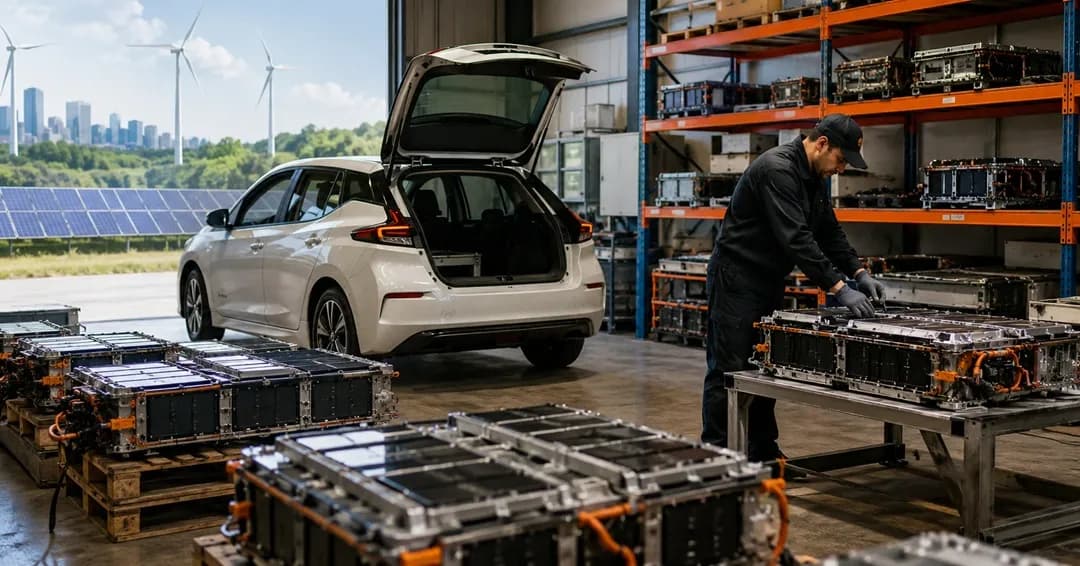
India's electric vehicle market is creating a battery problem that is also becoming a business opportunity. As more electric two-wheelers, three-wheelers, passenger vehicles, buses and commercial vehicles enter service, a growing number of batteries will eventually fall below the performance level expected for automotive use. That does not necessarily mean those batteries have reached the end of their useful economic life. In many cases, they can retain sufficient capacity for stationary energy storage or other less demanding applications.
This is the basic premise behind the second-life EV battery market. The opportunity is becoming more relevant because India's battery ecosystem is expanding quickly. The Ministry of Heavy Industries stated in December 2025, citing NITI Aayog's 2022 assessment, that annual lithium-ion battery demand was projected at about 40 GWh in 2025 and about 210 GWh by 2030. The government's ACC Production Linked Incentive programme targets 50 GWh of domestic manufacturing capacity; as of February 2026, 40 GWh had been awarded and 1 GWh was reported as installed. The ministry has also reported additional manufacturer capacity announcements.
That growth will eventually create a much larger pool of used batteries. The important commercial question is not simply how many batteries will become available, but how many will still have enough residual performance to justify refurbishment or repurposing.
For manufacturers, that distinction matters. A battery that can be used for another three to five years in a stationary application can generate additional value before its materials are finally recovered through recycling. The second life therefore has the potential to turn what was once considered an end-of-life cost into another stage of the battery value chain.
Why Manufacturers Are Becoming Interested in the Battery's Second Life
An EV battery reaches the end of its automotive usefulness for several reasons. Its capacity may have declined, its power output may no longer meet vehicle requirements, or its state of health may have fallen enough to affect driving range. Yet stationary storage has a different operating requirement.
A battery installed beside a solar plant, commercial building or charging station does not need to carry its own weight. It does not require the same packaging efficiency as an automotive pack, and its operating environment can often be controlled more effectively. This gives manufacturers room to use batteries that are no longer competitive in vehicles but still have useful storage capacity.
NITI Aayog's work on battery reuse identifies several different pathways, including reconditioning, refurbishing, repurposing and reuse. Repurposing is particularly relevant to stationary storage because an end-of-life EV battery with sufficient remaining capacity can potentially be redirected into grid-connected or commercial distributed energy-storage applications.
The commercial logic is attractive because the original battery cost can be distributed across more than one application. The first user absorbs part of the battery's cost during automotive operation, while a second user can acquire the remaining storage capability at a lower cost than purchasing a completely new battery.
That does not mean second-life batteries will always be cheaper. Testing, transportation, disassembly, battery-management systems, thermal management and warranty provisions can add substantial costs. The strongest business models will therefore be those that control these costs rather than simply those that acquire batteries cheaply.
India's EV Fleet Will Create the Future Supply of Second-Life Batteries
The long-term supply argument is straightforward. More EVs mean more batteries, and more batteries eventually mean more battery replacements.
India's EV market has an important characteristic that could influence how the second-life market develops: a large share of adoption has occurred in two-wheelers and three-wheelers. These vehicles can be used intensively, particularly in commercial and shared-mobility applications. High utilization can accelerate battery cycling and bring forward the point at which an operator considers replacement.
Commercial fleets could therefore become an important early source of second-life batteries. Passenger cars may follow a different path. A private vehicle owner may tolerate reduced range for considerably longer than a fleet operator because the financial consequences of lost range are different. Battery replacement decisions will also depend on warranty terms, repairability and the cost of replacement packs.
Consequently, the future second-life market will not receive a uniform stream of batteries. Manufacturers will have to forecast supply according to vehicle category, utilization and battery chemistry. This is an important reason to avoid assuming that rapid EV sales growth will immediately translate into equally rapid second-life battery availability. The market has a time lag built into it.
Stationary Storage Is the Most Logical Demand Center
Stationary storage provides the clearest commercial destination for retired EV batteries because it removes several constraints that make battery degradation more problematic in vehicles.
India's electricity system is creating multiple storage requirements. Renewable generation needs flexibility, commercial consumers increasingly need better control over their electricity consumption, and EV charging stations can create concentrated periods of high power demand. Batteries can also provide backup power and support distributed energy systems.
Second-life batteries can potentially address some of these requirements where the remaining battery performance is sufficient.
Application | Why second-life batteries can fit the application | Principal issue manufacturers must solve |
Solar energy storage | Stationary systems can use residual battery capacity to shift renewable electricity toward periods of higher demand. | Manufacturers must establish predictable cycle life and degradation characteristics. |
EV charging stations | Storage can help manage charging peaks and reduce the need for very large grid connections at selected sites. | Project economics depend on utilization, tariffs, connection costs and battery performance. |
Commercial and industrial backup | Larger stationary enclosures allow batteries with lower energy density to remain useful for backup and load management. | Buyers are likely to demand dependable warranties and predictable operating performance. |
Telecom infrastructure | Distributed storage can provide backup capacity without the weight constraints found in mobile applications. | Remote monitoring, maintenance and replacement logistics can increase total system costs. |
Microgrids | Retired EV batteries can provide local energy balancing and resilience for distributed power systems. | Different battery conditions can make system integration more complicated. |
Distributed storage | Lower-cost battery assets may improve the economics of smaller storage projects where capital costs are tightly controlled. | Collection, testing and refurbishment costs can reduce the initial battery price advantage. |
The most promising applications will therefore be those that can tolerate variation in battery performance. A stationary system designed around a specific battery's remaining capability is more likely to work economically than an application demanding the predictable performance of a new battery.
Battery Data Could Become More Valuable Than the Used Battery Itself
One of the biggest advantages for established EV and battery manufacturers is access to battery data. A battery's residual value depends on how it has been used. Two packs with the same chemistry, capacity and age may have very different remaining lives because one experienced frequent fast charging, high temperatures and deep discharge while the other operated under less stressful conditions.
Manufacturers that monitor batteries during their first life can use that information when deciding what happens next. This creates an important competitive advantage. An OEM can potentially identify batteries suitable for second-life use before they are removed from vehicles. It can also estimate the remaining value of the pack more accurately than a third-party buyer dealing with an unknown battery history. Battery-management data can therefore become part of the second-life business model.
Manufacturers may also benefit from designing battery packs for future disassembly. Modular architectures, accessible components and standardized diagnostic procedures can reduce the labor and engineering costs associated with refurbishment. These design decisions are unlikely to receive much attention when a vehicle is new, but they can materially influence the economics several years later. The broader lesson is that battery lifecycle management begins at product design, not at the recycling facility.
EPR Is Making Battery Lifecycle Management More Important
India's Battery Waste Management Rules, 2022, provide another structural reason for manufacturers to develop better end-of-life strategies. The framework has subsequently been amended, including in 2025, and applies Extended Producer Responsibility obligations to batteries, including EV batteries. The rules define refurbishment as repairing, reconditioning or repurposing a used battery for its second life and provide for collection and recycling and/or refurbishment obligations.
This matters because manufacturers can no longer treat the battery's end-of-life stage as entirely separate from the original product.
A battery that can be safely refurbished or repurposed may create more value than one that is sent directly to material recovery. At the same time, a battery that is too degraded or damaged for second-life use should move efficiently into recycling rather than being forced into another application.
The commercial challenge is therefore to establish a reliable decision process. Manufacturers need to know whether a particular battery should remain in automotive service, undergo repair, move into stationary storage or be recycled. Without consistent testing and classification, the second-life market becomes difficult to finance because buyers cannot easily predict the performance of the assets they are purchasing. Regulatory clarity around refurbishment, safety, ownership and liability will become increasingly important as the market moves beyond pilot projects.
Critical Mineral Security Strengthens the Circular-Battery Argument
There is another reason manufacturers are paying attention to what happens after an EV battery leaves the vehicle: India's exposure to imported battery materials.
The country is expanding domestic cell manufacturing, but it remains dependent on international supply chains for important battery minerals and processed materials. The government has explicitly identified recycling as one route to strengthening domestic critical-mineral security.
In September 2025, the Union Cabinet approved a ?1,500 crore incentive scheme to develop domestic recycling capacity for critical minerals from secondary sources, including spent lithium-ion battery scrap. The scheme, which runs from FY2025-26 to FY2030-31 under the National Critical Mineral Mission, was rolled out on 2 October 2025. The government expects the scheme to support at least 270 kilotonnes of annual recycling capacity and around 40 kilotonnes of annual critical-mineral production.
By April 2026, the Ministry of Mines had approved 58 companies as eligible to participate in the scheme, with pledged capacity of about 850 kilotonnes per year and pledged investment of roughly ?5,000 crore. On 30 April 2026, the Ministry of Mines reported that these were eligibility approvals, with project execution and subsequent capacity development still required before financial support would be considered under the scheme.
The policy direction suggests that India is building a broader battery circularity ecosystem rather than treating recycling as a narrow waste-management activity.
For manufacturers, second life fits naturally into that model. If a battery can support another application before its materials are recovered, the same underlying resources can deliver economic value for longer.
The Economics Are More Complicated Than a Cheap Used Battery
Second-life batteries often appear attractive because their acquisition cost should be lower than the cost of new batteries. That comparison is incomplete.
A manufacturer has to account for collection, transportation, testing, disassembly, cell or module grading, repackaging, electronics, thermal management, installation, monitoring and warranty costs. In some cases, the refurbishment process can become sufficiently expensive that direct recycling is the more rational option.
This is why standardized battery grading will be critical to market development.
Economic factor | Conditions that support second-life deployment | Conditions that weaken the business case |
Battery supply | Controlled fleet or OEM channels can provide predictable volumes of similar batteries. | Fragmented collection can increase logistics and procurement costs. |
Battery condition | Consistent state of health makes testing and system design easier. | Highly variable degradation increases diagnostic and warranty expenses. |
Pack design | Modular architectures can simplify disassembly and refurbishment. | Highly integrated packs can require expensive engineering work. |
Battery history | Complete usage and diagnostic data improve residual-value estimates. | Unknown charging and thermal history increases technical uncertainty. |
Storage demand | Strong demand for affordable stationary storage can support used-battery economics. | Falling prices for new batteries can narrow the cost advantage. |
Warranty | Clearly defined performance guarantees can make buyers more comfortable with refurbished systems. | Unclear responsibility for failures can limit commercial adoption. |
Recycling value | Lower immediate material value can make a second application more attractive. | High recoverable material value can favor direct recycling. |
The real comparison is therefore not "used battery versus new battery." It is the total cost of delivering reliable storage from a used battery versus the total cost of delivering the same service with a new battery.
That is a much harder calculation, but it is the calculation manufacturers need to make.
Charging Infrastructure Could Become an Important Early Customer
EV charging infrastructure is particularly interesting because storage can address a practical constraint created by the growth of electric mobility.
A fast-charging site can experience significant power demand when several vehicles charge simultaneously. In locations where grid capacity is constrained, adding battery storage can potentially allow the operator to manage peaks without immediately undertaking a major grid upgrade.
Second-life batteries can be considered for these systems because the stationary application removes the weight and packaging constraints of an EV.
The economics will vary considerably by site. A charging station with low utilization may not generate enough savings to justify the additional battery system. A high-throughput commercial charging location with expensive grid upgrades may have a much stronger business case.
Manufacturers should therefore focus on applications where the battery solves a measurable infrastructure problem rather than positioning second-life storage simply as a sustainability feature.
Battery Chemistry Will Influence Residual Value
Battery chemistry will become increasingly important as India's EV market moves beyond a relatively narrow set of early technologies.
LFP batteries can be attractive for stationary storage because cycle life, safety characteristics and cost can be more important than energy density in fixed installations. NMC batteries may retain value in applications where energy density is more important, although their economics will depend heavily on state of health and material-recovery values.
Manufacturers will consequently need chemistry-specific grading and valuation systems. A battery with 75% of its original capacity is not automatically worth a fixed percentage of a new battery. Its remaining cycle life, internal resistance, thermal history, warranty requirements and intended application can change its value substantially. This is another reason why the second-life market is fundamentally an engineering and asset-management business rather than simply a recycling extension.
Collection Will Remain a Difficult Part of the Value Chain
India's fragmented vehicle and battery ecosystem creates a practical challenge that is sometimes overlooked in market discussions: getting retired batteries to the right facility safely and economically.
Battery collection can involve OEM dealers, service centers, fleet operators, workshops, recyclers, scrap aggregators and other intermediaries. A formal second-life ecosystem will need to connect these channels while maintaining traceability and safety.
The informal sector should not necessarily be viewed only as competition. Existing collection networks already have relationships with dispersed vehicle owners and can help move batteries through the system. The more practical objective may be to bring suitable collection activity into traceable formal channels.
This becomes particularly important for lithium-ion batteries because damaged packs can create transportation and storage risks. A second-life manufacturer needs to know not only the battery's capacity but also whether it has suffered physical damage, water exposure, thermal incidents or other conditions that make refurbishment unsuitable. Safety screening must therefore be part of the economic model from the beginning.
Manufacturers Should Build the Second-Life Infrastructure Before Volumes Peak
The companies best positioned to capture second-life value are unlikely to be those that wait until retired batteries begin accumulating in large quantities. They need to build the infrastructure earlier.
Battery traceability should be a priority because information collected during the first life can reduce uncertainty during the second. Manufacturers should also develop standardized diagnostic procedures that allow packs to be classified according to remaining capacity, cycle life and safety condition.
Product architecture matters as well. Packs designed for easier servicing and disassembly can potentially reduce refurbishment costs later. Standardized modules could also make it easier to combine suitable components into stationary systems.
Partnerships will be equally important. EV manufacturers may have the battery data and customer relationship, while energy-storage companies understand stationary applications and recyclers understand material recovery. Fleet operators can provide predictable volumes, while charging companies can provide a potential market for repurposed storage.
The strongest business models are likely to connect these capabilities rather than attempting to keep the entire lifecycle inside one organization.
The Market Will Develop Unevenly Across Vehicle Categories
The supply of second-life batteries will not grow at the same pace across all EV categories. Commercial vehicles and fleets could become important sources earlier because their batteries are often subjected to intensive use. Electric three-wheelers may also become relevant because they have achieved significant penetration in commercial mobility and can accumulate substantial operating hours.
Passenger cars are likely to follow a more gradual path because replacement decisions depend on individual owner behavior, warranty arrangements and vehicle economics. This staggered development is commercially significant. Manufacturers should not build business plans around an assumption that every EV battery sold today will become available for second-life storage at a predictable date.
Instead, they should establish supply relationships with vehicle fleets, OEM service networks and battery manufacturers that can provide visibility into future battery retirement. Predictability will matter almost as much as volume.
Recycling Will Remain the Final Destination for Batteries That Cannot Be Repurposed
Second-life applications should not be positioned as an alternative to recycling. The two activities are better understood as successive stages of a circular battery economy.
A battery can provide several years of automotive service, move into stationary storage when its automotive performance falls below requirements and eventually enter recycling once its remaining capacity no longer supports an economically useful application.
This approach can maximize the value extracted from the original battery before its constituent materials are recovered.
Government policy increasingly supports this broader circular model. The critical-mineral recycling incentive scheme explicitly includes spent lithium-ion batteries as an eligible feedstock and is intended to strengthen domestic recovery of critical minerals.
For manufacturers, the commercial objective should therefore be to route each battery toward the highest-value safe application available at that point in its lifecycle.
Some batteries will be suitable for another application. Others will not. A sophisticated second-life market will depend on making that distinction accurately.
Outlook: Battery Lifecycle Management Could Become a Competitive Advantage
India's second-life EV battery market is being built from several converging developments. EV adoption is creating the future battery feedstock, domestic cell manufacturing is increasing the strategic importance of battery assets, stationary storage is creating potential demand, and regulation is making producers more accountable for battery end-of-life management.
The market, however, should not be judged solely by the number of retired EV batteries. The more important question is how many batteries can be economically tested, safely repurposed and matched with customers willing to pay for their remaining performance. That requires better battery data, standardized grading, efficient collection, modular pack design and clearly defined warranties.
Manufacturers have a natural advantage because they can potentially control much of this information. An OEM that knows a battery's operating history can estimate residual value more accurately than a buyer purchasing an unknown used pack. A manufacturer that designs batteries for serviceability can also reduce the cost of refurbishment several years later.
India's growing focus on domestic battery production and critical-mineral recycling strengthens the strategic case further. The government expects lithium-ion battery demand to reach about 210 GWh annually by 2030, while the critical-mineral recycling scheme is already attracting significant proposed investment and capacity. The 210 GWh figure is a NITI Aayog projection cited by the Ministry of Heavy Industries in December 2025, rather than an observed 2026 demand figure. The Ministry of Mines reported pledged, rather than commissioned, recycling capacity of about 850 KTPA from the 58 entities found eligible on 30 April 2026.
The second-life market should therefore be viewed as part of a larger battery lifecycle rather than as a standalone recycling niche. For manufacturers, the opportunity is to extract more value from every battery they produce. The same asset can potentially support an EV during its first life, provide stationary storage during its second life and eventually return its materials to the manufacturing chain through recycling.
That model changes the economics of battery ownership. It also changes the competitive question. The manufacturers most likely to benefit will not simply be those producing the cheapest batteries. They will be those capable of measuring battery health accurately, controlling lifecycle costs and moving each battery into the most appropriate next application.
India's second-life EV battery market will consequently mature as a function of operational discipline rather than hype. Once manufacturers can make residual battery value predictable, second-life storage can move from a promising circular-economy concept toward a meaningful commercial component of India's broader EV and energy-storage ecosystem.
Need specialized data cuts or competitive intelligence?
Our analyst team provides bespoke market sizing, supplier audits, and country-level feasibility reports tailored to your enterprise roadmap.
Speak With an Industry Analyst →Ask an Industry Analyst
Have questions regarding this briefing or market projections? Inquire with our sector lead.
Related Thought Articles
View All →
The Rise of Locally Manufactured Battery Separators in India’s EV Ecosystem
Aug 26, 2026
Why Hub Motors Are Becoming a Game Changer for India’s Electric Two-Wheeler Manufacturers
Aug 25, 2026
How Advanced Battery Thermal Management Is Transforming Cold-Weather EV Performance in India
Aug 24, 2026
From Highways to Cities: How Top Companies Are Expanding EV Charging Across India
Aug 20, 2026
How AI Is Revolutionizing EV Range Prediction in India
Aug 19, 2026More Thought Articles
Make in India and the Rise of Local EV Motor Controller Manufacturing
India’s EV industry is entering a deeper localisation phase, with motor controllers emerging as a strategic opportunity for domestic engineering and manufacturing. Rising electric two- and three-wheeler volumes, government incentives, semiconductor initiatives, and local supplier capabilities are supporting controller development. The next priority is shifting from assembly toward hardware, software, integration, and power-electronics localisation.
Why EV Conversion Kits Are Becoming a New Manufacturing Opportunity in India
India’s EV conversion kit market could create a new manufacturing opportunity by electrifying existing vehicles, particularly high-mileage three-wheelers, delivery fleets, and light commercial vehicles. The article examines market economics, standardization, battery systems, power electronics, certification, and lifecycle services, highlighting how India’s expanding EV ecosystem can support selective, scalable retrofit manufacturing.
How Advanced Power Electronics Are Reshaping India’s EV Powertrain Market
India’s EV industry is shifting toward power electronics as a key source of vehicle differentiation. Traction inverters, SiC semiconductors, integrated drive units, software and thermal management can improve efficiency, charging, range and reliability. Cost-sensitive two-wheelers will favour affordable solutions, while premium and commercial EVs accelerate adoption of advanced power electronics.