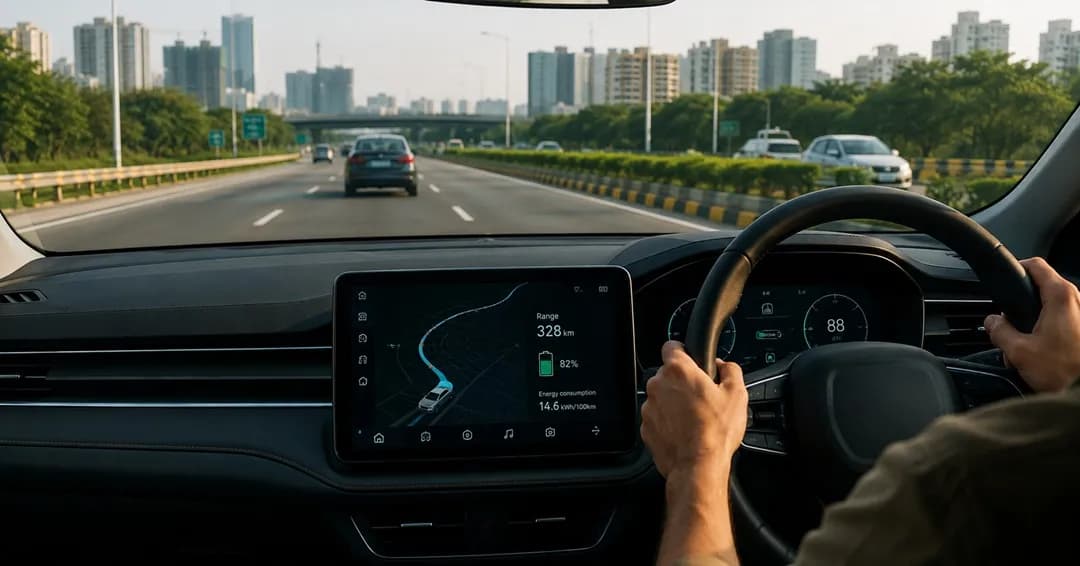
AI is improving EV range prediction in India by combining battery condition, driving behaviour, traffic, route elevation, weather and vehicle data. The approach can provide more adaptive energy forecasts, support route and charging decisions, and improve fleet management. Hybrid physics-based and machine-learning models offer a practical path toward reliable prediction.
For an electric vehicle owner, the range figure displayed on the dashboard can influence almost every decision made during a journey. It affects route selection, charging stops, driving speed and, in some cases, whether a trip is attempted at all. This makes range prediction far more important than a conventional vehicle specification. An inaccurate range estimate can create anxiety even when the battery itself has sufficient capacity.
The difficulty is that real-world EV range is determined by a combination of variables that change continuously. Battery state of charge is important, but it does not tell the entire story. Vehicle speed, acceleration, traffic density, road gradient, payload, tyre pressure, ambient temperature, air-conditioning use, battery temperature, regenerative braking and driving style can all influence electricity consumption. Battery ageing adds another variable because the relationship between stored energy and usable energy changes over the vehicle's operating life.
India makes the problem particularly demanding. An electric car moving through Bengaluru traffic can experience a very different consumption pattern from the same vehicle travelling on an open highway. A scooter operating in the heat of Delhi faces different conditions from one running through a coastal city during monsoon season, while vehicles travelling through the Western Ghats must contend with repeated elevation changes. A fixed efficiency assumption cannot easily accommodate this range of operating conditions.
Artificial intelligence is emerging as a practical way to address this problem. Rather than treating range as a calculation based largely on what happened during the previous few kilometres, AI can estimate future energy consumption using information about the vehicle, driver, road, weather and route ahead. The result is a shift from a static range figure toward a continuously updated forecast that becomes more relevant to the actual journey.
Why conventional EV range estimates struggle with Indian driving conditions
Conventional range estimation is not necessarily primitive. Modern battery-management systems already monitor state of charge, voltage, current, temperature and other parameters, while vehicle software can use recent energy consumption to update the displayed range. The limitation is that these systems often have to infer future consumption from a relatively narrow set of observations.
That becomes problematic when conditions change suddenly. An EV that has spent the previous 15 kilometres travelling efficiently on a relatively open road may display a healthy range immediately before entering a congested urban corridor. Once stop-start traffic begins, electricity consumption can rise and the displayed range may fall quickly. The reverse can happen when a vehicle leaves a congested area and reaches a steady-speed highway.
The issue becomes more pronounced on hilly routes. Climbing requires additional energy, while descending can allow regenerative braking to recover some of the vehicle's kinetic energy. A route with the same total distance can therefore produce very different battery consumption depending on its elevation profile.
AI offers an advantage because it can model relationships between several variables simultaneously. Recent research on EV battery state-of-charge prediction has demonstrated the use of machine-learning approaches to improve estimation while addressing the computational and generalization limitations associated with more complex deep-learning models.
For India, this matters because the objective is not simply to calculate how efficiently an EV performed in the past. The more valuable objective is to estimate how efficiently it will perform over the remaining journey.
AI changes range prediction from historical extrapolation into forward-looking estimation
A conventional range algorithm can be thought of as asking how much distance the vehicle could travel if recent energy consumption continues. An AI-enabled system can ask a more useful question: given the battery condition, current driving behaviour, route characteristics and expected conditions ahead, how much energy will the vehicle probably need to reach its destination?
Consider an EV travelling with 40% battery remaining. If the navigation system knows that the next section contains heavy congestion, steep gradients and several kilometres of slow-moving traffic, an intelligent range model can anticipate higher consumption. The prediction can be adjusted before the vehicle has actually used all of that additional energy.
If traffic later clears and the vehicle enters a steady-speed section, the model can revise the estimate again. This creates a range figure that responds to the journey rather than simply reacting to battery depletion.
That distinction is important for consumer confidence. A range estimate that changes because the system has identified a demanding section of road is more useful than an estimate that remains unchanged until the battery begins falling faster than expected. In practical terms, the quality of a range system should be judged by how accurately it anticipates change, not by how slowly the displayed number declines.
The data feeding an AI range prediction model is becoming increasingly diverse
The technology becomes more powerful when manufacturers combine information from several vehicle and external sources. Many of these inputs already exist in connected EVs, meaning the main challenge is increasingly one of integration, modelling and validation rather than simply adding hardware.
Data category | Examples of information used by the model | How the information improves range prediction |
Battery parameters | State of charge, voltage, current, temperature and state of health | Establishes available energy and battery operating condition |
Vehicle dynamics | Speed, acceleration, braking and motor load | Measures instantaneous propulsion demand and driving intensity |
Route information | Distance, road type, elevation and junction density | Estimates the energy required over the remaining route |
Traffic conditions | Congestion, average speed and stop frequency | Improves forecasts for urban and mixed-traffic operation |
Environmental conditions | Temperature, humidity, wind and weather information | Accounts for environmental and thermal influences on consumption |
Driver behaviour | Acceleration habits, speed preferences and braking patterns | Allows the prediction to reflect individual driving behaviour |
Vehicle condition | Tyre pressure, payload and battery ageing | Explains differences between nominal and observed efficiency |
Auxiliary loads | Air conditioning, lighting and other electrical systems | Captures electricity used outside the propulsion system |
The breadth of this dataset is important because EV efficiency is not determined by one dominant variable. A vehicle may be travelling slowly, for example, but still consume substantial energy if it is repeatedly accelerating in heavy traffic while running the air conditioner. A highway journey may involve higher speeds but produce a more predictable consumption pattern because acceleration is less frequent.
AI can identify these interactions from historical data. The model does not need engineers to manually define every possible combination of traffic, weather, battery temperature and driving behaviour. It can learn relationships from actual vehicle operation, provided the underlying dataset is sufficiently representative.
India's electric two-wheeler market creates a particularly strong opportunity for AI-based prediction
Electric two-wheelers are especially relevant because their operating environment is highly variable and the segment has substantial scale. The Ministry of Heavy Industry's PM E-DRIVE dashboard reported more than 2.8 million e-2W sales in its total-sales fields as of 18 August 2026, illustrating the size of the addressable vehicle base.
Two-wheelers also expose several weaknesses in simplistic range calculations. Riders can change speed frequently, select different routes, carry passengers or goods, and encounter traffic conditions that vary considerably between morning and evening. A scooter used for short urban trips can therefore develop a very different energy-consumption profile from the same model used mainly on open roads.
This creates an opportunity for manufacturers to develop rider-specific prediction models. During the initial period of ownership, the vehicle may rely largely on general vehicle and battery characteristics. As more journeys are completed, the system can learn the rider's typical speed, acceleration behaviour, route patterns and consumption history.
The prediction can consequently become more relevant to the individual vehicle rather than remaining a generic estimate for the model. This is potentially more valuable for affordable electric two-wheelers than simply increasing battery capacity because additional battery weight and cost can materially affect the economics of the vehicle.
Personalised prediction can make the dashboard range more meaningful to individual drivers
Two people driving the same EV on the same road will not necessarily achieve the same efficiency. One driver may accelerate aggressively and maintain higher speeds, while another may use smoother acceleration and more regenerative braking. Passenger weight, luggage and tyre pressure can create further differences.
AI allows these behavioural patterns to become part of the prediction process. The system can learn from previous trips and identify how a particular driver typically consumes energy under different conditions. It can then combine that information with current battery and route conditions.
This should not be confused with simply rewarding efficient driving by displaying a higher range. A robust model needs to balance driver behaviour against factors outside the driver's control. A careful driver cannot eliminate the energy penalty created by a steep climb or severe congestion.
The real advantage is improved calibration. If the system knows that a particular driver consistently consumes more energy during high-speed highway driving, it can incorporate that behaviour when forecasting a long highway trip. If another driver has demonstrated stable efficiency under similar conditions, the model can reflect that history instead.
Indian climate conditions make weather-aware prediction increasingly important
Temperature is an important variable in EV energy management because both the battery and vehicle auxiliary systems respond to environmental conditions. Air conditioning can add electrical demand, while battery thermal management can influence usable performance under extreme conditions.
India's geographic diversity makes this particularly relevant. A manufacturer selling the same EV across northern, western, southern and hill regions cannot assume that one environmental profile will adequately represent the entire fleet. Seasonal variation adds another layer because the same vehicle can experience very different conditions across the year.
AI can use historical operating data to identify these patterns. If a vehicle has previously consumed more energy under specific combinations of temperature, traffic and speed, the model can account for that relationship in future predictions.
The advantage is not that the algorithm somehow "understands" weather in isolation. Its value comes from connecting weather conditions with observed vehicle behaviour. That connection can be particularly useful when an environmental factor becomes significant only in combination with other variables.
Battery ageing creates a second layer of uncertainty that AI can help manage
Range prediction becomes harder as an EV ages because the battery's usable characteristics change. Capacity gradually declines, internal resistance can change, and charging and operating history influence the battery's condition. A vehicle therefore cannot rely indefinitely on the characteristics recorded when its battery was new.
This is where battery state-of-health estimation becomes closely connected with range prediction. If the system misjudges the battery's remaining usable capacity, the downstream range calculation will also be wrong.
Research at IIT Delhi has explored a one-dimensional convolutional neural-network approach for EV battery state-of-charge estimation and examined transfer learning to improve performance when the model encounters batteries with different chemical characteristics. The research specifically highlights the potential to obtain useful generalization with less battery data when transfer learning is used.
The broader implication is significant for Indian EV manufacturers. As fleets mature, the industry will accumulate information from batteries at different ages and operating histories. Algorithms that can adapt to these variations will become more valuable than models trained exclusively on laboratory or new-battery datasets.
This could eventually allow range prediction to account for the individual battery rather than applying a broad degradation assumption across an entire vehicle population.
Route-aware prediction could become more valuable than the range number itself
Drivers do not normally need to know the theoretical maximum distance an EV can cover. They need to know whether the vehicle can complete a particular trip with a sensible reserve.
This changes the role of the navigation system. A 100-kilometre journey is not automatically more energy-efficient than a 120-kilometre journey. The shorter route may contain heavy traffic and steep gradients, while the longer route could provide more consistent speeds and lower energy consumption.
An AI-enabled navigation system can potentially compare these factors and recommend a route based on predicted energy use rather than distance alone. If the predicted battery level at the destination is too low, the system could identify a charging stop that fits the route.
This becomes increasingly practical as India's charging infrastructure develops. The PM E-DRIVE framework allocates Rs. 2,000 crore for public charging infrastructure, and the government reported 52,718 public EV charging stations nationwide as of 21 July 2026, including 16,561 equipped with fast chargers for cars.
The PM E-DRIVE operational guidelines for EV public charging stations were issued on 26 September 2025 and support deployment across cities and along selected highways. This provides a clearer basis for navigation systems to incorporate charging availability into route decisions.
The important development is therefore the integration of three functions: predicting energy consumption, selecting a route and planning charging. Once these functions operate together, range prediction becomes part of energy management rather than merely a dashboard feature.
The likely technical architecture will combine physical models with machine learning
There is a temptation to view AI as a replacement for conventional engineering models, but that would be a risky approach for automotive applications. Batteries, motors, tyres and vehicle aerodynamics remain physical systems with measurable constraints. A data-driven model can learn patterns from observed behaviour, but it may behave poorly when presented with conditions that are poorly represented in its training data.
A hybrid architecture is therefore more practical. Physics-based calculations can establish fundamental relationships and boundaries, while machine learning can estimate real-world deviations caused by traffic, driver behaviour, weather and other variables that are difficult to model precisely.
This approach also makes validation more manageable. If a machine-learning model produces an implausible prediction, physical constraints can prevent the system from accepting that output without further verification.
Recent research in battery state-of-charge prediction also reflects the industry's interest in balancing accuracy, computational efficiency and explainability rather than pursuing model complexity for its own sake. A peer-reviewed 2026 study in Batteries proposed a LightGBM-based state-of-charge estimation approach specifically to balance prediction accuracy and computational efficiency.
For mass-market Indian EVs, that balance will matter. The best model is not necessarily the one with the highest theoretical accuracy in a laboratory. It is the one that can operate reliably within the vehicle's available computing resources and continue producing useful predictions under changing road conditions.
Range prediction is likely to evolve through several practical stages
The transition from conventional range estimation to AI-driven energy management is likely to happen incrementally. Different vehicle segments will adopt different levels of capability depending on their connectivity, computing resources, price and customer requirements.
Development stage | Principal information used | Expected capability |
Basic estimation | Battery state of charge and calibrated efficiency | Provides a conventional remaining-range estimate |
Adaptive estimation | Recent consumption and historical driving data | Adjusts range according to observed vehicle usage |
Context-aware estimation | Battery, route, traffic and environmental information | Accounts for current operating conditions |
Predictive estimation | Machine-learning forecasts of future energy demand | Estimates likely battery level at the destination |
Integrated energy management | Range, navigation, charging and battery-health data | Coordinates route selection, charging and battery utilization |
Premium passenger EVs are likely to adopt the more advanced stages earlier because they generally have greater connectivity and computing capability. However, the larger commercial opportunity in India may eventually come from simpler versions designed for two-wheelers, three-wheelers and fleet vehicles.
The economics will determine how much intelligence can be deployed at the vehicle level. Manufacturers may use a combination of onboard processing and cloud-based systems, depending on the importance of real-time response, connectivity and cost. For safety-critical functions, reliance on uninterrupted connectivity would be difficult to justify, making local processing particularly important.
Fleet operators could obtain a direct financial return from better range prediction
For private owners, improved range prediction primarily reduces uncertainty. For commercial fleets, the same technology can affect operating costs directly.
A delivery fleet needs to know whether a vehicle can complete its remaining assignments without an unplanned charging stop. A taxi operator needs to anticipate whether a vehicle can remain in service through a particular demand period. An electric three-wheeler operator may need to balance charging time against working hours.
AI can turn range prediction into an operational planning function. Historical fleet data can identify routes with unusually high consumption, vehicles that are underperforming compared with peers, and battery conditions associated with declining efficiency.
This can also create an early-warning mechanism for maintenance. If an individual vehicle consistently consumes more energy than comparable vehicles under similar conditions, the anomaly could indicate tyre-pressure issues, battery degradation, drivetrain inefficiency or another mechanical problem.
The range algorithm therefore becomes useful even when the driver never sees the underlying model. Its value can appear through better fleet scheduling, maintenance decisions and vehicle utilization.
Data quality and privacy will determine whether the technology scales effectively
The biggest barrier to AI range prediction may not be the availability of algorithms. It may be the quality of the data used to train them.
Manufacturers need datasets that represent different cities, seasons, traffic patterns, road surfaces, vehicle loads, battery ages and driver behaviours. A model trained primarily on new vehicles and predictable highway journeys will not necessarily perform well in congested urban environments or after several years of battery use.
Data consistency is another concern. Sensor errors, missing values, GPS inaccuracies and differences between vehicle generations can affect model performance. Manufacturers therefore need strong data-cleaning and validation processes before large datasets can be treated as reliable training material.
Privacy also deserves attention because detailed driving data can reveal where and when a vehicle is being used. India notified the Digital Personal Data Protection Rules, 2025, in November 2025; where connected-vehicle data qualifies as personal data, manufacturers and service providers need to account for the Act's and Rules' requirements on lawful processing, consent, security and related obligations.
For manufacturers, strong data governance will be as important as model accuracy. Data volume alone will not guarantee better AI performance; representative and well-managed data will matter more.
Better prediction could reduce some pressure to install larger batteries
One of the more interesting commercial implications of AI range prediction is its potential effect on battery sizing. When drivers do not trust range estimates, manufacturers may respond by offering larger battery packs to provide greater perceived security. However, larger batteries increase vehicle weight, cost and material requirements. This trade-off is especially important for electric two-wheelers, where additional battery mass can affect both vehicle efficiency and price.
More accurate prediction can reduce some of the uncertainty that encourages consumers to demand larger batteries. If the vehicle can reliably forecast its remaining energy requirement, a driver may be more comfortable operating with a smaller reserve.
This does not mean AI can substitute for battery capacity. A vehicle still needs enough energy to complete realistic journeys. The opportunity lies in improving the utilization of existing capacity by giving drivers better information about how much energy they will actually need.
For manufacturers, this creates an alternative path to improving perceived range. Instead of increasing battery size every time customers demand greater confidence, some improvements can come from software, efficiency and predictive energy management.
Trust will become the decisive measure of AI range systems
The most sophisticated prediction model will have limited commercial value if drivers do not trust it. An optimistic estimate that repeatedly leaves drivers searching for a charger can damage confidence much faster than a conservative estimate.
Manufacturers therefore need to focus on consistency rather than simply maximizing the displayed number. A useful system should update its prediction when conditions change, explain major deviations where practical and maintain sensible reserves when uncertainty is high.
This is particularly important for longer journeys, where small errors in consumption can accumulate into a meaningful difference by the time the vehicle approaches its destination. An intelligent system should recognize uncertainty rather than present an artificially precise figure that implies more confidence than the underlying data supports.
The strongest approach will probably combine an accurate numerical estimate with contextual information about the route and expected conditions. That allows the driver to understand not only how much range remains but why the system expects that range to be achievable.
India's expanding EV ecosystem provides a strong foundation for this transition
India already has several of the ingredients required to develop sophisticated EV range-prediction systems. The country has a growing installed EV base, substantial adoption of electric two-wheelers and three-wheelers, increasing vehicle connectivity and an expanding charging ecosystem supported by public policy.
The PM E-DRIVE scheme has an approved outlay of Rs. 10,900 crore and is scheduled to run until 31 March 2028. The e-2W incentive window was extended to 31 July 2026, while registered e-rickshaws and e-carts were extended to 31 March 2028.
The scheme's official model database also shows the increasing diversity of approved EV configurations. For example, approved electric two-wheelers can differ in battery capacity, energy consumption and certified range, reinforcing the importance of vehicle-specific rather than purely category-level range assumptions.
This diversity strengthens the case for vehicle-specific and context-aware prediction. The more varied the real-world operating environment becomes, the less useful a single fixed consumption assumption becomes. An adaptive model can learn from differences rather than treating them as noise.
Conclusion: AI could make EV range a live measure of vehicle capability rather than a fixed specification
AI can help address one of the most persistent practical challenges in electric mobility: the gap between certified range and actual journey performance. Battery state of charge remains central, but modern prediction systems can increasingly combine battery condition with driving behaviour, traffic, route elevation, weather, vehicle condition and charging availability.
The implications extend beyond improving a dashboard display. More accurate prediction can support route planning, charging decisions, fleet management, battery-health monitoring and potentially more efficient battery sizing. India's large electric two-wheeler and three-wheeler base makes the opportunity particularly important because these vehicles operate under highly variable traffic and load conditions.
The most practical path is unlikely to involve replacing established battery and vehicle models with black-box AI. Hybrid systems that combine physical constraints with machine-learning models offer a stronger balance between adaptability, computational efficiency and engineering reliability. Research from institutions such as IIT Delhi and recent battery-management studies illustrates the growing role of machine learning in state-of-charge estimation, which is a critical foundation for reliable range prediction.
Over the next phase of India's EV development, range is likely to become less of a fixed number associated with a vehicle model and more of a continuously calculated assessment of the vehicle's current capability. The most useful system will consider the condition of the battery, the behaviour of the driver, the route ahead and the surrounding environment before estimating how much energy the journey is likely to require.
For EV manufacturers, this creates a new competitive dimension. Battery capacity and charging speed will remain important, but software that can accurately predict and manage available energy could become equally relevant to real-world ownership. Companies that turn range prediction into a reliable energy-management capability could have an advantage in addressing one of the central practical concerns of India's expanding electric mobility market.
Have questions?
More Thought Articles
How EV Charger Manufacturers Can Capitalize on India’s Home Charging Revolution
India’s residential EV charging opportunity is expanding as policy support, EV adoption, and private parking infrastructure develop. Manufacturers can capture value beyond AC chargers through installation, smart charging, load management, solar integration, software, and after-sales services. Housing societies, automakers, and property developers offer scalable routes to residential charging customers.
Second-Life EV Battery Market in India: What Is Driving Demand from Manufacturers?
India’s second-life EV battery market is gaining relevance as electric vehicle adoption expands and batteries retain useful capacity after automotive service. Growing stationary-storage demand, battery data, refurbishment capabilities, EPR obligations, and critical-mineral policies are encouraging manufacturers to extend battery value through reuse before eventual recycling within India’s emerging circular battery ecosystem.
The Rise of Locally Manufactured Battery Separators in India’s EV Ecosystem
India’s battery industry is progressing from pack assembly toward domestic cell and material manufacturing, creating opportunities for lithium-ion battery separators. Policy support, ACC capacity expansion and R&D initiatives are strengthening the ecosystem. However, technical complexity, manufacturing yields, qualification requirements and economics mean localisation will likely advance gradually through coatings, testing and finishing.