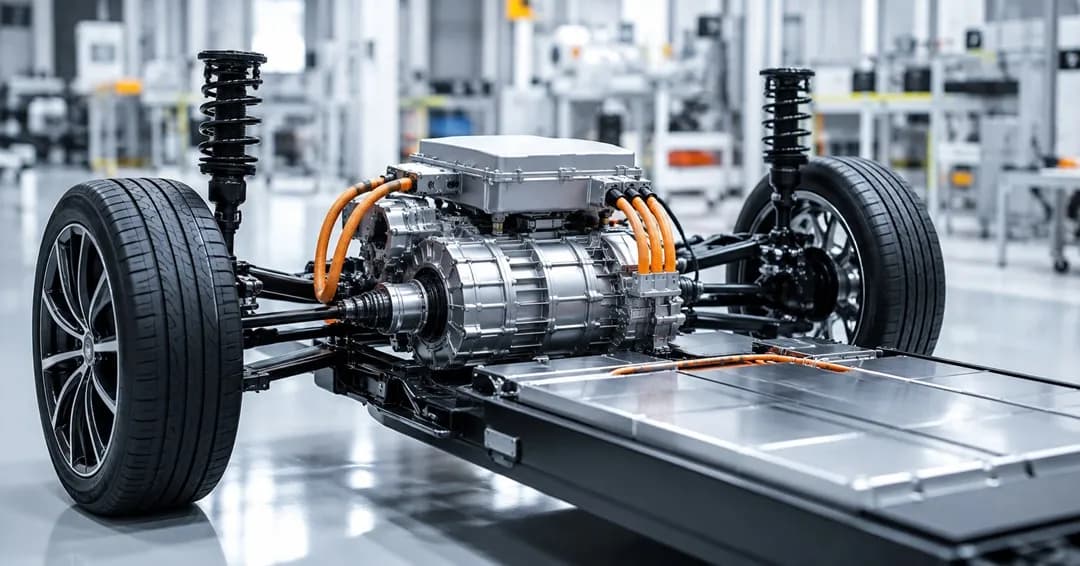
India’s EV industry is shifting toward power electronics as a key source of vehicle differentiation. Traction inverters, SiC semiconductors, integrated drive units, software and thermal management can improve efficiency, charging, range and reliability. Cost-sensitive two-wheelers will favour affordable solutions, while premium and commercial EVs accelerate adoption of advanced power electronics.
India’s electric vehicle industry is moving beyond the stage where electrification itself is the main differentiator. As battery costs, motor technologies and vehicle platforms mature, manufacturers are competing more closely on range, charging time, efficiency, acceleration, thermal performance and lifetime operating cost. Behind many of these improvements is a technology category that receives considerably less attention than battery power electronics.
Power electronics determines how electricity is converted, controlled and delivered throughout an electric vehicle. The traction inverter converts battery DC power into the controlled AC supply required by the motor, while the DC-DC converter manages voltage conversion for auxiliary systems and the onboard charger controls AC-to-DC charging. Semiconductor devices, gate drivers, sensors, control software and thermal systems then determine how effectively these components perform under real driving conditions.
The importance of this architecture is becoming more apparent as India's EV market expands. FADA reported 1.149 million electric two-wheeler retail sales in FY2025, while its June 2026 data showed electric two-wheelers reaching 10.60% of monthly two-wheeler retail sales, compared with 7.34% a year earlier. The PM E-DRIVE portal also reports scheme-linked e-2W registrations, but these figures should not be treated as equivalent to total national EV registrations because scheme coverage and reporting definitions differ.
This creates an important change in the competitive structure of India's EV powertrain market. The question is no longer simply how much energy the battery stores or how much torque the motor can produce. Increasingly, the commercial question is how efficiently the vehicle can move energy from the battery to the wheels, recover it during braking and manage heat during repeated operation.
Power Electronics Is Becoming the Control Layer of the EV Powertrain
In a conventional internal-combustion vehicle, mechanical engineering dominates the powertrain. An EV reverses much of that relationship because electrical conversion and control determine how the stored energy is translated into useful motion.
The traction inverter is at the centre of this architecture. It controls the frequency, voltage and current delivered to the motor and therefore influences torque production, acceleration, regenerative braking and energy consumption. Its performance also affects the thermal load placed on the vehicle because electrical losses ultimately appear as heat.
That makes inverter efficiency a system-level issue rather than an isolated component specification. A more efficient inverter can reduce energy losses, potentially lower cooling requirements and improve usable range. In a commercial vehicle that operates for long hours, even relatively modest efficiency improvements can accumulate into meaningful energy savings over the vehicle's operating life.
India's diverse EV mix makes this particularly interesting because the optimum power electronics architecture will differ substantially by vehicle class. A low-cost electric scooter does not need the same inverter architecture as an electric bus, and an urban delivery three-wheeler does not necessarily benefit from the same semiconductor technology as a premium passenger car.
EV application | Primary power electronics priority | Likely technology direction | Commercial implication |
Electric two-wheelers | Low cost, compactness, efficiency and durability under urban use | Advanced silicon devices, integrated controllers and selective wide-bandgap adoption | Component cost must remain tightly controlled because vehicle pricing is highly sensitive |
Electric three-wheelers | High utilisation efficiency, thermal durability and regenerative braking | Efficient motor controllers and increasingly integrated power electronics | Lower energy consumption can directly improve commercial operator economics |
Passenger EVs | Range, power density, fast charging and driving performance | SiC traction inverters, higher-voltage architectures and integrated e-drive systems | Higher component cost can be justified when it improves range and charging capability |
Electric buses | Sustained high-power operation, thermal control and reliability | High-power SiC or advanced IGBT modules with sophisticated cooling | Energy efficiency and uptime influence total fleet operating cost |
Electric trucks | High efficiency under heavy loads, charging performance and system durability | High-voltage SiC modules and advanced energy-management systems | Lower conversion losses become more valuable as annual vehicle utilisation increases |
This segmentation is likely to remain important for years. India's power electronics market will not develop around one dominant semiconductor technology; instead, manufacturers will select architectures according to vehicle price, voltage, duty cycle and performance expectations.
Silicon Carbide Is Raising the Performance Ceiling
Silicon carbide, or SiC, has become one of the most important developments in automotive power electronics because it can operate efficiently at high voltages and switching frequencies while supporting higher operating temperatures than conventional silicon devices. Its potential benefits include lower switching losses, improved power density and reduced thermal requirements in suitable applications.
The technology is particularly relevant to traction inverters, DC-DC converters and onboard chargers. Bosch, for example, identifies traction inverters, DC-DC converters and onboard chargers among automotive applications for SiC. Its automotive semiconductor portfolio also illustrates the broader industry shift toward higher-efficiency power devices for electrified vehicles.
However, SiC should not be treated as an automatic replacement for silicon. The commercial equation is more complicated. SiC devices generally command a premium, and extracting their full value may require changes to gate-drive circuits, electromagnetic compatibility design, thermal management and vehicle architecture.
That premium can make sense in a high-end passenger EV where lower losses contribute to longer range or faster charging. The calculation is less straightforward in an entry-level scooter, where the customer may be more sensitive to purchase price than to a relatively small improvement in electrical efficiency.
India is therefore likely to see a differentiated adoption curve. Silicon-based devices will remain important in high-volume, cost-sensitive vehicles, while SiC will gain share in higher-voltage passenger cars, buses, trucks and other applications where efficiency has greater economic value.
Higher-Voltage Architectures Will Strengthen the Case for Advanced Semiconductors
The movement toward 800-volt electrical architectures is closely connected with the rise of advanced power semiconductors. At a given power level, a higher system voltage allows the vehicle to operate at lower current, which can reduce resistive losses and support more compact electrical conductors. It also creates opportunities for faster charging and higher power density, although insulation, safety, switching and component qualification requirements become more demanding.
This is where SiC becomes particularly attractive. Higher-voltage systems increase the importance of semiconductor losses, and the efficiency advantage of SiC can become more commercially meaningful as power levels rise.
India's 800-volt market will probably develop from the premium segment downward rather than appearing simultaneously across all vehicle classes. Premium passenger cars and high-utilisation commercial vehicles have the strongest economic reasons to adopt such architectures because charging downtime and energy consumption have a direct impact on vehicle value.
Over time, however, component scale could change the equation. Higher production volumes can reduce the cost of high-voltage connectors, capacitors, busbars, insulation systems and associated power modules. The technology may therefore move into more affordable vehicles not because every component suddenly becomes inexpensive, but because the complete architecture becomes easier to manufacture and validate.
Integrated Electric Drive Units Are Changing Component Relationships
The next major shift is integration. Automotive manufacturers are increasingly combining the motor, inverter, reduction gearbox and associated electronics into compact electric drive units rather than treating each element as an entirely independent assembly.
This approach has practical advantages. Shorter electrical connections can reduce packaging complexity, while common thermal interfaces can simplify cooling. The motor and inverter can also be calibrated as one system, allowing engineers to optimise the electrical operating range more effectively.
For India, integration has an additional advantage because packaging and manufacturing cost are closely linked. A compact drive unit can reduce the number of interfaces, cables and assembly operations required during vehicle production. In a two-wheeler, lower weight and smaller packaging can be particularly valuable, while in a passenger vehicle the same approach can create additional space for the battery or passenger compartment.
It also changes the balance of power between OEMs and suppliers. A supplier that delivers only a semiconductor device competes primarily on cost, reliability and specifications. A supplier capable of integrating the inverter, motor controls, thermal architecture and software can participate in a much more valuable part of the vehicle engineering process.
This is likely to encourage deeper technical partnerships between Indian OEMs and power electronics suppliers as EV production volumes increase.
Software Is Increasing the Value of Hardware
Power electronics is increasingly inseparable from software because the inverter's physical capabilities are only useful when the control system can exploit them efficiently.
Motor-control software determines how quickly torque responds to accelerator inputs, how regenerative braking is applied and how the inverter behaves across different speed and load conditions. It can also adjust power delivery according to battery state of charge, temperature and other operating constraints.
This has important implications for Indian manufacturers. Hardware components can be sourced from multiple suppliers, but sophisticated calibration and control strategies can become a source of differentiation. An OEM that understands the interaction between its motor, battery and inverter can potentially extract more efficiency from the same physical hardware than a competitor using a generic control strategy.
The importance of software also increases as manufacturers pursue tighter integration. When the inverter, motor and battery management system exchange more information in real time, the vehicle can make more precise decisions about torque, regeneration and thermal protection.
India's established software engineering capabilities could therefore become a useful advantage in powertrain development, provided automotive manufacturers build deeper expertise in embedded controls, functional safety and power electronics rather than treating software as a secondary layer.
Thermal Management Will Matter More Under Indian Operating Conditions
Thermal management is one of the less visible factors that could determine which power electronics technologies succeed in India.
High ambient temperatures can increase the thermal stress on batteries, motors and inverters. Commercial vehicles may operate for extended periods, while urban driving creates frequent acceleration and braking cycles. Fast charging adds another substantial source of heat, particularly when vehicles are repeatedly charged at high power.
Under these conditions, peak laboratory efficiency is not enough. Manufacturers need power electronics that can maintain predictable performance over a wide operating range without excessive thermal derating.
SiC provides an advantage because of its high-temperature capability and lower switching losses, but it does not remove the need for effective cooling. Advanced packaging, thermal interface materials, heat spreaders and liquid-cooling systems will remain important for high-power applications.
This creates a realistic opportunity for Indian component manufacturers. Full domestic semiconductor fabrication will take time, but companies can develop capabilities in power-module assembly, thermal systems, inverter housings, gate drivers, control electronics and validation. Those activities can capture more domestic value while building the engineering knowledge needed for deeper localisation.
Charging Infrastructure Is Increasing the Need for Better Power Conversion
The charging ecosystem is also influencing power electronics design. As charging power rises, onboard chargers and high-voltage systems need to handle greater electrical loads while keeping conversion losses and thermal stress under control.
Government policy is supporting this transition. PM E-DRIVE includes provisions for EV public charging infrastructure, and the Ministry of Heavy Industries has published operational guidelines covering charging stations as part of the scheme. The programme also has dedicated support for e-2Ws, e-3Ws, e-trucks and other vehicle categories.
The important point is that charging requirements will remain vehicle-specific. A privately owned electric scooter can often operate effectively with overnight charging, whereas an electric taxi, bus or delivery vehicle loses revenue whenever it is waiting for energy.
That difference will shape the adoption of advanced charging electronics. High-power commercial vehicles have a stronger financial reason to invest in efficient onboard charging, high-voltage components and thermal management because faster turnaround directly affects asset utilisation.
Localisation Will Extend Beyond Vehicle Assembly
India's ambitions in EV manufacturing increasingly include the electronics and semiconductor ecosystem that supports the vehicle. This is important because power electronics remains exposed to global semiconductor supply chains, particularly for specialised power devices and automotive-grade components.
The India Semiconductor Mission is developing capabilities across semiconductor manufacturing, packaging and related areas. The Union Cabinet has approved multiple semiconductor projects under the India Semiconductor Mission, including projects covering semiconductor fabrication, assembly, testing and packaging. These capabilities are relevant to the longer-term localisation of automotive electronics, although they do not imply that all automotive-grade power semiconductors are already produced domestically.
The opportunity should nevertheless be viewed realistically. India does not need to manufacture every semiconductor used in an EV before it can establish a competitive domestic power electronics industry.
A more practical progression involves inverter design, power-module assembly, semiconductor packaging, testing, thermal management, control electronics and automotive validation. These activities can increase domestic value addition while reducing dependence on imported finished power electronics.
The policy framework is moving in that direction. PM E-DRIVE sets out phased manufacturing requirements for eligible vehicle components, while the India Semiconductor Mission supports domestic semiconductor and packaging capacity.
The result could be a gradual transition from importing complete systems toward importing selected semiconductor elements while designing and manufacturing more of the surrounding powertrain architecture domestically. A particularly relevant development came in August 2025, when the Union Cabinet approved a SiCSem project in Odisha to establish a silicon-carbide compound semiconductor facility, with a planned capacity of 5,000 wafers per month and a packaging capacity of 8 million units per month; the project is intended to serve applications including EVs and fast chargers.
Two-Wheelers Will Keep the Market Focused on Cost
India's electric two-wheeler market is likely to remain the most important environment for testing whether advanced power electronics can be produced at mass-market economics.
FADA's FY2025 data recorded 1.149 million electric two-wheeler retail sales, with TVS Motor, Bajaj Auto, Ola Electric and Ather Energy among the major participants. By June 2026, FADA reported that electric two-wheelers represented 10.60% of monthly two-wheeler retail sales, although a single month's share should not be interpreted as a full-year adoption rate.
The volume opportunity is substantial, but so is the price pressure. A scooter controller must be compact, reliable and inexpensive while delivering sufficient torque and efficiency from a relatively small battery.
That means the most commercially successful technology will not necessarily be the most advanced semiconductor available. A well-optimised silicon-based controller may remain the better solution for many vehicles if it delivers sufficient efficiency at a significantly lower cost.
The same logic applies to integration. Reducing component count, improving manufacturing yield and simplifying assembly can sometimes produce a larger commercial benefit than gaining a small additional percentage point of semiconductor efficiency.
Commercial Vehicles Could Accelerate High-Power Electronics Adoption
Electric buses and trucks present a different economic case because they typically operate at much higher utilisation levels. For these vehicles, energy consumption is a recurring operating expense, while charging time directly affects revenue-generating availability. A powertrain that reduces conversion losses and maintains performance under sustained load can therefore create a measurable financial benefit over its operating life.
PM E-DRIVE includes incentives for eligible electric trucks and supports public charging infrastructure, reinforcing the policy focus on commercial electrification.
High-power commercial vehicles are consequently likely to become an important market for advanced SiC modules, high-voltage inverters and sophisticated thermal systems. Reliability will be just as important as efficiency because a power electronics failure can remove a revenue-generating vehicle from service.
For fleet operators, the strongest purchasing argument will therefore be total cost of ownership rather than technology branding. Suppliers that can demonstrate lower energy consumption, reduced thermal derating and longer component life will have a stronger case than those relying only on headline efficiency figures.
The Emerging Opportunity Is a Complete Power Electronics Ecosystem
India's competitive opportunity is gradually shifting from individual components toward the broader power electronics system. Semiconductor devices remain foundational, but the commercial value increasingly comes from combining them with packaging, thermal management, controls, software and vehicle-level engineering.
Technology area | Near-term opportunity in India | Longer-term strategic significance |
Traction inverters | Strong demand as passenger and commercial EV production expands | Critical because inverter efficiency directly affects range, power and thermal performance |
SiC power modules | Increasing relevance in high-voltage passenger and commercial vehicles | Very high as higher-voltage platforms become more common |
Advanced silicon controllers | Strongest opportunity in cost-sensitive two- and three-wheelers | High because affordability will remain central to Indian EV adoption |
Integrated e-drive units | Growing adoption as manufacturers reduce powertrain size and complexity | Very high because integration can improve efficiency, packaging and manufacturing |
DC-DC converters | Broad requirement across nearly every EV category | High because auxiliary systems depend on efficient voltage conversion |
Onboard chargers | Increasing demand as charging power and vehicle battery capacity rise | High for passenger and commercial EVs with shorter charging windows |
Thermal management | Strong demand wherever vehicles operate at high loads or temperatures | Critical because sustained power delivery depends on thermal control |
Power electronics software | Growing role in motor control, regeneration and energy management | Very high because software can differentiate otherwise similar hardware |
Semiconductor packaging and testing | Emerging opportunity as localisation expands | Very high because automotive-grade qualification is essential to supply-chain resilience |
High-voltage electrical components | Growing with 400-volt and 800-volt platform development | High because higher-voltage architectures require specialised components and validation |
Cost Will Determine Which Technologies Reach Mass Adoption
The biggest commercial challenge for advanced power electronics is not technical feasibility. It is economic justification.
India's EV market remains highly sensitive to upfront vehicle cost, particularly in two- and three-wheelers. A semiconductor technology that improves efficiency but adds substantial cost will struggle unless the manufacturer can recover that investment through battery downsizing, improved range, reduced cooling requirements or better vehicle performance.
The calculation changes for premium passenger cars and commercial fleets. A more expensive inverter can become attractive when the vehicle accumulates high mileage, operates at high power or requires rapid charging. In those applications, a small efficiency improvement can generate measurable lifetime savings.
This is why power electronics suppliers should increasingly sell system economics rather than component specifications. The relevant question for an OEM is not simply how efficient a semiconductor is. It is whether the complete vehicle becomes cheaper to operate or easier to package after adopting it.
That distinction is likely to separate successful technology adoption from technology demonstrations that remain confined to premium applications.
Outlook: Power Electronics Will Become a Larger Source of EV Differentiation
India's EV powertrain market is entering a period in which the quality of electrical conversion will become increasingly important to vehicle competitiveness. Battery capacity will remain critical, but simply installing a larger battery is not always the most efficient route to improving range. Better power conversion, more precise motor control, lower switching losses and improved thermal management can deliver additional performance without proportionally increasing battery size.
SiC will be an important part of this transition, especially in high-voltage passenger cars, buses and trucks. Silicon devices will continue to dominate many cost-sensitive applications, while selected wide-bandgap technologies will find opportunities where switching frequency, compactness or efficiency justify the additional cost.
The policy environment is simultaneously creating stronger incentives for domestic EV production and electronics capability. PM E-DRIVE, the India Semiconductor Mission and related manufacturing policies are supporting investment in EVs, charging infrastructure and semiconductor capabilities, although the impact on domestic power-electronics localisation will develop over time. and the development of India's semiconductor ecosystem provide a foundation for greater domestic participation in power electronics. The PM E-DRIVE scheme was extended to 31 March 2028 in August 2025, giving the policy framework a longer implementation horizon.
The deeper opportunity, however, lies beyond localisation alone. India has the vehicle volumes needed to create manufacturing scale and substantial engineering capabilities in automotive software and electronics. The next step is to connect those strengths with power-module design, semiconductor packaging, thermal engineering, automotive validation and integrated powertrain development.
If that capability develops successfully, advanced power electronics could become one of the defining technologies of India's next EV growth phase. The companies that gain the strongest position will not necessarily be those using the newest semiconductor or the highest system voltage. They will be the ones that can combine efficiency, reliability, thermal performance and manufacturability into a powertrain that makes economic sense for the vehicle and the customer.
Have questions?
More Thought Articles
From Data Centers to EV Charging: Where Low-Voltage DC Distribution Is Making an Impact
Low-voltage DC distribution is gaining relevance as AI data centers, EV charging hubs, solar systems, and battery storage increase demand for efficient power architectures. The article examines 800 VDC standardization, conversion losses, protection challenges, and greenfield opportunities, highlighting why hybrid AC/DC systems could become increasingly important across high-power infrastructure applications.
How EV Charger Manufacturers Can Capitalize on India’s Home Charging Revolution
India’s residential EV charging opportunity is expanding as policy support, EV adoption, and private parking infrastructure develop. Manufacturers can capture value beyond AC chargers through installation, smart charging, load management, solar integration, software, and after-sales services. Housing societies, automakers, and property developers offer scalable routes to residential charging customers.
Second-Life EV Battery Market in India: What Is Driving Demand from Manufacturers?
India’s second-life EV battery market is gaining relevance as electric vehicle adoption expands and batteries retain useful capacity after automotive service. Growing stationary-storage demand, battery data, refurbishment capabilities, EPR obligations, and critical-mineral policies are encouraging manufacturers to extend battery value through reuse before eventual recycling within India’s emerging circular battery ecosystem.