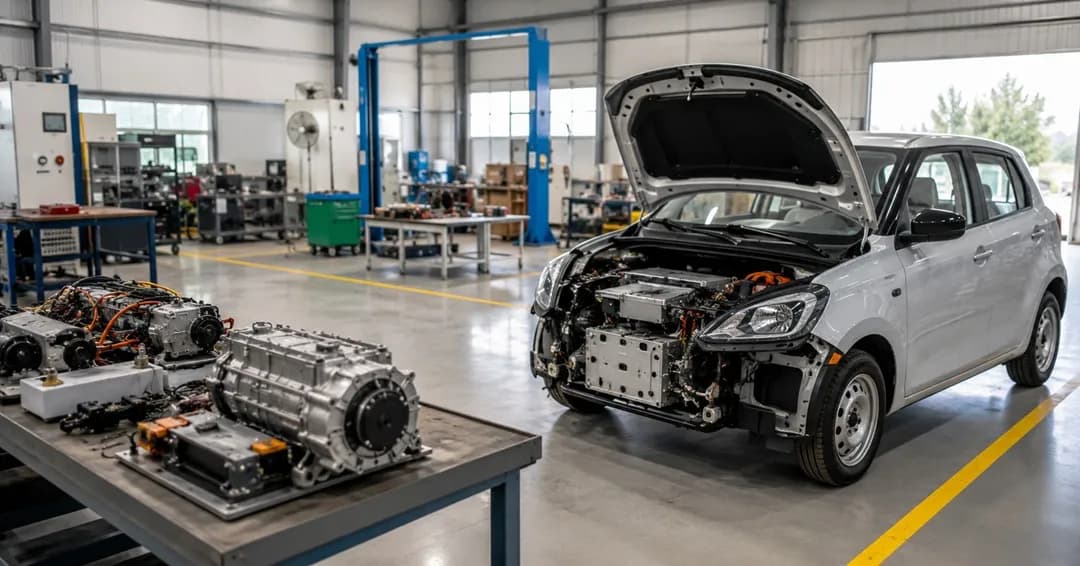
India’s EV conversion kit market could create a new manufacturing opportunity by electrifying existing vehicles, particularly high-mileage three-wheelers, delivery fleets, and light commercial vehicles. The article examines market economics, standardization, battery systems, power electronics, certification, and lifecycle services, highlighting how India’s expanding EV ecosystem can support selective, scalable retrofit manufacturing.
India's electric vehicle market is usually discussed through the lens of new vehicle sales. That makes sense because new electric scooters, three-wheelers, cars, buses, and commercial vehicles are driving visible changes across the automotive industry. Yet another opportunity is developing underneath that headline: electrifying vehicles that are already on Indian roads rather than replacing them altogether.
This is where EV conversion kits enter the picture. A conversion kit replaces the conventional propulsion system of an existing vehicle with an electric powertrain, generally involving a motor, controller, battery pack, battery management system, charger, DC-DC converter, wiring, mounting hardware and associated safety systems. The concept is not new, but India's combination of a large vehicle population, rising fuel and operating-cost concerns, expanding battery capabilities and a more defined regulatory framework is making it increasingly relevant to manufacturers.
The opportunity should not, however, be interpreted as a straightforward replacement for the new-EV market. Converting an existing vehicle is technically more complicated than assembling an electric drivetrain into a platform designed around it from the beginning. The commercial case also varies dramatically between a private car that travels a few thousand kilometers a year and a delivery vehicle that operates every day. That difference will determine where the industry develops first.
The strongest opportunity is likely to emerge around vehicles with high utilization, predictable operating patterns and enough remaining mechanical life to justify keeping the existing platform. Commercial fleets, selected three-wheelers, light commercial vehicles, institutional vehicles and specialized applications therefore have a stronger initial case than the average private passenger car.
India's Existing Vehicle Base Creates a Different EV Opportunity
India's automotive market is large enough that even a relatively narrow retrofit opportunity can support a meaningful component industry. SIAM reported domestic sales of 46.43 lakh passenger vehicles, 10.80 lakh commercial vehicles, 8.36 lakh three-wheelers, and 2.17 crore two-wheelers during FY2025-26. All four major vehicle categories recorded their highest-ever financial-year sales, while three-wheelers and commercial vehicles grew 12.8% and 12.6%, respectively.
Those figures do not represent the potential retrofit market directly, because a large proportion of newly sold vehicles will obviously remain in their original configuration. Their importance lies elsewhere. They demonstrate the scale of India's vehicle ecosystem and the number of platforms around which component suppliers, service networks and technical skills can develop.
The installed base is even more interesting from a retrofit perspective. A vehicle owner has already paid for the body, chassis, suspension, interior and other major components. If those systems remain serviceable, replacing the entire vehicle means abandoning a significant amount of embedded value. Electrification through conversion can preserve that investment while changing the vehicle's energy source. That proposition becomes stronger as the vehicle accumulates more kilometers.
For a private owner, fuel savings may be too small to justify a substantial retrofit bill. For a commercial operator, fuel expenditure is directly linked to business economics, so the same conversion can become much more attractive. The question for manufacturers is therefore not how many old vehicles exist, but how many vehicles have enough utilization and remaining life to support a commercially sensible conversion.
The First Market Is More Likely to Be Commercial Than Consumer
The commercial-vehicle case is relatively straightforward. A delivery van, goods carrier, shuttle or three-wheeler can spend several hours each day on the road, making energy costs a significant operating expense. If the vehicle follows a repeatable route and returns to a known location, charging can also be planned more easily than it can for many private users.
The economics become even more compelling when the customer operates multiple vehicles. A fleet operator can standardize the conversion across one or two vehicle platforms, establish centralized charging, train technicians and monitor vehicle performance. Instead of selling one customized kit to one individual, a manufacturer can supply dozens or hundreds of standardized systems.
India's recent commercial-vehicle performance strengthens the case for this approach. SIAM recorded 10.80 lakh commercial-vehicle sales in FY2025-26, the highest annual level for the segment, while Q1 FY2026-27 sales reached 2.65 lakh units, representing 18.3% growth from the corresponding quarter of the previous year.
The three-wheeler market is particularly relevant because electric mobility has a substantial presence within the category. SIAM reported 8.36 lakh three-wheeler sales in FY2025-26 and specifically linked part of the segment's performance to the expansion of electric autorickshaws. The market therefore has existing consumer familiarity with electric propulsion, which could make selected retrofit applications easier to introduce.
Which Vehicle Applications Offer the Strongest Opportunity?
Vehicle application | Commercial attractiveness | Main reason for potential demand | Key challenge for manufacturers |
High-mileage three-wheelers | High | Frequent operation creates a strong fuel-saving incentive | Battery packaging, payload and platform variation |
Light commercial vehicles | High | High utilization and predictable routes can improve payback | Range, payload and thermal management |
Delivery fleets | High | Centralized charging and repeatable vehicle platforms simplify deployment | Downtime during conversion and financing |
Institutional fleets | Medium to high | Controlled routes and centralized maintenance reduce uncertainty | Procurement requirements and approval processes |
Older passenger cars | Medium | Owners can retain an otherwise usable vehicle | Retrofit cost may approach the price of a new EV |
Premium and classic vehicles | Niche, potentially high margin | Preservation and customization can support higher pricing | Limited volumes and specialized engineering |
Low-mileage private cars | Low | Limited annual fuel savings weaken the financial case | Long payback period and uncertain residual value |
The table highlights an important point that is sometimes missed in discussions about retrofitting. A technically possible conversion is not necessarily a commercially viable conversion. Manufacturers will need to identify vehicle categories where the economic logic is strong enough for customers to make the investment without relying entirely on subsidies.
The Real Manufacturing Opportunity Is Standardization
The difference between a retrofit workshop and a conversion-kit manufacturer is repeatability.
A workshop can approach every vehicle as a separate engineering problem, fabricate brackets as required and modify wiring according to the individual vehicle. That model can serve a niche market, but it is difficult to scale. A manufacturer needs standardized components, controlled assembly processes, documented installation procedures and predictable performance.
This is why vehicle-platform selection will become one of the industry's most important strategic decisions. A company that develops a validated kit for a popular light commercial vehicle can manufacture the battery enclosure, motor mounts, wiring harnesses and control architecture in volume. The installation process can then be standardized across multiple workshops. That creates manufacturing efficiency while reducing quality variation.
The regulatory framework reinforces this requirement. AIS-123 Part 3 establishes the CMVR type-approval framework for electric propulsion kits intended to convert vehicles to pure-electric operation. Its requirements include vehicle weighment, gradeability, electric range and energy consumption, braking performance, electromagnetic compatibility, traction motor performance, constructional safety, rechargeable energy storage systems and wiring-related provisions.
For manufacturers, this means certification cannot be treated as an administrative exercise performed after product development. The kit has to be engineered as a complete system from the beginning, with the vehicle, battery, motor, controller and safety architecture considered together.
Battery Systems Will Become a Major Differentiator
The battery is likely to represent one of the largest portions of a conversion system's cost, but battery quality will matter just as much as battery price.
A vehicle battery pack requires more than cells assembled into a box. The system needs a battery management system, contactors, fuses, sensing equipment, appropriate insulation, thermal monitoring and mechanical protection. The enclosure must also be positioned within an existing vehicle without compromising ground clearance, weight distribution or serviceability.
This is particularly challenging because the donor vehicle was not originally designed around the battery. New EV platforms can allocate structural space for the pack from the earliest stages of engineering. Retrofit manufacturers have to find suitable space inside an existing architecture and then make that solution safe and repeatable.
India's battery manufacturing ambitions could nevertheless improve the economics over time. The Production Linked Incentive programme for Advanced Chemistry Cell battery storage has an outlay of ?18,100 crore and envisages 50 GWh of domestic ACC manufacturing capacity. As of the Ministry of Heavy Industries' current programme information, three beneficiary firms have been allocated a combined 30 GWh, with 20 GWh available for fresh allocation.
Most conversion-kit companies will not need to manufacture battery cells themselves. Their opportunity is more likely to sit in pack design, thermal management, battery electronics, enclosure manufacturing and vehicle integration. A deeper domestic supplier base can gradually reduce dependence on imported assemblies while allowing kit manufacturers to concentrate capital on their own engineering strengths.
Power Electronics Could Become Another Important Manufacturing Layer
The electric motor receives much of the attention in a conversion project, but the controller and supporting power electronics are equally important to vehicle performance.
The inverter or motor controller determines how electrical energy is converted into useful propulsion. The DC-DC converter supports the vehicle's low-voltage electrical architecture, while the charger controls energy transfer from the charging source to the battery. These components also have to communicate with the vehicle control system and operate reliably across India's temperature, road and duty-cycle conditions. This creates an opening for established automotive-component manufacturers.
A company does not necessarily have to become a complete retrofit brand to benefit from the market. It could supply motor controllers, battery management systems, connectors, harnesses, enclosures or thermal components to several kit integrators. In some cases, that may be a more attractive business model because it spreads product development costs across multiple customers.
The emergence of domestic advanced automotive manufacturing supports this possibility. India's PLI-Auto programme has a budgetary outlay of ?25,938 crore for FY2022-23 through FY2026-27 and is focused on Advanced Automotive Technology products, with an explicit emphasis on deep localization and domestic and global supply chains. The programme is focused on zero-emission vehicles, including battery-electric and hydrogen fuel-cell vehicles.
Although retrofit kits are not synonymous with new ZEV production, they use many of the same technologies. The broader EV supply chain can therefore become an indirect enabler for the retrofit industry.
Economics Will Decide Whether Retrofitting Scales
The biggest mistake manufacturers could make is assuming that technical feasibility creates market demand. It does not. The conversion has to generate enough value over the remaining life of the donor vehicle to justify the capital expenditure. That calculation needs to include the kit price, installation, charging infrastructure where necessary, financing, maintenance, battery warranty and eventual battery replacement.
For high-mileage vehicles, the numbers can work because fuel savings accumulate quickly. For low-mileage vehicles, the same conversion can take many years to recover its cost. That is why the commercial market should develop before mass passenger-car adoption.
A fleet operator also values uptime differently from an individual customer. If a converted delivery vehicle is unavailable for several days because a replacement component is difficult to obtain, the economic benefit can disappear quickly. Manufacturers will therefore need to maintain spare parts and service capabilities rather than treating installation as the end of the customer relationship.
This is where warranty terms can become a competitive weapon. A company offering transparent battery performance guarantees, predictable replacement policies and long-term parts support may justify a higher initial price than a low-cost converter with limited lifecycle support.
Regulatory Compliance Could Become a Competitive Advantage
India's retrofit framework is becoming more structured, and that should favor companies capable of operating within formal automotive certification processes.
AIS-123 Part 3 is significant because it recognizes electric propulsion kits as a specific technical category for vehicle conversion rather than leaving the activity entirely to informal aftermarket practices. The framework covers vehicle-level performance and safety requirements, making it possible for manufacturers to develop repeatable products around defined approval requirements.
The regulatory burden may initially appear to slow the industry, particularly for small companies. In the longer term, it can have the opposite effect by creating a barrier against poorly engineered products.
This matters especially for battery safety. A conversion company that controls component traceability, installation procedures, electrical isolation, battery enclosure design and end-of-line testing can build a stronger reputation with fleets, insurers and institutional buyers. The industry will eventually need that credibility because customers will want confidence that a converted vehicle remains safe throughout its operating life.
Amendment 4 to AIS-123 Part 3, published on 13 March 2025, aligned the requirements for constructional and functional safety and rechargeable energy storage systems with AIS-156:2020 for L-category vehicles and AIS-038 Rev. 2:2022 for M- and N-category vehicles. The amendment states that these provisions apply six months after publication.
Fleet Conversion Could Create a Recurring Revenue Model
The strongest retrofit businesses may eventually earn money from more than the initial kit. Fleet operators need diagnostics, maintenance, battery monitoring, replacement parts and technical support. A manufacturer can use software to monitor battery condition, energy consumption and fault events, while regional service partners handle physical maintenance. That creates a lifecycle business.
The initial conversion becomes the entry point for a relationship that can last for several years. Replacement battery modules, software support, periodic inspections and service contracts can generate recurring revenue while also improving customer retention.
A certified-installer network could make this model geographically scalable. The central manufacturer would control kit design, critical components, software and certification, while trained regional partners would handle installation and maintenance according to standardized procedures.
Such a model could be particularly effective in India because the country already has an extensive automotive repair and service ecosystem. The challenge is not creating every workshop from scratch; it is bringing enough of them into a controlled technical network.
The Passenger-Car Market Will Develop More Selectively
Private passenger cars will remain part of the retrofit opportunity, but they are unlikely to be its first major volume driver. The economics are difficult when the donor vehicle has a low market value, and the conversion represents a large share of that value. Owners also have to consider the condition of the suspension, tyres, air-conditioning system, steering, brakes and bodywork. Converting the powertrain does not reset the age of the rest of the vehicle.
There are more promising niches within passenger cars. Classic and enthusiast vehicles, for example, can justify higher conversion costs because the owner may value preservation more than the simple economics of replacing the car. Some premium vehicles may also offer enough residual value to support specialized conversion.
The mainstream market could become more attractive if standardized kits bring down installation costs. That is the key variable to watch. Battery costs alone will not determine the passenger-car retrofit market if every vehicle still requires extensive custom engineering.
The Retrofit Supply Chain Could Become a New Automotive Component Ecosystem
The manufacturing structure emerging around conversion kits could eventually resemble a smaller, specialized version of the conventional automotive component industry.
At one level, suppliers will provide cells, batteries, motors, controllers, power electronics and connectors. At another, kit integrators will combine these components into vehicle-specific systems. Installation networks will perform conversions, while service providers will maintain the vehicles and support battery systems throughout their operating life.
Manufacturing or service layer | What the company provides | Why it could become commercially important |
Battery suppliers | Cells, modules, packs and BMS | Battery reliability has a direct effect on vehicle economics and safety |
Powertrain suppliers | Motors, inverters and controllers | Standardized systems can serve several retrofit platforms |
Structural suppliers | Battery enclosures, mounts and brackets | Lightweight, repeatable components reduce installation time |
Kit integrators | Complete certified conversion systems | Integration and homologation create a higher-value product |
Installation networks | Vehicle conversion and commissioning | Geographic coverage is essential for customer support |
Diagnostic and service providers | Monitoring, maintenance and replacement parts | Lifecycle support can create recurring revenue |
Fleet partners | Procurement, financing and operations | Fleet contracts can provide predictable volume |
This structure creates room for both startups and established suppliers. Startups may move faster in developing platform-specific solutions, while established component companies have advantages in quality systems, procurement, tooling and manufacturing discipline.
The most successful companies may be those that combine the two approaches rather than trying to replicate the full structure of a major vehicle manufacturer.
What Could Hold the Market Back?
Several risks could prevent the segment from scaling as quickly as advocates expect. The first is cost, particularly when battery prices fall faster than installation and certification costs. The second is vehicle diversity, which can turn every new model into a separate engineering programme. The third is the condition of donor vehicles, because an inexpensive old vehicle may require substantial mechanical work before it becomes a reliable electric platform.
Insurance and residual value also matter. A customer may be willing to convert a vehicle if the economics are attractive, but uncertainty about future resale, battery replacement and insurance coverage can still delay the purchase. Fleet operators may be more comfortable with the model because they can evaluate the investment across a larger number of vehicles, but they will demand stronger guarantees around uptime and service.
There is also a risk that the market becomes divided between certified manufacturers and informal converters. If consumers cannot easily distinguish between the two, legitimate manufacturers could find themselves competing primarily on price rather than engineering quality. That would be damaging for the industry. A strong regulatory and certification framework is therefore important not only for safety but also for market structure.
Manufacturers Should Start Narrow Rather Than Chase Every Vehicle
The sensible strategy for a new entrant is unlikely to be a catalogue containing dozens of conversion kits. A manufacturer should identify a small number of high-volume vehicle platforms where the donor vehicles are common, the duty cycles are predictable, and the financial case is clear. It can then standardize the battery pack, motor, mounting system, wiring and software around those platforms.
The next objective should be reducing installation time. Every hour spent fabricating a bracket or modifying a harness adds cost and creates another opportunity for quality variation. A well-designed kit should arrive with vehicle-specific components that allow trained technicians to complete the conversion through a documented process.
Manufacturers should also build serviceability into the original design. Batteries, controllers and other critical components will eventually require inspection or replacement. If accessing those parts requires dismantling half the vehicle, the product will become expensive to maintain.
This sounds obvious, but retrofit businesses often focus heavily on getting the vehicle running and less on what happens five years later. A manufacturer thinking beyond the first sale has a better chance of building a durable brand.
Why the Timing Is Becoming More Favorable
The underlying EV ecosystem is now substantially larger than it was when retrofit concepts first appeared in India. The country is producing more electric vehicles, domestic suppliers are developing battery and power-electronics capabilities, and vehicle manufacturers are investing in advanced automotive technologies.
The broader vehicle market is also continuing to expand. The latest SIAM quarterly release, published on 15 July 2026, reports SIAM figures of 12.74 lakh passenger-vehicle sales, 2.65 lakh commercial-vehicle sales, 2.14 lakh three-wheeler sales and 56.29 lakh two-wheeler sales. Three-wheelers grew 29.7% year on year, while commercial vehicles grew 18.3%.
Again, these are not retrofit figures, and it would be misleading to treat them as direct evidence of retrofit demand. They indicate something more useful: the scale of the underlying automotive ecosystem is increasing, creating more component suppliers, technicians, engineering expertise and electric-vehicle familiarity that retrofit manufacturers can potentially use. That lowers some of the barriers to entry.
The Opportunity Is Real, but It Will Be Selective
EV conversion kits are unlikely to become a universal alternative to buying new electric vehicles. The economics simply do not support that conclusion across every vehicle category. A low-mileage private car with a weak residual value is unlikely to become an attractive retrofit candidate merely because the technology exists.
The more compelling opportunity is selective electrification of vehicles that are still useful but expensive to operate.
High-mileage three-wheelers, delivery vehicles, light commercial vehicles and controlled institutional fleets have the characteristics that can make conversion financially rational. They operate frequently, can often charge predictably and have measurable operating costs against which the investment can be evaluated.
For manufacturers, the opportunity extends beyond the final conversion. It includes batteries, enclosures, power electronics, controllers, wiring, software, diagnostics, installation equipment and lifecycle service. India's broader automotive manufacturing policies are already supporting advanced automotive technologies and localization, while the ACC battery programme is intended to strengthen domestic battery manufacturing.
The companies that capture this opportunity will probably not be the ones promising to convert every vehicle on the road. They will be the ones that choose the right platforms, engineer repeatable systems, manage certification carefully and understand the economics of the vehicle after conversion.
That is ultimately why EV conversion kits are becoming a manufacturing opportunity rather than remaining a niche workshop activity. India does not need to replace every existing vehicle to electrify a meaningful portion of road transport. If manufacturers can make the existing vehicle worth keeping, the country's enormous installed automotive base can become another channel for electric powertrain demand, component manufacturing and technical innovation.
The opportunity is therefore less about turning old vehicles into new ones and more about extracting additional economic life from vehicles that are still useful. For India, where commercial mobility is deeply tied to operating cost and vehicle utilization, that distinction could make retrofit manufacturing a surprisingly important part of the next stage of the EV supply chain.
Have questions?
More Thought Articles
From Data Centers to EV Charging: Where Low-Voltage DC Distribution Is Making an Impact
Low-voltage DC distribution is gaining relevance as AI data centers, EV charging hubs, solar systems, and battery storage increase demand for efficient power architectures. The article examines 800 VDC standardization, conversion losses, protection challenges, and greenfield opportunities, highlighting why hybrid AC/DC systems could become increasingly important across high-power infrastructure applications.
How EV Charger Manufacturers Can Capitalize on India’s Home Charging Revolution
India’s residential EV charging opportunity is expanding as policy support, EV adoption, and private parking infrastructure develop. Manufacturers can capture value beyond AC chargers through installation, smart charging, load management, solar integration, software, and after-sales services. Housing societies, automakers, and property developers offer scalable routes to residential charging customers.
Second-Life EV Battery Market in India: What Is Driving Demand from Manufacturers?
India’s second-life EV battery market is gaining relevance as electric vehicle adoption expands and batteries retain useful capacity after automotive service. Growing stationary-storage demand, battery data, refurbishment capabilities, EPR obligations, and critical-mineral policies are encouraging manufacturers to extend battery value through reuse before eventual recycling within India’s emerging circular battery ecosystem.