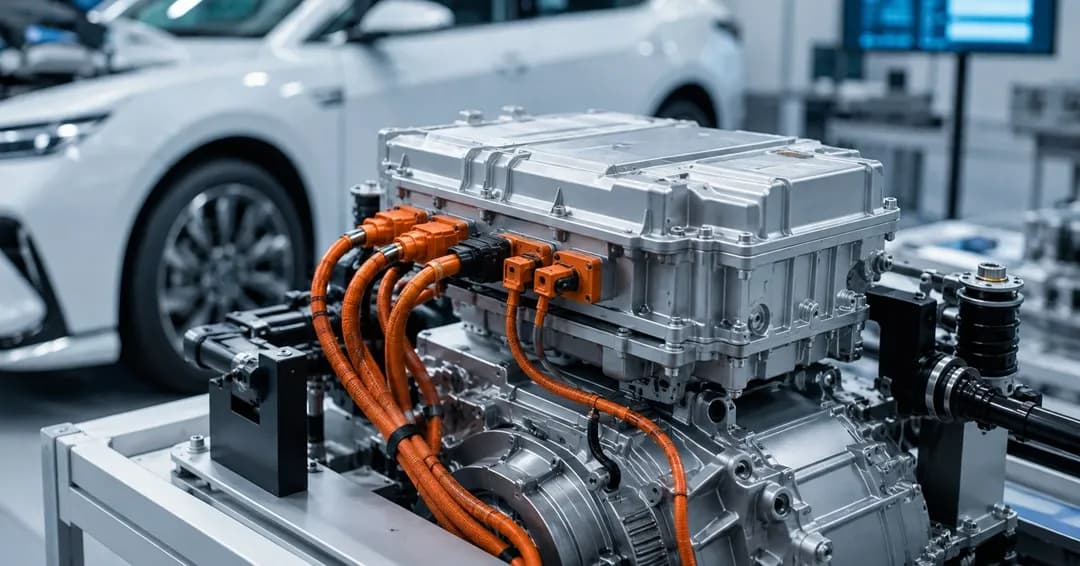
India’s EV industry is entering a deeper localisation phase, with motor controllers emerging as a strategic opportunity for domestic engineering and manufacturing. Rising electric two- and three-wheeler volumes, government incentives, semiconductor initiatives, and local supplier capabilities are supporting controller development. The next priority is shifting from assembly toward hardware, software, integration, and power-electronics localisation.
India’s electric vehicle industry is moving into a more demanding phase of localisation. The first stage of the transition was largely about putting electric vehicles on the road, building battery-pack capacity, establishing assembly lines, and developing enough domestic supply to make EV production commercially viable. The next stage is less visible but arguably more important for industrial competitiveness: increasing the amount of technology, engineering, electronics, and intellectual property that is created inside the country.
Motor controllers sit directly in the middle of this transition. They are not as prominent as batteries or electric motors, but they influence how effectively those components work together. A controller manages the electrical power delivered to the motor, regulates torque, supports regenerative braking, monitors operating conditions, and communicates with other electronic systems in the vehicle. Its hardware, embedded software, calibration, thermal management, and protection functions all contribute to vehicle performance.
The timing is favourable for India. The country remained the second-largest electric two-wheeler market in the world in 2025, with electric two-wheeler sales less than 1.3 million units, while electric three-wheeler sales rose by 15% to almost 800,000 units. India also remained the world's largest electric three-wheeler market, with more than two-thirds of new three-wheelers sold in 2025 being electric.
These volumes matter because motor-controller manufacturing is not an attractive business if suppliers cannot achieve scale. Engineering teams need to invest in electronic design, software, testing, validation, tooling, production equipment, and technical support before large production revenues begin. India's growing EV volumes provide a sufficiently large domestic market to justify those investments, particularly in two- and three-wheelers.
Government policy is reinforcing the opportunity. The Production Linked Incentive scheme for automobiles and auto components has a budgetary outlay of Rs. 25,938 crore for FY2022-23 to FY2026-27 and specifically targets Advanced Automotive Technology products, deep localisation, and domestic as well as global supply chains. The India Semiconductor Mission is simultaneously working to establish a stronger semiconductor and electronics manufacturing and design ecosystem in India.
The result is a potentially important shift. India is moving from the question of whether it can manufacture electric vehicles toward the more commercially significant question of how much of the technology inside those vehicles can be designed, manufactured, tested, and improved domestically.
The Motor Controller Is Becoming a Strategic Part of the EV Powertrain
A motor controller is essentially the electronic interface between the battery and the electric motor, but describing it only in those terms understates its importance. The controller determines how electrical energy is converted into motor behaviour, which means it directly affects acceleration, torque delivery, efficiency, regenerative braking, thermal performance, and fault response.
The hardware typically combines power-switching devices, gate drivers, sensors, microcontrollers, communication interfaces, protection circuits, and thermal-management provisions. The software layered on top of that hardware determines how the system behaves under different loads and operating conditions. This combination makes the controller both an electronic component and a control system.
That distinction matters for Indian EV manufacturers because vehicle requirements vary significantly. A commuter electric scooter does not place the same demands on its controller as a high-utilisation delivery scooter. A passenger three-wheeler operating throughout the day has different thermal and torque requirements from a private-use vehicle. A cargo three-wheeler carrying heavy loads can place sustained demands on the motor and controller that would rarely occur during short urban trips.
Local engineering can respond to those differences more effectively when the controller supplier works closely with the vehicle manufacturer. Firmware can be calibrated around specific motor characteristics, battery voltage ranges, payload patterns, regenerative-braking preferences, and thermal conditions. Field data can also be fed back into subsequent software releases or hardware revisions without requiring the entire engineering process to move through an overseas supplier.
This is where domestic manufacturing begins to offer something more valuable than import substitution. A local supplier can potentially become a technology partner to the OEM.
India's EV Volumes Are Creating the Scale Required for Local Controllers
The economics of motor-controller manufacturing depend heavily on production volumes. Designing one controller for a limited production run can be expensive because engineering, testing, tooling, and certification costs are spread over relatively few units. As volumes rise, the same architecture can be used across multiple vehicle programmes, bringing down the average engineering and manufacturing cost.
India's two- and three-wheeler markets are particularly attractive for this reason. The IEA reported that electric two-wheeler sales in India grew 5% in 2025 to less than 1.3 million units, while electric three-wheeler sales increased 15% to almost 800,000 units. The combination of large unit volumes and relatively compact powertrain architectures creates a useful entry point for domestic power-electronics suppliers.
The three-wheeler market is especially important because electrification has moved well beyond the experimental stage. Electric three-wheelers accounted for more than two-thirds of India's new three-wheeler sales in 2025, according to the IEA. For component suppliers, that creates an increasingly predictable pool of demand.
The localisation process will not happen all at once. India can capture progressively more value as domestic engineering capabilities improve and upstream electronics manufacturing becomes more sophisticated.
Localisation stage | Capabilities developed in India | Strategic benefit for EV manufacturers | Principal dependency that remains |
Domestic controller manufacturing | PCB assembly, enclosure production, wiring, thermal interfaces, end-of-line testing, and production quality control | Shorter logistics chains, greater production flexibility, and faster service response | Imported semiconductors and specialised electronic components |
Controller hardware development | PCB architecture, sensing circuits, gate-drive design, power-stage integration, and mechanical packaging | Greater vehicle-specific customisation and increased domestic engineering content | Advanced power devices, selected sensors, and specialised materials |
Embedded software development | Firmware, motor-control algorithms, diagnostics, communication protocols, and calibration | Better drivability, energy efficiency, fault management, and faster application-specific development | Specialist talent and extensive software validation |
Motor-controller integration | Joint optimisation of motor characteristics, controller parameters, battery behaviour, and thermal performance | Better drivetrain efficiency, packaging, and vehicle performance | Advanced testing infrastructure and OEM qualification |
Power-electronics localisation | Domestic power-module assembly, semiconductor packaging, testing, and selected device manufacturing | Lower exposure to imported critical components and stronger supply-chain resilience | Semiconductor process technology and certain upstream materials |
Export-oriented platform development | International validation, modular architectures, certification, and multi-market calibration | Larger addressable market and potential export revenue | Global certification, overseas customer relationships, and international cost competitiveness |
The practical implication is that India does not have to wait for complete semiconductor self-sufficiency before developing a strong domestic controller industry. Local design, firmware, assembly, validation, calibration, and customer support can create substantial value while upstream semiconductor capabilities develop in parallel.
Make in India Is Expanding From Vehicle Manufacturing Into Automotive Electronics
The PLI-Auto scheme is significant because it recognises that India's automotive competitiveness depends on advanced component manufacturing rather than vehicle assembly alone. The Ministry of Heavy Industries states that the programme is intended to boost manufacturing of Advanced Automotive Technology products and facilitate deep localisation while creating domestic and global supply chains.
That objective aligns closely with motor controllers. The component is simultaneously part of the automotive supply chain, the electronics industry, and the power-electronics ecosystem. Investment in local controller manufacturing therefore has implications beyond the controller itself.
A domestic controller factory creates demand for PCB manufacturing, surface-mount technology, electronic testing, connectors, busbars, thermal materials, enclosures, embedded software, calibration services, and specialised engineering. As production volumes increase, suppliers of those supporting products gain a stronger commercial reason to invest locally.
The government data indicates that localisation under the PLI-Auto framework is progressing. As of March 31, 2026, approved applicants had reported ?44,326 crore in investment and ?52,414 crore in incremental sales over the FY2019-20 base, while 67,820 jobs had been generated. As of July 16, 2026, 18 applicants had received Domestic Value Addition certificates covering 154 products or variants.
These figures show that the policy framework is translating into investment, sales and measurable domestic value addition, but they do not establish deep localisation across every EV component.
The more important test over the longer term will be whether these investments survive beyond the incentive period because the underlying products are commercially competitive.
Domestic Suppliers Are Moving Beyond the Imported Controller Model
The emergence of Indian suppliers with dedicated EV power-electronics capabilities is an important development because it indicates that the market is progressing beyond final assembly.
Anevolve Mando eMobility is one example. The joint venture between ANAND Group and Mando Corporation was established in July 2021 to address the electrification of two- and three-wheeler powertrains. The company says it designs, develops, and manufactures traction motors and controllers for the electric two- and three-wheeler market, with an emphasis on locally manufactured alternatives to imported components. Production started in October 2021, nine months after the JV was established.
Tata AutoComp has developed another model through TACO EV Component Solutions. Its electronics division was established in November 2022 and manufactures automotive electronics and EV components, including motor controllers, battery-management systems, battery disconnect units, chargers, and PCB assemblies. The company operates in-house electronic manufacturing capabilities covering PCB production, SMT, and final assembly and testing.
This broader portfolio is strategically relevant because the EV powertrain is becoming increasingly integrated. A supplier that understands only one component may eventually find it difficult to capture the higher-value opportunities emerging around complete electronic architectures.
Tata AutoComp's published capabilities include advanced PCB assembly, automated optical inspection, in-circuit testing, functional circuit testing, and manufacturing defect analysis. Its technology portfolio also describes motor-controller capabilities involving thermal, voltage, and polarity protection, CAN and LIN communication, field-oriented control, field weakening, and ASPICE Level 3 compliance.
These capabilities illustrate how the competitive definition of a motor-controller manufacturer is changing. The supplier is expected to contribute to electronic design, embedded software, validation, manufacturing quality, and vehicle integration rather than simply producing a metal enclosure containing imported electronics.
The Most Important Localisation Question Is What Happens Inside the Controller
A controller can be manufactured in India without being deeply localised. The PCB can be assembled domestically while the underlying design, firmware, power module, and critical electronic components remain imported.
That distinction matters when evaluating the industrial impact of Make in India. The first level of localisation is manufacturing. Domestic assembly can reduce logistics exposure and create production employment. The second level is engineering, where Indian companies develop the PCB architecture, mechanical design, thermal strategy, and electrical interfaces. The third level is software, where firmware, control algorithms, diagnostics, and calibration are developed domestically. The fourth level is upstream power electronics, where companies begin producing or packaging critical power devices and modules.
Each level captures more value. The power stage is particularly important because the semiconductor devices determine how efficiently and reliably the controller switches electrical power. Silicon MOSFETs remain common in many lower-voltage applications, while IGBTs and silicon-carbide devices become increasingly relevant as power and efficiency requirements rise.
India will continue to import many of these components for the foreseeable future. That is not necessarily a problem. Complete vertical integration into semiconductor manufacturing would be economically difficult and technologically unnecessary for every controller supplier.
The more sensible objective is supplier diversification and increasing domestic control over the parts of the value chain that offer the greatest strategic benefit. If an Indian company owns the controller architecture, firmware, calibration, manufacturing process, testing system, and customer relationship, it retains meaningful technological control even if a power semiconductor is sourced internationally.
The Semiconductor Ecosystem Will Determine How Deep Localisation Can Become
India's semiconductor strategy is increasingly relevant to EV power electronics because motor controllers depend on semiconductor devices at their core. The India Semiconductor Mission states that its vision is to establish a vibrant semiconductor and display ecosystem that can position India as a global hub for electronics manufacturing and design. In July 2026, the Union Cabinet approved Semicon 2.0 with a ?1,27,500 crore outlay to extend support for semiconductor design, manufacturing, equipment, materials and supply-chain capabilities.
The programme includes support for semiconductor fabs, display fabs, compound semiconductor facilities, silicon-photonics and sensor facilities, discrete semiconductor fabs, and semiconductor packaging and assembly operations. It also includes a Design Linked Incentive programme intended to support semiconductor design across areas such as integrated circuits, chipsets, systems-on-chip, and related intellectual property.
For the motor-controller industry, the development of packaging and power-device capabilities may be particularly important. A controller manufacturer does not necessarily need to own a semiconductor fabrication facility, but access to reliable domestic power modules, packaging, testing, and specialised semiconductor components could reduce supply-chain risk and shorten development cycles. By July 2026, 12 semiconductor projects had been approved under the programme, with three already in commercial production.
The longer-term opportunity is even more interesting. If domestic semiconductor companies develop products around Indian EV requirements, controller manufacturers could collaborate directly with them on power-stage optimisation. That would create a closer connection between semiconductor design and vehicle-level requirements. Such integration would be difficult to achieve if the entire controller is imported as a finished unit.
Software Could Become the Most Defensible Part of the Local Controller Business
Hardware is tangible, but software may become the more durable source of competitive advantage.
The controller's firmware determines how the vehicle behaves under acceleration, deceleration, regenerative braking, high temperature, low battery conditions, and fault scenarios. It also controls communication with other systems and can influence how efficiently the available battery energy is converted into useful motion.
This creates significant room for differentiation. Two controllers can use similar semiconductor devices and have broadly similar electrical ratings while producing different vehicle behaviour because of differences in control algorithms and calibration. One may prioritise smooth acceleration, another may prioritise maximum efficiency, while a third may be tuned for high-load commercial operation.
India's diverse vehicle market allows local suppliers to develop those application-specific strategies. A delivery scooter, for example, may spend much of its operating day accelerating and decelerating in congested urban areas. Its controller needs to manage repeated power transitions without excessive heat generation. A cargo three-wheeler may spend long periods operating near its rated load, making thermal protection and torque management more important. A passenger vehicle may place greater emphasis on refinement and predictable regenerative braking.
Domestic engineering teams can develop these control strategies in close cooperation with OEMs and use field data to improve them over time. This can turn the controller into an important source of intellectual property rather than a commodity part.
Two- and Three-Wheelers Will Remain the Main Entry Point for Domestic Controller Suppliers
India's two- and three-wheeler markets offer a combination of scale, electrification, cost sensitivity, and relatively compact powertrain architecture that is difficult to replicate in other vehicle categories.
The IEA estimates that electric two-wheelers represented around 6% of India's two-wheeler sales in 2025, with the country remaining the world's second-largest electric two-wheeler market. Electric three-wheeler sales approached 800,000 units and represented more than two-thirds of the country's three-wheeler market.
The three-wheeler segment is especially attractive for suppliers because the vehicle is often a commercial asset rather than a discretionary consumer purchase. Operators care about energy costs, uptime, reliability, serviceability, and total cost of ownership. A controller that improves efficiency or reduces downtime can therefore generate a measurable financial benefit.
The two-wheeler market is more price-sensitive, which creates a different challenge. Suppliers need to reduce component cost while maintaining reliability, particularly because controller failure can leave the entire vehicle unusable.
These markets also provide an ideal environment for suppliers to develop manufacturing discipline. High production volumes allow companies to automate PCB assembly, improve end-of-line testing, gather field data, and refine manufacturing processes before moving into more complex passenger and commercial vehicle applications.
Platform Reuse Will Be Critical to Controlling Costs
India's EV industry has another characteristic that could complicate controller localisation: fragmentation.
Different OEMs can use different motor technologies, battery voltages, communication protocols, connectors, packaging arrangements, and control strategies. A controller supplier that develops a completely new product for every customer may win contracts but struggle to reach the scale necessary for competitive pricing. The better approach is likely to be modular platform development.
A supplier can maintain a common hardware architecture while adapting software, communication interfaces, thermal provisions, and calibration for individual vehicles. This allows the OEM to retain product differentiation without forcing the supplier to redesign the entire controller.
Controller development model | OEM advantage | Supplier advantage | Principal commercial limitation |
Fully customised controller | Maximum optimisation for a particular motor, battery, and vehicle | Strong customer integration and application-specific engineering revenue | High engineering cost, longer development cycles, and limited reuse |
Common hardware with software variants | Different driving characteristics can be achieved without redesigning the complete power stage | Hardware, tooling, and production investments can be spread across several programmes | Requires strong software architecture and disciplined validation |
Modular controller platform | Balances OEM differentiation with a reusable electronic architecture | Higher volumes, shorter development cycles, and improved manufacturing efficiency | Requires substantial upfront platform engineering |
Integrated motor-controller system | Allows motor and controller to be optimised as a single drivetrain | Creates a higher-value system-level product and stronger OEM relationship | Greater testing, calibration, and engineering responsibility |
Multi-market platform | Provides flexibility for adapting the same architecture to different vehicle markets | Creates export opportunities and larger potential production volumes | Requires international certification, validation, and customer support |
Platform development also improves engineering efficiency. Once a supplier has accumulated field experience with a particular processor, power stage, communication architecture, and software framework, improvements can be incorporated into multiple products.
That cumulative learning effect can become an important barrier to entry.
Reliability Will Become More Important as Local Suppliers Scale
The early phase of EV manufacturing can tolerate a certain amount of experimentation because production volumes are relatively limited and vehicle architectures are still evolving. That tolerance decreases as EVs become mainstream.
Motor controllers have to withstand vibration, moisture, high temperatures, electrical transients, repeated load cycles, and manufacturing variation. They also need predictable fault behaviour when sensors malfunction, communication is interrupted, or battery conditions move outside expected limits. This makes validation infrastructure a strategic asset.
Suppliers need thermal testing, electromagnetic compatibility testing, hardware-in-the-loop systems, environmental testing, software validation, automated production inspection, and end-of-line functional testing. These investments can be expensive, but they become more economical as production volumes increase.
Tata AutoComp's electronics business illustrates the direction of the industry. Its manufacturing infrastructure includes SMT production and testing capabilities involving automated optical inspection, in-circuit testing, functional circuit testing, and manufacturing defect analysis.
This level of manufacturing discipline will increasingly become necessary for Indian suppliers seeking contracts with established vehicle manufacturers.
The commercial consequences of failure are also significant. A controller problem can disable an otherwise functional vehicle, potentially creating warranty costs, service campaigns, lost customer confidence, and production delays. OEMs therefore have a strong incentive to select suppliers based on quality and engineering depth rather than price alone.
Localisation Can Reduce More Than the Cost of Imported Components
The conventional argument for localisation focuses on import substitution. There is another economic benefit that deserves greater attention: supply-chain responsiveness.
An imported controller may involve long procurement cycles, international logistics, foreign-exchange exposure, and dependence on an overseas engineering team. When a problem emerges in the field, the vehicle manufacturer may need to coordinate technical analysis across multiple time zones and supply-chain organisations.
A domestic supplier can potentially shorten that response cycle. The OEM can work directly with the controller engineering team, production engineers, software developers, and quality organisation. Firmware changes can be evaluated locally. Hardware modifications can be prototyped closer to the vehicle plant. Replacement components can be produced within the domestic supply chain.
For commercial electric vehicles, this can affect total cost of ownership. A three-wheeler or delivery vehicle that remains idle because a replacement controller is unavailable can cost an operator more than the original price difference between an imported and locally manufactured component. Localisation therefore has a resilience value that cannot be captured by comparing component prices alone.
Higher-Voltage Vehicles Will Push Indian Suppliers Toward More Advanced Controllers
The two- and three-wheeler market provides the volume base, but the longer-term opportunity extends into higher-voltage passenger and commercial vehicles.
As vehicle power requirements increase, controller design becomes more demanding. Higher-voltage architectures require more sophisticated insulation, protection, sensing, switching, thermal management, and electromagnetic compatibility engineering. Silicon-carbide power devices become more attractive in applications where efficiency gains and higher switching performance justify their cost.
Indian suppliers that want to remain relevant as the market develops will need to move beyond low-voltage architectures.
The industry is already beginning to see this transition at the broader drivetrain level. Tata AutoComp's TACO Prestolite Electric business describes integrated electric drivetrains that combine motor, controller, gearbox, DC-DC, onboard charger, and power-distribution functions, with systems covering 200 V to 800 V platforms and outputs from 30 kW to 220 kW.
That type of integration points toward the next phase of EV electronics. Instead of treating the controller as a standalone box, suppliers can increasingly combine it with other power-electronics functions to reduce wiring, packaging, weight, and system complexity.
The commercial advantage is potentially substantial because an integrated drivetrain gives the supplier a larger share of the vehicle's electronic value and creates deeper technical dependence between the supplier and OEM.
Export Markets Could Provide the Next Stage of Scale
India's domestic market is large enough to establish a controller industry, but international demand could determine whether Indian suppliers become globally competitive.
Many emerging markets have large two- and three-wheeler fleets and are exploring electric mobility as a way to reduce fuel costs and urban emissions. India's experience with affordable electric two- and three-wheelers gives domestic suppliers a useful engineering base for entering these markets.
The opportunity is particularly relevant where operating conditions resemble India, including high temperatures, congested urban environments, variable road conditions, and strong demand for cost-effective mobility.
Export success will nevertheless require more than low manufacturing costs. International OEMs will expect robust quality systems, documented validation, traceability, software maturity, electromagnetic compatibility performance, environmental testing, and reliable technical support.
The companies that make those investments can potentially move beyond exporting individual controllers. They could supply complete motor-controller platforms, integrated powertrains, firmware, calibration services, and application engineering.
That would create considerably more value than simply exporting an assembled electronic component.
The Biggest Risk Is Confusing Local Assembly With Technological Localisation
The Indian EV industry should be careful about how it measures localisation.
A controller assembled in an Indian factory is not automatically a domestically developed technology. If its architecture, firmware, power module, processor, and critical electronics are all imported, the manufacturing value captured domestically may be meaningful but the technological value remains limited.
That does not make local assembly unimportant. Manufacturing experience is a necessary foundation for deeper localisation. The concern arises only when assembly becomes the final destination rather than the first stage.
A stronger localisation model would progressively increase domestic responsibility for product design, software, calibration, testing, manufacturing engineering, supply-chain management, and eventually selected upstream electronic components.
This approach is more likely to survive changes in government incentives because the supplier's competitiveness comes from its capabilities rather than solely from a policy benefit.
The PLI-Auto programme itself is designed around advanced automotive technology and deep localisation rather than basic assembly. The commercial challenge for Indian companies is to convert that policy support into products that remain competitive once incentive-driven economics become less important.
What Investors and OEMs Should Watch in the Next Phase
The most useful indicators of India's motor-controller industry will not necessarily be headline production numbers. Several less visible developments will provide a better indication of whether the sector is becoming technologically mature.
One is the number of controller platforms developed and engineered domestically rather than merely assembled in India. Another is the proportion of firmware and calibration work performed by Indian engineering teams. Growth in high-voltage controller programmes would indicate that suppliers are moving beyond entry-level applications. Investment in domestic power-module packaging and testing would demonstrate progress deeper into the electronics value chain.
OEM relationships will also be important. A supplier that wins repeat programmes from major manufacturers has a much stronger position than one dependent on occasional low-volume orders.
Export contracts would provide another important signal because international customers impose a higher level of validation and quality discipline. A successful export programme would indicate that an Indian supplier's controller technology is competitive beyond the domestic market.
These factors collectively provide a more meaningful picture of industry development than domestic-content percentages alone.
Make in India Can Create a Broader EV Electronics Industry
The motor-controller opportunity should ultimately be viewed as part of a wider industrial ecosystem. A successful controller manufacturer requires PCB suppliers, electronic assembly companies, sensor suppliers, semiconductor distributors, power-module manufacturers, thermal-management specialists, software engineers, testing laboratories, connector manufacturers, tooling companies, and automotive validation organisations. As demand expands, these companies can develop capabilities that are useful beyond EVs.
Power-electronics expertise can support industrial drives, renewable-energy systems, energy storage, charging infrastructure, automation equipment, and other applications. Embedded software capabilities can serve multiple automotive and industrial markets. Semiconductor packaging and testing infrastructure can support electronics sectors beyond mobility. This is why motor controllers can have an economic significance disproportionate to their individual component value. They provide an entry point into a wider technology ecosystem.
India Has the Volume Advantage, but It Must Build the Technology Advantage
India has already established an important advantage through market scale. The country is one of the world's largest markets for electric two- and three-wheelers, and those segments are becoming increasingly electrified. The IEA's 2026 analysis identifies India as the second-largest electric two-wheeler market and the world's largest electric three-wheeler market.
That scale creates the foundation for domestic controller manufacturing. Government policy adds another layer of support. As of March 31, 2026, PLI-Auto applicants had reported ?44,326 crore in investment, ?52,414 crore in incremental sales and 67,820 jobs, against the scheme's ?25,938 crore outlay. The India Semiconductor Mission is developing the broader electronics and semiconductor ecosystem required to support more sophisticated power-electronics production.
Domestic suppliers are already demonstrating how the opportunity can develop. Anevolve Mando eMobility is focused on locally manufactured traction motors and controllers for electric two- and three-wheelers, while Tata AutoComp has built an electronics-oriented EV component business covering motor controllers, battery systems, chargers, PCB assemblies, and related power-electronics products.
The next challenge is to move from production capability toward technology ownership. India does not need to manufacture every semiconductor domestically to achieve that objective. It does need companies capable of designing controller architectures, developing firmware, performing vehicle calibration, validating complete systems, building reliable manufacturing processes, and managing multiple upstream suppliers. The industry's strongest competitive advantage may eventually come from the combination of these capabilities rather than from any single component.
The Next Five Years Could Reshape the Domestic Controller Supply Chain
The coming years are likely to bring greater interaction between EV OEMs, electronics manufacturers, motor suppliers, battery companies, semiconductor businesses, and software developers. The boundaries between these categories will become less rigid as electric powertrains become more integrated.
For controller suppliers, the opportunity is to move upward from component manufacturing toward system engineering.
The first step is likely to remain concentrated in two- and three-wheelers because those markets offer the volumes required to build manufacturing scale. The second step will involve greater use of domestic firmware and application-specific control strategies. The third will involve higher-power and higher-voltage platforms, integrated motor-controller systems, and more sophisticated thermal and protection architectures.
The semiconductor ecosystem will develop in parallel, although India will continue to rely on international supply chains for several critical components.
The most successful suppliers will probably be those that understand this progression and invest accordingly rather than treating today's controller requirements as the final market opportunity.
Conclusion: The Real Opportunity Is to Build Indian EV Power-Electronics Capability
The rise of local motor-controller manufacturing represents a more important industrial development than the component's relatively small physical size might suggest. The controller connects battery energy, motor performance, vehicle software, thermal management, regenerative braking, protection systems, and driver behaviour. Developing the capability to design and manufacture it domestically therefore creates expertise across several areas of advanced automotive technology.
India now has the market scale to support that development. Electric two-wheeler sales approached 1.3 million units in 2025, while electric three-wheeler sales reached almost 800,000 units, according to the IEA. Government programmes are encouraging deeper localisation, with PLI-Auto specifically targeting Advanced Automotive Technology products and domestic supply chains. By March 31, 2026, the PLI-Auto scheme had recorded ?44,326 crore in investment and ?52,414 crore in incremental sales, while 18 applicants had received DVA certificates covering 154 products or variants by July 16, 2026. At the same time, the India Semiconductor Mission is building an ecosystem intended to strengthen electronics manufacturing and semiconductor design within the country.
The opportunity should nevertheless be approached with realistic expectations. India will remain dependent on international suppliers for several semiconductor devices and specialised electronic components for years. Domestic companies will also face substantial costs associated with testing, validation, software development, OEM qualification, and manufacturing automation.
Those constraints do not undermine the localisation case. They define the sequence in which the industry needs to develop.
The most credible path begins with domestic assembly and manufacturing, progresses into hardware engineering and embedded software, expands into motor-controller integration, and eventually reaches deeper power-electronics localisation. Modular product architectures can help suppliers achieve scale while still allowing OEMs to differentiate their vehicles. High-quality validation and field support can turn local proximity into a genuine competitive advantage. Export programmes can then provide the additional volume required to make Indian controller platforms globally competitive.
The distinction between assembly and engineering will remain critical throughout this process. A domestically assembled imported controller can support manufacturing localisation, but an Indian-designed and calibrated controller supported by domestic validation, software, manufacturing, and increasingly localised power electronics creates far greater strategic value.
That is the real significance of Make in India for EV motor controllers. The objective is not merely to replace an imported box with an Indian-made box. It is to use India's rapidly expanding electric mobility market as a platform for developing domestic expertise in power electronics, embedded software, automotive controls, semiconductor packaging, testing, and integrated drivetrain engineering.
If Indian suppliers can make that transition successfully, motor controllers could become one of the clearest examples of how the country's EV boom can evolve into a deeper manufacturing and technology opportunity. The consumer may never see the controller, but the engineering capability built around it could influence the competitiveness of India's entire electric-mobility ecosystem for years to come.
Have questions?
More Thought Articles
From Data Centers to EV Charging: Where Low-Voltage DC Distribution Is Making an Impact
Low-voltage DC distribution is gaining relevance as AI data centers, EV charging hubs, solar systems, and battery storage increase demand for efficient power architectures. The article examines 800 VDC standardization, conversion losses, protection challenges, and greenfield opportunities, highlighting why hybrid AC/DC systems could become increasingly important across high-power infrastructure applications.
How EV Charger Manufacturers Can Capitalize on India’s Home Charging Revolution
India’s residential EV charging opportunity is expanding as policy support, EV adoption, and private parking infrastructure develop. Manufacturers can capture value beyond AC chargers through installation, smart charging, load management, solar integration, software, and after-sales services. Housing societies, automakers, and property developers offer scalable routes to residential charging customers.
Second-Life EV Battery Market in India: What Is Driving Demand from Manufacturers?
India’s second-life EV battery market is gaining relevance as electric vehicle adoption expands and batteries retain useful capacity after automotive service. Growing stationary-storage demand, battery data, refurbishment capabilities, EPR obligations, and critical-mineral policies are encouraging manufacturers to extend battery value through reuse before eventual recycling within India’s emerging circular battery ecosystem.