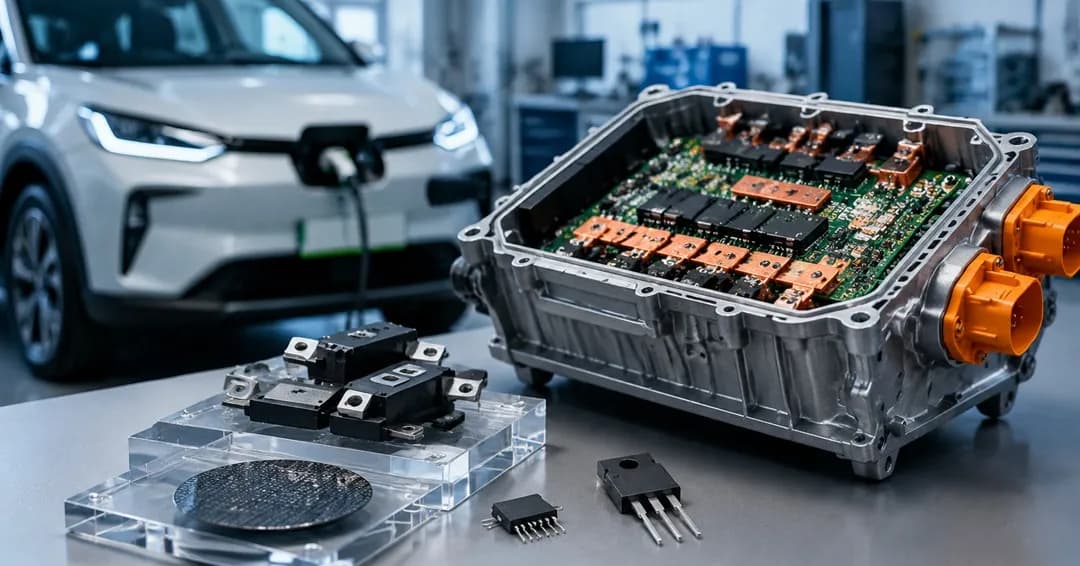
Silicon Carbide (SiC) and Gallium Nitride (GaN) are transforming India's EV motor controllers by improving power efficiency, thermal management, and power density. As EV production and semiconductor localisation expand, these wide-bandgap technologies are enabling advanced vehicle architectures, supporting faster charging, and strengthening India's automotive electronics ecosystem for long-term competitiveness.
India's electric vehicle (EV) market has reached a stage where incremental improvements are no longer sufficient to support the industry's next phase of growth. As vehicle manufacturers strive to improve driving range, reduce charging time, increase power density and lower system costs, attention has gradually shifted from batteries alone to the electronics that govern how efficiently energy is converted into motion. Among these, the motor controller has emerged as one of the most strategically important components.
For years, conventional silicon-based power electronics formed the backbone of EV motor controllers across two-wheelers, passenger vehicles and commercial fleets. Their reliability, manufacturing maturity and cost-effectiveness made them the default choice for most manufacturers. However, as Indian OEMs pursue higher efficiency, higher power density, and compatibility with emerging 800V vehicle platforms, silicon is increasingly approaching its practical performance limits.
This transition has opened the door for wide-bandgap semiconductors, particularly Silicon Carbide (SiC) and Gallium Nitride (GaN). Both technologies are enabling more efficient power conversion, improved thermal performance and more compact power electronic systems. Although SiC and GaN have existed in industrial applications for years, their growing adoption in electric mobility is creating new opportunities across India's automotive electronics ecosystem.
The discussion surrounding these technologies often focuses on efficiency improvements, but their influence extends much further. They affect thermal management strategies, controller size, battery utilisation, manufacturing economics, supply chain localisation and future vehicle architectures. Consequently, decisions regarding SiC and GaN are no longer confined to semiconductor engineers; they have become strategic considerations for OEMs, Tier-1 suppliers, semiconductor manufacturers and policymakers.
India presents a particularly interesting case. Unlike mature automotive markets that must gradually replace an established internal combustion ecosystem, India is simultaneously expanding EV production while building domestic electronics manufacturing capabilities. Government initiatives supporting semiconductor manufacturing and electronics localisation are also strengthening the ecosystem for advanced automotive power electronics. This creates a unique opportunity to adopt next-generation semiconductor technologies without carrying decades of legacy manufacturing constraints.
Why Motor Controllers Have Become Central to EV Performance
Most discussions about electric vehicles revolve around batteries, yet the motor controller is the component that determines how effectively stored electrical energy reaches the motor.
A motor controller performs several critical functions:
Controls motor speed
Regulates torque delivery
Converts DC battery power into AC motor power
Protects electrical systems
Optimises regenerative braking
Balances thermal performance
Every switching event inside the controller produces heat and electrical losses. When millions of switching cycles occur during normal driving, even modest efficiency improvements translate into measurable gains in vehicle range, energy efficiency and component reliability.
Traditional silicon insulated-gate bipolar transistors (IGBTs) have served this purpose effectively for decades. However, higher switching frequencies inevitably increase switching losses and heat generation. Wide-bandgap semiconductor devices, including SiC MOSFETs and GaN high-electron-mobility transistors (HEMTs), can switch faster while reducing conduction and switching losses under appropriate operating conditions.
Instead of merely replacing one semiconductor with another, manufacturers are redesigning the entire controller architecture around the capabilities of SiC and GaN.
Understanding Why Wide-Bandgap Semiconductors Matter
Wide-bandgap materials possess electrical characteristics that allow them to operate at significantly higher voltages, temperatures and switching frequencies than conventional silicon devices.
The immediate advantages include:
Performance Parameter | Conventional Silicon | Silicon Carbide (SiC) | Gallium Nitride (GaN) |
Switching Speed | Moderate | Very High | Extremely High |
Thermal Performance | Moderate | Excellent | Very Good |
High Voltage Capability | Good | Excellent | Moderate to High** |
Energy Loss | Higher | Low | Very Low** |
Cooling Requirement | High | Reduced | Reduced |
Power Density | Moderate | High | Very High |
The exact performance of GaN devices depends on device design, operating voltage and application. While GaN offers exceptionally fast switching and low switching losses, commercial automotive traction applications currently remain more limited than those of SiC.
These improvements influence nearly every aspect of EV controller design.
Rather than increasing battery capacity to improve range, manufacturers can often achieve meaningful efficiency gains by reducing power conversion losses. That approach can be more economical than adding larger battery packs, especially as battery materials remain among the costliest elements of electric vehicles.
Silicon Carbide Is Becoming the Preferred Choice for High-Power EVs
Among wide-bandgap technologies, Silicon Carbide has gained stronger commercial momentum within the automotive industry, particularly in high-voltage traction inverters for passenger cars, buses, and commercial vehicles.
SiC devices tolerate much higher operating voltages while maintaining excellent efficiency. This makes them particularly suitable for:
Passenger EVs
Electric SUVs
Electric buses
Commercial trucks
Premium electric vehicles
Higher voltage capability also supports emerging 800V electrical architectures, allowing vehicles to charge more quickly while reducing cable thickness, electrical losses and overall system weight.
Indian manufacturers aiming to compete globally increasingly view SiC as an investment in long-term competitiveness rather than simply a premium component. Several international automotive manufacturers have adopted SiC-based traction inverters in production EVs to improve drivetrain efficiency, extend driving range and support ultra-fast charging architectures.
Several global OEMs have already demonstrated measurable efficiency improvements after shifting from silicon IGBTs to SiC MOSFET-based inverters. Those results are encouraging Indian engineering teams to accelerate similar development programmes.
GaN Is Finding Opportunities Beyond Traditional High-Power Applications
While Silicon Carbide dominates traction inverter discussions, Gallium Nitride (GaN) is developing its own market niche. GaN devices are particularly well suited to applications requiring high switching frequencies, compact designs and improved power density. Although SiC currently leads in high-voltage traction systems, GaN is gaining attention in auxiliary power electronics and lower-voltage EV applications.
Potential applications include:
Low-voltage electric vehicles
Electric scooters
E-bikes
On-board chargers (OBCs)
DC-DC converters
Auxiliary power electronics
GaN transistors switch considerably faster than SiC devices, enabling smaller passive components and highly compact power electronic designs. This characteristic aligns particularly well with India's two-wheeler EV segment, where packaging space and weight remain significant engineering constraints. Commercial automotive GaN devices are presently used more extensively in onboard chargers, DC-DC converters and auxiliary systems than in high-voltage traction inverters. Although GaN currently supports lower operating voltages than SiC in most commercial automotive applications, ongoing advances in device architecture and manufacturing continue to expand its capabilities. Rather than replacing SiC, GaN is expected to complement it across different vehicle categories.
India's EV Industry Is Creating an Ideal Environment for Semiconductor Innovation
India's EV ecosystem differs significantly from those in Europe, Japan, and North America.
The domestic market includes:
High-volume electric scooters
Three-wheelers
Fleet mobility
Commercial delivery vehicles
Emerging passenger EVs
Electric buses
Each category has different controller requirements. Unlike countries where passenger cars dominate EV adoption, India's diverse vehicle mix creates multiple commercial opportunities for both SiC and GaN technologies. This diversity encourages semiconductor manufacturers to develop application-specific products rather than a single universal solution. It also accelerates controller innovation because engineers can optimise designs across different voltage platforms, vehicle classes and duty cycles.
Government initiatives, including the India Semiconductor Mission, the Modified Programme for Semiconductors and Display Manufacturing Ecosystem, and production-linked incentive (PLI) schemes for automobiles and advanced chemistry cell (ACC) batteries, are supporting broader investments in semiconductor manufacturing, electronics and EV supply chains. While these initiatives are not specific to SiC or GaN devices, they contribute to the long-term development of India's automotive electronics ecosystem.
Local Manufacturing Is Gradually Moving Up the Value Chain
India has traditionally depended on imported power semiconductors. However, policy support for electronics manufacturing, automotive localisation and semiconductor investments is beginning to reshape the supply chain. Several semiconductor packaging, assembly and testing projects have also been announced in recent years, reflecting India's broader ambition to strengthen domestic semiconductor capabilities. Motor controller assembly has already witnessed significant localisation among several Indian EV manufacturers and suppliers.
The next challenge lies in developing domestic expertise across:
Power module packaging
Gate driver integration
Thermal interface materials
Advanced substrates
Reliability testing
Controller software
Wide-bandgap semiconductor adoption naturally encourages higher localisation because these devices require specialised packaging, thermal management and manufacturing expertise.
Instead of importing fully assembled controllers, Indian suppliers increasingly have opportunities to manufacture higher-value assemblies domestically. Developing expertise in power module integration, advanced packaging and reliability qualification will be critical for increasing domestic value addition in next-generation EV power electronics.
Thermal Management Is Becoming a Competitive Advantage
Many discussions around SiC focus primarily on efficiency improvements.
However, improved thermal performance can also reduce cooling requirements, enhance system reliability and increase power density, particularly in demanding operating environments.
Motor controllers generate considerable thermal stress during:
Fast acceleration
Hill climbing
Regenerative braking
High ambient temperatures
India's climate makes thermal performance especially important. Vehicles routinely operate in temperatures exceeding 40°C while navigating congested urban environments. Traditional silicon controllers often require larger cooling systems. SiC devices reduce heat losses sufficiently to allow engineers to redesign cooling architectures and improve overall system efficiency.
The benefits include:
Smaller heat sinks
Lower coolant requirements
Reduced vehicle weight
Higher reliability
Extended component life
Although these improvements may appear incremental individually, together they can contribute to meaningful gains in vehicle efficiency, packaging flexibility and long-term durability.
Controller Miniaturisation Is Becoming an Engineering Priority
Electric vehicle manufacturers increasingly seek integrated powertrain platforms.
Rather than treating the inverter, controller and motor as separate systems, many manufacturers are moving towards integrated electric drive units (e-axles) that combine these components into a more compact assembly.
Wide-bandgap semiconductors facilitate this trend because they support:
Higher switching frequencies
Smaller passive components
Compact cooling systems
Higher power density
As controller dimensions shrink, manufacturers gain greater flexibility in battery placement, thermal management and overall vehicle packaging.
For compact Indian vehicles, where interior space and weight directly influence vehicle design and efficiency, this flexibility offers an important engineering advantage. The combination of compact controllers and integrated electric drive systems is expected to remain a key design trend as India's EV market continues to mature.
Cost Remains the Largest Barrier
Despite their technical advantages, SiC and GaN devices remain more expensive than conventional silicon power semiconductors. Although production capacity has expanded in recent years, wide-bandgap semiconductor manufacturing continues to involve higher material, wafer processing and packaging costs than mature silicon technologies.
Several factors contribute to the higher cost:
Limited production capacity for SiC wafers
Complex manufacturing processes
Higher packaging and module integration costs
Supply chain concentration for critical materials
Automotive qualification and reliability testing expenses
This cost premium remains an important consideration for India's price-sensitive EV market.
However, evaluating semiconductor costs in isolation can be misleading. Smaller cooling systems, improved drivetrain efficiency, lower energy losses and, in some applications, reduced battery capacity requirements can offset part of the higher initial component cost over the vehicle's lifecycle. As manufacturing scales and wafer yields improve, the cost gap between silicon and wide-bandgap devices is expected to narrow, although SiC and GaN are likely to remain premium technologies for many applications in the near term.
Supply Chain Diversification Has Become Strategically Important
Recent semiconductor shortages highlighted the vulnerability of globally concentrated supply chains. Although supply conditions have improved since the peak shortages experienced during 2021–2022, supply chain resilience remains a strategic priority for automotive manufacturers and semiconductor suppliers. Power semiconductor production continues to depend on a relatively small number of manufacturers with expertise in advanced materials and fabrication.
Indian automotive companies are therefore increasingly prioritising:
Supplier diversification
Multi-sourcing strategies
Domestic assembly
Local packaging capabilities
Inventory resilience
Wide-bandgap semiconductor adoption has reinforced these discussions because global production capacity for automotive-grade SiC devices is still expanding to meet rising demand from the electric vehicle industry.
Companies securing long-term semiconductor supply agreements and investing in strategic partnerships may be better positioned to manage future supply constraints while supporting production growth.
Software Is Becoming as Important as Hardware
Modern motor controllers are increasingly software-defined.
Advanced control algorithms continuously optimise:
Torque delivery
Switching frequency
Battery efficiency
Regenerative braking
Thermal balancing
Fault detection
SiC and GaN enable much higher switching frequencies, but fully exploiting those capabilities requires sophisticated control software. Advanced motor control techniques, including field-oriented control (FOC), model-based control and predictive control algorithms, are increasingly being adopted to improve efficiency, drivability and system reliability.
Consequently, India's growing automotive software engineering ecosystem represents an important competitive strength. The country's established expertise in embedded software, electronics design and automotive engineering supports the development of intelligent powertrain control systems alongside advanced semiconductor technologies.
The convergence of semiconductor innovation and embedded software development is expected to strengthen India's role in the global EV value chain, particularly in engineering, design and software development for automotive electronics.
Industry Outlook: Technology Adoption Across Vehicle Segments
Vehicle Category | Preferred Technology Trend | Adoption Outlook |
Electric Two-Wheelers | Advanced Silicon, with increasing use of GaN in auxiliary power electronics | Medium to High |
Electric Three-Wheelers | Advanced Silicon with gradual adoption of GaN and SiC where application requirements justify higher efficiency | Medium |
Passenger EVs | Silicon Carbide | High |
Premium EVs | Silicon Carbide | Very High |
Electric Buses | Silicon Carbide | Very High |
Commercial Electric Trucks | Silicon Carbide | Very High |
While SiC is expected to remain the preferred technology for high-voltage traction inverters, silicon IGBTs and advanced silicon MOSFETs are likely to continue serving cost-sensitive vehicle segments for several years. Technology adoption will depend on vehicle price, performance requirements and total cost of ownership rather than a single semiconductor platform.
Emerging Trends That Will Shape the Next Decade
Several technological developments are expected to influence India's EV motor controller landscape over the coming years.
Integrated power modules (IPMs) are expected to become more widely adopted as manufacturers seek to reduce system complexity, improve reliability and optimise power density. Artificial intelligence-assisted controller calibration and model-based engineering tools are expected to shorten vehicle development cycles by enabling faster software validation and performance optimisation. Digital twin technology is also being adopted across the automotive industry to simulate powertrain behaviour, helping engineers refine controller designs before physical testing.
Meanwhile, advances in semiconductor packaging, including double-sided cooling, silver-sintered die attachment, copper clip interconnections and advanced ceramic substrates, are expected to improve thermal performance, reliability and power density in next-generation power modules.
India's semiconductor ecosystem is also expected to benefit from stronger collaboration between automotive manufacturers, electronics companies, semiconductor firms and academic institutions. Such partnerships will be important for strengthening capabilities in materials science, power electronics, semiconductor packaging and automotive reliability engineering.
Another noteworthy trend is the growing interest in 800V battery architectures, particularly for premium passenger vehicles and commercial EVs. As fast-charging infrastructure expands and more vehicle platforms adopt higher-voltage electrical systems, demand for SiC-based power electronics is expected to increase because of their ability to operate efficiently under high-voltage conditions. However, 400V platforms are expected to remain the dominant architecture across much of India's mass-market EV segment in the medium term owing to cost considerations.
Automotive manufacturers are also investing in more integrated electric drive systems, where the inverter, motor and transmission are packaged into a single unit. This approach can reduce vehicle weight, simplify assembly and improve overall drivetrain efficiency.
Strategic Implications for India's Automotive Industry
The transition towards Silicon Carbide and Gallium Nitride should not be viewed merely as a semiconductor upgrade. It represents a broader evolution in electric powertrain design, manufacturing and supply chain development.
For OEMs, adopting wide-bandgap semiconductors offers an opportunity to improve drivetrain efficiency, reduce energy losses and support higher-performance vehicle platforms without relying solely on larger battery packs. For Tier-1 suppliers, it creates opportunities to develop differentiated controller platforms, integrated power modules and advanced thermal management solutions. Component manufacturers can move beyond basic assembly into power module packaging, semiconductor integration, thermal management and controller software development.
At the policy level, India's continued investments in semiconductor manufacturing, electronics production and EV localisation are expected to strengthen domestic capabilities across the automotive electronics value chain. Continued progress in semiconductor fabrication, outsourced semiconductor assembly and test (OSAT), and advanced packaging will be important for increasing domestic value addition over the long term.
There are, however, practical challenges. Costs must continue to decline, skilled engineering talent needs to expand, and domestic manufacturing capabilities require sustained investment. Wide-bandgap technologies also demand rigorous qualification processes because automotive reliability standards leave little margin for error. The availability of automotive-grade SiC and GaN devices, reliable supply chains and specialised testing infrastructure will also influence the pace of adoption in India. Success will therefore depend not only on technological progress but also on coordinated development across the semiconductor, automotive and electronics ecosystems.
Conclusion
Silicon Carbide and Gallium Nitride are redefining expectations for EV motor controllers by enabling higher efficiency, greater power density and improved thermal performance. While Silicon Carbide has established itself as the preferred wide-bandgap technology for high-voltage traction inverters, Gallium Nitride is finding increasing use in onboard chargers, DC-DC converters and other auxiliary power electronics where high switching speeds and compact designs offer clear advantages. Rather than competing directly, the two technologies are expected to serve complementary roles across India's diverse electric mobility landscape.
India's rapidly expanding EV industry provides a favourable environment for this transition. A broad mix of vehicle categories, supportive manufacturing policies and growing expertise in automotive software and electronics engineering create favourable conditions for the wider adoption of advanced power electronics. The shift also aligns with the country's broader objective of increasing domestic value addition in strategically important technologies.
The pace of adoption will vary by vehicle segment, system voltage and cost sensitivity, with conventional silicon technologies expected to remain relevant in many cost-sensitive applications alongside SiC and GaN for the foreseeable future. As semiconductor manufacturing capacity expands, packaging technologies improve and supply chains mature, wide-bandgap semiconductors are expected to become an increasingly important component of next-generation EV motor controllers. Companies that invest in power electronics design, software capabilities, strategic semiconductor partnerships and localisation initiatives are likely to be better positioned as India's electric mobility ecosystem continues to develop.
Have questions?
More Thought Articles
How EV Charger Manufacturers Can Capitalize on India’s Home Charging Revolution
India’s residential EV charging opportunity is expanding as policy support, EV adoption, and private parking infrastructure develop. Manufacturers can capture value beyond AC chargers through installation, smart charging, load management, solar integration, software, and after-sales services. Housing societies, automakers, and property developers offer scalable routes to residential charging customers.
Second-Life EV Battery Market in India: What Is Driving Demand from Manufacturers?
India’s second-life EV battery market is gaining relevance as electric vehicle adoption expands and batteries retain useful capacity after automotive service. Growing stationary-storage demand, battery data, refurbishment capabilities, EPR obligations, and critical-mineral policies are encouraging manufacturers to extend battery value through reuse before eventual recycling within India’s emerging circular battery ecosystem.
The Rise of Locally Manufactured Battery Separators in India’s EV Ecosystem
India’s battery industry is progressing from pack assembly toward domestic cell and material manufacturing, creating opportunities for lithium-ion battery separators. Policy support, ACC capacity expansion and R&D initiatives are strengthening the ecosystem. However, technical complexity, manufacturing yields, qualification requirements and economics mean localisation will likely advance gradually through coatings, testing and finishing.