
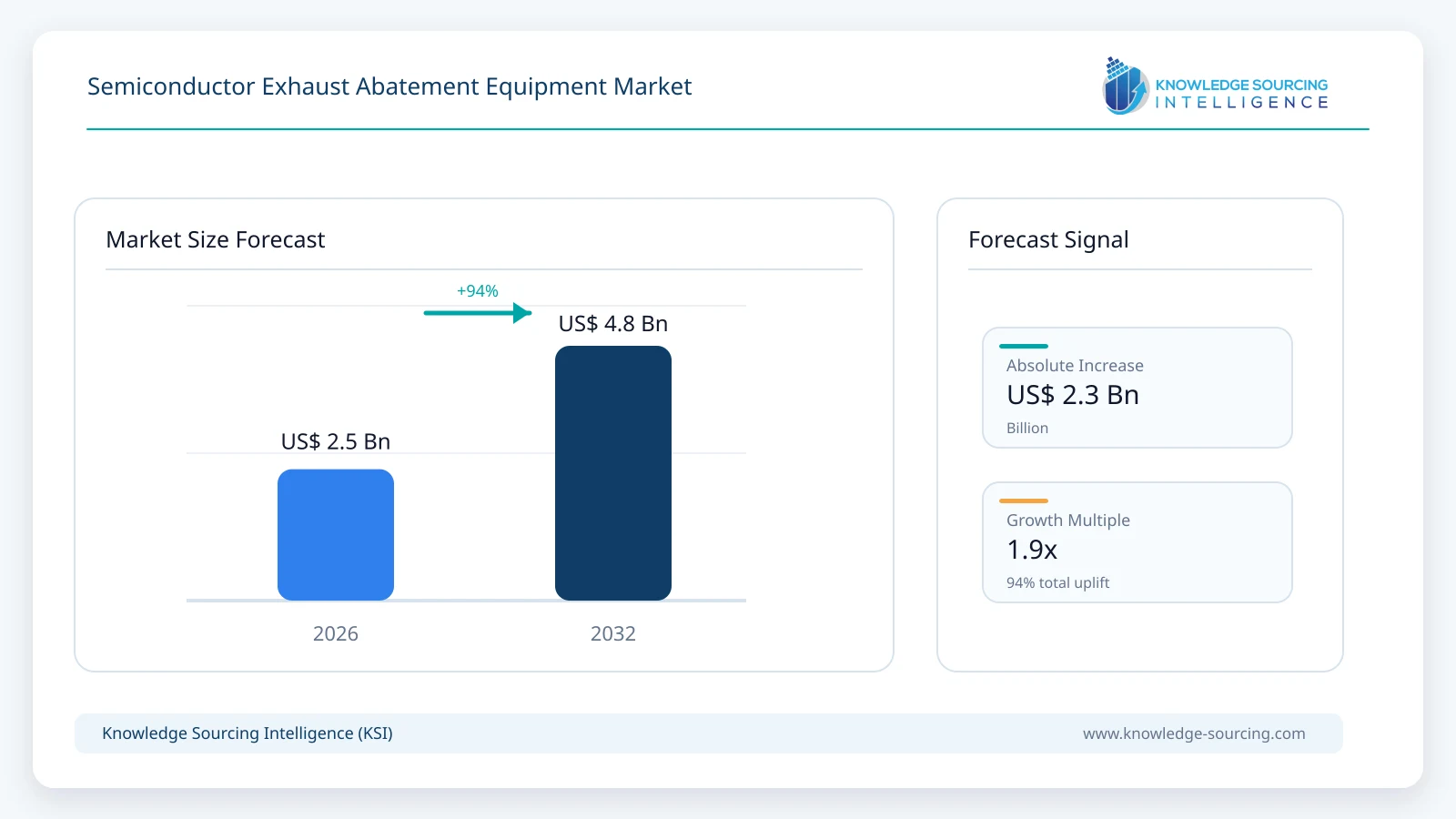
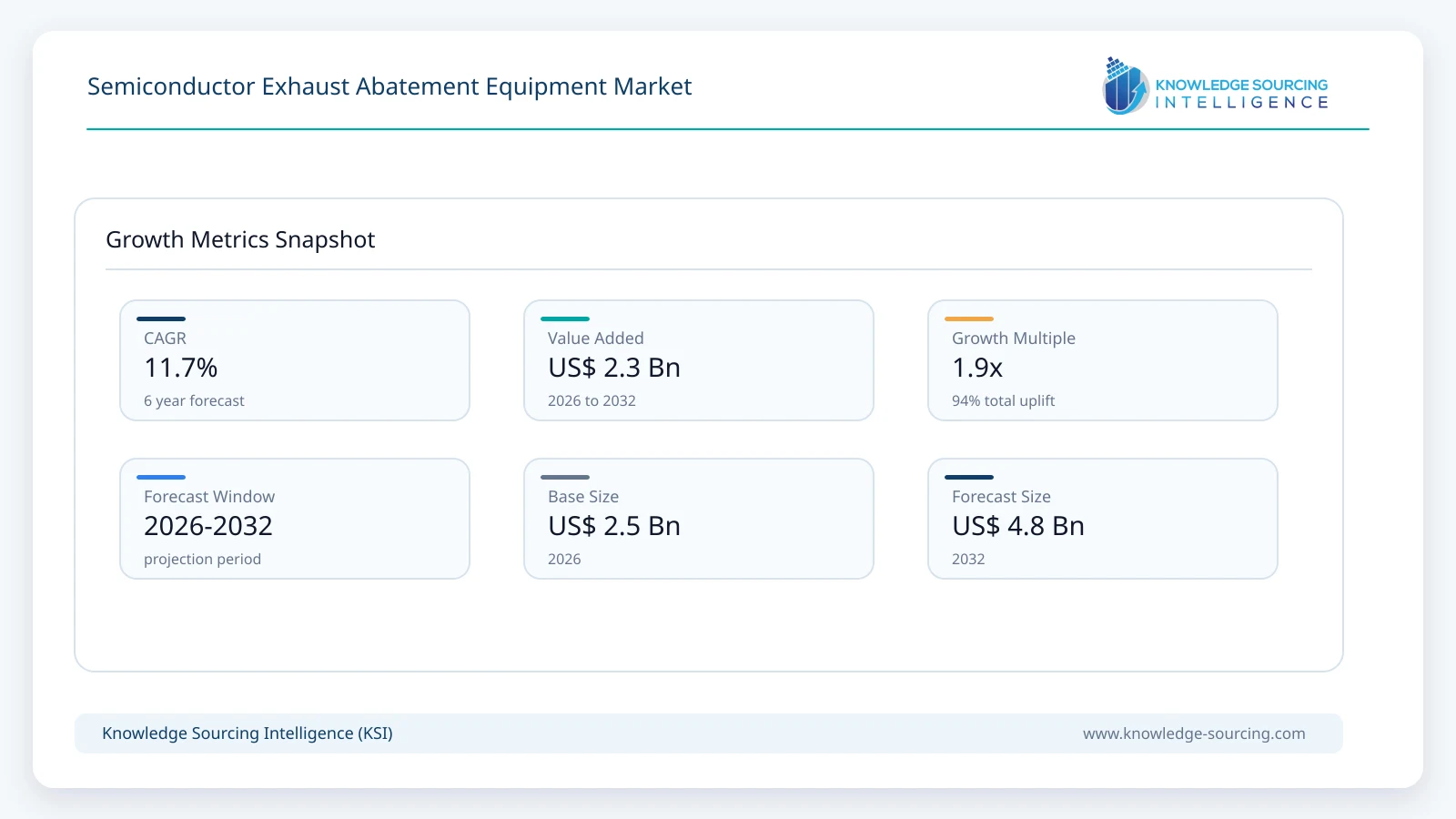
The Semiconductor Exhaust Abatement Equipment Market is estimated at USD 2.45 billion in 2026 and is projected to reach USD 4.75 billion by 2032, representing a CAGR of 11.7% during 2026-2032.
Highlights:
- 1Point-of-use burn-wet and plasma-wet systems remain core solutions for high-volume etch and CVD exhaust streams.
- 2F-GHG destruction requirements are increasing the value of high-DRE abatement for CF4, NF3, SF6 and related process gases.
- 3NOx and fine-particle control is emerging as a secondary-abatement layer downstream of primary burn or plasma systems.
- 4Subfab footprint, energy use, water consumption and maintenance interval increasingly influence equipment selection alongside DRE.
- 5Asia Pacific remains the largest opportunity because Taiwan, South Korea, Japan and China combine the highest semiconductor fab density with local abatement suppliers.
Market Overview
Semiconductor process tools generate chemically diverse exhaust streams. Plasma etch and chamber-clean steps can release perfluorocarbons, nitrogen trifluoride and sulfur hexafluoride; deposition and epitaxy can involve silane, hydrogen, ammonia, arsine, phosphine and metal-organic precursors; wet cleaning creates acid, solvent and ammonia vapors; and many reactions generate particles or corrosive by-products that can accumulate inside pumps and exhaust lines. The abatement system must therefore address safety and environmental performance without creating excessive restriction, corrosion or downtime in the process exhaust path.
Point-of-use abatement dominates the most hazardous process streams because treating gases close to the source reduces the length of contaminated ductwork and allows the abatement recipe to be matched to the process tool. Burn-wet systems thermally destroy gases before a wet stage cools and captures soluble reaction products. Plasma-wet systems use electrically generated plasma and are gaining attention where fabs seek to reduce fossil-fuel consumption. Catalytic systems can offer lower energy use for selected fluorinated gases, while dry adsorption systems convert hazardous compounds into stable solids without generating wastewater. Wet scrubbers remain effective for water-soluble acids, ammonia and cleaning-process vapors.
A second layer of abatement is becoming more relevant as primary treatment creates secondary pollutants. High-temperature combustion and plasma processes can generate nitrogen oxides, while complex CVD and etch chemistries create fine powders and aerosols. DAS launched ALCEA in 2026 specifically to remove NOx downstream of NOx-generating abatement units, while its TSUGA and electrostatic collection systems address combined NOx and particulate loads. This expands the addressable market from one device per process tool toward multi-stage exhaust architectures in the most demanding fabs.
Market Drivers
Advanced etch and deposition increase exhaust complexity
Logic, memory and advanced packaging processes require more plasma etch, atomic layer deposition, chemical vapor deposition and chamber-cleaning steps. These processes use fluorinated compounds, halogens, silanes, metal precursors and cleaning gases with very different reaction products. A single abatement platform increasingly needs multiple gas inlets, by-product management and dynamic operation linked to process-tool recipes. Suppliers such as Edwards, EBARA, DAS, GST and UNISEM are therefore emphasizing high-flow capacity, process coupling and longer maintenance intervals rather than only destruction efficiency.
Fluorinated greenhouse-gas control remains a structural requirement
The U.S. Environmental Protection Agency identifies PFCs, hydrofluorocarbons, NF3 and SF6 as important semiconductor-manufacturing emissions and recognizes destruction technologies as a principal mitigation option. These compounds can have global warming potentials thousands of times higher than carbon dioxide. Fabs consequently require verified destruction and removal performance for gases such as CF4, C2F6, NF3 and SF6, particularly as advanced manufacturing capacity expands and corporate net-zero commitments place greater scrutiny on process emissions.
Fab expansion increases subfab equipment demand
New leading-edge logic, memory, power-semiconductor and advanced-packaging fabs add abatement demand alongside every incremental cluster of etch, deposition, implant and clean tools. The effect is strongest in Asia Pacific, where a dense installed base also creates recurring replacement, refurbishment and service demand. Kanken Techno reported group sales of JPY 30.7 billion for fiscal 2025 and maintains a broad global service footprint, while Korean suppliers GST and UNISEM continue to expand internationally through SEMICON events and local support operations.
Energy, water and floor-space pressure drives next-generation systems
Subfab space is expensive and utility consumption can become material across hundreds of abatement units. This is pushing suppliers toward compact multi-inlet platforms, on-demand combustion, electrically powered plasma systems, lower-water wet stages and integrated pump-abatement architectures. EBARA's newer combustion systems emphasize smaller footprints, lower NOx/COx emissions and by-product control, while DAS markets plasma-wet systems with reduced energy use and ALCEA with virtually no additional subfab footprint because its catalyst stage is integrated into the duct.
Restraints and Adoption Challenges
Abatement equipment operates in one of the harshest environments in the fab. Fluorine compounds, acids, fine powders and condensed reaction products can corrode components or block gas paths, forcing periodic cleaning and parts replacement. High DRE may also require energy, fuel, water or consumable media that increase operating cost. Combustion can generate NOx and COx, plasma systems require electrical power, wet scrubbers create wastewater, and dry systems require cartridge replacement and hazardous-solid handling. These trade-offs make total cost of ownership, uptime and by-product behavior as important as nominal removal efficiency.
Segment Analysis
By Abatement Technology
Burn-wet systems remain the most broadly deployed technology for high-volume semiconductor processes because they can treat mixtures of pyrophoric, fluorinated and combustible gases and then capture soluble reaction products in a wet stage. Plasma-wet systems are gaining share where fabs prioritize lower fossil-fuel use, high PFC destruction and flexible process matching. Catalytic systems are important for selected PFC and NOx applications, while dry adsorption systems remain attractive when water discharge is undesirable or when highly toxic gases must be converted into stable solids. Wet-only scrubbers remain cost-effective for water-soluble exhaust from clean and epitaxy processes.
Technology | Primary Strength | Typical Semiconductor Use | Key Trade-Off |
Burn-wet | Broad chemistry coverage and high throughput | CVD, etch, epitaxy, chamber clean | Fuel use, NOx and wet by-products |
Plasma-wet | High F-GHG destruction with electric energy source | Etch, CVD and advanced clean | Electrical load and electrode/torch maintenance |
Catalytic / catalytic-wet | Lower fuel requirement and targeted high efficiency | PFC destruction and secondary DeNOx | Catalyst life and chemistry sensitivity |
Dry adsorption / conversion | No wastewater and stable solid capture | Implant, toxic gases, selected etch streams | Consumable media replacement |
Wet scrubber | Low-cost removal of soluble acids and ammonia | Wet clean, epitaxy and acid exhaust | Limited performance on persistent PFCs |
Secondary NOx / particle control | Treats pollutants generated after primary abatement | Post-combustion and high-particle processes | Adds another treatment stage |
Market and Technology Indicators
Indicator | Current Evidence | Market Implication |
DAS ALCEA launch | September 2026 launch targets up to 95% NOx reduction with an in-duct catalyst stage. | Secondary abatement becomes a distinct revenue layer. |
SEMI benchmark direction | Industry benchmarks increasingly emphasize >95% DRE for F-GHGs, with higher aspirational performance. | Vendors compete on verified destruction performance, not only safety. |
EBARA compact combustion systems | LPCMN/LA+ designs target >95% DRE for CF4 with reduced by-product adhesion and smaller footprint. | Replacement demand favors lower-TCO, compact systems. |
CS CLEAN plasma conversion | PCS systems target PFCs as well as ammonia and hydrogen without conventional water-intensive architectures. | Dry/plasma solutions gain relevance in water- and fuel-constrained fabs. |
Korean supplier expansion | GST and UNISEM continue positioning scrubbers for global semiconductor customers in 2026. | Local Asian suppliers intensify competition and service coverage. |
Integrated pump + abatement | Edwards and EBARA offer integrated vacuum/abatement architectures for harsh process exhaust. | System-level optimization can reduce footprint and maintenance complexity. |
Regional Opportunity
Asia Pacific
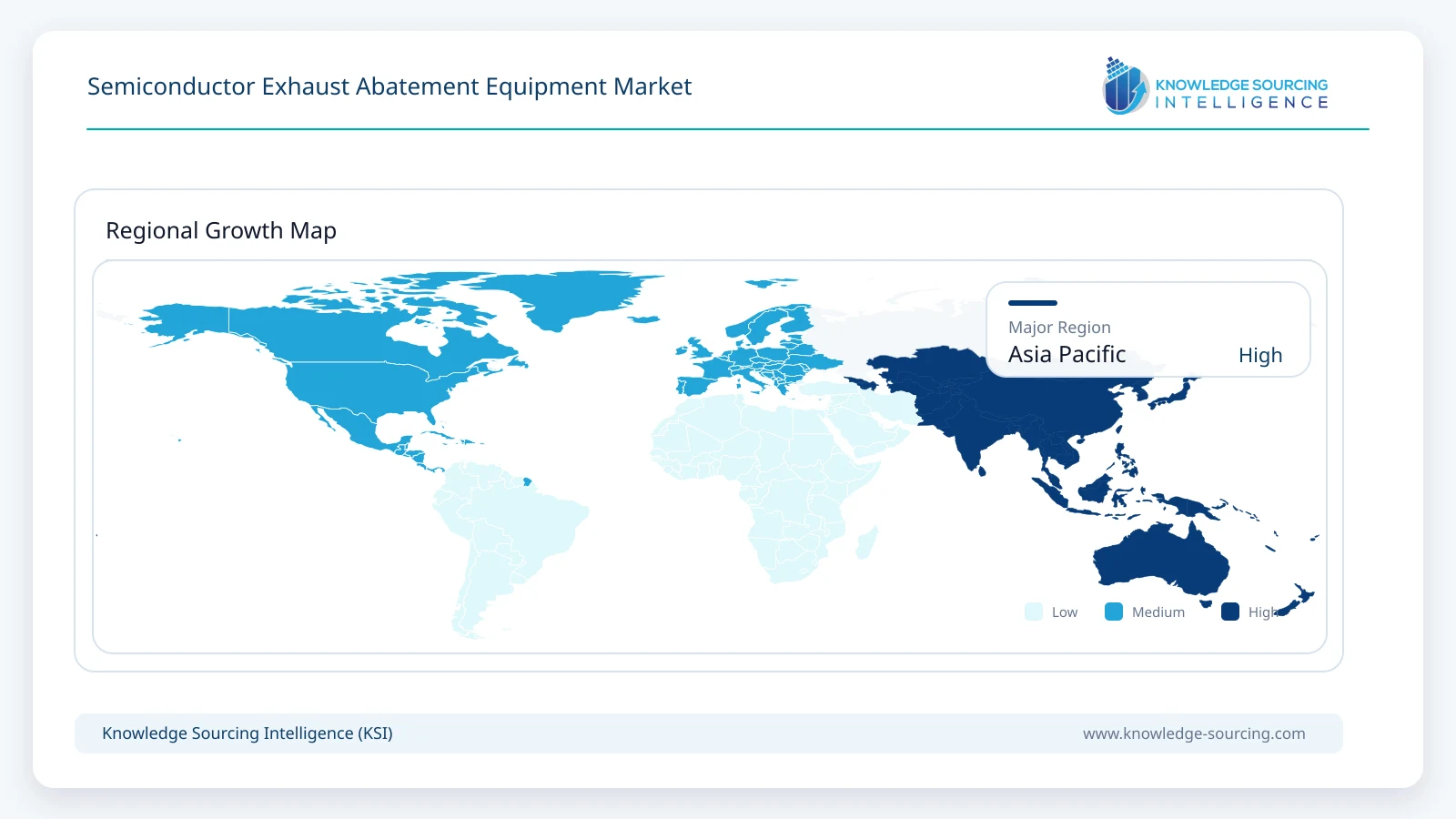
Asia Pacific is the largest semiconductor exhaust-abatement market because Taiwan, South Korea, Japan and China contain the highest concentration of wafer fabs and advanced process tools. Each new etch, deposition, epitaxy and chamber-clean tool creates a corresponding exhaust-management requirement, while dense installed bases generate recurring demand for replacement reactors, burners, scrubber parts, catalysts, consumables and field service. The region also contains a deep supplier base that includes Kanken Techno and EBARA in Japan, GST and UNISEM in South Korea, and manufacturing or service operations from Edwards, DAS and other international suppliers.
Taiwan is especially important for leading-edge foundry and advanced-packaging demand. DAS developed ALCEA in collaboration with Taiwan's Industrial Technology Research Institute and launched the product at SEMICON Taiwan 2026, illustrating how emissions-control development is moving closer to fab customers. GST maintains a Taiwan organization with operations across northern, central and southern Taiwan, while EBARA and Edwards support large installed bases through regional service networks. Short response times matter because abatement failures can stop the associated process tool.
South Korea combines large memory and logic fabs with domestic equipment suppliers. UNISEM states that it was the first Korean company to localize gas scrubbers, while GST markets next-generation scrubbers around energy efficiency and NOx reduction. Japan contributes through EBARA, Kanken Techno, Air Water Mechatronics, Taiyo Nippon Sanso and other equipment suppliers, giving the region a strong position in combustion, wet, dry and catalytic technologies. China is adding demand through continued fab expansion and the localization of subfab equipment; DAS presented its SALIX portfolio at SEMICON China 2026 specifically for wet-clean exhaust streams.
North America remains important through leading-edge logic, memory, compound-semiconductor and research fabs, with Edwards, EBARA Technologies, HIGHVAC and Exentec providing local equipment and service. Europe contributes through new and expanded fabs in Germany, Ireland and France and through environmental-technology suppliers such as DAS and CS CLEAN SOLUTIONS. The European market also places strong emphasis on energy efficiency, water use and secondary emissions, supporting adoption of electric, catalytic and dry alternatives.
Competitive Landscape
Competition combines global vacuum-and-subfab suppliers, specialist environmental-equipment companies and regional semiconductor-equipment manufacturers. Edwards Vacuum has a broad installed base across combustion abatement and integrated EUV support. EBARA competes across combustion, dry, wet, catalytic and integrated pump-abatement platforms. Kanken Techno is a major Japanese specialist in semiconductor exhaust treatment, while DAS Environmental Experts competes across burn-wet, plasma-wet, wet, catalytic and particle-control technologies. CS CLEAN SOLUTIONS is differentiated in dry and plasma-based treatment.
Asian suppliers add strong local competition. GST and UNISEM provide scrubbers and chillers to Korean and international semiconductor customers, while Air Water Mechatronics and Taiyo Nippon Sanso offer multiple dry, wet, combustion and catalytic treatment approaches in Japan. Exentec, HIGHVAC and Tosetz address point-of-use abatement in North America and Japan. Competitive differentiation increasingly depends on customer qualification, local field-service capacity, process-specific inlet design, maintenance interval, particle handling, energy and water intensity, and the ability to verify DRE under real process conditions.
Major companies and ecosystem participants covered: Edwards Vacuum, EBARA Corporation, Kanken Techno, DAS Environmental Experts, CS CLEAN SOLUTIONS, Global Standard Technology (GST), UNISEM, Air Water Mechatronics, Exentec, HIGHVAC Corporation, Tosetz, Taiyo Nippon Sanso, Nishimura Chemitech, Jiangsu Haoyan Equipment Technology and regional semiconductor subfab integrators.
Recent Developments
September 2026: DAS Environmental Experts launched ALCEA, an integrated plasma-enhanced catalytic secondary-abatement system designed to reduce NOx emissions by up to 95%.
March 2026: DAS Environmental Experts presented the SALIX wet-scrubber portfolio at SEMICON China for point-of-use treatment of IPA, ammonia, hydrofluoric acid, particles and droplets from single-wafer cleaning processes.
2026: CS CLEAN SOLUTIONS promoted its PCS plasma-conversion product line for PFC removal and ammonia/hydrogen treatment across major semiconductor exhibitions including SEMICON Europe and SEMICON India.
2026: GST and UNISEM expanded international marketing and support for semiconductor scrubber platforms through SEMICON Korea, Taiwan and West, emphasizing energy efficiency, process stability and environmental performance.
November 2025: EBARA Precision Machinery presented the LA+ combustion exhaust-gas abatement system with >95% DRE for CF4 and reduced by-product adhesion and NOx/COx emissions.
Semiconductor Exhaust Abatement Equipment Market Scope:
| Report Metric | Details |
|---|---|
| Total Market Size in 2026 | USD 2.45 billion |
| Total Market Size in 2032 | USD 4.75 billion |
| Forecast Unit | USD BillionBillion |
| Growth Rate | 11.7% |
| Study Period | 2021 to 2032 |
| Historical Data | 2021 to 2024 |
| Base Year | 2025 |
| Forecast Period | 2026 – 2032 |
| Segmentation | Abatement Technology, Process Application, Pollutant Type, Installation Architecture, Geography |
| Companies |
|
Market Segmentation
By Abatement Technology
Burn-Wet Systems
Plasma-Wet Systems
Catalytic and Catalytic-Wet Systems
Dry Adsorption and Conversion Systems
Wet Scrubbers
Thermal and Electric Oxidation
Secondary NOx and Particle-Control Systems
By Process Application
Etch
Chemical Vapor Deposition
Atomic Layer Deposition
Epitaxy and MOCVD
Ion Implantation
Chamber Cleaning
Wet Cleaning and Specialty Processes
By Pollutant Type
PFCs and Other Fluorinated Greenhouse Gases
Toxic and Pyrophoric Gases
Acid and Halogen Gases
VOCs and Solvent Vapors
NOx
Particles and Aerosols
By Installation Architecture
Point-of-Use Abatement
Bay and Secondary Abatement
Integrated Vacuum and Abatement Systems
By Geography
Asia Pacific
Taiwan
South Korea
Japan
China
Southeast Asia
North America
Europe
Rest of World
Table of Contents
1. EXECUTIVE SUMMARY
1.1. Market Opportunity and Key Findings
1.2. Semiconductor Process-Exhaust Outlook
1.3. Principal Revenue Pools
2. MARKET OVERVIEW
2.1. Semiconductor Exhaust-Gas Architecture
2.2. Point-of-Use versus Secondary Abatement
2.3. F-GHG, Toxic and Pyrophoric Gas Treatment
2.4. By-Product, Particle and Corrosion Management
2.5. DRE, Utilities and Uptime Requirements
3. MARKET SIZE AND FORECAST, 2026-2032
3.1. Global Market Revenue
3.2. Annual Growth Analysis
3.3. Equipment Replacement and Service Drivers
4. MARKET BY ABATEMENT TECHNOLOGY
4.1. Burn-Wet Systems
4.2. Plasma-Wet Systems
4.3. Catalytic and Catalytic-Wet Systems
4.4. Dry Adsorption and Conversion Systems
4.5. Wet Scrubbers
4.6. Thermal and Electric Oxidation
4.7. Secondary NOx and Particle-Control Systems
5. MARKET BY PROCESS APPLICATION
5.1. Etch
5.2. Chemical Vapor Deposition
5.3. Atomic Layer Deposition
5.4. Epitaxy and MOCVD
5.5. Ion Implantation
5.6. Chamber Cleaning
5.7. Wet Cleaning and Specialty Processes
6. MARKET BY POLLUTANT TYPE
6.1. PFCs and Other Fluorinated Greenhouse Gases
6.2. Toxic and Pyrophoric Gases
6.3. Acid and Halogen Gases
6.4. VOCs and Solvent Vapors
6.5. NOx
6.6. Particles and Aerosols
7. MARKET BY INSTALLATION ARCHITECTURE
7.1. Point-of-Use Abatement
7.2. Bay and Secondary Abatement
7.3. Integrated Vacuum and Abatement Systems
8. REGIONAL MARKET
8.1. Asia Pacific
8.1.1. Taiwan
8.1.2. South Korea
8.1.3. Japan
8.1.4. China
8.1.5. Southeast Asia
8.2. North America
8.3. Europe
8.4. Rest of World
9. MARKET DYNAMICS
9.1. Drivers
9.1.1. Advanced Etch and Deposition Complexity
9.1.2. Fluorinated-GHG Emissions Control
9.1.3. Global Fab Expansion
9.1.4. Energy, Water and Footprint Optimization
9.2. Restraints
9.2.1. Utility Consumption and Operating Cost
9.2.2. By-Product Deposition and Maintenance
9.2.3. Secondary NOx and Wastewater Generation
9.2.4. Process-Specific Qualification Requirements
10. COMPETITIVE LANDSCAPE
10.1. Market Structure and Competitive Intensity
10.2. Burn-Wet and Plasma-Wet Positioning
10.3. Dry and Catalytic Technology Strategies
10.4. Integrated Pump-Abatement Architectures
10.5. Regional Service and Installed-Base Advantage
11. COMPANY PROFILES
11.1. Edwards Vacuum
11.2. EBARA Corporation
11.3. Kanken Techno
11.4. DAS Environmental Experts
11.5. CS CLEAN SOLUTIONS
11.6. Global Standard Technology (GST)
11.7. UNISEM
11.8. Air Water Mechatronics
11.9. Exentec
11.10. HIGHVAC Corporation
11.11. Tosetz
11.12. Taiyo Nippon Sanso
11.13. Nishimura Chemitech
11.14. Jiangsu Haoyan Equipment Technology
12. RECENT DEVELOPMENTS
13. APPENDIX
Navigate
Trusted by the world's leading organizations











