
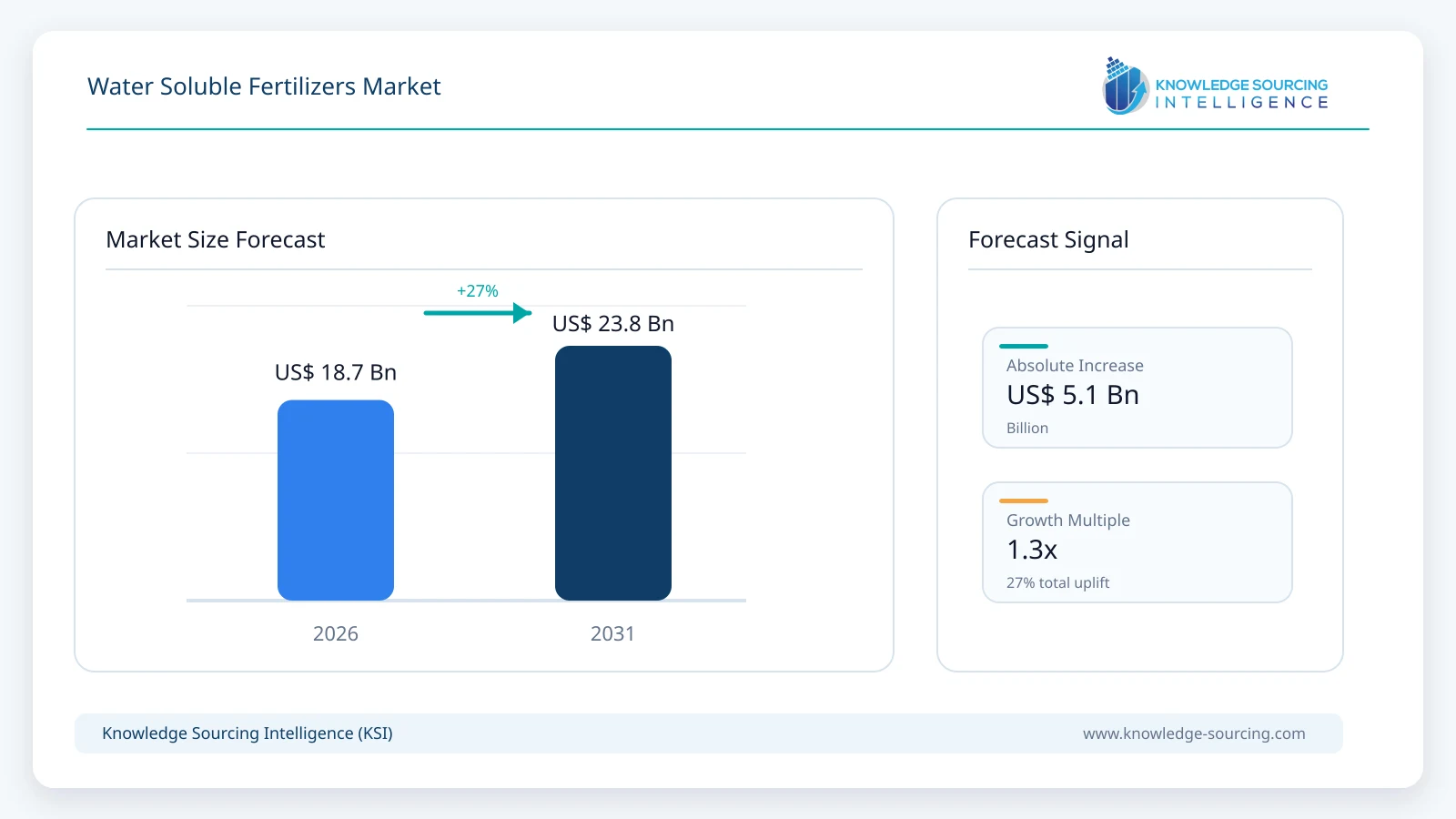
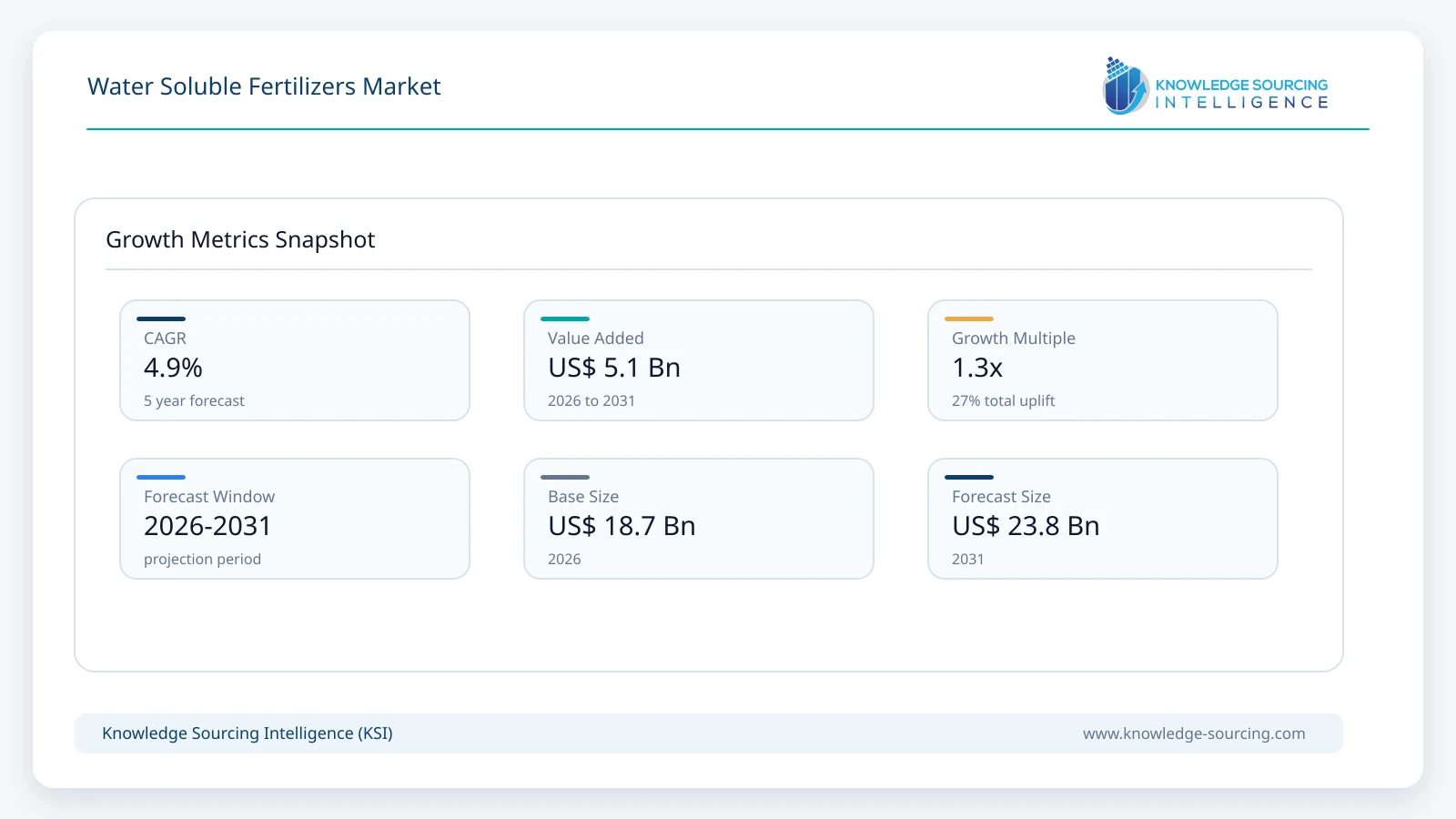
The global water-soluble fertilizers market is projected to increase from USD 18.74 billion in 2026 to USD 23.80 billion in 2031, representing a CAGR of 4.9% over the forecast period.
Highlights:
- 1Fertigation accounts for approximately 47% of global water-soluble fertilizer revenue in 2026.
- 2Potassium-based products represent about one-third of 2026 market value across fertigation and foliar use.
- 3Powder and granular formulations retain the largest share because of transport and storage efficiency.
- 4Asia Pacific contributes approximately 39% of global demand, led by China and India.
- 5Greenhouse and hydroponic growers are increasing demand for precise, low-residue nutrient formulations.
- 6Localized production is expanding as suppliers reduce exposure to import and freight disruptions.
Water-soluble fertilizers occupy the higher-precision end of the plant-nutrition market. Unlike conventional bulk fertilizers that are typically broadcast or incorporated into soil, these products are designed to dissolve rapidly and deliver nutrients through irrigation systems or foliar sprays. The commercial category includes soluble nitrogen, phosphate and potassium salts, complete NPK formulations, chelated micronutrients and specialty blends tailored to particular crops or growth stages. Potassium nitrate, monoammonium phosphate, monopotassium phosphate, calcium nitrate and soluble NPK blends are among the most widely used products because they combine predictable nutrient analysis with compatibility in controlled application systems.
Fertigation is the central demand mechanism. Food and Agriculture Organization (FAO) guidance describes fertigation as the application of fertilizers through irrigation water and notes its close association with drip systems. A global meta-analysis indexed by FAO AGRIS found that fertigation increased average crop yield by about 20%, nutrient-use efficiency by 26% and water productivity by 51% across the studies included. These results do not translate directly into product demand in every crop, but they explain why soluble nutrition is most commercially attractive where water, labor and fertilizer efficiency can be managed together. The value proposition is strongest in fruits, vegetables, tree crops, protected cultivation and other high-value production systems where precise nutrition can influence both yield and quality.
The input-cost environment remains volatile. The World Bank reported that its fertilizer price index rose by more than 12% quarter on quarter in the first quarter of 2026 and reached its highest monthly level since 2022 in March. Water-soluble grades typically command premiums over commodity fertilizers because of purity, solubility, blending and packaging requirements. This creates a two-sided market effect: higher raw-material costs can lift nominal product value, but they also make growers more selective about application rates and crop economics. Suppliers are responding with crop-specific formulations, digital nutrient-planning tools and localized manufacturing intended to improve availability and demonstrate a clearer return per hectare.
Market Dynamics
Precision Irrigation Is Expanding the Addressable Base for Fertigation
The strongest structural driver is the integration of nutrient delivery with irrigation. Drip and micro-irrigation allow growers to apply smaller nutrient doses more frequently and closer to crop demand, which increases the commercial relevance of highly soluble inputs. FAO continues to promote protected cultivation, hydroponics and efficient resource management through its Smart Farming programs, while 2026 field projects in the Caribbean and Africa included direct training in hydroponic nutrient management and fertigation. The commercial effect is broader than greenhouse farming alone. Fruit orchards, vineyards, vegetables, sugarcane and other irrigated crops increasingly use fertigation where water quality, emitter performance and crop value justify the additional management intensity.
Protected Cultivation and Hydroponics Increase Demand for High-Purity Nutrient Solutions
Greenhouses and hydroponic systems depend on soluble plant nutrition because the grower controls the nutrient solution directly. FAO highlighted in 2025 that indoor farming can improve water and fertilizer management and enable year-round production, although successful systems require strong technical management. In hydroponics, nutrient purity and balance are particularly important because salts accumulate within closed or recirculating systems and small formulation errors can affect crop performance quickly. This supports demand for greenhouse-grade NPK blends, calcium nitrate, magnesium nitrate, potassium nitrate, monopotassium phosphate and chelated micronutrients. Suppliers such as Haifa and ICL increasingly pair these products with nutrient-planning tools and crop-specific recommendations rather than selling undifferentiated fertilizer salts alone.
Localization and Crop-Specific Formulations Are Strengthening Supplier Positions
Specialty fertilizer suppliers are expanding local production and more differentiated product portfolios in major agricultural markets. ICL opened a new water-soluble fertilizer facility in Maharashtra in March 2026 to support Indian demand and reduce supply-chain exposure. Coromandel has developed crop-specific soluble grades for grapes, banana, pomegranate, sugarcane, cereals and other crops and reported continued investment in specialty nutrients. Haifa expanded its precision-nutrition portfolio during 2025 with products including Haifa Soluble DUO, while its established Poly-Feed ranges address greenhouse, drip and foliar applications. These developments shift competition toward agronomic support, local availability and formulation performance rather than commodity price alone.
Raw-Material Prices and Farmer Economics Constrain Premium Product Adoption
Water-soluble fertilizers generally cost more per tonne than conventional bulk nutrients because raw materials must meet higher purity and solubility requirements and are often processed into specialized crystalline blends. When urea, phosphate or potassium prices rise sharply, growers may reduce discretionary applications, simplify nutrient programs or reserve premium products for the highest-value acreage. The constraint is particularly visible in broad-acre crops where the yield response must justify a large cost per hectare. Water-soluble fertilizers therefore penetrate fastest where the economics of crop value, irrigation control and quality premiums are strongest rather than replacing commodity fertilizers across all agricultural land.
Water Quality, Compatibility and Technical Skill Limit Use in Less-Controlled Systems
Successful fertigation requires more than a soluble product. Water hardness, bicarbonates, pH, mixing order and chemical compatibility can cause precipitation or emitter blockage if nutrient programs are poorly designed. Growers also need calibrated injectors, filtration and enough technical knowledge to adjust application by crop stage. These requirements can slow adoption in markets where irrigation infrastructure is basic or advisory support is limited. Supplier training, digital recommendation tools and simpler crop-specific formulations reduce this barrier, but the market remains more knowledge-intensive than conventional broadcast fertilization.
Water Soluble Fertilizers Market Segment Analysis
By Product Type
Potassium-Based Fertilizers
Potassium-based water-soluble fertilizers form the largest high-value product group, accounting for roughly one-third of 2026 market revenue. Potassium nitrate and potassium sulfate are widely used in fruits, vegetables, tree crops, greenhouse production and fertigation programs because potassium influences yield, fruit sizing, color, soluble solids and stress tolerance. Specialty plant-nutrition producer SQM reported USD 982 million of specialty plant nutrient revenue in 2025 and estimated that it supplied approximately 39% of global agricultural potassium nitrate volume, illustrating the scale of the potassium-nitrate supply chain. Nitrogen- and phosphorus-based soluble fertilizers remain essential for complete programs, while micronutrients and bio-based soluble products grow from smaller bases as growers adopt more targeted nutrient strategies.
By Application Method
Fertigation
Fertigation is the largest application method, representing approximately 47% of market value in 2026. The segment is concentrated in drip-irrigated fruit, vegetables, orchards, vineyards, greenhouses and other crops where precise nutrient placement produces a clear operational benefit. Soluble fertilizers can be applied in frequent low doses and adjusted to crop development, reducing the mismatch between nutrient supply and plant demand. Foliar feeding remains important for rapid correction of deficiencies and targeted potassium or micronutrient applications, while direct soil application uses soluble products where quick availability or high purity is required. Through 2031, fertigation continues to gain share because it is closely linked to investment in water-saving irrigation and protected agriculture.
By Formulation
Powder and Granular Water-Soluble Fertilizers
Powder and granular products retain the largest formulation share because dry crystalline fertilizers are comparatively efficient to transport and store and can be dissolved on site at different concentrations. This is particularly important for international trade and distribution to farms that use mixing tanks or fertigation units. Liquid formulations reduce preparation time and can simplify dosing, but shipping water raises transport cost and storage requirements. Liquids are most competitive where suppliers operate close to large users or where convenience and automated dosing outweigh freight economics. The market therefore supports both formats, with dry products dominating global trade and liquids gaining relevance in intensive local production systems.
By End User
Greenhouses and Hydroponics Growers
Commercial farmers remain the largest end-user group by value, but greenhouse and hydroponic growers represent one of the most specialized growth pockets. In soilless systems, virtually all mineral nutrition is delivered in solution, increasing demand for clean, fully soluble salts and complete recipes. FAO continues to promote hydroponics as a water-efficient production option in locations where soil quality, rainfall or land availability constrain conventional farming. The segment is commercially attractive because nutrient spend per unit of cultivated area is high and growers are more willing to pay for consistency, purity and technical support. Its overall market share remains below commercial open-field agriculture because the physical cultivated area is much smaller.
Technology and Demand Indicators
Indicator | Latest Development | Market Impact |
Localized WSF production | ICL opened a dedicated water-soluble fertilizer facility in Maharashtra, India, in March 2026. | Improves local availability and reduces dependence on imported specialty fertilizer supply. |
Specialty potassium demand | SQM reported USD 982 million of specialty plant nutrient revenue in 2025 and more than 1.0 million tonnes of sales. | Confirms substantial commercial scale for potassium nitrate and specialty blends. |
Fertigation efficiency | A global meta-analysis indexed by FAO AGRIS found average gains in crop yield, nutrient-use efficiency and water productivity under fertigation. | Supports the agronomic case for soluble nutrients in controlled irrigation systems. |
Hydroponic expansion | FAO continued protected-cultivation and hydroponic programs in 2026, including nutrient-management training. | Expands demand for greenhouse-grade, low-residue soluble nutrient formulations. |
Fertilizer price environment | The World Bank fertilizer price index rose sharply in early 2026. | Raises nominal product values but increases grower sensitivity to input efficiency and crop economics. |
Asia Pacific Analysis
Asia Pacific is the largest regional market, accounting for approximately 39% of global water-soluble fertilizer revenue in 2026. The region combines very large agricultural economies with rapid growth in horticulture, micro-irrigation, greenhouse production and crop-specific specialty nutrition.
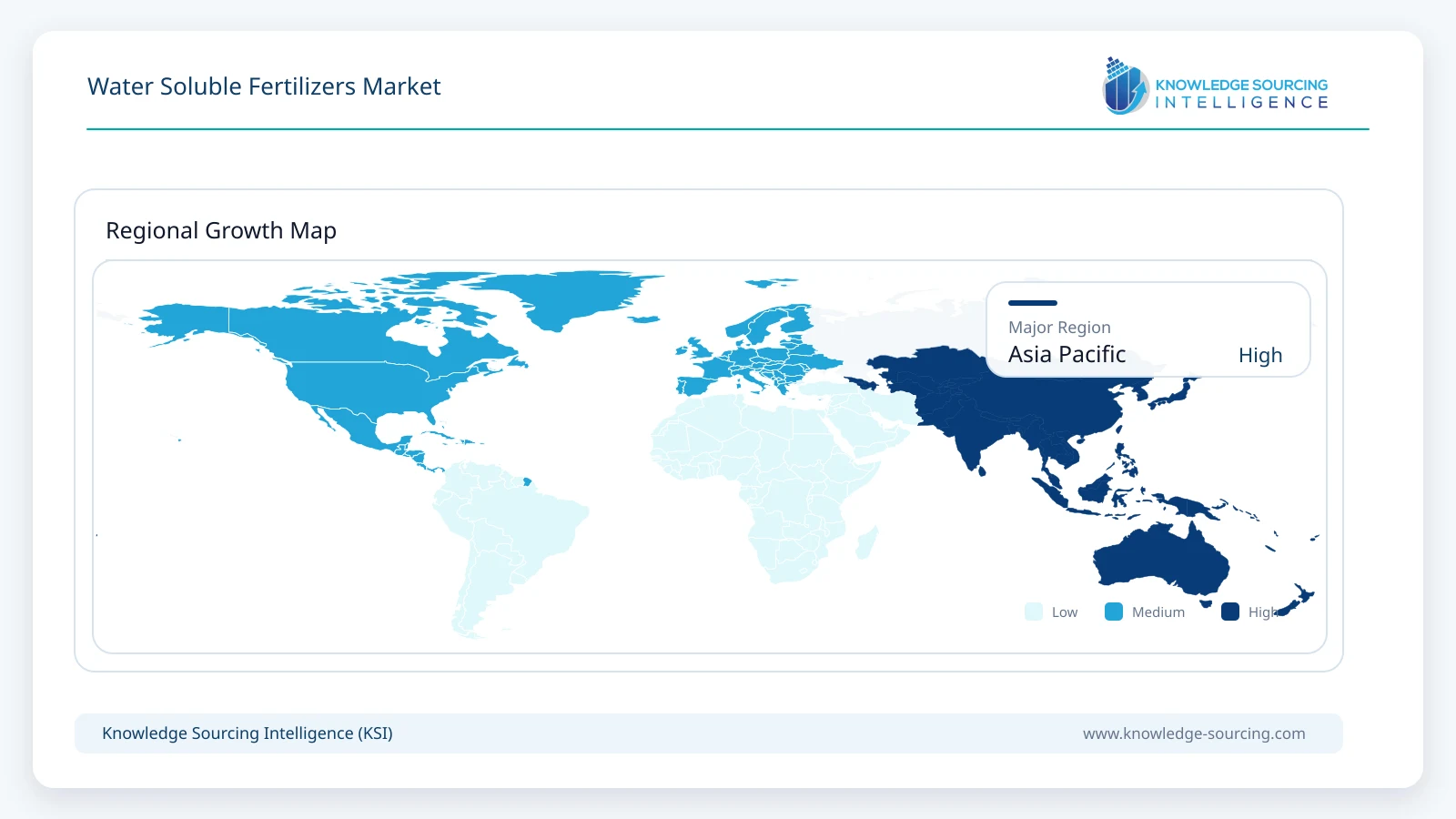
China has a large protected-cultivation and fruit-and-vegetable base, while India provides one of the clearest expansion opportunities because drip irrigation, high-value horticulture and localized specialty fertilizer manufacturing are developing simultaneously. Southeast Asian markets add demand from fruit, vegetables, plantations and protected agriculture, while Japan, South Korea and Australia support higher-value precision nutrition and greenhouse applications.
India is becoming particularly important to supplier strategy. ICL’s March 2026 Maharashtra facility adds domestic water-soluble fertilizer production, and Coromandel markets a broad portfolio of crop-specific fertigation and foliar grades. These investments improve product availability while reducing exposure to freight disruption and import lead times. Adoption remains uneven because small farmers face infrastructure and cost constraints, but the direction of travel favors more precise nutrient management where growers already use drip irrigation or produce high-value crops. The region therefore combines substantial volume potential with a growing premium segment for formulations linked to agronomic advice, digital planning and specialty crop programs.
Competitive Landscape
The market combines global fertilizer producers, specialty plant-nutrition companies and strong regional suppliers. Yara International, ICL Group, Haifa Group, SQM, Nutrien, EuroChem, K+S, COMPO EXPERT and Van Iperen compete across soluble NPK blends, potassium and phosphate salts, calcium and magnesium products and micronutrients. Coromandel International has an important position in India through generic and crop-specific water-soluble fertilizers, while The Mosaic Company and other large nutrient producers participate through upstream fertilizer supply and specialty distribution channels.
Product differentiation is increasingly based on nutrient purity, dissolution performance, chloride and sodium content, compatibility in fertigation systems and the ability to support crop-specific programs. Haifa markets greenhouse-grade and drip-grade Poly-Feed products alongside potassium nitrate and micronutrient solutions. ICL’s Agrolution, Solinure, NovaNPK and related ranges address fertigation, while SQM has a leading global position in agricultural potassium nitrate. These product systems are difficult to evaluate only on nutrient percentage because agronomic service, consistency and handling characteristics influence the grower’s total cost and operational risk.
Distribution and technical support are also central to competition. The strongest suppliers maintain local agronomy teams, distributors and blending or manufacturing capacity close to large horticultural regions. Digital nutrient-planning tools are becoming more common, particularly for greenhouse and hydroponic customers that need recipes linked to crop stage, water quality and recirculation. This creates room for premium pricing where suppliers can demonstrate better nutrient-use efficiency or crop quality, but it also intensifies competition from regional formulators able to produce standard NPK grades at lower cost.
Recent Developments
March 2026: ICL opened a new specialty and water-soluble fertilizer production facility in Maharashtra, India.
May 2026: Coromandel reported FY2025-26 results and continued investment across fertilizers, specialty nutrients and digital agriculture.
June 2026: FAO completed a hydroponic demonstration and nutrient-management training program in Saint Vincent and the Grenadines.
2025: Haifa introduced Haifa Soluble DUO, a water-soluble potassium-calcium formulation for precision plant nutrition.
2025: SQM specialty plant nutrient revenue increased to US$982.4 million, with sales volume above one million tonnes.
Water Soluble Fertilizers Market Scope:
| Report Metric | Details |
|---|---|
| Total Market Size in 2026 | USD 18.74 billion |
| Total Market Size in 2031 | USD 23.80 billion |
| Forecast Unit | Billion |
| Growth Rate | 4.9% |
| Study Period | 2021 to 2031 |
| Historical Data | 2021 to 2024 |
| Base Year | 2025 |
| Forecast Period | 2026 – 2031 |
| Segmentation | Product Type, Application Method, Formulation, End User, Geography |
| Companies |
|
Market Segmentation
By Product Type
Nitrogen-Based Fertilizers
Urea
Ammonium Nitrate
Ammonium Sulfate
Phosphorus-Based Fertilizers
Monoammonium Phosphate (MAP)
Diammonium Phosphate (DAP)
Monopotassium Phosphate (MKP)
Potassium-Based Fertilizers
Potassium Nitrate
Potassium Sulfate
Micronutrients
Bio-Based and Other Specialty Water-Soluble Fertilizers
By Application Method
Foliar Feeding
Fertigation
Drip Irrigation
Sprinkler and Other Pressurized Irrigation
Hydroponics and Soilless Systems
Soil Application
By Formulation
Liquid Water-Soluble Fertilizers
Powder/Granular Water-Soluble Fertilizers
By End User
Commercial Farmers and Large-Scale Agriculture
Greenhouses and Hydroponics Growers
Hobby Farmers and Home Gardeners
By Geography
North America
United States
Canada
Mexico
South America
Brazil
Argentina
Others
Europe
Germany
United Kingdom
France
Italy
Spain
Others
Middle East and Africa
Saudi Arabia
United Arab Emirates
Others
Asia Pacific
China
India
Japan
South Korea
Thailand
Indonesia
Others
Table of Contents
1. EXECUTIVE SUMMARY
2. MARKET SNAPSHOT
2.1. Market Overview
2.2. Market Segmentation
3. BUSINESS LANDSCAPE
3.1. Market Drivers
3.1.1. Precision Irrigation Expands the Addressable Base for Fertigation
3.1.2. Protected Cultivation and Hydroponics Increase Demand for High-Purity Nutrient Solutions
3.1.3. Localization and Crop-Specific Formulations Strengthen Supplier Positions
3.2. Market Restraints
3.2.1. Raw-Material Prices and Farmer Economics Constrain Premium Product Adoption
3.2.2. Water Quality, Compatibility and Technical Skill Limit Use in Less-Controlled Systems
3.3. Market Opportunities
3.4. Porter's Five Forces Analysis
3.5. Industry Value Chain Analysis
3.6. Policies, Fertilizer Standards and Irrigation Programs
4. TECHNOLOGICAL OUTLOOK
4.1. Precision Fertigation and Automated Dosing
4.2. Crop-Specific Soluble NPK Formulations
4.3. Chelated Micronutrients and Specialty Blends
4.4. Hydroponic Nutrient Management and Recirculating Systems
4.5. Digital Nutrient Planning and Water-Quality Integration
5. WATER SOLUBLE FERTILIZERS MARKET BY PRODUCT TYPE
5.1. Nitrogen-Based Fertilizers
5.1.1. Urea
5.1.2. Ammonium Nitrate
5.1.3. Ammonium Sulfate
5.2. Phosphorus-Based Fertilizers
5.2.1. Monoammonium Phosphate (MAP)
5.2.2. Diammonium Phosphate (DAP)
5.2.3. Monopotassium Phosphate (MKP)
5.3. Potassium-Based Fertilizers
5.3.1. Potassium Nitrate
5.3.2. Potassium Sulfate
5.4. Micronutrients
5.5. Bio-Based and Other Specialty Water-Soluble Fertilizers
6. WATER SOLUBLE FERTILIZERS MARKET BY APPLICATION METHOD
6.1. Foliar Feeding
6.2. Fertigation
6.2.1. Drip Irrigation
6.2.2. Sprinkler and Other Pressurized Irrigation
6.2.3. Hydroponics and Soilless Systems
6.3. Soil Application
7. WATER SOLUBLE FERTILIZERS MARKET BY FORMULATION
7.1. Liquid Water-Soluble Fertilizers
7.2. Powder/Granular Water-Soluble Fertilizers
8. WATER SOLUBLE FERTILIZERS MARKET BY END USER
8.1. Commercial Farmers and Large-Scale Agriculture
8.2. Greenhouses and Hydroponics Growers
8.3. Hobby Farmers and Home Gardeners
9. WATER SOLUBLE FERTILIZERS MARKET BY GEOGRAPHY
9.1. North America
9.1.1. United States
9.1.2. Canada
9.1.3. Mexico
9.2. South America
9.2.1. Brazil
9.2.2. Argentina
9.2.3. Others
9.3. Europe
9.3.1. Germany
9.3.2. United Kingdom
9.3.3. France
9.3.4. Italy
9.3.5. Spain
9.3.6. Others
9.4. Middle East and Africa
9.4.1. Saudi Arabia
9.4.2. United Arab Emirates
9.4.3. Others
9.5. Asia Pacific
9.5.1. China
9.5.2. India
9.5.3. Japan
9.5.4. South Korea
9.5.5. Thailand
9.5.6. Indonesia
9.5.7. Others
10. COMPETITIVE ENVIRONMENT AND ANALYSIS
10.1. Major Players and Strategy Analysis
10.2. Market Share Analysis
10.3. Mergers, Acquisitions, Agreements and Collaborations
10.4. Competitive Dashboard
11. COMPANY PROFILES
11.1. Yara International ASA
11.2. ICL Group Ltd.
11.3. Haifa Group
11.4. Sociedad Química y Minera de Chile S.A. (SQM)
11.5. Nutrien Ltd.
11.6. The Mosaic Company
11.7. EuroChem Group AG
11.8. K+S Aktiengesellschaft
11.9. COMPO EXPERT GmbH
11.10. Van Iperen International
11.11. Coromandel International Limited
11.12. Grupa Azoty S.A.
11.13. Kingenta Ecological Engineering Group Co., Ltd.
11.14. Hebei Monband Water Soluble Fertilizer Co., Ltd.
11.15. Uralchem-Uralkali Group
11.16. Fertiberia S.A.
11.17. Valagro / Syngenta Biologicals
11.18. Aries Agro Limited
12. RECENT DEVELOPMENTS
13. APPENDIX
13.1. Currency
13.2. Assumptions
13.3. Base and Forecast Years Timeline
13.4. Research Methodology
13.5. Abbreviations
Navigate
Trusted by the world's leading organizations











