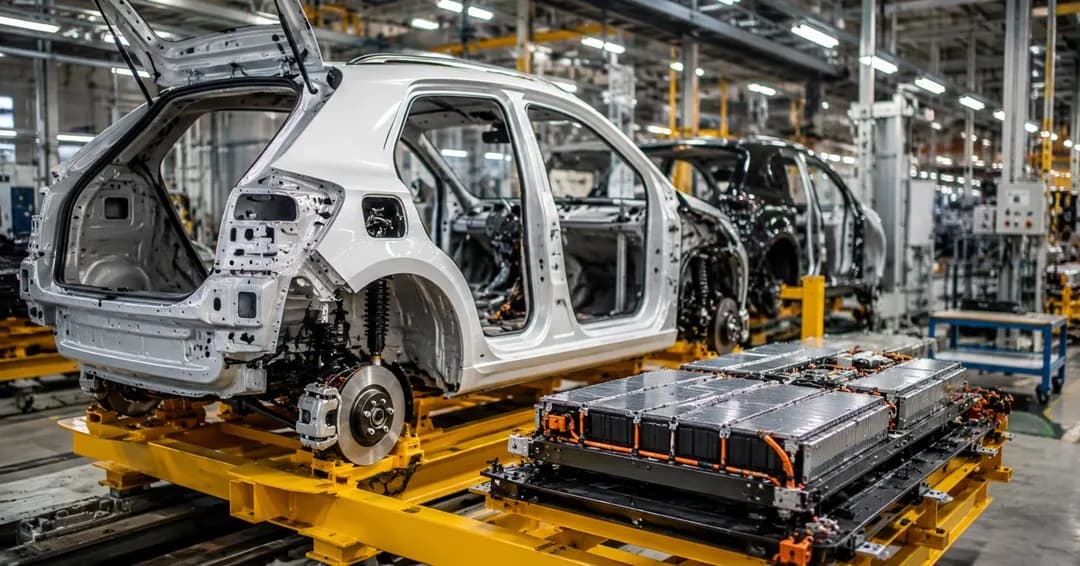
India’s electric vehicle market is shifting toward cost-efficient platform strategies. Tata Motors, Hyundai, Maruti Suzuki, and Mahindra are using modular or dedicated EV architectures to share components, optimize battery capacity, integrate powertrains, and improve manufacturing economics. These approaches could help lower upfront costs while maintaining range, safety, technology, and practicality for Indian buyers.
India's electric passenger vehicle market is moving into a more consequential phase. The early challenge was to demonstrate that an electric car could work for Indian driving conditions. The next challenge is considerably harder: manufacturers must make EVs affordable enough to compete with petrol vehicles while maintaining the range, safety, technology and everyday practicality that buyers increasingly expect.
That is changing the way automakers think about vehicle development. Battery chemistry and cell prices remain central to EV economics, but manufacturers are discovering that the architecture surrounding the battery can be just as important. The way a battery is packaged, how the motor and inverter are integrated, how electronic systems communicate, how many components can be shared across models, and how efficiently the factory can produce those vehicles all influence the final cost.
Compact EV platforms have emerged as an important answer to this problem. Their purpose is not simply to make electric cars physically smaller. The more significant objective is to create a reusable technical foundation that can support different battery capacities, power outputs, equipment levels and, in some cases, multiple vehicle models.
That distinction matters in India because the economics of the market are unusually sensitive to upfront price. An automaker can reduce battery cost by a few percentage points, but if it still needs separate engineering programmes, dedicated tooling and fragmented component sourcing for every model, much of the potential saving disappears.
Indian manufacturers are consequently experimenting with different platform strategies. Tata Motors is using its acti.ev architecture for products including the Punch.ev, Hyundai has adapted an existing vehicle architecture for the CRETA Electric, Maruti Suzuki has developed the dedicated HEARTECT-e platform for the e VITARA, and Mahindra has built its BE 6 and XEV 9e around the electric-origin INGLO architecture. These approaches differ technically, but they share a commercial objective: extracting more vehicle value from each rupee spent on engineering and manufacturing.
Why the EV platform has become a cost-control tool
An electric vehicle has fewer major mechanical systems than an internal-combustion vehicle, but that does not automatically make it cheaper to develop. The battery, power electronics, electric motor, thermal systems and high-voltage architecture introduce their own engineering requirements. Platform decisions influence almost all of them.
A manufacturer that develops a completely different battery enclosure for every model will have to repeat structural engineering, validation and manufacturing investment. The same problem occurs with motor mounts, wiring systems, thermal-management hardware and electronic controllers. Even when individual components are relatively inexpensive, engineering them separately creates unnecessary duplication. Platform sharing addresses this duplication.
A common motor family can be tuned for different performance levels. A related battery enclosure can accommodate different quantities of modules. A common electronic architecture can support several vehicle functions and trim levels. Manufacturing equipment can also be designed around repeatable processes rather than being tailored to one model.
The resulting saving is rarely dramatic at the individual component level. The advantage comes from accumulation and scale.
Platform cost lever | How automakers can use it | Potential commercial effect |
Battery modularity | Offer different battery capacities within a common vehicle architecture | Allows buyers to choose range according to usage and budget |
Shared powertrain systems | Reuse motor, inverter and control-system families across variants | Spreads engineering and sourcing costs over higher volumes |
Electrical architecture commonality | Use common controllers, wiring principles and software foundations | Reduces hardware and development duplication |
Common manufacturing processes | Build related models using similar assembly and testing operations | Improves plant utilization and tooling economics |
Localized battery assembly | Move pack manufacturing closer to vehicle production | Reduces logistics and imported-system exposure |
Scalable platform design | Support multiple products from one technical foundation | Increases the number of vehicles over which fixed development costs are recovered |
For Indian automakers, the last point is particularly important. The more products that can use a platform without appearing mechanically identical, the faster the manufacturer can spread its initial investment.
Tata Motors is demonstrating the value of battery and platform modularity
Tata Motors has been one of the most active Indian manufacturers in expanding its electric passenger-vehicle portfolio. Its acti.ev architecture provides an important example of how a common foundation can be used to serve a relatively broad range of customers.
The Punch.ev is particularly relevant because it brings the platform strategy into the compact SUV segment. Tata currently lists 30 kWh and 40 kWh battery configurations for the Punch.ev, with the range currently starting at Rs. 9.69 lakh ex-showroom. Tata currently states that the 40 kWh battery provides an ARAI-certified range of 468 km and a C75 real-world range of approximately 355 km.
The important point is not simply that Tata offers two battery sizes. It is that the same compact vehicle architecture can accommodate materially different energy-storage propositions.
That gives Tata a useful cost-segmentation mechanism. A customer who mainly drives within a city can select the smaller battery without financing the cost and weight of a larger pack. A customer who regularly undertakes longer trips can move to the higher-capacity version.
This is commercially more intelligent than forcing every buyer into the largest battery simply because a minority of customers require more range.
The Punch.ev also illustrates another aspect of platform economics through its integrated electric drivetrain. Tata lists a permanent-magnet synchronous motor in both battery configurations, with the 30 kWh version producing 65 kW and the 40 kWh version producing 95 kW.
Such commonality allows the manufacturer to standardize important parts of the propulsion system while differentiating the vehicle through software calibration, battery capacity and equipment.
That is where compact platforms can become powerful. The architecture does not have to dictate one specification. It can create a controlled range of specifications around a common industrial foundation.
The smaller battery is becoming a product strategy rather than a compromise
Range anxiety has historically pushed automakers toward larger batteries. The logic is easy to understand because a higher battery capacity gives manufacturers a straightforward headline selling point. However, the economics of India's compact EV market are beginning to challenge that assumption.
A battery is expensive, heavy and physically demanding to package. Adding capacity to an EV does not simply increase battery cost. It can also increase vehicle mass, which may require additional energy to move that vehicle and may influence other components.
For many urban users, the economic value of a very large battery may therefore be lower than its technical value suggests. This creates an opportunity for right-sized EVs.
The Punch.ev's 30 kWh and 40 kWh configurations show how an automaker can give customers a choice between lower acquisition cost and greater range without creating a completely different vehicle programme.
Hyundai has adopted a comparable principle with the CRETA Electric. The model is offered with 42 kWh and 51.4 kWh liquid-cooled lithium-ion battery packs, while the overall vehicle dimensions remain the same across the two configurations. Hyundai lists certified ranges of 420 km and 510 km respectively.
That flexibility has an important implication for future EV pricing. Manufacturers can increasingly treat battery capacity as a configurable commercial variable rather than an inseparable characteristic of the vehicle.
As EVs move into more price-sensitive segments, that could become one of the most effective ways to reduce the entry price without making the vehicle itself fundamentally different.
Hyundai's CRETA Electric shows why adaptation can sometimes beat a clean-sheet platform
A dedicated EV platform offers significant engineering advantages, but it is not always the cheapest route to market.
Hyundai's CRETA Electric illustrates why an automaker may choose to adapt an established architecture instead. The company has positioned the model around the familiar CRETA form factor while introducing an electric powertrain and battery system.
The approach provides a practical bridge between existing manufacturing capability and EV-specific technology. An automaker can reuse knowledge of body dimensions, supplier relationships, production processes and vehicle integration rather than creating every system from a blank sheet of paper. That can be particularly attractive while EV volumes are still developing.
The downside is that an adapted platform may impose packaging compromises that a dedicated architecture could avoid. A clean-sheet EV platform can optimize battery placement, weight distribution and cabin space from the beginning. The economic question is whether those advantages justify the additional development investment.
Hyundai has demonstrated that an adapted architecture does not prevent substantial technological content. The CRETA Electric offers two battery configurations, liquid-cooled battery packs, DC fast charging and a broad suite of connected and safety technologies. Its feature structure also allows the same basic vehicle to cover several price and equipment levels.
The lesson is not that adapted platforms are better than dedicated platforms. It is that platform strategy must match production economics.
For an automaker with a large existing SUV business, adapting a known architecture may offer a faster route to scale. For a manufacturer expecting very high EV volumes, the economics can eventually shift in favour of a dedicated architecture.
Maruti Suzuki is combining a dedicated EV platform with manufacturing scale
Maruti Suzuki has chosen a more EV-specific approach with the e VITARA. The vehicle is based on the HEARTECT-e platform and is offered with 49 kWh and 61 kWh battery options. Maruti Suzuki states a driving range of up to 543 km for the 61 kWh configuration under the applicable test conditions. The platform decision becomes more significant when the company's manufacturing strategy is considered.
Maruti Suzuki has positioned India as a manufacturing base for the e VITARA, giving the programme an export dimension. That matters because platform economics depend heavily on volume. A dedicated architecture requires substantial upfront investment, but the cost per vehicle falls as the same engineering foundation supports more production.
As of July 2026, Maruti Suzuki had started production at the fourth plant at its Hansalpur facility, taking the site’s annual capacity to 1 million vehicles; the e VITARA is the plant’s initial BEV model. The company also reported that the Hansalpur facility accounted for nearly 47% of its overall overseas shipments in FY2025-26.
An export-oriented programme can therefore improve the economics of an Indian-developed and manufactured EV architecture by broadening the addressable production base.
The strategy also plays to India's established strength in cost-efficient vehicle manufacturing. If local suppliers can support increasing volumes and the same factory can produce vehicles for several markets, engineering and tooling costs can be distributed more widely.
This is an important distinction from a platform designed only for the domestic market. Maruti Suzuki is effectively testing whether India can become a competitive manufacturing base for globally relevant electric vehicles rather than simply a market for imported EV technology.
Mahindra demonstrates the benefits of designing around an electric-first architecture
Mahindra has taken the most clearly electric-origin route among the major Indian manufacturers discussed here. Its INGLO architecture was developed specifically around electric propulsion and underpins the BE 6 and XEV 9e.
Mahindra describes INGLO as a lightweight, flat-floor architecture using an electric-first design philosophy. The company emphasizes its ability to maximize cabin space while eliminating the central transmission tunnel associated with conventional vehicle architectures.
The two products occupy different positions within the company's portfolio, but they share the same underlying architecture. That is exactly where the platform economics become relevant.
Mahindra's introductory prices were Rs. 18.90 lakh for the BE 6 and Rs. 21.90 lakh for the XEV 9e. These are not entry-level EVs, so Mahindra is not using compact architecture simply to produce the cheapest possible electric car. Instead, it is using platform commonality to create a family of technologically differentiated vehicles.
The approach also highlights a broader point: platform efficiency does not necessarily require a low-cost vehicle. The same principles of shared components, integrated propulsion and common software architecture can improve the economics of premium EVs.
Mahindra has also emphasized the ability of INGLO to accommodate different battery and powertrain configurations, creating a foundation that can potentially support further products.
The strategic value lies in utilization. A platform becomes more powerful when more products are built on it without requiring a proportional increase in engineering investment.
Manufacturing integration can determine whether platform savings actually reach the customer
The platform is only one part of the cost equation. The factory has to be designed around it as well.
This is especially true for batteries. A manufacturer can standardize its vehicle architecture, but if battery packs are assembled through fragmented processes, transported over long distances and handled multiple times before reaching the vehicle line, some of the potential savings are lost. Battery assembly therefore increasingly sits at the intersection of product engineering and manufacturing strategy.
Mahindra's EV manufacturing operations at Chakan illustrate this direction. In January 2025, the company unveiled a dedicated EV manufacturing and battery assembly facility, with automated battery assembly and end-of-line testing.
The underlying principle is straightforward. A highly integrated factory can reduce handling, improve process consistency and provide greater control over production scheduling.
This is particularly valuable for EVs because battery packs are high-value systems. Small improvements in assembly efficiency can have a disproportionate impact when production volumes become substantial.
The same logic applies to motors, inverters and electronic systems. If common components are designed into several products, the factory can build them in larger batches and reduce the complexity of maintaining multiple production processes.
The future cost advantage may therefore come not from a single platform decision but from coordination between the vehicle architecture, supplier network and factory.
Battery localization will determine how much of the cost advantage India can retain
Platform rationalization can lower the amount of material and engineering required per vehicle, but it cannot fully resolve the issue of battery supply.
India is therefore attempting to develop domestic advanced-cell manufacturing capacity. The Production Linked Incentive programme for Advanced Chemistry Cell battery storage was approved with a budgetary outlay of Rs. 18,100 crore. The government says the programme is intended to establish gigascale ACC manufacturing in India while increasing domestic value addition. Beneficiary firms are required to achieve at least 25% domestic value addition initially and raise it to 60% within five years.
This policy is important to automakers because the battery is both a cost centre and a supply-chain risk.
Local pack assembly provides some protection, but imported cells can still expose manufacturers to international pricing, exchange-rate movements and logistics costs. Deeper localization could eventually give automakers greater control over battery economics.
The relationship between localization and platform design is also becoming more direct. Once domestic cell manufacturing reaches sufficient scale, automakers can design battery modules, cooling systems and pack structures around more predictable local supply. That can create another layer of efficiency.
The most competitive Indian EV platforms will probably not be those that merely use fewer components. They will be those that use fewer components while also aligning the design with an increasingly localized supply base.
Electronics may become one of the largest hidden sources of platform savings
The mechanical platform receives most of the attention, but the electrical architecture may ultimately provide an equally important source of cost reduction.
Modern EVs contain controllers for propulsion, battery management, thermal systems, charging, safety, infotainment and connectivity. If every vehicle programme uses different hardware, automakers have to validate and support a large number of electronic combinations. A common architecture can reduce that burden.
Manufacturers can use common controllers and software foundations while differentiating vehicles through calibration and feature activation. A common electronic platform can support different regenerative-braking characteristics, energy-management strategies and connected services without requiring a completely different hardware system for each model.
This does not mean software development is inexpensive. Cybersecurity, functional safety, testing and over-the-air update capability require substantial investment.
However, those investments become easier to justify when the same electronic foundation can be used across several vehicles. For compact EVs, this matters because buyers increasingly expect connected features, digital interfaces and advanced safety systems even when the vehicle sits in a relatively price-sensitive category. The manufacturer therefore has to reduce electronic complexity without making the vehicle feel technologically basic.
Battery-as-a-Service is another tool for reducing the affordability barrier
Automakers are also beginning to attack EV affordability through the ownership model rather than solely through engineering.
Hyundai introduced Battery-as-a-Service for the CRETA Electric on 2 July 2026, with an introductory vehicle price starting at Rs. 10.99 lakh and a battery charge of Rs. 3.90 per kilometre under the company's stated programme.
Maruti Suzuki introduced BaaS for the e VITARA in February 2026, with an introductory price starting at Rs. 10.99 lakh plus a battery charge of Rs. 3.99 per kilometre; the company stated that this introductory offer was valid through 31 March 2026.
The significance is that the physical cost of the battery does not have to disappear for the customer to perceive a lower entry price.
This could become an important complement to compact platform engineering. A smaller and more efficiently manufactured vehicle reduces the underlying cost, while BaaS changes how much of that cost the customer needs to finance upfront.
There are still questions around battery residual values, long-term rental economics, warranty responsibilities and customer acceptance. Even so, the emergence of BaaS indicates that automakers increasingly recognize affordability as both an engineering problem and a financial problem.
The emerging Indian EV cost model is becoming more integrated
The direction of the market can be understood by looking at how the major cost levers interact rather than considering them separately.
Cost area | Current direction among automakers | Longer-term economic implication |
Battery capacity | More variants matched to different customer requirements | Reduces over-specification and expands price coverage |
Platform sharing | Common foundations across multiple products or variants | Spreads fixed development expenditure across higher volumes |
Powertrain integration | Greater consolidation of motor, inverter and transmission functions | Reduces weight, component count and packaging complexity |
Electronics | Common hardware and software foundations | Lowers development duplication and supports feature scalability |
Battery manufacturing | Greater domestic pack assembly and cell-production investment | Reduces imported-system and logistics exposure |
Factory integration | More dedicated EV and battery production processes | Improves quality control and manufacturing efficiency |
Export production | Indian platforms increasingly designed for multiple markets | Broadens the volume available to recover investment |
Ownership models | BaaS and other usage-linked battery payment models | Can reduce upfront purchase barriers without changing vehicle hardware |
The significance of this model is that the savings can reinforce each other.
A lighter platform may require less battery capacity. A smaller battery reduces weight further. Lower weight can allow a smaller motor for the same performance target. Integrated electronics can reduce wiring and controller count. Higher component volumes can improve supplier pricing. Localized battery production can reduce logistics exposure. None of these effects is large on its own. Together, they can change the economics of an entire vehicle programme.
The danger is optimizing for the lowest possible cost
There is a temptation in a price-sensitive market to treat platform engineering as a race toward minimum cost. That would be a mistake.
Indian EV buyers are becoming more informed. They are comparing range, charging speed, battery warranty, safety equipment, cabin technology and resale prospects rather than simply looking at the cheapest available electric vehicle.
A manufacturer that saves money by installing a battery that is too small for the intended customer or by reducing charging capability too aggressively may discover that the saving damages demand. The correct objective is therefore not minimum manufacturing cost. It is the best allocation of cost.
Some systems deserve additional expenditure because customers directly experience their benefits. Battery thermal management, structural safety, charging performance and efficient energy management can justify higher investment. Other systems can be simplified when customers are unlikely to perceive a difference. That distinction is likely to become a central engineering discipline.
The best compact EV platform will not necessarily have the lowest bill of materials. It will be the platform that delivers the strongest combination of cost, range, safety, performance and perceived quality.
Scale will ultimately determine which platforms win
Platform commonality creates value only when the manufacturer uses it extensively enough to recover the initial investment. This makes production scale one of the most important variables in India's EV competition.
Tata Motors can potentially spread acti.ev development across a growing electric portfolio. Maruti Suzuki can broaden the economics of HEARTECT-e through domestic and export production. Mahindra can use INGLO across multiple electric-origin products. Hyundai can leverage an established vehicle architecture while building EV-specific volume around it.
The important question is not simply how many EV models an automaker sells. It is how many vehicles can share meaningful technical and manufacturing foundations without becoming indistinguishable to consumers. Too little commonality leaves savings unrealized. Excessive commonality can weaken product differentiation. The optimal strategy is selective standardization.
Manufacturers should standardize components that customers rarely notice while preserving differentiation in design, driving dynamics, interior experience, software and packaging. That balance will become increasingly important as competition intensifies.
Compact platforms could reshape the EV price ladder in India
The long-term significance of these strategies is that they can gradually narrow the gap between electric and internal-combustion vehicles.
Tata's Punch.ev demonstrates that an electric compact SUV can already be positioned with an entry price below Rs. 10 lakh ex-showroom. Hyundai introduced BaaS for the CRETA Electric in July 2026, while Maruti Suzuki introduced an e VITARA BaaS offer in February 2026.
As platforms become more efficient and component localization improves, manufacturers will have more options. They can reduce the retail price and chase volume. They can retain pricing and improve margins. They can use some of the savings to add features that improve perceived value. The most likely outcome will be a mixture of all three approaches across different segments.
For entry-level EVs, price competition will be particularly important. In higher segments, platform savings may instead fund larger batteries, better software, improved interiors or more sophisticated driver assistance. That flexibility is one of the strongest commercial arguments for modular architectures.
The strategic outlook for Indian automakers
The next phase of India's EV market is unlikely to be determined by a single battery chemistry or one dominant platform design. Instead, manufacturers will continue experimenting with dedicated architectures, adapted platforms, modular battery systems, integrated powertrains and localized manufacturing.
The choice between dedicated and adapted platforms will depend on expected volume, product segment and investment horizon. Hyundai's approach demonstrates the value of using an existing industrial base when speed and capital efficiency matter. Maruti Suzuki's e VITARA demonstrates the potential of a dedicated architecture tied to manufacturing scale. Tata's acti.ev strategy shows how battery and powertrain modularity can be used to address different customer requirements within a compact vehicle. Mahindra's INGLO architecture demonstrates how an electric-first foundation can support multiple differentiated products.
The common thread is a shift in how manufacturers think about cost. The cheapest EV will not necessarily be the one with the cheapest battery or the fewest components. It will increasingly be the vehicle whose architecture allows the manufacturer to avoid unnecessary expenditure at every stage of development and production.
A smaller battery can reduce material cost and weight. A modular platform can spread engineering expenditure. An integrated powertrain can simplify packaging. Common electronics can reduce software and hardware duplication. Local battery manufacturing can reduce supply-chain exposure. Higher production volumes can distribute fixed costs over more vehicles. The result is a fundamentally different way of approaching affordability.
Indian automakers are moving from the question of how to build an electric vehicle cheaply to the more important question of how to design an entire EV ecosystem around efficient economics. That includes the platform, battery, powertrain, electronics, supplier network, factory and ownership model.
Compact EV platforms are therefore likely to become more than an engineering convenience. They can become the foundation for a broader cost strategy in which manufacturers build several commercially distinct vehicles from a smaller number of highly optimized technical architectures.
If that strategy succeeds, India's EV affordability curve could change materially over the next several years. The most competitive manufacturers will be those that can remove unnecessary cost without removing the attributes customers actually value.
That is the central opportunity offered by compact EV platforms: not simply producing smaller electric vehicles, but creating a scalable architecture in which battery size, vehicle configuration, manufacturing volume and customer value can be balanced much more precisely than they were in the first generation of Indian passenger EVs.
Have questions?
More Thought Articles
How EV Charger Manufacturers Can Capitalize on India’s Home Charging Revolution
India’s residential EV charging opportunity is expanding as policy support, EV adoption, and private parking infrastructure develop. Manufacturers can capture value beyond AC chargers through installation, smart charging, load management, solar integration, software, and after-sales services. Housing societies, automakers, and property developers offer scalable routes to residential charging customers.
Second-Life EV Battery Market in India: What Is Driving Demand from Manufacturers?
India’s second-life EV battery market is gaining relevance as electric vehicle adoption expands and batteries retain useful capacity after automotive service. Growing stationary-storage demand, battery data, refurbishment capabilities, EPR obligations, and critical-mineral policies are encouraging manufacturers to extend battery value through reuse before eventual recycling within India’s emerging circular battery ecosystem.
The Rise of Locally Manufactured Battery Separators in India’s EV Ecosystem
India’s battery industry is progressing from pack assembly toward domestic cell and material manufacturing, creating opportunities for lithium-ion battery separators. Policy support, ACC capacity expansion and R&D initiatives are strengthening the ecosystem. However, technical complexity, manufacturing yields, qualification requirements and economics mean localisation will likely advance gradually through coatings, testing and finishing.