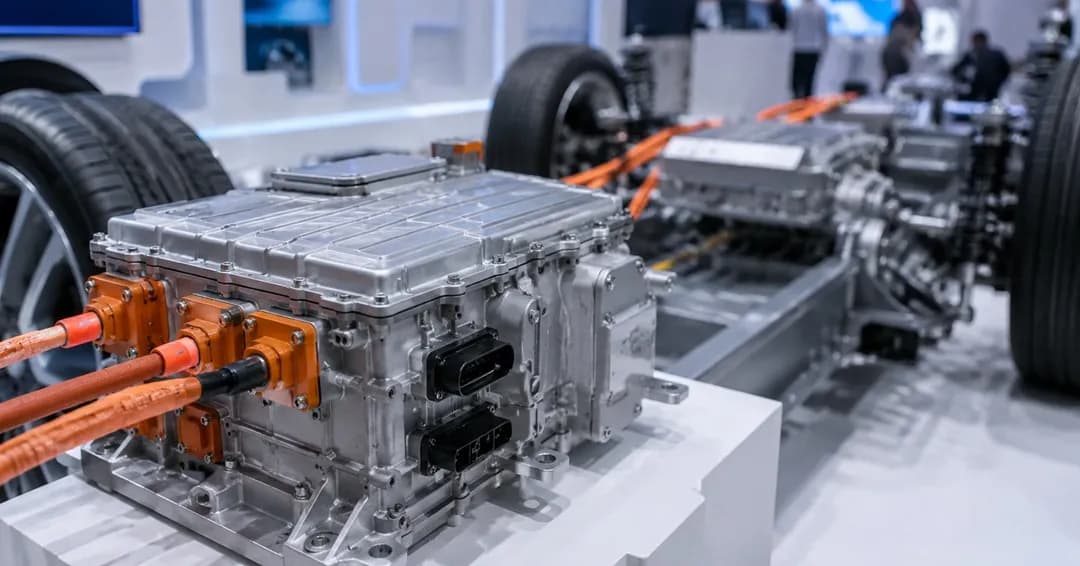
India’s EV transition is shifting attention from batteries toward traction inverters, where efficiency, software, thermal management, semiconductors and integration can shape vehicle economics. Growing EV volumes, policy support and semiconductor investments create opportunities for suppliers to localize inverter engineering and capture higher-value automotive electronics capabilities across two-wheelers, three-wheelers and cars.
For much of India’s electric-vehicle transition, the battery has occupied the centre of the conversation. That focus is understandable because battery cost, energy density, charging capability and domestic cell production directly influence the economics of an EV. Yet as electric vehicles move from an emerging technology into a larger automotive category, the next important contest may increasingly shift toward power electronics, particularly the traction inverter.
The inverter does not have the same visibility as a battery pack or electric motor, but its role is fundamental. It converts the battery’s DC electricity into the controlled AC power required by the traction motor and manages the electrical conditions under which torque is produced. During regenerative braking, the energy flow reverses. The same system therefore sits at the centre of both propulsion and energy recovery.
This matters because the quality of that conversion affects more than electrical efficiency. Inverter design influences thermal losses, motor response, regenerative braking, packaging, durability and the amount of useful energy extracted from every kilowatt-hour stored in the battery. For Indian automakers operating in a highly price-sensitive market, those interactions can translate into meaningful differences in vehicle cost and performance.
The timing is also becoming favourable. India sold about 2.3 million EVs in 2025, compared with roughly 50,000 in 2016, according to government data. Much of that growth came from electric two-wheelers and three-wheelers, which together accounted for approximately 2.08 million sales in 2025. The market is therefore reaching the scale at which specialised power-electronics manufacturing can become commercially significant rather than remaining a niche engineering activity.
The important question is no longer whether India will assemble EV inverters. The larger industrial question is whether Indian companies can capture the engineering, software, semiconductor and system-integration value surrounding them.
Why the inverter matters more as EVs mature
A conventional internal-combustion vehicle has a relatively clear mechanical hierarchy. The engine, transmission and fuel system dominate propulsion, while electronics provide control and supporting functions. EVs redistribute much of that complexity into electrical and software systems.
The inverter is one of the principal points where that complexity converges. It has to respond to commands from the vehicle-control system, manage current supplied to the motor, protect power semiconductors, coordinate with the battery-management system and support regenerative braking. Its operating efficiency also changes across speed and load conditions, meaning that peak laboratory efficiency alone does not determine real-world performance.
This creates an important commercial distinction. An inverter that is marginally more expensive but materially more efficient may lower the amount of heat that has to be removed from the powertrain. Better thermal behaviour can allow a smaller cooling system or reduce the frequency of power derating. Improved control algorithms can make the motor operate more effectively across the drive cycle.
For a passenger EV, these improvements can contribute to range and drivability. For a commercial vehicle, they can have an even more direct economic impact because energy consumption affects operating costs over thousands of kilometres.
India’s market makes this relationship particularly important because battery capacity remains a major cost and weight consideration. If better motor-inverter efficiency provides additional usable range from the same battery, an automaker can either improve range without proportionally increasing battery capacity or pursue a smaller battery for a given range target. Neither option is trivial, but both can improve the vehicle-level business case.
That is why the inverter should increasingly be evaluated as a system-level cost lever rather than as another electronic box on the bill of materials.
India’s unusual EV mix could accelerate inverter localization
India’s electric-vehicle market differs from many developed markets because mass adoption has been driven heavily by two- and three-wheelers. Government data shows that 11.49 lakh electric two-wheelers were sold in FY2024-25, while electric L5 three-wheelers reached 1.59 lakh units. The respective year-on-year increases were 21% and 57%.
The pattern continued under PM E-DRIVE. As of 22 July 2026, 20.57 lakh e-2Ws had been incentivised under the scheme. The scheme’s overall implementation has been extended to 31 March 2028, while the e-2W incentive window ended on 31 July 2026 and L5 support closed on 26 December 2025. The government had already reported by December 2025 that the PM E-DRIVE target for L5 electric three-wheelers had been reached, with 2.88 lakh vehicles sold under the scheme.
This concentration has consequences for inverter manufacturers. The power levels may be lower than those of passenger cars, but the cost pressure is severe and vehicle utilisation can be high. A three-wheeler used commercially can spend many hours operating under demanding thermal and electrical conditions. A scooter inverter, meanwhile, has to be compact, inexpensive and reliable while fitting within tight packaging constraints.
Those requirements can become a useful training ground for Indian suppliers. A company that learns to reduce inverter cost without sacrificing durability can subsequently apply that engineering discipline to higher-power vehicle platforms.
The risk is that suppliers remain trapped in low-cost assembly. The more valuable path is to use high-volume two- and three-wheeler programmes to develop proprietary motor-control software, power-module expertise, thermal engineering and automated validation capabilities. Those are the capabilities that can later support passenger cars, buses and commercial vehicles.
The competitive stack is much larger than the inverter housing
The term “inverter” can make the technology sound simpler than it is. A modern traction inverter is a combination of power semiconductors, control electronics, software, thermal systems, high-voltage components and mechanical packaging. Each layer can influence performance and reliability.
Inverter technology layer | Strategic significance for India’s automotive industry |
Power semiconductors | Determine switching losses, efficiency, voltage capability and thermal behaviour across operating conditions. |
Gate drivers and control electronics | Manage semiconductor switching, protection functions and the speed of electrical response. |
DC-link components | Stabilise high-voltage operation and absorb electrical transients within the power stage. |
Motor-control software | Influences torque delivery, efficiency, regenerative braking and overall drivability. |
Thermal management | Controls junction temperatures, sustained output capability and long-term component reliability. |
EMC and EMI engineering | Becomes increasingly important as switching speeds increase and vehicle electronics become more interconnected. |
Mechanical packaging | Determines weight, volume, vibration resistance, sealing and manufacturing complexity. |
Diagnostics and protection | Supports fault detection, high-voltage safety, system protection and serviceability. |
Vehicle integration | Coordinates the inverter with the battery, motor, vehicle controller and broader electrical architecture. |
This distinction becomes particularly relevant when discussing localization. A vehicle may contain an inverter that is assembled domestically while its highest-value semiconductor, microcontroller and control components remain imported. Such localization is useful, but it does not provide the same strategic depth as domestic design and engineering.
India’s policy direction is already encouraging deeper automotive manufacturing. The PLI-Auto scheme has a budgetary outlay of Rs. 25,938 crore and is intended to strengthen manufacturing capabilities for advanced automotive technologies. The government has also used phased manufacturing requirements and localization conditions in earlier EV-support programmes.
For the inverter industry, this creates an opportunity to move beyond final assembly. The suppliers that capture design, calibration, software, testing and system integration will be positioned closer to the highest-value portions of the powertrain.
Silicon carbide could raise the competitive stakes
Power semiconductor technology is likely to become one of the defining issues in higher-performance EV inverters. Silicon carbide, or SiC, has attracted particular attention because it can reduce switching losses and support high-power applications with potentially improved efficiency and thermal performance compared with conventional silicon devices in appropriate designs.
The shift toward SiC is not simply a semiconductor substitution exercise. It affects gate-driver design, switching behaviour, electromagnetic compatibility, thermal management, packaging and control strategies. An automaker or supplier therefore needs broader power-electronics competence before it can fully exploit the technology.
This creates a strategic opening for India. The country is simultaneously trying to develop its semiconductor ecosystem and deepen automotive manufacturing. The first phase of the Semicon India Programme has approved 12 manufacturing projects with committed investment exceeding Rs. 1.64 lakh crore. These include one silicon fab, one silicon carbide fab, an integrated gallium nitride Micro LED display fab and nine packaging units.
The government has now moved further with Semicon 2.0. The Union Cabinet approved the programme on 15 July 2026 with an overall outlay of Rs. 1,27,500 crore, covering semiconductor design, manufacturing, equipment, materials and supply-chain development.
It would be unrealistic to expect India to become self-sufficient in every power semiconductor used by automotive manufacturers within a few years. A more credible progression would involve domestic semiconductor design, packaging, testing, power-module engineering and selected manufacturing capabilities, followed by deeper integration as volumes and technical expertise increase.
That progression could make the EV inverter one of the most important interfaces between India’s semiconductor ambitions and its automotive ambitions.
Software may become as important as the hardware
The hardware content of an inverter is substantial, but the software controlling it may provide greater differentiation over time. Motor-control algorithms influence how efficiently electrical current is converted into torque across different operating points. Regenerative-braking calibration affects energy recovery as well as the driver’s perception of the vehicle. Protection logic determines how the system responds to overheating, overcurrent and abnormal voltage conditions.
As vehicle architectures become more software-defined, the inverter will also become more tightly connected to the battery-management system and vehicle-control architecture.
That changes the economics of supplier relationships. An OEM that purchases a completely closed inverter system has less freedom to optimise the powertrain around its own battery, motor and vehicle software. A supplier that provides configurable hardware combined with control software can become deeply embedded in the vehicle-development process.
Once such a system has been validated, calibrated and deployed across multiple models, switching suppliers becomes expensive. The OEM has to repeat significant portions of testing and software validation, while the supplier retains a valuable position in the vehicle programme.
For Indian electronics companies, this is a much more attractive position than competing purely on assembly cost. The long-term prize is not simply a larger number of inverter units. It is ownership of the control layer that determines how those units perform.
Thermal management could become an Indian differentiator
India’s operating environment provides another reason why inverter engineering should not be treated as a commodity activity. High ambient temperatures, congested traffic, extended idling and heavy commercial use can place considerable demands on thermal systems.
Every inverter produces some heat because electrical conversion is not perfectly efficient. The engineering challenge is to remove that heat while keeping the cooling system compact, lightweight and affordable. If the thermal architecture is inadequate, the vehicle may have to reduce power output under sustained load. Repeated thermal cycling can also influence component life.
This issue could be especially relevant in electric three-wheelers, buses and commercial vehicles, where daily utilisation is often much higher than in private passenger vehicles.
Indian suppliers have an opportunity to develop power-electronics systems specifically for these conditions. That does not necessarily mean creating radically different hardware for India. It means optimising cooling paths, component selection, packaging and calibration around the actual operating environment.
There is commercial value in that expertise. A fleet operator may accept a modestly higher component price if it produces predictable power delivery and lower downtime. For consumer vehicles, meanwhile, improved thermal performance can support consistent acceleration and range in hot conditions.
Integration will probably become the next cost battleground
The standalone inverter is unlikely to remain completely isolated from other power-electronics functions. Automakers and suppliers are increasingly interested in integrating components to reduce packaging, wiring, connectors and manufacturing steps.
Depending on the vehicle architecture, this can involve combining traction inversion with DC-DC conversion or charging-related functions. Integrated power-electronics systems can reduce the number of separate modules and potentially improve overall packaging efficiency.
This trend is particularly relevant to India because vehicle economics are highly sensitive to bill-of-material cost and assembly complexity. A technically superior inverter that requires several additional components may lose to a slightly less sophisticated architecture that delivers better vehicle-level economics.
The strongest suppliers will therefore need to optimise the entire system rather than one component in isolation.
Competitive model | Potential advantage | Principal challenge |
Imported inverter with local assembly | Enables rapid vehicle launch and uses established technology. | Leaves significant design and semiconductor value outside India. |
Domestic inverter manufacturing | Improves supply resilience and local value addition. | Requires investment in validation, engineering and quality systems. |
Proprietary inverter with software | Creates differentiation and deeper OEM relationships. | Requires substantial R&D and software-development capability. |
Motor-inverter integration | Allows optimisation of efficiency, packaging and torque control. | Creates greater engineering complexity and programme dependence. |
Integrated e-powertrain platform | Maximises system-level optimisation and potential value capture. | Requires expertise across motors, electronics, software and thermal systems. |
The progression across these models will probably not happen uniformly. Two-wheelers may move rapidly toward highly integrated, low-cost systems, while premium passenger vehicles may prioritise higher-voltage architectures and advanced semiconductor technologies.
OEMs are likely to pursue selective vertical integration
The increasing importance of inverters does not mean every automaker will manufacture them internally. That would require substantial investment in electronics engineering, semiconductor procurement, validation and manufacturing.
A more likely approach is selective vertical integration. Automakers can retain ownership of vehicle-level architecture, motor-control calibration and software while sourcing power modules and manufacturing selected inverter assemblies through specialist suppliers.
The trend is already visible in the broader EV manufacturing strategy of major automakers. Companies are investing in dedicated EV facilities, battery assembly and localised powertrain capabilities rather than treating electrification as a simple replacement of an engine with a motor.
For suppliers, this creates an interesting middle ground. The most attractive partner will not necessarily be the one offering the lowest unit price. It will be the supplier capable of jointly developing a platform while also meeting automotive-grade manufacturing and reliability requirements.
That requires a very different organisational capability from conventional component assembly.
Policy support is creating demand, but capability will determine who captures value
India’s EV policy framework has helped create the volume necessary for suppliers to consider large-scale investments. PM E-DRIVE supports multiple EV categories and includes Rs. 4,391 crore for the deployment of 14,028 electric buses, while the overall scheme supports more than 28 lakh EVs. The scheme has since been extended to 31 March 2028, although the e-2W incentive window ended on 31 July 2026 and L5 support ended on 26 December 2025.
The wider adoption trend is also substantial. Government data shows registered EVs increasing from 1.74 lakh in FY2019-20 to 19.68 lakh in FY2024-25.
However, demand incentives alone cannot create a globally competitive inverter industry. Semiconductor access, software talent, high-voltage testing, functional safety, thermal engineering and automotive qualification all require sustained investment.
This distinction is important for policymakers as well as manufacturers. A supplier that localises assembly because incentives make it economical may create employment and reduce imports, but a supplier that uses the same support to establish proprietary engineering and testing capabilities creates a much more durable industrial asset. The latter is where India should aim.
The semiconductor constraint will remain real
India’s inverter ambitions should not be confused with semiconductor self-sufficiency. Power devices, microcontrollers, gate-driver ICs and other electronic components continue to depend substantially on global supply chains.
The government’s semiconductor strategy is intended to address that structural weakness over time. Semicon 2.0 specifically targets domestic capability in equipment, materials, semiconductor IP and supply chains, while the government has emphasised the need to move from chip design toward broader manufacturing capability.
For inverter manufacturers, the immediate objective should therefore be resilience rather than complete isolation from global suppliers.
A domestic company can remain competitive while importing selected semiconductor devices if it controls the architecture, software, packaging, testing and vehicle integration. Over time, domestic semiconductor manufacturing can increase the portion of the value chain captured within India.
That approach is more commercially realistic than attempting to reproduce the entire global semiconductor supply chain domestically.
The next five years could decide the industry structure
The inverter market is entering a different phase because the underlying EV industry is also changing. Early electric vehicles competed primarily on adoption incentives, basic range and affordability. As volumes expand, buyers and fleet operators will increasingly care about energy consumption, durability, charging performance, thermal consistency and total operating cost. Those requirements reward better power electronics.
India has an unusual advantage in this transition because its EV market spans mass-market scooters and three-wheelers as well as increasingly capable passenger cars and commercial vehicles. This gives domestic suppliers multiple routes to scale. A supplier can establish manufacturing discipline in lower-power platforms while developing more sophisticated technologies for higher-voltage applications.
The semiconductor ecosystem could reinforce this opportunity. By July 2026, three of the 12 approved semiconductor manufacturing projects had started commercial production. If automotive power electronics can connect effectively with this emerging ecosystem, the impact could extend well beyond imported-component substitution.
The result would be an industrial chain in which vehicle manufacturers, Tier-1 suppliers, semiconductor companies, software developers and specialised electronics manufacturers increasingly develop technologies together.
The real battleground will be system efficiency
The most important mistake would be to treat the inverter as another isolated component market. Its economic value comes from its interaction with the battery, motor, cooling system and software architecture.
A more efficient inverter can reduce energy losses. Better thermal management can maintain performance under demanding conditions. Improved software can increase efficiency and refine torque delivery. Higher integration can reduce packaging and assembly costs. Better semiconductor technology can support higher power density. These improvements reinforce one another.
India therefore has an opportunity to build an inverter industry that is considerably more sophisticated than a domestic assembly base. The country already has high-volume automotive manufacturing, a large supplier ecosystem, a growing EV market and an expanding semiconductor policy framework. The missing link is the depth of engineering capability connecting those assets.
That capability will not emerge automatically. It requires long-term investment in power semiconductor knowledge, embedded software, automotive validation, thermal engineering and high-voltage systems. It also requires OEMs to give domestic suppliers enough programme visibility to justify those investments.
If that happens, the inverter could become one of the defining technologies of India’s next automotive manufacturing cycle. The battery will continue to determine how much energy an EV can store, and the motor will remain responsible for turning electrical energy into mechanical motion. Yet the inverter increasingly determines how intelligently the vehicle manages the energy between those two points. As Indian automakers move from simply adopting EV technology toward competing on efficiency, cost and driving performance, that control function is likely to become considerably more valuable.
The companies that recognise this early will have an advantage. Those that treat the inverter as a commodity purchased primarily on price may still participate in the volume market, but they are less likely to capture the higher-value portion of the transition. For India’s automotive electronics industry, that difference could determine whether electrification creates another assembly opportunity or establishes a genuinely new technology ecosystem.
Have questions?
More Thought Articles
How EV Charger Manufacturers Can Capitalize on India’s Home Charging Revolution
India’s residential EV charging opportunity is expanding as policy support, EV adoption, and private parking infrastructure develop. Manufacturers can capture value beyond AC chargers through installation, smart charging, load management, solar integration, software, and after-sales services. Housing societies, automakers, and property developers offer scalable routes to residential charging customers.
Second-Life EV Battery Market in India: What Is Driving Demand from Manufacturers?
India’s second-life EV battery market is gaining relevance as electric vehicle adoption expands and batteries retain useful capacity after automotive service. Growing stationary-storage demand, battery data, refurbishment capabilities, EPR obligations, and critical-mineral policies are encouraging manufacturers to extend battery value through reuse before eventual recycling within India’s emerging circular battery ecosystem.
The Rise of Locally Manufactured Battery Separators in India’s EV Ecosystem
India’s battery industry is progressing from pack assembly toward domestic cell and material manufacturing, creating opportunities for lithium-ion battery separators. Policy support, ACC capacity expansion and R&D initiatives are strengthening the ecosystem. However, technical complexity, manufacturing yields, qualification requirements and economics mean localisation will likely advance gradually through coatings, testing and finishing.