
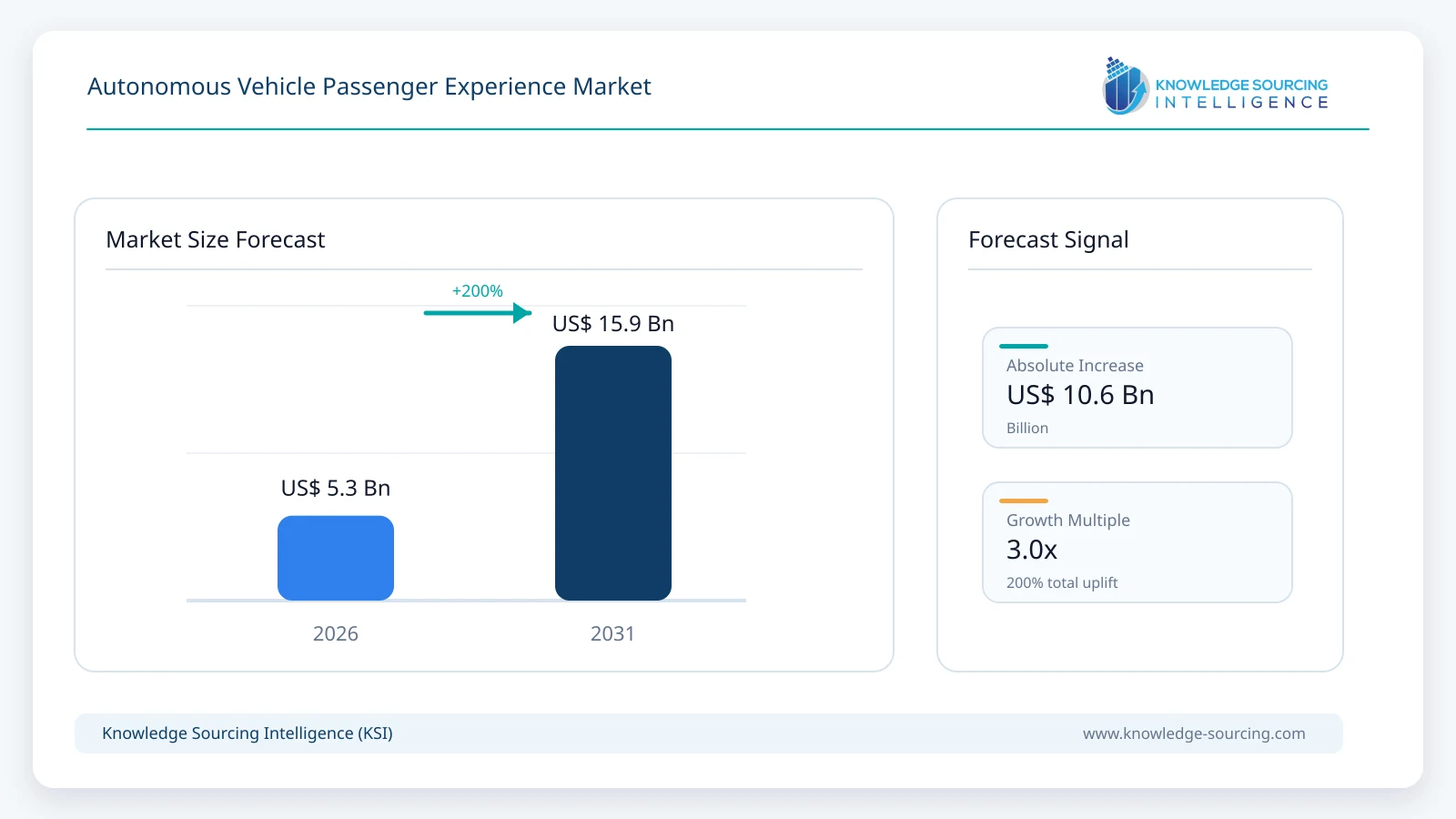
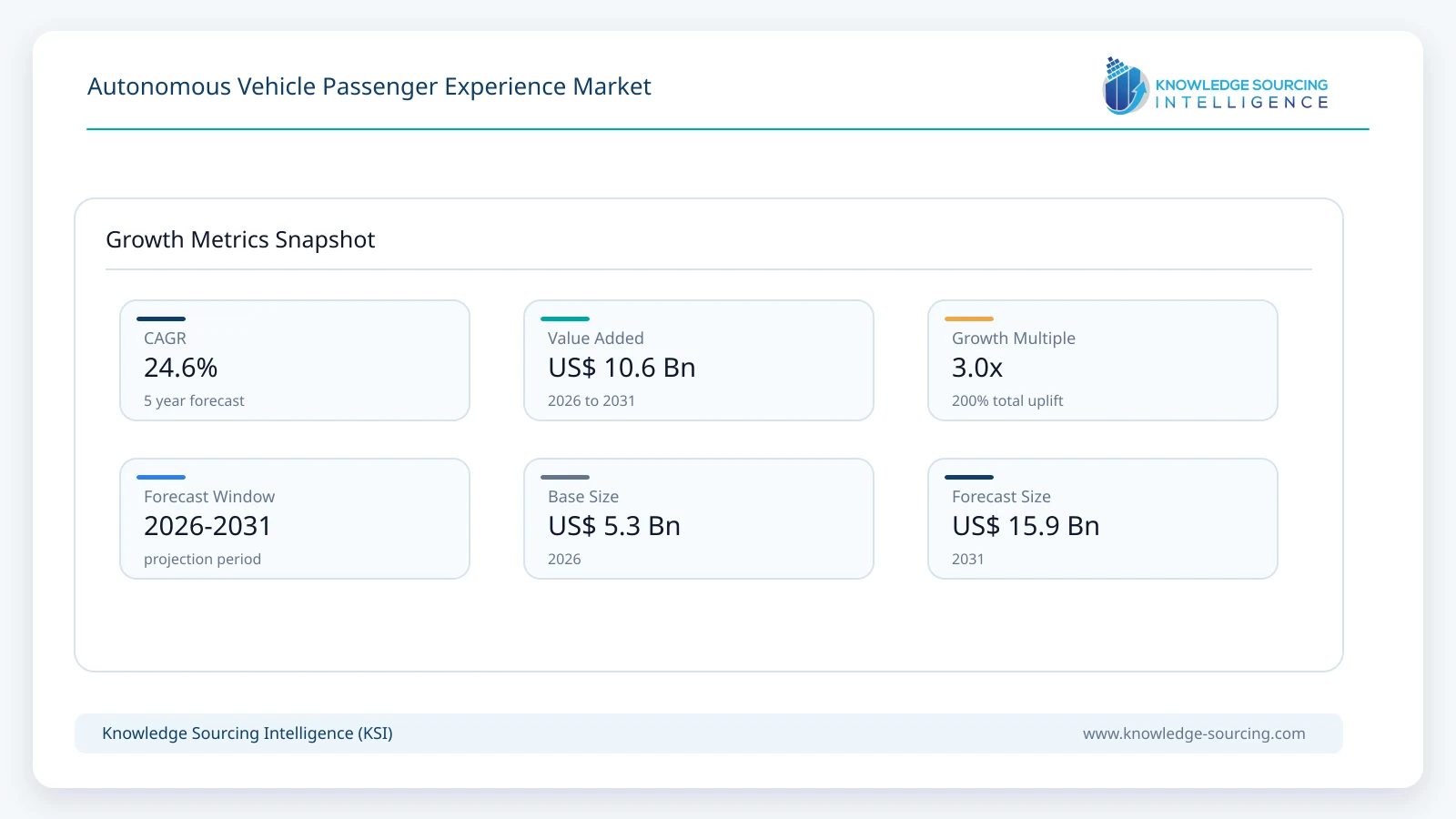
The autonomous vehicle passenger experience market is forecast to grow at a CAGR of 24.6%, reaching approximately USD 15.90 billion in 2031 from USD 5.30 billion in 2026.
Highlights:
- 1Digital entertainment, displays and HMI account for approximately 34% of global market value in 2026, supported by larger passenger displays, multimodal interaction and increasingly personalized media environments.
- 2Comfort and wellness functions represent approximately 27% of market value in 2026, reflecting growing integration of adaptive seating, thermal comfort, massage, lighting and other occupant-focused systems.
- 3SAE Level 3 applications account for approximately 57% of global market value in 2026 as conditional automation creates the first production-scale opportunity for occupants to redirect attention toward non-driving activities.
- 4Personally owned autonomous passenger vehicles account for approximately 60% of market value in 2026, while Level 4 robotaxi and shared autonomous mobility applications are expanding rapidly.
- 5Battery electric vehicles represent approximately 73% of global market value in 2026 because software-defined electric platforms provide the strongest foundation for connected, personalized, and immersive passenger experiences.
- 6Asia Pacific represents approximately 39% of global market value in 2026, supported by rapid smart-cabin and EV development in China, Japan and South Korea.
Demand is being driven by vehicles that provide richer digital interaction, individualized cabin settings, immersive media, wellness functions, and passenger-centric services during periods when occupants are less engaged with the driving task.
Passenger experience increasingly combines displays, voice assistants, connected services, seat comfort, thermal management, lighting, audio and sensing through a coordinated software layer. Waymo's Ojai demonstrates this approach in Level 4 mobility through rider-focused screens, personalized cabin controls, accessibility functions and Gemini-based conversational assistance.
Supplier development is also accelerating. Yanfeng's XiM27 combines AI-adaptive seating, individualized climate, adaptive lighting, spatial audio and a centralized domain controller; LG integrates displays, in-cabin sensing and on-device AI; HARMAN develops context-aware AI interaction; Toyota Boshoku is creating living-space-oriented mobility concepts; and Gentherm coordinates localized thermal technologies through ClimateSense.
Market Overview
Passenger experience becomes a larger source of vehicle differentiation as automated driving reduces the need for continuous attention to the road. The cabin can support entertainment, communication, information access, relaxation, productivity, and personalized comfort rather than serving primarily as a driving environment.
Waymo's Ojai provides a direct Level 4 example. Its flat-floor cabin uses three large LED screens with seat-aware controls, personalized temperature and media functions, and built-in accessibility features. Gemini in Waymo adds voice-based assistance for cabin controls, journey information, and general knowledge while operating independently from the autonomous driving system.
Yanfeng's XiM27 shows how passenger experience can be coordinated across hardware and software. The platform uses AI-based emotion recognition and learned preferences to adjust seat position, temperature, lighting and audio while allowing the cabin to shift among social, work, entertainment, rest and family scenarios.
LG's AI-defined vehicle solutions combine in-cabin sensing, advanced displays and on-device AI to tailor information and media to different occupants. HARMAN's Ready Engage uses context and intent to create more natural AI interaction, while Toyota Boshoku's mobility concepts emphasize how passengers spend time inside automated vehicles.
Market Trends
Conversational AI Is Becoming a Core Passenger Interface
Generative and conversational AI is moving in-vehicle interaction beyond fixed voice commands. Waymo's Gemini integration allows riders to change cabin settings, ask questions and access journey information through natural conversation, while HARMAN's Ready Engage is designed to orchestrate context-aware, human-like exchanges inside the vehicle.
Voice becomes especially valuable when passengers are reclined, engaged with media, or seated away from conventional controls.
Passenger Experiences Are Becoming Seat-Aware and Personalized
Autonomous cabins increasingly adapt interfaces according to occupant identity and seating position. Waymo distributes controls and information across three screens depending on where riders are seated, while Yanfeng and LG use sensing and software to tailor cabin behavior to individual occupants.
Personalization is expanding from stored profiles toward real-time adaptation of comfort, content and environmental settings.
Immersive Media Is Expanding Beyond the Central Display
Passenger entertainment is moving toward multi-screen, panoramic and spatial experiences. LG is developing windshield and passenger display solutions, Yanfeng combines large screens with spatial audio and adaptive lighting, and Toyota Boshoku is developing immersive content-support systems for automated mobility.
The value of these systems increases as autonomous driving creates longer periods in which occupants can safely redirect attention toward digital content.
Localized Comfort Is Becoming Part of the Experience Layer
Passenger experience is increasingly shaped by individualized heating, cooling, ventilation, seat support, and wellness rather than a single cabin-wide setting. Gentherm's ClimateSense coordinates localized conductive, convective, and radiative technologies with central HVAC to create occupant-specific microclimate comfort.
Adaptive seating technologies from Magna and other suppliers add another layer by changing support and position according to occupant posture and condition.
Accessibility Is Becoming a Designed-In Feature
Autonomous mobility creates an opportunity to improve accessibility because vehicles can be designed from the outset around riders rather than drivers. Waymo's Ojai incorporates a low step, flat floor, embedded braille, screen-reader compatibility, and seat-integrated support handles.
Accessibility features are expected to become more integrated with digital guidance, HMI and flexible seating as autonomous mobility services scale.
Segment Analysis
By Experience System: Digital Entertainment, Displays and HMI
Digital entertainment, displays and HMI systems are projected to reach approximately USD 4.61 billion by 2031. Growth is being supported by larger passenger displays, personalized multi-screen interfaces, conversational AI, media services, and context-aware interaction that become more valuable as occupants spend less time actively driving.
By Experience Function: Comfort, Wellness and Relaxation
Comfort, wellness and relaxation applications are projected to reach approximately USD 4.13 billion by 2031. Adaptive seating, localized thermal comfort, massage, lighting and acoustic functions are increasingly coordinated to create individualized passenger environments during commuting, long-distance travel and automated mobility.
By Automation Level: SAE Level 4 and Above
SAE Level 4 and above passenger-experience systems are projected to reach approximately USD 9.38 billion by 2031. Higher automation creates longer periods of genuine rider freedom, increasing demand for personalized media, cabin services, accessibility, relaxation and passenger-oriented interaction.
By Vehicle Application: Personally Owned Autonomous Passenger Vehicles
Personally owned autonomous passenger vehicles are projected to generate approximately USD 7.31 billion of passenger-experience market value by 2031. Premium and upper-mid EVs provide a strong commercialization path for rich digital, comfort, and wellness features that can be personalized to recurring users.
By Propulsion: Battery Electric Vehicles
Battery electric vehicles are projected to generate approximately USD 13.04 billion of passenger-experience market value by 2031. Electric platforms have a strong overlap with software-defined electronics and automated-driving development, making them the principal architecture for advanced connected and personalized cabins.
By Geography: Asia Pacific
Asia Pacific is projected to reach approximately USD 6.52 billion by 2031. China is the principal growth engine through rapid premium EV and smart-cabin development, while Japan and South Korea contribute established strengths in displays, seating, electronics, and passenger-comfort technologies.
Market Drivers
Expansion of Level 3 and Level 4 Automated Driving
Increasing vehicle automation creates more time for occupants to interact with digital content, cabin services and comfort features rather than focusing continuously on driving. This increases the commercial value of passenger-facing systems.
Growth of Software-Defined Vehicle Architectures
Centralized computing allows displays, AI assistants, climate, seating, lighting, and audio to operate through coordinated software. This supports more personalized experiences and makes it easier to add new passenger-facing features over the vehicle lifecycle.
Demand to Reclaim Travel Time
Passengers increasingly value mobility time for entertainment, communication, work, and relaxation. Autonomous vehicles can convert previously task-constrained travel time into a digital and experiential environment.
Scaling of Robotaxi and Autonomous Mobility Services
Commercial autonomous ride-hailing is creating direct competition around rider comfort, digital interaction, accessibility, and service quality. Purpose-built vehicles can be designed around the passenger journey rather than adapting a conventional driver-centric cabin.
Advances in AI, Sensing and Personalized Comfort
In-cabin sensing and AI allow vehicles to recognize occupant state, preferences, and context. Combined with smart seating, climate and HMI, this enables the cabin to respond automatically rather than relying on repeated manual input.
Market Restraints
High Hardware and Software Cost
Large displays, high-performance computing, AI software, advanced seating and individualized comfort systems add substantial content. Early adoption therefore remains concentrated in premium vehicles and commercial autonomous fleets.
Data Privacy and Cybersecurity
Passenger-experience systems can process voice, profiles, media preferences, location and in-cabin sensing data. Secure processing and transparent privacy controls are necessary as personalization becomes more detailed.
Motion Sickness and Sensory Conflict
Reading, screen use, and immersive media can increase discomfort when visual attention is directed away from the road. Passenger-experience systems must coordinate seating, display position, lighting and sensory cues to reduce motion-related discomfort.
Uneven Availability of Higher Automation
Level 3 and Level 4 operation remains limited by geography, regulation and operating domain. Passenger-experience revenue therefore depends on the pace at which automated-driving capability becomes available across more roads and vehicle classes.
Integration Complexity
Digital content, comfort, lighting, audio and sensing increasingly depend on shared vehicle electronics. Poor integration can create inconsistent user experience, latency or feature conflicts, increasing validation requirements.
Regional Outlook
Asia Pacific
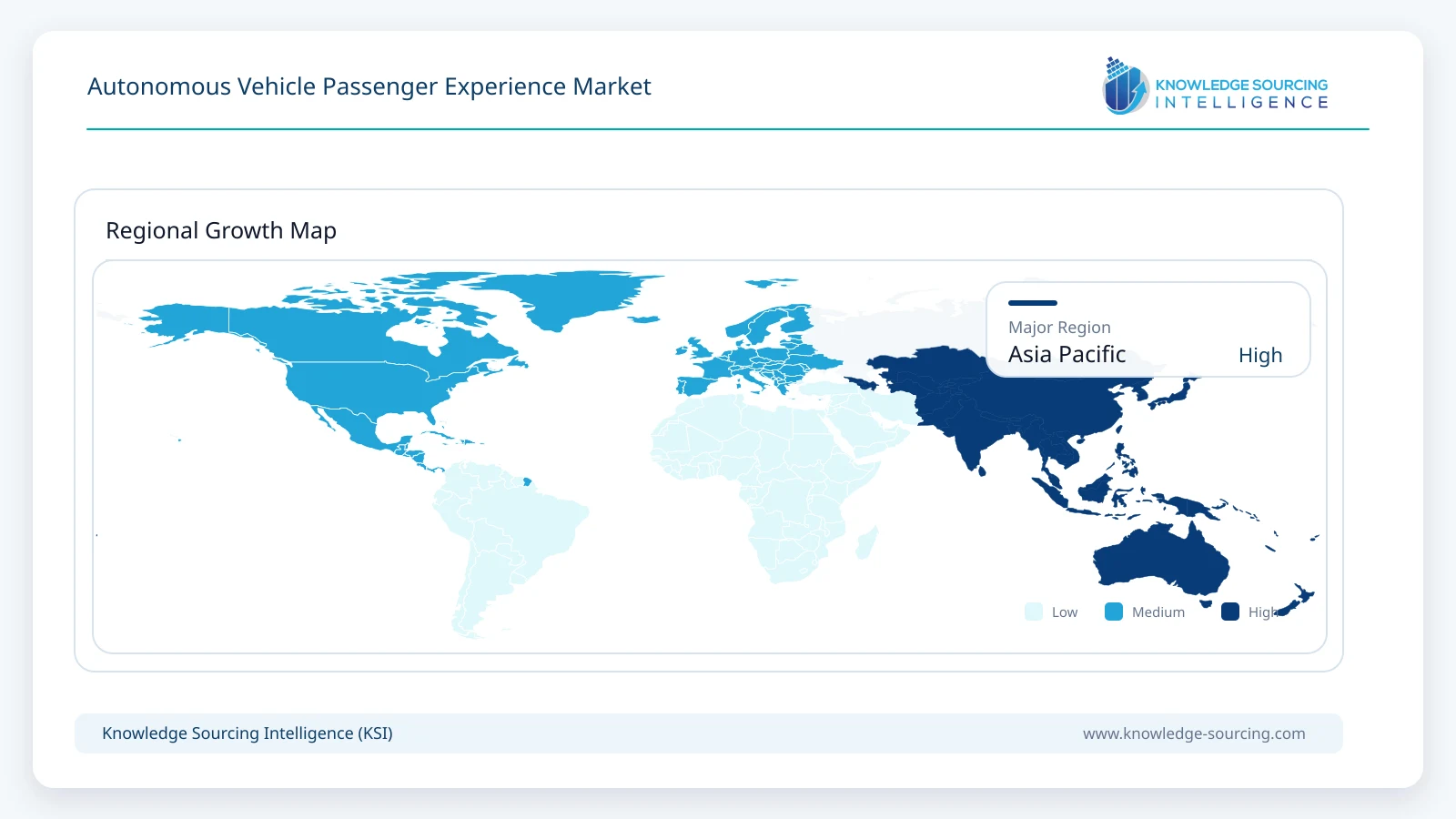
Asia Pacific is the largest regional market and is expected to remain the strongest growth centre through 2031. China is driving rapid commercialization of smart-cabin features, premium EVs and AI-enabled passenger environments, with strong competition around displays, comfort, audio, lighting and personalized digital interaction.
Yanfeng's XiM27 demonstrates this direction through AI-adaptive seating, adaptive lighting, spatial audio and individualized climate control. Toyota Boshoku is developing LOUNZE+ and MOOX-RIDE to create living-space and immersive content experiences, while LG provides displays, sensing and AI technologies from South Korea.
North America
North America is a major high-growth market because Level 4 ride-hailing is already creating real-world passenger-experience requirements. Waymo's Ojai is designed around riders, with a flat floor, tri-screen interface, personalized climate and media controls, accessibility features, and conversational AI.
The region also benefits from HARMAN's automotive AI and digital-cockpit portfolio, Gentherm's microclimate technologies and Magna's adaptive seating capabilities. Continued robotaxi scaling and premium software-defined EV development are expected to increase passenger-experience content per vehicle.
Competitive Landscape
The autonomous vehicle passenger experience market includes smart-cabin, HMI, infotainment, seating, and thermal-comfort suppliers that directly shape the rider-facing environment. Yanfeng, LG Electronics Vehicle Solution, HARMAN, Toyota Boshoku, FORVIA, Gentherm and Magna are directly active in technologies that improve digital interaction, comfort, personalization or immersive cabin experience.
Yanfeng differentiates through complete smart-cabin integration and AI-based personalization. LG combines displays, in-cabin sensing, AI and vehicle computing, while HARMAN provides context-aware digital interaction through platforms such as Ready Engage.
Toyota Boshoku develops mobility spaces and immersive content-support systems, FORVIA combines intelligent seating, HMI and wellness technologies, Gentherm specializes in localized microclimate comfort, and Magna applies adaptive seating to improve physical personalization and wellbeing.
Recent Developments
29 July 2026: Waymo introduced Gemini in Waymo and a redesigned Ojai interface, adding conversational cabin controls, journey information, personalized tri-screen behavior and Calm Mode for a more flexible rider experience.
10 July 2026: Yanfeng's XiM27 received the 2026 Red Dot Design Concept Award; the platform integrates adaptive lighting, spatial audio, individualized climate and AI-based emotion recognition to personalize passenger experience.
29 June 2026: Yanfeng unveiled XiM27, a production-ready smart-cabin platform designed around work, social interaction, rest, entertainment and family scenarios with AI-adaptive seating and centralized cabin control.
28 May 2026: Waymo began welcoming first public riders to the Ojai, a rider-first Level 4 vehicle with a flat floor, three large LED screens, personalized temperature and media controls, and built-in accessibility features.
11 May 2026: Magna detailed its adaptive-seat technology direction, emphasizing occupant recognition, automatic positioning and continuous support adjustment to improve comfort and wellbeing.
23 April 2026: Toyota Boshoku presented LOUNZE+ at Auto China 2026, coordinating seats, door trims and console functions to create a relaxing living-space-oriented mobility environment.
2 February 2026: Toyota Boshoku detailed MOOX-RIDE, an immersive in-vehicle content-experience support system developed around how passengers spend time as autonomous driving expands.
17 December 2025: LG Electronics announced CES 2026 in-vehicle solutions combining display technology, in-cabin sensing and on-device AI to create more personalized driver and passenger experiences.
Market Outlook
The autonomous vehicle passenger experience market is expected to expand rapidly through 2031 as automated vehicles increasingly compete on what occupants can do and how they feel during the journey. Digital entertainment and HMI will remain a major value pool, while conversational AI, individualized comfort and immersive sensory systems are expected to gain share.
Future passenger experiences will become more context-aware, with vehicles identifying occupants, understanding activity and coordinating seating, media, lighting, audio and thermal comfort automatically. Accessibility and motion-comfort design will also become more important as Level 4 mobility reaches broader rider populations.
Asia Pacific is expected to lead global expansion, while North America remains a major commercialization region for Level 4 rider experience. Competitive advantage will depend on software integration, personalization quality, digital content, comfort performance, data privacy, accessibility, and the ability to deliver intuitive experiences across multiple automation levels.
Autonomous Vehicle Passenger Experience Market Scope:
| Report Metric | Details |
|---|---|
| Total Market Size in 2026 | USD 5.30 billion |
| Total Market Size in 2031 | USD 15.90 billion |
| Forecast Unit | USD Billion |
| Growth Rate | 24.6% |
| Study Period | 2021 to 2031 |
| Historical Data | 2021 to 2024 |
| Base Year | 2025 |
| Forecast Period | 2026 – 2031 |
| Segmentation | Experience System, Experience Function, Automation Level, Vehicle Application |
| Companies |
|
Market Segmentation
By Experience System
Digital Entertainment, Displays and HMI
Comfort and Wellness Systems
Connectivity, AI and Digital Services
Lighting, Audio and Immersive Environment
Accessibility and Passenger Convenience
By Experience Function
Comfort, Wellness and Relaxation
Entertainment and Media
Productivity and Communication
Information, Guidance and Cabin Control
Accessibility and Assistance
By Automation Level
SAE Level 3
SAE Level 4 and Above
By Vehicle Application
Personally Owned Autonomous Passenger Vehicles
Robotaxi and Shared Autonomous Mobility
Autonomous Shuttle and Commercial Mobility
By Propulsion
Battery Electric Vehicles
Hybrid Electric Vehicles
Internal Combustion Engine Vehicles
Fuel Cell Electric Vehicles
By Geography
North America
United States
Canada
Mexico
South America
Brazil
Argentina
Others
Europe
Germany
United Kingdom
France
Italy
Spain
Others
Middle East and Africa
Saudi Arabia
UAE
South Africa
Others
Asia Pacific
China
Japan
South Korea
India
Singapore
Others
Table of Contents
1. INTRODUCTION
1.1. Market Overview
1.2. Market Definition
1.3. Scope of the Study
1.4. Market Segmentation
1.5. Currency
1.6. Assumptions
1.7. Base and Forecast Years
1.8. Key Benefits to Stakeholders
2. RESEARCH METHODOLOGY
2.1. Research Design
2.2. Secondary Research
2.3. Primary Research
2.4. Market Estimation
2.5. Segment Modelling
2.6. Data Triangulation and Validation
3. EXECUTIVE SUMMARY
3.1. Key Findings
3.2. Autonomous Vehicle Passenger Experience Market Size, 2026-2031
3.3. Experience System Outlook
3.4. Experience Function Outlook
3.5. Automation Level Outlook
3.6. Vehicle Application Outlook
3.7. Propulsion Outlook
3.8. Regional Opportunity Summary
4. MARKET DYNAMICS
4.1. Market Drivers
4.1.1. Expansion of Level 3 and Level 4 Automated Driving
4.1.2. Growth of Software-Defined Vehicle Architectures
4.1.3. Demand to Reclaim Travel Time
4.1.4. Scaling of Robotaxi and Autonomous Mobility Services
4.1.5. Advances in AI, Sensing and Personalized Comfort
4.2. Market Restraints
4.2.1. High Hardware and Software Cost
4.2.2. Data Privacy and Cybersecurity
4.2.3. Motion Sickness and Sensory Conflict
4.2.4. Uneven Availability of Higher Automation
4.2.5. Integration Complexity
4.3. Market Opportunities
4.4. Porter's Five Forces Analysis
4.5. Industry Value Chain Analysis
4.6. Passenger Experience System Economics
4.7. Privacy, Accessibility and Human-Factors Environment
5. TECHNOLOGY OUTLOOK
5.1. Multi-Screen and Panoramic Display Experience
5.2. Conversational and Generative AI
5.3. Multimodal HMI
5.4. In-Cabin Sensing and Context Recognition
5.5. Adaptive Seating and Wellness
5.6. Personalized Thermal Microclimate
5.7. Adaptive Lighting and Spatial Audio
5.8. Connected Services and Digital Content
5.9. Accessibility and Inclusive Passenger Interfaces
5.10. Motion-Comfort and Anti-Kinetosis Design
6. AUTONOMOUS VEHICLE PASSENGER EXPERIENCE MARKET BY EXPERIENCE SYSTEM
6.1. Introduction
6.2. Digital Entertainment, Displays and HMI
6.3. Comfort and Wellness Systems
6.4. Connectivity, AI and Digital Services
6.5. Lighting, Audio and Immersive Environment
6.6. Accessibility and Passenger Convenience
7. AUTONOMOUS VEHICLE PASSENGER EXPERIENCE MARKET BY EXPERIENCE FUNCTION
7.1. Introduction
7.2. Comfort, Wellness and Relaxation
7.3. Entertainment and Media
7.4. Productivity and Communication
7.5. Information, Guidance and Cabin Control
7.6. Accessibility and Assistance
8. AUTONOMOUS VEHICLE PASSENGER EXPERIENCE MARKET BY AUTOMATION LEVEL
8.1. Introduction
8.2. SAE Level 3
8.3. SAE Level 4 and Above
9. AUTONOMOUS VEHICLE PASSENGER EXPERIENCE MARKET BY VEHICLE APPLICATION
9.1. Introduction
9.2. Personally Owned Autonomous Passenger Vehicles
9.3. Robotaxi and Shared Autonomous Mobility
9.4. Autonomous Shuttle and Commercial Mobility
10. AUTONOMOUS VEHICLE PASSENGER EXPERIENCE MARKET BY PROPULSION
10.1. Introduction
10.2. Battery Electric Vehicles
10.3. Hybrid Electric Vehicles
10.4. Internal Combustion Engine Vehicles
10.5. Fuel Cell Electric Vehicles
11. AUTONOMOUS VEHICLE PASSENGER EXPERIENCE MARKET BY GEOGRAPHY
11.1. North America
11.1.1. United States
11.1.2. Canada
11.1.3. Mexico
11.2. South America
11.2.1. Brazil
11.2.2. Argentina
11.2.3. Others
11.3. Europe
11.3.1. Germany
11.3.2. United Kingdom
11.3.3. France
11.3.4. Italy
11.3.5. Spain
11.3.6. Others
11.4. Middle East and Africa
11.4.1. Saudi Arabia
11.4.2. UAE
11.4.3. South Africa
11.4.4. Others
11.5. Asia Pacific
11.5.1. China
11.5.2. Japan
11.5.3. South Korea
11.5.4. India
11.5.5. Singapore
11.5.6. Others
12. COMPETITIVE ENVIRONMENT AND ANALYSIS
12.1. Major Players and Strategy Analysis
12.2. Market Share Analysis
12.3. Passenger Experience Technology Benchmarking
12.4. Platform Launches and Development Activity
12.5. Competitive Dashboard
13. COMPANY PROFILES
13.1. Yanfeng
13.2. LG Electronics Vehicle Solution Company
13.3. HARMAN International
13.4. Toyota Boshoku Corporation
13.5. FORVIA
13.6. Gentherm Incorporated
13.7. Magna International Inc.
14. APPENDIX
14.1. Currency
14.2. Assumptions
14.3. Base and Forecast Years Timeline
14.4. Key Benefits for Stakeholders
14.5. Research Methodology
14.6. Abbreviations
14.7. Data Sources
Navigate
Trusted by the world's leading organizations











