
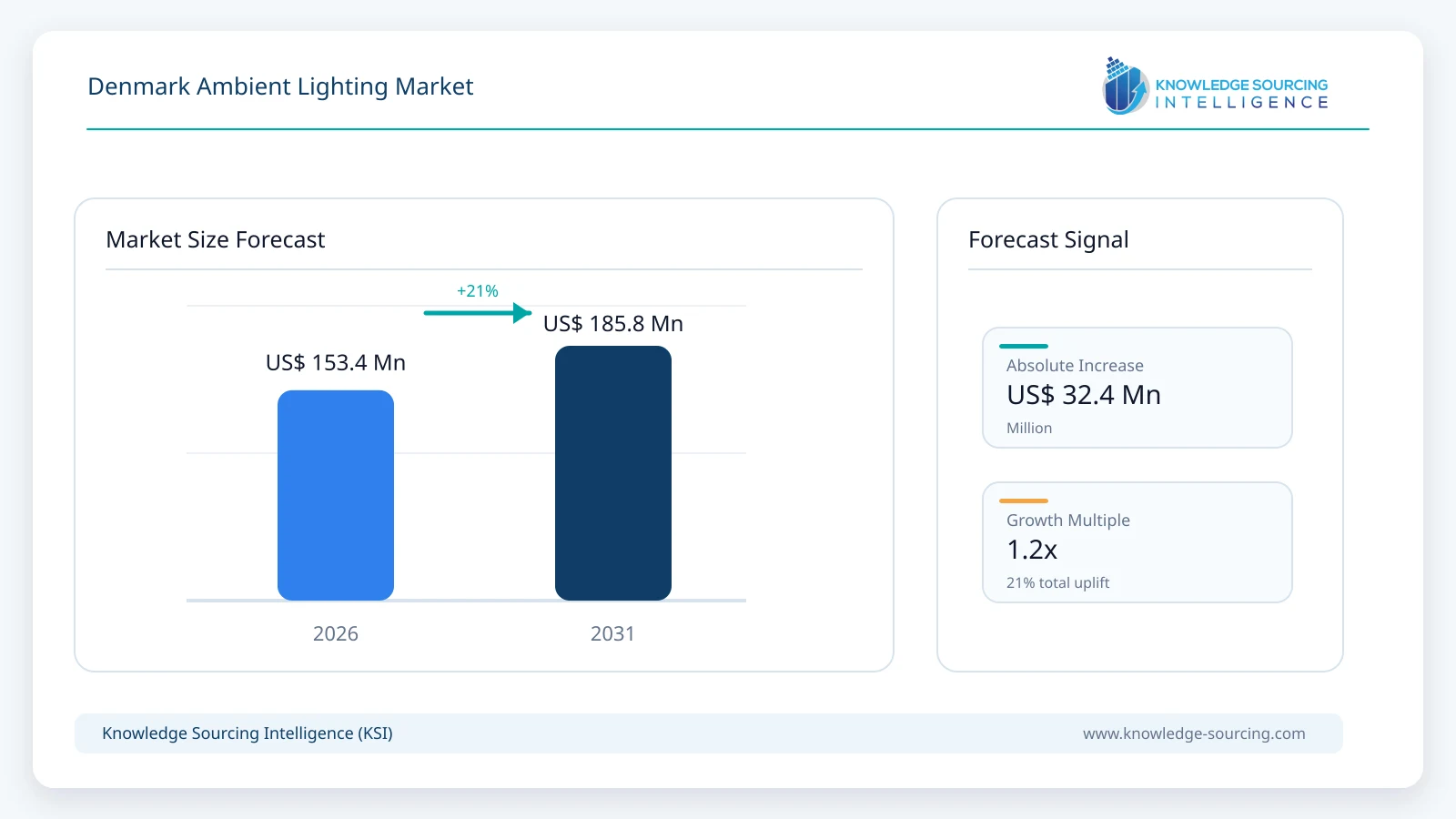
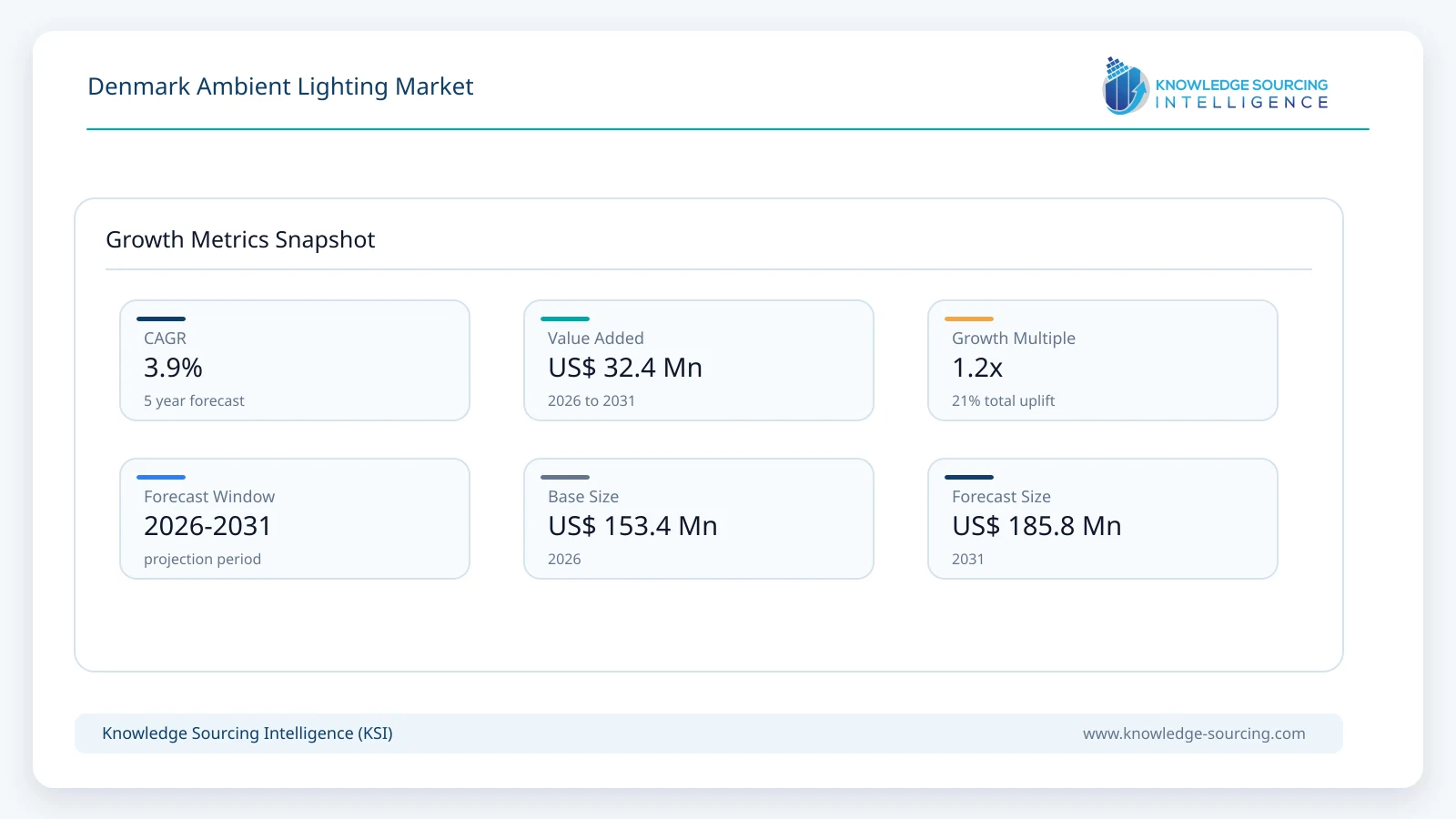
Denmark Ambient Lighting Market is forecast to grow at a CAGR of 3.9%, reaching USD 185.8 million in 2031 from USD 153.4 million in 2026.
Highlights:
- 1Denmark's ambient lighting market is shaped by architectural quality, energy efficiency requirements, and premium design preferences.
- 2Commercial refurbishment and residential renovation projects continue to influence demand for advanced ambient lighting solutions.
- 3LED technology, smart lighting controls, and circular design principles are changing product specifications and procurement decisions.
- 4Public sustainability targets and stricter building efficiency standards are increasing demand for compliant lighting systems.
- 5Danish manufacturers compete through design heritage, product durability, lighting quality, and integrated control capabilities.
Purchasing decisions extend beyond fixture appearance, incorporating lifecycle costs, maintenance requirements, color quality, digital compatibility, and compliance with national and European lighting regulations. Residential renovation activity, commercial refurbishment, hospitality modernization, healthcare facility upgrades, and workplace redesign collectively sustain procurement across multiple customer groups. Rather than focusing solely on replacing conventional luminaires, buyers increasingly specify complete lighting systems capable of integrating occupancy sensors, daylight harvesting, wireless controls, and building management platforms. This shift expands value creation beyond hardware, increasing demand for engineering support, lighting design services, commissioning, and long-term maintenance agreements.
Denmark's lighting industry benefits from internationally recognized product design and close collaboration between architects, lighting designers, electrical contractors, and manufacturers. Premium interior projects frequently prioritize visual comfort, glare control, color rendering, and fixture longevity alongside energy efficiency. As environmental performance receives greater attention, purchasers also evaluate recycled materials, repairability, product documentation, and environmental declarations before awarding contracts.
Commercial value is distributed across product development, manufacturing, specification consulting, installation, digital lighting controls, and aftermarket services. Manufacturers capable of combining architectural design, regulatory compliance, intelligent controls, and sustainable product development remain well positioned as procurement increasingly favors complete lighting solutions instead of standalone luminaires.
Key Market Indicators
Indicator | Latest Evidence | Commercial Meaning |
EU energy performance framework | Revised EPBD (2024) | Building renovations increasingly incorporate energy-efficient lighting alongside broader efficiency upgrades. |
Ecodesign regulation | EU Ecodesign and Energy Labelling rules | Manufacturers must meet stricter efficiency and product performance requirements before market placement. |
LED market transition | LEDs represent the standard lighting technology across new installations | Procurement increasingly emphasizes lighting controls and lifecycle value rather than lamp replacement. |
Digital building integration | Growing adoption of building automation under EU efficiency initiatives | Demand is shifting toward connected lighting compatible with smart building infrastructure. |
Key indicator: The revised Energy Performance of Buildings Directive (EPBD), adopted in 2024, places greater emphasis on improving the energy performance of Europe's building stock.
Commercial meaning: Building renovation programmes increasingly incorporate efficient lighting systems as part of broader energy improvement projects.
Market Drivers
Building renovation programmes are increasing specification of efficient lighting systems.
Denmark continues to prioritize energy-efficient buildings through national implementation of European energy legislation and long-term building decarbonization objectives. Renovation projects frequently replace legacy fluorescent systems with integrated LED ambient lighting that reduce electricity consumption while improving lighting quality. Public authorities, commercial property owners, and institutional buyers increasingly evaluate lighting alongside insulation, ventilation, and digital building controls. Manufacturers therefore compete by supplying complete lighting solutions that simplify installation, reduce maintenance intervals, and comply with evolving efficiency standards rather than supplying individual fixtures alone.
Architectural lighting quality has become an important procurement criterion across commercial and residential projects.
Danish architecture places considerable emphasis on visual comfort, daylight integration, and high-quality interior environments. Architects and lighting consultants increasingly specify luminaires based on glare control, color rendering performance, optical precision, dimming capability, and compatibility with contemporary interior design. Premium residential developments, hospitality facilities, offices, and cultural buildings often require customized lighting layouts instead of standardized fixture packages. Companies including Nordlux A/S, Louis Poulsen A/S, LE KLINT A/S, and Focus Lighting A/S continue expanding product portfolios that combine aesthetic design with technical performance, allowing them to address specification-driven projects where purchasing decisions depend on both visual quality and operational efficiency.
Smart building adoption is increasing demand for connected ambient lighting solutions.
Lighting systems increasingly function as components of wider building management platforms rather than isolated electrical products. Property developers and facility managers seek luminaires capable of integrating occupancy sensors, daylight harvesting, wireless communication protocols, and centralized monitoring systems to reduce operating costs and improve building performance. This requirement is particularly relevant within commercial offices, educational institutions, healthcare facilities, and public buildings where energy management receives continuous attention. Manufacturers are responding through connected lighting platforms, intelligent drivers, digital commissioning tools, and software-enabled maintenance capabilities that strengthen recurring service opportunities beyond initial equipment sales.
Sustainability requirements are reshaping product development and purchasing decisions.
Environmental considerations increasingly influence lighting procurement across Denmark. Buyers evaluate product durability, repairability, material selection, energy consumption, environmental product declarations, and expected service life alongside purchase price. European Ecodesign legislation and circular economy initiatives encourage manufacturers to improve product efficiency while reducing environmental impact throughout the product lifecycle. Several lighting producers have expanded investments in recyclable materials, modular product construction, replaceable components, and sustainability reporting, reflecting growing customer preference for products that support long-term environmental objectives without compromising lighting performance.
Market Restraints and Challenges
Lengthy specification and procurement cycles delay revenue realization.
Ambient lighting products specified for commercial buildings, healthcare facilities, public infrastructure, and hospitality projects typically undergo multiple stages of technical review before purchase approval. Architects, consulting engineers, electrical contractors, facility owners, and procurement authorities evaluate compliance with lighting standards, energy performance, lifecycle cost, maintenance requirements, and compatibility with building management systems before awarding contracts. These extended qualification periods increase project uncertainty for manufacturers and distributors, particularly when construction schedules change or public investment is postponed. Companies therefore maintain broader project pipelines and strengthen relationships with specification consultants to reduce dependence on a limited number of large contracts.
Higher compliance and sustainability documentation requirements increase development costs.
Manufacturers supplying the Danish market must satisfy European legislation covering ecodesign, energy labelling, electrical safety, electromagnetic compatibility, hazardous substances, waste electrical equipment, and product environmental documentation. Commercial buyers increasingly request Environmental Product Declarations (EPDs), lifecycle assessments, recycled material information, and carbon reporting during tender evaluations. Producing and maintaining this documentation requires additional engineering, testing, certification, and compliance resources, creating proportionally higher costs for smaller lighting suppliers than for larger manufacturers with established regulatory teams and international product portfolios.
Input cost volatility and supply-chain dependence continue to affect profitability.
Although supply conditions have improved compared with the disruptions experienced during the early 2020s, lighting manufacturers remain exposed to fluctuations in LED components, electronic drivers, aluminium, plastics, optical materials, and logistics costs. Annual reports and risk disclosures from several international lighting companies continue to identify supplier concentration, component availability, and inflationary cost pressure as operational risks. Premium Danish manufacturers often face additional pressure because higher-quality materials and specialized optical components cannot always be substituted without affecting product performance or design integrity. These factors compress margins when customers resist equivalent price increases.
Intense competition limits pricing flexibility across standard product categories.
The Danish ambient lighting market includes premium domestic manufacturers alongside international suppliers offering standardized LED luminaires at competitive prices. While design-oriented projects continue to reward technical differentiation and architectural quality, routine residential and commercial installations often prioritize total installed cost and energy efficiency. This pricing environment reduces opportunities to increase margins on conventional product lines. Manufacturers increasingly respond by expanding customized solutions, lighting controls, project consulting, after-sales support, and digital services that provide greater differentiation than hardware specifications alone.
Major Segment Analysis
Commercial End-use
The commercial segment represents the most strategically important area of demand because lighting decisions are increasingly linked to energy management, workplace quality, operational efficiency, and compliance with building regulations rather than simple illumination requirements. Offices, retail facilities, hotels, healthcare institutions, educational buildings, and public infrastructure frequently undertake refurbishment projects that replace conventional lighting with integrated LED systems capable of supporting intelligent controls and lower operating costs.
Purchasing decisions within this segment differ from residential applications. Buyers typically evaluate total cost of ownership, maintenance intervals, lighting quality, control compatibility, warranty support, and supplier service capability before awarding contracts. Architects and consulting engineers also influence supplier selection by specifying glare performance, colour rendering, optical distribution, and integration with building management systems during project design.
Competition within the commercial segment therefore extends beyond fixture performance. Manufacturers differentiate themselves through project engineering, customized lighting layouts, digital commissioning support, sustainability documentation, and long-term maintenance capability. These factors increase customer retention and create recurring opportunities through upgrades, replacement programmes, and lighting modernization projects as building owners continue improving operational efficiency.
Competitive Landscape
Competition in the Danish ambient lighting market is primarily specification-driven rather than volume-driven. Domestic manufacturers such as Nordlux A/S, LE KLINT A/S, Louis Poulsen A/S, Focus Lighting A/S, Danish Lighting, Scangrip A/S, and EllisEllis compete across different price points and application areas, reflecting a market that combines premium architectural lighting with functional commercial and residential solutions. Design quality, optical performance, energy efficiency, regulatory compliance, and long product life remain important differentiators, particularly for architect-led and public-sector projects.
Manufacturers are expanding connected lighting capabilities, improving sustainability documentation, and increasing the use of modular product designs that support repair and component replacement throughout the product lifecycle. Competition also extends to lighting design assistance, technical specification support, commissioning services, and post-installation maintenance, as these capabilities strengthen customer relationships and reduce switching opportunities. Established supplier reputations and longstanding collaborations with architects, consulting engineers, and electrical contractors continue to create practical barriers for new entrants attempting to compete solely on product price.
Recent Developments
June 2026: Danish investment company Chr. Augustinus Fabrikker acquired Louis Poulsen from Flos B&B Italia Group, reinforcing Denmark’s premium lighting industry while supporting continued innovation in architectural and ambient lighting solutions.
June 2026: Louis Poulsen presented new decorative and ambient lighting designs during Copenhagen’s 3 Days of Design 2026, highlighting contemporary Danish craftsmanship, atmospheric illumination, and innovative residential and hospitality lighting concepts.
2026: Signify announced the expansion of its European specification lighting portfolio under the Signify brand, introducing additional connected, energy-efficient luminaires that strengthen ambient lighting offerings across Denmark and other European markets.
May 2025: Louis Poulsen launched the PH Aged Brass Collection, reinterpreting Poul Henningsen’s iconic designs with aged brass finishes, delivering warm ambient illumination while celebrating Denmark’s heritage in timeless decorative lighting
Regulatory and Policy Environment
Denmark's ambient lighting market operates within a regulatory framework shaped by both national building rules and European Union legislation. Ecodesign and Energy Labelling Regulations establish minimum energy performance and product information requirements for lighting products placed on the European market. These rules encourage manufacturers to improve efficacy, durability, and lifecycle performance while reducing energy consumption.
Additional legislation, including the Restriction of Hazardous Substances (RoHS) Directive and the Waste Electrical and Electronic Equipment (WEEE) Directive, governs material selection, recycling obligations, and end-of-life product management. Compliance with these requirements has become an established element of product development and market access rather than a secondary consideration.
The revised Energy Performance of Buildings Directive further strengthens the commercial outlook for efficient lighting by encouraging renovation of existing buildings and higher energy performance standards for new construction. Although lighting represents only one component of overall building efficiency, integrated LED systems with occupancy sensing, daylight control, and building automation compatibility increasingly support compliance with broader energy performance objectives.
Public procurement policies also influence supplier selection. Government and municipal projects frequently evaluate lifecycle cost, environmental documentation, maintenance requirements, and technical quality in addition to purchase price. Consequently, manufacturers increasingly invest in product testing, digital product documentation, and sustainability reporting to improve competitiveness during public tenders.
Outlook and Strategic Implications
Demand throughout the 2026-2031 forecast period is expected to remain closely linked to Denmark's building renovation activity, energy efficiency objectives, and continued adoption of intelligent building technologies rather than rapid expansion in new construction alone. Commercial property owners, healthcare providers, hospitality operators, retailers, and public authorities are expected to prioritize lighting systems that reduce operating costs while improving occupant comfort and supporting digital facility management.
The market is also likely to shift further toward integrated lighting ecosystems. Buyers increasingly evaluate complete solutions combining luminaires, sensors, software, wireless connectivity, and maintenance services instead of procuring standalone fixtures. This transition should expand opportunities for manufacturers capable of providing engineering expertise, commissioning support, and long-term service contracts in addition to hardware.
Key strategic implications include:
Manufacturers: Continued investment in connected lighting, modular product architecture, sustainability reporting, and circular product design is expected to strengthen competitiveness as procurement criteria become more comprehensive.
Architects and lighting consultants: Greater emphasis on visual comfort, energy efficiency, and digital integration will increase the importance of specification-led product selection during project design.
Electrical contractors and system integrators: Demand is likely to grow for expertise in commissioning, interoperability testing, wireless lighting controls, and integration with broader building management systems.
Public and commercial buyers: Lifecycle cost, environmental documentation, maintenance requirements, and software compatibility are expected to influence purchasing decisions more strongly than initial acquisition cost.
Technology providers and service partners: Opportunities should expand through cloud-enabled monitoring, predictive maintenance, data-driven energy optimization, and retrofit solutions supporting existing building stock.
Rather than competing primarily through fixture pricing, the Danish ambient lighting market is expected to reward suppliers capable of combining architectural design quality, regulatory compliance, digital functionality, reliable supply chains, and measurable lifecycle value. As sustainability requirements and intelligent building adoption continue to influence procurement, competitive advantage will increasingly depend on delivering integrated lighting solutions that align with long-term operational and environmental objectives.
Denmark Ambient Lighting Market Scope:
| Report Metric | Details |
|---|---|
| Total Market Size in 2026 | USD 153.4 million |
| Total Market Size in 2031 | USD 185.8 million |
| Forecast Unit | Million |
| Growth Rate | 3.9% |
| Study Period | 2021 to 2031 |
| Historical Data | 2021 to 2024 |
| Base Year | 2025 |
| Forecast Period | 2026 – 2031 |
| Segmentation | Type, End-Use Industry |
| Companies |
|
Market Segmentation
By Type
- Surface-mounted Light
- Track Light
- Suspended/Pendant Light
- Recessed Light
- Wall-mounted Lights
- Others
By End-Use Industry
- Residential
- Commercial
- Healthcare
- Hospitality
- Retail
- Industrial
- Automotive
- Others
Table of Contents
1. INTRODUCTION
1.1. Market Overview
1.3. Market Definition
1.4. Market Segmentation
2. RESEARCH METHODOLOGY
2.1. Research Data
2.2. Assumptions
3. EXECUTIVE SUMMARY
3.1. Research Highlights
4. MARKET DYNAMICS
4.1. Market Drivers
4.2. Market Restraints
4.3. Porter’s Five Force Analysis
4.3.1. Bargaining Power of Suppliers
4.3.2. Bargaining Power of Buyers
4.3.3. The Threat of New Entrants
4.3.4. Threat of Substitutes
4.3.5. Competitive Rivalry in the Industry
4.4. Industry Value Chain Analysis
5. DENMARK AMBIENT LIGHTING MARKET BY TYPE
5.1. Introduction
5.2. Surface-mounted Light
5.3. Track Light
5.4. Suspended/ Pendant Light
5.5. Recessed Light
5.6. Wall-mounted Lights
5.7. Others
6. DENMARK AMBIENT LIGHTING MARKET BY END-USE INDUSTRY
6.1. Introduction
6.2. Residential
6.3. Commercial
6.4. Healthcare
6.5. Hospitality
6.6. Retail
6.7. Industrial
6.8. Automotive
6.9. Others
7. COMPETITIVE ENVIRONMENT AND ANALYSIS
7.1. Major Players and Strategy Analysis
7.2. Emerging Players and Market Lucrative
7.3. Mergers, Acquisitions, Agreements, and Collaborations
7.4. Vendor Competitiveness Matrix
8. COMPANY PROFILES
8.1. Nordlux A/S
8.2. LE KLINT A/S
8.3. Louis Poulsen A/S
8.4. Focus Lighting A/S
8.5. Danish Lighting
8.6. Scangrip A/S
8.7. EllisEllis
Navigate
Trusted by the world's leading organizations











