
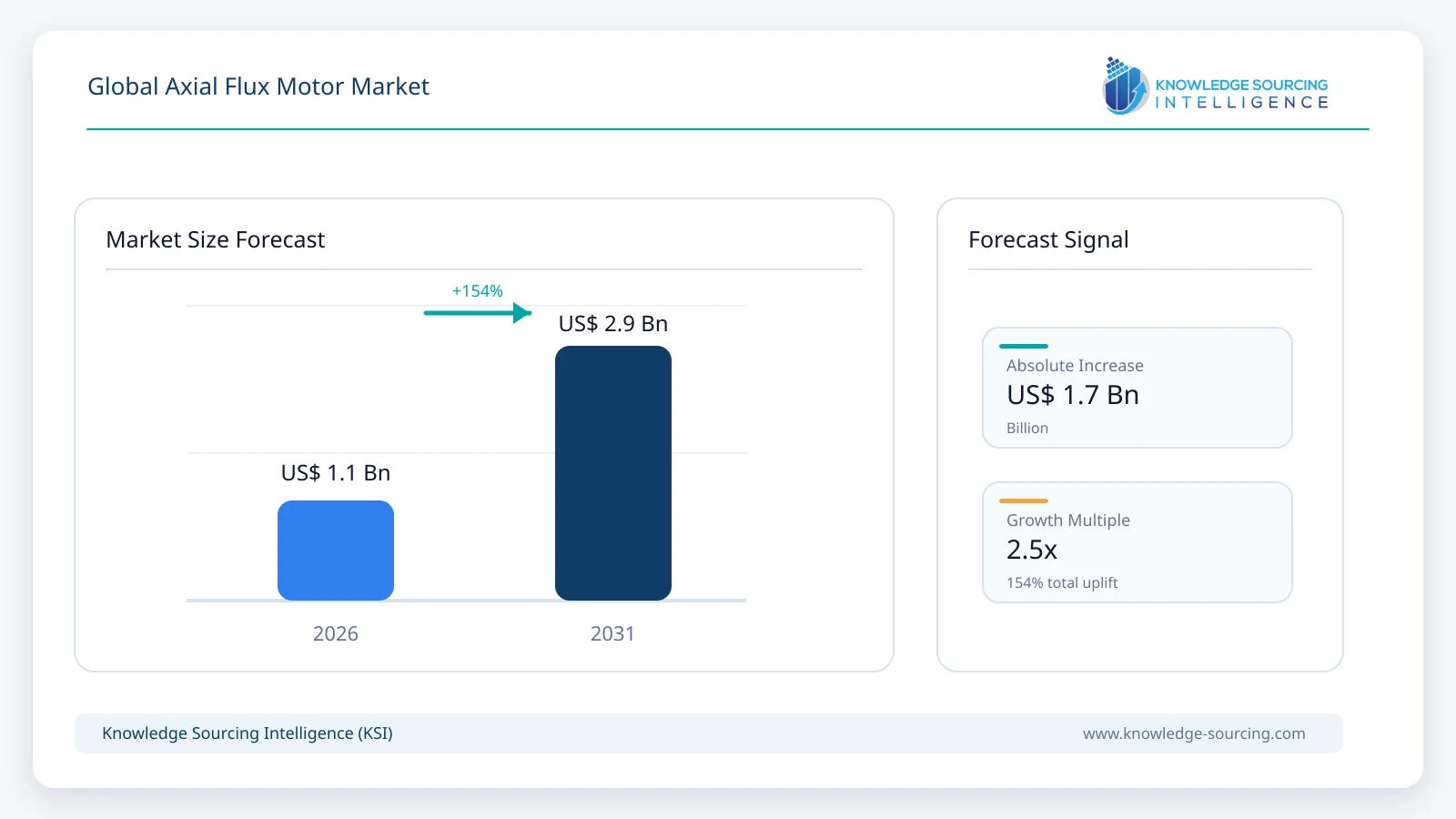
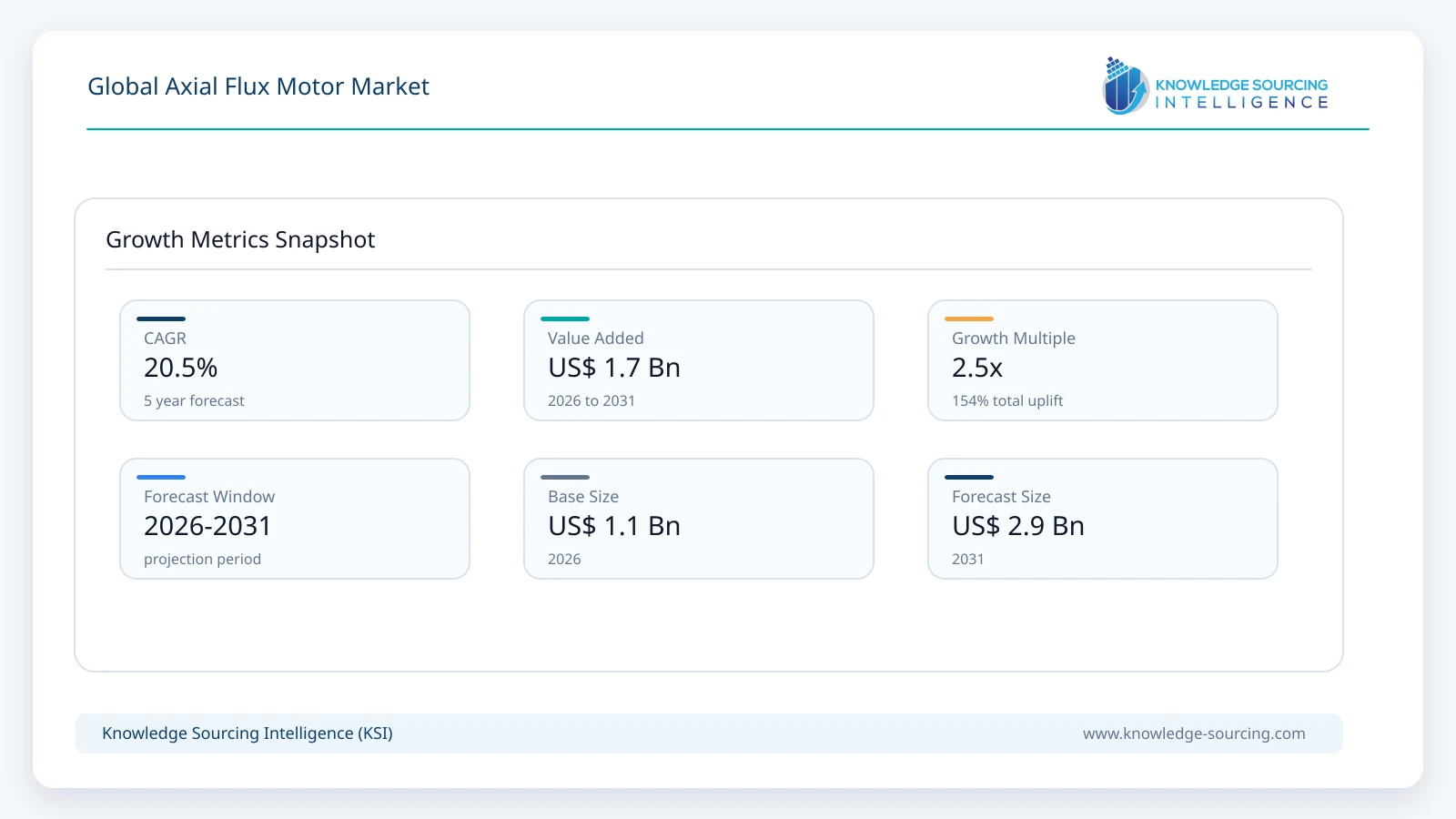
The global axial flux motor market is projected to increase from USD 1.12 billion in 2026 to USD 2.85 billion in 2031, representing a CAGR of 20.5% across the forecast period.
Highlights:
- 1Automotive applications account for approximately 46% of global axial flux motor revenue in 2026.
- 2Aerospace and unmanned aerial vehicle applications grow at approximately 27.5% CAGR through 2031.
- 3Liquid-cooled axial flux motors generate approximately USD 650 million in revenue during 2026.
- 4Dual-rotor/single-stator configurations represent approximately 54% of the global market in 2026.
- 5The 80–160 kW power segment generates approximately USD 347 million in revenue during 2026.
- 6Europe accounts for approximately 38% of the global axial flux motor market in 2026.
- 7Large-scale automotive production is increasing as suppliers expand manufacturing capacity.
Axial flux motors compete where system designers place a premium on torque density, low axial length and weight reduction. In automotive powertrains, the topology can free packaging space around the axle or hybrid transmission while reducing motor mass. In aircraft, marine and off-highway equipment, the same geometry supports direct-drive or high-torque propulsion configurations in which every kilogram and centimetre matters. The technology is not a direct substitute for every radial flux motor. Radial machines retain mature manufacturing infrastructure, a broad supplier base and strong economics at scale. Axial flux adoption is therefore strongest where the system-level value of compactness, torque density or efficiency offsets the additional manufacturing complexity.
The competitive environment is diversifying by motor architecture. YASA uses a yokeless and segmented armature approach optimized for high-performance mobility. Infinitum commercializes an axial air-core motor with a printed circuit board stator for industrial and mobility applications. Turntide offers stackable liquid-cooled axial flux motors across commercial vehicle and heavy-duty power classes, while EMRAX, Evolito and Beyond Motors target aerospace, marine and specialty propulsion. WEG has extended the topology into industrial equipment through the W80 AXgen. This widening application base reduces dependence on any single automotive program and supports a broader revenue pool through 2031.
Market Dynamics
Series Automotive Production Is Moving Axial Flux Beyond Niche Programs
Automotive industrialization is the strongest near-term growth driver. YASA established volume credibility through Ferrari and Lamborghini hybrid programs, and Mercedes-Benz has now moved the topology into large-scale production for the new high-performance electric AMG platform. Mercedes-Benz states that the Berlin-Marienfelde production system uses approximately 100 manufacturing processes, including 35 processes described as new globally within its production network. This matters because axial flux motors historically faced greater difficulty in automated assembly, rotor handling, magnet placement and thermal control than conventional radial machines. As these production processes become repeatable, the commercial discussion shifts from whether axial flux can deliver high power density to whether it can meet automotive cost, quality and cycle-time requirements at sustained volume.
Power Density and Packaging Advantages Expand Adoption Beyond Passenger Vehicles
High torque and power density create opportunities in applications that cannot easily accommodate a conventional long cylindrical motor. Turntide's axial flux portfolio spans compact motors for electrified commercial vehicles through high-output units with peak ratings above 600 kW, while Infinitum positions its air-core design across commercial vehicles, aerospace, marine, construction and agricultural equipment. In aviation, Evolito's E800 integrates an axial flux motor and controls into a 110 kW continuous-power electric engine and is progressing toward civil certification. EMRAX also supplies axial flux machines across aircraft, marine, automotive and industrial projects. These markets are smaller in unit volume than passenger cars but can support higher motor values because system weight, redundancy, certification and packaging carry greater economic importance.
Manufacturing Investment Is Reducing a Historical Commercialization Barrier
Manufacturing scale is becoming a competitive differentiator. Magnax's EUR 35.5 million investment announced in March 2026 supports its transition from engineering development toward industrial-scale supply. Turntide was selected in August 2026 for a UK Government-supported GBP 17 million project intended to accelerate volume production of axial flux motors. YASA's Oxfordshire investment expanded production beyond 25,000 units annually, while Mercedes-Benz established a dedicated large-scale manufacturing footprint in Berlin. The increasing availability of purpose-built winding, assembly, magnet-placement and end-of-line testing equipment should lower unit costs and improve repeatability, particularly as suppliers standardize platforms across several torque and power classes.
Materials, Cost and Thermal Control Remain Key Constraints
Axial flux architectures still face commercialization constraints. High-performance permanent-magnet designs can be exposed to neodymium and dysprosium supply volatility, while thin air gaps and disc-shaped rotors require tight dimensional control. Sustained high-power operation also creates demanding cooling requirements, especially in automotive and aerospace applications where compact packaging reduces thermal headroom. YASA's 2026 rare-earth-free development program illustrates the industry's response to magnet-supply risk, but alternative materials must preserve torque density and efficiency without creating new cost or manufacturability penalties. Radial flux motors also benefit from decades of automated production learning, meaning axial flux platforms must demonstrate a compelling system-level advantage rather than only laboratory power-density records.
Technological Outlook
Yokeless and Segmented Armature Architectures
Yokeless motor architectures remove part of the conventional stator back iron and concentrate magnetic material where it contributes most directly to torque production. YASA's segmented armature approach is the most commercially visible example and has demonstrated how a thin motor can deliver high torque density without requiring an equally long active magnetic path. Further development is focused on cooling, high-speed operation, automated segment manufacture and reduced rare-earth dependence. The architecture is especially relevant to performance automotive and compact e-drive applications where motor length directly affects drivetrain packaging.
Air-Core and Printed Circuit Board Stators
Air-core axial flux designs reduce iron-related losses and can simplify portions of the stator structure. Infinitum uses a printed circuit board stator between two magnet rotors, combining the motor with integrated variable-frequency drive capability for industrial and commercial applications. This approach targets efficiency, serviceability and lower material mass rather than maximum traction-motor torque alone. Through 2031, air-core designs can gain further relevance in heating, ventilation and air conditioning, data centres, pumps and auxiliary mobility systems where part-load efficiency and energy consumption matter over long operating hours.
Cooling, Stacking and High-Voltage Integration
Liquid cooling is becoming increasingly important as axial flux machines move into higher continuous-power classes. Turntide's high-voltage axial flux portfolio uses indirect liquid cooling and supports operation at up to approximately 850 VDC across several products. Stacking is another advantage of the disc geometry because multiple motor modules can be combined to raise torque or power without redesigning the entire electromagnetic platform. EMRAX and Beyond Motors also emphasize stackable configurations for aviation, marine and heavy-duty propulsion. These approaches support platform reuse across several applications and can improve development economics for lower-volume customers.
Global Axial Flux Motor Market Segment Analysis
By Application
Automotive
Automotive is the largest application segment, accounting for approximately 46% of global axial flux motor revenue in 2026. Adoption is concentrated in high-performance passenger vehicles, premium hybrid systems and emerging commercial-vehicle programs rather than the full electric-vehicle market. YASA motors are already used in Ferrari and Lamborghini applications, while Mercedes-Benz began large-scale production for the new electric AMG platform in June 2026. Schaeffler has also developed axial flux technology for sports-car applications, and Turntide is targeting commercial vehicles and hybrid heavy-duty systems. The segment benefits from high unit values and rapid industrialization, but penetration into mass-market passenger cars depends on manufacturing cost, magnet supply and durability at scale.
By Application
Aerospace and UAV
Aerospace and unmanned aerial vehicle applications are forecast to record the fastest growth, at approximately 27.5% CAGR through 2031. Weight sensitivity makes the power-to-mass advantage of axial flux motors especially valuable in electric aircraft, hybrid-electric propulsion, electric vertical take-off and landing platforms and large unmanned systems. Evolito is developing certifiable axial flux electric engines, EMRAX supplies motors used in aviation and vertical-flight applications, and several newer suppliers are designing stackable platforms for higher-power aircraft. Certification cycles remain long, but each successful program carries relatively high motor and control value, allowing aerospace revenue to expand faster than unit volumes alone would suggest.
Market and Demand Indicators
Indicator | Latest Development | Market Impact |
Large-scale automotive production | Mercedes-Benz started axial flux motor production in Berlin in June 2026 across seven production lines. | Confirms transition from specialist programs toward industrial automotive volume. |
UK production capacity | YASA upgraded its Oxfordshire facility to exceed 25,000 motors annually. | Strengthens near-term supply for premium automotive customers. |
Volume-production funding | Turntide joined a GBP 17M UK-backed project in August 2026. | Supports manufacturing scale for commercial-vehicle and heavy-duty applications. |
Industrialization capital | Magnax announced EUR 35.5M of investment in March 2026. | Funds transition from engineering development to industrial-scale technology supply. |
Power-density development | YASA demonstrated a 750 kW prototype at 12.7 kg in October 2025. | Extends the performance ceiling for compact high-output propulsion. |
Rare-earth diversification | YASA launched a UK-backed rare-earth-free axial flux development program in August 2026. | Addresses magnet supply concentration and long-term material risk. |
Europe Market Analysis
Europe is the largest regional market, representing approximately 38% of global axial flux motor revenue in 2026. The region combines the deepest concentration of specialist motor developers with premium automotive customers willing to pay for packaging and power-density advantages.
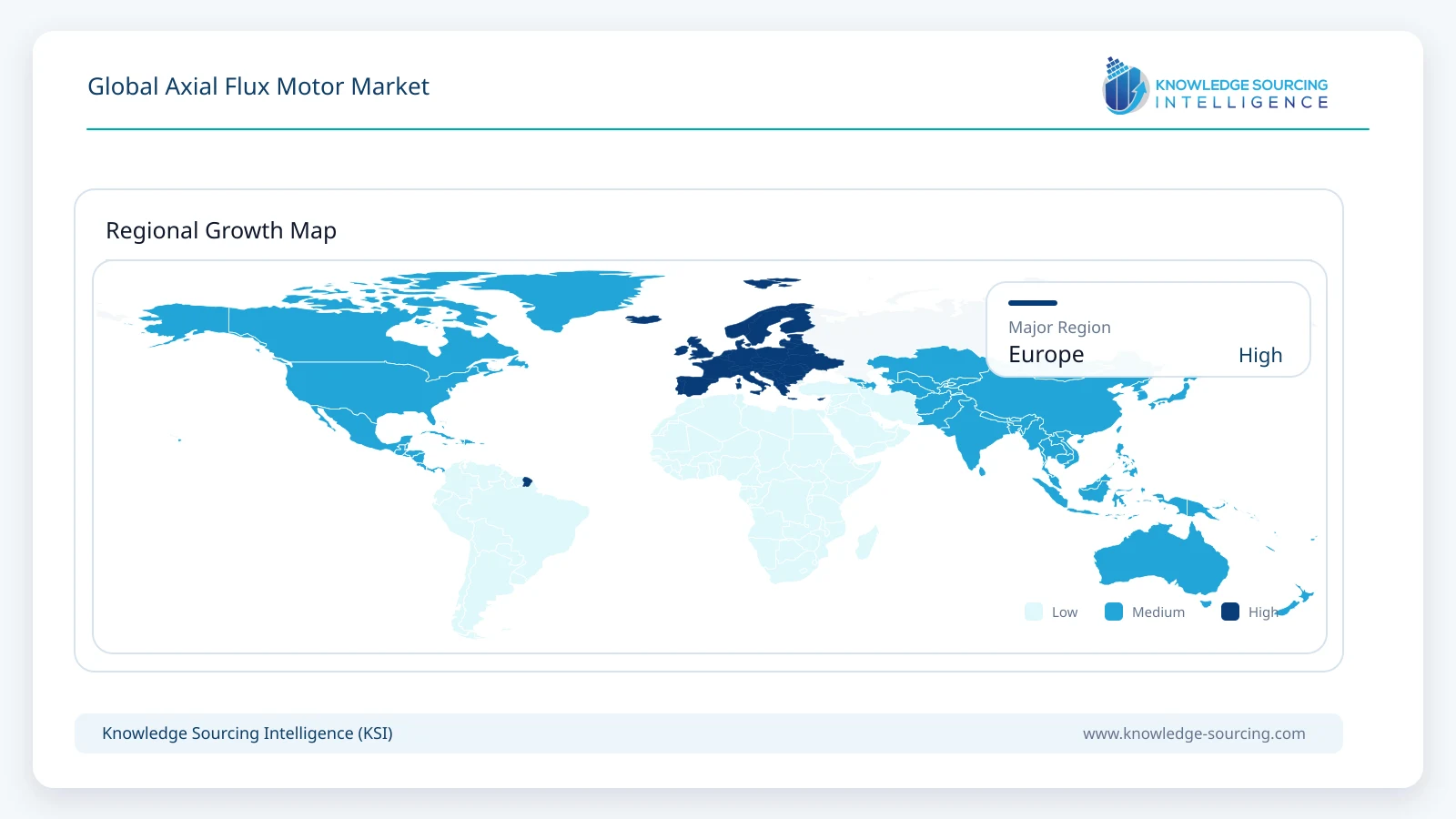
The United Kingdom remains particularly important through YASA, Turntide, Evolito and Agni Motors, while continental Europe contributes EMRAX in Slovenia, Whylot in France, Magnax in Belgium, Miba in Austria and Schaeffler and Mercedes-Benz in Germany. The start of Mercedes-Benz large-scale production in Berlin creates an important industrial anchor because it links specialist axial flux intellectual property to an established automotive manufacturing network.
European growth is also becoming less dependent on supercars. Turntide is positioning axial flux systems for commercial vehicles, hybrid off-highway applications and industrial uses. Evolito is pursuing certified aerospace propulsion, while WEG's W80 AXgen extends axial flux architecture into industrial equipment in Europe and North America. Miba has moved an axial flux system into series production for commercial-vehicle hydraulic applications. This widening demand base supports a more durable regional market through 2031, although Europe remains exposed to rare-earth magnet supply chains and must continue investing in automated motor production and alternative material pathways.
Competitive Landscape
The competitive landscape combines specialized axial flux developers, diversified motor manufacturers and large automotive suppliers. YASA has the strongest visible position in premium automotive series production and benefits from Mercedes-Benz ownership and manufacturing investment. Turntide offers a broad stackable motor range for commercial and heavy-duty electrification, while Magnax is scaling its yokeless platform for industrial and mobility markets. Infinitum differentiates through an air-core printed circuit board stator architecture for industrial efficiency applications. Evolito and EMRAX have strong positions in electric aviation and specialty propulsion, while Schaeffler, WEG and Miba bring larger-scale manufacturing and customer access from established industrial businesses.
Competitive advantage is increasingly determined by manufacturability rather than electromagnetic performance alone. Suppliers must combine power density with predictable thermal behaviour, magnet sourcing, automated assembly, quality control and integration with inverters and gear systems. Automotive suppliers that can demonstrate high-volume yield and functional safety gain an advantage in traction applications, while aerospace suppliers require certification capability and very high reliability. Industrial customers place more weight on lifecycle efficiency, serviceability and compatibility with existing drive systems. These differing requirements are encouraging suppliers to specialize rather than converge on one universal axial flux architecture.
Recent Developments
September 2026: Turntide showcased compact high-torque axial flux motor systems for commercial vehicles at IAA Transportation.
August 2026: Turntide was selected for a GBP 17 million UK Government-supported project to accelerate volume production of axial flux motors.
August 2026: YASA secured UK Government funding to develop fully rare-earth-free and heavy-rare-earth-free axial flux motor technologies.
June 2026: Mercedes-Benz started large-scale axial flux motor production at Berlin-Marienfelde for the new electric Mercedes-AMG GT 4-Door Coupe.
March 2026: Magnax announced EUR 35.5 million of investment from Pan-International and partners to industrialize its axial flux technology.
October 2025: YASA reported a 750 kW, 12.7 kg axial flux prototype, equivalent to 59 kW/kg peak power density.
Global Axial Flux Motor Market Scope:
| Report Metric | Details |
|---|---|
| Total Market Size in 2026 | USD 1.12 billion |
| Total Market Size in 2031 | USD 2.85 billion |
| Forecast Unit | USD Billion |
| Growth Rate | 20.5% |
| Study Period | 2021 to 2031 |
| Historical Data | 2021 to 2024 |
| Base Year | 2025 |
| Forecast Period | 2026 – 2031 |
| Segmentation | Motor Configuration, Cooling, Power Rating, Application, Geography |
| Companies |
|
Market Segmentation
By Motor Configuration
Single-Rotor / Single-Stator
Dual-Rotor / Single-Stator
Single-Rotor / Dual-Stator
Multi-Disc and Stacked Configurations
By Cooling
Air-Cooled
Liquid-Cooled
Combined and Other Cooling
By Power Rating
Up to 15 kW
15-80 kW
80-160 kW
Above 160 kW
By Application
Automotive
Industrial Machinery and HVAC
Aerospace, UAV and eVTOL
Marine
Off-Highway and Robotics
Others
By Geography
North America
United States
Canada
Mexico
South America
Brazil
Argentina
Rest of South America
Europe
Germany
United Kingdom
France
Italy
Benelux
Rest of Europe
Middle East and Africa
Saudi Arabia
United Arab Emirates
South Africa
Rest of Middle East and Africa
Asia Pacific
China
Japan
India
South Korea
Australia
Rest of Asia Pacific
Table of Contents
1. EXECUTIVE SUMMARY
2. MARKET SNAPSHOT
2.1. Market Overview
2.2. Market Segmentation
3. BUSINESS LANDSCAPE
3.1. Market Drivers
3.1.1. Series Automotive Production Is Moving Axial Flux Beyond Niche Programs
3.1.2. Power Density and Packaging Advantages Expand Adoption Beyond Passenger Vehicles
3.1.3. Manufacturing Investment Is Reducing a Historical Commercialization Barrier
3.2. Market Restraints
3.2.1. Materials, Cost and Thermal Control Remain Key Constraints
3.3. Market Opportunities
3.4. Porter's Five Forces Analysis
3.5. Industry Value Chain Analysis
3.6. Standards and Regulatory Landscape
4. TECHNOLOGICAL OUTLOOK
4.1. Yokeless and Segmented Armature Architectures
4.2. Air-Core and Printed Circuit Board Stators
4.3. Cooling, Stacking and High-Voltage Integration
4.4. Rare-Earth-Free and Alternative Magnet Pathways
5. GLOBAL AXIAL FLUX MOTOR MARKET BY MOTOR CONFIGURATION
5.1. Single-Rotor / Single-Stator
5.2. Dual-Rotor / Single-Stator
5.3. Single-Rotor / Dual-Stator
5.4. Multi-Disc and Stacked Configurations
6. GLOBAL AXIAL FLUX MOTOR MARKET BY COOLING
6.1. Air-Cooled
6.2. Liquid-Cooled
6.3. Combined and Other Cooling
7. GLOBAL AXIAL FLUX MOTOR MARKET BY POWER RATING
7.1. Up to 15 kW
7.2. 15-80 kW
7.3. 80-160 kW
7.4. Above 160 kW
8. GLOBAL AXIAL FLUX MOTOR MARKET BY APPLICATION
8.1. Automotive
8.2. Industrial Machinery and HVAC
8.3. Aerospace, UAV and eVTOL
8.4. Marine
8.5. Off-Highway and Robotics
8.6. Others
9. GLOBAL AXIAL FLUX MOTOR MARKET BY GEOGRAPHY
9.1. North America
9.1.1. United States
9.1.2. Canada
9.1.3. Mexico
9.2. South America
9.2.1. Brazil
9.2.2. Argentina
9.2.3. Rest of South America
9.3. Europe
9.3.1. Germany
9.3.2. United Kingdom
9.3.3. France
9.3.4. Italy
9.3.5. Benelux
9.3.6. Rest of Europe
9.4. Middle East and Africa
9.4.1. Saudi Arabia
9.4.2. United Arab Emirates
9.4.3. South Africa
9.4.4. Rest of Middle East and Africa
9.5. Asia Pacific
9.5.1. China
9.5.2. Japan
9.5.3. India
9.5.4. South Korea
9.5.5. Australia
9.5.6. Rest of Asia Pacific
10. COMPETITIVE ENVIRONMENT AND ANALYSIS
10.1. Major Players and Strategy Analysis
10.2. Market Share Analysis
10.3. Mergers, Investments, Agreements and Collaborations
10.4. Competitive Dashboard
11. COMPANY PROFILES
11.1. YASA Limited (Mercedes-Benz Group)
11.2. Turntide Technologies
11.3. Magnax BV
11.4. Infinitum
11.5. Evolito Ltd.
11.6. EMRAX d.o.o.
11.7. Whylot SAS
11.8. Donut Lab
11.9. Schaeffler AG
11.10. WEG S.A.
11.11. Miba AG
11.12. Bharat Heavy Electricals Limited (BHEL)
11.13. Beyond Motors
11.14. Nidec Corporation
11.15. Agni Motors Ltd.
12. RECENT DEVELOPMENTS
13. APPENDIX
13.1. Currency
13.2. Assumptions
13.3. Base and Forecast Years Timeline
13.4. Research Methodology
13.5. Abbreviations
Navigate
Trusted by the world's leading organizations











