
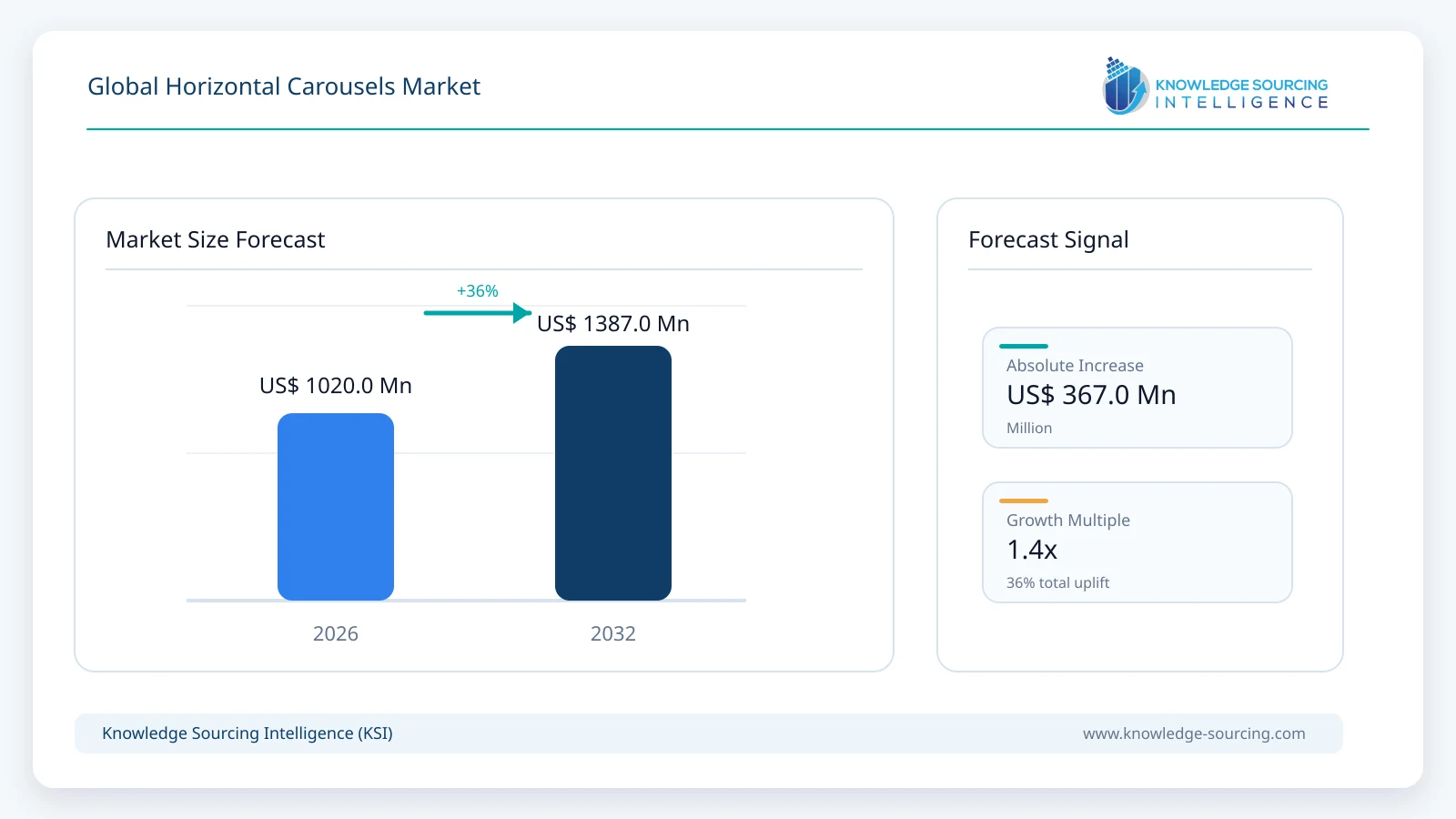
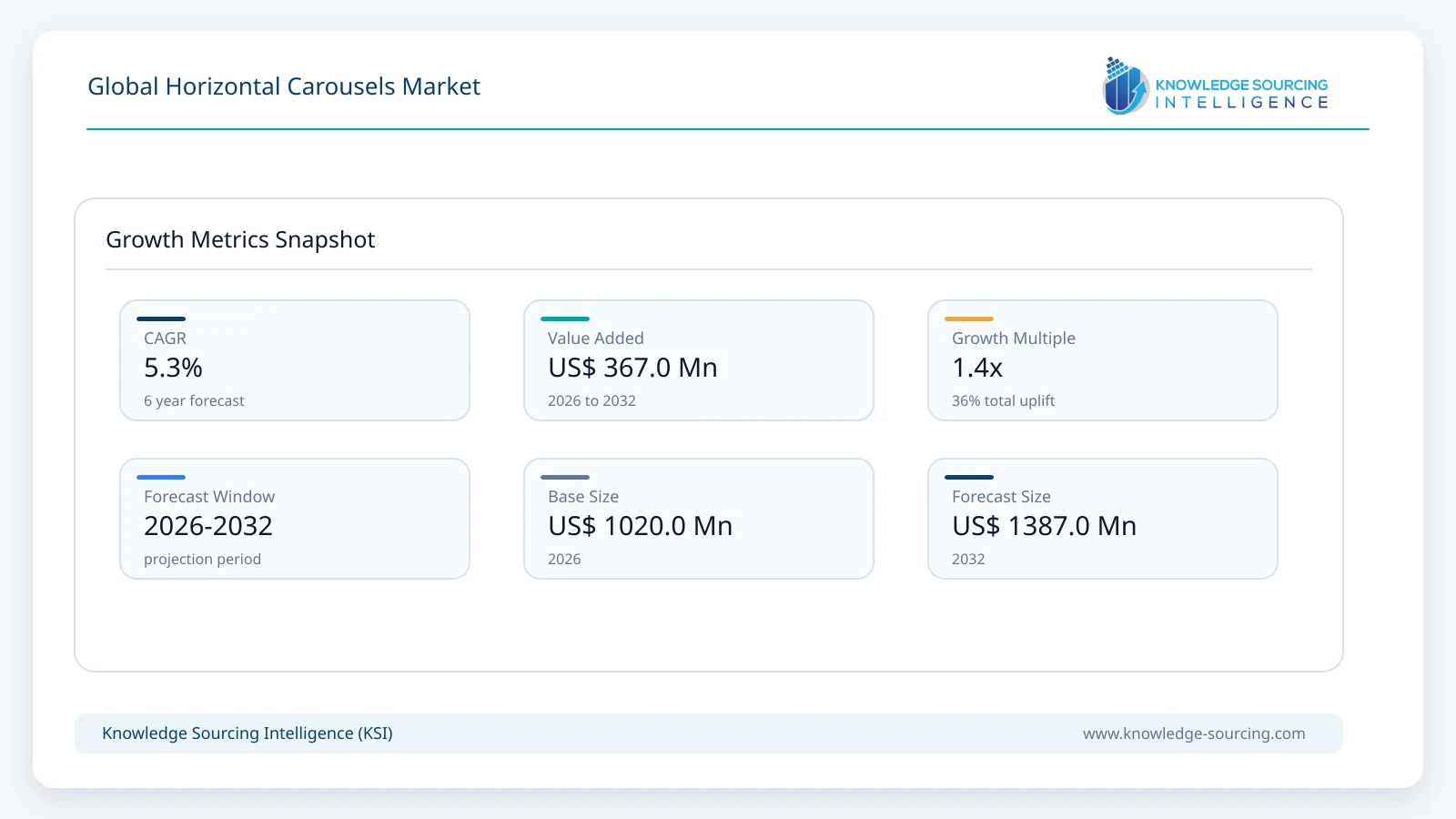
The global horizontal carousels market is estimated at US$1,020 million in 2026 and is projected to reach US$1,387 million by 2032, growing at a compound annual growth rate of 5.26% during the forecast period.
Highlights:
- 1Bottom-drive carousels are estimated to generate US$459 million in 2026 as buyers specify higher load capacity and demanding duty cycles.
- 2Twin-bin configurations are projected to grow at a 7.2% CAGR during 2026–2032 as additional pick faces support dense, high-throughput workstations.
- 3Manufacturing is estimated to represent 27.5% of 2026 market revenue, led by parts storage, kitting and production replenishment.
- 4Pharmaceutical applications are projected to reach US$255 million in 2032 as controlled access and accurate small-item picking remain important.
- 5North America is estimated at US$330 million in 2026, supported by warehouse modernization and a developed supplier and integrator network.
- 6Asia Pacific is projected to generate US$466 million in 2032 as distribution and manufacturing sites invest in goods-to-person picking.
Horizontal carousels are evaluated against static shelving, vertical lift modules, shuttle systems and other automated storage. Their advantage is clearest when they reduce walking and search time without requiring a new high-bay building. A carousel pod can position the next bin while the operator picks from another unit, improving workstation utilization. Actual productivity depends on order mix, replenishment practice and software sequencing, so equipment capacity alone is a poor measure of value.
Market Dynamics
Labor availability, order-line growth and pressure to use existing floor space support investment. A warehouse with thousands of slow- or medium-moving items can reduce travel by bringing inventory to a fixed pick point. The economic case becomes stronger when the system also improves accuracy, shortens training and supports later order cutoffs. However, customers typically approve the project only after comparing total installed cost with the labor and space savings available in their own workflow.
Capital cost and integration effort restrain adoption. The carousel must fit the building geometry, item dimensions, load profile and fire and safety requirements. Warehouse management software needs to maintain location accuracy and coordinate picking with replenishment, packing and shipping. An attractive equipment quote can become less compelling if software changes, guarding, electrical work or downtime during installation are large. Service availability is important because a stopped carousel can interrupt several orders at once.
Competitive systems continue to improve. Vertical lift modules use building height efficiently and can suit changing item dimensions; shuttle systems support high throughput in larger automated facilities. Horizontal carousels retain an advantage in low-ceiling sites and in compact pods with many pick locations. Suppliers that can configure the full workstation and prove throughput with the customer's order data are better positioned than those selling storage density alone.
Technology and Product Economics
Top-drive carousels
Top-drive systems are estimated at US$357 million in 2026 and US$452 million in 2032. They are suited to standard and lighter-duty applications where a simpler drive arrangement and moderate loads meet the requirement. Buyers should test carrier capacity, track wear and access for maintenance against expected operating hours. The lower entry cost can be attractive, but the application must remain within the design's load and duty limits.
Bottom-drive carousels
Bottom-drive systems form the largest product category, estimated at US$459 million in 2026 and US$626 million in 2032. Floor-level drive and heavier-duty arrangements support more demanding loads and sustained use. The purchase case rests on reliability, accessible maintenance and the ability to store the items that generate the most picking work. A higher capital price can be justified where fewer breakdowns and better load handling protect daily throughput.
Twin-bin configurations
Twin-bin systems are estimated at US$204 million in 2026 and US$310 million in 2032. Two accessible pick faces can increase the number of locations presented at each stop, improving selection density and reducing unnecessary rotation in suitable small-parts operations. The benefit is strongest when the software and bin layout exploit the second face. A buyer should compare throughput per operator and total floor area with a conventional carousel pod, rather than assuming every twin-bin installation will deliver the same gain.
Applications and Purchasing Behaviour
Manufacturing is estimated at US$280 million in 2026 and US$354 million in 2032, the largest industry vertical. Carousels support spare-parts access, kitting and component replenishment where many items must remain identifiable and available. Warehousing and logistics are estimated at US$250 million in 2026 and US$367 million in 2032. This segment has the fastest modeled growth among the listed industries because distribution sites can use pods, batch picking and light guidance to handle more order lines without expanding travel paths.
Pharmaceutical use is estimated at US$180 million in 2026 and US$255 million in 2032. Secure, auditable access and accurate dispensing matter in pharmacies and medical-supply operations, although software controls and operational procedures remain essential. Retail is estimated at US$170 million in 2026 and US$228 million in 2032, supported by fulfillment of varied small orders. Food and beverage accounts for US$140 million in 2026 and US$182 million in 2032; suitability depends on item packaging, hygiene needs and operating environment.
Buyers normally purchase a configured system rather than an isolated machine. They assess the number of units per pod, bin dimensions, pick-station layout, light-directed guidance, software connection, operator safety and the likely cost of service. A pilot or simulation using real order histories can reveal whether faster picking offsets replenishment work. Financing and installation timing can determine whether a project proceeds even when the operational case is strong.
Regional Market Outlook
North America is estimated at US$330 million in 2026 and US$437 million in 2032. Existing warehouses and parts networks provide opportunities to replace walking-intensive picking with compact goods-to-person systems. The region has established product suppliers and integrators, but buyers increasingly compare carousels with vertical lifts and robotics. Successful proposals need clear productivity and service commitments.
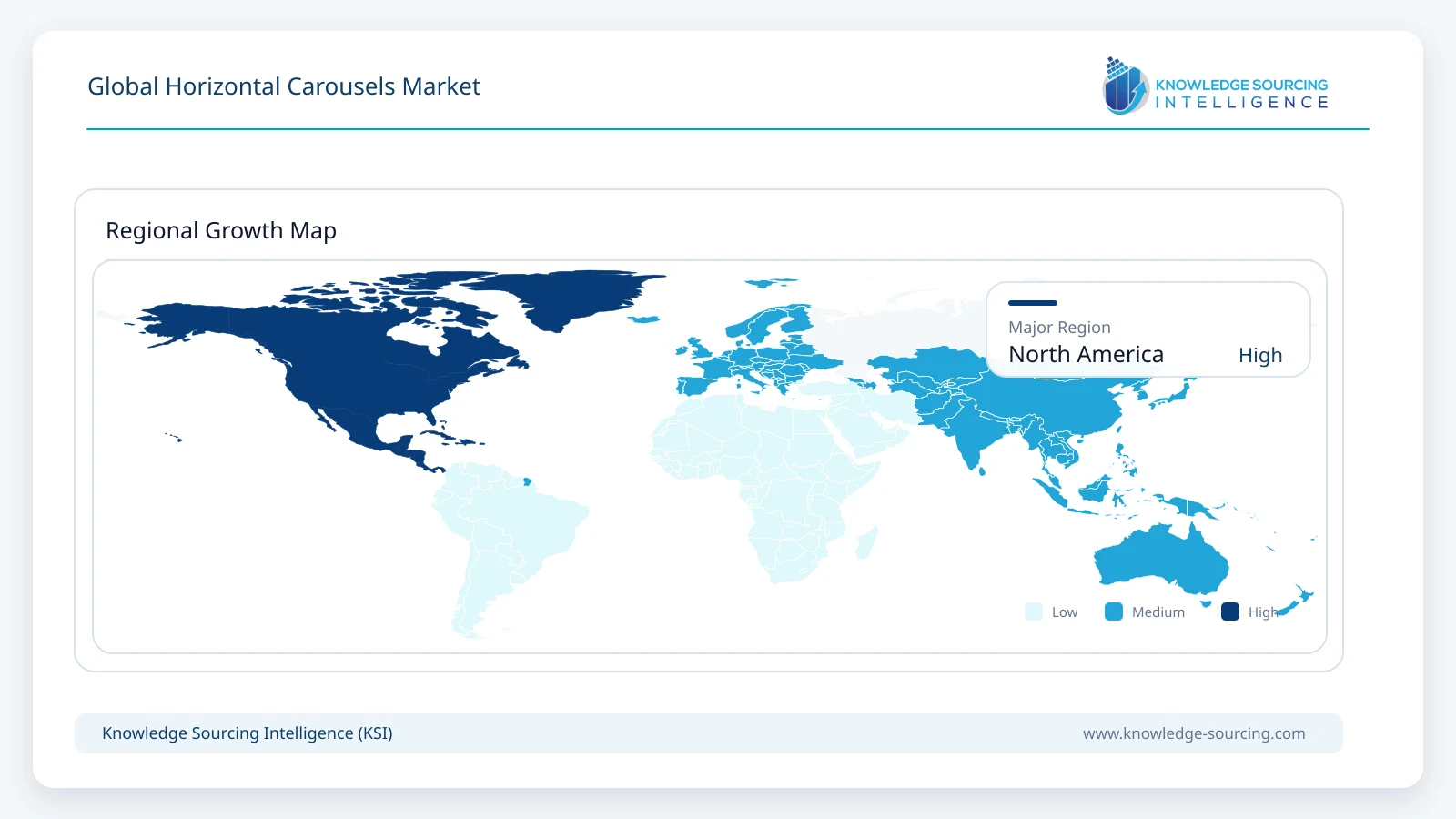
Asia Pacific is estimated at US$325 million in 2026 and US$466 million in 2032, becoming the largest regional market in the forecast. Growth depends on distribution investment, manufacturing modernization and the economics of local installation and support. Product configuration must reflect different labor costs, building designs and software maturity across countries. Europe is estimated at US$288 million in 2026 and US$379 million in 2032, where dense facilities and process quality support adoption.
South America is estimated at US$42 million in 2026 and US$56 million in 2032, while the Middle East and Africa are estimated at US$35 million and US$48 million respectively. These markets offer selective opportunities in distribution, healthcare and industrial parts handling. Import costs, service coverage and project financing can have more influence on the purchase decision than the carousel's headline throughput.
Competitive Landscape and Outlook
Kardex, Modula, White Systems and Dexion have identifiable horizontal storage-carousel products. Kardex and Modula compete through modular pods, software and pick guidance; White Systems has a broad range of horizontal configurations, including twin-bin designs; Dexion offers its HOCA system for controlled storage and picking. Bastian Solutions participates as an integrator that can specify and install carousels within a wider material-handling project. Supplier comparisons should focus on the delivered system and service, not only the machine frame.
Competition will center on measurable throughput, reliability and ease of integration. Suppliers with strong local service can reduce perceived risk for a buyer whose operations depend on a small number of carousel pods. Product upgrades in controls, safety and workstation design will matter, but the decisive proof remains a credible return on the customer's own order profile. The forecast assumes steady investment in warehouse productivity rather than a rapid replacement of all manual storage.
Recent Developments
June 2025: Kardex described a Kubota Canada parts operation using six horizontal carousel modules alongside vertical lift modules to support multi-order picking.
White Systems documented a medical-device distribution installation with four horizontal carousels and light-directed picking to improve order handling.
Modula documented a Marposs installation that combines a horizontal carousel, multiple picking bays, conveyor movement and put-to-light guidance.
Global Horizontal Carousels Market Scope:
| Report Metric | Details |
|---|---|
| Total Market Size in 2026 | US$1,020 million |
| Total Market Size in 2032 | US$1,387 million |
| Forecast Unit | Million |
| Growth Rate | 5.26% |
| Study Period | 2021 to 2032 |
| Historical Data | 2021 to 2024 |
| Base Year | 2025 |
| Forecast Period | 2026 – 2032 |
| Segmentation | Product Type, Industry Vertical, Geography |
| Companies |
|
| Customization Scope | 15% Free Customization included with purchase — Request Custom Breakdown → |
| Sample & Data Access | PDF Sample, Excel Databook & Analyst Briefing — Download Free Sample → |
Market Segmentation
By Product Type
Top Drive
Bottom Drive
Twin Bin
By Industry Vertical
Pharmaceutical
Food and Beverage
Warehousing and Logistics
Retail
Manufacturing
By Geography
North America
USA
Canada
Mexico
South America
Brazil
Argentina
Others
Europe
Germany
France
United Kingdom
Spain
Others
Middle East and Africa
Saudi Arabia
UAE
Others
Asia Pacific
China
India
Japan
South Korea
Indonesia
Thailand
Others
Table of Contents
1. EXECUTIVE SUMMARY
2. MARKET SNAPSHOT
2.1. Market Overview
2.2. Market Definition
2.3. Scope of the Study
2.4. Market Segmentation
3. BUSINESS LANDSCAPE
3.1. Market Drivers
3.2. Market Restraints
3.3. Market Opportunities
3.4. Porter's Five Forces Analysis
3.5. Industry Value Chain Analysis
3.6. Policies and Regulations
3.7. Strategic Recommendations
4. TECHNOLOGICAL OUTLOOK
5. HORIZONTAL CAROUSELS MARKET BY PRODUCT TYPE
5.1. Introduction
5.2. Top Drive
5.3. Bottom Drive
5.4. Twin Bin
6. HORIZONTAL CAROUSELS MARKET BY INDUSTRY VERTICAL
6.1. Introduction
6.2. Pharmaceutical
6.3. Food and Beverage
6.4. Warehousing and Logistics
6.5. Retail
6.6. Manufacturing
7. HORIZONTAL CAROUSELS MARKET BY GEOGRAPHY
7.1. Introduction
7.2. North America
7.2.1. USA
7.2.2. Canada
7.2.3. Mexico
7.3. South America
7.3.1. Brazil
7.3.2. Argentina
7.3.3. Others
7.4. Europe
7.4.1. Germany
7.4.2. France
7.4.3. United Kingdom
7.4.4. Spain
7.4.5. Others
7.5. Middle East and Africa
7.5.1. Saudi Arabia
7.5.2. UAE
7.5.3. Others
7.6. Asia Pacific
7.6.1. China
7.6.2. India
7.6.3. Japan
7.6.4. South Korea
7.6.5. Indonesia
7.6.6. Thailand
7.6.7. Others
8. COMPETITIVE ENVIRONMENT AND ANALYSIS
8.1. Major Players and Strategy Analysis
8.2. Market Share Analysis
8.3. Mergers, Acquisitions, Agreements and Collaborations
8.4. Competitive Dashboard
9. COMPANY PROFILES
9.1. Kardex
9.2. Modula
9.3. White Systems
9.4. Dexion
9.5. Bastian Solutions
10. APPENDIX
10.1. Currency
10.2. Assumptions
10.3. Base and Forecast Years Timeline
10.4. Key Benefits for Stakeholders
10.5. Research Methodology
10.6. Abbreviations
LIST OF FIGURES
LIST OF TABLES





Frequently asked questions
What is the projected market size for horizontal carousels by 2032?
The Global Horizontal Carousels Market is projected to reach US$1,387 million by 2032 at 5.26% CAGR.
Which horizontal carousel configuration shows the fastest growth rate?
Twin-bin configurations project 7.2% CAGR for dense, high-throughput workstations.
What are the primary market drivers supporting horizontal carousel investment?
Labor availability, order growth, and existing floor space usage drive investment.
Which regional market is projected for significant growth by 2032?
Asia Pacific is projected to generate US$466 million by 2032.
Which industries represent key application segments for horizontal carousels?
Manufacturing and pharmaceutical applications are significant market contributors.
What is a key advantage of horizontal carousels over alternative systems?
They reduce walking, search time without needing a new high-bay building.
Cite this report
Knowledge Sourcing Intelligence. (Oct 2026). Global Horizontal Carousels Market - Strategic Insights and Forecasts (2026-2032). https://www.knowledge-sourcing.com/report/global-horizontal-carousels-market