
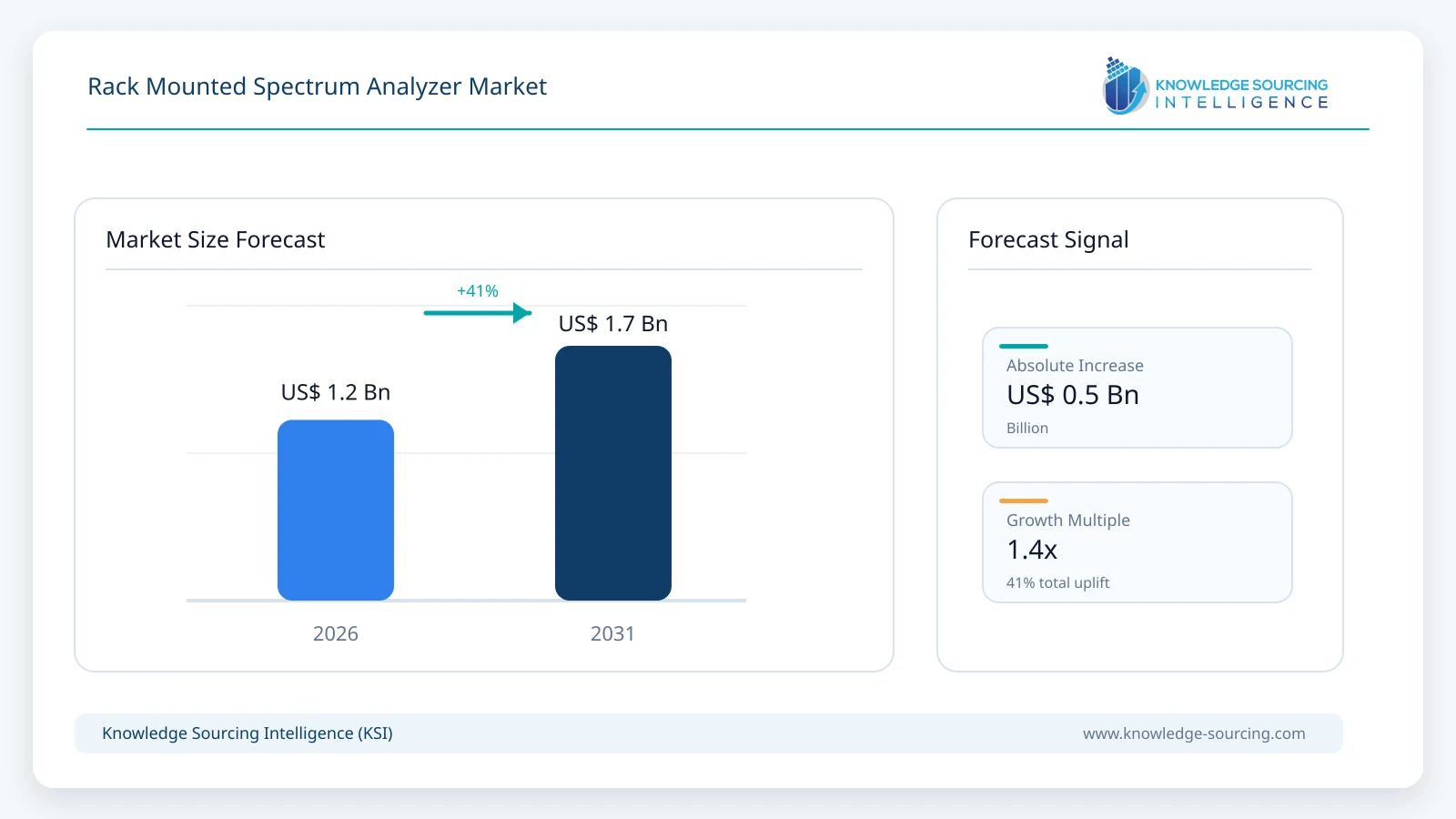
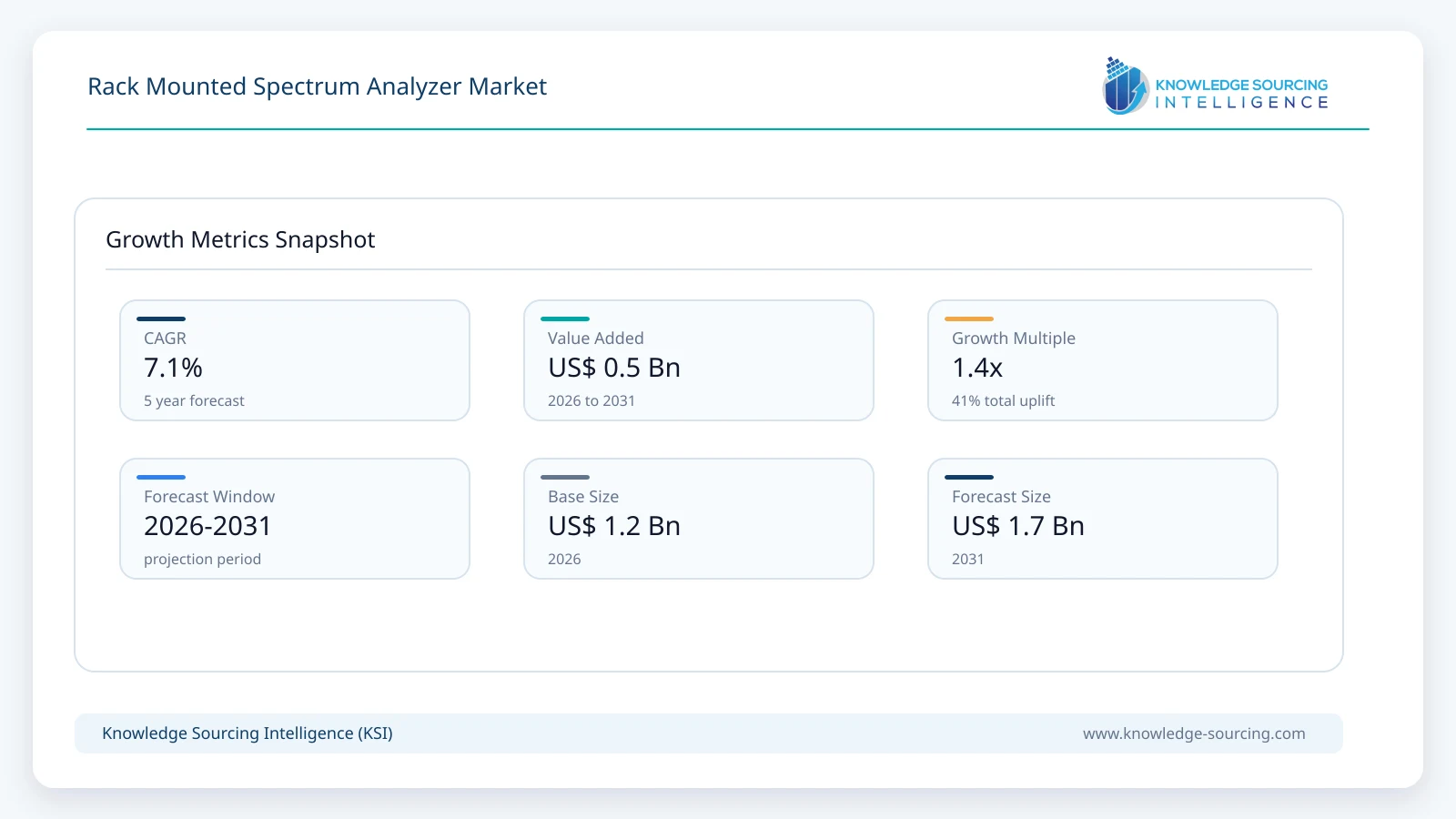
The global rack mounted spectrum analyzer market is projected to increase from USD 1.22 billion in 2026 to USD 1.72 billion in 2031, representing a CAGR of 7.1% across the forecast period.
Highlights:
- 1Real-time spectrum analyzers account for approximately 46% of 2026 rack-mounted market revenue.
- 2Wireless communication applications generate approximately 68% of 2026 communication-technology demand.
- 3Commercial users account for approximately 62% of global rack-mounted spectrum analyzer revenue in 2026.
- 4IT and telecommunications represent approximately 31% of 2026 industry demand.
- 5North America contributes approximately 34% of global market revenue in 2026.
- 6Asia Pacific records the strongest growth as semiconductor, telecom and electronics test capacity expands.
Rack-mounted spectrum analyzers sit at the performance-intensive end of the radio-frequency test-and-measurement market. Unlike handheld analyzers, which prioritize portability, rack systems are purchased where sustained measurement accuracy, high dynamic range, automation interfaces, wide analysis bandwidth and continuous duty are central requirements. They are commonly deployed in research laboratories, electromagnetic compatibility chambers, production test racks, network operations centers and defense monitoring systems. Modern products increasingly combine swept spectrum analysis with vector signal analysis, real-time capture, pulse measurements, demodulation software and remote control, allowing one platform to support a wider set of engineering workflows.
The technical requirements are rising quickly. Keysight’s N9042B UXA platform supports models to 50 GHz and analysis bandwidth configurations extending to 11 GHz, while Rohde & Schwarz’s FSWX introduces multichannel signal analysis and up to 8 GHz of internal analysis bandwidth. Anritsu’s current spectrum-monitoring portfolio extends to 54 GHz and includes compact modules designed specifically for integration into remote and custom systems. These capabilities are relevant to 5G-Advanced, Wi-Fi 8, non-terrestrial networks, satellite payloads, phased arrays, radar, electronic warfare and increasingly complex semiconductor devices, where conventional narrowband swept measurements are no longer sufficient.
Underlying end markets remain supportive. Ericsson reported 5G subscriptions above three billion during the first quarter of 2026 and close to 3.3 billion by mid-year, with 6G standardization progressing toward first commercial services around 2030. Semiconductor manufacturing investment has also accelerated: SEMI forecast total semiconductor manufacturing equipment sales of USD 165.9 billion in 2026, with semiconductor test equipment alone reaching USD 15.3 billion, up 31% year over year. These industries require increasingly automated RF validation, production test and signal-integrity analysis, supporting both new instrument purchases and software or bandwidth upgrades to installed rack platforms.
Selected Segment Estimates
Dimension | Selected Subsegment | 2026 Indicator | Forecast Interpretation |
By Communication Technology | Wireless | ~68% share | Wireless test remains dominant as 5G-Advanced, Wi-Fi, satellite and radar signals become wider and more complex. |
By Type | Real-Time | ~46% share | Real-time analysis gains share as transient, hopping and burst signals become more common. |
By End-User | Commercial | ~62% share | Telecom, electronics, automotive and industrial test organizations provide the largest recurring demand base. |
By Industry Vertical | IT and Telecommunication | ~31% share | Network R&D, device validation and spectrum monitoring sustain the largest vertical. |
By Geography | North America | ~34% share | High aerospace-defense, wireless R&D and semiconductor test intensity supports premium instrument demand. |
By Geography | Asia Pacific | Fastest growth | Semiconductor manufacturing, electronics production and next-generation wireless investment accelerate adoption. |
Market Dynamics
5G-Advanced and Early 6G Research Raise Signal-Analysis Requirements
The transition from 5G toward 5G-Advanced and 6G increases the complexity of laboratory and system-level RF testing. Wider channel bandwidths, more advanced multiple-input multiple-output architectures, network slicing, integrated sensing and communication, and greater use of millimeter-wave frequencies all increase the amount of spectrum data engineers must capture and interpret. Ericsson reported 3.1 billion 5G subscriptions in the first quarter of 2026 and expects 6.4 billion by 2031, while commercial 5G Standalone network slicing offerings are already expanding. Rack-mounted analyzers benefit because these workflows demand repeatable, high-dynamic-range measurements that can be automated across development and validation benches.
Semiconductor and Electronics Test Investment Expands the Installed Base
Semiconductor capital spending is creating another strong demand channel. SEMI forecast total semiconductor manufacturing equipment sales of USD 165.9 billion in 2026 and semiconductor test-equipment sales of USD 15.3 billion, supported by artificial-intelligence processors, high-bandwidth memory, advanced logic and more complex packaging. Spectrum and signal analyzers are used in RF integrated circuit characterization, power-amplifier validation, clock and spur analysis, high-frequency device testing and automated production environments. Growth in RF front ends, automotive radar, satellite components and high-speed wireless chipsets increases the number of test steps requiring wideband frequency-domain analysis.
Remote Spectrum Monitoring Broadens Demand Beyond the Laboratory
Rack and module formats are increasingly deployed as unattended spectrum-monitoring systems. Telecom operators, regulators, defense agencies and critical-infrastructure operators use fixed monitors to identify interference, detect unauthorized transmissions, measure spectrum occupancy and maintain persistent visibility over radio environments. Anritsu’s MS27200A, for example, is designed for custom system integration and covers frequencies to 54 GHz with real-time spectrum analysis, 5G/LTE measurements and IQ capture. This shifts part of the market from periodic engineering test toward continuous operational monitoring, supporting multiple-instrument deployments and centralized software management.
High Capital Cost and Long Replacement Cycles Restrain Unit Growth
High-end rack systems can represent substantial capital purchases once frequency extensions, real-time bandwidth, measurement applications, calibration and automation software are included. Large laboratories and defense programs can justify these configurations, but smaller electronics companies may rely on lower-cost benchtop, USB or modular instruments for less demanding tasks. Instrument life can also be long because premium platforms are designed for hardware and software upgrades. This limits unit replacement even while revenue per system rises, making market growth increasingly dependent on new applications, bandwidth upgrades and expansion of automated test capacity rather than simple one-for-one replacement.
Modular and Software-Defined Test Architectures Increase Competitive Pressure
Dedicated rack analyzers also compete with vector signal transceivers, PXI-based RF instruments and software-defined monitoring modules that can be assembled into custom test systems. These architectures are attractive where customers need multiple synchronized channels, compact density or direct integration with production software. Traditional analyzer vendors are responding with smaller form factors, remote-control interfaces, multichannel acquisition and software licensing that make fixed analyzers easier to embed into automated environments. The result is not the disappearance of rack-mounted spectrum analysis, but a shift toward platforms that behave as programmable system components rather than isolated laboratory instruments.
Rack Mounted Spectrum Analyzer Market Segment Analysis
By Type
Real-Time Spectrum Analyzers
Real-time spectrum analyzers represent the largest and fastest-expanding type segment, accounting for approximately 46% of rack-mounted market revenue in 2026. Their advantage is the ability to capture intermittent, burst, hopping or transient signals that conventional swept analyzers can miss between frequency sweeps. This is increasingly important in 5G-Advanced, radar, electronic warfare, satellite communications and interference analysis. The segment also benefits from rising instantaneous bandwidth: premium platforms now support several gigahertz of real-time or vector analysis, allowing engineers to examine wide modulated carriers, multi-channel scenarios and complex pulse environments in a single acquisition.
By Communication Technology
Wireless
Wireless communication generates roughly 68% of communication-technology demand in 2026. The segment covers cellular infrastructure and devices, Wi-Fi, satellite links, radar, private wireless, broadcast and regulatory spectrum work. Wired applications remain relevant where spectrum analyzers support electromagnetic compatibility, cable-system noise, high-speed digital interference and mixed-signal validation, but the most demanding growth drivers are increasingly radio based. Wider wireless channels and more crowded spectrum also increase the value of high-performance preselection, dynamic range and automated signal classification.
By End-User
Commercial
Commercial users account for approximately 62% of global market revenue in 2026. Telecommunications vendors and operators, semiconductor companies, electronics manufacturers, automotive suppliers and industrial test organizations purchase instruments for R&D, compliance, manufacturing and troubleshooting. Government and defense demand remains strategically important and often carries higher average selling prices because of secure communications, radar and surveillance requirements. Research institutions form a smaller share but contribute disproportionately to demand for the newest high-frequency and wideband configurations used in 6G, quantum-control and advanced communications work.
By Industry Vertical
IT and Telecommunication
IT and telecommunications form the largest vertical at approximately 31% of 2026 market revenue. Operators, network-equipment vendors, chipset companies and device manufacturers use rack analyzers for signal quality, error-vector magnitude, adjacent-channel emissions, interference analysis and standards validation. Semiconductor and electronics is the next major demand pool and is gaining importance as AI-related semiconductor investment expands. Aerospace and defense remains a high-value segment because radar, electronic warfare and satellite systems require wide bandwidth, high frequency coverage and sophisticated pulse or real-time analysis.
Technology and Demand Indicators
Indicator | Latest Development | Market Impact |
Global 5G base | More than 3.1 billion subscriptions in Q1 2026; close to 3.3 billion by mid-2026. | Expands installed wireless infrastructure and device base requiring laboratory and network test. |
Semiconductor equipment | SEMI forecasts USD 165.9 billion of equipment sales in 2026. | Supports RF and mixed-signal test investment across fabs, packaging and production environments. |
Semiconductor test equipment | SEMI forecasts USD 15.3 billion in 2026, up 31% year over year. | Directly strengthens automated test demand for advanced devices and RF components. |
High-end analysis bandwidth | Keysight N9042B offers configurations up to 11 GHz analysis bandwidth. | Raises instrument value and supports complex wideband 5G, satellite, radar and research signals. |
Multichannel signal analysis | Rohde & Schwarz FSWX supports multichannel acquisition and up to 8 GHz internal analysis bandwidth. | Supports MIMO, beamforming, radar and advanced wireless R&D. |
Remote monitoring | Anritsu MS27200A provides system-integrated monitoring to 54 GHz. | Broadens rack-mounted demand into persistent spectrum surveillance and interference management. |
North America Market Analysis
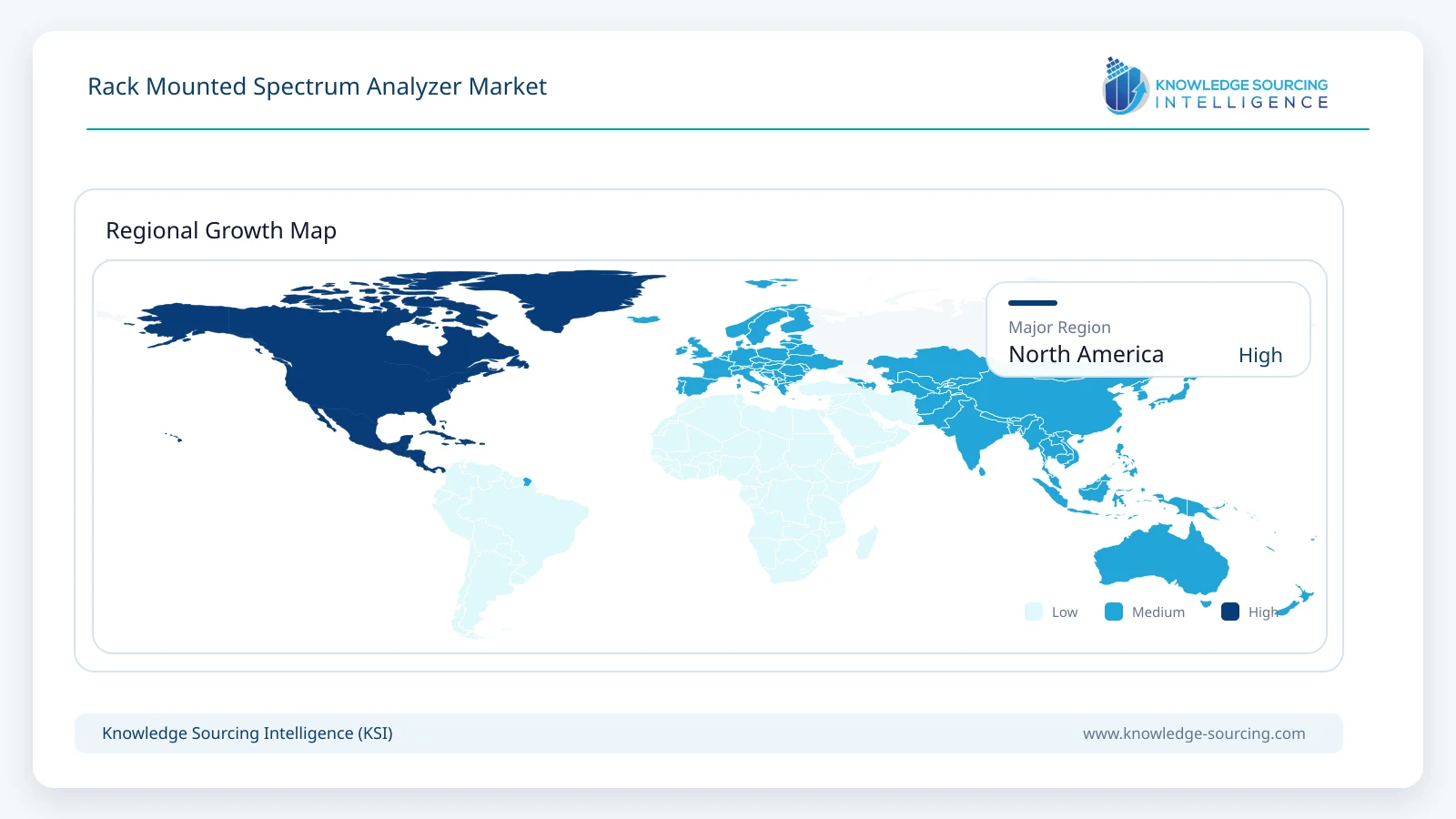
North America is the largest regional market, contributing approximately 34% of global rack-mounted spectrum analyzer revenue in 2026. The United States combines a large telecommunications R&D base with advanced aerospace and defense programs, satellite communications, semiconductor design, cloud and data-center infrastructure, automotive electronics and a mature regulatory spectrum environment.
High-value customers are concentrated in applications where instrument dynamic range, phase noise, real-time bandwidth and automation are more important than purchase price, supporting demand for premium Keysight, Rohde & Schwarz, Anritsu and Tektronix platforms.
The region should retain leadership through 2031, although Asia Pacific grows faster. North American demand is increasingly tied to 5G-Advanced and 6G research, phased-array and radar validation, electronic warfare, satellite payloads and high-performance semiconductor development. The market also benefits from software upgrades and test-application licensing, which extend the commercial life of installed analyzers while increasing revenue per platform. Asia Pacific narrows the gap through semiconductor manufacturing expansion in Taiwan, South Korea, China and Japan, combined with rapid 5G deployment and electronics production across the wider region.
Competitive Landscape
The premium market is concentrated around a small group of global test-and-measurement vendors. Keysight Technologies competes through the X-Series signal analyzer portfolio, including the N9042B UXA for wideband and high-frequency work. Rohde & Schwarz serves high-end wireless, radar and defense applications with the FSW and newly launched FSWX families. Anritsu combines signal analyzers with rack and module-based spectrum-monitoring systems, while Tektronix participates through real-time spectrum analysis and mixed-domain test. These companies compete on RF performance, analysis bandwidth, phase noise, application software, calibration, automation support and global service rather than on price alone.
A broader supplier tier includes Advantest, Yokogawa Test & Measurement, RIGOL Technologies, Aaronia, Narda Safety Test Solutions, National Instruments under Emerson, Signal Hound, Berkeley Nucleonics and specialist system integrators. Competition is widening as modular RF instruments and software-defined platforms become more capable. Vendors with strong software ecosystems have an advantage because customers increasingly want measurement applications, automated workflows and common user interfaces across benchtop, rack, modular and cloud-connected test environments. This also increases recurring software and service revenue relative to one-time hardware sales.
Recent Developments
August 2024: Anritsu released updated technical data for the MS27200A microwave spectrum monitor module, covering system-integrated monitoring to 54 GHz.
June 2026: Ericsson reported more than 3.1 billion 5G subscriptions in the first quarter and projected 6.4 billion by 2031.
March 2026: Keysight updated configuration guidance for the N9042B UXA, which supports 26.5 GHz, 44 GHz and 50 GHz models with analysis bandwidth options to 11 GHz.
January 2026: Anritsu published its 2026 electronic measuring instruments catalog, expanding current microwave spectrum-monitoring and analyzer positioning.
July 2026: SEMI raised its 2026 semiconductor manufacturing-equipment forecast to USD 165.9 billion and test-equipment sales to USD 15.3 billion.
Rack Mounted Spectrum Analyzer Market Scope:
| Report Metric | Details |
|---|---|
| Total Market Size in 2026 | USD 1.22 billion |
| Total Market Size in 2031 | USD 1.72 billion |
| Forecast Unit | Billion |
| Growth Rate | 7.1% |
| Study Period | 2021 to 2031 |
| Historical Data | 2021 to 2024 |
| Base Year | 2025 |
| Forecast Period | 2026 – 2031 |
| Segmentation | Communication Technology, Type, End-User, Industry Vertical, Geography |
| Companies |
|
Market Segmentation
BY COMMUNICATION TECHNOLOGY
Wired
Wireless
BY TYPE
Swept-Tuned
Real-Time
Vector Signal
BY END-USER
Commercial
Government
Research and Development Sectors
BY INDUSTRY VERTICAL
Automotive
Semiconductor and Electronics
IT and Telecommunication
Industrial
Aerospace and Defense
Others
BY GEOGRAPHY
North America
USA
Canada
Mexico
South America
Brazil
Argentina
Others
Europe
United Kingdom
Germany
France
Spain
Others
Middle East and Africa
Saudi Arabia
UAE
Others
Asia Pacific
China
Japan
India
South Korea
Taiwan
Others
Table of Contents
1. EXECUTIVE SUMMARY
2. MARKET SNAPSHOT
2.1. Market Overview
2.2. Market Segmentation
3. BUSINESS LANDSCAPE
3.1. Market Drivers
3.1.1. 5G-Advanced and Early 6G Research Raise Signal-Analysis Requirements
3.1.2. Semiconductor and Electronics Test Investment Expands the Installed Base
3.1.3. Remote Spectrum Monitoring Broadens Demand Beyond the Laboratory
3.2. Market Restraints
3.2.1. High Capital Cost and Long Replacement Cycles Restrain Unit Growth
3.2.2. Modular and Software-Defined Test Architectures Increase Competitive Pressure
3.3. Market Opportunities
3.4. Porter's Five Forces Analysis
3.5. Industry Value Chain Analysis
3.6. Policies and Regulations
4. TECHNOLOGICAL OUTLOOK
4.1. Wideband Real-Time Spectrum Analysis
4.2. Multichannel and Phase-Coherent Signal Analysis
4.3. Millimeter-Wave and Sub-Terahertz Testing
4.4. Remote Spectrum Monitoring and Automated Signal Classification
4.5. Software-Defined and Modular Test Platforms
5. RACK MOUNTED SPECTRUM ANALYZER MARKET BY COMMUNICATION TECHNOLOGY
5.1. Wired
5.2. Wireless
6. RACK MOUNTED SPECTRUM ANALYZER MARKET BY TYPE
6.1. Swept-Tuned
6.2. Real-Time
6.3. Vector Signal
7. RACK MOUNTED SPECTRUM ANALYZER MARKET BY END-USER
7.1. Commercial
7.2. Government
7.3. Research and Development Sectors
8. RACK MOUNTED SPECTRUM ANALYZER MARKET BY INDUSTRY VERTICAL
8.1. Automotive
8.2. Semiconductor and Electronics
8.3. IT and Telecommunication
8.4. Industrial
8.5. Aerospace and Defense
8.6. Others
9. RACK MOUNTED SPECTRUM ANALYZER MARKET BY GEOGRAPHY
9.1. North America
9.1.1. USA
9.1.2. Canada
9.1.3. Mexico
9.2. South America
9.2.1. Brazil
9.2.2. Argentina
9.2.3. Others
9.3. Europe
9.3.1. United Kingdom
9.3.2. Germany
9.3.3. France
9.3.4. Spain
9.3.5. Others
9.4. Middle East and Africa
9.4.1. Saudi Arabia
9.4.2. UAE
9.4.3. Others
9.5. Asia Pacific
9.5.1. China
9.5.2. Japan
9.5.3. India
9.5.4. South Korea
9.5.5. Taiwan
9.5.6. Others
10. COMPETITIVE ENVIRONMENT AND ANALYSIS
10.1. Major Players and Strategy Analysis
10.2. Market Share Analysis
10.3. Mergers, Acquisitions, Agreements and Collaborations
10.4. Competitive Dashboard
11. COMPANY PROFILES
11.1. Keysight Technologies, Inc.
11.2. Rohde & Schwarz GmbH & Co. KG
11.3. Anritsu Corporation
11.4. Tektronix, Inc.
11.5. Advantest Corporation
11.6. Yokogawa Test & Measurement Corporation
11.7. National Instruments / Emerson
11.8. RIGOL Technologies
11.9. Aaronia AG
11.10. Narda Safety Test Solutions GmbH
11.11. Signal Hound
11.12. Berkeley Nucleonics Corporation
11.13. Avcom of Virginia, Inc.
11.14. Stanford Research Systems, Inc.
11.15. Teledyne LeCroy
12. RECENT DEVELOPMENTS
13. APPENDIX
13.1. Currency
13.2. Assumptions
13.3. Base and Forecast Years Timeline
13.4. Research Methodology
13.5. Abbreviations
Navigate
Trusted by the world's leading organizations











