
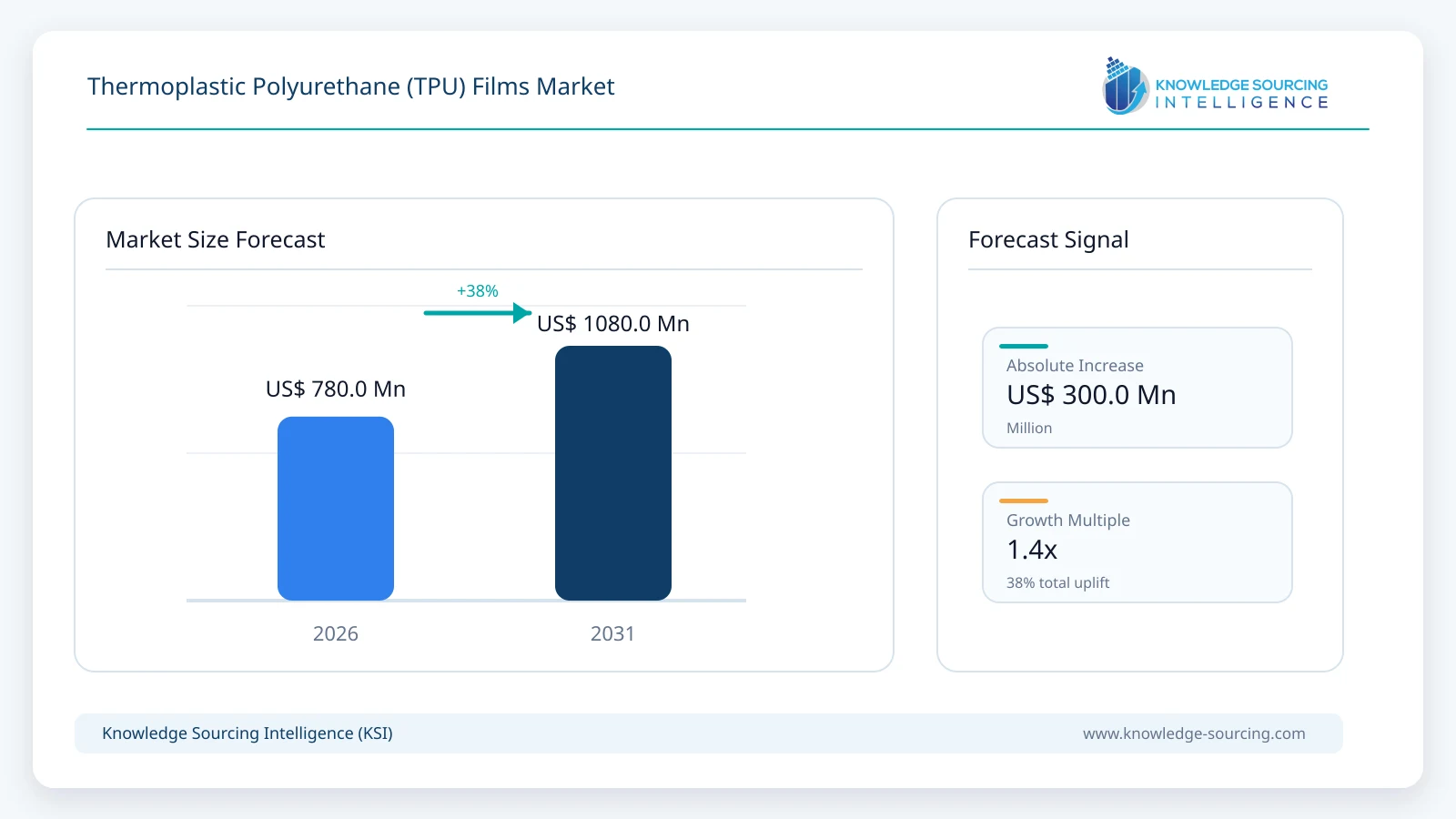
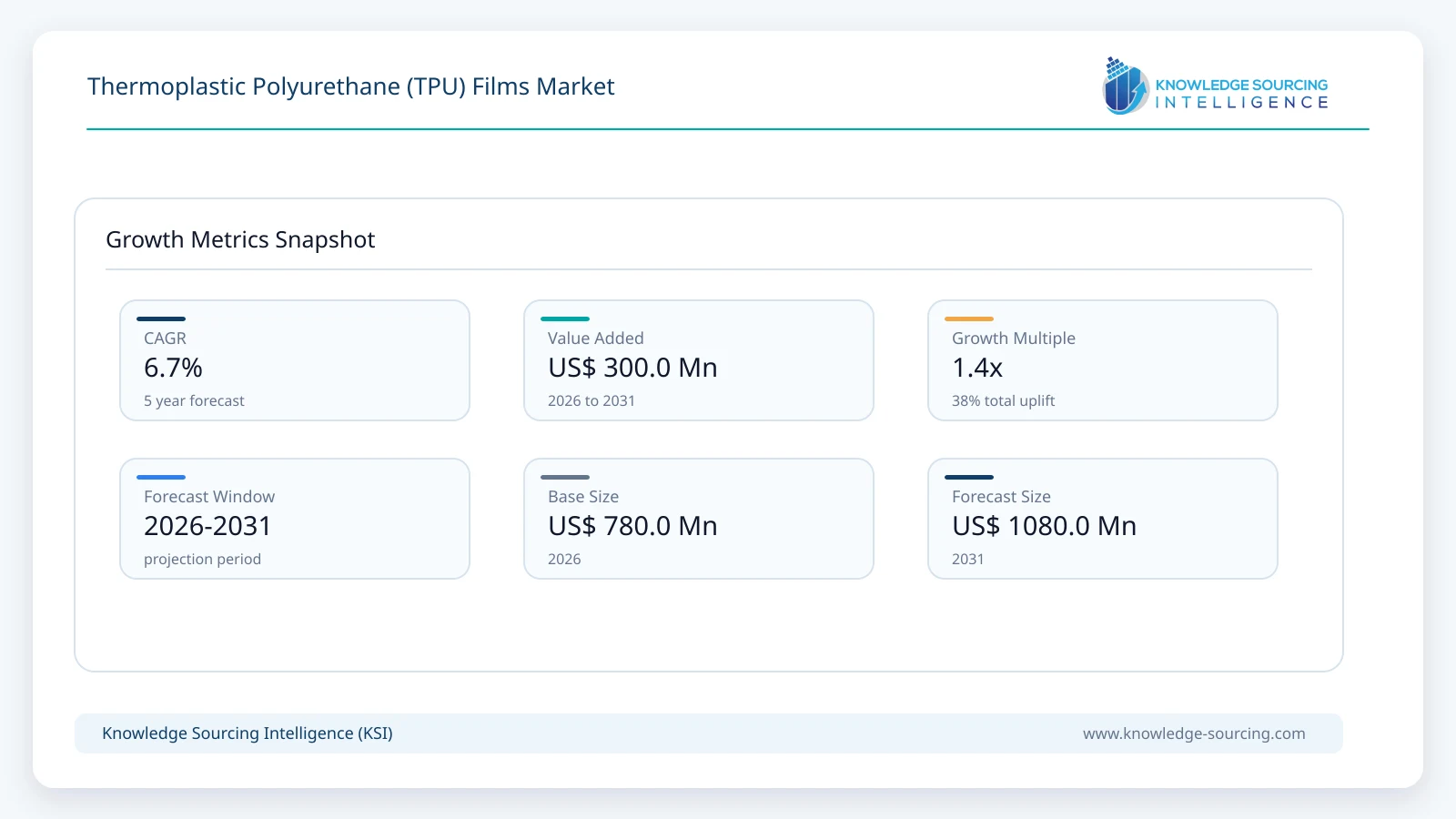
The global thermoplastic polyurethane (TPU) films market is estimated at USD 780 million in 2026 and is projected to reach USD 1,080 million by 2031, growing at a CAGR of 6.7% during the forecast period.
Highlights:
- 1Polyester-based TPU films account for an estimated 54% of the global market by chemical class in 2026.Their mechanical strength, abrasion resistance and versatility support extensive use across footwear, textiles, automotive products and industrial applications.
- 2Polyether-based TPU films account for approximately 37% of global demand in 2026.Their hydrolysis resistance and performance in humid environments support increasing adoption in medical products, breathable membranes and other moisture-sensitive applications.
- 3Textile lamination and waterproof/breathable membranes represent approximately 24% of TPU film demand by application in 2026.TPU films provide a combination of elasticity, waterproofing and water-vapour permeability required in performance apparel, footwear and technical textiles.
- 4Footwear and apparel represent approximately 28% of TPU film demand by end-user industry in 2026.The industry remains a major consumption base for TPU films used in lamination, bonding, waterproof structures, footwear components and performance apparel.
- 5Flexible electronics and sensor substrates account for approximately 7% of the market in 2026.Although relatively small today, the application is gaining relevance as TPU films are incorporated into stretchable electronics, smart textiles, medical sensors and wearable devices.
- 6Asia-Pacific accounts for approximately 44% of the global TPU films market in 2026.The region's position is supported by its concentration of footwear, textile, electronics and automotive manufacturing, particularly across China, India and Southeast Asia.
Thermoplastic polyurethane films combine the elasticity of elastomers with the processability of thermoplastics. Their flexibility, abrasion resistance, tear strength, transparency and ability to withstand demanding operating conditions support their use across footwear, textiles, medical products, automotive components, electronics, industrial products and construction. Film properties can also be modified through TPU chemistry and formulation to provide hydrolysis resistance, UV stability, optical clarity, breathability, adhesion and other application-specific characteristics.
The market is gradually moving toward higher-value functional applications. Conventional demand from footwear, apparel and textile lamination remains substantial, while medical films, automotive functional films, surface-protection products, hot-melt bonding films and flexible electronic substrates are creating additional opportunities. BASF currently identifies medical films, optical films, surface films, breathable membranes, textiles and roof linings among TPU-film applications. Covestro's Platilon portfolio includes wound dressings, automotive interiors, waterproof apparel, adhesive laminates and emerging electronic applications.
Thermoplastic Polyurethane (TPU) Films Market Growth Drivers
Growing demand for high-performance flexible films
TPU films are increasingly selected where manufacturers require flexibility without sacrificing mechanical durability. Depending on grade and formulation, they can provide high elasticity, resistance to cuts and tear propagation, abrasion resistance, transparency and environmental resistance. BASF offers both ether- and ester-based grades for flexible films and extrusion processes, including grades optimized for hydrolysis, chemicals, UV exposure, medical applications and breathable films.
The ability to laminate, weld, thermoform and combine TPU films with other materials further broadens their addressable applications. Covestro offers monolayer and multilayer TPU films and identifies processing methods including gluing, lamination, welding, thermoforming and back-foaming. This versatility is allowing film manufacturers to target increasingly specialized products rather than competing only in conventional commodity film applications.
Footwear and functional textiles provide a substantial demand base
Footwear, sportswear, protective clothing and technical textiles remain central to TPU-film consumption. TPU films can function as waterproof and breathable layers, bonding materials, protective surfaces and flexible structural components. Their elasticity allows laminated textiles to retain flexibility while their water-vapour permeability can improve wearer comfort.
The footwear and apparel segment is projected to grow at approximately 5.2% CAGR through 2031. Growth is comparatively moderate because TPU films are already well established in this industry, but increasing performance requirements and continued expansion of technical and functional textiles sustain demand.
BASF specifically identifies textiles and nonwovens as applications benefiting from TPU's elasticity, water-vapour permeability and surface feel, while its breathable membrane grades combine weather protection with wind and waterproof characteristics. Covestro similarly markets TPU films for waterproof apparel, protective apparel, sportswear and outdoor equipment.
Medical and healthcare applications are becoming more important
TPU films are increasingly relevant to wound care, medical wearables, hygienic products and other healthcare applications where skin compatibility, flexibility and moisture management are important. Transparent films can move with the skin while providing waterproof protection, and selected grades can provide the regulatory and material characteristics required for sensitive applications.
Medical and healthcare films are estimated to reach approximately US$162 million by 2031. The segment benefits from the development of advanced wound-care products and from the convergence of flexible materials with body-worn monitoring technologies.
BASF identifies wound dressings and wearables among applications for its sensitive TPU grades and notes characteristics including transparency, breathability, waterproofing and chemical resistance. Covestro also offers TPU films for wound care and increasingly for flexible medical electronics.
Automotive applications are extending the addressable market
Automotive is treated as a separate end-user industry in the rebuilt report rather than being absorbed within “Others.” TPU films are used in interior trim, seating systems, surface protection, bonding structures and other functional components where flexibility, abrasion resistance and durability are required.
The automotive and mobility end-user segment accounts for an estimated 14% of TPU film demand in 2026. Future opportunities are expected to be influenced not only by vehicle production but also by the increasing integration of functional surfaces, lightweight components and electronic features into vehicle interiors.
Covestro identifies automotive interior trim and lumbar support among current Platilon applications. BASF likewise positions extruded TPU films across automotive applications and highlights optical films for automotive and electronic surface protection.
Flexible electronics create a high-growth specialty application
Flexible and printed electronics are opening a relatively new demand area for TPU films. Stretchable films can provide a conformable substrate or protective layer around printed circuits and sensors while maintaining performance during repeated bending, stretching and compression.
The flexible electronics and sensor substrate application is projected to grow at approximately 12.2% CAGR between 2026 and 2031, making it one of the fastest-growing applications in the modeled market.
Commercial development is already visible. Covestro identifies TPU films for smart insoles, ECG applications, medical wearables and printed circuits for biosensors and smart textiles. This creates an opportunity for TPU films to participate in the convergence of polymers, electronics and wearable technologies rather than remaining solely a mechanical film material.
Thermoplastic Polyurethane (TPU) Films Market by Chemical Class
Polyester-based TPU Films
Polyester TPU films form the largest chemical-class segment. Their strength, abrasion resistance, toughness and processing characteristics make them suitable for applications that experience repeated mechanical stress, including footwear, textiles, automotive products and industrial components.
The segment is estimated at approximately US$421 million in 2026. Polyester-based films are expected to retain their leading position, although their share is likely to moderate as polyether-based materials gain demand in applications where hydrolysis resistance and moisture performance are more important.
BASF's film portfolio confirms that ester- and ether-based TPU grades coexist across film and extrusion applications, with formulation selected according to required mechanical, chemical and environmental performance.
Polyether-based TPU Films
Polyether-based TPU films offer advantages in applications exposed to moisture, humidity and repeated environmental stress. Their hydrolysis resistance makes them particularly suitable for breathable membranes, medical products, wearable devices and applications requiring reliable performance under wet conditions.
The segment is projected to expand at approximately 8.4% CAGR during 2026-2031, faster than the overall TPU films market.
BASF's sensitive-application portfolio is particularly relevant to this trend. Its TPU grades intended for medical applications are ether based and are designed to provide flexibility, mechanical durability and biocompatibility.
Polycaprolactone-based TPU Films
Polycaprolactone-based TPU films occupy a smaller specialty position. They can provide a balance of mechanical performance, chemical resistance and processing characteristics for applications where conventional polyester or polyether formulations do not provide the required performance profile.
The segment represents an estimated 9% of the TPU films market in 2026. Demand is expected to remain concentrated in specialized applications rather than challenging polyester or polyether TPU films for overall market leadership.
Thermoplastic Polyurethane (TPU) Films Market by Application
Textile Lamination and Waterproof/Breathable Membranes
Textile lamination and breathable membranes remain the largest application category. TPU films can provide a barrier against liquid water while maintaining water-vapour transmission, making them suitable for outdoor apparel, performance clothing, footwear, protective garments and technical textiles.
The segment is projected to reach approximately US$248 million by 2031. Demand is increasingly influenced by functional performance requirements, including lighter structures, improved wearer comfort and durable waterproofing rather than conventional textile volumes alone.
BASF identifies water-vapour permeability, elasticity and surface feel among the key properties of TPU films for textiles and nonwovens, while its membrane applications include breathable weatherproofing and wind and waterproof performance.
Optical, Surface Protection and Protective Films
TPU films are used as protective layers where transparency, flexibility and resistance to mechanical damage are required. Applications include automotive and electronic surface protection, glazing, graphic films and other exposed surfaces.
The application accounts for an estimated 16% of the market in 2026. Aliphatic TPU grades are particularly important where optical clarity and long-term appearance are critical.
BASF identifies its optical TPU films for glazing and automotive and electronic surface protection and highlights transparency, low haze, mechanical resilience and adhesion to substrates including glass and polycarbonate.
Hot-Melt Adhesive and Bonding Films
TPU hot-melt films are used to bond textiles and other materials in footwear, apparel, automotive, sports and industrial applications. They allow manufacturers to create flexible laminated structures while reducing reliance on liquid adhesive systems in selected applications.
The segment is estimated at approximately US$109 million in 2026. Growth is supported by increasing use of engineered laminates and manufacturing processes requiring controlled, clean and flexible bonding layers.
Covestro specifically markets TPU hot-melt adhesive films and highlights textile bonding as a current application of its film portfolio.
Medical and Healthcare Films
Medical films are being adopted across wound dressings, hygienic products, wearable devices and other products requiring thin, flexible and skin-compatible structures. TPU's combination of breathability and waterproof performance is particularly valuable where a film must protect an application without creating an impermeable barrier to moisture vapour.
The application is projected to grow at approximately 9.8% CAGR through 2031. Medical-film growth is increasingly connected to wearable electronics as well as conventional wound-care and barrier applications.
BASF explicitly identifies medical films as a TPU-film application and offers grades suitable for sensitive applications, while Covestro's portfolio includes wound-care and medical-wearable solutions.
Automotive Interior and Functional Films
Automotive TPU films are used in interior trim, seating structures, surface protection and bonding applications. The material's resistance to wear and ability to retain flexibility across a broad temperature range are important in vehicle interiors exposed to repeated mechanical and environmental stresses.
The application represents approximately 11% of global TPU film demand in 2026. Increasing use of integrated surfaces and electronic functions within vehicle interiors provides additional opportunities beyond conventional trim applications.
Flexible Electronics and Sensor Substrates
TPU films are becoming useful substrates and protective layers for flexible electronics because they can withstand repeated deformation while remaining lightweight and conformable. Applications under development include smart textiles, medical sensors, ECG devices and sensor-equipped insoles.
The segment is projected to reach approximately US$97 million by 2031. Its comparatively small starting base means it can grow substantially without becoming one of the largest TPU-film applications during the forecast period.
Covestro currently showcases Platilon TPU films in smart insoles, ECG devices, medical wearables and printed biosensor circuits, providing direct evidence that flexible-electronics applications have moved beyond purely conceptual use cases.
Construction and Roofing Membranes
TPU films are used in roof linings, membranes and other construction applications where tear resistance, ageing performance, flexibility and water-vapour transmission are required. The segment is more mature and is expected to grow more slowly than medical and electronic applications.
Construction and roofing membranes account for approximately 8% of TPU film demand in 2026. BASF identifies roof linings and breathable weatherproof membranes among current TPU-film applications.
Thermoplastic Polyurethane (TPU) Films Market by End-User Industry
The end-user structure of the TPU films market is becoming more diversified. Footwear and apparel remain the largest demand base, but automotive, medical and electronics applications are increasing the proportion of TPU films used in higher-value functional products.
Electronics and electrical applications are projected to grow at approximately 10.4% CAGR through 2031. Demand includes protective films as well as newer flexible-electronics applications. BASF identifies electronic surface protection among optical-film applications, while Covestro is developing TPU films for sensor and wearable-electronics systems.
Sports and outdoor equipment account for approximately 9% of market demand in 2026. TPU films provide durability, flexibility and waterproofing for performance products that undergo repeated deformation and exposure to environmental conditions. Covestro's current specialty-film portfolio includes TPU films specifically positioned for sportswear, outdoor gear and sports equipment.
The industrial end-user segment is estimated at approximately US$78 million in 2026. Industrial demand encompasses laminates, protective products, profiles and belts, specialty bonding applications and other film uses where resistance to abrasion and repeated mechanical loading is important.
Building and construction applications are projected to reach approximately US$86 million by 2031. Demand is supported by membranes, roof linings and other specialty structures rather than high-volume commodity construction films.
Thermoplastic Polyurethane (TPU) Films Market Geographical Outlook
Asia-Pacific
Asia-Pacific is expected to remain the largest regional TPU films market because it combines large footwear and textile industries with major automotive, electronics and industrial manufacturing clusters. China forms the centre of the regional supply chain, while India and Southeast Asia contribute growing footwear, automotive and manufacturing demand. Japan, South Korea and Taiwan provide additional exposure to advanced electronics, automotive and specialty-material applications.
The regional market is projected to reach approximately US$508 million by 2031. Faster expansion relative to Europe and North America reflects the continued concentration of downstream manufacturing capacity in Asia and increasing regional availability of specialty TPU materials.
North America
North American demand is more heavily oriented toward medical products, automotive applications, advanced industrial films, protective materials and specialty consumer applications. The United States accounts for the majority of regional consumption and also hosts specialist film converters and medical-material suppliers.
North America represents an estimated 23% of global TPU film demand in 2026. The region is expected to remain important for higher-value film applications even as its global share gradually moderates because of faster Asian growth.
Europe
Europe is an established production and technology base for specialty TPU films, particularly in automotive, medical, functional textile and industrial applications. Sustainability and material circularity are also increasingly influencing product development in the region.
The European TPU films market is projected to grow at approximately 4.6% CAGR through 2031. Its relatively mature downstream industries limit volume growth compared with Asia-Pacific, but sophisticated application requirements support demand for higher-performance film grades.
South America
Demand in South America is concentrated in Brazil and supported by footwear, automotive, industrial and construction applications. Argentina and other regional markets contribute smaller demand pools.
South America accounts for approximately 5% of global TPU film demand in 2026. Brazil is expected to remain the principal national market during the forecast period.
Middle East and Africa
The Middle East and Africa market is comparatively small and fragmented. Construction, automotive products, medical applications, protective materials and imported finished goods account for much of regional TPU-film consumption. Saudi Arabia and the United Arab Emirates represent important addressable markets within the Middle East.
The region is estimated at approximately US$55 million in 2026, with future demand supported by industrial diversification and expansion of downstream manufacturing activity.
Thermoplastic Polyurethane (TPU) Films Market Key Developments
June 2026: Covestro and Insulectro announced a collaboration expanding access to Platilon® and Dureflex® TPU films for flexible electronics, wearable devices, medical technologies, and robotics applications across the Americas.
May 2026: Covestro opened a new TPU Application Development Center in Guangzhou, China, combining film capabilities with regional R&D and production to accelerate customized TPU film solutions for electronics, automotive, footwear, and specialty applications.
March 2026: BASF and Niber Technologies introduced Freeflex® E 130 TPU-based electrospun nanomembrane technology for outdoor apparel, offering high MVTR, lamination resistance, and PFAS-free membrane performance.
January 2026: Covestro showcased Platilon® TPU films for smart medical insoles and flexible printed electronics, supporting pressure-sensing applications through durable compression, flexibility, and stable sensor performance.
Thermoplastic Polyurethane (TPU) Films Market Scope:
| Report Metric | Details |
|---|---|
| Total Market Size in 2026 | USD 780 million |
| Total Market Size in 2031 | USD 1,080 million |
| Forecast Unit | Million |
| Growth Rate | 6.7% |
| Study Period | 2021 to 2031 |
| Historical Data | 2021 to 2024 |
| Base Year | 2025 |
| Forecast Period | 2026 – 2031 |
| Segmentation | Chemical Class, Application, End-User Industry, Geography |
| Companies |
|
Market Segmentation
By Chemical Class
Polyester-based TPU Films
Polyether-based TPU Films
Polycaprolactone-based TPU Films
By Application
Textile Lamination & Waterproof/Breathable Membranes
Optical, Surface Protection & Protective Films
Hot-Melt Adhesive & Bonding Films
Medical & Healthcare Films
Automotive Interior & Functional Films
Flexible Electronics & Sensor Substrates
Construction & Roofing Membranes
Others
By End-User Industry
Footwear & Apparel
Automotive & Mobility
Medical & Healthcare
Electronics & Electrical
Sports & Outdoor Equipment
Building & Construction
Industrial
Others
By Geography
North America
USA
Canada
Mexico
South America
Brazil
Argentina
Rest of South America
Europe
United Kingdom
Germany
France
Italy
Spain
Rest of Europe
Middle East & Africa
Saudi Arabia
United Arab Emirates
Rest of Middle East & Africa
Asia-Pacific
China
India
Japan
South Korea
Taiwan
Thailand
Indonesia
Rest of Asia-Pacific
Table of Contents
1. INTRODUCTION
1.1. Market Overview
1.2. Market Definition
1.3. Scope of the Study
1.4. Market Segmentation
1.5. Currency
1.6. Assumptions
1.7. Base and Forecast Years Timeline
1.8. Key Benefits for the Stakeholders
2. RESEARCH METHODOLOGY
2.1. Research Design
2.2. Research Process
3. EXECUTIVE SUMMARY
3.1. Key Findings
3.2. Analyst View
4. MARKET DYNAMICS
4.1. Market Drivers
4.1.1. Increasing Usage in the Footwear and Apparel Industry
4.1.2. Fast-Paced Urbanization and Investments to Boost the Industry
4.2. Market Restraints
4.2.1. Rising Prices of Raw Materials
4.2.2. Threats from Substitutes
4.3. Porter’s Five Forces Analysis
4.3.1. Bargaining Power of Suppliers
4.3.2. Bargaining Power of Buyers
4.3.3. Threat of New Entrants
4.3.4. Threat of Substitutes
4.3.5. Competitive Rivalry in the Industry
4.4. Industry Value Chain Analysis
5. THERMOPLASTIC POLYURETHANE (TPU) FILMS MARKET BY CHEMICAL CLASS
5.1. Introduction
5.2. Polyester-Based TPU Films
5.3. Polyether-Based TPU Films
5.4. Polycaprolactone-Based TPU Films
6. THERMOPLASTIC POLYURETHANE (TPU) FILMS MARKET BY APPLICATION
6.1. Introduction
6.2. Textile Lamination & Waterproof/Breathable Membranes
6.3. Optical, Surface Protection & Protective Films
6.4. Hot-Melt Adhesive & Bonding Films
6.5. Medical & Healthcare Films
6.6. Automotive Interior & Functional Films
6.7. Flexible Electronics & Sensor Substrates
6.8. Construction & Roofing Membranes
6.9. Others
7. THERMOPLASTIC POLYURETHANE (TPU) FILMS MARKET BY END-USER INDUSTRY
7.1. Introduction
7.2. Footwear & Apparel
7.3. Automotive & Mobility
7.4. Medical & Healthcare
7.5. Electronics & Electrical
7.6. Sports & Outdoor Equipment
7.7. Building & Construction
7.8. Industrial
7.9. Others
8. THERMOPLASTIC POLYURETHANE (TPU) FILMS MARKET BY GEOGRAPHY
8.1. Global Overview
8.2. North America
8.2.1. USA
8.2.2. Canada
8.2.3. Mexico
8.3. South America
8.3.1. Brazil
8.3.2. Argentina
8.3.3. Rest of South America
8.4. Europe
8.4.1. United Kingdom
8.4.2. Germany
8.4.3. France
8.4.4. Italy
8.4.5. Spain
8.4.6. Rest of Europe
8.5. Middle East & Africa
8.5.1. Saudi Arabia
8.5.2. United Arab Emirates
8.5.3. Rest of Middle East & Africa
8.6. Asia-Pacific
8.6.1. China
8.6.2. India
8.6.3. Japan
8.6.4. South Korea
8.6.5. Taiwan
8.6.6. Thailand
8.6.7. Indonesia
8.6.8. Rest of Asia-Pacific
9. COMPETITIVE ENVIRONMENT AND ANALYSIS
9.1. Major Players and Strategy Analysis
9.2. Market Share Analysis
9.3. Mergers, Acquisitions, Agreements, and Collaborations
9.4. Competitive Dashboard
10. COMPANY PROFILES
10.1. 3M
10.2. BASF SE
10.3. American Polyfilm Inc.
10.4. Avery Dennison Corporation
10.5. Covestro AG
10.6. DingZing Advanced Materials Inc.
10.7. Gerlinger Industries GmbH
10.8. Huntsman International LLC
10.10. Okura Industrial Co., Ltd.
10.10. Permali Gloucester Ltd.
10.11. RTP Company
10.12. Mativ Holdings, Inc.
10.13. The Lubrizol Corporation
10.14. Wanhua Chemical Group Co., Ltd.
Navigate
Trusted by the world's leading organizations











