
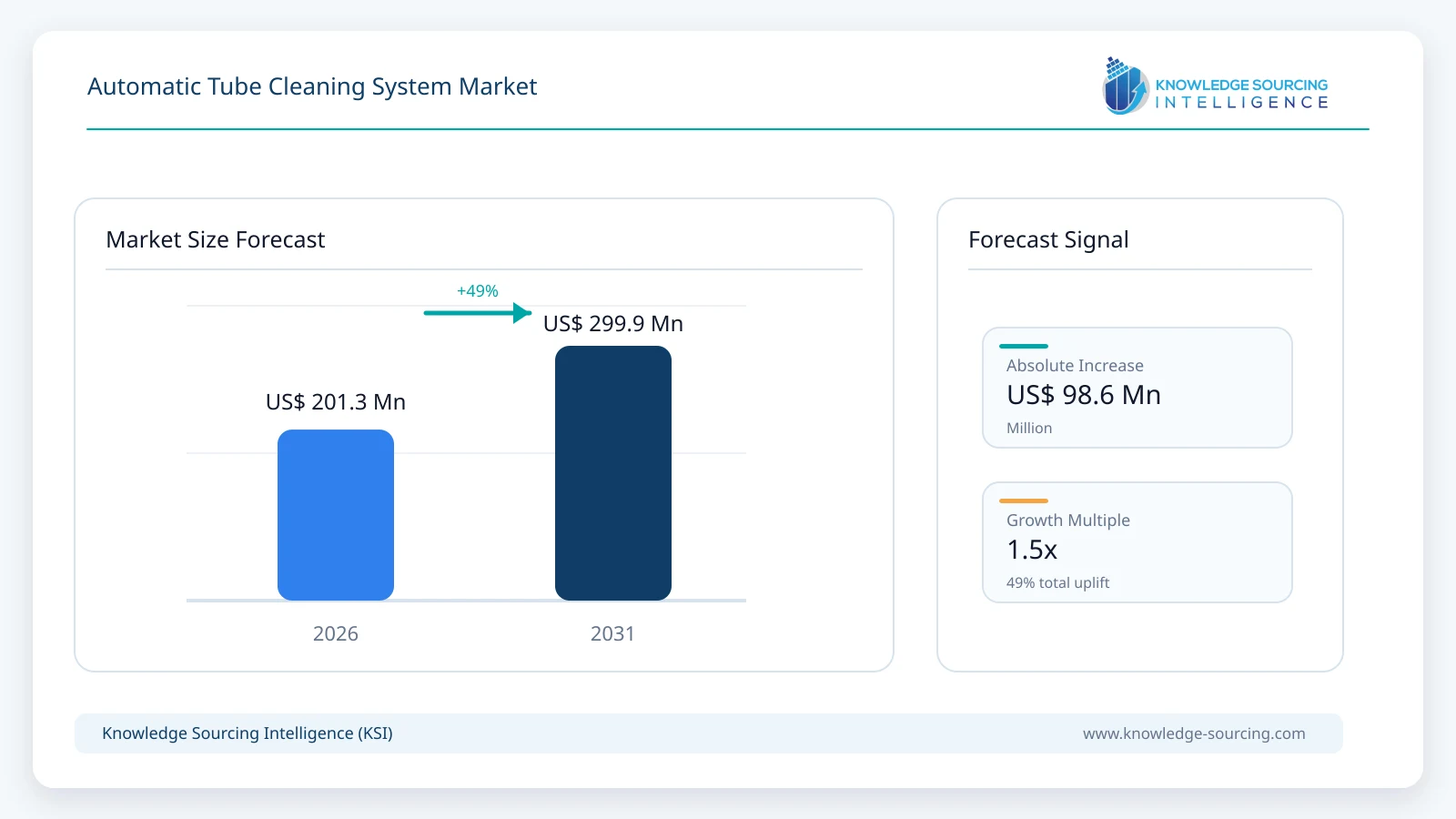
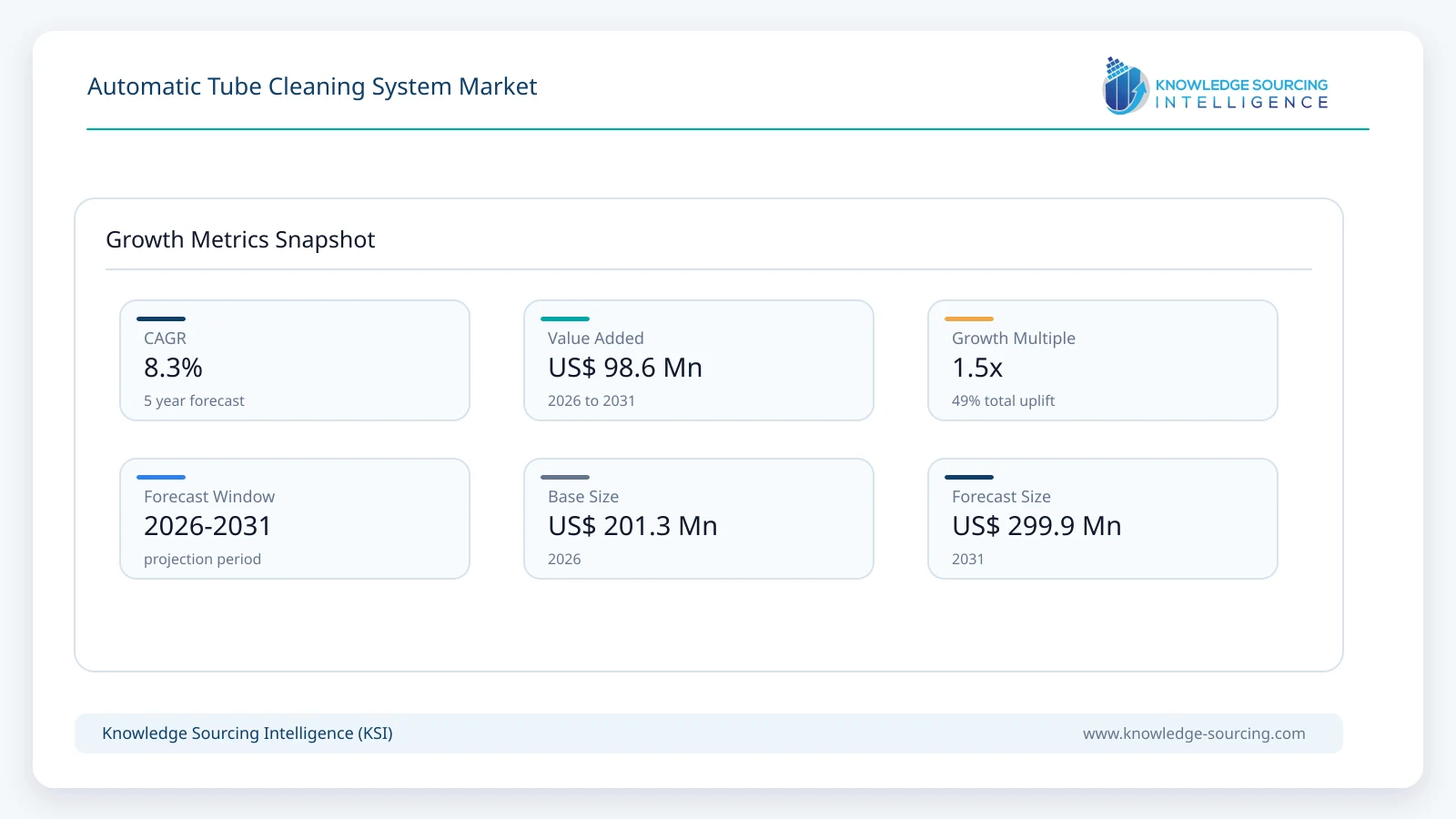
The Automatic Tube Cleaning System Market is projected to expand at a CAGR of 8.3%, reaching USD 299.9 million in 2031 from USD 201.3 million in 2026.
Highlights:
- 1Ball systems account for approximately 72% of market value in 2026, supported by their established use in large condensers, power plants and chilled-water systems.
- 2Brush systems are projected to grow at approximately 9.1% annually through 2031, supported by compact heat exchangers and retrofit applications.
- 3Energy and Power remains the largest end-user group, accounting for approximately 34% of market value in 2026.
- 4Commercial and District Cooling is projected to record approximately 9.9% CAGR, supported by increasing cooling demand, data centres and large chilled-water systems.
- 5Asia Pacific represents approximately 37% of global market value in 2026, supported by power generation, industrial expansion and rising cooling demand.
- 6Middle East and Africa records one of the strongest regional growth rates as district cooling, data centres, petrochemicals and large commercial cooling infrastructure expand.
- 7Automatic systems increasingly incorporate PLC controls, ball-circulation monitoring, BAS/SCADA connectivity and performance monitoring alongside the mechanical cleaning components.
- 8Energy efficiency and avoidance of shutdowns remain the primary commercial rationale for adoption rather than cleaning labour savings alone.
Automatic tube cleaning systems continuously or periodically remove scale, biological fouling, sediment and other deposits from heat-exchanger and condenser tubes while equipment remains in operation. The systems are deployed across power generation, central chilled-water plants, district cooling, commercial buildings, hospitals, industrial facilities, oil and gas operations and other processes where water-cooled heat exchangers need to maintain stable heat-transfer performance.
The underlying economic case is based on the direct relationship between tube cleanliness and thermal efficiency. Even relatively thin layers of scale, slime or sediment increase thermal resistance, raising condenser approach temperatures and forcing chillers or power-generation equipment to consume more energy to deliver the same output. ASHRAE research has documented the performance impact of waterside fouling on enhanced condenser tubes, while an energy audit at Delhi Technological University identified scaling-related pressure loss in a 390 TR chiller condenser and recommended automatic tube cleaning as an efficiency measure.
Ball-based cleaning remains the largest technology category, accounting for approximately 72% of market value in 2026. These systems periodically circulate elastomer or sponge cleaning balls through condenser tubes, recover them downstream and return them for another cycle. TAPROGGE states that more than 18,000 of its systems are currently in use globally, while Ovivo’s Brackett Green system is installed across hundreds of applications and supports water flows exceeding 118,000 cubic metres per hour. These capabilities make ball systems particularly suitable for large condensers and continuous industrial operation.
Demand is also broadening beyond traditional thermal power stations. Global electricity demand is forecast by the IEA to grow by approximately 3.6% in 2026 and 3.8% in 2027, with air conditioning, data centres, industry and electrification among the major structural drivers. Growing cooling requirements increase the installed base of water-cooled chillers and heat exchangers, particularly in large commercial facilities, campuses, hospitals, data centres and district-energy networks, strengthening the addressable market for automated fouling control.
Market Growth Drivers and Trends
Rising Cooling Demand Increases the Cost of Heat-Exchanger Fouling
Cooling is becoming a larger component of electricity demand as global temperatures, air-conditioner penetration and commercial building loads increase. The IEA expects electricity demand to rise strongly through 2030, with space cooling and data centres among the major contributors to growth in the buildings sector. In India alone, cooling is projected to account for more than 20% of additional electricity demand through 2030.
The effect strengthens the economic case for keeping water-cooled heat exchangers operating near design performance. Fouled condenser tubes increase compressor lift and pressure differential, reducing chiller efficiency during precisely the periods when cooling systems are most heavily loaded. Automatic tube cleaning maintains cleaner heat-transfer surfaces while avoiding repeated shutdowns for mechanical brushing.
Innovas Technologies estimated in a June 2026 analysis that a representative plant operating five 1,200-ton chillers with 9% fouling degradation could consume around 686,400 kWh of unnecessary electricity annually. The example is supplier-generated and therefore should not be generalized to every plant, but it demonstrates why large central chilled-water systems can justify investment in continuous cleaning even when the percentage efficiency loss appears relatively modest.
Data Centres Are Creating a New High-Value Cooling Application
Data-centre expansion is increasing demand for high-capacity and highly reliable cooling. Large facilities increasingly operate substantial chilled-water infrastructure, and downtime or loss of cooling performance can directly constrain computing capacity.
The IEA identifies data centres as one of the fastest-growing sources of electricity demand, with their electricity consumption increasing by approximately 17% during 2025. In the United States, data centres are expected to account for around half of electricity-demand growth through 2030.
Automatic tube cleaning is relevant because maintaining condenser efficiency improves cooling capacity without requiring proportional increases in installed chiller equipment. Innovas currently markets its Helios Tube Cleaning System specifically to data centres alongside hospitals, campuses and commercial high-rise facilities, positioning continuous condenser cleaning as both an energy-efficiency and capacity-management tool.
Power Generation Continues to Provide the Largest Industrial Base
Steam-turbine power plants depend on condensers to maintain low turbine back-pressure and effective heat rejection. Deposits inside cooling-water tubes raise condensing temperatures and reduce the efficiency of the thermodynamic cycle, creating direct losses in power output or additional fuel requirements.
TAPROGGE’s large-flow D2 system is designed specifically for steam-turbine condensers and other large thermal applications, handling cooling-water flows from approximately 4,000 to 90,000 cubic metres per hour. The company estimates that maintaining continuous tube cleanliness can reduce primary-energy requirements by around 1–2% in typical power-plant applications, although actual savings depend heavily on water conditions and the level of untreated fouling.
CET Enviro similarly markets its COLTCS system around continuous on-load condenser cleaning for power stations, using circulating sponge-rubber balls and automated recovery to protect condenser back-pressure while the generating unit remains online.
Global power consumption continues to expand, with the IEA forecasting electricity demand growth of 3.6% annually over the 2026–2030 period. Even as the generation mix changes, thermal generation, nuclear plants, industrial power systems and other water-cooled facilities continue to provide a substantial installed base requiring condenser-efficiency management.
Online Cleaning Reduces Dependence on Planned Shutdowns
Traditional tube cleaning generally requires operators to open condenser water boxes and mechanically brush, hydroblast or chemically clean the tubes. These methods can restore performance but require labour, planning and equipment downtime and allow fouling to build between maintenance intervals.
Automatic systems change the maintenance philosophy from periodic restoration toward continuous prevention. Sponge balls or brushes move through the tube during normal operation and remove deposits before substantial insulating layers form. Ovivo’s Brackett Green system, for example, performs complete cleaning cycles without interrupting essential flow through the heat exchanger. TAPROGGE’s closed-loop systems similarly collect and recirculate cleaning balls continuously during plant operation.
The economic benefit can therefore include avoided shutdowns, reduced labour and more stable equipment performance rather than energy savings alone. This is particularly important in hospitals, data centres, district-cooling systems and power stations where cooling or generation availability has direct operational value.
Automation and Monitoring Are Improving System Reliability
Earlier generations of ball-based systems faced concerns around uneven ball distribution, ball loss, blocked strainers and the need for frequent operator intervention. Current systems increasingly address these weaknesses through programmable controls, flow monitoring, automated ball recovery and integration with building or plant automation.
Innovas’ current Helios system uses Metis controls designed to communicate with existing building automation and SCADA systems. TAPROGGE’s large condenser systems use programmable logic controllers to manage ball circulation and report system status, while CET Enviro’s current COLTCS architecture emphasizes automated ball trapping and recirculation.
The evolution is commercially significant because a tube-cleaning system that itself requires extensive maintenance undermines the operating-cost argument for installation. Reliability, recovery efficiency and system diagnostics therefore increasingly differentiate suppliers alongside cleaning performance.
Market Restraints
Initial Installation Cost Can Limit Retrofit Adoption
Automatic tube cleaning systems require ball or brush mechanisms, strainers or traps, piping modifications, controls and installation work around the heat exchanger. Existing plants may also have limited physical space around condenser-water piping.
The resulting capital requirement can be difficult to justify for small chillers or facilities with limited annual operating hours. Manual cleaning remains economically viable where fouling develops slowly and labour costs are relatively low.
Adoption is therefore strongest where energy consumption, equipment utilisation or the cost of downtime is sufficiently high to create a measurable payback from keeping the heat exchanger clean continuously.
Retrofit Complexity Varies Significantly by Plant
Automatic systems need to be integrated into the water circuit without creating unacceptable pressure losses or disrupting the existing hydraulic design. Ball systems also require appropriate separation and recovery equipment downstream of the condenser.
TAPROGGE offers different configurations for small industrial chillers and very large power-plant condensers because flow conditions, pipe diameter and available installation space vary significantly. Ovivo similarly customizes system orientation, diameter and materials according to site hydraulic requirements.
Retrofit feasibility can therefore depend heavily on plant layout rather than simply equipment size.
Cleaning Elements Require Ongoing Replacement and Management
Sponge balls and mechanical brushes are consumable components. Their dimensions and material characteristics need to match tube diameter, tube material, cooling-water chemistry and the type of fouling present.
Balls gradually wear and need replacement, while inappropriate ball selection can reduce cleaning performance or potentially increase tube wear. TAPROGGE maintains a large portfolio of cleaning-ball types for stainless steel, titanium, copper alloys, seawater and low-salinity applications, reflecting the extent to which cleaning elements need to be matched to the operating environment.
Consumable replacement is therefore part of lifecycle cost and prevents automatic systems from becoming completely maintenance-free.
Ball Loss and Recovery Remain Important Design Considerations
A ball-cleaning system only operates effectively if cleaning elements pass through the target tubes and are subsequently recovered and recirculated. Poor flow distribution, damaged strainers or operating anomalies can lead to ball loss and reduce cleaning coverage.
Modern suppliers emphasize improved recovery specifically because this was a weakness of earlier systems. Ovivo markets a patented zero-ball-loss recovery configuration, while CET Enviro highlights a redesigned ball trap intended to improve recovery and extend cleaning-ball service life.
Operators consequently evaluate the whole circulation architecture rather than treating the cleaning ball itself as the main technology.
Water Treatment Still Remains Necessary
Automatic cleaning controls deposits on tube surfaces but does not eliminate the need for appropriate water chemistry management. Cooling systems still require treatment for corrosion, microbiological growth, mineral concentration and other water-quality conditions.
Cleaning systems should therefore be viewed as complementary to water treatment rather than a complete substitute. The strongest applications combine effective cooling-water chemistry with online mechanical fouling prevention so that treatment requirements and tube cleanliness are managed together.
Automatic Tube Cleaning System Market Segmentation Analysis
By Type
Ball Systems Remain the Largest Technology
Ball systems account for approximately 72% of market value in 2026, making them the dominant technology. Their scale reflects decades of deployment across large steam condensers, desalination plants, industrial heat exchangers and increasingly water-cooled chillers.
The operating principle is well established. Sponge or elastomer cleaning balls slightly larger than the tube internal diameter are introduced into the cooling-water flow, pass through the condenser tubes and mechanically remove deposits before being recovered downstream. TAPROGGE reports more than 18,000 systems in operation globally, while Ovivo’s Brackett Green range can be configured for extremely large cooling-water flows.
Their established use in large plants keeps Ball systems the principal market category through 2031, even as compact alternatives increase their share.
Brush Systems Record Faster Growth
Brush systems are projected to grow at approximately 9.1% annually through 2031, slightly faster than the total market. These systems typically use brushes or cleaning elements that move through individual tubes or dedicated circuits, making them suitable for selected heat-exchanger configurations and applications where continuous circulating-ball infrastructure is less practical.
Growth is supported by retrofit requirements, smaller equipment footprints and continued demand for automated cleaning in commercial and industrial heat exchangers. Ball systems retain the larger installed base, but the market is increasingly application-specific rather than assuming one mechanical cleaning principle will suit every condenser.
By Industry Vertical
Energy & Power Remains the Largest End-User
Energy & Power accounts for approximately 34% of market value in 2026 because condenser performance directly affects output and heat rate in steam-based electricity generation. Large thermal and nuclear power plants operate very high cooling-water flows and can incur substantial economic losses when condenser back-pressure increases.
TAPROGGE’s product portfolio remains strongly rooted in power generation, while Ovivo supplies automatic tube cleaning and cooling-water technologies for conventional and nuclear power applications. CET Enviro also positions its COLTCS platform specifically around preserving megawatt output while generating units remain online.
Growth remains healthy through 2031, although the segment’s share gradually moderates as automatic cleaning expands into commercial cooling and data-centre applications.
Commercial & District Cooling Records the Strongest Growth
Commercial & District Cooling is projected to grow at approximately 9.9% annually through 2031. The segment includes central chilled-water plants, district-cooling networks, campuses, large commercial buildings, data centres, hospitality complexes and similar facilities operating large water-cooled chillers.
The growth opportunity is supported by rising electricity consumption for cooling and growing data-centre capacity. The IEA expects cooling and data centres to account for a significant portion of additional building-sector electricity demand through 2030.
Existing installations demonstrate the economic proposition. Innovas reports automatic tube-cleaning deployment across university district-energy systems, hospitals, commercial buildings and data centres, while its 2026 analysis focuses specifically on reducing avoidable chiller electricity consumption by preventing condenser fouling.
Geographical Outlook
Asia Pacific Remains the Largest Regional Market
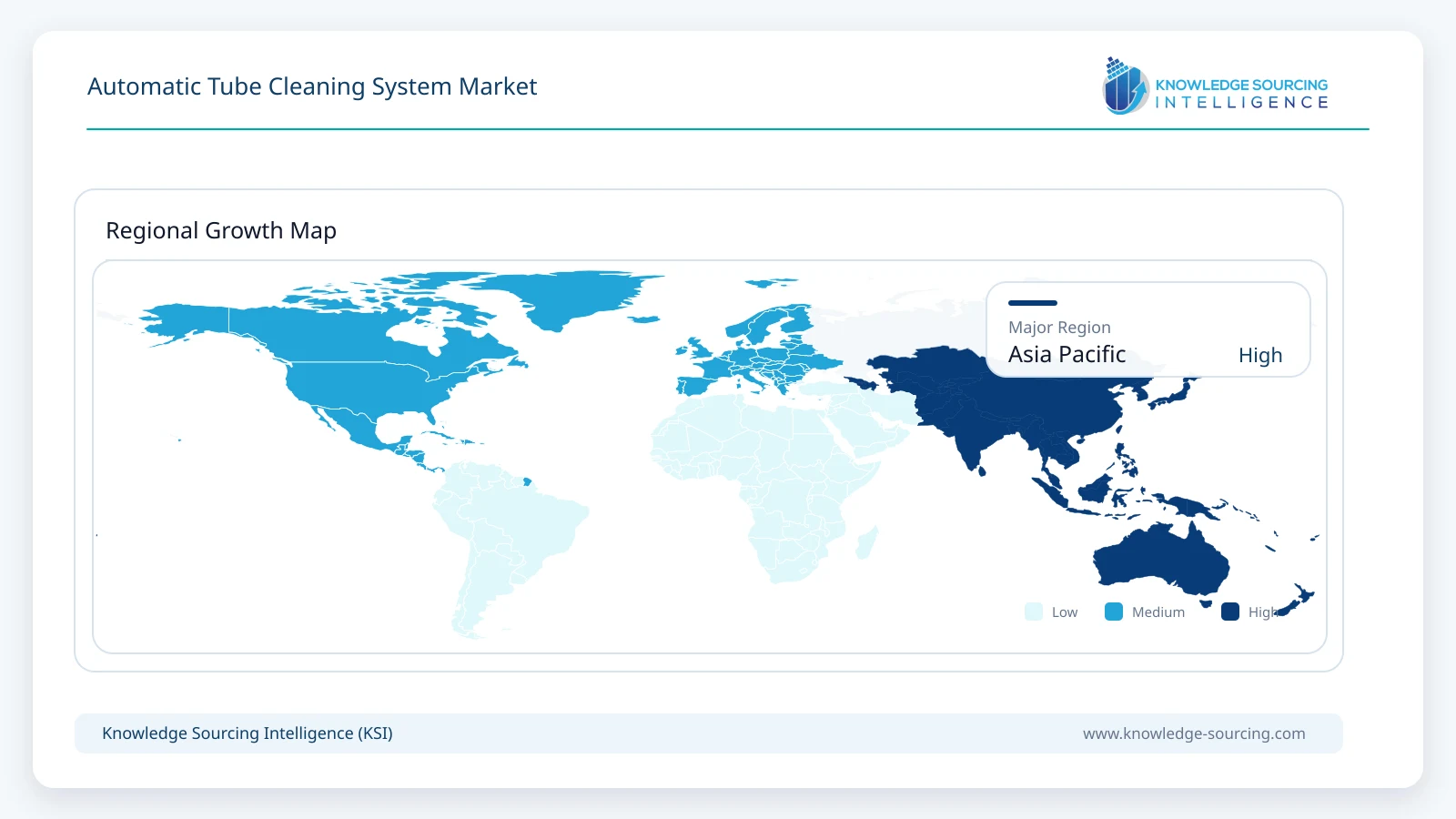
Asia Pacific accounts for approximately 37% of global market value in 2026, supported by large thermal-generation fleets, expanding industrial production, rapidly increasing electricity consumption and rising cooling requirements across China, India and Southeast Asia.
The IEA expects China’s electricity demand to increase by around 5.5% in 2026 and India’s by approximately 7%, while industrial activity and air-conditioning demand remain important drivers across the region. India also reached a record 191.6 TWh of net electricity production in May 2026, coinciding with elevated cooling requirements.
These conditions support automatic tube cleaning across both large power condensers and smaller chilled-water systems. Regional availability is also improving, with suppliers including CET Enviro, Thermax, HydroBall, Watco and TAPROGGE’s Asian operations supporting local installation and service.
Middle East & Africa Records the Strongest Regional Growth
Middle East & Africa is projected to grow at approximately 9.6% annually through 2031, from a smaller base. The strongest demand is concentrated in Gulf markets where high ambient temperatures coincide with large district-cooling networks, commercial developments, data centres, petrochemical facilities and desalination infrastructure.
Cooling systems in these markets operate for long annual periods and frequently handle challenging cooling-water conditions, increasing the economic cost of reduced heat-transfer performance. The region therefore provides favourable conditions for online cleaning even though total installed value remains substantially below Asia Pacific.
Recent Developments
In June 2026, Innovas Technologies published an analysis of condenser fouling and grid demand using a representative five-chiller plant. The company estimated that 9% fouling degradation could add approximately 686,400 kWh of annual electricity consumption, reinforcing the relationship between chiller maintenance and broader electricity-system efficiency.
In July 2026, the IEA raised its near-term global electricity-demand outlook, forecasting growth of 3.6% in 2026 and 3.8% in 2027 as air conditioning, data centres, industry and electrification increase power consumption. The trend raises the commercial value of efficiency improvements across both generation and cooling infrastructure.
During 2026, TAPROGGE expanded the presentation of its current cleaning-system portfolio around distinct large-condenser, industrial-chiller and heat-pump applications. Its D2 platform is optimized for high cooling-water flows, while E1 and T1/F1 systems address more compact heat exchangers and refrigeration equipment.
In December 2025, Innovas published operating results from Chanel’s Rodeo Drive flagship property, reporting three years of continuous tube cleaning without manual tube maintenance or process interruption for the equipped chiller.
TAPROGGE also identifies the shipment of an integrated intake, debris-filtration and tube-cleaning solution for the 70 MW seawater heat pump in Esbjerg, Denmark among its recent technology milestones, demonstrating how online cleaning is moving beyond conventional power generation into large heat-pump infrastructure.
Competitive Environment
The Automatic Tube Cleaning System Market combines long-established condenser-cleaning specialists with water-treatment companies and newer energy-efficiency suppliers. TAPROGGE remains one of the industry’s most established participants, with a global installed base spanning power generation, desalination, industrial refrigeration and heat exchangers. Its competitive strength lies not only in cleaning balls but in the engineering of complete circulation, straining and monitoring systems.
Ovivo participates through the Brackett Green portfolio, combining automatic tube cleaning with debris filtration and cooling-water systems. The ability to supply extremely high-flow installations and nuclear-qualified configurations gives Ovivo a strong position in large power-generation applications.
Innovas Technologies is more concentrated on chiller and central cooling applications. Its Helios system is positioned around continuous fouling prevention, BAS/SCADA integration and measurable energy-performance improvement across campuses, hospitals, data centres and commercial buildings.
BallTech Energy, HydroBall Technics, Watco Group, WSA Engineered Systems and CET Enviro strengthen competition in circulating-ball systems, while BEAUDREY, WesTech, Thermax, Nijhuis Saur and Conco participate through broader condenser, cooling-water or tube-maintenance capabilities.
The market remains technically fragmented because application conditions differ significantly. Large utility condensers can process tens of thousands of cubic metres of water each hour, while commercial chillers require smaller systems that fit into constrained mechanical rooms. Suppliers therefore compete increasingly on hydraulic engineering, ball recovery, retrofit capability, reliability and system integration rather than simply on the cleaning element itself.
Analyst View
The market remains relatively small compared with the much larger installed base of chillers and industrial heat exchangers, but this creates significant room for penetration because automatic cleaning is still not standard equipment across many existing facilities.
The underlying commercial argument is increasingly compelling where electricity and downtime costs are high. Fouling affects thermal efficiency continuously between manual cleaning events, meaning that a facility can lose energy performance even when maintenance is carried out regularly. Automated systems convert cleaning from a periodic maintenance event into an ongoing operating process.
Ball systems remain the largest technology because they have a long operating record and scale effectively into major condensers. Brush systems grow faster from a smaller base as automatic cleaning moves into more compact heat-exchanger and retrofit applications.
The strongest change in demand is likely to occur outside traditional power stations. Data centres, district cooling, campuses, hospitals and commercial central plants are becoming more important as cooling electricity demand rises and facility operators place greater emphasis on measurable efficiency improvements. Suppliers that combine reliable cleaning hardware with automation, monitoring and verifiable performance data are therefore likely to capture a greater share of growth through 2031.
Automatic Tube Cleaning System Market Scope:
| Report Metric | Details |
|---|---|
| Total Market Size in 2026 | USD 201.3 million |
| Total Market Size in 2031 | USD 299.9 million |
| Forecast Unit | Million |
| Growth Rate | 8.3% |
| Study Period | 2021 to 2031 |
| Historical Data | 2021 to 2024 |
| Base Year | 2025 |
| Forecast Period | 2026 – 2031 |
| Segmentation | Type, Industry Vertical, Geography |
| Companies |
|
Market Segmentation
By Type
Ball
Brush
By Industry Vertical
Energy & Power
Commercial & District Cooling
Oil & Gas & Petrochemicals
Industrial Processing
Healthcare & Institutional
Others
By Geography
North America
United States
Canada
Mexico
South America
Brazil
Argentina
Others
Europe
United Kingdom
Germany
France
Italy
Others
Middle East and Africa
Saudi Arabia
United Arab Emirates
Israel
South Africa
Others
Asia Pacific
China
Japan
India
South Korea
Thailand
Taiwan
Indonesia
Singapore
Others
Table of Contents
1. EXECUTIVE SUMMARY
2. MARKET SNAPSHOT
2.1. Market Overview
2.2. Market Definition
2.3. Scope of the Study
2.4. Market Segmentation
3. BUSINESS LANDSCAPE
3.1. Market Drivers
3.2. Market Restraints
3.3. Market Opportunities
3.4. Porter’s Five Forces Analysis
3.5. Industry Value Chain Analysis
3.6. Energy-Efficiency and Operating-Cost Considerations
3.7. Analyst View
4. TECHNOLOGICAL OUTLOOK
4.1. Continuous Online Tube Cleaning
4.2. Ball Recovery and Recirculation Technology
4.3. Brush-Based Cleaning Systems
4.4. PLC and BAS/SCADA Integration
4.5. Tube-Fouling and Performance Monitoring
5. AUTOMATIC TUBE CLEANING SYSTEM MARKET BY TYPE
5.1. Introduction
5.2. Ball
5.3. Brush
6. AUTOMATIC TUBE CLEANING SYSTEM MARKET BY INDUSTRY VERTICAL
6.1. Introduction
6.2. Energy & Power
6.3. Commercial & District Cooling
6.4. Oil & Gas & Petrochemicals
6.5. Industrial Processing
6.6. Healthcare & Institutional
6.7. Others
7. AUTOMATIC TUBE CLEANING SYSTEM MARKET BY GEOGRAPHY
7.1. Introduction
7.2. North America
7.2.1. United States
7.2.2. Canada
7.2.3. Mexico
7.3. South America
7.3.1. Brazil
7.3.2. Argentina
7.3.3. Others
7.4. Europe
7.4.1. United Kingdom
7.4.2. Germany
7.4.3. France
7.4.4. Italy
7.4.5. Others
7.5. Middle East and Africa
7.5.1. Saudi Arabia
7.5.2. United Arab Emirates
7.5.3. Israel
7.5.4. South Africa
7.5.5. Others
7.6. Asia Pacific
7.6.1. China
7.6.2. Japan
7.6.3. India
7.6.4. South Korea
7.6.5. Thailand
7.6.6. Taiwan
7.6.7. Indonesia
7.6.8. Singapore
7.6.9. Others
8. COMPETITIVE ENVIRONMENT AND ANALYSIS
8.1. Major Players and Strategy Analysis
8.2. Technology and Product Benchmarking
8.3. Retrofit and Service Capability
8.4. Agreements, Projects and Product Developments
8.5. Competitive Dashboard
9. COMPANY PROFILES
9.1. TAPROGGE GmbH
9.2. Ovivo Inc.
9.3. Innovas Technologies LLC
9.4. BallTech Energy Ltd.
9.5. BEAUDREY
9.6. WesTech Engineering, LLC
9.7. HydroBall Technics Holdings Pte. Ltd.
9.8. WSA Engineered Systems
9.9. Watco Group
9.10. Thermax Limited
9.11. Conco Services LLC
9.12. CET Enviro Pvt. Ltd.
9.13. Ecomax Solutions Pvt. Ltd.
9.14. Nijhuis Saur Industries
9.15. NLB Corporation
9.16. Sahapie Engineering Co., Ltd.
9.17. Purita Water Solution
10. APPENDIX
10.1. Currency
10.2. Assumptions
10.3. Base and Forecast Years Timeline
10.4. Key Benefits for Stakeholders
10.5. Research Methodology
10.6. Abbreviations
Navigate
Trusted by the world's leading organizations











