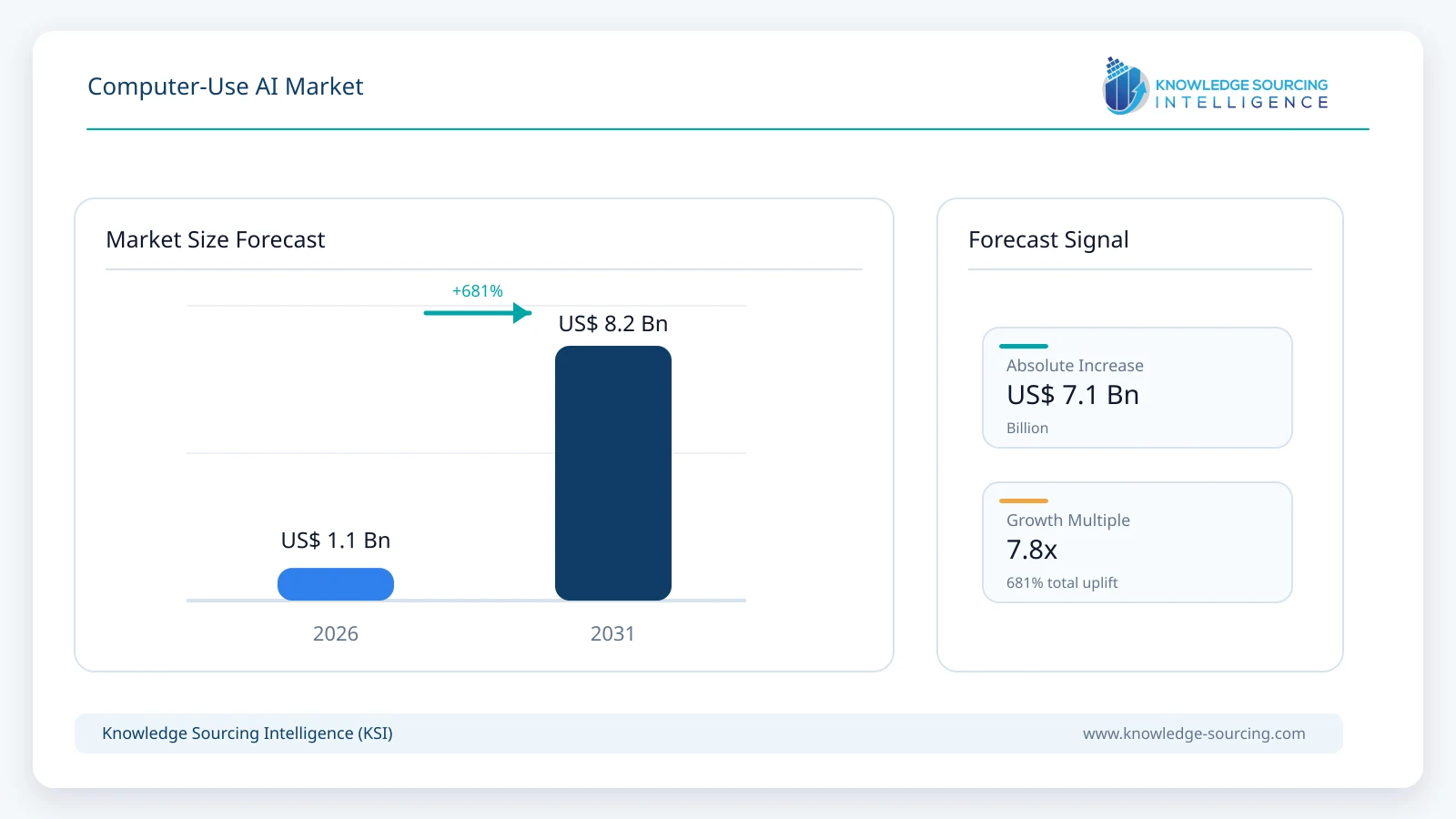
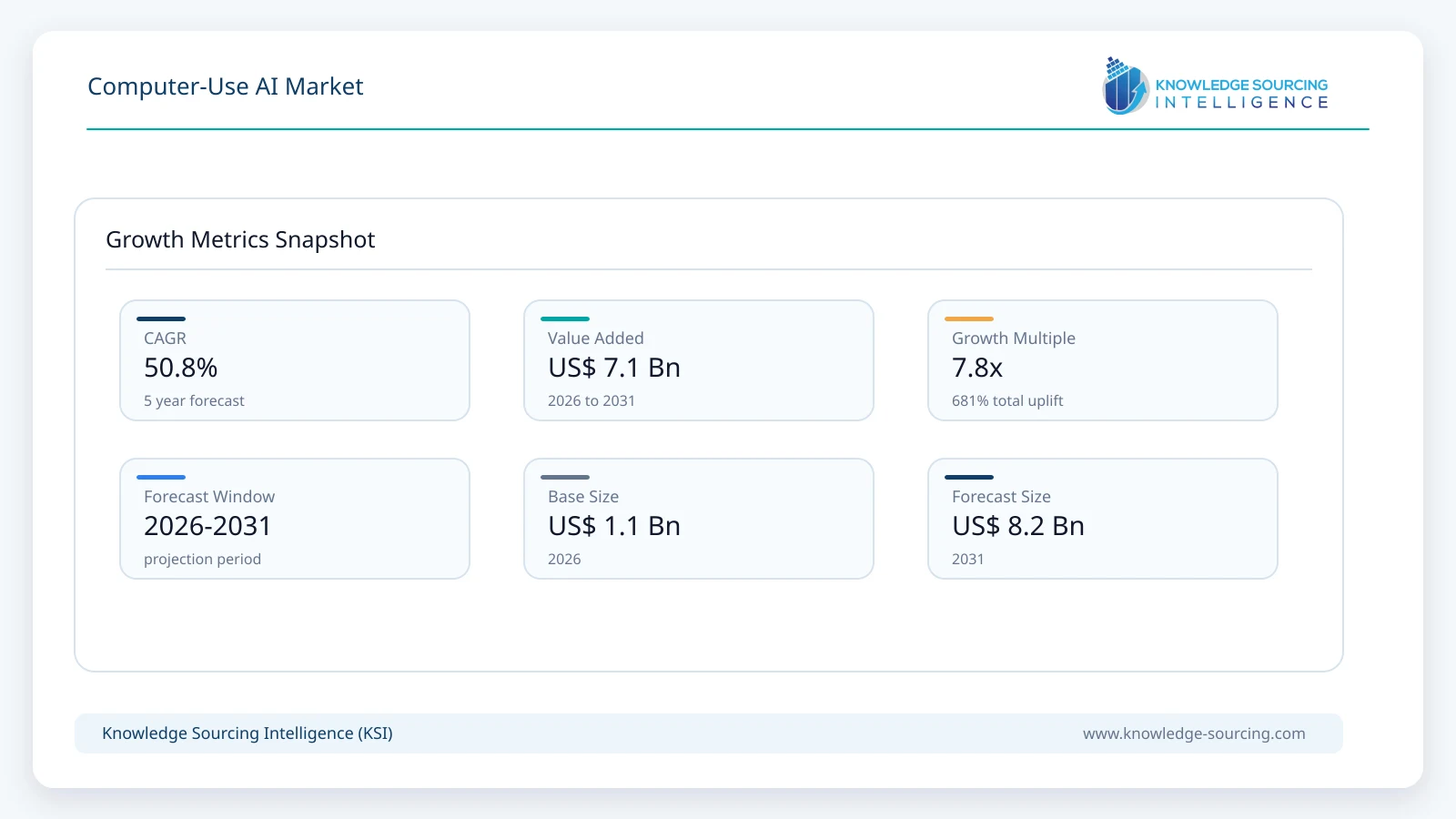
The Computer-Use AI Market is estimated at USD 1.05 billion in 2026 and is forecast to reach USD 8.20 billion in 2031, representing a CAGR of 50.8% during the forecast period.
Highlights:
- 1Vision and screenshot-centric computer-use agents account for an estimated 40.00% of 2026 revenue and are projected to reach USD 3.30 billion in 2031.
- 2Enterprise computer-use software licenses contribute an estimated USD 370 million in 2026 and are expected to reach USD 3.10 billion by 2031.
- 3Browser and web-application tasks form the largest interface segment, at USD 575 million in 2026, with desktop and installed-application interaction gaining importance.
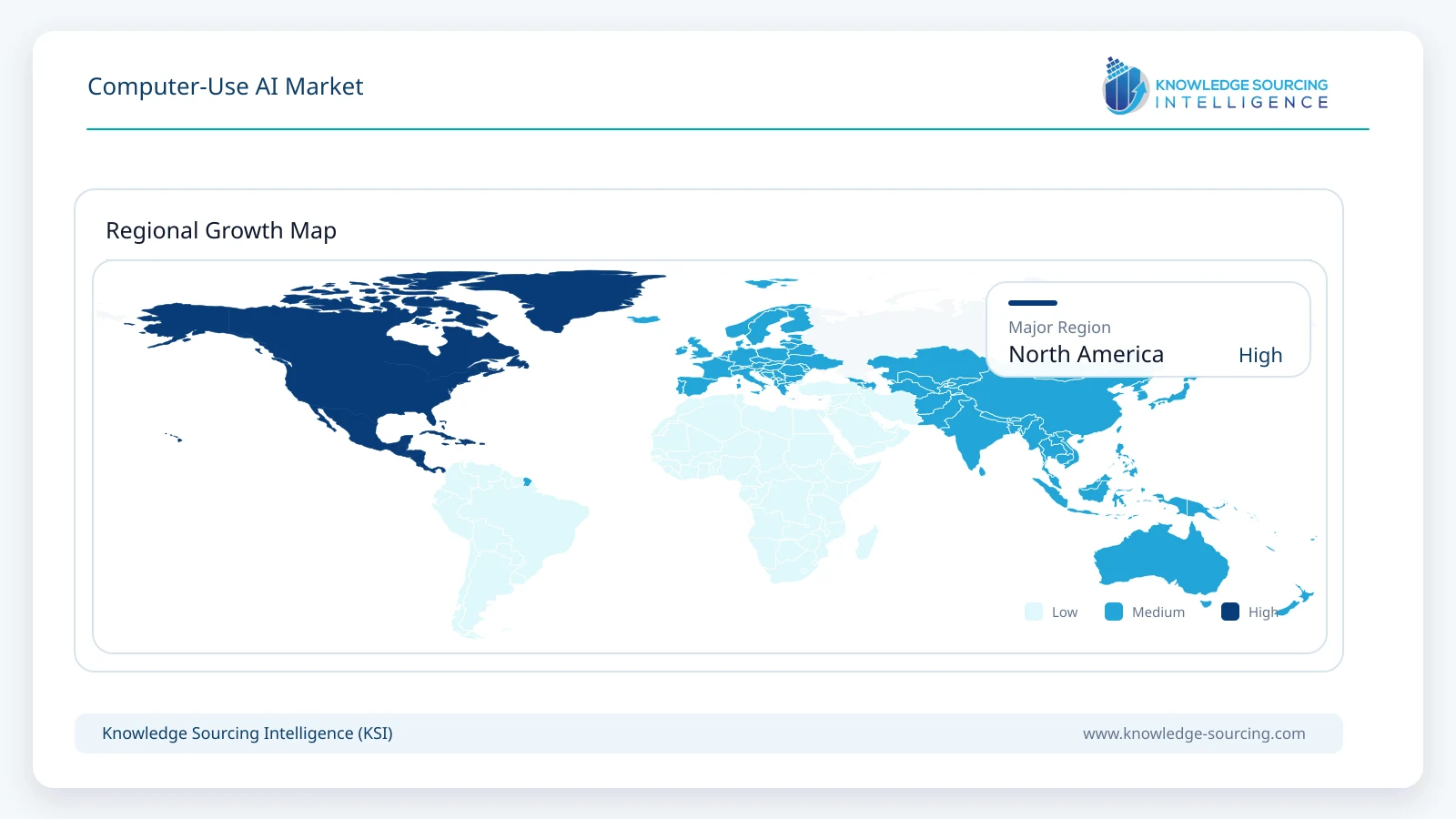
- 4North America represents an estimated USD 490 million of the 2026 market and is projected to reach USD 3.39 billion in 2031.
- 5Asia Pacific is forecast to reach USD 2.38 billion by 2031 as enterprises adopt agentic workflow execution across growing digital-service ecosystems.
The market covers attributable revenue from computer-use model access, managed UI-task execution, enterprise computer-use software and specialist services implementing those functions.
Computer-using agents interpret interface state, identify the next action and interact through click, typing, scrolling and navigation functions. Amazon Nova Act focuses on production browser workflows, Microsoft Copilot Studio integrates computer use with enterprise orchestration, and UiPath ScreenPlay can operate across changing interfaces without relying solely on selectors.
Commercial adoption is closely linked to execution reliability, per-task economics and governance. A model that completes isolated benchmark actions may still need exception handling when websites change, sessions expire or users must approve a transaction. Customers therefore evaluate the cost of verified successful outcomes, security of credentials and evidence of completed work instead of assuming that an agent can replace every conventional automation step.
Market Overview
Computer-use systems operate through a perception-action loop in which screenshots, accessibility information or browser document structure become inputs for a reasoning model. The agent chooses a permissible action, the runtime applies it to the target application, and the next observed screen is used to assess progress.
Enterprise integration adds separate technical requirements beyond simple mouse and keyboard control. User credentials, session boundaries, role-based permissions and approval gates must remain enforceable even when the model encounters persuasive instructions inside webpages or documents. Microsoft Copilot Studio, UiPath and AWS have built managed approaches around such requirements, while specialist developers provide browser sessions, orchestration and execution infrastructure.
The competitive structure combines foundation-model suppliers, enterprise automation providers and focused computer-use platforms. A model provider can sell inference capacity without owning the browser runtime; a cloud execution service can charge per completed task without developing its own model; and an enterprise software vendor can bundle graphical automation into a broader license.
Market Trends
GUI-Native Agents Are Moving Into Production Workflows
Production computer-use deployments are expanding from experimental demonstrations into controlled business processes. Amazon Nova Act is generally available for browser workflows and has been used by First Orion for user-interface testing; AWS also documented HIPAA eligibility for deployments involving healthcare information.
Organizations often start with repeatable but exception-prone activities such as claims checks, form completion, invoice entry and testing customer journeys. The commercial case improves when agents reduce rework and can signal uncertainty before an irreversible step. Providers that offer monitoring, retry policies and human intervention can support wider production use, although the realized savings depend on application complexity and the share of tasks completed without correction.
Hybrid Screen and Application-State Interpretation Is Improving Reliability
Computer-use platforms increasingly combine visual screenshots with structured information from accessibility trees, browser document models and controlled tool calls. Browserbase introduced Stagehand v4 in August 2026 to work more directly with live browser state, while UiPath broadened its ScreenPlay model options and cross-application execution during 2026.
Different interface methods nevertheless carry practical trade-offs. Screenshots are broadly portable but may be slower and can misread small controls, while DOM-aware tools are more precise within supported browsers but cannot automatically operate every native desktop application. Mixed approaches are therefore attractive where enterprises must connect established web portals with installed business software.
Enterprise Governance Is Becoming Part of Computer-Use Procurement
Enterprise computer-use products must enforce the authority granted to each workflow, particularly when agents cross applications and authenticated accounts. Microsoft Copilot Studio provides governed computer-use tools, and UiPath positions ScreenPlay alongside credentials management and its AI Trust Layer. AWS describes human escalation and orchestration within Nova Act, allowing organizations to separate routine tasks from decisions that require supervised review.
Prompt injection creates a distinct risk because an agent can encounter untrusted webpage text while holding permission to act inside a separate trusted application. Supplier controls include isolated browsers, restricted domains, task logs and explicit approval before sensitive external actions. Heavily regulated buyers also need records that show which pages were accessed and whether data was transmitted.
Managed Browser Agents and Metered Execution Are Expanding
Computer-use services are increasingly sold through metered execution platforms rather than only annual software licenses. Browser Use lists consumption-based browser-agent access, while Browserbase provides browser infrastructure and its Stagehand framework for developers operating web tasks. Skyvern focuses on workflows such as filling forms and collecting information across websites.
Metering also changes purchasing decisions because unsuccessful attempts, repeated screenshots and long-running navigation can consume measurable resources. Vendors compete on the number of verified successful tasks, predictable concurrency, traceability and ability to resume after failure. Pricing models may include per-run charges, model-token consumption and enterprise orchestration fees; the market estimate counts each commercial payment stream according to its principal purchased function and avoids recognizing unrelated proxy or raw hosting fees.
Segment Analysis
By Interface Interpretation Architecture: Vision and Screenshot-Centric Agents
Vision-oriented computer-use models convert the visible application interface into a sequence of grounded software actions. The architecture is useful for websites and desktops that cannot easily expose clean semantic controls, and it allows a single planning system to move among several software products.
The segment is estimated at USD 420 million in 2026 and projected to reach USD 3.30 billion by 2031. Growth will depend on better grounding of visual elements, reduced inference cost and wider deployment within enterprise software, while hybrid and structured UI techniques remain competitive alternatives in environments where direct accessibility or document-model access is possible.
By Commercial Offering: Enterprise Computer-Use Software Licenses
Enterprise computer-use licenses monetize access to governed task execution, workflow configuration and administrative controls across organizational software. UiPath ScreenPlay and Microsoft Copilot Studio demonstrate how these capabilities can be purchased within enterprise automation environments rather than solely through low-level model calls.
The enterprise license category is forecast to grow from USD 370 million in 2026 to USD 3.10 billion in 2031 as repeatable workloads expand beyond technical pilots. Other monetization routes include model APIs, projected at USD 1.62 billion in 2031, and managed task-execution platforms, projected at USD 2.60 billion.
By Interacted Interface: Browser and Web Applications
Browser and web-application interfaces remain the largest deployment environment because procurement portals, customer systems and cloud business applications are typically accessed through web sessions. Amazon Nova Act, Browserbase Stagehand and Browser Use support automation built around live web interactions, while Microsoft and UiPath span web and other enterprise applications.
Browser and web-application computer-use revenue is estimated at USD 575 million in 2026 and USD 4.05 billion by 2031. Desktop and installed-application computer-use capability is expected to reach USD 2.78 billion by 2031, supported by back-office software and virtual workstations.
Market Drivers
Automation of Legacy Software Without APIs
Large organizations continue to operate business systems through screens, forms and portals that lack suitable application programming interfaces. Computer-use agents can perform authorized actions through existing interfaces, reducing the need for custom integrations in selected workflows. Potential savings are greatest where staff repeat the same cross-system steps and where automated verification can catch incomplete actions before they disrupt business operations.
Rising Volume of Repetitive Knowledge-Work Tasks
Finance, procurement, customer operations and IT teams regularly copy data between applications, extract records and reconcile web forms. A governed computer-use agent can combine visual understanding with natural-language task instructions to reduce manual navigation. Savings depend on how many actions are completed correctly and how much review effort remains, supporting demand for tools that measure both automation rate and exception handling.
Greater Capability of Multimodal Action Models
Advances in vision-language systems and interface grounding have improved performance on tasks involving screenshots, tab switching and changing software layouts. Google expanded Gemini computer use in 2026, and Microsoft Research released Fara1.5 computer-use models. These capabilities broaden the range of candidate tasks, enabling commercial suppliers to package automation for users who cannot write brittle scripts or build API connectors.
Enterprise Availability Through Existing Software Platforms
Microsoft Copilot Studio, UiPath and AWS offer computer-use capabilities through platforms already familiar to enterprise buyers and developers. Integration with existing identity, workflow and cloud contracts can lower the procurement and deployment burden relative to isolated experimental tools. Governance, technical support and managed runtime options create incentives to expand successful pilots into repeatable departmental installations.
Growth of Metered Agent Execution Services
Developers increasingly have access to hosted computer-use execution and orchestration, allowing automated tasks to run without operating entire browser fleets in-house. Browser Use, Browserbase and specialist workflow agents support consumption-based procurement. The model lowers initial infrastructure commitments, while ongoing task volume creates an identifiable recurring revenue stream for providers able to demonstrate reliable completion at an acceptable cost.
Market Restraints
Unreliable Completion of Long Multistep Tasks
Computer-use systems can fail after a series of otherwise correct actions when a page loads unexpectedly, a pop-up intercepts a control or an interface changes during execution. Small action-level errors compound during long tasks and can be costly if a wrong submission changes customer records.
Prompt-Injection and Credential Security Risks
Computer-use agents operate close to authenticated accounts and can encounter untrusted text embedded in webpages, emails and documents. Malicious instructions may attempt to redirect an agent toward unauthorized access or data disclosure. Domain restrictions, policy enforcement, short-lived credentials and human approval reduce exposure but increase engineering complexity and can limit use in sensitive business environments.
Cost of Model Inference and Runtime Sessions
Visual interface automation can require repeated model invocations, screenshots, browser sessions and retries during a single task. When the model is expensive or a workflow has many steps, operating costs can exceed the value of the time saved.
Application Terms and Anti-Automation Restrictions
Some websites prohibit automated actions, require human verification or use bot-detection controls that interrupt headless browsers. Enterprise applications can also impose rate limits, multi-factor authentication and narrow access policies. Computer-use deployment cannot assume universal permission to operate every interface, so procurement teams must assess legal terms, acceptable-use requirements and the practical availability of authorized automation paths.
Difficulty Establishing Accountability Across Systems
When an AI agent initiates changes in several business applications, customers must know which approvals were granted, what actions succeeded and how errors will be corrected. Logging, process ownership, audit trails and segregation of duties can be difficult when workflows cross vendors.
Regional Outlook
North America
North America leads early spending on computer-use AI because US cloud and software suppliers are making computer-use capabilities available within developer APIs, enterprise automation suites and managed browser runtimes. The region is estimated to generate USD 490 million in 2026, supported by technology firms, business-services organizations and early adoption in insurance, financial operations and software testing.
North American computer-use AI revenue is projected to reach USD 3.39 billion in 2031 as enterprise rollout moves beyond proof-of-concept activity. Growth will increasingly depend on secure operation of authenticated applications, consistent completion rates and contractual accountability for task execution.
Asia Pacific
Asia Pacific demand is developing across software engineering, outsourced business processes, e-commerce operations and enterprise applications with multilingual interfaces. The region is estimated at USD 255 million in 2026, led by China, India, Japan, South Korea and regional digital-service hubs.
Asia Pacific computer-use AI revenue is projected at USD 2.38 billion in 2031, expanding faster than North America from a smaller starting base. Indian IT services and business process operators can deploy interface automation across international customer workflows, while Japanese and South Korean organizations can apply similar tools to aging application estates and productivity improvement. Practical adoption will require reliable task evaluation across regional sites, appropriate customer-data residency and controls for shared or outsourced service accounts.
Competitive Landscape
Competition is developing across three commercial groups: general-purpose model providers supplying screen-action capabilities, enterprise automation suppliers packaging governed UI agents, and specialist execution platforms selling developer tools or managed browser tasks. OpenAI, Anthropic and Google provide key model-level capabilities, while Microsoft, AWS and UiPath offer enterprise environments where computer use can be orchestrated with existing tasks and human approvals. Browserbase, Browser Use and Skyvern serve developers or firms seeking more focused execution infrastructure.
Commercial differentiation depends on audited task success, latency, interface coverage, credential security, approved application access and the ability to recover from failures. Buyers should not equate an open-weight research model with booked software revenue or count entire RPA subscription spending as computer-use AI. Anthropic acquired Vercept in February 2026 and said the acquired company would wind down its external product, demonstrating why corporate ownership and active product status must be checked before assigning independent market participation.
Supplier strategies increasingly favor combined visual interpretation and structured application controls rather than unrestricted autonomous clicking. Enterprises require evidence of what an agent viewed and changed, while developers prioritize cost per successful action and maintainability. Continued expansion of model options within platforms such as UiPath may increase competitive pressure on standalone execution services, although specialists can compete through workflow templates and hosting efficiency.
Recent Developments
October 2026: Browserbase introduced Stagehand 4.3, adding direct integrations with the OpenAI and Anthropic SDKs and expanded page-control options for browser agents.
August 2026: Browserbase released Stagehand v4, moving core browser state handling into an extension to improve reliability and execution efficiency.
June 2026: Google introduced computer use as a built-in tool in Gemini 3.5 Flash for building agents across browser, mobile and desktop environments.
May 2026: Microsoft announced general availability of computer-using agents in Copilot Studio for enterprise web and desktop automation.
May 2026: Amazon Web Services announced that Nova Act was eligible for HIPAA-related deployments, extending its use in healthcare-administration workflows.
February 2026: Anthropic acquired Vercept to strengthen Claude computer-use technology and stated that Vercept would wind down its external product.
Market Outlook
Computer-use AI revenue is expected to grow as enterprise buyers turn experimental screen-action models into repeatable workflow components, particularly where legacy applications cannot be integrated economically through APIs. Market expansion will depend on tasks that combine visual software interpretation with controlled execution, allowing agents to operate selected portals, desktops and virtual sessions. Enterprise software licenses and managed execution should benefit when customers can establish task ownership, permitted actions and consistent output validation.
The fastest commercial gains are likely in structured processes with many interface steps but clear rules for verifying outcomes, including software QA, administrative entry and routine account-service tasks. Stronger model capabilities alone will not eliminate requirements for human approval, exception handling or vendor compliance. Providers that reduce cost per successfully completed task while maintaining reliable security controls should be better positioned than those competing only on benchmarks or model size.
Computer-Use AI Market Scope
| Report Metric | Details |
|---|---|
| Total Market Size in 2026 | USD 1.05 billion |
| Total Market Size in 2031 | USD 8.20 billion |
| Forecast Unit | Billion |
| Growth Rate | 50.8% |
| Study Period | 2021 to 2031 |
| Historical Data | 2021 to 2024 |
| Base Year | 2025 |
| Forecast Period | 2026 – 2031 |
| Segmentation | Interface Interpretation Architecture, Commercial Offering, Interacted Interface, Primary Workflow, Customer Organization, Deployment Model, End-User Industry, Geography |
| Companies |
|
| Customization Scope | 15% Free Customization included with purchase — Request Custom Breakdown → |
| Sample & Data Access | PDF Sample, Excel Databook & Analyst Briefing — Download Free Sample → |
Market Segmentation
By Interface Interpretation Architecture
Vision and Screenshot-Centric Agents
Hybrid Vision and DOM-Aware Agents
Semantic and Accessibility-Tree Agents
OS-Native and System-Control Agents
By Commercial Offering
Computer-Use Model APIs
Managed Task-Execution Platforms
Enterprise Computer-Use Software Licenses
Attributable Implementation and Managed Services
By Interacted Interface
Browser and Web Applications
Desktop and Installed Applications
Virtual Desktop and Remote Workspaces
Mobile Application Interfaces
By Primary Workflow
Back-Office Data Entry and Operations
Software Quality Assurance and Testing
Customer Service and Sales Operations
Research, Extraction and Document Work
IT and Application Administration
Procurement and Commerce Tasks
By Customer Organization
Cloud and Technology Providers
Large Enterprises
Small and Medium Enterprises
Public-Sector Agencies
Developers and Systems Integrators
By Deployment Model
Cloud-Hosted Computer-Use Services
Customer-Hosted and Private Deployments
Hybrid and Controlled-Desktop Deployments
By End-User Industry
Banking and Financial Services
Technology and IT Services
Retail and E-Commerce
Healthcare and Life Sciences
Manufacturing and Logistics
Government and Education
Other Industries
By Geography
North America
United States
Canada
Mexico
South America
Brazil
Argentina
Chile
Colombia
Rest of South America
Europe
Germany
United Kingdom
France
Netherlands
Sweden
Spain
Switzerland
Rest of Europe
Middle East and Africa
United Arab Emirates
Saudi Arabia
Israel
South Africa
Rest of Middle East and Africa
Asia Pacific
China
India
Japan
South Korea
Singapore
Australia
Taiwan
Rest of Asia Pacific
Table of Contents
1. EXECUTIVE SUMMARY
1.1. Research Highlights
1.2. Market Size and Forecast, 2026-2031
1.3. Strategic Market Outlook
2. MARKET SNAPSHOT
2.1. Definition and Scope
2.2. Market Dynamics
2.3. Commercialization and Adoption
3. BUSINESS LANDSCAPE
3.1. Market Drivers
3.1.1. Automation of Legacy Software Without APIs
3.1.2. Rising Volume of Repetitive Knowledge-Work Tasks
3.1.3. Greater Capability of Multimodal Action Models
3.1.4. Enterprise Availability Through Existing Software Platforms
3.1.5. Growth of Metered Agent Execution Services
3.2. Market Restraints
3.2.1. Unreliable Completion of Long Multistep Tasks
3.2.2. Prompt-Injection and Credential Security Risks
3.2.3. Cost of Model Inference and Runtime Sessions
3.2.4. Application Terms and Anti-Automation Restrictions
3.2.5. Difficulty Establishing Accountability Across Systems
3.3. Market Opportunities
3.4. Porter’s Five Forces Analysis
3.5. Industry Value Chain Analysis
3.6. Policies and Regulations
3.7. Strategic Recommendations
4. TECHNOLOGICAL OUTLOOK
4.1. GUI Perception and Grounded Action Models
4.2. Browser and Desktop Control Runtimes
4.3. Hybrid Visual and Semantic Interface Tools
4.4. Credential, Approval and Execution Policies
4.5. Task Verification and Failure Recovery
4.6. Security and Prompt-Injection Controls
5. COMPUTER-USE AI MARKET BY INTERFACE INTERPRETATION ARCHITECTURE
5.1. Vision and Screenshot-Centric Agents
5.2. Hybrid Vision and DOM-Aware Agents
5.3. Semantic and Accessibility-Tree Agents
5.4. OS-Native and System-Control Agents
6. COMPUTER-USE AI MARKET BY COMMERCIAL OFFERING
6.1. Computer-Use Model APIs
6.2. Managed Task-Execution Platforms
6.3. Enterprise Computer-Use Software Licenses
6.4. Attributable Implementation and Managed Services
7. COMPUTER-USE AI MARKET BY INTERACTED INTERFACE
7.1. Browser and Web Applications
7.2. Desktop and Installed Applications
7.3. Virtual Desktop and Remote Workspaces
7.4. Mobile Application Interfaces
8. COMPUTER-USE AI MARKET BY PRIMARY WORKFLOW
8.1. Back-Office Data Entry and Operations
8.2. Software Quality Assurance and Testing
8.3. Customer Service and Sales Operations
8.4. Research, Extraction and Document Work
8.5. IT and Application Administration
8.6. Procurement and Commerce Tasks
9. COMPUTER-USE AI MARKET BY CUSTOMER ORGANIZATION
9.1. Cloud and Technology Providers
9.2. Large Enterprises
9.3. Small and Medium Enterprises
9.4. Public-Sector Agencies
9.5. Developers and Systems Integrators
10. COMPUTER-USE AI MARKET BY DEPLOYMENT MODEL
10.1. Cloud-Hosted Computer-Use Services
10.2. Customer-Hosted and Private Deployments
10.3. Hybrid and Controlled-Desktop Deployments
11. COMPUTER-USE AI MARKET BY END-USER INDUSTRY
11.1. Banking and Financial Services
11.2. Technology and IT Services
11.3. Retail and E-Commerce
11.4. Healthcare and Life Sciences
11.5. Manufacturing and Logistics
11.6. Government and Education
11.7. Other Industries
12. COMPUTER-USE AI MARKET BY GEOGRAPHY
12.1. North America
12.1.1. United States
12.1.2. Canada
12.1.3. Mexico
12.2. South America
12.2.1. Brazil
12.2.2. Argentina
12.2.3. Chile
12.2.4. Colombia
12.2.5. Rest of South America
12.3. Europe
12.3.1. Germany
12.3.2. United Kingdom
12.3.3. France
12.3.4. Netherlands
12.3.5. Sweden
12.3.6. Spain
12.3.7. Switzerland
12.3.8. Rest of Europe
12.4. Middle East and Africa
12.4.1. United Arab Emirates
12.4.2. Saudi Arabia
12.4.3. Israel
12.4.4. South Africa
12.4.5. Rest of Middle East and Africa
12.5. Asia Pacific
12.5.1. China
12.5.2. India
12.5.3. Japan
12.5.4. South Korea
12.5.5. Singapore
12.5.6. Australia
12.5.7. Taiwan
12.5.8. Rest of Asia Pacific
13. COMPETITIVE ENVIRONMENT AND ANALYSIS
13.1. Major Players and Strategy Analysis
13.2. Market Share Analysis
13.3. Mergers, Acquisitions, Agreements and Collaborations
13.4. Competitive Dashboard
14. COMPANY PROFILES
14.1. OpenAI
14.2. Anthropic
14.3. Google LLC (Alphabet)
14.4. Microsoft Corporation
14.5. Amazon Web Services (Amazon)
14.6. UiPath, Inc.
14.7. Browserbase, Inc.
14.8. Browser Use
14.9. Skyvern
14.10. Automation Anywhere, Inc.
14.11. ServiceNow, Inc.
15. APPENDIX
15.1. Currency
15.2. Assumptions
15.3. Market Estimation Methodology
15.4. Research Sources
15.5. Abbreviations





Frequently asked questions
What is the projected growth forecast for the Computer-Use AI market?
Market to reach $8.20 billion by 2031, with a 50.8% CAGR.
Which regions are forecast to lead the Computer-Use AI market?
North America leads; Asia Pacific is forecast for strong growth by 2031.
What is the growth projection for vision-centric computer-use agents?
Projected to reach $3.30 billion by 2031, accounting for significant revenue.
How much will enterprise computer-use software licenses contribute by 2031?
Enterprise software licenses are expected to reach $3.10 billion by 2031.
Which interface segment currently dominates the Computer-Use AI market?
Browser and web-application tasks form the largest interface segment.
What factors are critical for commercial adoption of computer-use AI?
Execution reliability, per-task economics, and governance are key adoption factors.
Cite this report
Knowledge Sourcing Intelligence. (Oct 2026). Computer-Use AI Market Size, Share & Growth Forecast (2026-2031). https://www.knowledge-sourcing.com/report/computer-use-ai-market