
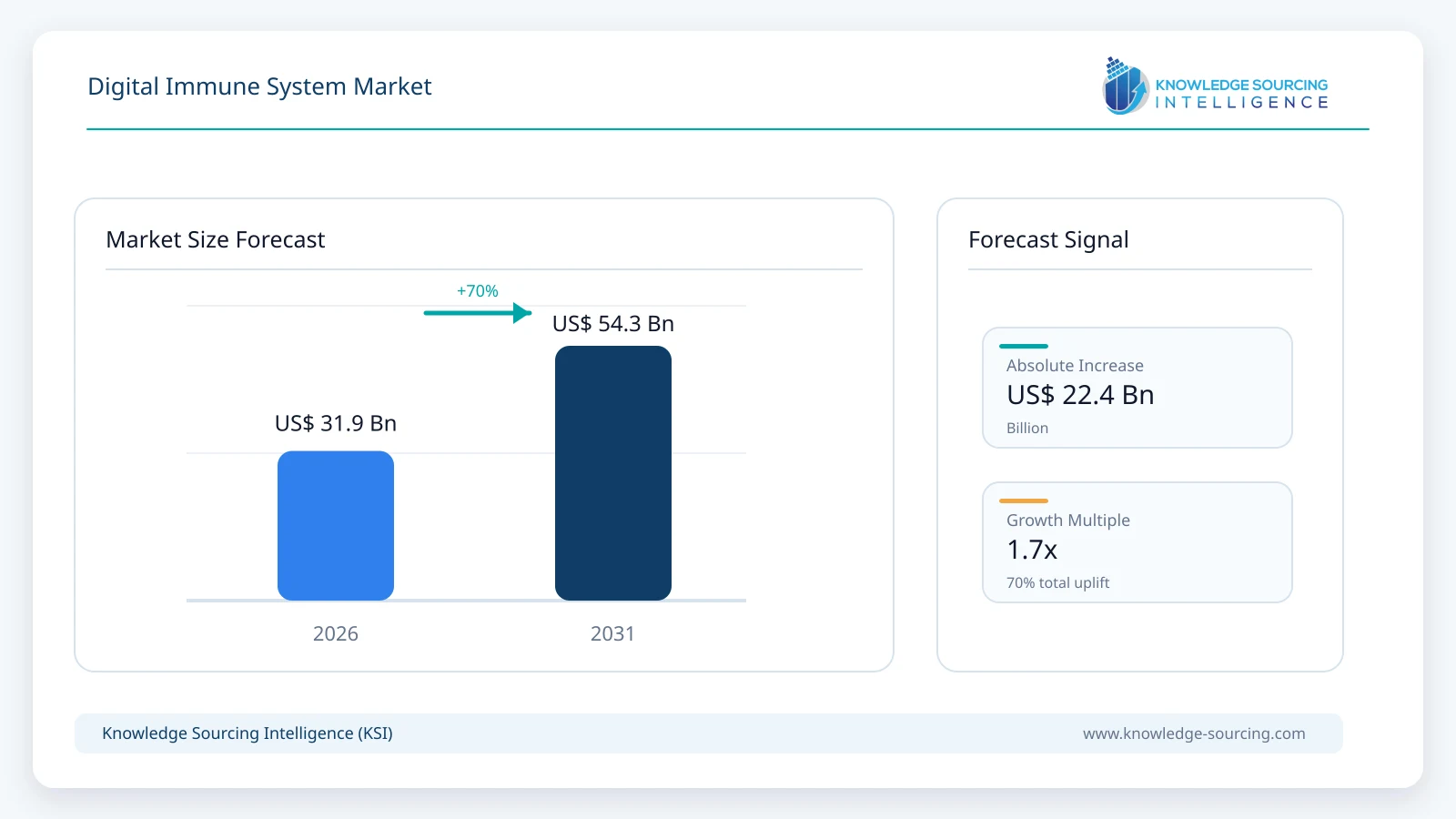
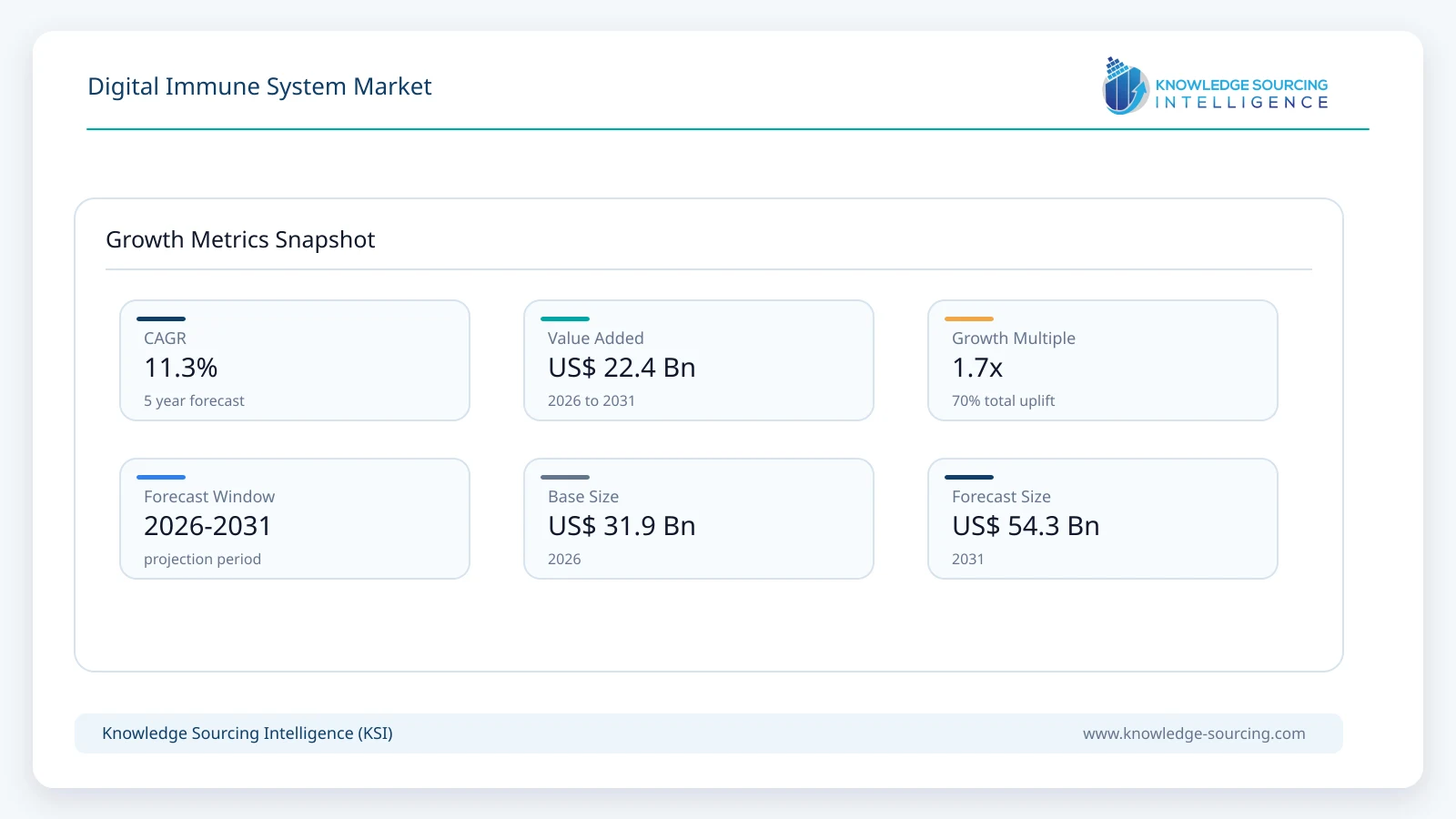
The Digital Immune System Market is forecast to grow at a CAGR of 11.3%, reaching USD 54.3 billion in 2031 from USD 31.9 billion in 2026.
Highlights:
- 1AI-enabled threats are increasing demand for integrated detection, response, identity, endpoint, cloud, and application controls.
- 2Cloud deployment is commercially important because distributed infrastructure requires centralized visibility and policy enforcement.
- 3Financial services, healthcare, government, telecom, and manufacturing face strong resilience requirements because outages can create operational or regulatory consequences.
- 4Automation is becoming central to digital immune system architectures as security teams seek faster investigation and response without proportionally expanding headcount.
- 5NIST CSF 2.0, NIS2, DORA, and emerging product-security requirements are strengthening the business case for measurable cyber resilience.
- 6Competition is shifting toward integrated platforms, managed services, ecosystem partnerships, and security controls embedded within existing infrastructure.
The Digital Immune System Market covers technologies and services designed to improve the resilience, security, reliability, and recoverability of digitally enabled business operations. The market sits at the intersection of cybersecurity, software quality, observability, automation, artificial intelligence, cloud security, endpoint protection, network defense, and operational resilience. Rather than treating security incidents, software defects, infrastructure failures, and anomalous behavior as isolated events, digital immune system approaches connect telemetry, analytics, automated controls, testing, and response mechanisms across the technology environment.
Commercial demand is being shaped by the increasing economic dependence of enterprises on always-available digital services. Banking transactions, healthcare workflows, manufacturing operations, telecommunications, public services, software delivery, and customer-facing applications now depend on distributed technology estates. A disruption therefore creates costs beyond the immediate IT incident. Lost transactions, regulatory exposure, production downtime, customer attrition, recovery expenditure, and reputational damage all influence the business case for resilience-oriented security investments.
The buyer base is consequently broader than the traditional cybersecurity function. Chief information security officers remain central decision-makers for network, endpoint, cloud, and threat-management requirements, while CIOs, chief technology officers, software engineering leaders, infrastructure teams, risk officers, compliance departments, and business-unit owners are becoming more involved in procurement. The purchasing decision increasingly considers whether a platform can integrate security signals with application performance, identity, cloud infrastructure, software development, and incident response rather than adding another isolated monitoring tool.
The commercial structure includes software vendors, cybersecurity specialists, IT services companies, managed security providers, cloud and infrastructure suppliers, and software quality platforms. This creates several routes to market. Vendors can sell dedicated platforms, add digital-resilience capabilities to established security portfolios, provide managed services, or integrate their technology into wider enterprise transformation and cloud contracts.
Artificial intelligence is changing the economics of the category. Security teams face large volumes of telemetry while skilled personnel remain constrained. Cisco's 2025 Cybersecurity Readiness Index found that only 4% of surveyed organizations reached its mature readiness category, while 86% reported AI-related security incidents during the preceding year. The same research showed that organizations were already using AI for threat understanding, detection, response, and recovery, indicating that automation is moving from an experimental capability toward an operational requirement.
The buyer's priority is therefore shifting from simple detection toward continuous visibility, rapid validation, automated containment, predictable recovery, and measurable resilience. NIST Cybersecurity Framework 2.0 reinforces this direction by providing organizations with a common structure for managing cybersecurity risk across governance, identification, protection, detection, response, and recovery activities.
The market does not have a single standardized technical definition across vendors. For this analysis, the Digital Immune System Market includes solutions and services that combine multiple capabilities to protect, monitor, validate, adapt, and recover digital environments. These capabilities can include security analytics, automated threat response, application testing, observability, cloud and endpoint controls, AI-assisted security operations, resilience engineering, and continuous risk assessment.
Market Drivers
Increasing Economic Cost of Digital Disruption
The financial consequences of technology outages and cyber incidents are strengthening the case for resilience-oriented procurement. Organizations no longer evaluate cybersecurity solely by the number of blocked attacks. They increasingly consider how quickly an incident can be identified, contained, remediated, and recovered without interrupting revenue-generating operations.
For financial institutions, telecommunications companies, healthcare providers, manufacturers, and public-sector organizations, system availability can be directly connected to service continuity. This encourages procurement teams to combine prevention with observability, automated remediation, application testing, and recovery capabilities.
Digital immune system suppliers benefit when they can demonstrate measurable reductions in downtime, incident response effort, false positives, or software-related failures. Commercial proposals that connect security expenditure with operational continuity are likely to receive greater executive attention than narrowly defined security tools.
Expansion of AI and Autonomous Software Workloads
Enterprise AI introduces new attack surfaces across models, applications, agents, APIs, data pipelines, identities, and cloud infrastructure. Cisco introduced AI Defense in January 2025 to address risks associated with AI application development and usage, including AI discovery, model validation, runtime protection, access control, and data protection.
The emergence of autonomous agents further expands the requirement. AI agents may interact with enterprise applications, data repositories, APIs, and infrastructure with limited human intervention. Security architecture must therefore evaluate not only users and devices but also machine identities, agent permissions, application behavior, and automated actions.
This creates demand for continuous assessment rather than periodic security reviews. Vendors that can connect AI security with identity, endpoint, network, cloud, and application controls can address a larger portion of the enterprise risk-management budget.
Shortage of Skilled Cybersecurity Personnel
Security teams face a structural capacity problem. Organizations must monitor more endpoints, cloud workloads, applications, identities, and network connections while responding to a growing volume of alerts. Cisco's 2025 research reported that 86% of surveyed organizations viewed cybersecurity skills shortages as a challenge.
Automation therefore has a direct economic rationale. Buyers can use AI-assisted triage, automated investigation, continuous exposure assessment, orchestration, and predefined remediation workflows to reduce repetitive analyst work.
However, procurement teams are not simply purchasing automation for its own sake. They require auditability, human approval controls, explainability, integration with existing systems, and confidence that automated actions will not interrupt legitimate business activity. Suppliers that address these requirements can command stronger enterprise consideration.
Regulatory Pressure on Operational Resilience
Regulation is moving cybersecurity procurement toward formal governance, documented controls, incident reporting, third-party risk management, and resilience testing. The EU's Digital Operational Resilience Act became applicable on January 17, 2025, establishing requirements covering ICT risk management, incident reporting, resilience testing, and third-party ICT risk.
For financial institutions, this changes procurement from a discretionary technology decision into part of regulatory risk management. Buyers must demonstrate visibility over ICT suppliers, operational dependencies, incident processes, and resilience controls.
Similar pressures are emerging across critical infrastructure and digital service providers. The resulting procurement environment favors platforms that generate evidence, maintain audit trails, support policy enforcement, and integrate operational data with security workflows.
Expansion of Distributed Technology Environments
Enterprises increasingly operate across public clouds, private infrastructure, SaaS applications, remote endpoints, branch networks, operational technology, and third-party platforms. This distribution reduces the effectiveness of security approaches built around a single perimeter.
Digital immune system architectures respond by collecting signals from multiple environments and correlating them through centralized analytics and policy controls. Cloud-native deployment, API integration, identity-aware security, and agentless visibility therefore have direct commercial relevance.
The more distributed the technology estate, the greater the value of a platform that can provide a consistent security and resilience view without forcing organizations to replace every existing security product.
Market Restraints and Challenges
Integration Complexity Across Existing Security Stacks
Large organizations rarely begin with a clean technology environment. They may operate separate products for endpoint protection, SIEM, network security, vulnerability management, cloud posture, identity, application testing, and observability.
Integrating these systems can require extensive engineering work, data normalization, API development, and policy redesign. The implementation burden can delay purchasing decisions and reduce the short-term return on investment.
Suppliers can mitigate this constraint through open APIs, prebuilt connectors, standardized data models, orchestration capabilities, and managed implementation services. Integration depth is likely to remain an important competitive differentiator.
High Cost of Enterprise Deployment
Digital immune system programs can require software subscriptions, cloud infrastructure, professional services, security operations resources, training, and integration expenditure. Smaller enterprises may find comprehensive deployments difficult to justify when their immediate requirement is limited to endpoint, cloud, or network protection.
Vendors therefore face pressure to offer modular deployment models. Consumption-based pricing, managed services, phased implementation, and packaged capabilities can reduce initial expenditure and shorten the path to measurable benefits.
Automation Trust and Governance
Automated security actions can create operational risks if systems misclassify legitimate behavior or execute inappropriate remediation. This is particularly sensitive in healthcare, manufacturing, telecommunications, and financial services, where security controls can affect critical workflows.
Organizations consequently require human oversight, approval thresholds, rollback capabilities, explainable recommendations, and detailed logging. Cisco's 2025 research showed that organizations were comfortable with some security automation but remained more cautious about full automation, illustrating the commercial importance of trust controls.
Data Privacy and Sovereignty Requirements
Digital immune systems depend on extensive telemetry. Logs, application data, endpoint information, identities, network flows, and user activity can contain sensitive information.
Cross-border data-transfer restrictions and sector-specific requirements can therefore influence architecture decisions. Enterprises may require regional data processing, sovereign cloud infrastructure, encryption, access controls, and locally operated security services.
This creates an opportunity for suppliers that can provide regional deployment options without compromising analytics or response capabilities.
Fragmentation of the Digital Immune System Category
The market remains fragmented because the term encompasses several technology disciplines. A software testing provider may emphasize application reliability, while a cybersecurity vendor may emphasize threat detection and automated response. IT services companies may position the category around managed resilience and security operations.
This fragmentation can make vendor comparisons difficult and create ambiguity in procurement specifications. Buyers increasingly need measurable capability definitions, integration requirements, security outcomes, and service-level expectations before selecting suppliers.
Major Segment Analysis
Cloud Deployment
Cloud deployment represents a commercially important segment because the operating model aligns closely with the distributed architecture that digital immune systems are designed to monitor and protect.
Cloud environments generate continuous streams of infrastructure, application, identity, network, configuration, and security data. Enterprises can use this telemetry to identify abnormal behavior, detect configuration weaknesses, monitor workloads, validate application security, and automate responses. Unlike isolated on-premises deployments, cloud architectures can also support centralized policy management across geographically dispersed operations.
The buyer requirement is shifting from basic cloud security toward integrated cloud resilience. Organizations want visibility across multiple cloud accounts and environments while maintaining consistent identity policies, workload controls, vulnerability management, and incident response processes.
The commercial attractiveness of cloud deployment is also linked to purchasing flexibility. Subscription-based services reduce the requirement for organizations to purchase and maintain dedicated security infrastructure. They can expand capacity as workloads increase and integrate new services through APIs.
Palo Alto Networks' recent product activity illustrates this shift. In March 2026, the company launched Prisma AIRS 3.0 to provide discovery, risk assessment, and protection across the agentic AI lifecycle, while its broader portfolio connects AI, cloud, identity, endpoint, and network security capabilities.
Cloud deployment also supports managed security models. Enterprises without sufficient internal expertise can outsource monitoring, detection, threat hunting, and response while retaining governance and policy ownership. This expands the addressable customer base beyond large enterprises with mature security operations centers.
However, cloud deployment faces data residency, integration, latency, identity, and vendor-dependency considerations. Buyers may prefer hybrid architectures when sensitive workloads cannot be moved into public cloud environments. Consequently, successful suppliers must support interoperability between cloud and on-premises infrastructure rather than assuming that all workloads will migrate to one environment.
Regional Analysis
North America
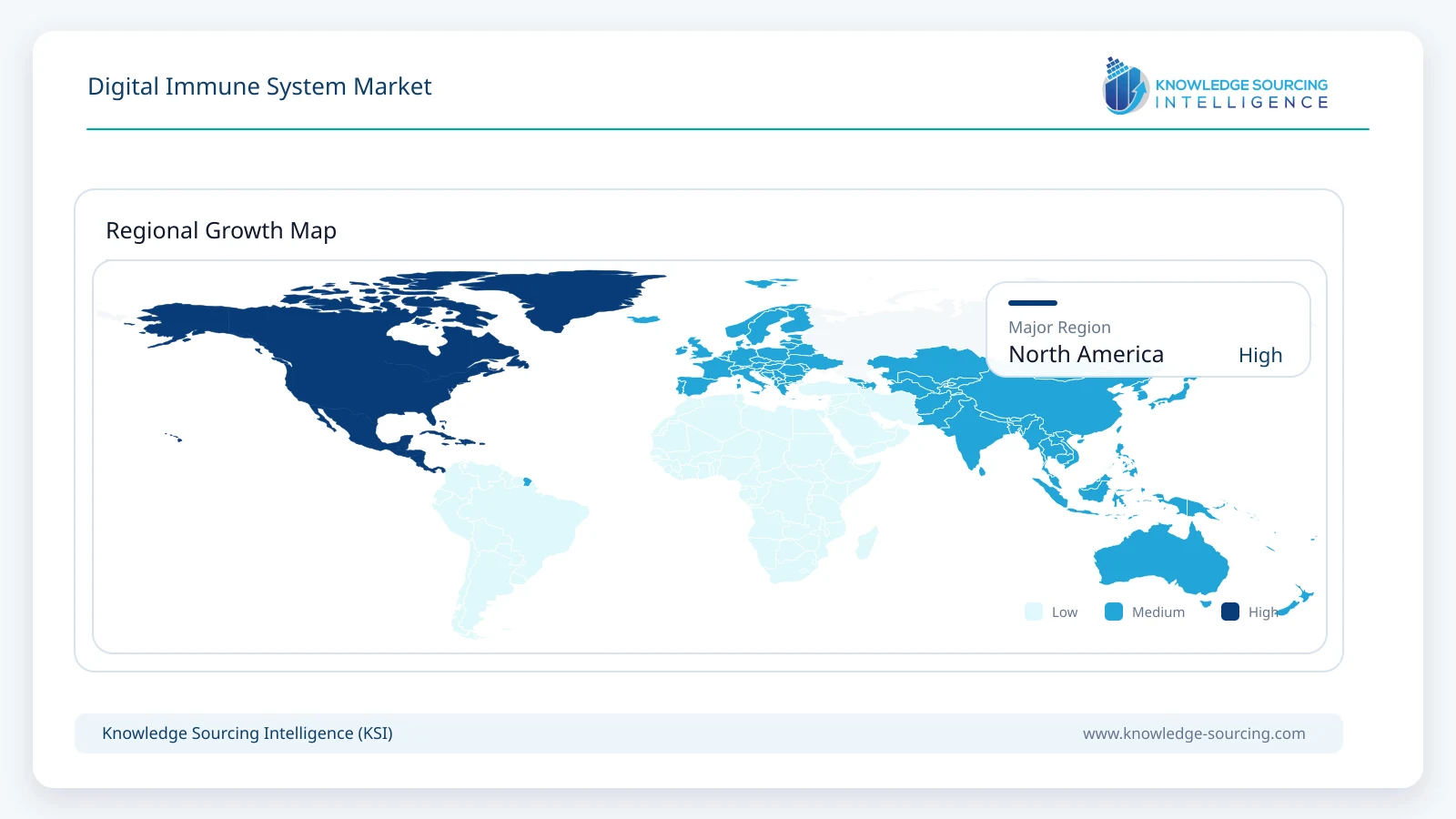
North America represents an important demand center because enterprises face high exposure to cyber incidents, extensive cloud adoption, complex technology estates, and strong regulatory expectations across critical industries.
The United States provides a particularly broad customer base across technology, financial services, healthcare, government, manufacturing, and telecommunications. CISA's Cross-Sector Cybersecurity Performance Goals provide organizations with prioritized cybersecurity practices intended to reduce risk across critical infrastructure, reinforcing the emphasis on measurable security outcomes.
Enterprise procurement in the region tends to favor integrated platforms that can consolidate multiple security workflows and connect with existing infrastructure. Managed security services also have strong relevance because organizations face persistent staffing constraints.
Canada offers additional opportunity through requirements around data protection, critical infrastructure resilience, and data sovereignty. HCLTech's June 2026 launch of a Cybersecurity Fusion Center in Mississauga illustrates the commercial importance of locally supported security operations, AI-assisted threat detection, and regional data considerations.
Mexico represents a developing opportunity as manufacturing, financial services, telecommunications, and digitally enabled supply chains increase their security requirements. Cost sensitivity and shortages of specialized security talent can encourage adoption of managed and cloud-based services.
Europe
Europe has a strong regulatory foundation for digital resilience. NIS2 applies to a broad set of essential and important entities, with national implementation requirements following the October 2024 transposition deadline. The directive establishes cybersecurity risk-management and incident-reporting obligations across covered organizations and sectors.
DORA is particularly important for the BFSI segment. Since January 2025, financial entities within scope have been required to manage ICT risk, report major incidents, conduct resilience testing, and monitor ICT third-party dependencies.
The Cyber Resilience Act adds another layer for manufacturers and suppliers of products with digital elements. Reporting obligations began applying in September 2026, while the principal requirements become applicable in December 2027.
Germany, France, the United Kingdom, Italy, and Spain therefore offer demand across regulated industries and industrial technology. Buyers are likely to place particular emphasis on compliance evidence, data sovereignty, incident response, software supply-chain security, and secure-by-design practices.
Asia Pacific
Asia Pacific combines strong technology adoption with substantial variation in cybersecurity maturity, regulatory frameworks, and enterprise purchasing power.
China has a large technology and industrial base, with demand shaped by data-security requirements, critical infrastructure protection, domestic technology ecosystems, and localization considerations. Market access can depend heavily on regulatory compliance and local delivery capabilities.
India presents strong commercial potential because of its expanding digital economy, technology services sector, financial infrastructure, government digitization, and growing enterprise cloud adoption. Local security operations and engineering capacity are increasingly important. HCLTech's expansion of cybersecurity and AI capabilities in India illustrates how service providers are building domestic delivery capacity alongside global operations.
Japan and South Korea provide mature technology markets where manufacturing, automotive, electronics, telecommunications, and financial institutions require high levels of operational reliability. Security procurement in these markets can be influenced by integration requirements, quality assurance, data protection, and long-term vendor support.
Australia has a strong regulatory and critical-infrastructure focus, while Indonesia and Thailand offer expanding opportunities as cloud adoption, digital financial services, and connected industrial environments increase.
Middle East and Africa
The Middle East is supported by national cybersecurity programs, smart infrastructure projects, cloud investment, financial-sector modernization, and government technology initiatives. Saudi Arabia and the UAE are particularly relevant because large enterprises and public organizations are investing in centralized security operations and cloud infrastructure.
Procurement decisions frequently emphasize sovereignty, local hosting, regulatory compliance, and managed services. Vendors with regional delivery centers and partnerships can therefore gain an advantage over suppliers offering technology without implementation capacity.
South Africa provides an important entry point into Sub-Saharan Africa due to its established financial sector, telecommunications infrastructure, and enterprise technology base. Cost constraints remain relevant, increasing the importance of managed security and cloud-based delivery models.
South America
South America offers demand from banking, telecommunications, government, manufacturing, retail, and technology companies. Brazil represents the largest commercial opportunity within the region because of its large enterprise base and extensive digital services ecosystem.
Cybersecurity procurement is influenced by data protection requirements, cloud adoption, digital payments, and the need to protect distributed operations. Argentina and other South American markets provide additional opportunities, although macroeconomic conditions, IT budgets, specialist talent availability, and currency volatility can affect investment timing.
Competitive Landscape
The competitive structure consists of cybersecurity vendors, technology services providers, software quality companies, and specialists positioned around digital resilience. The provided competitive set includes Sauce Labs, HCLTech, GAVS Technologies, Digital Immunity, Cisco Systems, Inc., McAfee, Palo Alto Networks, and IBM.
Competition is not based solely on individual security functions. Vendors are differentiating through the breadth of telemetry they can access, integration with existing infrastructure, automation capabilities, AI-assisted analysis, managed services, regulatory support, and ability to provide measurable resilience outcomes.
Cisco and Palo Alto Networks have broad security portfolios spanning network, cloud, endpoint, identity, and AI security. Their strategy allows digital immune system capabilities to be embedded into larger enterprise security architectures. Cisco's 2025 announcements around AI Defense, Hybrid Mesh Firewall, Zero Trust Network Access, and integration with Splunk demonstrate an approach centered on connecting security controls across infrastructure and operations.
IBM competes through enterprise security, AI, hybrid-cloud capabilities, consulting, and managed services. Its 2025 annual report and investor materials continue to position hybrid cloud and AI as major components of its corporate strategy.
HCLTech and GAVS Technologies bring services-oriented capabilities into the competitive field, particularly where enterprises require security operations, implementation, integration, automation, and ongoing management rather than software alone. HCLTech's 2026 Cybersecurity Fusion Center expansion in Canada reinforces the role of regional security operations and managed capabilities.
Sauce Labs occupies a more specialized position around continuous software quality, testing, application reliability, and AI-assisted software engineering. Its platform surpassed eight billion tests in May 2025, highlighting the scale of continuous application testing as an input into software reliability and resilience programs.
McAfee and Digital Immunity contribute additional specialist capabilities within the broader security ecosystem. The competitive model therefore includes direct platform competition as well as partnerships and technology integrations.
Over the forecast period, competition is expected to favor suppliers capable of connecting security with software development, cloud infrastructure, identity, observability, and automated remediation. Partnerships will remain commercially important because no single supplier can control every layer of an enterprise technology environment.
Recent Developments
August 2026: Palo Alto Networks launched its Frontier AI Critical Defense Program with technology partners to protect critical infrastructure from AI-driven exploits through network-level virtual patching. Commercial relevance: the initiative illustrates demand for preventive controls that can protect vulnerable infrastructure without waiting for conventional patch cycles.
June 2026: HCLTech launched a Cybersecurity Fusion Center in Mississauga, Ontario, adding AI-driven security operations, threat intelligence, and locally supported cyber-defense capabilities to its global CSFC network. Commercial relevance: regional security operations are becoming important for enterprises requiring local support, sovereignty, and managed resilience.
July 2026: IBM reported that one in four malicious breaches in its 2026 research were AI-enabled and that organizations using AI and automation in security operations reduced breach costs by an average of nearly $2 million. Commercial relevance: the findings strengthen the economic case for AI-assisted detection, response, and automated security operations.
Regulatory and Policy Environment
Regulation is becoming an important demand catalyst because organizations must increasingly demonstrate that cybersecurity is governed as an enterprise risk rather than treated solely as an IT function.
In the United States, NIST CSF 2.0 provides a flexible framework for organizations to understand, prioritize, communicate, and manage cybersecurity risks. It does not prescribe one technology architecture, allowing organizations to map digital immune system capabilities to broader governance and risk-management objectives.
CISA's Cross-Sector Cybersecurity Performance Goals provide prioritized practices for critical infrastructure operators. Their alignment with NIST functions helps organizations translate cybersecurity objectives into operational actions and measurable controls.
In Europe, NIS2 broadens cybersecurity obligations across essential and important entities and establishes requirements for cybersecurity risk management and incident reporting. This supports demand for continuous monitoring, asset visibility, vulnerability management, incident response, and compliance reporting.
DORA has a particularly direct commercial impact on financial institutions. It requires covered entities to establish ICT risk-management processes, report major ICT incidents, conduct resilience testing, and manage third-party ICT risk. The EBA has also highlighted the importance of maintaining registers of contractual arrangements with ICT third-party providers.
The EU Cyber Resilience Act introduces mandatory cybersecurity requirements for products with digital elements across their lifecycle. Its reporting obligations began in September 2026, with major obligations scheduled for December 2027. This creates additional demand for secure software development, vulnerability management, product monitoring, and lifecycle security.
Regulatory requirements will not automatically create demand for one specific digital immune system architecture. Instead, they increase the commercial value of platforms that can provide evidence of risk assessment, continuous monitoring, incident handling, vulnerability remediation, third-party oversight, and resilience testing.
Outlook and Strategic Implications
The 2026–2031 outlook will be shaped by the convergence of cybersecurity, software reliability, cloud operations, AI governance, and operational resilience. Enterprises are unlikely to replace every existing security product with a single digital immune system platform. Instead, adoption will generally occur through integration, consolidation, managed services, and progressive automation.
Investment priorities are expected to move toward platforms that can correlate data across network, endpoint, cloud, identity, application, and software-development environments. Buyers will place greater emphasis on reducing security-team workload while maintaining human oversight over high-impact actions.
AI will remain central to this development. The commercial question will shift from whether security products contain AI to whether AI can produce measurable improvements in detection accuracy, investigation speed, exposure prioritization, remediation, and recovery. IBM's 2026 findings linking AI-enabled breaches with higher breach costs and lower costs among organizations using AI and automation illustrate why buyers will increasingly evaluate these capabilities through an economic lens.
Agentic AI will add another layer of complexity. Security teams will need visibility into machine identities, agent permissions, tool usage, autonomous actions, and interactions between agents and enterprise systems. Palo Alto Networks' 2026 expansion into agentic endpoint, identity, and AI security demonstrates how suppliers are extending conventional security portfolios toward this emerging requirement.
Cloud deployment is expected to remain commercially important because it supports centralized control, subscription pricing, scalable telemetry processing, and managed security delivery. However, hybrid architectures will remain necessary for organizations with sensitive, regulated, or operational technology workloads.
The competitive environment will also favor platform integration. Cisco's combination of network visibility, security, AI protection, identity, and Splunk capabilities provides one example of how vendors are attempting to consolidate security workflows across infrastructure. Palo Alto Networks is pursuing a similar expansion through AI, cloud, endpoint, identity, and network capabilities.
Services will remain important because technology alone does not solve implementation, governance, process redesign, or skills constraints. Providers such as HCLTech and GAVS Technologies can compete by combining software with managed security operations, consulting, engineering, and regional delivery.
The principal risks include high implementation costs, integration complexity, automation errors, data-sovereignty restrictions, fragmented procurement ownership, and uncertainty around the definition of the digital immune system category itself. Suppliers must therefore demonstrate concrete business outcomes rather than relying on broad resilience claims.
Strategically, vendors should prioritize interoperable architectures, transparent AI controls, cloud and hybrid deployment options, strong identity management, continuous exposure assessment, automated remediation with human oversight, and regulatory reporting capabilities. Buyers, meanwhile, should evaluate platforms according to measurable outcomes such as mean time to detect, mean time to respond, recovery time, false-positive reduction, vulnerability remediation speed, application reliability, and operational downtime.
The strongest commercial opportunities through 2031 are likely to emerge where security becomes embedded into everyday technology operations rather than operated as a separate control layer. Enterprises that connect application quality, infrastructure observability, security analytics, identity governance, automated response, and recovery processes can create a more coherent resilience architecture.
Additional Assumptions and Scope Notes
This analysis treats the Digital Immune System Market as a cross-functional technology category encompassing solutions and services that improve the security, reliability, monitoring, adaptation, and recovery of digital environments.
Market revenues, where measured in a commercial sizing exercise, should include software subscriptions, licenses, managed services, professional services, implementation, integration, and related support directly attributable to digital immune system capabilities.
Conventional cybersecurity products are included only when they form part of an integrated digital immune system proposition or are commercially positioned to deliver continuous digital resilience. Standalone cybersecurity expenditure without an identifiable resilience, automation, continuous monitoring, or integrated-defense component is outside the core scope.
The geographic assessment follows the countries specified in the supplied segmentation. The forecast period is 2026–2031. No market size or CAGR has been supplied, so no unsupported numerical estimate has been introduced.
The competitive assessment is restricted to the companies specified by the user: Sauce Labs, HCLTech, GAVS Technologies, Digital Immunity, Cisco Systems, Inc., McAfee, Palo Alto Networks, and IBM.
Digital Immune System Market Scope
| Report Metric | Details |
|---|---|
| Total Market Size in 2026 | USD 31.9 billion |
| Total Market Size in 2031 | USD 54.3 billion |
| Forecast Unit | Billion |
| Growth Rate | 11.3% |
| Study Period | 2021 to 2031 |
| Historical Data | 2021 to 2024 |
| Base Year | 2025 |
| Forecast Period | 2026 – 2031 |
| Segmentation | Component, Deployment, Security Type, Industry, Geography |
| Companies |
|
Market Segmentation
By Component
By Deployment
By Security Type
By Industry
By Geography
Table of Contents
1. EXECUTIVE SUMMARY
2. MARKET SNAPSHOT
2.1. Market Overview
2.2. Market Definition
2.3. Scope of the Study
2.4. Market Segmentation
3. BUSINESS LANDSCAPE
3.1. Market Drivers
3.2. Market Restraints
3.3. Market Opportunities
3.4. Porter’s Five Forces Analysis
3.5. Industry Value Chain Analysis
3.6. Policies and Regulations
3.7. Strategic Recommendations
4. TECHNOLOGICAL OUTLOOK
5. DIGITAL IMMUNE SYSTEM MARKET BY COMPONENT
5.1. Introduction
5.2. Solution
5.3. Services
6. DIGITAL IMMUNE SYSTEM MARKET BY DEPLOYMENT
6.1. Introduction
6.2. On-Premises
6.3. Cloud
7. DIGITAL IMMUNE SYSTEM MARKET BY SECURITY TYPE
7.1. Introduction
7.2. Network Security
7.3. Cloud Security
7.4. Endpoint Security
7.5. IoT Security
7.6. Others
8. DIGITAL IMMUNE SYSTEM MARKET BY INDUSTRY
8.1. Introduction
8.2. IT and Telecom
8.3. BFSI
8.4. Manufacturing
8.5. Healthcare
8.6. Government
8.7. Education
8.8. Others
9. DIGITAL IMMUNE SYSTEM MARKET BY GEOGRAPHY
9.1. Introduction
9.2. North America
9.2.1. USA
9.2.2. Canada
9.2.3. Mexico
9.3. South America
9.3.1. Brazil
9.3.2. Argentina
9.3.3. Others
9.4. Europe
9.4.1. Germany
9.4.2. France
9.4.3. United Kingdom
9.4.4. Spain
9.4.5. Italy
9.4.6. Others
9.5. Middle East and Africa
9.5.1. Saudi Arabia
9.5.2. UAE
9.5.3. South Africa
9.5.4. Others
9.6. Asia Pacific
9.6.1. China
9.6.2. India
9.6.3. Japan
9.6.4. South Korea
9.6.5. Indonesia
9.6.6. Thailand
9.6.7. Australia
9.6.8. Others
10. COMPETITIVE ENVIRONMENT AND ANALYSIS
10.1. Major Players and Strategy Analysis
10.2. Competitive Positioning Analysis
10.3. Mergers, Acquisitions, Agreements, and Collaborations
10.4. Competitive Dashboard
11. COMPANY PROFILES
11.1. Sauce Labs
11.2. HCLTech
11.3. GAVS Technologies
11.4. Digital Immunity
11.5. Cisco Systems, Inc.
11.6. McAfee
11.7. Palo Alto Networks
11.8. IBM
12. APPENDIX
12.1. Currency
12.2. Assumptions
12.3. Base and Forecast Years Timeline
12.4. Key Benefits for Stakeholders
12.5. Research Methodology
12.6. Abbreviations
LIST OF FIGURES
LIST OF TABLES
Navigate
Trusted by the world's leading organizations











