
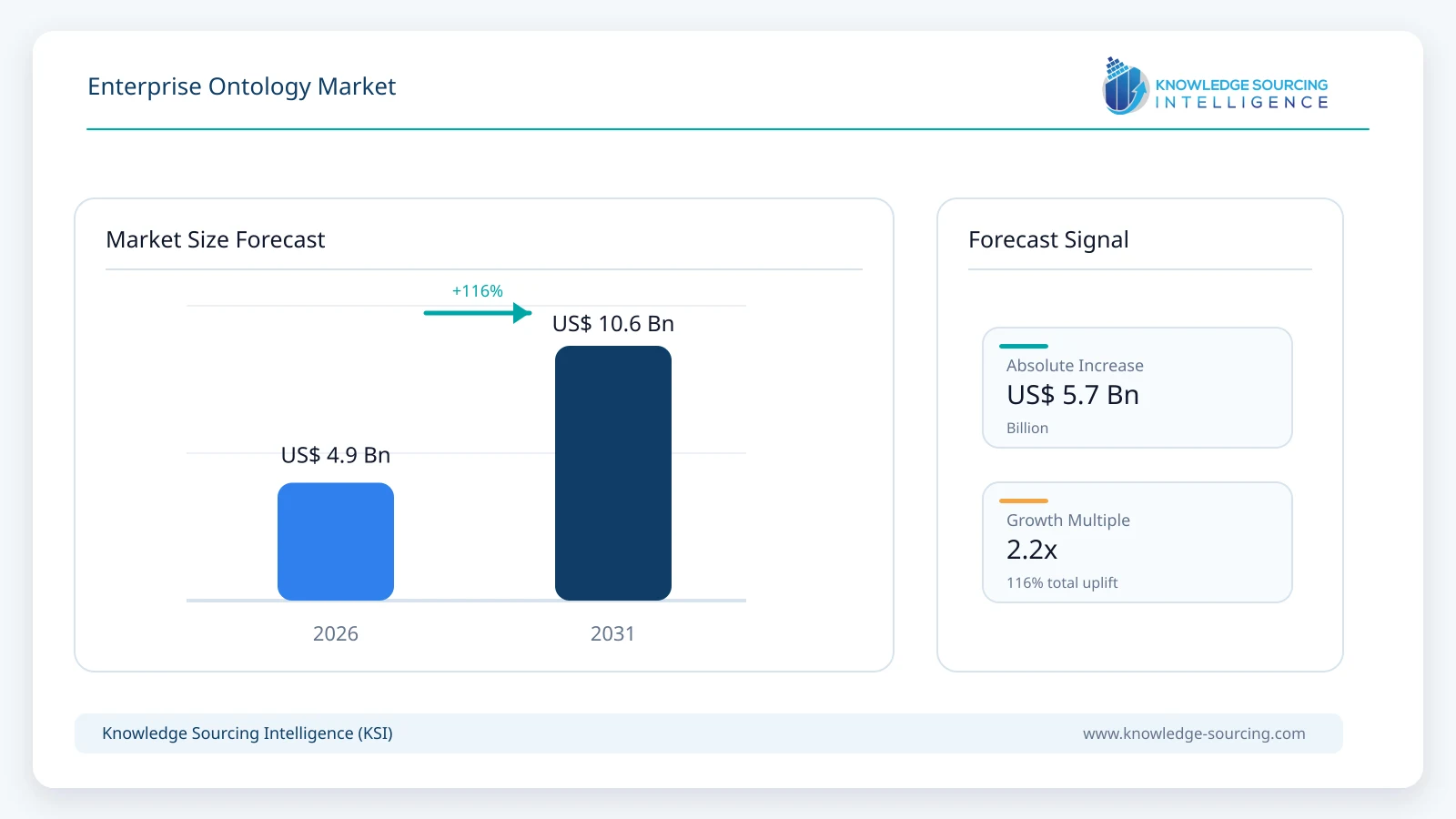
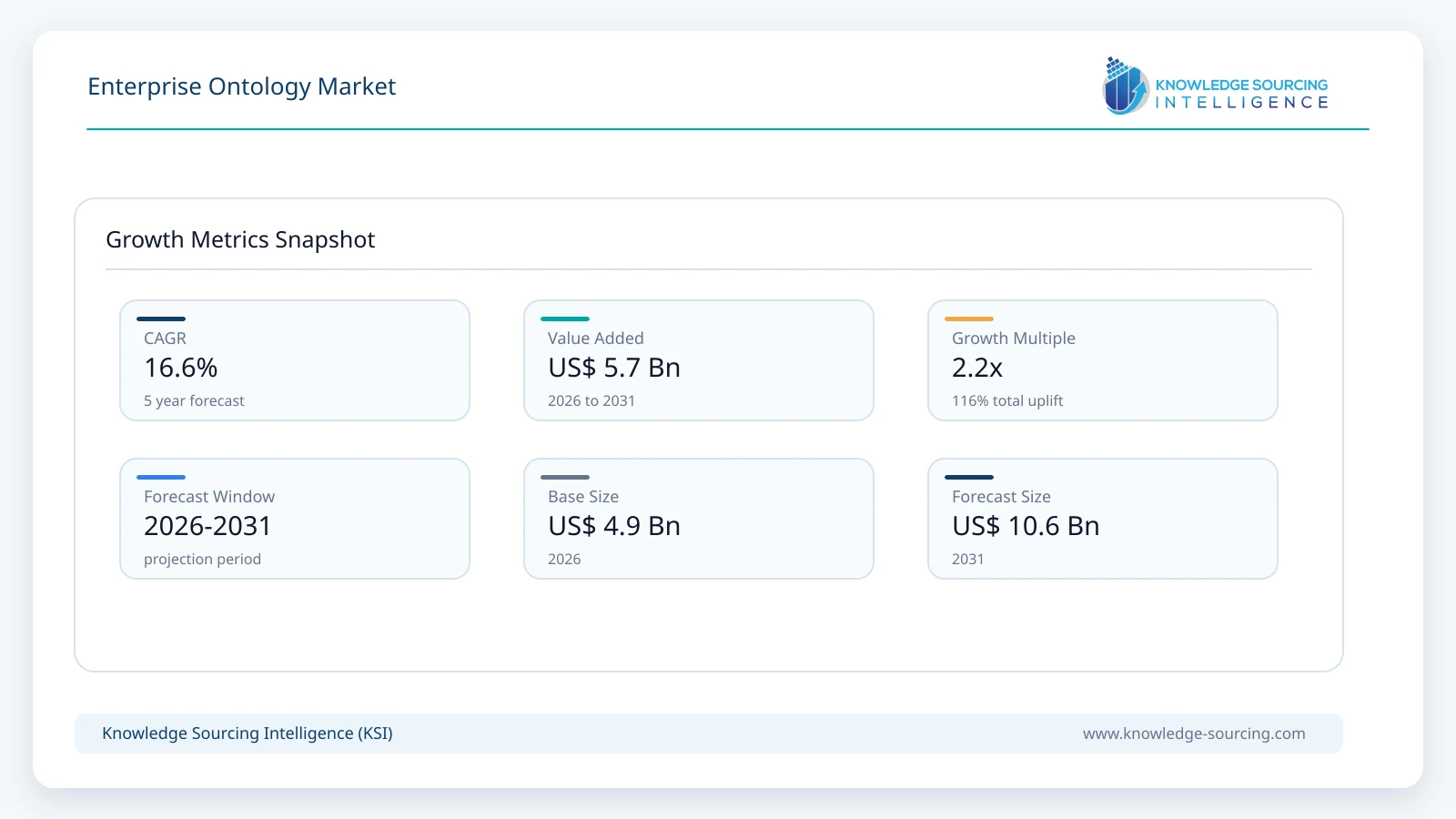
The Enterprise Ontology Market is forecast to grow at a CAGR of 16.6%, reaching USD 10.55 billion in 2031 from USD 4.88 billion in 2026.
Highlights:
- 1Increasing Enterprise Data FragmentationEnterprises operate complicated data ecosystems and contain ERP systems and CRM platforms, data warehouses and data lakes, SaaS applications, documents, APIs, and operational databases. As a result, this business entity can be represented differently in different departments, leading to inconsistency in reporting and analytics. Enterprise ontologies solve this problem by defining common concepts, relationships, and reusing them across these systems. For instance, SAP has located its business data fabric around unified data and shared semantics, maintaining the business context across SAP and third-party environments.
- 2Massive Growth of Enterprise AI and Generative AI:Growing generative AI is leading to demand for enterprise context that can be trusted. LLMs are able to process vast quantities of information, and when the language of the internal concepts is not explicitly represented, LLMs may misinterpret terminology, relationships, and business rules. This direction was demonstrated by Microsoft Research in April 2025, with ontology-grounded retrieval via OG-RAG through applicability of domain-specific ontologies. The research utilizes domain-specific ontologies to structure knowledge and make use of LLM applications where specialized knowledge is necessary for the retrieval process.
- 3Growth of Enterprise Knowledge Graphs:Knowledge graphs are established as providing an important architecture for linking business entities and relationships, and enterprise ontologies provide the semantics to represent them in structured regularity. GraphDB by Ontotext supports semantic metadata, reasoning, and shared conceptual models that can be used for enterprise knowledge graphs, data integration, and provenance.
- 4Increased Demand for Data Governance and Standardization:Organizations need to define business terminology as well as data entities, ownership, policies, and relationships across their applications to have the structure for all data governance programs. Enterprise ontology offers a machine-readable layer connecting these definitions with feasible data assets. TopQuadrant brings together ontology governance with metadata management, reference data, data quality, policy management, lineage, and AI governance. Designed to model concepts, relationships & constraints with data steward ownership over the resulting assets through its platform.
Enterprise Ontology is a formal and irreducible specification of the business concepts in your enterprise, such as organizations, people, as well as resources within it, which uses attributes from this relationship domain of open-world nature as a source of expressions. It offers a common semantic framework that allows consistent interpretation of information sourced from various enterprise systems. An enterprise ontology does not focus on the information in the same manner as a standard database schema, but instead focuses on the meaning and relationships of that information to facilitate reuse across multiple applications and data environments.
Enterprise ontologies are usually modeled as concepts for customers, products, suppliers, employees, locations, business units, contracts, transactions, assets, services, risks, and processes. Then those concepts can be linked together with relationships indicating the way an organization works. This makes it possible to drive information from ERP, CRM, supply-chain, financials, manufacturing, engineering, and other systems into a common semantic framework.
The technology has been increasingly incorporated into enterprise knowledge graph architectures. For instance, Ontotext's GraphDB utilizes ontologies and conceptual models to discover diverse enterprise data, fuel semantic search, reason, and govern enterprise knowledge graphs. Thus, the market is broader than ontology-editing software. It includes ontology modeling, semantic data management, knowledge graph and governance services, consulting & implementation, migration, ontology alignment, validation, and AI integration services.
Enterprise Ontology Market Key Highlights
The software is still the major part, because there are ontology modeling, semantic management, validation, and integrated knowledge-graph capabilities.
One of the key application areas is AI and Generative AI, when combined with ontology-based structured business context annotation for building semantic knowledge around AI systems.
Data Management and Governance is a foundational application, working for the discovery of common definitions or metadata relationships, data lineage, and semantic consistency.
The AI-assisted ontology development trend helps reduce manual semantic modeling requirements, enabling enterprises to do concept discovery, classification, and semantic enrichment through machine learning and LLMs.
Market Dynamics
Market Drivers
Market Restraints & Opportunities
Enterprise ontology development combines knowledge of business processes, data structures, semantic standards, and relationships with domain terminology. Stipulating governance processes for change approval and managing inter-departmental conflict.
Enterprise ontology cannot typically work as a replacement for existing databases and applications but needs to work across them. Thus, augmenting semantic models with implementations of legacy ERP, CRM, data warehouses, operational systems, and proprietary applications can generate significant technical debt.
The most potent opportunity on the horizon is combining enterprise ontologies with generative AI and agents. Ontologies can also offer formal definitions, relationships, and business rules that assist in retrieving the properties required for AI systems to interpret enterprise information more accurately.
A second major opportunity is the centralized enterprise knowledge cores made from ontologies, combining master data with metadata, data products, business processes, and knowledge graphs.
Key Developments
June 2026: Genie One, an automated assistant to the business team on “Engineer One," was released and has been used by many other experiments for orchestrating work that takes place across structured as well as unstructured data. It connected enterprise information with AI tools and workplace applications for more accurate responses and to perform business tasks using the Genie Ontology, which is a context layer that is continuously updated.
March 2026: Tech Mahindra teamed up with Microsoft to launch an Ontology-Driven Agentic-AI platform for Telecom & Enterprise Data-Mesh transformation. The platform, built upon Microsoft Fabric and Azure AI Foundry, is transforming enterprise metadata into governed data products by converging knowledge graphs, semantic models, and task-specific agents.
Market Segmentation
The market is segmented by component, enterprise size, application, end user, and geography.
By Component: Software
The software component segment has accounted for the largest share during the forecasted period, as ontology deployment requires seamless capabilities specific to semantic modeling, ontology editing, relationship management, validation and reasoning, version control, integration, and knowledge-graph construction.
TopQuadrant's platform offers ontology and schema modeling, SHACL validation, reusable vocabularies with their graph data model combined with a hierarchy mapping approach, and some other capabilities.
In addition, FluentEditor, from Cognitum, supports OWL 2 as well as OWL-DL, OWL-RL, SWRL, SPARQL, RDF syntax diagrams support, collaboration, and AI interoperability. The software segment is thus evolving away from the standalone ontology editors to more comprehensive enterprise semantic platforms that integrate ontology management with data governance and AI.
By Enterprise Size: Machine Learning
Large enterprises dominate the enterprise-size segmentation as they have the most complex and regionally spread-out information environments. Most global organizations have a number of ERP instances, regional databases, business units, acquisitions, and homegrown legacy systems, each with their own data definition.
Enterprise ontology gives these organizations the ability to provide a common semantic framework without forcing every underlying system to have the same physical data structure. SAP Business Data Cloud is built with the express purpose of orchestrating SAP and third-party data, while ensuring consistent business semantics across hybrid and multi-cloud environments.
TopQuadrant also identifies governed semantic infrastructure users within large enterprises in other data-intensive industries such as financial services, life sciences, media, and government. Additionally, large enterprises maintain the vast majority of enterprise ontology demand prospects because semantic standardization progressively becomes necessary as complexity rises in data and organization.
By Application: Artificial Intelligence and Generative AI
One of the rapidly developing application areas is Artificial Intelligence and Generative AI, as organizations are growing in their adoption of ontologies to offer a structured base for AI systems.
Microsoft's Fabric Ontology enables AI agents to leverage entity definitions and relationships in a semantic definition instead of merely reasoning over raw tables and columns.
Similarly, OH-RAG from Microsoft Research exemplifies the way domain-oriented ontologies may structure retrieval needed for LLM systems when data is quite specialized to the specialty area of AI-driven connection of pieces or datasets of knowledge.
SAP is going for the same broader architecture with its knowledge core that links semantics, business processes, policies, data, and knowledge graphs to give context to an AI agent.
As a result, the segment is transitioning ontology from a backend data modeling role into an AI-enablement layer enabling retrieval, reasoning, agent orchestration, and contextual decision-making.
Regional Analysis
North America Market Analysis
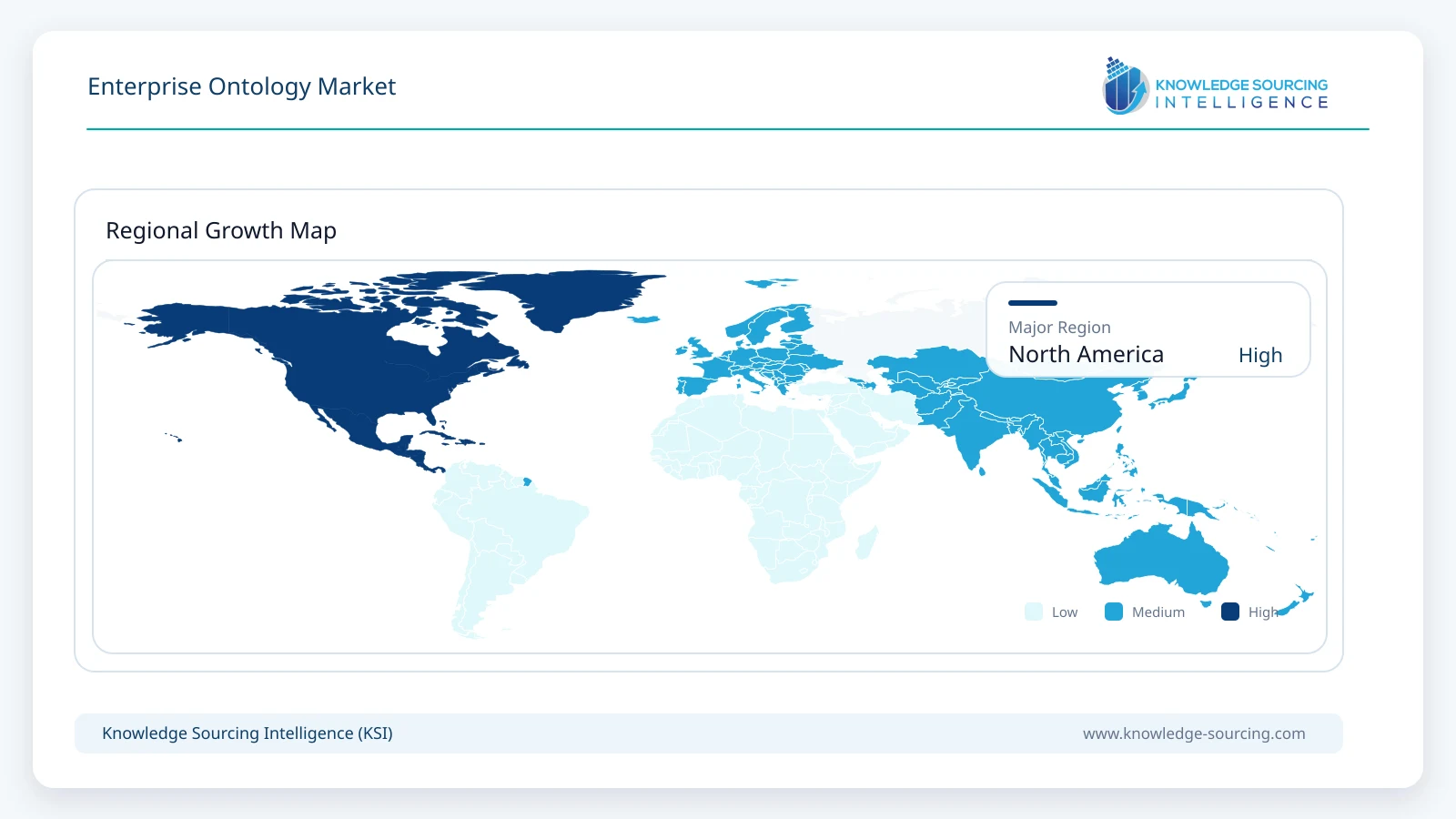
The North America enterprise ontology market is poised to register significant growth during the forecast period due to the presence of a high adoption rate of cloud data platforms, knowledge graphs, analytics, and AI in the basic software ecosystem. The market is especially growing in the US, where new technologies are being created by Microsoft, Google, IBM, Oracle, and Neo4j to connect semantic models to enterprise data and AI.
South America Market Analysis
South America market is starting to emerge as companies modernize their data architectures and spend more heavily on things like cloud computing, analytics, artificial intelligence (AI), and digital transformation. Brazil is most important because of its scale in financial services, telecommunications, industrial, energy, healthcare, and government sectors.
Europe Market Analysis
Europe is a major market for organizations where data governance, interoperability, privacy, regulatory compliance, and standardized info architectures are paramount. These needs mean that semantic modeling is particularly appropriate for heavily controlled industries like financial services, pharmaceuticals, healthcare, manufacturing, and government.
Middle East and Africa Market Analysis
The investments in digital government, smart and connected cities, cloud infrastructure, AI, financial technology, energy, and enterprise modernization are driving growth across the Middle East & Africa market. For Saudi Arabia and the UAE in particular, these constitute important opportunities as modern large-scale digital programs are creating greater need for integrated data and AI architectures.
Asia Pacific Market Analysis
Asia Pacific will continue to be a huge growth market for data because enterprises in China, Japan, South Korea, India, Singapore, and Australia are investing more in AI, cloud computing, digital transformation, and advanced analytics. Large manufacturers are most relevant in the region as they deal with complex datasets of products, engineers, suppliers, production, and logistics.
List of Companies
Cognitum
TopQuadrant Inc.
Ontotext AD (Graphwise)
Semantic Web Company GmbH
SAP SE
Microsoft
Google
IBM
Oracle
Neo4j Inc.
Cognitum
Cognitum specializes in semantic-technology solutions, and its flagship ontology-engineering product is FluentEditor. FluentEditor supports OWL 2, OWL-DL, OWL-RL, SWRL, SPARQL, RDF, and controlled natural language. It also offers ontology diagrams, collaborative editing, Protégé interoperability, and SWRL debugging.
TopQuadrant Inc.
TopQuadrant offers the TQ Data Foundation / TopBraid platform that integrates ontology management with data governance offerings, metadata management, reference data, knowledge graphs, and AI governance along with semantic–layer functionality. The platform enables teams to model concepts, relationships, and constraints and reuse standard vocabularies, define SHACL validation rules, and manage enterprise ontology workflows.
Ontotext AD (Graphwise)
Ontotext AD provides GraphDB, which is an RDF graph database targeted to model heterogeneous business data and enhance it with ontologies and semantic metadata. It is capable of running across AWS, Azure, Google Cloud, and on-premises.
Analyst View
Enterprise Ontology Market is shifting from a niche semantic-modeling role to an enterprise data and AI infrastructure layer. Software is a major component, whilst services provide the capability for complex implementation and governance. The leading adoption amongst use cases is in large enterprises, and AI and generative AI represent the strongest emerging application as organizations need a shared, governed business context for knowledge graphs, retrieval, and autonomous agents.
Enterprise Ontology Market Scope:
| Report Metric | Details |
|---|---|
| Total Market Size in 2026 | USD 4.88 billion |
| Total Market Size in 2031 | USD 10.55 billion |
| Forecast Unit | USD Billion |
| Growth Rate | 16.6% |
| Study Period | 2021 to 2031 |
| Historical Data | 2021 to 2024 |
| Base Year | 2025 |
| Forecast Period | 2026 – 2031 |
| Segmentation | Component, Enterprise Size, Application, End User, Geography |
| Companies |
|
Market Segmentation
By Component
Software
Services
By Enterprise Size
Large Enterprises
Small and Medium-Sized Enterprises
By Application
Data Management and Governance
Enterprise Knowledge Management
Business Intelligence and Analytics
Artificial Intelligence and Generative AI
Others
By End User
Banking, Financial Services & Insurance (BFSI)
Healthcare & Life Sciences
Automotive
Aerospace & Defense
Energy & Utilities
Others
By Geography
North America
USA
Canada
Mexico
South America
Brazil
Argentina
Others
Europe
United Kingdom
Germany
France
Others
Middle East and Africa
Saudi Arabia
UAE
Others
Asia Pacific
China
Japan
India
South Korea
Others
Table of Contents
1. EXECUTIVE SUMMARY
2. MARKET SNAPSHOT
2.1. Market Overview
2.2. Market Definition
2.3. Scope of the Study
2.4. Market Segmentation
3. MARKET DYNAMIC
3.1. Market Drivers
3.2. Market Restraints
3.3. Market Opportunities
3.4. Porter’s Five Forces Analysis
3.5. Industry Value Chain Analysis
4. BUSINESS LANDSCAPE
4.1. Enterprise Ontology Governance, Standards and Regulatory Landscape
4.2. Enterprise Ontology Development, Implementation and Commercialization Analysis
4.3. Enterprise Data Integration and Semantic Architecture Analysis
4.4. Strategic Recommendations
5. TECHNOLOGICAL OUTLOOK
5.1. Enterprise Ontology Modeling and Knowledge Representation Technologies
5.2. Ontology Mapping, Alignment and Automated Engineering Technologies
5.3. Enterprise Knowledge Graph and Semantic-Layer Technologies
5.4. Generative AI, GraphRAG and Agentic Ontology Technologies
6. ENTERPRISE ONTOLOGY MARKET BY COMPONENT
6.1. Introduction
6.2. Software
6.3. Services
7. ENTERPRISE ONTOLOGY MARKET BY ENTERPRISE SIZE
7.1. Introduction
7.2. Large Enterprises
7.3. Small and Medium-Sized Enterprises
8. ENTERPRISE ONTOLOGY MARKET BY APPLICATION
8.1. Introduction
8.2. Data Management and Governance
8.3. Enterprise Knowledge Management
8.4. Business Intelligence and Analytics
8.5. Artificial Intelligence and Generative AI
8.6. Others
9. ENTERPRISE ONTOLOGY MARKET BY END USER
9.1. Introduction
9.2. Banking, Financial Services & Insurance (BFSI)
9.3. Healthcare & Life Sciences
9.4. Automotive
9.5. Aerospace & Defense
9.6. Energy & Utilities
9.7. Others
10. ENTERPRISE ONTOLOGY MARKET BY GEOGRAPHY
10.1. Introduction
10.2. North America
10.2.1. USA
10.2.2. Canada
10.2.3. Mexico
10.3. South America
10.3.1. Brazil
10.3.2. Argentina
10.3.3. Others
10.4. Europe
10.4.1. United Kingdom
10.4.2. Germany
10.4.3. France
10.4.4. Others
10.5. Middle East and Africa
10.5.1. Saudi Arabia
10.5.2. UAE
10.5.3. Others
10.6. Asia Pacific
10.6.1. China
10.6.2. Japan
10.6.3. India
10.6.4. South Korea
10.6.5. Others
11. COMPETITIVE ENVIRONMENT AND ANALYSIS
11.1. Major Players and Strategy Analysis
11.2. Market Share Analysis
11.3. Mergers, Acquisitions, Agreements, and Collaborations
11.4. Competitive Dashboard
12. COMPANY PROFILES
12.1. Cognitum
12.2. TopQuadrant
12.3. Ontotext AD (Graphwise)
12.4. Stardog Union
12.5. Semantic Web Company
12.6. Franz Inc.
12.7. Metaphacts GmbH
12.8. CNRS France
12.9. Smartlogic
12.10.
13. APPENDIX
13.1. Currency
13.2. Assumptions
13.3. Base and Forecast Years Timeline
13.4. Key benefits for the stakeholders
13.5. Research Methodology
13.6. Abbreviations
Navigate
Trusted by the world's leading organizations











