
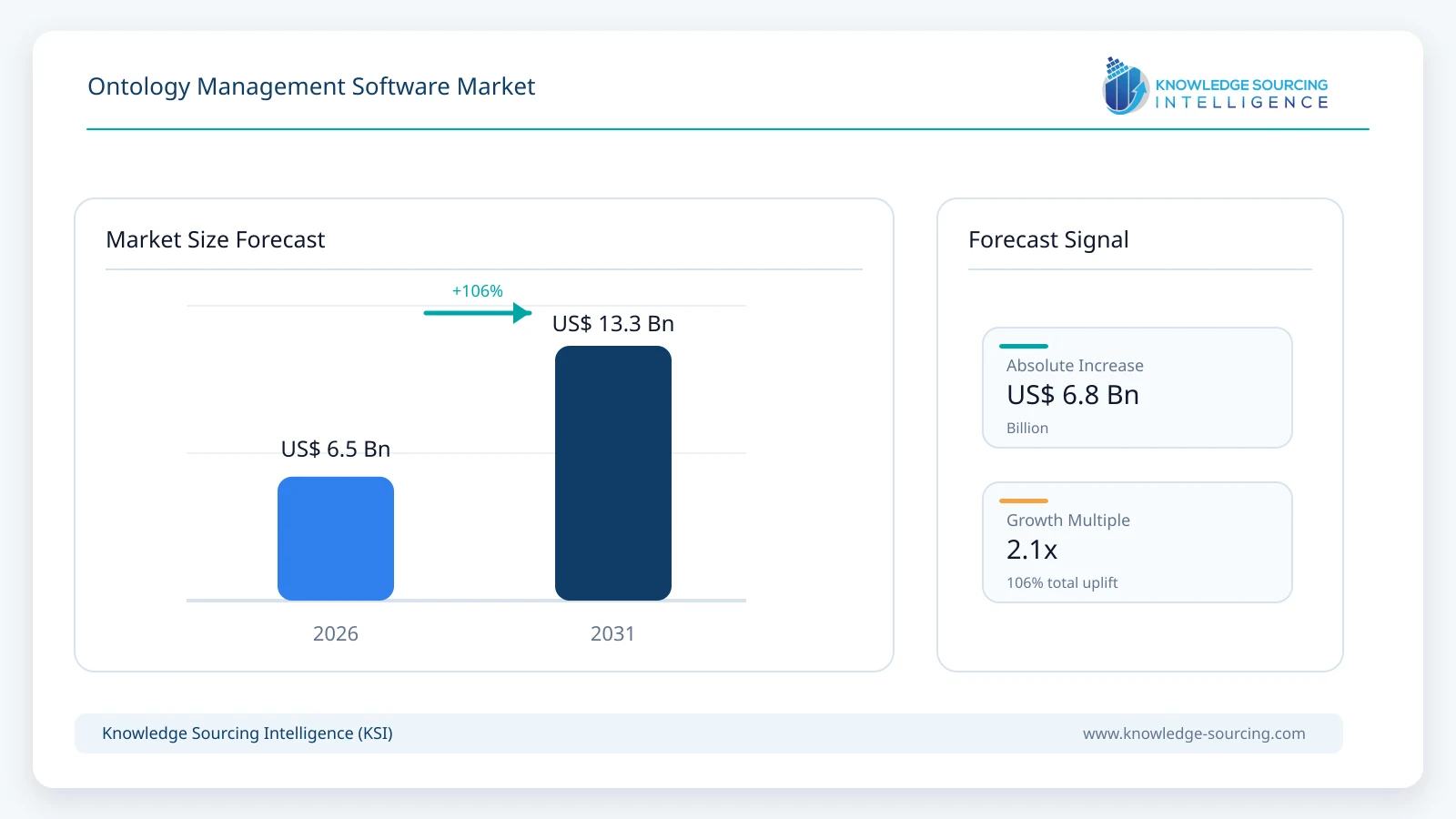
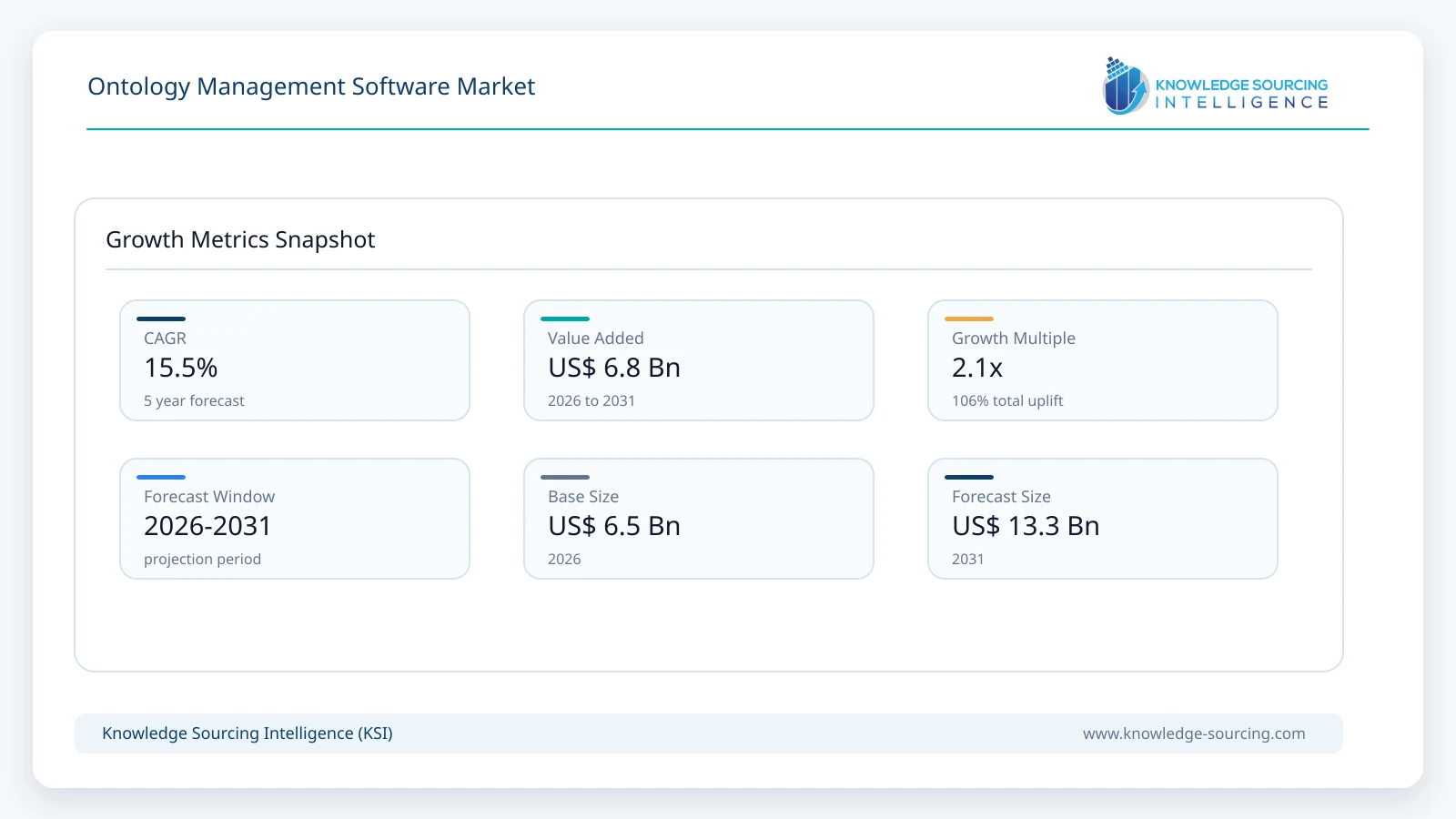
The Ontology Management Software Market is forecast to grow at a CAGR of 15.5%, reaching USD 13.30 billion in 2031 from USD 6.47 billion in 2026.
Highlights:
- 1Enterprise ontologies are becoming the major semantic base for linking the data assets, applications, business terms, and AI systems together.
- 2Integration of AI with knowledge graphs is emerging as the most strategically important application area, as enterprises want context-rich and explainable AI.
- 3Expansion of cloud and hybrid deployment architectures has improved the availability of ontology services without necessitating the migration of all enterprise data.
- 4The field of AI-assisted ontology development is an emerging technology space where vendors are leveraging LLMs and machine learning to suggest concepts, relationships, classifications, and metadata.
Ontology Management Software is software that is used to achieve the principles, concepts, and entities that are formal descriptions specific to a domain in terms of attributes, relationships, and constraints, and rules governing these entities. The software can support standards like RDF, RDFS, OWL, SKOS, SPARQL, and SHACL depending on the platform. The OWL 2 tasks provide formal semantics for representing classes, properties, individuals, and data values, while the SHACL task aims to describe and validate the structure of RDF graphs.
In an era where organizations are running data across ERP systems, CRM platforms, data warehouses, data lakes, documents, APIs, applications, and external datasets, ontology management is emerging as a strategic pillar of enterprise information architecture. An ontology gives a common semantic structure over which concepts like customer, product, supplier, asset, transaction, employee, location, or risk have consistent definitions and are related across these systems.
The technology is moving beyond the realm of standalone ontology editors. Modern platforms integrate ontology engineering with enterprise knowledge graphs, metadata management, semantic search, data governance, entity resolution, reasoning, and AI integration. For instance, TopBraid EDG views ontologies as a class of assets and provides integration with enterprise data governance, reference data, business glossaries, policies knowledge graphs.
Additionally, GraphRAG and AI agents are also contributing to market growth. Ontologies can contain normalised definitions and links that ensure those AI systems understand the meaning behind enterprise terminology, and also pull more precise information in context. Neo4j is clearly positioning the knowledge layer as a common semantic substrate for enterprise AI, and both Google Cloud and SAP deliver business context and semantic relationships as part of their broader AI/data architectures.
Market Dynamics
Market Drivers
Need for Enterprise-Wide Semantic Consistency: Enterprises are working in an environment of ever-more fragmented data wherein the same business concept can have other names, forms, IDs, or even definitions in a variety of systems. To tackle this problem, ontology management software builds semantic definitions to be shared across databases, applications, analytical environments, and AI systems. Enterprise requirements are becoming broader, spanning governance, reuse, versioning, validation, and collaboration with operational data integration.
Growth of Knowledge Graphs and Semantic Data Architectures: As knowledge graph deployments are on the rise, ontologies gain more prominence because they offer the conceptual layer in which entities and relations are organized. Semantic layers based on ontology enable organizations to interconnect bits of information, treating it as a whole system without losing anything related to the business meaning and associations. For instance, PoolParty integrates ontology management with enterprise knowledge graphs, semantic search, machine learning, text mining, and data governance. This convergence is expanding the scope of ontology management beyond a niche knowledge-engineering activity to an area of enterprise data architecture.
Growing Importance of Context in Enterprise AI: The rapid rollout of generative AI and AI agents is proving an imperative for reliable enterprise context. While LLMs can handle a lot of data, organizations also need structured definitions for business entities, relationships, policies, and terminology to ensure AI applications interpret enterprise information. Google Cloud launched Google Cloud Knowledge Catalog in April 2026 specifically to address this problem of insufficient business context for AI agents. The platform aims to deliver a global context layer that integrates enterprise metadata with business relationships and trusted knowledge.
Increasing Importance of Data Validation & Quality: As organizations interconnect more datasets with different structures, all kinds of incorrect relations can make your downstream analytics and AI applications unreliable. The ontology management software includes validation and constraint-management features. The W3C SHACL standard gives a formal way of specifying constraint conditions on RDF graphs, which are encoded in SHACL and validated against the RDF graph, while SHACL 1.2 extends the capabilities of the specification, particularly around graph structures and validation.
Market Restraints & Opportunities
Development of an ontology involves knowledge about semantic modeling, domain terminology, logical relationships, standards, and validation. This can result in long cycle times and, in some cases, an inability to maintain complex structures of knowledge about terms and relationships to the concepts they model for organizations that do not have dedicated teams focused solely on general market ontology engineering.
The biggest opportunity is at the intersection of ontology management, knowledge graphs, and generative AI. Ontologies can offer deliberate semantic frameworks that help the AI distinguish entities, relations, and categories of a class and business meaning.
Another major opportunity lies in AI-assisted ontology construction. LLMs pull candidate concepts and relationships from the documents. LLMs can discover duplicate terminologies, propose mappings, and create surface maps of concepts.
Key Developments
April 2026: Google Cloud announced Knowledge Catalog, described as a real-time enterprise context engine that is expected to give AI agents trusted metadata, business context, and relations instead of only traditional technical data catalogs.
February 2026: Neo4j declared Aura Agent generally available, along with computerized ontology-driven operator development and knowledge-graph-established professionals, cementing the bond involving ontology architectures and agentic AI.
Market Segmentation
The market is segmented by ontology type, enterprise size, application, end user, and geography.
By Ontology Type: Enterprise Ontologies
Enterprise Ontologies are the major ontology type because organisations see the need for a common semantic framework between departments, applications, data assets, and governance processes. Instead of defining concepts for a single application, enterprise ontologies define reusable concepts like customer, product, supplier, employee, asset, location, transaction, and organization chart.
TopBraid EDG is designed for enterprise ontology development in a wider data-governance context. Organizations can establish either one common enterprise ontology or multiple ontologies for departments and business domains separately, which will probably be integrated via some ontology inclusion mechanisms.
Cognitum developed Fluent Editor, an enterprise ontology engineering platform boasting support for OWL 2, OWL-DL, OWL-RL, SWRL, SPARQL, RDF, and controlled natural languages. The platform is geared towards collaborative ontology editing, with applicability to healthcare, manufacturing, IoT, security, and telecommunications.
By Enterprise Size: Large Enterprises
Large enterprises are the leading segment due to their more complex information environments and greater need for semantic interoperability than smaller enterprise-size segments, as well as greater needs for governance, regulatory traceability, and general AI integration.
Enterprise Resource Planning (ERP), CRM, supply-chain, financial, engineering, and operational information, as well as unstructured information, are increasingly integrated by large organizations. Management of ontologies typically offers a common semantics for interconnecting these systems and can enable enterprise knowledge graphs as well as AI applications.
SAP's Business Data Cloud creates a governed business data foundation and centralised semantic tier for the purported benefit of providing consistent business context to applications and AI agents.
By Application: Knowledge Graph, Data and AI Integration
Knowledge Graph, Data and AI Integration is the largest application segment, as ontology management is gaining traction as a semantic layer between enterprise data and AI applications. Rather than viewing ontologies as static conceptual documents, organizations are leveraging them to organize knowledge graphs, align datasets, support semantic search, and provide context for AI systems.
An example of this convergence can be seen in Ontotext GraphDB, where ontology-based conceptual modeling and RDF graph storage combine with a rich feature set including semantic search, reasoning, data integration, GraphRAG, and enterprise AI integration.
Google Cloud's Knowledge Catalog and SAP's Business Data Cloud Illustrating semantic context layers for AI are moving industry-wide. Google refers to Knowledge Catalog as a context engine that can be harnessed by AI agents, while SAP describes its business data fabric as a governed knowledge core that gives AI agents universal business context.
Regional Analysis
North America Market Analysis
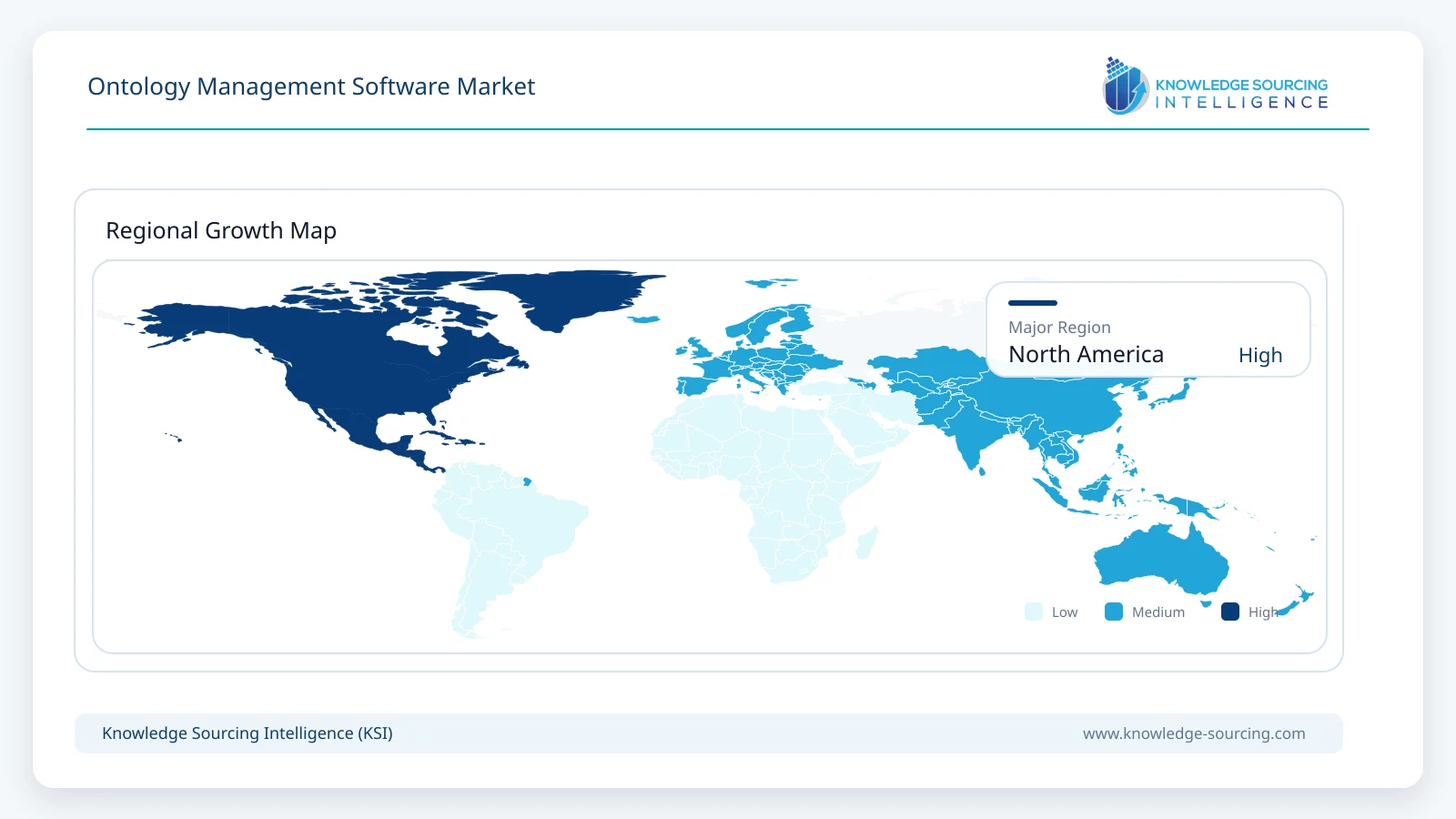
North America has the most advanced markets for ontology management software because enterprises in the United States and Canada have been investing heavily in knowledge graphs, cloud data platforms, AI infrastructure, and enterprise data governance. The US is particularly significant because key global technology providers, including Google, Microsoft, IBM, Oracle, and Neo4j, are investing in semantic, graph, data, and AI capabilities that are related to ontology management.
South America Market Analysis
Emerging market with organizations in South America modernizing enterprise data architectures and investing more heavily in analytics, cloud computing, and AI. Brazil is the biggest opportunity due to its relative size of financial, digital, energy, telecommunications, healthcare, and public-sector technology ecosystems.
Europe Market Analysis
Europe is a key market with organizations focusing on data governance, interoperability and semantic standards, data spaces and trusted AI. It also features a well-matured semantic-technology ecosystem with ontology, knowledge graph, and semantic data technologies being developed by companies like Semantic Web Company and Ontotext.
Middle East and Africa Market Analysis
The Middle East & Africa is the fastest-growing market owing to digital transformation, cloud infrastructure, AI, and smart-city platforms by governments and enterprises. The UAE and Saudi Arabia are rapidly emerging as vital markets due to the continuing digitization programs within large governments and enterprises driving demand for integrated data and AI architectures.
Asia Pacific Market Analysis
Asia Pacific is experiencing significant growth, as organizations invest heavily in AI and knowledge graphs, digital transformation initiatives, and enterprise data platforms in China, Japan, South Korea, India, Singapore, and Australia. This makes large manufacturing and technology companies relevant, as they are operating on complex product, supplier, engineering, production and warehouse logistics datasets that require continuous semantic mappings.
Company Profiles
List of Companies
Cognitum
TopQuadrant Inc.
Ontotext AD
Semantic Web Company GmbH
SAP SE
Microsoft
Google
IBM
Oracle
Neo4j Inc.
TopQuadrant Inc.
TopQuadrant offers TopBraid Enterprise Data Governance (EDG), which adds ontology management to an enterprise data-governance platform. EDG supports ontology modeling using SHACL, in addition to RDFS and OWL, and it facilitates connecting ontologies with business glossaries, data assets, reference data, policies, workflows, and knowledge graphs.
Ontotext AD
Ontotext offers GraphDB, an RDF graph database with strong ontology and semantic-data capabilities. GraphDB has features for Ontology-based conceptual modeling, reasoning, semantic search, and data integration for enterprise knowledge graphs and GraphRAG.
Semantic Web Company GmbH
Semantic Web Company offers the PoolParty semantic suite, which specializes in taxonomy management, ontology management, linked data, and enterprise knowledge graphs. It offers a combination of a semantic search engine, machine learning solution, and place for data governance.
Analyst View
The Ontology Management Software Market is moving from specialized ontology editing to a more general semantic infrastructure market bridging enterprise data, knowledge graphs, governance, and AI. Enterprise ontology, large-enterprise deployment, and knowledge graph/AI integration should continue to be the most robust enterprise segments as organizations embrace consistent business context, interoperability, validation, and trustworthy AI.
Ontology Management Software Market Scope:
| Report Metric | Details |
|---|---|
| Total Market Size in 2026 | USD 6.47 billion |
| Total Market Size in 2031 | USD 13.30 billion |
| Forecast Unit | USD Billion |
| Growth Rate | 15.5% |
| Study Period | 2021 to 2031 |
| Historical Data | 2021 to 2024 |
| Base Year | 2025 |
| Forecast Period | 2026 – 2031 |
| Segmentation | Ontology Type, Enterprise Size, Application, End User, Geography |
| Companies |
|
Market Segmentation
By Ontology Type
Enterprise Ontologies
Domain-Specific Ontologies
Industry Ontologies
Application Ontologies
By Enterprise Size
Large Enterprises
Small and Medium Enterprises
By Application
Standards, Modeling, and Validation
Reasoning And Inference
Collaboration, Versioning, and Lifecycle Control
Governance Workflows
Knowledge Graph, Data, and AI Integration
Others
By End User
IT & Telecommunications
BFSI
Healthcare & Life Sciences
Government & Public Sector
Retail & E-commerce
Others
By Geography
North America
USA
Canada
Mexico
South America
Brazil
Argentina
Others
Europe
United Kingdom
Germany
France
Others
Middle East and Africa
Saudi Arabia
UAE
Others
Asia Pacific
China
Japan
India
South Korea
Others
Table of Contents
1. EXECUTIVE SUMMARY
2. MARKET SNAPSHOT
2.1. Market Overview
2.2. Market Definition
2.3. Scope of the Study
2.4. Market Segmentation
3. MARKET DYNAMIC
3.1. Market Drivers
3.2. Market Restraints
3.3. Market Opportunities
3.4. Porter’s Five Forces Analysis
3.5. Industry Value Chain Analysis
4. BUSINESS LANDSCAPE
4.1. Governance, Standards and Regulatory Landscape
4.2. Ontology Development, Implementation and Commercialization Analysis
4.3. Enterprise Knowledge Management and Semantic Data Infrastructure Analysis
4.4. Strategic Recommendations
5. TECHNOLOGICAL OUTLOOK
5.1. Ontology Modeling, Editing and Knowledge Representation Technologies
5.2. Ontology Mapping, Alignment and Automated Engineering Technologies
5.3. Knowledge Graph and Semantic Layer Technologies
5.4. AI, GraphRAG and Intelligent Ontology Technologies
6. ONTOLOGY MANAGEMENT SOFTWARE MARKET BY ONTOLOGY TYPE
6.1. Introduction
6.2. Enterprise Ontologies
6.3. Domain-Specific Ontologies
6.4. Industry Ontologies
6.5. Application Ontologies
7. ONTOLOGY MANAGEMENT SOFTWARE MARKET BY ENTERPRISE SIZE
7.1. Introduction
7.2. Large Enterprises
7.3. Small and Medium Enterprises
8. ONTOLOGY MANAGEMENT SOFTWARE MARKET BY APPLICATION
8.1. Introduction
8.2. Standards, Modeling, and Validation
8.3. Reasoning And Inference
8.4. Collaboration, Versioning, and Lifecycle Control
8.5. Governance Workflows
8.6.Knowledge Graph, Data, and AI Integration
8.7. Others
9. ONTOLOGY MANAGEMENT SOFTWARE MARKET BY END USER
9.1. Introduction
9.2. IT & Telecommunications
9.3. BFSI
9.4. Healthcare & Life Sciences
9.5. Government & Public Sector
9.6. Retail & E-commerce
9.7. Others
10. ONTOLOGY MANAGEMENT SOFTWARE MARKET BY GEOGRAPHY
10.1. Introduction
10.2. North America
10.2.1. USA
10.2.2. Canada
10.2.3. Mexico
10.3. South America
10.3.1. Brazil
10.3.2. Argentina
10.3.3. Others
10.4. Europe
10.4.1. United Kingdom
10.4.2. Germany
10.4.3. France
10.4.4. Others
10.5. Middle East and Africa
10.5.1. Saudi Arabia
10.5.2. UAE
10.5.3. Others
10.6. Asia Pacific
10.6.1. China
10.6.2. Japan
10.6.3. India
10.6.4. South Korea
10.6.5. Others
11. COMPETITIVE ENVIRONMENT AND ANALYSIS
11.1. Major Players and Strategy Analysis
11.2. Market Share Analysis
11.3. Mergers, Acquisitions, Agreements, and Collaborations
11.4. Competitive Dashboard
12. COMPANY PROFILES
12.1. Cognitum
12.2. TopQuadrant Inc.
12.3. Ontotext AD
12.4. Semantic Web Company GmbH
12.5. SAP SE
12.6. Microspoft
12.7. Google
12.8. IBM
12.9. Oracle
12.10. Neo4j Inc.
13. APPENDIX
13.1. Currency
13.2. Assumptions
13.3. Base and Forecast Years Timeline
13.4. Key benefits for the stakeholders
13.5. Research Methodology
13.6. Abbreviations
Navigate
Trusted by the world's leading organizations











