
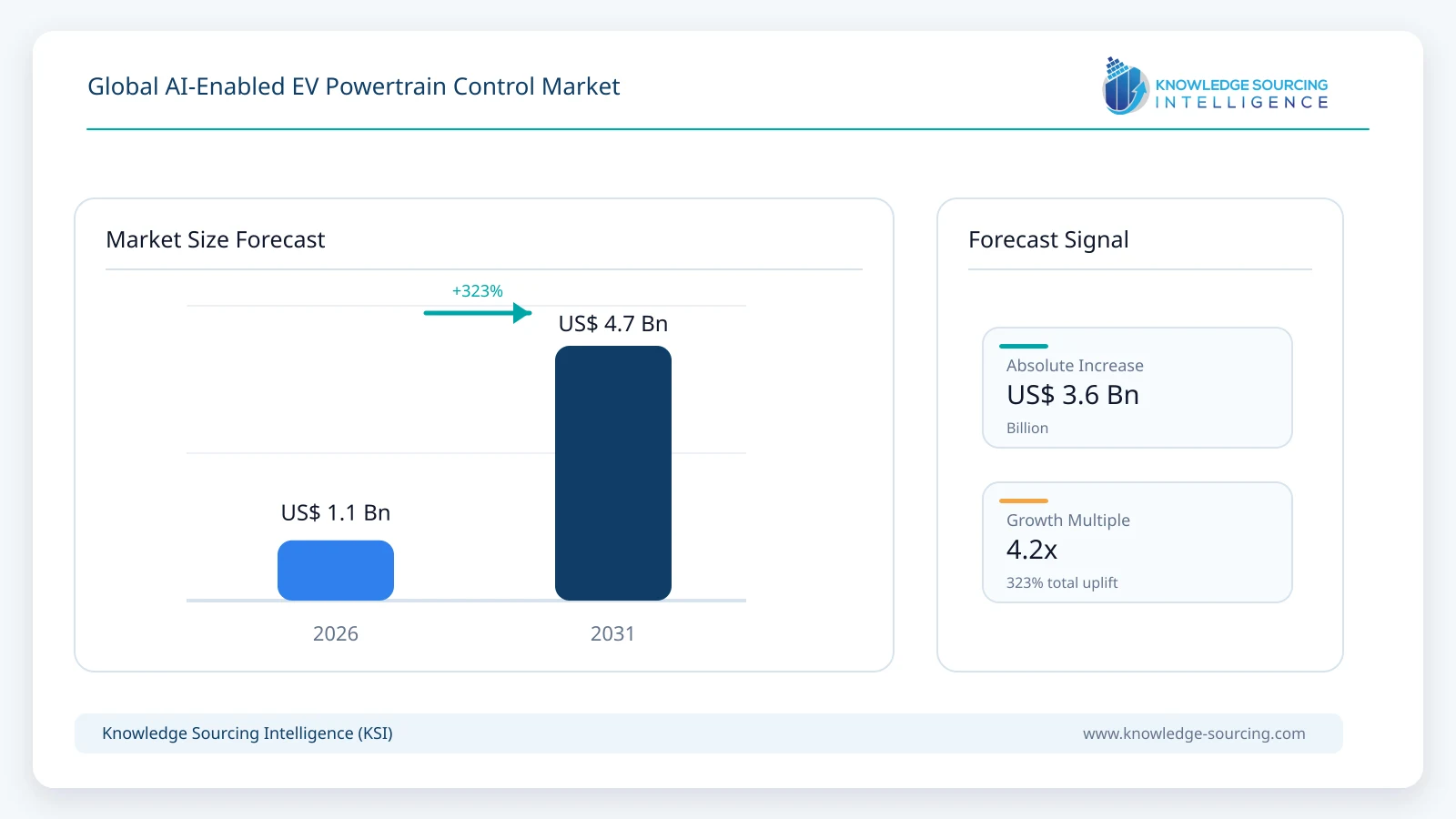
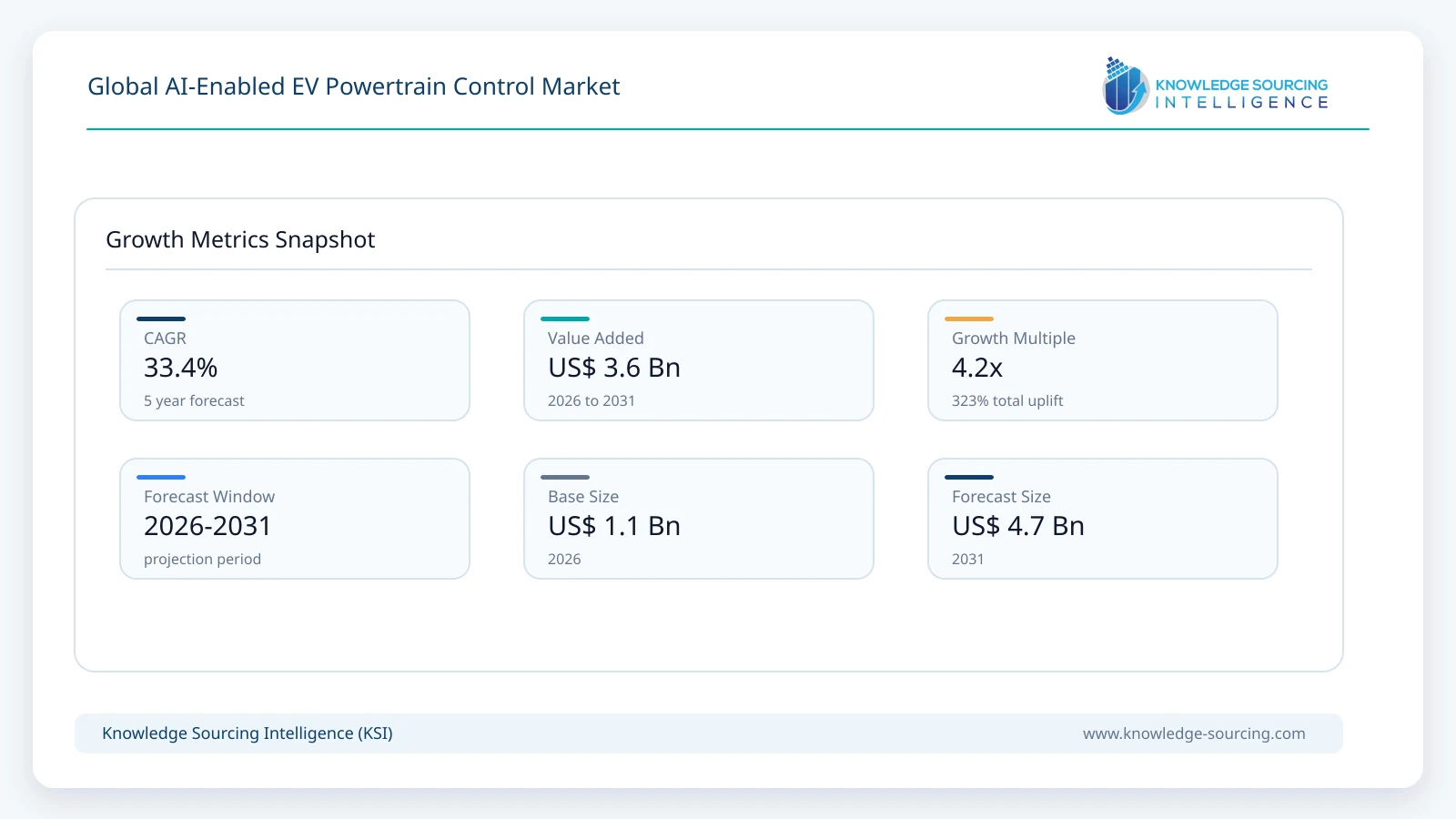
The global AI-enabled EV powertrain control market is estimated at USD 1.10 billion in 2026 and is projected to reach USD 4.65 billion by 2031, representing a compound annual growth rate (CAGR) of 33.4% throughout the forecast period.
Highlights:
- 1AI-enabled battery and energy management represents approximately 42% of 2026 market revenue.
- 2Predictive thermal and powertrain-efficiency control grows at approximately 37.5% CAGR through 2031.
- 3Machine-learning and deep-learning solutions generate approximately USD 539 million of revenue in 2026.
- 4Reinforcement-learning control accounts for approximately 18% of global market revenue in 2026.
- 5Passenger electric vehicles contribute approximately USD 814 million to the market during 2026.
- 6Commercial-vehicle applications expand at approximately 37.0% CAGR as fleet optimisation gains importance.
- 7Embedded and edge deployment accounts for approximately 68% of AI-enabled control revenue in 2026.
- 8Asia Pacific approaches approximately USD 2.38 billion by 2031 as intelligent EV platforms scale.
Artificial intelligence is becoming an additional control layer within EV powertrains rather than a replacement for deterministic automotive control. Safety-critical torque, inverter and battery-protection functions continue to rely on validated control logic, while machine learning is increasingly used for estimation, prediction and optimisation around those functions. This creates a practical deployment model in which AI improves state-of-charge and state-of-health estimation, forecasts power demand, adapts energy-management decisions to route and driver conditions, and identifies emerging thermal or component faults before conventional threshold-based systems.
The commercial opportunity is expanding with EV scale. IEA expects global electric-car sales to reach approximately 23 million in 2026, while software-defined architectures are reducing the number of isolated controllers and increasing the role of central and zonal compute. This makes it easier to deploy common AI models across vehicle platforms and update them after production. The revenue pool therefore includes embedded control software, AI inference and middleware, powertrain-specific analytics, calibration and engineering tools, model deployment platforms and selected recurring software services attributable to propulsion and energy management.
The market remains narrower than the broader EV powertrain market. Battery packs, motors, inverters, reduction gears and ordinary electronic control units are excluded unless their value is directly attributable to AI-enabled control functionality. Likewise, automated-driving perception, infotainment assistants and general cockpit AI are outside scope. This separation is important commercially and for search positioning because the report addresses how intelligence changes powertrain operation rather than the value of the underlying propulsion hardware.
Market Dynamics
AI Is Moving from Battery Analytics Toward Integrated Vehicle Control
The strongest structural driver is the shift from isolated estimation algorithms toward integrated control across battery, motor, inverter, braking, thermal and route data. IEA notes that AI and computing power are increasingly relevant to integrated vehicle control and that AI-enabled energy-management systems are already being used to optimise electrified vehicles. In practice, this means the powertrain controller can use more contextual information than conventional map-based control, improving decisions around torque demand, regenerative braking, battery temperature, charging readiness and energy reserve.
Fleet Data and Over-the-Air Updates Improve Model Performance After Vehicle Launch
Connected EV fleets create a feedback loop that conventional powertrain software did not have at comparable scale. Battery state-estimation models can be trained initially on laboratory data and then refined with field data before being redistributed through over-the-air updates. The same architecture supports continuous calibration of energy-management and predictive-maintenance models. This shifts some value from one-time control-unit engineering toward reusable software platforms, validation tooling and lifecycle software support.
Software-Defined Vehicle Architectures Reduce the Cost of Deploying AI Across Platforms
Centralised and zonal vehicle architectures allow automakers to reuse compute platforms, middleware and validated software across multiple models. Qualcomm has highlighted AI model portability and common compute as central requirements for AI-defined vehicles because separate hardware and software stacks for each vehicle line multiply development costs. For powertrain control, the same architectural trend supports common inference environments that can serve battery analytics, energy prediction and selected vehicle-control workloads while retaining functional-safety separation.
Safety Validation, Explainability and Cybersecurity Limit Unconstrained AI Deployment
Powertrain control remains safety critical. AI models can perform well on known data but may behave unpredictably under operating conditions not represented during training. Functional-safety validation, deterministic fallback logic, cybersecurity and data governance therefore remain substantial adoption constraints. The market is likely to favor hybrid architectures combining physics-based control and AI rather than fully replacing validated automotive control stacks during the forecast period.
Technological Outlook
Machine Learning and Deep Learning
Machine learning and deep learning remain the most broadly applicable AI technologies for EV powertrain control because they can estimate nonlinear battery states, identify anomalies and predict power or thermal demand from high-dimensional operating data. These methods are increasingly paired with physics-based models to improve generalisation while preserving engineering interpretability.
Reinforcement Learning and Adaptive Optimisation
Reinforcement learning is moving from simulation toward data-driven energy-management applications. Research using real-world vehicle data has demonstrated that offline reinforcement-learning frameworks can improve energy-management performance as training data expands. Commercial deployment remains earlier than machine-learning estimation, but the approach is relevant for adaptive decisions involving energy allocation, degradation and operating efficiency.
Digital Twins and Predictive Diagnostics
Digital twins provide a structured environment for combining physics models, operational data and AI prediction. Within EV powertrains, the technology supports battery-health estimation, motor-temperature prediction, virtual calibration and fault prediction. The value proposition is strongest where the same digital model can be reused across engineering, vehicle operation and fleet maintenance.
Embedded and Edge AI
Most safety-relevant powertrain inference is expected to remain inside the vehicle because latency, availability and functional-safety requirements limit dependence on remote cloud processing. Higher-performance automotive systems-on-chip and neural-processing accelerators support increasingly sophisticated edge inference, while cloud platforms remain important for model training, fleet learning and software distribution.
Global AI-Enabled EV Powertrain Control Market Segment Analysis
By Control Function
Battery and Energy Management
Battery and energy management is the largest control-function segment. It represents an estimated USD 462 million in 2026 and is projected to expand at approximately 31.0% CAGR through 2031. AI adds value by refining state-of-charge, state-of-health and remaining-life estimation, then using those estimates to improve power limits, thermal decisions, charging readiness and energy allocation. The segment benefits from the large installed base of EV battery-management systems and from the direct economic value of preserving usable battery capacity and warranty performance.
By Control Function
Predictive Thermal and Powertrain-Efficiency Control
Predictive thermal and efficiency control is the fastest-growing selected function. It accounts for approximately 24% of the market in 2026 and is projected to approach USD 1.30 billion by 2031. Growth is supported by higher-voltage charging, denser battery packs and increasing integration between battery conditioning, cabin thermal loads and route-aware energy management. Predictive approaches can prepare battery temperature for charging or high-load operation while balancing efficiency against component life.
By AI Technology
Machine Learning and Deep Learning
Machine-learning and deep-learning solutions hold approximately 49% of the market in 2026 and are expected to grow at around 31.5% CAGR through 2031. Their commercial advantage is versatility: the same broad technology family can support battery estimation, thermal prediction, anomaly detection, driver-demand forecasting and calibration. Deployment is increasingly combined with model-based control rather than treated as a standalone replacement.
By AI Technology
Reinforcement Learning
Reinforcement-learning applications are projected to exceed USD 1.0 billion by 2031 from a relatively early commercial base. The technology is particularly relevant where control decisions must balance multiple objectives such as energy consumption, battery degradation, thermal limits and drivability. Its commercialization depends on safe training environments, validation, explainability and reliable fallback strategies.
By Vehicle Type
Passenger Electric Vehicles
Passenger EVs represent approximately 74% of 2026 market revenue and are projected to grow at roughly 32.5% CAGR through 2031. Scale is the principal advantage: high-volume passenger platforms justify substantial software-development expenditure that can be reused across vehicle variants. Premium and software-led EV brands also provide a route for monetising continuously improved control functionality through over-the-air updates.
By Vehicle Type
Commercial Electric Vehicles
Commercial EVs account for approximately 18% of 2026 revenue and are projected to approach USD 960 million by 2031. Fleet duty cycles create strong economic incentives for AI-enabled powertrain control because small improvements in energy efficiency, battery health, thermal management and unplanned downtime can translate into measurable operating-cost savings across high-mileage vehicles.
By Deployment
Embedded and Edge AI
Embedded and edge AI generates approximately USD 748 million in 2026 and is projected to expand at around 32.0% CAGR through 2031. Low-latency response and vehicle availability make onboard deployment the preferred architecture for powertrain decision support. Cloud connectivity remains complementary, enabling fleet learning, retraining, simulation and over-the-air deployment rather than replacing safety-critical onboard inference.
Market and Demand Indicators
Indicator | Latest Development | Market Imapcy |
Global EV sales | IEA expects about 23 million electric-car sales in 2026. | Expands the addressable vehicle base for intelligent powertrain control. |
AI and EV integration | IEA identifies integrated vehicle control and AI-enabled energy management as growing applications. | Confirms AI is moving beyond cockpit and automated-driving use cases. |
Real-world learning | Offline reinforcement-learning research used more than 60 million km of vehicle data. | Supports data-driven energy-management approaches outside simulation-only testing. |
AI-defined vehicle compute | Qualcomm highlighted common compute and AI-model portability across vehicle platforms in 2026. | Reduces deployment cost for reusable automotive AI software. |
Battery intelligence | 2026 research increasingly combines AI-based SoC, SoH and remaining-life estimation with energy management. | Broadens software value from monitoring toward active optimisation. |
Asia Pacific Market Analysis
Asia Pacific is the largest market for AI-enabled EV powertrain control because it combines the world's highest EV production volumes with rapid software iteration and vertically integrated vehicle platforms. China remains the principal volume centre, while Korea, Japan and India contribute automotive semiconductor, battery-management, engineering and software capabilities. IEA reported that Chinese manufacturers accounted for more than half of global battery-electric vehicle sales in 2025, creating a large installed base for embedded energy-management, battery analytics and vehicle-control software.
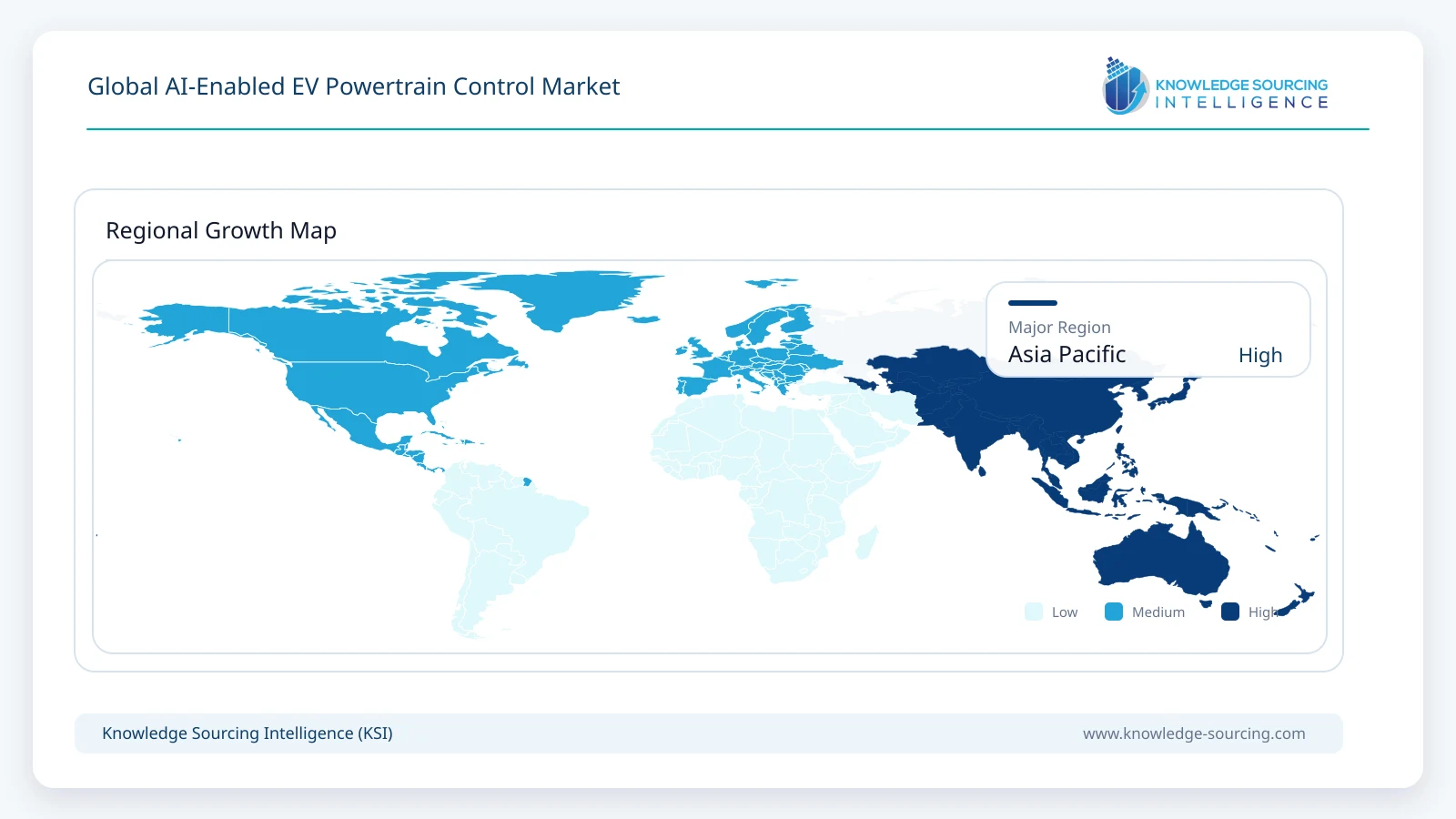
The region's advantage is not limited to unit volume. Chinese EV manufacturers typically operate shorter product cycles and increasingly use centralised electrical/electronic architectures, over-the-air software delivery and proprietary vehicle operating systems. This increases the commercial relevance of reusable control software and fleet-data learning. India is also becoming more important as locally developed EV platforms expand and software engineering providers support global OEM programs. Through 2031, Asia Pacific is expected to remain the largest revenue pool even as Europe and North America accelerate software-defined vehicle deployment.
Competitive Landscape
Competition spans traditional automotive Tier 1 suppliers, semiconductor vendors, automotive software specialists, engineering-tool providers and EV manufacturers developing proprietary control stacks. Bosch, Continental, ZF, Valeo and Denso bring deep powertrain-control and vehicle-integration expertise. Qualcomm, NVIDIA, NXP, Infineon and Renesas supply automotive compute and semiconductor platforms that increasingly support AI inference. MathWorks, AVL, ETAS, Vector, KPIT, Tata Elxsi and Elektrobit provide simulation, embedded software, calibration and software-defined vehicle engineering that can accelerate AI-enabled control deployment.
Competitive advantage depends less on a standalone AI algorithm than on the ability to validate it within a production vehicle. Suppliers need access to vehicle data, functional-safety processes, embedded compute, simulation environments and OEM integration workflows. This favors companies that can combine AI development with automotive-grade software engineering, cybersecurity, model validation and long-term platform support.
Recent Developments
May 2026: The International Energy Agency published a dedicated Artificial Intelligence and EVs analysis, highlighting integrated vehicle control and AI-enabled energy management as growing EV applications.
March 2026: Qualcomm outlined its AI-defined vehicle architecture, emphasizing common automotive compute, AI-model portability and scalable deployment across vehicle platforms.
January 2026: Qualcomm introduced Snapdragon Chassis Agents, extending on-device agentic AI capabilities across software-defined vehicle functions.
February 2026: A peer-reviewed review in Discover Artificial Intelligence assessed machine-learning techniques across EV powertrain, battery-management and charging applications.
September 2025: Mercedes-Benz researchers published a supervised machine-learning approach for predictive energy management in plug-in hybrid electric vehicles through SAE.
March 2025: Nature Communications published a real-world-data-driven offline reinforcement-learning framework for vehicle energy management, trained on more than 60 million kilometres of operating data.
Global AI-Enabled EV Powertrain Control Market Scope:
| Report Metric | Details |
|---|---|
| Total Market Size in 2026 | USD 1.10 billion |
| Total Market Size in 2031 | USD 4.65 billion |
| Forecast Unit | USD Billion |
| Growth Rate | 33.4% |
| Study Period | 2021 to 2031 |
| Historical Data | 2021 to 2024 |
| Base Year | 2025 |
| Forecast Period | 2026 – 2031 |
| Segmentation | Control Function, AI Technology, Vehicle Type, Deployment, Geography |
| Companies |
|
| Customization Scope | 15% Free Customization included with purchase — Request Custom Breakdown → |
| Sample & Data Access | PDF Sample, Excel Databook & Analyst Briefing — Download Free Sample → |
Market Segmentation
By Control Function
Battery and Energy Management
Motor and Inverter Control
Predictive Thermal and Powertrain-Efficiency Control
Predictive Diagnostics and Component Health
Other Control Functions
By AI Technology
Machine Learning and Deep Learning
Reinforcement Learning
Hybrid AI and Model-Based Control
Other AI Technologies
By Vehicle Type
Passenger Electric Vehicles
Commercial Electric Vehicles
Electric Two-Wheelers and Three-Wheelers
By Deployment
Embedded / Edge AI
Cloud-Assisted AI
By Geography
North America
United States
Canada
Mexico
South America
Brazil
Argentina
Rest of South America
Europe
Germany
United Kingdom
France
Italy
Rest of Europe
Middle East and Africa
Saudi Arabia
United Arab Emirates
South Africa
Rest of Middle East and Africa
Asia Pacific
China
Japan
India
South Korea
Rest of Asia Pacific
Table of Contents
1. EXECUTIVE SUMMARY
2. MARKET SNAPSHOT
2.1. Market Overview
2.2. Market Segmentation
3. BUSINESS LANDSCAPE
3.1. Market Drivers
3.1.1. AI Is Moving from Battery Analytics Toward Integrated Vehicle Control
3.1.2. Fleet Data and Over-the-Air Updates Improve Model Performance After Vehicle Launch
3.1.3. Software-Defined Vehicle Architectures Reduce the Cost of Deploying AI Across Platforms
3.2. Market Restraints
3.2.1. Safety Validation, Explainability and Cybersecurity Limit Unconstrained AI Deployment
3.3. Market Opportunities
3.4. Porter's Five Forces Analysis
3.5. Industry Value Chain Analysis
3.6. Regulatory and Functional-Safety Landscape
4. TECHNOLOGICAL OUTLOOK
4.1. Machine Learning and Deep Learning
4.2. Reinforcement Learning and Adaptive Optimisation
4.3. Digital Twins and Predictive Diagnostics
4.4. Embedded and Edge AI
5. GLOBAL AI-ENABLED EV POWERTRAIN CONTROL MARKET BY CONTROL FUNCTION
5.1. Battery and Energy Management
5.2. Motor and Inverter Control
5.3. Predictive Thermal and Powertrain-Efficiency Control
5.4. Predictive Diagnostics and Component Health
5.5. Other Control Functions
6. GLOBAL AI-ENABLED EV POWERTRAIN CONTROL MARKET BY AI TECHNOLOGY
6.1. Machine Learning and Deep Learning
6.2. Reinforcement Learning
6.3. Hybrid AI and Model-Based Control
6.4. Other AI Technologies
7. GLOBAL AI-ENABLED EV POWERTRAIN CONTROL MARKET BY VEHICLE TYPE
7.1. Passenger Electric Vehicles
7.2. Commercial Electric Vehicles
7.3. Electric Two-Wheelers and Three-Wheelers
8. GLOBAL AI-ENABLED EV POWERTRAIN CONTROL MARKET BY DEPLOYMENT
8.1. Embedded / Edge AI
8.2. Cloud-Assisted AI
9. GLOBAL AI-ENABLED EV POWERTRAIN CONTROL MARKET BY GEOGRAPHY
9.1. North America
9.1.1. United States
9.1.2. Canada
9.1.3. Mexico
9.2. South America
9.2.1. Brazil
9.2.2. Argentina
9.2.3. Rest of South America
9.3. Europe
9.3.1. Germany
9.3.2. United Kingdom
9.3.3. France
9.3.4. Italy
9.3.5. Rest of Europe
9.4. Middle East and Africa
9.4.1. Saudi Arabia
9.4.2. United Arab Emirates
9.4.3. South Africa
9.4.4. Rest of Middle East and Africa
9.5. Asia Pacific
9.5.1. China
9.5.2. Japan
9.5.3. India
9.5.4. South Korea
9.5.5. Rest of Asia Pacific
10. COMPETITIVE ENVIRONMENT AND ANALYSIS
10.1. Major Players and Strategy Analysis
10.2. Market Share Analysis
10.3. Partnerships, Software Platforms and Collaborations
10.4. Competitive Dashboard
11. COMPANY PROFILES
11.1. Robert Bosch GmbH
11.2. Continental AG
11.3. ZF Friedrichshafen AG
11.4. Valeo SE
11.5. DENSO Corporation
11.6. Aptiv PLC
11.7. Qualcomm Technologies, Inc.
11.8. NVIDIA Corporation
11.9. NXP Semiconductors N.V.
11.10. Infineon Technologies AG
11.11. Renesas Electronics Corporation
11.12. MathWorks
11.13. AVL List GmbH
11.14. ETAS GmbH
11.15. Vector Informatik GmbH
11.16. KPIT Technologies
11.17. Tata Elxsi
11.18. Elektrobit Automotive GmbH
12. RECENT DEVELOPMENTS
13. APPENDIX
13.1. Currency
13.2. Assumptions
13.3. Base and Forecast Years Timeline
13.4. Abbreviations





Frequently asked questions
What is the projected market size for AI-enabled EV powertrain control by 2031?
The Global AI-Enabled EV Powertrain Control Market is projected to reach USD 4.65 billion by 2031.
What is the compound annual growth rate (CAGR) for this market?
The Global AI-Enabled EV Powertrain Control Market is growing at a strong 33.4% CAGR between 2026-2031.
Which application segment holds the largest revenue share in 2026?
AI-enabled battery and energy management accounts for 42% of 2026 revenue.
Which geographic region shows the most significant growth by 2031?
Asia Pacific is projected to approach USD 2.38 billion by 2031.
What deployment model generated the most revenue in 2026?
Embedded and edge deployment accounted for 68% of AI-enabled control revenue in 2026.
What is a primary driver for AI integration in EV powertrains?
AI improves estimation, prediction, and optimization around core powertrain functions.
Cite this report
Knowledge Sourcing Intelligence. (Sep 2026). Global AI-Enabled EV Powertrain Control Market Size, Share & Growth Forecast (2026-2031). https://www.knowledge-sourcing.com/report/global-ai-enabled-ev-powertrain-control-market