
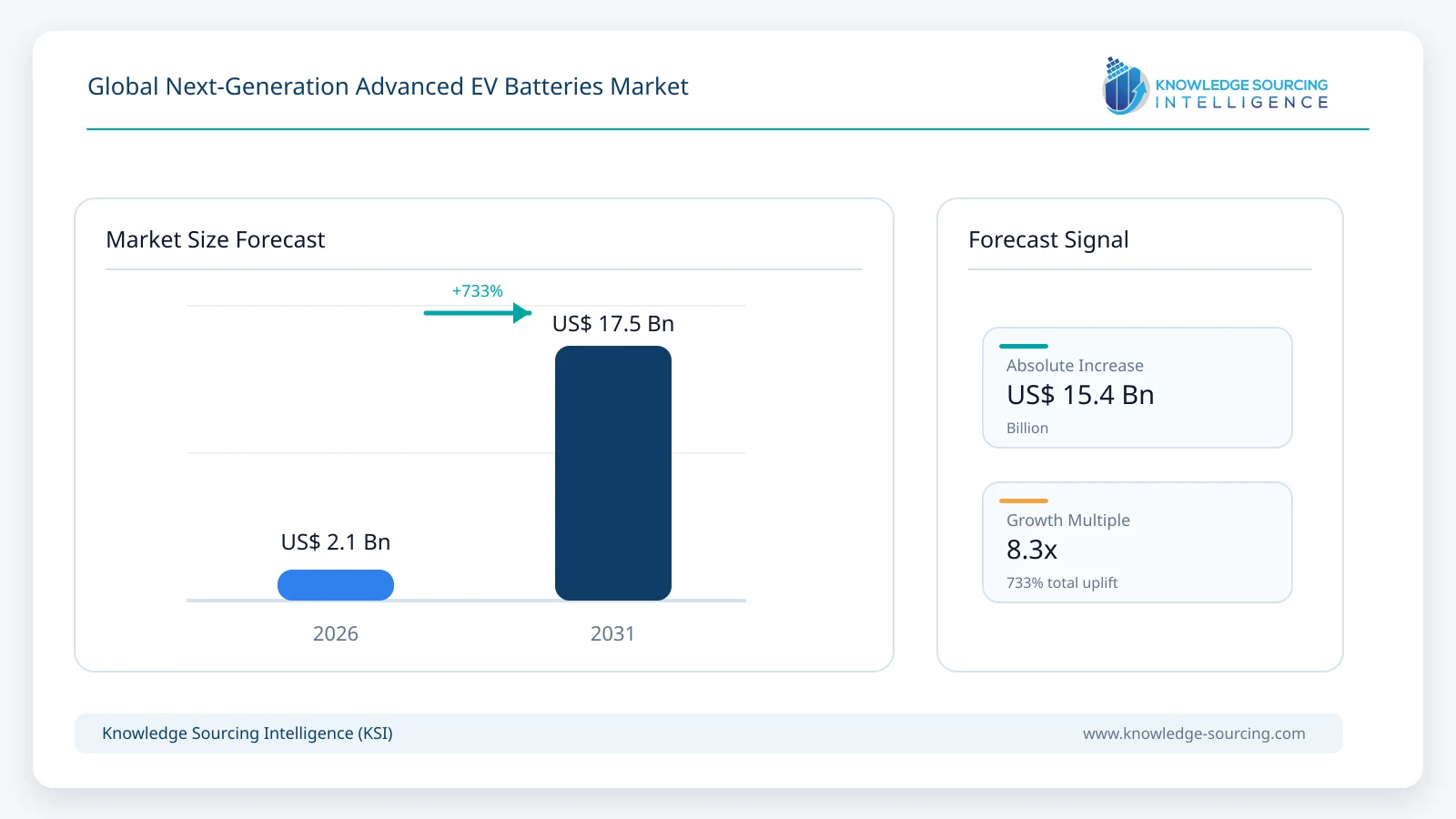
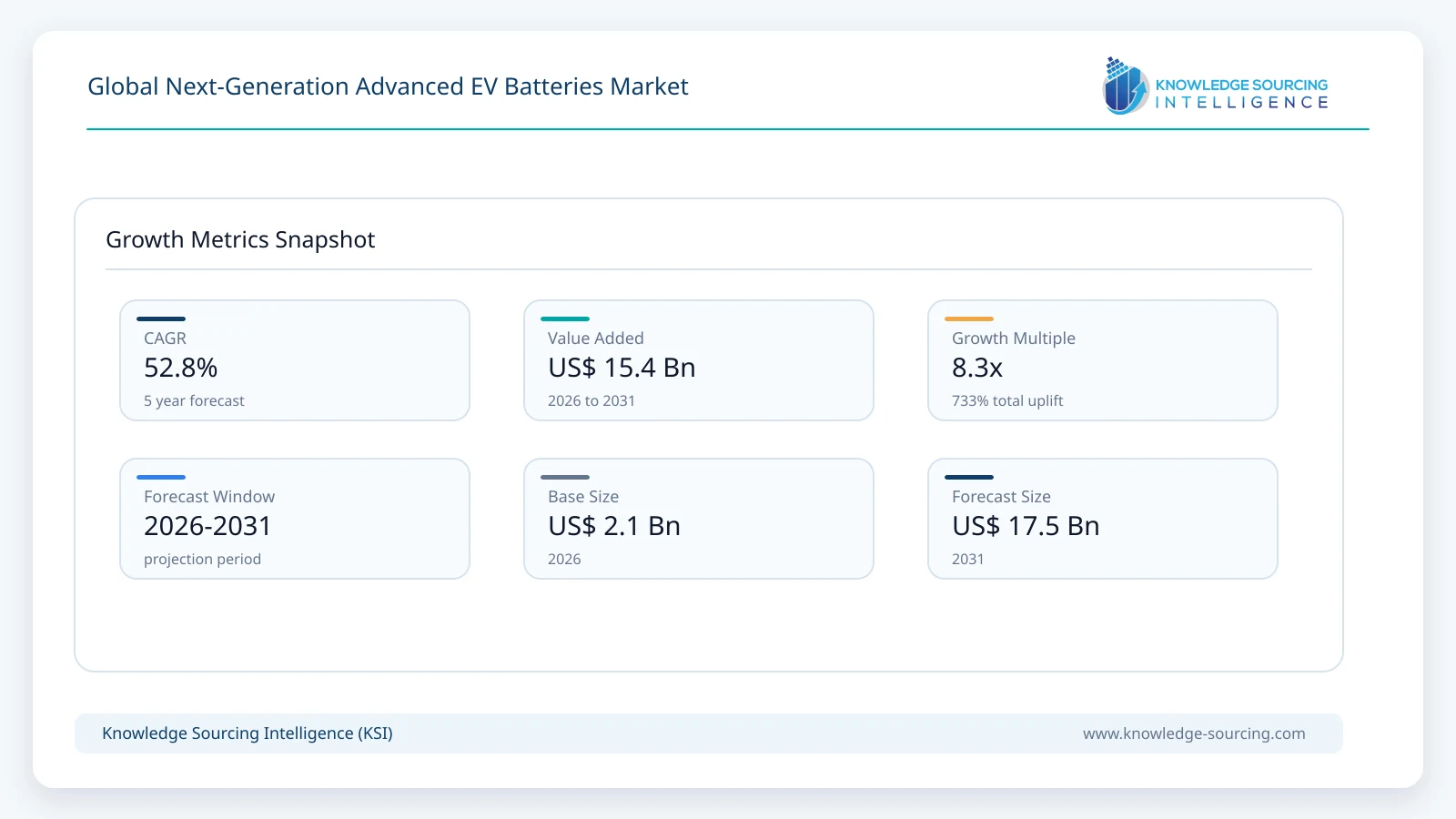
The global next-generation advanced EV batteries market is projected to increase from USD 2.10 billion in 2026 to USD 17.50 billion in 2031, representing a CAGR of approximately 52.8% during the forecast period.
Highlights:
- 1Silicon-dominant lithium-ion batteries generate approximately USD 0.82 billion in global revenue during 2026.
- 2All-solid-state and lithium-metal batteries account for approximately 17% of the advanced battery market in 2026.
- 3Passenger battery electric vehicles represent approximately 72% of next-generation advanced EV battery revenue in 2026.
- 4Asia Pacific accounts for approximately 67% of global next-generation advanced EV battery revenue in 2026.
- 5Sodium-ion batteries enter mass-production passenger vehicles, broadening commercialization beyond lithium-dependent advanced chemistries.
- 6Automotive qualification, manufacturing yield and scalable production increasingly determine next-generation battery commercialization success.
Market Overview
Global electric vehicle battery deployment reached approximately 1.2 TWh in 2025, according to the International Energy Agency (IEA), and is expected to approach 3 TWh by 2030 under current and stated policy pathways. That expansion provides a large addressable platform for new battery technologies, but the transition will not occur through a single successor chemistry. LFP continues to improve on cost and fast charging, while high-nickel lithium-ion retains an energy-density advantage in premium applications. Next-generation technologies therefore have to outperform a moving incumbent on one or more specific attributes rather than simply demonstrate a laboratory-level energy-density gain.
The strongest commercialization signal in 2026 is the move toward multiple technology pathways. CATL has advanced sodium-ion from laboratory development into a passenger-vehicle program with Changan, while high-silicon anode suppliers are adding automotive-scale capacity. Semi-solid systems have demonstrated very high pack energy density, although their economics remain challenging in premium applications. All-solid-state programs are progressing through road tests, B-sample qualification and pilot production, with Toyota targeting commercialization in 2027-2028 and several Western developers pursuing automotive validation. Lithium-sulfur remains earlier-stage but continues to attract automotive development because sulfur-based cathodes can reduce dependence on nickel, cobalt and manganese while supporting lower battery mass.
Technology Commercialization Snapshot
Technology | 2026 Commercial Position | Primary Advantage | Constraint |
Silicon-Dominant Lithium-Ion | Early commercial / scaling | Higher energy density and faster charging within familiar lithium-ion manufacturing. | Silicon expansion, cycle life, material cost and qualification. |
Semi-Solid / Quasi-Solid | Limited series deployment | Higher energy density with an intermediate step toward solid-state architecture. | High cost, complex manufacturing and uncertain mass-market economics. |
All-Solid-State / Lithium-Metal | Pilot, demonstration and early commercial production | High energy density, safety potential and reduced inactive material. | Yield, interface stability, pressure management and scale-up. |
Sodium-Ion | Entering mass-production vehicles | Abundant materials, strong cold-weather performance and reduced lithium exposure. | Lower energy density than premium lithium-ion systems. |
Lithium-Sulfur | Pilot and pre-production development | Very high gravimetric potential with lower reliance on nickel and cobalt. | Cycle life, volumetric density and manufacturing maturity. |
Market Dynamics
Automotive-Scale Manufacturing Is Replacing Laboratory Performance as the Main Commercial Test
The market is entering a phase in which manufacturing readiness matters as much as electrochemical performance. Group14 began ramping an EV-scale silicon battery material plant in South Korea in March 2026 with approximately 10 GWh of annual capacity, while Sila is ramping its Moses Lake silicon-anode facility from an initial 2 GWh phase with substantially larger expansion potential. QuantumScape inaugurated its Eagle Line in February 2026 to support customer sampling and product integration, and Solid Power is commissioning continuous sulfide-electrolyte pilot production. These investments indicate that supplier competition is shifting toward repeatability, yield, customer qualification and cost per usable kilowatt-hour rather than headline cell performance alone.
Energy Density and Charging Performance Are Supporting Multiple Advanced Battery Pathways
Longer range remains important, but advanced battery development is increasingly tied to combining range with faster charging and lower pack mass. Mercedes-Benz reported that its Factorial-powered solid-state EQS test vehicle increased usable battery energy by approximately 25% without increasing battery size and completed a 1,205 km drive on a single charge during testing. Silicon-dominant anodes offer another route because they can increase lithium storage at the anode while remaining compatible with variants of existing lithium-ion production. The result is a market in which automakers can pursue incremental silicon-based improvements before all-solid-state platforms reach full series scale, reducing the likelihood that one chemistry replaces all others simultaneously.
Material Diversification Is Creating a Commercial Role for Sodium-Ion and Lithium-Sulfur
Supply-chain resilience is becoming a technology driver in its own right. CATL's Naxtra sodium-ion battery entered a mass-production passenger-vehicle program with Changan in 2026 and offers energy density up to 175 Wh/kg together with strong low-temperature performance. Lithium-sulfur developers are targeting a different performance envelope: Stellantis and Zeta Energy are developing sulfur-based cells for future EV production, with the program intended to support substantially lighter packs and production planning around the end of the decade. Neither pathway is expected to displace mainstream lithium-ion broadly by 2031, but both can gain meaningful positions in use cases where resource availability, cold-weather operation or weight is more valuable than maximum volumetric energy density.
Manufacturing Yield, Cost and Qualification Timelines Remain the Primary Constraints
Advanced battery commercialization remains exposed to technical and financial execution risk. Solid-state cells require stable interfaces, high-quality separators or solid electrolytes, tight stack pressure and manufacturing processes that can deliver automotive yields at high throughput. Silicon-dominant anodes must control expansion and maintain cycle life as silicon content rises. Sodium-ion benefits from abundant raw materials but still trails premium lithium-ion in energy density, while lithium-sulfur has to demonstrate long-duration cycle stability and automotive-grade volumetric performance. The rapid improvement of conventional LFP and NMC batteries raises the threshold further because new technologies must justify retooling, validation and supply-chain changes against incumbent products that continue to become cheaper and faster to charge.
Segment Analysis
By Technology - Silicon-Dominant Lithium-Ion Batteries
Silicon-dominant lithium-ion batteries represent the largest advanced technology revenue pool in 2026, accounting for approximately 39% of the market. Their advantage is compatibility with the broader lithium-ion ecosystem: manufacturers can improve anode capacity and charging performance without replacing every element of cell design, pack integration and vehicle qualification. Commercial scale is also becoming visible. Group14 states that its South Korean factory is designed for roughly 10 GWh of annual silicon-battery material capacity, while Sila began operations at its first automotive-scale U.S. silicon-anode plant and is expanding from an initial multi-GWh phase. Adoption is expected to broaden first in premium and performance-oriented vehicles where additional range, charging speed and packaging efficiency can justify higher material costs.
By Technology - All-Solid-State and Lithium-Metal Batteries
All-solid-state and lithium-metal batteries are expected to record the fastest growth through 2031 as vehicle programs move beyond prototypes. Mercedes-Benz and Factorial have already demonstrated solid-state technology in real-world road testing, while Stellantis started road testing a Dodge Charger Daytona development vehicle using Factorial cells in June 2026. BMW, Samsung SDI and Solid Power are jointly evaluating all-solid-state technology, and Toyota continues to target 2027-2028 commercialization. ProLogium announced mass production of its Gen 3.5 large-format all-solid-state battery in September 2026. Growth is therefore expected to accelerate after 2027, but early deployment should remain concentrated in higher-value vehicles until manufacturing yield, electrolyte supply and pack integration mature.
Market and Demand Indicators
Indicator | Latest Development | Market Impact |
Global EV battery deployment | IEA reported approximately 1.2 TWh of EV battery deployment in 2025. | Provides the underlying scale into which advanced battery technologies can penetrate. |
Sodium-ion commercialization | CATL and Changan launched a mass-production sodium-ion passenger vehicle program in February 2026. | Moves sodium-ion from pilot activity into automotive series deployment. |
Silicon-anode scale | Group14 began ramping a roughly 10 GWh EV-scale silicon material facility in March 2026. | Supports commercial supply of higher-energy-density anode materials. |
Solid-state road validation | Stellantis began road testing a Factorial solid-state development vehicle in June 2026. | Demonstrates progress from cell qualification toward vehicle-level validation. |
All-solid-state production | ProLogium announced mass production of a 381 Wh/kg large-format all-solid-state cell in September 2026. | Strengthens evidence that solid-state manufacturing is moving beyond pilot scale. |
Toyota commercialization roadmap | Toyota continues to target all-solid-state battery commercialization in 2027-2028. | Creates a defined automotive adoption window for higher-volume solid-state deployment. |
Asia Pacific Market Analysis
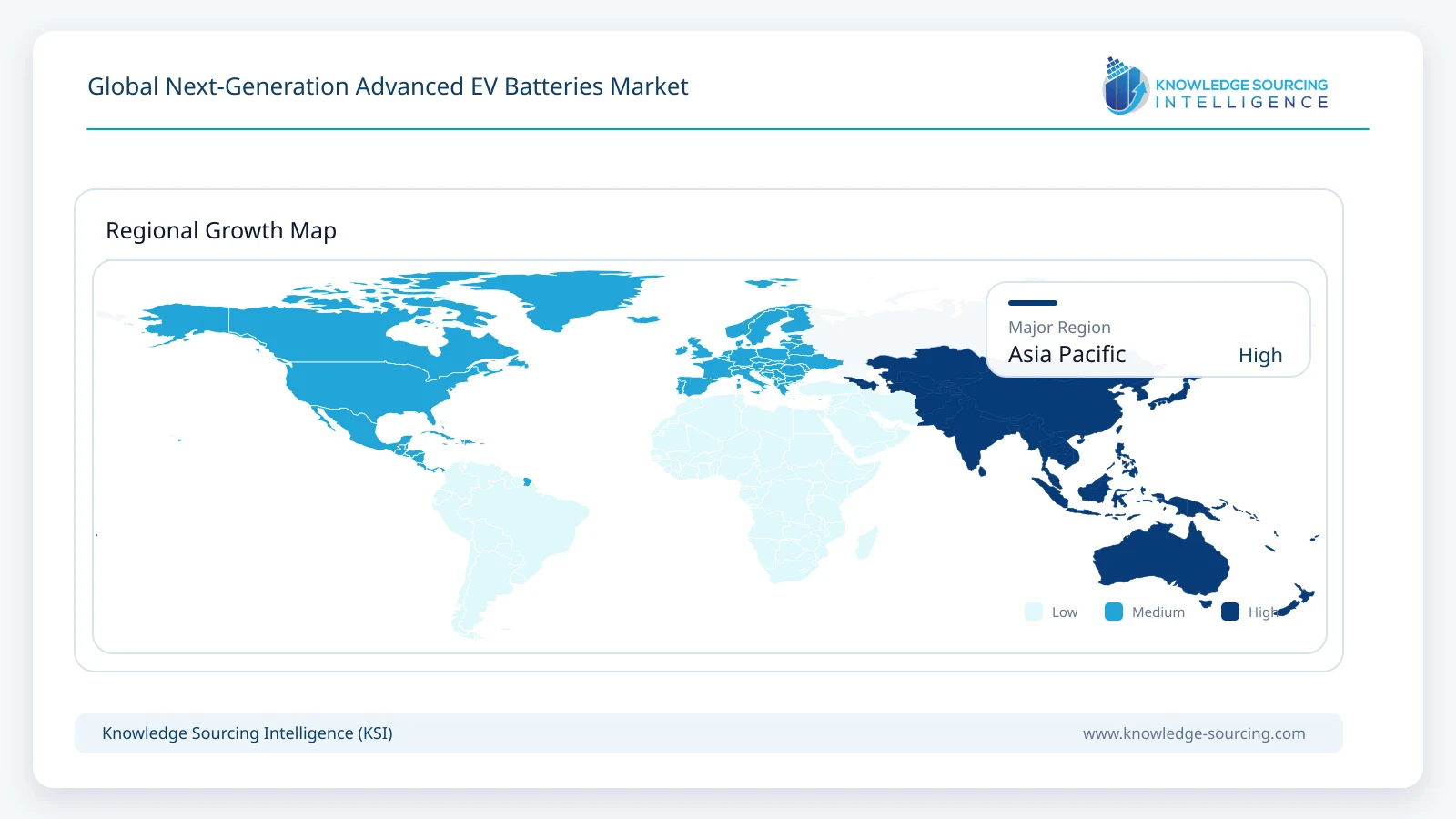
Asia Pacific is the leading region for next-generation advanced EV batteries because it combines the world's largest electric vehicle and battery manufacturing base with active development programs across China, Japan and South Korea. China is the most important near-term commercialization market. CATL is taking sodium-ion into mass-production passenger vehicles and has stated that Naxtra will reach GWh-scale industrialisation, while domestic suppliers have also led early semi-solid battery deployment. The region's manufacturing advantage matters because advanced batteries require rapid iteration between materials, cell production, pack engineering and vehicle validation. Existing supplier clusters therefore reduce the time required to qualify new chemistries and scale new processes.
Japan and South Korea add a different layer of capability focused on materials science, automotive qualification and next-generation lithium platforms. Toyota is advancing all-solid-state batteries toward 2027-2028 commercialization and is working with Idemitsu Kosan on solid electrolytes and mass-production technology. Samsung SDI has joined BMW and Solid Power in all-solid-state evaluation, while SK On is working with Solid Power and Factorial on advanced battery manufacturing pathways. Group14's South Korean silicon-material facility is already ramping at EV scale. Through 2031, Asia Pacific is expected to remain the largest regional market, but its mix should shift from semi-solid and advanced lithium-ion systems toward a broader combination of sodium-ion, high-silicon and all-solid-state batteries.
Competitive Landscape
The competitive landscape is unusually diverse because different companies control different layers of the technology stack. CATL combines cell development, manufacturing scale and vehicle integration across sodium-ion and advanced lithium-ion systems. Toyota, Samsung SDI, LG Energy Solution, SK On and Panasonic Energy bring established automotive manufacturing and customer qualification capabilities. QuantumScape, Factorial, Solid Power, ProLogium and SES AI compete around solid-state or lithium-metal platforms, while Group14 and Sila focus on silicon-rich anode materials that can be integrated into lithium-ion manufacturing. Zeta Energy and Lyten are developing lithium-sulfur pathways that target lower mass and reduced dependence on conventional cathode metals.
Competitive advantage through 2031 will depend less on a single laboratory metric and more on the ability to move technology through automotive qualification, secure materials at scale, achieve repeatable manufacturing yields and integrate cells into production vehicles. Partnerships are therefore central to the market. Factorial works with Mercedes-Benz, Stellantis, Hyundai and Kia; Solid Power is linked with BMW, Samsung SDI and SK On; QuantumScape is advancing programs with Volkswagen Group and Honda; and Toyota is developing solid-state production with Idemitsu. The strongest suppliers are increasingly those that can connect proprietary chemistry with automotive-scale process engineering rather than technology developers operating in isolation.
Recent Developments
September 2026: Factorial and Mitsui Kinzoku signed a joint development agreement to scale Factorial's Solstice all-solid-state battery platform.
September 2026: ProLogium announced mass production of a large-format all-solid-state cell reaching 381 Wh/kg and 903 Wh/L.
July 2026: Sila raised USD 300 million to accelerate silicon-anode production and expand its Moses Lake manufacturing platform.
June 2026: QuantumScape and Honda announced a multi-year joint research program covering solid-state battery technology and manufacturing processes.
June 2026: Stellantis and Factorial began road testing a Dodge Charger Daytona development vehicle equipped with solid-state cells.
March 2026: Group14 began ramping its South Korean EV-scale silicon battery material factory, designed for approximately 10 GWh annually.
February 2026: CATL and Changan unveiled a mass-production passenger vehicle using CATL Naxtra sodium-ion batteries.
Next-Generation Advanced EV Batteries Market Scope
| Report Metric | Details |
|---|---|
| Total Market Size in 2026 | USD 2.10 billion |
| Total Market Size in 2031 | USD 17.50 billion |
| Forecast Unit | Billion |
| Growth Rate | 52.8% |
| Study Period | 2021 to 2031 |
| Historical Data | 2021 to 2024 |
| Base Year | 2025 |
| Forecast Period | 2026 – 2031 |
| Segmentation | Technology, Vehicle Platform, Geography |
| Companies |
|
Market Segmentation
By Technology
Silicon-Dominant Lithium-Ion Batteries
Semi-Solid / Quasi-Solid Batteries
All-Solid-State / Lithium-Metal Batteries
Sodium-Ion EV Batteries
Lithium-Sulfur Batteries
Other Advanced Battery Technologies
By Vehicle Platform
Passenger Battery Electric Vehicles
Plug-In Hybrid and Range-Extended Electric Vehicles
Electric Commercial Vehicles
Performance and Luxury Electric Vehicles
Other Electric Mobility Platforms
By Geography
North America
United States
Canada
Mexico
South America
Brazil
Argentina
Rest of South America
Europe
Germany
United Kingdom
France
Italy
Rest of Europe
Middle East and Africa
Saudi Arabia
United Arab Emirates
South Africa
Rest of Middle East and Africa
Asia Pacific
China
Japan
South Korea
India
Rest of Asia Pacific
Table of Contents
1. EXECUTIVE SUMMARY
2. MARKET SNAPSHOT
2.1. Market Overview
2.2. Market Segmentation
3. BUSINESS LANDSCAPE
3.1. Market Drivers
3.1.1. Automotive-Scale Manufacturing Is Replacing Laboratory Performance as the Main Commercial Test
3.1.2. Energy Density and Charging Performance Are Supporting Multiple Advanced Battery Pathways
3.1.3. Material Diversification Is Creating a Commercial Role for Sodium-Ion and Lithium-Sulfur
3.2. Market Restraints
3.2.1. Manufacturing Yield, Cost and Qualification Timelines Remain the Primary Constraints
3.3. Market Opportunities
3.4. Porter's Five Forces Analysis
3.5. Industry Value Chain Analysis
3.6. Regulatory and Standards Landscape
4. TECHNOLOGY AND COMMERCIALIZATION OUTLOOK
4.1. Silicon-Dominant Anodes
4.2. Semi-Solid and Quasi-Solid Batteries
4.3. All-Solid-State and Lithium-Metal Batteries
4.4. Sodium-Ion Batteries
4.5. Lithium-Sulfur Batteries
4.6. Advanced Manufacturing and Cell Integration
5. GLOBAL NEXT-GENERATION ADVANCED EV BATTERIES MARKET BY TECHNOLOGY
5.1. Silicon-Dominant Lithium-Ion Batteries
5.2. Semi-Solid / Quasi-Solid Batteries
5.3. All-Solid-State / Lithium-Metal Batteries
5.4. Sodium-Ion EV Batteries
5.5. Lithium-Sulfur Batteries
5.6. Other Advanced Battery Technologies
6. GLOBAL NEXT-GENERATION ADVANCED EV BATTERIES MARKET BY VEHICLE PLATFORM
6.1. Passenger Battery Electric Vehicles
6.2. Plug-In Hybrid and Range-Extended Electric Vehicles
6.3. Electric Commercial Vehicles
6.4. Performance and Luxury Electric Vehicles
6.5. Other Electric Mobility Platforms
7. GLOBAL NEXT-GENERATION ADVANCED EV BATTERIES MARKET BY GEOGRAPHY
7.1. North America
7.1.1. United States
7.1.2. Canada
7.1.3. Mexico
7.2. South America
7.2.1. Brazil
7.2.2. Argentina
7.2.3. Rest of South America
7.3. Europe
7.3.1. Germany
7.3.2. United Kingdom
7.3.3. France
7.3.4. Italy
7.3.5. Rest of Europe
7.4. Middle East and Africa
7.4.1. Saudi Arabia
7.4.2. United Arab Emirates
7.4.3. South Africa
7.4.4. Rest of Middle East and Africa
7.5. Asia Pacific
7.5.1. China
7.5.2. Japan
7.5.3. South Korea
7.5.4. India
7.5.5. Rest of Asia Pacific
8. COMPETITIVE ENVIRONMENT AND ANALYSIS
8.1. Major Players and Strategy Analysis
8.2. Technology Commercialization Benchmarking
8.3. Partnerships, Agreements and Joint Development Programs
8.4. Manufacturing Scale and Readiness Dashboard
9. COMPANY PROFILES
9.1. Contemporary Amperex Technology Co., Limited (CATL)
9.2. Toyota Motor Corporation
9.3. Samsung SDI Co., Ltd.
9.4. LG Energy Solution Ltd.
9.5. SK On Co., Ltd.
9.6. Panasonic Energy Co., Ltd.
9.7. QuantumScape Corporation
9.8. Factorial Inc.
9.9. Solid Power, Inc.
9.10. ProLogium Technology Co., Ltd.
9.11. Beijing WeLion New Energy Technology Co., Ltd.
9.12. SES AI Corporation
9.13. Group14 Technologies, Inc.
9.14. Sila Nanotechnologies, Inc.
9.15. StoreDot Ltd.
9.16. Zeta Energy Corp.
9.17. Lyten, Inc.
9.18. Idemitsu Kosan Co., Ltd.
10. RECENT DEVELOPMENTS
11. APPENDIX
11.1. Currency
11.2. Assumptions
11.3. Base and Forecast Years Timeline
11.4. Research Methodology
11.5. Abbreviations
Navigate
Trusted by the world's leading organizations











