
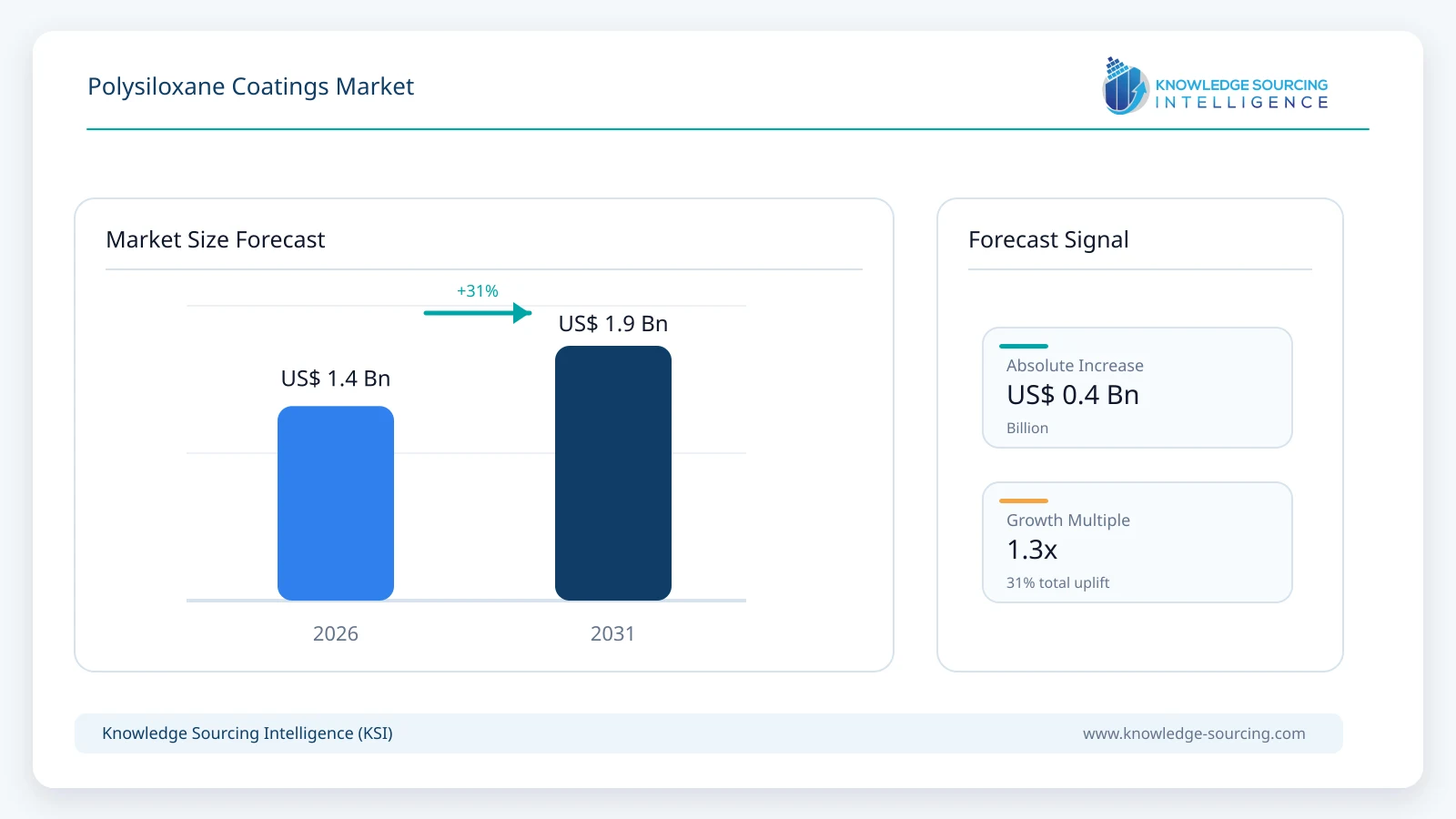
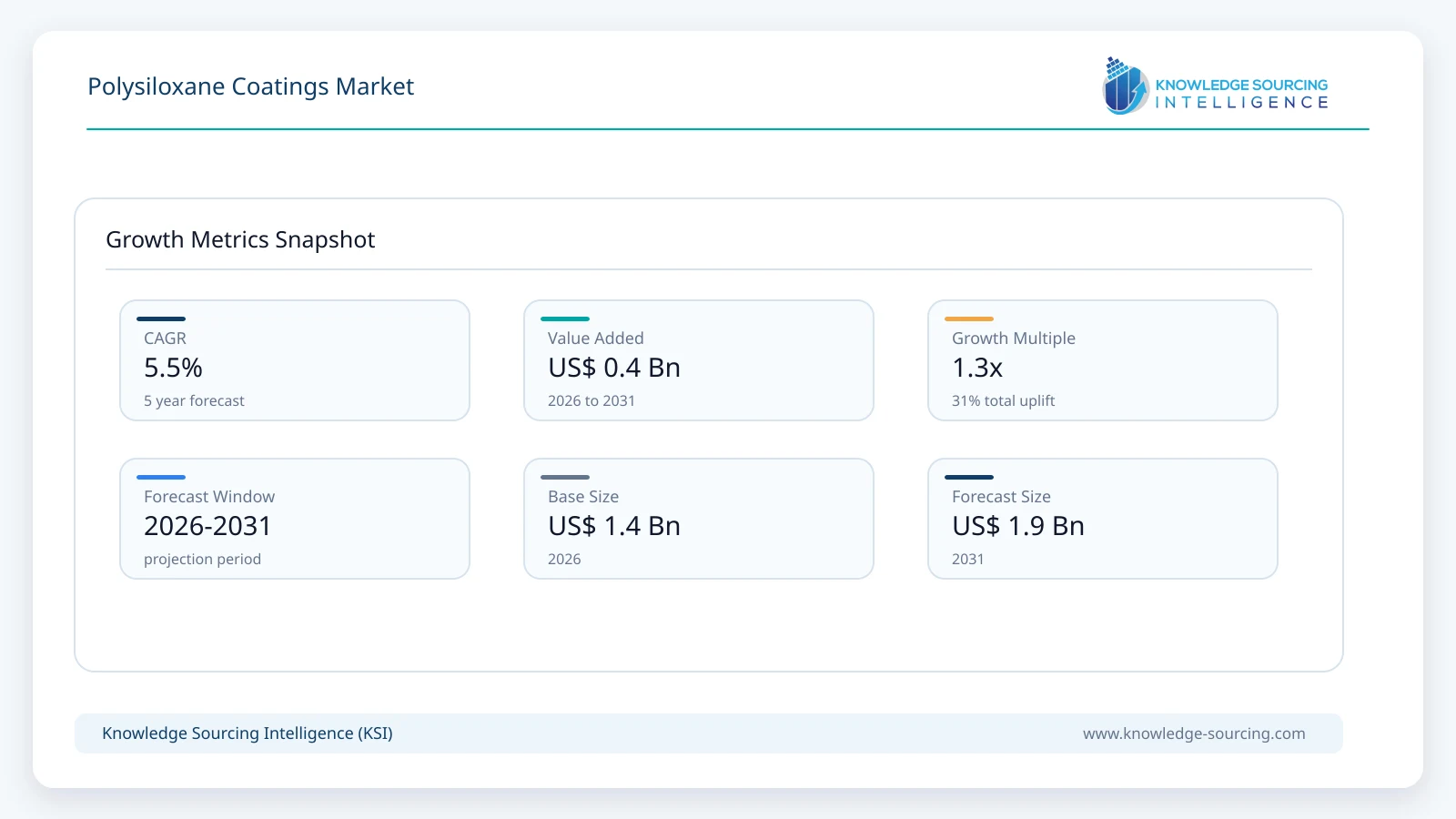
The polysiloxane coatings market is forecast to grow at a CAGR of 5.5%, reaching USD 1.86 billion in 2031 from approximately USD 1.42 billion in 2026.
Highlights:
- 1Epoxy-polysiloxane coatings account for approximately 46% of global market value in 2026, supported by their use in high-durability industrial and marine protective systems.
- 2Protective and anti-corrosion applications represent approximately 42% of market value in 2026 as asset owners seek longer maintenance intervals for exposed steel and infrastructure.
- 3Oil & gas and chemical processing account for approximately 26% of market value in 2026, reflecting extensive use on tanks, piping, process equipment and structural steel.
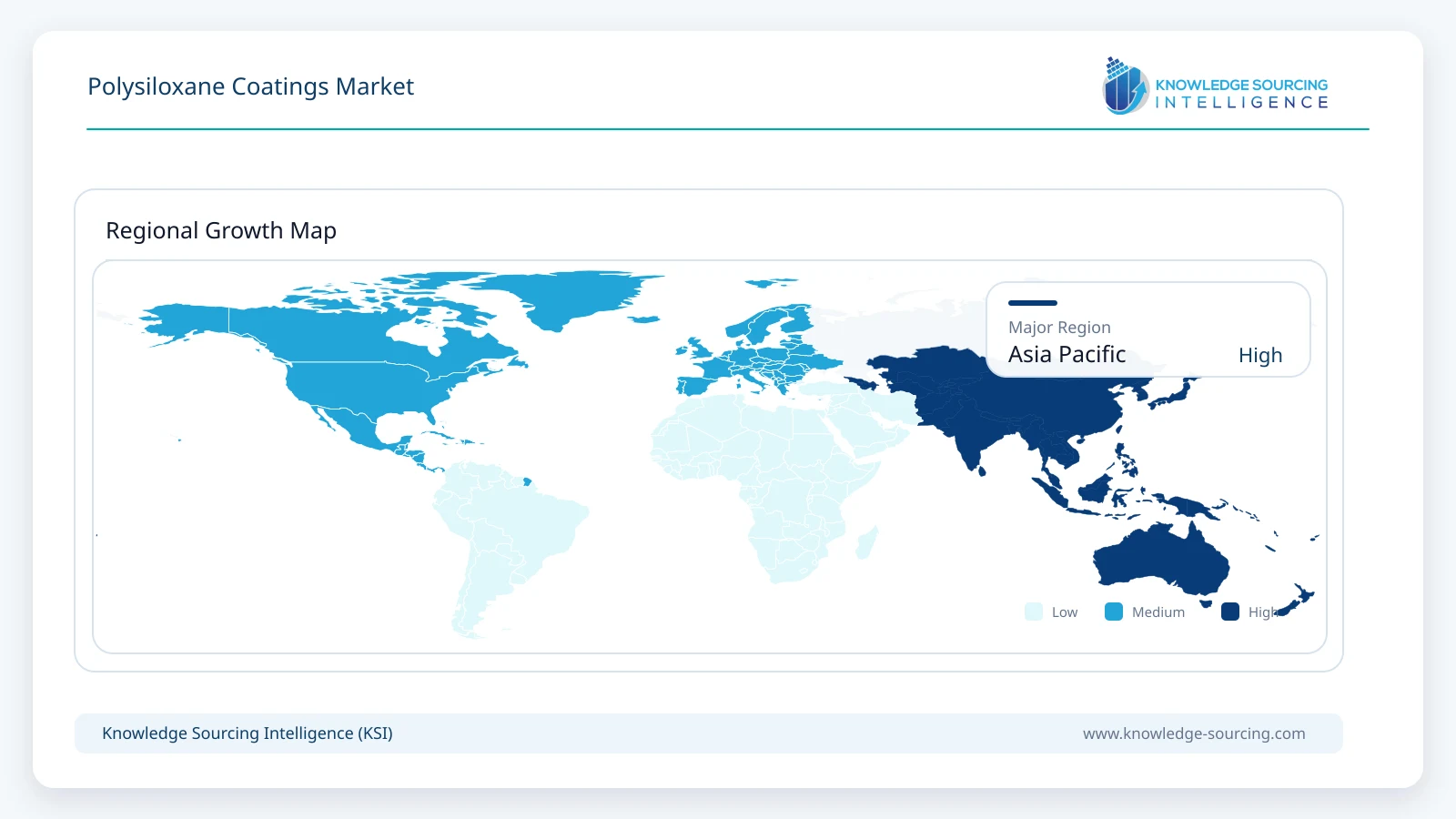
- 4North America represents approximately 32% of global market value in 2026, supported by mature industrial, infrastructure, marine and energy coating demand.
- 5Asia Pacific is projected to be the fastest-growing regional market through 2031 as industrial infrastructure, shipbuilding, energy and manufacturing investment expand.
The market covers protective and functional coatings in which polysiloxane chemistry forms a material part of the binder or curing system, including epoxy-polysiloxane, acrylic-polysiloxane, silicone-resin hybrid and related high-performance formulations used across industrial, marine, infrastructure and energy applications.
Polysiloxane coatings occupy a differentiated position between conventional epoxy and polyurethane systems. Their silicon-oxygen backbone provides strong resistance to ultraviolet radiation and weathering, while hybridization with organic polymers can improve adhesion, chemical resistance and mechanical performance. PPG describes modern polysiloxane-organic hybrid systems as combining long-term weatherability and color retention with corrosion and abrasion resistance across oil and gas platforms, bridges, tanks, heavy equipment, wind turbines and marine vessels.
Market Overview
Polysiloxane coatings are high-performance protective and decorative systems formulated using siloxane-based binders or organic-inorganic hybrid polymers. Their principal commercial advantage is the ability to deliver durable exterior performance while reducing some of the limitations associated with traditional polyurethane topcoats, particularly ultraviolet degradation, color fading and gloss loss.
Epoxy-polysiloxane technology is particularly established in severe-service applications. PPG’s PSX technology combines organic and silicone chemistry to provide long-term weatherability, chemical resistance and corrosion protection, with systems qualified for C4 and C5 corrosive environments. The company positions its PSX 700 products for bridges, tanks, oil and gas assets, wind turbines, ships and other exposed infrastructure.
AkzoNobel’s International portfolio also includes acrylic-polysiloxane technology. Interfine 979 is a high-solids acrylic polysiloxane finish developed for long-term gloss and color retention in marine newbuilding and refurbishment applications while maintaining comparatively low VOC content. Sherwin-Williams similarly supplies epoxy-siloxane systems such as Sher-Loxane 800 and Polysiloxane XLE-80 for marine, military, bridge and infrastructure applications.
The upstream chemistry market is supported by silicone resin and hardener suppliers including WACKER and Evonik. WACKER’s SILRES portfolio includes reactive polysiloxane systems for water-resistant coatings and epoxy-polysiloxane topcoats, while Evonik supplies polysiloxane resins and siloxane additives for architectural, protective and industrial formulations.
Market Trends
Two-Coat Protective Systems Are Replacing More Complex Coating Schemes
One of the most important commercial advantages of polysiloxane technology is its potential to reduce the number of coating layers required for long-life corrosion protection. Conventional severe-service systems frequently combine zinc-rich primers, epoxy intermediate coats and polyurethane finishes. Polysiloxane topcoats can provide higher build and improved weatherability, allowing selected projects to move toward two-coat systems.
PPG currently positions its PSX 700 technology as part of two-coat C5 protection systems that can replace traditional three-coat architectures in appropriate applications. Fewer layers can reduce application labor, curing time, scaffold occupation and total project downtime while preserving long-term exterior durability.
This lifecycle advantage is particularly important for bridges, offshore structures, process plants and other assets where access costs can exceed the cost of the coating itself.
Isocyanate-Free Chemistry Is Becoming More Important
Polysiloxane systems can provide polyurethane-like exterior durability without relying on conventional isocyanate curing chemistry. This characteristic is becoming more valuable as coating users increase attention to worker exposure, VOC content and application safety.
WACKER introduced SILRES HP 2000 LV as a lower-volatility hardener for epoxy-polysiloxane coatings, enabling isocyanate-free metal topcoats with long-term gloss retention and corrosion protection for ships, bridges and industrial plants. Evonik’s TEGO Cure 100 similarly provides ambient-temperature curing for silicone and silicone-hybrid resins without an isocyanate curing mechanism.
Marine Applications Are Moving Toward Silicone-Rich High-Performance Systems
Marine coatings are a significant technology-development area because vessel operators increasingly evaluate coatings according to both corrosion protection and their ability to improve operating efficiency. Hempel completed its first applications of its Hempaguard NB silicone hull coating on Maersk newbuild vessels in early 2026, demonstrating that advanced silicone coating systems can be incorporated directly into shipyard newbuilding processes.
PPG has also expanded use of silicone-based marine coatings. In March 2026, it completed its 200th vessel dry docking using electrostatic application of its biocide-free Sigmaglide 2390 silicone-based fouling-release coating.
These fouling-release systems are not identical to epoxy-polysiloxane protective topcoats, but they demonstrate increasing acceptance of siloxane chemistry across high-value marine coating systems.
Regulatory Purity Is Becoming More Important for Siloxane Raw Materials
European regulatory scrutiny is increasing around low-molecular-weight cyclic and linear siloxanes. This is pushing manufacturers to control residual impurities in siloxane additives and resin systems.
Evonik reported in June 2026 that more than 95% of its active siloxane-based coating additive portfolio contained relevant substances of very high concern below the 0.1% classification threshold. The development illustrates the growing importance of raw-material purification and regulatory documentation for coating formulators operating in European and multinational markets.
Market Drivers
Longer Asset-Maintenance Cycles
Industrial asset owners increasingly evaluate protective coatings according to lifecycle cost rather than purchase price per litre. Bridges, offshore platforms, chemical plants and storage terminals can incur substantial expenses for scaffolding, blasting, shutdowns and labor each time a coating system requires renewal.
The weatherability of polysiloxane coatings can extend maintenance intervals, particularly where conventional polyurethane finishes lose gloss, chalk or deteriorate under continuous ultraviolet exposure.
Infrastructure Refurbishment
Aging bridges, industrial plants, ports and transport infrastructure create a recurring requirement for corrosion protection. Existing assets often present a particularly attractive opportunity because owners seek coating systems capable of extending remaining service life without repeated maintenance interventions.
PPG explicitly positions polysiloxane technology for infrastructure exposed to C4 and C5 corrosive environments, including coastal and industrial applications.
Marine Decarbonization and Vessel Efficiency
Shipping companies are increasingly evaluating coating systems as part of overall vessel-efficiency strategies. Silicone-based fouling-release systems can reduce hull resistance while high-performance topside coatings extend maintenance intervals and improve exterior durability.
Hempel’s newbuilding use with Maersk and PPG’s growing deployment of silicone-based marine systems demonstrate continued commercialization of this technology across major vessel fleets.
Lower-VOC and Isocyanate-Free Formulations
Environmental and occupational-health requirements support coatings that reduce solvent emissions and eliminate conventional isocyanate curing agents. Polysiloxane chemistry can deliver high solids and strong exterior durability while meeting these requirements.
Sherwin-Williams’ Sher-Loxane 800 operates at below 100 g/L VOC, while WACKER’s newer SILRES hardener technology supports low-volatility, isocyanate-free epoxy-polysiloxane formulations.
Expansion of Renewable-Energy Infrastructure
Wind turbines, offshore wind structures, substations and other energy assets require long-term exterior protection because maintenance can be difficult and expensive. Polysiloxane coatings are suited to these applications because of their weatherability, corrosion protection and color retention.
The opportunity is particularly relevant to offshore installations, where the combination of ultraviolet exposure, saltwater and limited maintenance access increases the value of high-durability coating systems.
Market Restraints
Higher Initial Material Cost
Polysiloxane coatings generally carry a higher material cost than basic epoxy, acrylic or conventional industrial coatings. This can restrict adoption in applications where maintenance access is simple and owners prioritize upfront project cost.
The lifecycle advantage is strongest where longer service intervals or fewer coating layers materially reduce application and maintenance expenditure.
Surface Preparation Remains Critical
High-performance coating chemistry cannot compensate fully for inadequate substrate preparation. Contamination, poor blasting, residual salts or incorrect primer selection can reduce adhesion and long-term corrosion protection.
Large industrial projects therefore require experienced contractors, quality-control procedures and specification compliance, increasing application complexity compared with lower-performance coatings.
Competition from High-Performance Polyurethanes
Polyurethane topcoats remain deeply established in industrial, marine and infrastructure coating specifications. They provide good exterior appearance, broad availability and extensive contractor familiarity.
Polysiloxanes therefore compete not only through coating performance but through the ability to demonstrate lower lifecycle cost or reduced coating-system complexity.
Raw-Material and Regulatory Requirements
Siloxane chemistry faces increasing scrutiny around specific low-molecular-weight impurities, particularly in Europe. Resin and additive manufacturers must maintain tighter control over composition and regulatory documentation.
This can raise production and qualification costs, although higher-purity products also create differentiation for technically advanced suppliers.
Qualification and Specification Cycles
Protective coating systems used on bridges, ships, military assets and industrial infrastructure frequently require extensive testing and customer approval. Established specifications can remain unchanged for many years, slowing adoption of new coating systems even when they demonstrate technical advantages.
Segment Analysis
By Chemistry: Epoxy-Polysiloxane
Epoxy-polysiloxane represents the principal chemistry used in high-performance industrial protective coatings because it combines epoxy-derived adhesion and chemical resistance with the weatherability and ultraviolet stability of siloxane chemistry. The technology is widely used where asset owners require both corrosion protection and a durable exterior finish.
The segment is projected to reach approximately USD 867 million by 2031. Growth is supported by adoption of two-coat protective systems, lower-VOC formulations and applications where longer repainting intervals can materially reduce lifecycle maintenance expenditure.
PPG remains a prominent technology supplier through PSX 700 and related systems, while Sherwin-Williams offers epoxy-siloxane products including Sher-Loxane 800 and Polysiloxane XLE-80. WACKER and Evonik supply upstream silicone resin and hardener technologies used by coating formulators.
By Application: Protective and Anti-Corrosion Coatings
Protective and anti-corrosion coatings form the largest application group because polysiloxane chemistry is particularly valuable where steel assets are exposed to sunlight, moisture, industrial pollution, marine atmospheres or chemical environments.
The segment is projected to reach approximately USD 784 million by 2031. Demand extends across bridges, storage tanks, pipelines, chemical plants, offshore structures, process equipment, wind-energy infrastructure and industrial facilities.
The economic argument becomes stronger as maintenance access becomes more expensive. High-durability polysiloxane finishes can preserve appearance and corrosion resistance for longer intervals, reducing repainting frequency and the associated cost of surface preparation, labor and operational shutdowns.
By End User: Oil & Gas and Chemical Processing
Oil & gas and chemical installations represent a major demand pool because these facilities contain large quantities of exposed steel, piping, tanks, process equipment and structural infrastructure operating in corrosive environments. Protective coatings must withstand ultraviolet radiation, moisture, chemicals and frequent temperature changes while maintaining long service intervals.
The segment is projected to approach approximately USD 481 million by 2031. Growth is supported primarily by maintenance of existing infrastructure, offshore investment and refurbishment of processing assets rather than only construction of new facilities.
Polysiloxane systems are especially attractive in applications where reducing a conventional three-coat specification to a two-coat system can lower labor and shutdown costs without sacrificing exterior durability.
Regional Outlook
North America
North America is the largest regional polysiloxane coatings market, supported by extensive oil and gas infrastructure, chemical processing, bridges, marine assets, military applications and industrial maintenance requirements.
The regional market is projected to reach approximately USD 581 million by 2031. The United States provides the majority of demand and contains several leading technology suppliers, including PPG and Sherwin-Williams. Polysiloxane coatings have been adopted across naval vessels, bridges, petrochemical installations, tanks and other assets where long-term exterior performance justifies higher-performance coating systems.
Asia Pacific
Asia Pacific is projected to be the fastest-growing regional market, expanding at approximately 6.4% annually from 2026 to 2031. Growth is being supported by shipbuilding, industrial infrastructure, petrochemicals, energy facilities and large-scale manufacturing investment across China, South Korea, Japan, India and Southeast Asia.
The region is projected to reach approximately USD 565 million by 2031 and approach North America’s market size toward the end of the forecast period. Marine demand is particularly important because China, South Korea and Japan remain major global shipbuilding centers, while Southeast Asian countries are expanding energy and industrial infrastructure.
Competitive Landscape
The polysiloxane coatings market combines major protective-coating manufacturers with upstream silicone and specialty-resin suppliers. PPG, AkzoNobel, Sherwin-Williams, Jotun and Hempel compete through finished protective and marine coating systems, while WACKER, Evonik, Dow, Momentive, Shin-Etsu and Elkem participate primarily through silicone resins, intermediates and formulation technologies.
PPG has one of the strongest established positions in epoxy-polysiloxane protective coatings through its PSX platform, while AkzoNobel’s International brand maintains an established acrylic-polysiloxane position through Interfine. Sherwin-Williams competes in marine, infrastructure and military markets with Sher-Loxane and XLE technologies.
Jotun markets Hardtop Pro as a durable polysiloxane topcoat with high solids, long-term gloss retention and isocyanate-free chemistry, adding another major global protective-coatings supplier to the competitive landscape.
Upstream chemistry remains strategically important because coating performance depends on resin architecture, curing chemistry and impurity control. WACKER and Evonik continue developing polysiloxane resin and hardener systems while broader silicone manufacturers provide functional intermediates for specialty coating formulations.
Recent Developments
September 2026: Hempel signed a three-year global hull-coatings agreement covering a significant share of Maersk’s 2026-2028 dry-docking program, building on documented performance of Hempel’s silicone coating technology.
July 2026: PPG’s Sigmaglide 2390 silicone-based fouling-release coating received a 2026 Green Chemistry Challenge Award for its biocide-free marine technology.
June 2026: Evonik reported that more than 95% of its active siloxane coating-additive portfolio contained relevant SVHC substances below the 0.1% classification threshold.
March 2026: PPG completed its 200th vessel dry docking using electrostatic application of its Sigmaglide 2390 silicone-based marine coating.
February 2026: Hempel completed the first newbuilding applications of Hempaguard NB silicone hull coating on Maersk vessels constructed at Yangzijiang Shipyard in China.
March 2025: WACKER introduced SILRES HP 2000 LV, a lower-volatility silicone resin hardener for weather-resistant and isocyanate-free epoxy-polysiloxane topcoats used on ships, bridges and industrial assets.
Market Outlook
The polysiloxane coatings market is set to expand , with protective and anti-corrosion applications being the key revenue sources, as industrial asset owners increasingly focus on total lifecycle maintenance expenditure. Epoxy-polysiloxane remains the leading chemistry because it combines the adhesion and chemical resistance associated with epoxy technology with improved weatherability and ultraviolet stability.
Marine applications are expected to remain an important source of technology development. Vessel owners are increasingly evaluating silicone and siloxane-based coating systems for both protection and operating efficiency, while shipyards are demonstrating that these technologies can be integrated into newbuilding and dry-docking workflows at commercial scale.
North America remains the largest regional market through most of the forecast period, supported by mature infrastructure and industrial maintenance expenditure. Asia Pacific grows faster as shipbuilding, petrochemical, energy and infrastructure investment expand across the region.
Competition will increasingly center on longer maintenance intervals, reduced coating-layer counts, lower VOC emissions, isocyanate-free curing and compliance with tighter chemical regulations rather than on material price alone.
Polysiloxane Coatings Market Scope
| Report Metric | Details |
|---|---|
| Total Market Size in 2026 | USD 1.42 billion |
| Total Market Size in 2031 | USD 1.86 billion |
| Forecast Unit | Billion |
| Growth Rate | 5.5% |
| Study Period | 2021 to 2031 |
| Historical Data | 2021 to 2024 |
| Base Year | 2025 |
| Forecast Period | 2026 – 2031 |
| Segmentation | Chemistry, Application, End User, Geography |
| Companies |
|
Market Segmentation
By Chemistry
Epoxy-Polysiloxane
Acrylic-Polysiloxane
Silicone Resin and Other Hybrid Polysiloxanes
By Application
Protective and Anti-Corrosion Coatings
Marine and Offshore Coatings
Architectural and Infrastructure Coatings
Heat-Resistant Coatings
Others
By End User
Oil & Gas and Chemicals
Building and Infrastructure
Marine
Energy and Power
Industrial Manufacturing
Transportation
Others
By Geography
North America
United States
Canada
Mexico
South America
Brazil
Argentina
Others
Europe
Germany
United Kingdom
France
Italy
Spain
Others
Middle East and Africa
Saudi Arabia
UAE
South Africa
Others
Asia Pacific
China
Japan
South Korea
India
Indonesia
Thailand
Others
Table of Contents
1. INTRODUCTION
1.1. Market Overview
1.2. Market Definition
1.3. Scope of the Study
1.4. Market Segmentation
1.5. Currency
1.6. Assumptions
1.7. Base and Forecast Years
1.8. Key Benefits to Stakeholders
2. RESEARCH METHODOLOGY
2.1. Research Design
2.2. Secondary Research
2.3. Primary Research
2.4. Market Estimation
2.5. Segment Modelling
2.6. Data Triangulation and Validation
3. EXECUTIVE SUMMARY
3.1. Key Findings
3.2. Polysiloxane Coatings Market Size, 2026-2031
3.3. Chemistry Outlook
3.4. Application Outlook
3.5. End-User Outlook
3.6. Regional Opportunity Summary
4. MARKET DYNAMICS
4.1. Market Drivers
4.1.1. Longer Industrial Asset-Maintenance Cycles
4.1.2. Infrastructure Refurbishment and Corrosion Protection
4.1.3. Marine Decarbonization and Vessel-Efficiency Requirements
4.1.4. Adoption of Lower-VOC and Isocyanate-Free Coatings
4.1.5. Expansion of Renewable-Energy Infrastructure
4.2. Market Restraints
4.2.1. Higher Initial Material Cost
4.2.2. Surface-Preparation Requirements
4.2.3. Competition from High-Performance Polyurethane Systems
4.2.4. Raw-Material and Regulatory Requirements
4.2.5. Long Qualification and Specification Cycles
4.3. Market Opportunities
4.4. Porter’s Five Forces Analysis
4.5. Industry Value Chain Analysis
4.6. Protective Coating System Economics
4.7. Regulatory and VOC Environment
5. TECHNOLOGY OUTLOOK
5.1. Epoxy-Polysiloxane Hybrid Technology
5.2. Acrylic-Polysiloxane Technology
5.3. Silicone Resin Hybrid Systems
5.4. Isocyanate-Free Curing
5.5. Low-VOC and High-Solids Formulation
5.6. Silicone-Based Marine Fouling-Release Technology
6. POLYSILOXANE COATINGS MARKET BY CHEMISTRY
6.1. Introduction
6.2. Epoxy-Polysiloxane
6.3. Acrylic-Polysiloxane
6.4. Silicone Resin and Other Hybrid Polysiloxanes
7. POLYSILOXANE COATINGS MARKET BY APPLICATION
7.1. Introduction
7.2. Protective and Anti-Corrosion Coatings
7.3. Marine and Offshore Coatings
7.4. Architectural and Infrastructure Coatings
7.5. Heat-Resistant Coatings
7.6. Others
8. POLYSILOXANE COATINGS MARKET BY END USER
8.1. Introduction
8.2. Oil & Gas and Chemicals
8.3. Building and Infrastructure
8.4. Marine
8.5. Energy and Power
8.6. Industrial Manufacturing
8.7. Transportation
8.8. Others
9. POLYSILOXANE COATINGS MARKET BY GEOGRAPHY
9.1. North America
9.1.1. United States
9.1.2. Canada
9.1.3. Mexico
9.2. South America
9.2.1. Brazil
9.2.2. Argentina
9.2.3. Others
9.3. Europe
9.3.1. Germany
9.3.2. United Kingdom
9.3.3. France
9.3.4. Italy
9.3.5. Spain
9.3.6. Others
9.4. Middle East and Africa
9.4.1. Saudi Arabia
9.4.2. UAE
9.4.3. South Africa
9.4.4. Others
9.5. Asia Pacific
9.5.1. China
9.5.2. Japan
9.5.3. South Korea
9.5.4. India
9.5.5. Indonesia
9.5.6. Thailand
9.5.7. Others
10. COMPETITIVE ENVIRONMENT AND ANALYSIS
10.1. Major Players and Strategy Analysis
10.2. Market Share Analysis
10.3. Mergers, Acquisitions, Agreements, and Collaborations
10.4. Competitive Dashboard
11. COMPANY PROFILES
11.1. PPG Industries, Inc.
11.2. Akzo Nobel N.V.
11.3. The Sherwin-Williams Company
11.4. Jotun A/S
11.5. Hempel A/S
11.6. Wacker Chemie AG
11.7. Evonik Industries AG
11.8. Dow Inc.
11.9. Momentive Performance Materials Inc.
11.10. Shin-Etsu Chemical Co., Ltd.
11.11. Elkem ASA
11.12. BRB International B.V.
11.13. Kansai Paint Co., Ltd.
11.14. Nippon Paint Holdings Co., Ltd.
11.15. 3M Company
12. APPENDIX
Navigate
Trusted by the world's leading organizations











