
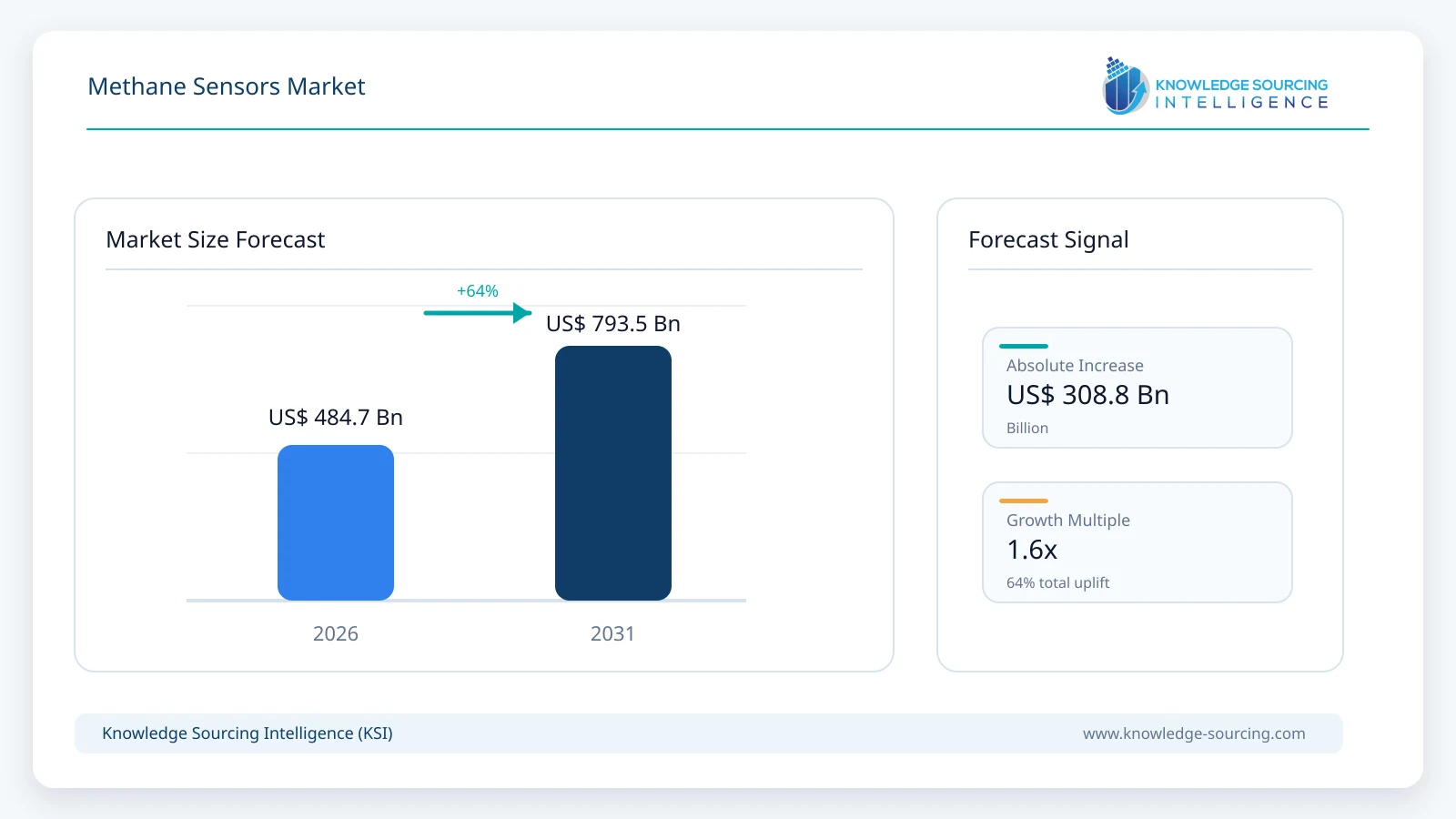
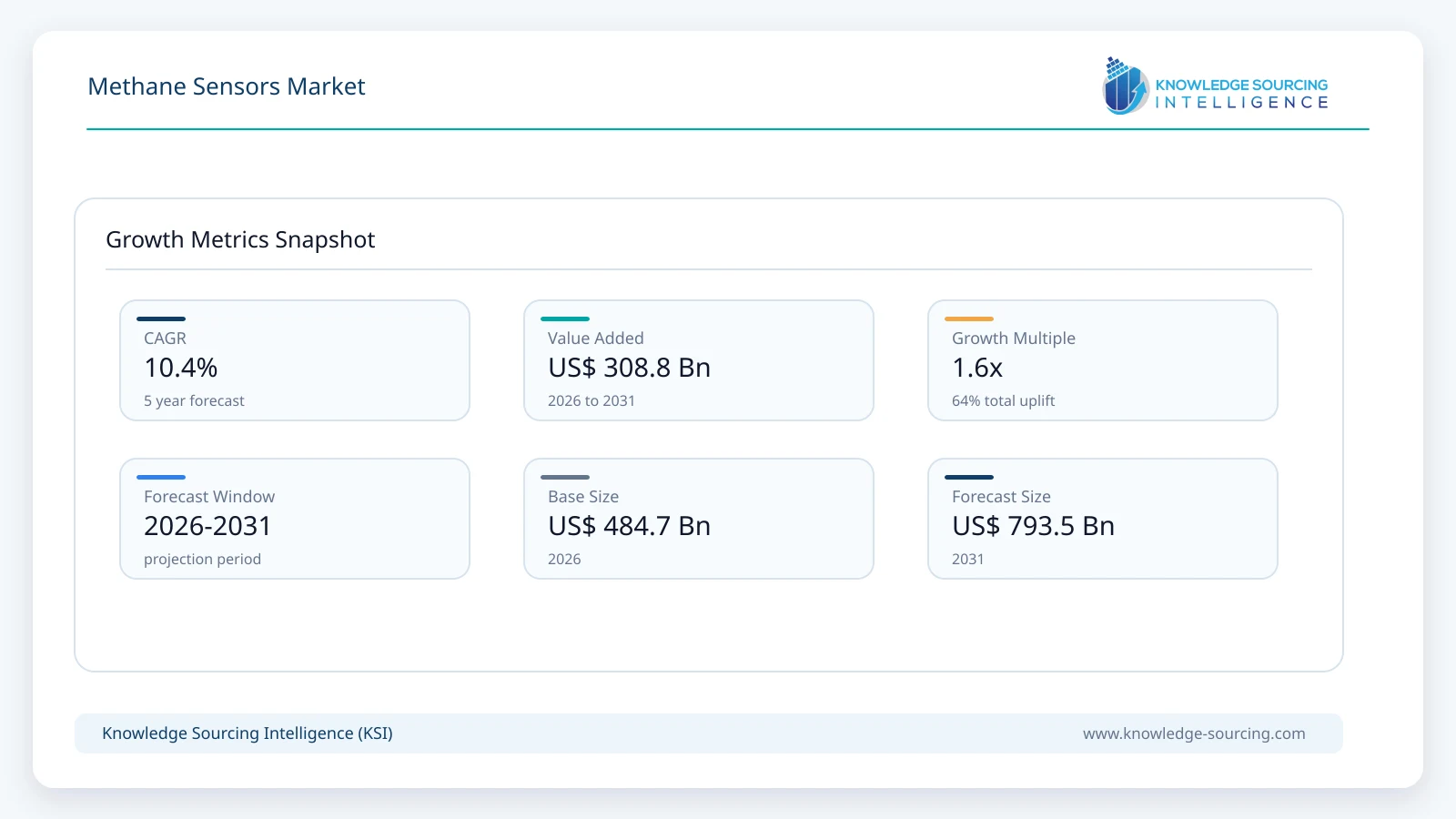
The Methane Sensors Market is forecast to grow at a CAGR of 10.4%, reaching USD 793.5 million in 2031 from USD 484.7 million in 2026.
Highlights:
- 1Methane emission regulations are increasing demand for continuous gas detection across industrial and environmental applications.
- 2Optical sensing technologies are gaining adoption where high sensitivity, low maintenance, and remote monitoring are required.
- 3Oil and gas operators remain the largest commercial buyers because leak detection has become an operational and regulatory priority.
- 4Environmental monitoring programmes and methane reduction initiatives are expanding demand beyond traditional industrial users.
- 5Product differentiation increasingly depends on detection accuracy, false alarm reduction, digital connectivity, and certification compliance.
Demand originates primarily from industries where methane presents safety, environmental, or operational risks, including upstream and midstream oil and gas, underground mining, chemical processing, waste management, wastewater treatment, agriculture, and power generation. The market encompasses fixed and portable gas detection systems, integrated monitoring platforms, and standalone sensing modules employing catalytic, infrared, semiconductor, and laser-based detection technologies.
Commercial demand has shifted beyond workplace safety toward continuous emissions monitoring as governments strengthen methane reduction policies and operators seek to minimise product losses, comply with environmental reporting requirements, and improve operational efficiency. Oil and gas producers increasingly deploy permanent monitoring networks capable of detecting small leaks before they develop into larger safety or environmental incidents. Similar procurement trends are emerging in landfill operations, wastewater treatment facilities, and agricultural methane management programmes where emissions reporting is becoming more structured.
Purchasing decisions increasingly prioritise measurement accuracy, long-term sensor stability, response time, maintenance intervals, certification, and compatibility with digital asset management platforms. Buyers also evaluate lifecycle costs rather than equipment prices alone, particularly where sensors operate continuously in remote or hazardous environments. Manufacturers therefore compete through sensing performance, diagnostics, wireless connectivity, cloud-based monitoring, and software integration instead of hardware specifications alone.
Investment patterns indicate a gradual transition from periodic gas inspections to continuous monitoring infrastructure. This shift supports recurring revenue opportunities through calibration services, software subscriptions, maintenance contracts, and replacement sensors while encouraging suppliers to expand digital monitoring capabilities alongside traditional gas detection equipment.
Key Market Indicators
Indicator | Latest Evidence | Commercial Meaning |
Global Methane Pledge participation | Over 150 countries | Expands regulatory attention on methane measurement and reporting across multiple industries. |
Oil and gas methane emissions (IEA, 2024 estimate) | Around 120 million tonnes annually | Sustains demand for continuous leak detection and emissions monitoring technologies. |
U.S. EPA methane fee implementation | Beginning under phased implementation from 2025 | Encourages operators to strengthen methane monitoring and reporting capabilities. |
EU Methane Regulation | Entered into force in 2024 | Requires expanded leak detection, repair programmes, and methane measurement across energy infrastructure. |
Key indicator: The International Energy Agency estimated that global energy operations emitted around 120 million tonnes of methane during 2023.
Commercial meaning: Energy operators increasingly require accurate continuous monitoring systems that support emissions reduction programmes and regulatory compliance.
Market Drivers
Expansion of mandatory methane leak detection and emissions reporting programmes. Regulatory agencies are moving beyond voluntary emissions reduction initiatives by introducing mandatory leak detection and repair (LDAR) requirements supported by documented measurement and reporting obligations. The U.S. Environmental Protection Agency's updated methane regulations require more frequent inspections, expanded monitoring, and improved reporting for oil and gas operations, while the European Union's Methane Regulation introduces mandatory leak detection programmes, repair timelines, and routine emissions measurement across fossil energy infrastructure. These measures increase procurement of both fixed and portable methane sensing systems, particularly among upstream producers, pipeline operators, compressor stations, and storage facilities. Equipment suppliers are responding by expanding certified optical sensing portfolios, cloud-based monitoring software, and automated reporting capabilities that simplify regulatory compliance while reducing inspection costs.
Continuous emissions monitoring is replacing periodic inspection programmes. Conventional inspection schedules often identify methane leaks only after substantial product losses or safety risks have developed. Industrial operators increasingly favour continuous methane monitoring because permanent sensor networks provide earlier leak detection, improved operational visibility, and faster maintenance response. NevadaNano, Honeywell, Dräger, MSA Safety, and several other suppliers have expanded portfolios that support continuous monitoring through wireless communication, predictive diagnostics, and remote asset management. Customer demand increasingly focuses on reducing unplanned maintenance, improving worker safety, and demonstrating measurable emissions reductions rather than meeting minimum inspection obligations alone. As monitoring systems become integrated with industrial control platforms, procurement decisions increasingly include software functionality alongside sensing performance.
Growing investment in environmental methane measurement beyond industrial safety applications. National governments, environmental agencies, research institutions, and municipal authorities are increasing methane measurement across landfills, wastewater treatment plants, agricultural operations, and environmental monitoring networks. The Global Methane Pledge has strengthened international attention on methane reduction, encouraging countries to improve emissions inventories and monitoring infrastructure. These initiatives create demand for high-sensitivity sensors capable of detecting relatively low methane concentrations over extended periods. Laser-based technologies and non-dispersive infrared sensors benefit from this trend because they offer stable long-term measurements with comparatively lower calibration requirements than conventional sensing technologies. Manufacturers are therefore expanding products intended specifically for environmental monitoring, smart infrastructure, and remote deployment rather than concentrating exclusively on industrial gas detection.
Market Restraints and Challenges
Higher lifecycle costs for high-precision optical sensing technologies. Laser-based and non-dispersive infrared (NDIR) methane sensors deliver better selectivity and lower false-alarm rates than conventional catalytic or semiconductor technologies, but they require higher initial investment and more complex system integration. Industrial users operating large monitoring networks must also budget for calibration, communication infrastructure, software licences, and periodic maintenance. Honeywell, Drägerwerk AG & Co. KGaA, and Teledyne FLIR continue to invest in optical sensing platforms because customers increasingly seek long-term measurement accuracy, although cost remains an adoption barrier for smaller operators and municipal facilities with limited capital budgets.
Harsh operating environments reduce sensor reliability and increase maintenance requirements. Methane sensors frequently operate in explosive atmospheres, underground mines, offshore installations, landfill sites, and wastewater facilities where humidity, dust, corrosive gases, vibration, and temperature fluctuations affect measurement performance. Catalytic bead sensors are susceptible to catalyst poisoning from sulphur- and silicon-containing compounds, while metal oxide semiconductor sensors may experience signal drift under prolonged exposure to changing environmental conditions. Operators therefore require frequent calibration, preventive maintenance, and sensor replacement to maintain compliance with safety standards. These maintenance requirements increase operating costs and influence purchasing decisions, particularly where thousands of sensing points are deployed across extensive industrial assets.
Fragmented regulatory and certification requirements complicate global product deployment. Methane sensor manufacturers must comply with different safety, performance, electromagnetic compatibility, and hazardous-area certification requirements across multiple jurisdictions. Products intended for oil and gas, mining, chemical processing, or environmental monitoring often require separate certifications before commercial deployment. Companies including MSA Safety, Honeywell, and Dräger maintain extensive compliance programmes to support international sales, but smaller manufacturers face higher certification costs and longer product commercialisation timelines. Regulatory variation also slows product standardisation because manufacturers frequently adapt designs for regional certification frameworks instead of producing a single globally certified platform.
Major Segment Analysis
Oil and Gas
Oil and gas represents the most commercially important application segment because methane detection directly supports worker safety, asset integrity, emissions reduction, and regulatory compliance throughout upstream, midstream, and downstream operations. Production facilities, compressor stations, pipelines, liquefied natural gas terminals, storage sites, and processing plants increasingly require continuous methane monitoring to identify fugitive emissions before they develop into operational or environmental liabilities. Buyers prioritise detection sensitivity, response speed, hazardous-area certification, low maintenance requirements, and compatibility with supervisory control and industrial automation systems.
Supplier competition increasingly centres on integrated monitoring solutions rather than standalone sensors. Honeywell, NevadaNano, MSA Safety, Drägerwerk AG & Co. KGaA, and Teledyne FLIR continue expanding fixed monitoring platforms that combine wireless communications, cloud analytics, and predictive diagnostics with high-performance sensing technologies. Compared with applications such as agriculture or landfill monitoring, oil and gas customers generally maintain stricter procurement specifications because equipment reliability directly influences regulatory compliance, production continuity, and operating risk. Consequently, this segment continues to shape product development priorities across the broader methane sensors market.
Regional Analysis
Region | Main Demand Signal | Principal Constraint |
Americas (United States) | Methane regulations for oil and gas operations, expanding continuous emissions monitoring | Higher compliance and certification costs |
Europe, Middle East and Africa (Germany, Netherlands, Others) | Tightening methane regulations and industrial decarbonisation programmes | Diverse regulatory and industrial operating requirements |
Asia-Pacific (China, Japan, South Korea, Taiwan, Others) | Industrial manufacturing, semiconductor production, and expanding gas infrastructure | Cost sensitivity and uneven adoption across industries |
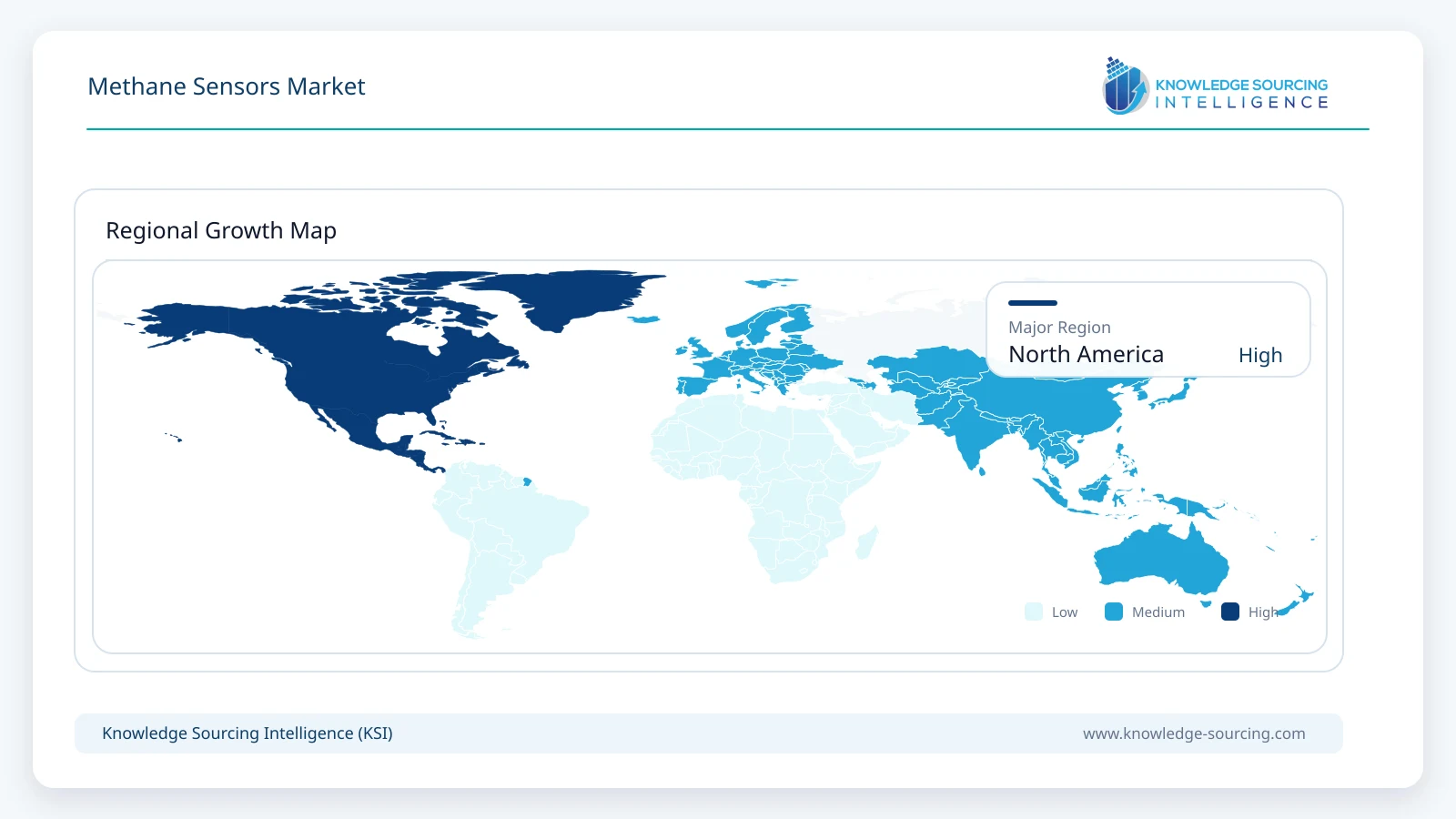
The United States remains the principal demand centre within the Americas due to its extensive oil and gas production network and strengthening methane emissions regulations. The U.S. Environmental Protection Agency has introduced updated methane standards covering new and existing oil and gas facilities, encouraging operators to expand leak detection and continuous monitoring programmes. Major pipeline operators, LNG facilities, and shale producers increasingly deploy permanent methane monitoring systems that combine fixed sensors with cloud-based reporting platforms, creating sustained demand for both high-performance sensing hardware and associated monitoring software.
Within Europe, Middle East and Africa, Germany and the Netherlands account for much of the commercial demand generated by industrial automation, chemical manufacturing, energy infrastructure, and environmental compliance programmes. The European Union Methane Regulation requires operators across the fossil energy value chain to strengthen leak detection, repair activities, and emissions measurement, encouraging broader deployment of certified methane sensing equipment. Other countries in the region continue to modernise industrial safety systems, although procurement priorities vary according to energy infrastructure, environmental policy, and industrial investment patterns.
The Asia-Pacific market is supported by expanding industrial production and increasing environmental monitoring across China, Japan, South Korea, and Taiwan. China continues investing in industrial safety and emissions management across energy, chemicals, and manufacturing sectors, while Japan emphasises highly reliable gas detection technologies for industrial facilities and energy infrastructure. South Korea and Taiwan contribute additional demand through semiconductor manufacturing, electronics production, and advanced industrial automation, where highly sensitive methane detection supports process safety and facility management. Other Asia-Pacific economies continue adopting methane monitoring technologies as industrial safety regulations and environmental compliance requirements become more stringent.
Competitive Landscape
The methane sensors market combines established industrial gas detection suppliers with specialist optical sensing companies focused on emissions monitoring. Competition is driven by measurement accuracy, sensor longevity, hazardous-area certification, software integration, and lifecycle support rather than hardware pricing alone. Honeywell International Inc., Drägerwerk AG & Co. KGaA, MSA Safety Incorporated, Teledyne FLIR LLC, NevadaNano (Honeywell International Inc.), and Edinburgh Sensors compete through broad industrial portfolios, global service networks, and certified gas detection systems, while eLichens, PemTech, Figaro Engineering Inc., Winsen Electronics Technology Co., Ltd., AIYI Technologies, and other specialist manufacturers target niche applications requiring compact, low-power, or high-sensitivity methane detection.
Competitive differentiation increasingly extends beyond sensing hardware. Suppliers are integrating wireless communications, cloud-based diagnostics, predictive maintenance, and automated leak detection and repair (LDAR) reporting into their product portfolios. Companies are also investing in calibration-free sensing technologies, lower power consumption, and remote monitoring platforms to reduce total ownership costs for industrial operators. These capabilities raise switching costs for customers because monitoring software, installed sensor networks, and compliance reporting systems become closely integrated with plant operations, supporting longer-term customer relationships and recurring service revenue.
Recent Developments
July 2026 – Pergam-Suisse and Xer Technologies integrate FALCON Plus methane sensor with X8 PRO drone: Pergam-Suisse integrated its FALCON Plus infrared laser methane sensor with Xer Technologies' X8 PRO UAV, enabling long-range autonomous methane leak detection, emissions quantification and EU-compliant infrastructure inspections.
March 2026 – Honeywell launches NDIR Hydrocarbon Gas Sensor: Honeywell introduced its non-dispersive infrared (NDIR) Hydrocarbon Gas Sensor for detecting methane, propane and butane, delivering high accuracy, low maintenance and improved worker safety across industrial, mining and oil-and-gas facilities.
February 2026 – Zeitview acquires Insight M: Zeitview acquired methane detection specialist Insight M, combining advanced methane sensing, emissions analytics and AI-powered asset intelligence to strengthen monitoring solutions for oil, gas and critical infrastructure operators worldwide.
October 2025 – Sensirion’s Kuva methane monitoring camera receives US EPA approval: Sensirion Connected Solutions announced US EPA approval for its Kuva continuous methane monitoring camera, validating the image-based methane sensing platform for regulatory compliance and continuous emissions monitoring applications.
Regulatory and Policy Environment
Methane reduction policies are becoming a direct commercial driver for sensor deployment rather than simply influencing broader environmental strategies. The United States Environmental Protection Agency has strengthened methane standards for the oil and gas sector while implementing the Methane Emissions Reduction Program, requiring operators to improve emissions measurement, leak detection, and reporting. Similarly, the European Union Methane Regulation establishes mandatory leak detection and repair programmes, routine inspections, and emissions reporting obligations for energy infrastructure. These requirements encourage wider adoption of continuous methane monitoring systems instead of periodic manual inspections.
International initiatives such as the Global Methane Pledge are encouraging governments to improve emissions inventories and strengthen monitoring frameworks across energy, agriculture, and waste sectors. Although implementation varies between countries, regulatory direction consistently favours more frequent measurement, improved reporting quality, and higher confidence in emissions data. Manufacturers therefore continue investing in certified sensing technologies, digital reporting platforms, and integrated monitoring solutions that simplify compliance while supporting operational safety and environmental performance.
Outlook and Strategic Implications
Demand for methane sensors during the 2026-2031 period will increasingly depend on regulatory enforcement, industrial digitalisation, and broader adoption of continuous emissions monitoring rather than traditional workplace safety requirements alone. Oil and gas operators are expected to remain the primary revenue source, although landfill operators, wastewater utilities, agriculture, and environmental monitoring agencies are likely to expand procurement as methane reporting obligations become more comprehensive. Optical sensing technologies, particularly NDIR and laser-based systems, are expected to capture a larger share of new installations because they provide improved selectivity, longer operating life, and lower maintenance requirements than several conventional sensing technologies.
Strategic priorities across the value chain are expected to include:
Expansion of continuous monitoring platforms integrating sensing hardware, cloud analytics, and automated compliance reporting.
Investment in calibration-free, lower-power, and higher-sensitivity sensing technologies to reduce lifecycle operating costs.
Greater localisation of manufacturing and service capabilities to meet regional certification and customer support requirements.
Stronger collaboration between sensor manufacturers, industrial automation providers, and environmental software developers to deliver integrated methane management solutions.
As purchasing decisions increasingly emphasise lifecycle value instead of equipment cost alone, suppliers capable of combining reliable sensing performance with digital services, regulatory compliance expertise, and long-term technical support are expected to strengthen their competitive position during the forecast period.
Methane Sensors Market Scope
| Report Metric | Details |
|---|---|
| Total Market Size in 2026 | USD 484.7 million |
| Total Market Size in 2031 | USD 793.5 million |
| Forecast Unit | Million |
| Growth Rate | 10.4% |
| Study Period | 2021 to 2031 |
| Historical Data | 2021 to 2024 |
| Base Year | 2025 |
| Forecast Period | 2026 – 2031 |
| Segmentation | Type, Detection Range, Application, Geography |
| Companies |
|
Market Segmentation
By Type
Catalytic Bead Sensors
Non-Dispersive Infrared (NDIR) Sensors
Metal Oxide Semiconductor (MOS) Sensors
Laser-based Sensors (TDLAS/Open-path Laser)
By Detection Range
Up to 1,000 ppm
1,001–10,000 ppm
Above 10,000 ppm
By Application
Oil and Gas
Mining
Landfills
Wastewater Treatment
Agriculture and Livestock
Chemical and Petrochemical
Power Generation
Environmental Monitoring
Semiconductor Manufacturing
Others
By Geography
Americas
United States
Europe, Middle East, and Africa
Germany
Netherlands
Others
Asia-Pacific
China
Japan
South Korea
Taiwan
Others
Table of Contents
1. INTRODUCTION
1.1. Market Overview
1.2. Market Definition
1.3. Scope of the Study
1.4. Market Segmentation
1.5. Currency
1.6. Assumptions
1.7. Base and Forecast Years Timeline
1.8. Key benefits for the stakeholders
2. RESEARCH METHODOLOGY
2.1. Research Design
2.2. Research Process
3. EXECUTIVE SUMMARY
3.1. Key Findings
4. MARKET DYNAMICS
4.1. Market Drivers
4.2. Market Restraints
4.3. Porter’s Five Forces Analysis
4.3.1. Bargaining Power of Suppliers
4.3.2. Bargaining Power of Buyers
4.3.3. The Threat of New Entrants
4.3.4. Threat of Substitutes
4.3.5. Competitive Rivalry in the Industry
4.4. Industry Value Chain Analysis
4.5. Analyst View
5. METHANE SENSOR MARKET BY TYPE
5.1. Introduction
5.2. Catalytic Bead Sensors
5.3. Non-Dispersive Infrared Sensors
5.4. Metal Oxide Semiconductor (MOS) Sensors
5.5. Laser-based Sensors (TDLAS/Open-path Laser)
6. METHANE SENSOR MARKET BY DETECTION RANGE
6.1. Introduction
6.2. Up to 1,000 ppm
6.3. 1,001–10,000 ppm
6.4. Above 10,000 ppm
7. METHANE SENSOR MARKET BY APPLICATION
7.1. Introduction
7.2. Oil and Gas
7.3. Mining
7.4. Landfills
7.5. Wastewater Treatment
7.6. Agriculture and Livestock
7.7. Chemical and Petrochemical
7.8. Power Generation
7.9. Environmental Monitoring
7.10. Semiconductor Manufacturing
7.11. Others
8. METHANE SENSOR MARKET BY GEOGRAPHY
8.1. Introduction
8.2. Americas
8.2.1. US
8.3. Europe, Middle East and Africa
8.3.1. Germany
8.3.2. Netherlands
8.3.3. Others
8.4. Asia-Pacific
8.4.1. China
8.4.2. Japan
8.4.3. South Korea
8.4.4. Taiwan
8.4.5. Others
9. COMPETITIVE ENVIRONMENT AND ANALYSIS
9.1. Major Players and Strategy Analysis
9.2. Market Share Analysis
9.3. Mergers, Acquisitions, Agreements, and Collaborations
9.4. Competitive Dashboard
10. COMPANY PROFILES
10.1. eLichens
10.2. Figaro Engineering Inc.
10.3. NevadaNano (Honeywell International Inc)
10.4. R.C. System Inc
10.5. Winsen Electronics Technology Co., Ltd.
10.6. Toshniwal Sensing Devices Pvt Ltd.
10.7. Drägerwerk AG & Co. KGaA
10.8. Edinburgh Sensors
10.9. Honeywell International Inc.
10.10. MSA Safety Incorporated
10.11. Amphenol Sensors
10.12. Teledyne FLIR LLC
10.13. PemTech
10.14. Global Detection Systems Corp
10.15. AIYI Technologies
LIST OF FIGURES
LIST OF TABLES
Navigate
Trusted by the world's leading organizations











