
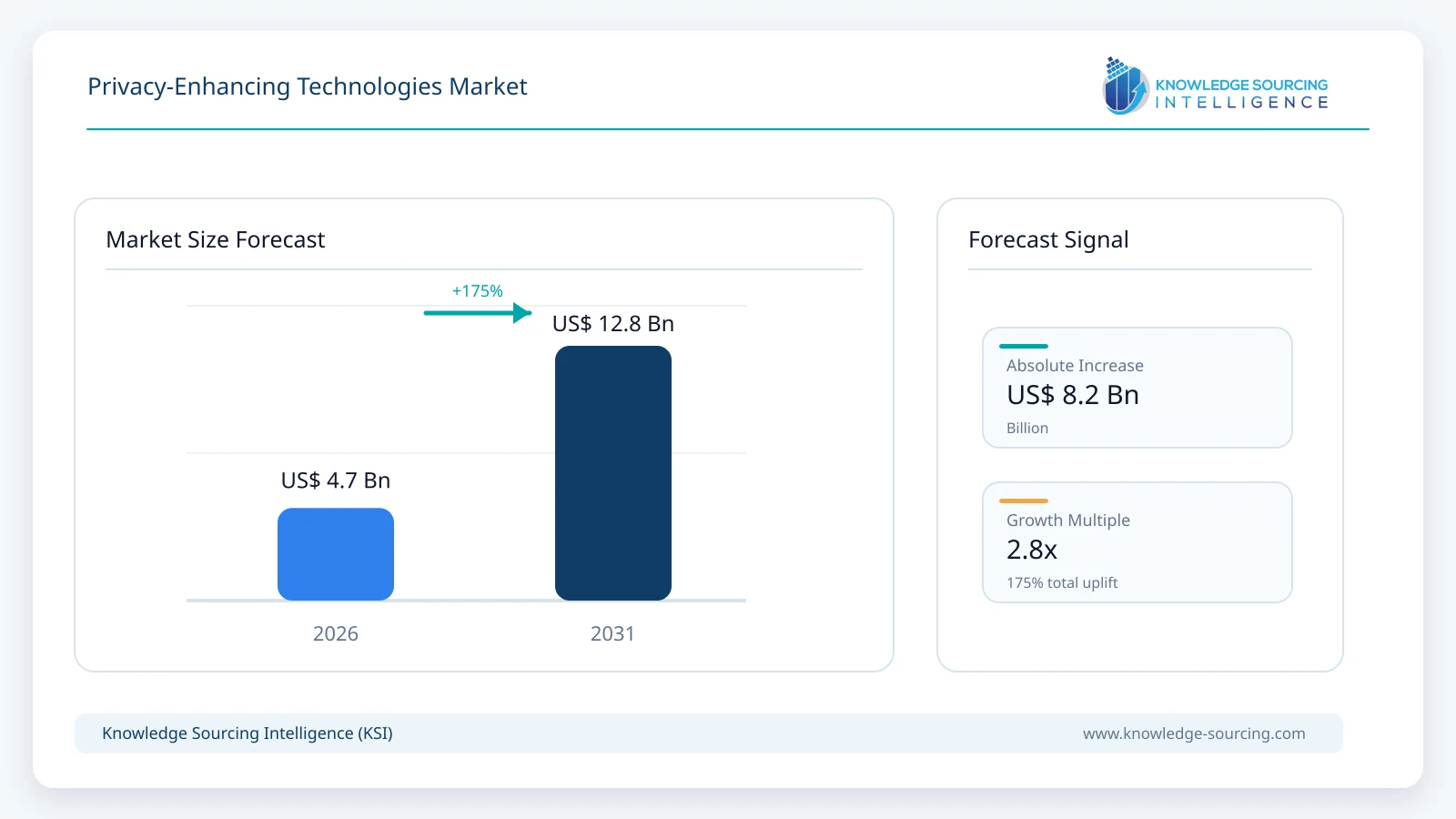
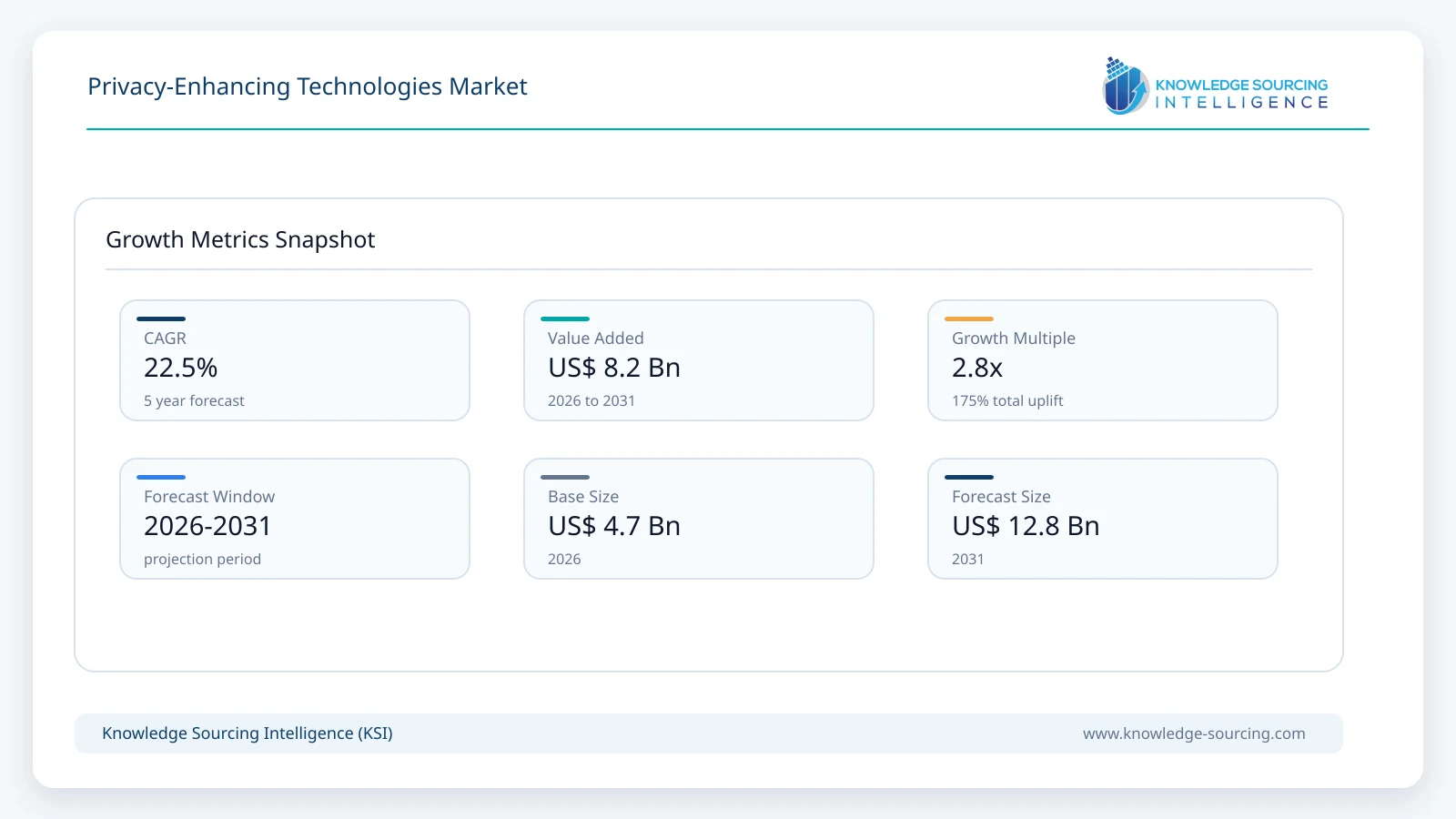
The Privacy-Enhancing Technologies Market is forecast to grow at a CAGR of 22.5%, reaching USD 12.8 billion in 2031 from USD 4.65 billion in 2026.
Highlights:
- 1Technology leaderHomomorphic Encryption represents 20.0% of the Privacy-Enhancing Technologies Market in 2026, with a market value of USD 0.93 billion, reflecting its growing role in privacy-preserving data processing.
- 2Deployment momentumCloud-Based solutions are set to expand at a CAGR of 24.2% from 2026 to 2031, making this the fastest-growing deployment segment as organizations increasingly adopt scalable privacy technologies.
- 32031 market positionThe Cloud-Based segment is projected to reach USD 7.42 billion by 2031, increasing its market share to 58.0%, supported by rising demand for secure cloud data processing.
- 4Regional strengthNorth America leads geographically, valued at USD 1.81 billion in 2026 and representing 39.0% of the market, driven by strong adoption of privacy-focused technologies across regulated industries.
PETs include a group of techniques which enable organizations to collect, process, share and analyze sensitive data without putting individuals at risk of exposure, nor compromising their confidentiality, throughout the computation process. Some of the most prominent techniques are homomorphic encryption, which enables computation over encrypted data without decoding it; secure multi-party computation, which allows multiple parties to compute a function on multiple datasets without revealing the individual party data to other parties; differential privacy, which injects calibrated statistical noise into query result sets to prevent re-identification of individuals in a dataset; and zero-knowledge proofs, which enable one party to prove a fact is true without revealing the underlying data to the other party. Federated learning and trusted execution environments (TEEs) are complementary technologies that can be employed to train machine learning models across decentralized data sources without consolidating the raw data, and to protect data during processing with hardware-isolated enclaves.
The market for software accounts for the highest percentage, while the cryptographic technologies market has the highest market share within the technology segments, indicating that PETs are in the main delivered as software libraries, cloud services and platform features, not as stand-alone hardware appliances. Cloud-based deployment is the dominant choice, with the close coupling of the confidential computing enclaves provided by the major cloud providers and enterprises' general migration to sensitive-data workloads run from the cloud; edge and IoT deployment is the fastest-growing deployment model as privacy-preserving computation moves closer to the point of data collection.
Market Dynamics
Market Drivers
Regulated industries are increasingly required to modernize cryptographic infrastructure years before the arrival of quantum computers that could break traditional cryptography, due to the deadline to implement quantum-safe cryptographic algorithms, set by PCI-DSS 4.0, and the recent adoption of post-quantum cryptographic standards by countries.
Propelling organisations to implement cryptographically enforced protections, in addition to data governance via policy, is the continued enforcement of GDPR, the EU Digital Services Act, sector-specific regulations like HIPAA in healthcare, and a continuing fragmented landscape of U.S. state privacy laws.
The increasing adoption of AI-driven workloads and machine learning applications that require sharing data across organizational or geographic boundaries are creating a demand for privacy-preserving collaboration models like federated learning, secure multi-party computation, and confidential computing for collaborative analytics without sharing sensitive raw data.
Market Restraints & Opportunities
Notably, the historical performance overhead of fully homomorphic encryption and other cryptographic PETs compared to clear-text computation, lack of engineering resources with applied cryptography skill and complexity of incorporating PETs into existing data pipelines are significant constraints, especially for organizations that lack a dedicated cryptography team.
However, the acceleration of hardware for confidential computing, escalating VC funding for PET experts, and strategic partnerships between chipmakers, cloud hyperscalers, and PET vendors are all gradually closing the gap in terms of cost and complexity. As quantum-safe compliance requirements continue to be extended, and the demand for privacy-preserving collaboration among enterprises with AI grows, the potential is significant in the long run, especially for workloads in the BFSI, healthcare, and government sectors.
Market Segmentation
By Technology: Homomorphic Encryption
Homomorphic encryption constitutes the largest technology segment in cryptographic PETs, enabling computation directly on encrypted data and supporting BFSI and healthcare applications that analyze sensitive information without decrypting it. The segment is projected to account for 21.1% share by 2031, reaching a segment value of USD 2.70 billion at a CAGR of 23.8%.
Microsoft integrates confidential computing and homomorphic encryption capabilities into its Azure cloud platform, supporting enterprise workloads that require enhanced data protection during processing.
IBM provides homomorphic encryption toolkits and confidential computing solutions for regulated businesses seeking to analyze sensitive information while maintaining strong cryptographic confidentiality.
Google supports privacy-preserving analytics through its cloud platform, combining confidential computing infrastructure and differential privacy tools for large-scale data processing.
By Technology: Secure Multi-Party Computation & Federated Learning
Secure multi-party computation and federated learning are emerging as highly popular solutions for financial institutions and healthcare networks that must undertake joint analytics without exposing raw data in a central repository. The segment is projected to grow from USD 0.84 billion in 2026 to USD 2.16 billion by 2031, at a CAGR of 20.8%.
Duality Technologies offers secure computation and analytics platforms that facilitate collaboration between organizations on sensitive data while protecting underlying data records.
Intel provides confidential computing hardware, including processor capabilities for trusted execution environments, which provides the hardware infrastructure supporting numerous commercial confidential computing deployments.
By End-User Vertical: BFSI
The banking, financial services, and insurance industry is the leading user of privacy-enhancing technologies, driven by cross-institution fraud detection, anti-money laundering data sharing, and stringent regulatory requirements for customer data confidentiality. With a 26.3% share in 2031, the sector is expected to maintain its strong position.
The retail and e-commerce industry is anticipated to record the highest growth rate, supported by privacy-aware personalized recommendations, stricter consumer privacy expectations, and growing requirements for privacy measurement in digital advertising.
Regional Analysis
North America Market Analysis
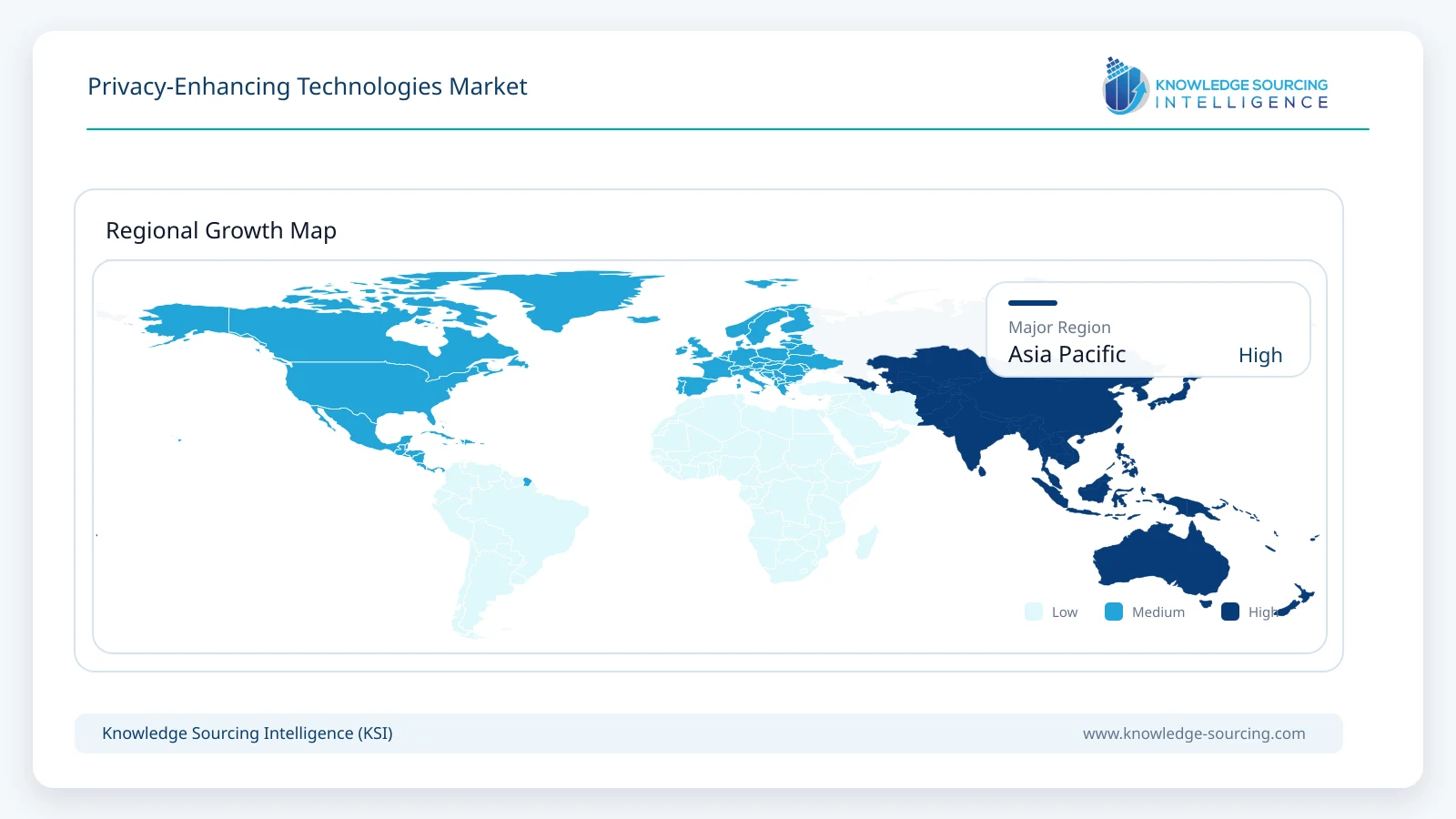
The North American region accounts for the highest share, representing 36.3% in 2031, supported by its strong concentration of cloud and PET technology vendors, robust enterprise cybersecurity spending, and expanding federal compliance mandates such as FedRAMP-High.
Europe Market Analysis
The GDPR and the EU Digital Services Act influence the market in Europe, and the financial sector and health care organizations are the top adopters of cryptographically enforced privacy protections.
Asia-Pacific Market Analysis
The Asia-Pacific region is expanding rapidly as national data protection laws evolve, while financial services and technology firms across China, India, Japan, and South Korea increasingly adopt privacy-first data collaboration, with the segment recording a 25.7% CAGR.
Middle East and Africa Market Analysis
Emerging investment in privacy-enhancing technologies in the Middle East and Africa is driven by digital-government projects and modernization of the financial sector, with the UAE and Saudi Arabia leading the way.
South America Market Analysis
The region is expected to see the highest growth with South America's data protection policies encouraging increasing enterprise privacy-preserving data infrastructure investments.
Recent Developments
September 2026: Google Cloud made Intel TDX support generally available on C3-standard LSSD Confidential VMs, strengthening hardware-based protection for sensitive data processed in cloud environments.
August 2026: IBM and Duality Technologies announced Sovereign Core integration with privacy-enhancing technologies, enabling organizations to analyze sensitive distributed data without exposing underlying raw information.
August 2026: Google Cloud made its accelerator-optimized G4-standard-48 Confidential VM generally available, combining AMD SEV and NVIDIA RTX PRO 6000 for protected AI and machine-learning workloads.
July 2026: AWS announced AMD SEV-SNP support for EC2 Dedicated Hosts, allowing customers to run confidential computing workloads on physically dedicated servers with hardware-based data-in-use protection.
June 2026: Google Cloud announced expanded Confidential Computing capabilities for AI, enabling confidential inference and fine-tuning with hardware-based trusted execution environments and verifiable privacy protections at global scale.
List of Companies
Microsoft
IBM
Google
Intel
Duality Technologies
Zama
Inpher
Privitar
Enveil
TripleBlind
Competitive Landscape
Microsoft
Microsoft has built in and embedded confidential computing, homomorphic encryption, and differential-privacy features throughout its Azure cloud platform, to enable enterprise and government workloads to process data with cryptographically enforced data protection.
IBM
IBM offers several toolkits and services for homomorphic encryption, designed to be used by highly regulated industries to analyze sensitive data without compromising the cryptographic assurances of confidentiality.
Duality Technologies
Secure computation and privacy-enhancing analytics are the core strengths of Duality Technologies, allowing businesses in the BFSI and healthcare industries to share sensitive data without compromising underlying records.
Analyst View
As quantum-safe data migration deadlines and privacy regulation become increasingly strict and begin to fall on the same migration timeline, the Privacy-Enhancing Technologies market is shifting from the niche compliance tool for the most regulated industries to a key piece of the enterprise data infrastructure. The performance disparity between PETs and HWs, which historically hindered PETs, is now coming down as hardware accelerators continue to advance, and strategic partnerships among chip vendors, cloud hyperscalers and specialist vendors are also compressing deployment times. Vendors that combine cryptographic depth, cloud-native deployment simplicity, and clear alignment with quantum-safe compliance deadlines are best positioned to lead the next phase of market growth.
Privacy-Enhancing Technologies Market Scope:
| Report Metric | Details |
|---|---|
| Total Market Size in 2026 | USD 4.65 billion |
| Total Market Size in 2031 | USD 12.8 billion |
| Forecast Unit | Billion |
| Growth Rate | 22.5% |
| Study Period | 2021 to 2031 |
| Historical Data | 2021 to 2024 |
| Base Year | 2025 |
| Forecast Period | 2026 – 2031 |
| Segmentation | Technology, Deployment, End-User Vertical, Geography |
| Companies |
|
Market Segmentation
By Technology
Homomorphic Encryption
Differential Privacy
Secure Multi-Party Computation
Zero-Knowledge Proofs
Federated Learning & Trusted Execution Environments
Others
By Deployment
Cloud-Based
On-Premise
Edge & IoT
By End-User Vertical
BFSI
Healthcare
Government & Public Sector
Retail & E-Commerce
Technology & Telecom
Others
By Geography
North America
USA
Canada
Mexico
Europe
Germany
France
United Kingdom
Others
Asia Pacific
China
India
Japan
South Korea
Others
Middle East and Africa
UAE
Saudi Arabia
Others
South America
Brazil
Others
Table of Contents
1. EXECUTIVE SUMMARY
2. MARKET SNAPSHOT
2.1. Market Overview
2.2. Market Definition
2.3. Scope of the Study
2.4. Market Segmentation
3. BUSINESS LANDSCAPE
3.1. Market Drivers
3.2. Market Restraints
3.3. Market Opportunities
3.4. Porter's Five Forces Analysis
3.5. Industry Value Chain Analysis
3.6. Policies and Regulations
3.7. Strategic Recommendations
4. TECHNOLOGICAL OUTLOOK
4.1. Homomorphic Encryption
4.2. Secure Multi-Party Computation
4.3. Federated Learning
4.4. Post-Quantum Cryptography Integration
5. PRIVACY-ENHANCING TECHNOLOGIES MARKET BY TECHNOLOGY
5.1. Introduction
5.2. Homomorphic Encryption
5.3. Differential Privacy
5.4. Secure Multi-Party Computation
5.5. Zero-Knowledge Proofs
5.6. Federated Learning & Trusted Execution Environments
5.7. Others
6. PRIVACY-ENHANCING TECHNOLOGIES MARKET BY DEPLOYMENT
6.1. Introduction
6.2. Cloud-Based
6.3. On-Premise
6.4. Edge & IoT
7. PRIVACY-ENHANCING TECHNOLOGIES MARKET BY END-USER VERTICAL
7.1. Introduction
7.2. BFSI
7.3. Healthcare
7.4. Government & Public Sector
7.5. Retail & E-Commerce
7.6. Technology & Telecom
7.7. Others
8. PRIVACY-ENHANCING TECHNOLOGIES MARKET BY GEOGRAPHY
8.1. Introduction
8.2. North America
8.2.1. USA
8.2.2. Canada
8.2.3. Mexico
8.3. Europe
8.3.1. Germany
8.3.2. France
8.3.3. United Kingdom
8.3.4. Others
8.4. Asia Pacific
8.4.1. China
8.4.2. India
8.4.3. Japan
8.4.4. South Korea
8.4.5. Others
8.5. Middle East and Africa
8.5.1. UAE
8.5.2. Saudi Arabia
8.5.3. Others
8.6. South America
8.6.1. Brazil
8.6.2. Others
9. COMPETITIVE ENVIRONMENT AND ANALYSIS
9.1. Major Players and Strategy Analysis
9.2. Market Share Analysis
9.3. Mergers, Acquisitions, Agreements, and Collaborations
9.4. Competitive Dashboard
10. COMPANY PROFILES
10.1. Microsoft
10.2. IBM
10.3. Google
10.4. Intel
10.5. Duality Technologies
10.6. Zama
10.7. Inpher
10.8. Privitar
10.9. Enveil
10.10. TripleBlind
11. APPENDIX
11.1. Currency
11.2. Assumptions
11.3. Base and Forecast Years Timeline
11.4. Key Benefits for the Stakeholders
11.5. Research Methodology
11.6. Abbreviations
Navigate
Trusted by the world's leading organizations











