
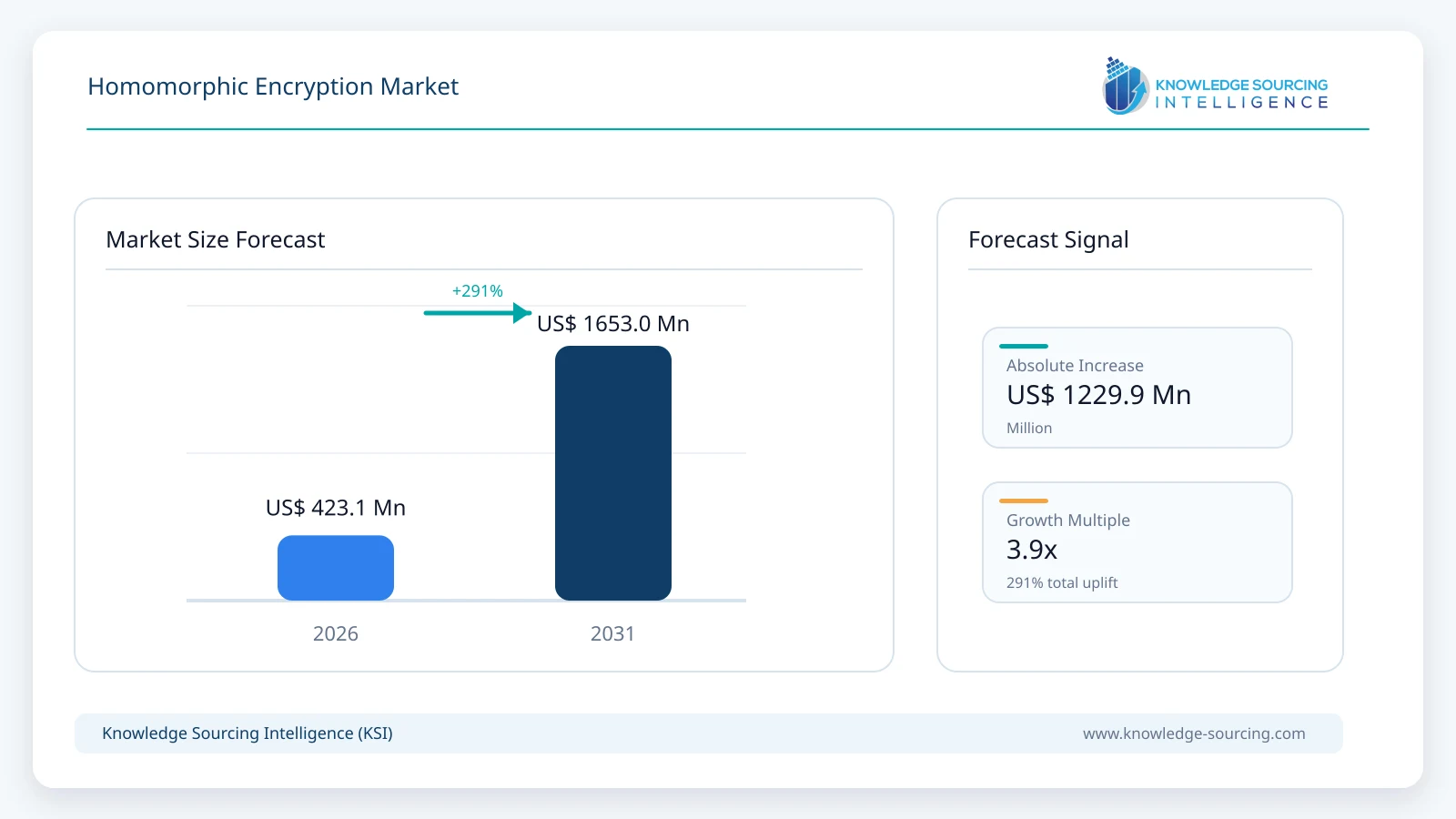
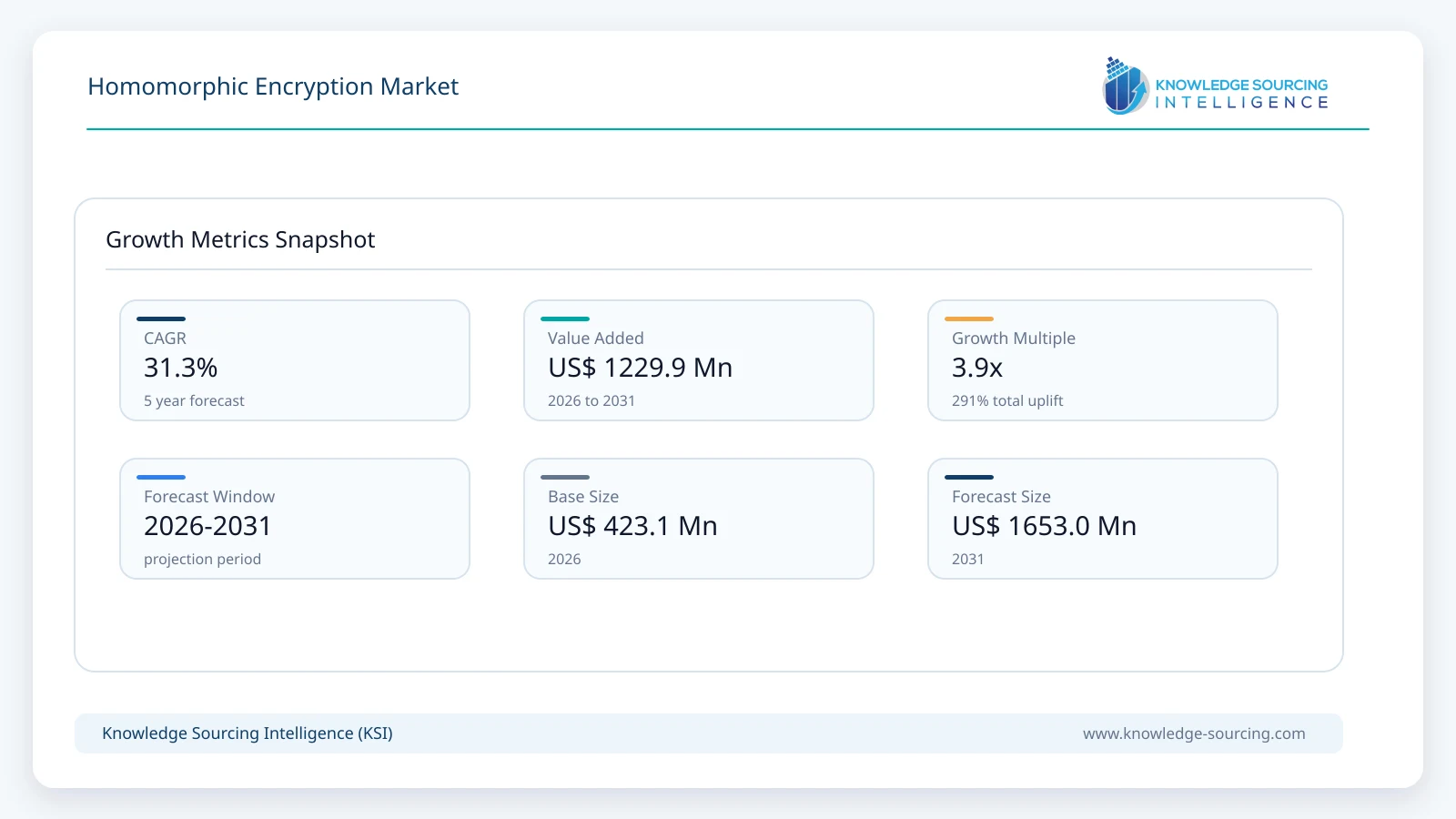
The Homomorphic Encryption market is forecast to grow at a CAGR of 31.3%, reaching USD 1,653.0 million in 2031 from USD 423.1 million in 2026.
Highlights:
- 1As computations are improved, arbitrary computations of encrypted data are becoming more feasible and practical for production workloads in AI and analytics, marking the biggest and most rapidly expanding technique segment, fully homomorphic encryption (FHE).
- 2NIST's upcoming July 2026 update of its overview of privacy-enhancing cryptography and the continuous standardisation workshops are setting the technical landscape that will guide enterprise and government procurement in the next several years.
- 3BFSI is a major end-user segment with the use cases of encrypted fraud-detection and cross-institution analytics, whereas healthcare adoption is picking up in the APAC region as cloud integration grows.
- 4The US is one of the highest-impact market players, with a cluster of cloud providers, cybersecurity vendors and nation states adopting homomorphic encryption in their encrypted intelligence activities.
Homomorphic encryption is a type of cryptographic system where computations can be executed directly on the encrypted data, producing an encrypted result which, when decrypted, will be the same as that of the same computations performed on the unencrypted data. This feature enables organisations to use untrusted or semi-trusted compute infrastructure, such as public cloud operations, without ever exposing the underlying plaintext. It ranges from partial homomorphic encryption, which allows only one type of operation (addition, multiplication, etc.) in the encrypted data, is moderately simple and can be used with less compute power, to “full” homomorphic encryption (FHE), which enables arbitrary computation on encrypted data, but has a significantly higher computational cost. In 2026, it is expected that the use of partially homomorphic encryption will be the market share of approximately half of the market, due to the fact that it suits well-defined use cases like encrypted search and secure aggregation, whereas the fully homomorphic encryption market is projected to grow the fastest and largest by component depending on the growing efficiency of computations and the increasing need for arbitrary computation on encrypted data in the context of the growing AI and machine learning workloads.
By component, software is the biggest part of the market, as software-based cryptographic libraries, SDKs and cloud-integrated services are increasingly popular ways of delivering the technology, as opposed to standalone, hardware-based appliances; hardware acceleration, including the specialized processors and FPGA-based accelerators that can reduce the computational burden of FHE, is a growing space of vendor investment. North America, and the US in particular, is the largest region, as it is home to large cloud providers, cybersecurity vendors, and research organizations actively working on developing encrypted computing technologies, and government national security agencies take note, they too are significant adopters and are now using homomorphic encryption to safeguard their encrypted intelligence operations.
Market Dynamics
Market Drivers
The tightening of Data Privacy Regulation across Jurisdictions, for instance,s GDPR, HIPAA, CCPA and new legislations like the Digital Personal Data Protection Rules in India are pushing companies towards the cryptographic frame of protection that limit their legal liability, yet empower them to still process and analyse information.
AI and ML workloads that process sensitive financial, health, and personal data continues to grow, and this is fueling the demand for encrypted computation which enables models to train and infer on protected data, but without exposing that data to the infrastructure or people performing the computation.
Continued improvements in the efficiency of FHE algorithms, hardware acceleration, and open-source libraries like OpenFHE are reducing the barriers to broad adoption of homomorphic encryption in terms of performance and expertise.
Market Restraints & Opportunities
Computational overhead still poses the biggest barrier, even full homomorphic encryption is much slower than computation in clear text, and there is a shortage of engineers with applied cryptography skills to drive organizations into going from pilot to production deployment in a reasonable amount of time.
However, continued investments in hardware acceleration, increased usage by governments and national security agencies for encrypted intelligence gathering, and the increase in cooperation between chip manufacturers, cloud hyperscalers and specialist vendors is slowly eroding the performance and expertise gap. The growing commitments from enterprises to incorporate homomorphic encryption in data protection strategies are huge long-term opportunities, especially in workloads like BFSI, healthcare and government workloads.
Competitive Landscape
April 2026: DESILO, a pioneering deep-tech company specializing in privacy-enhancing technologies, has announced the release of the world's first Fully Homomorphic Encryption (FHE) library to seamlessly integrate the 5th-generation 'GL Scheme (Gentry-Lee Scheme)'. This breakthrough marks a monumental step forward in making 'Private AI', the ability to train and run advanced AI models directly on encrypted data, a practical reality.
August 2025: CryptoLab, a leader in fully homomorphic encryption cryptography solutions, and UClone, a pioneer in personalized AI, announced a collaboration to integrate CryptoLab's Encrypted Vector Search (ES2) for Retrieval-Augmented Generation (RAG) into UClone's AI agent platform. This partnership marks the first time fully homomorphic encryption is being used to secure AI agents, ensuring unparalleled data privacy and security for users.
Market Segmentation
By Component: Software
Software holds the largest component share, reflecting the delivery of homomorphic encryption predominantly as cryptographic libraries, SDKs, and cloud-integrated services rather than standalone hardware.
Microsoft integrates homomorphic encryption capabilities into its Azure confidential computing offerings, supporting enterprise workloads that require cryptographically enforced data protection during processing.
IBM offers homomorphic encryption toolkits aimed at highly regulated industries seeking to analyze sensitive data while maintaining cryptographic guarantees of confidentiality throughout the computation lifecycle.
Google provides confidential computing infrastructure that complements homomorphic encryption workloads as part of its broader cloud privacy-preservation portfolio.
By Technique: Fully Homomorphic Encryption (FHE)
Fully homomorphic encryption is the largest and fastest-growing technique segment as continued efficiency gains make arbitrary computation over encrypted data increasingly viable for AI, machine learning, and shared-analytics use cases that partial schemes cannot support.
Zama develops open-source fully homomorphic encryption tooling aimed at making encrypted computation accessible to a broader developer base without requiring deep cryptography expertise.
Duality Technologies provides secure computation platforms built on homomorphic encryption and related techniques, enabling organizations to collaborate on sensitive data without exposing underlying records.
By End-User Vertical: BFSI
The banking, financial services, and insurance sector represents a leading end-user vertical, driven by encrypted fraud-detection consortia, secure cross-institution analytics, and stringent regulatory requirements around customer data confidentiality.
Growing adoption in healthcare, particularly across Asia-Pacific as cloud integration expands, is expected to register strong vertical growth as hospital networks and research organizations seek to analyze patient data without exposing protected health information.
Regional Analysis
North America Market Analysis
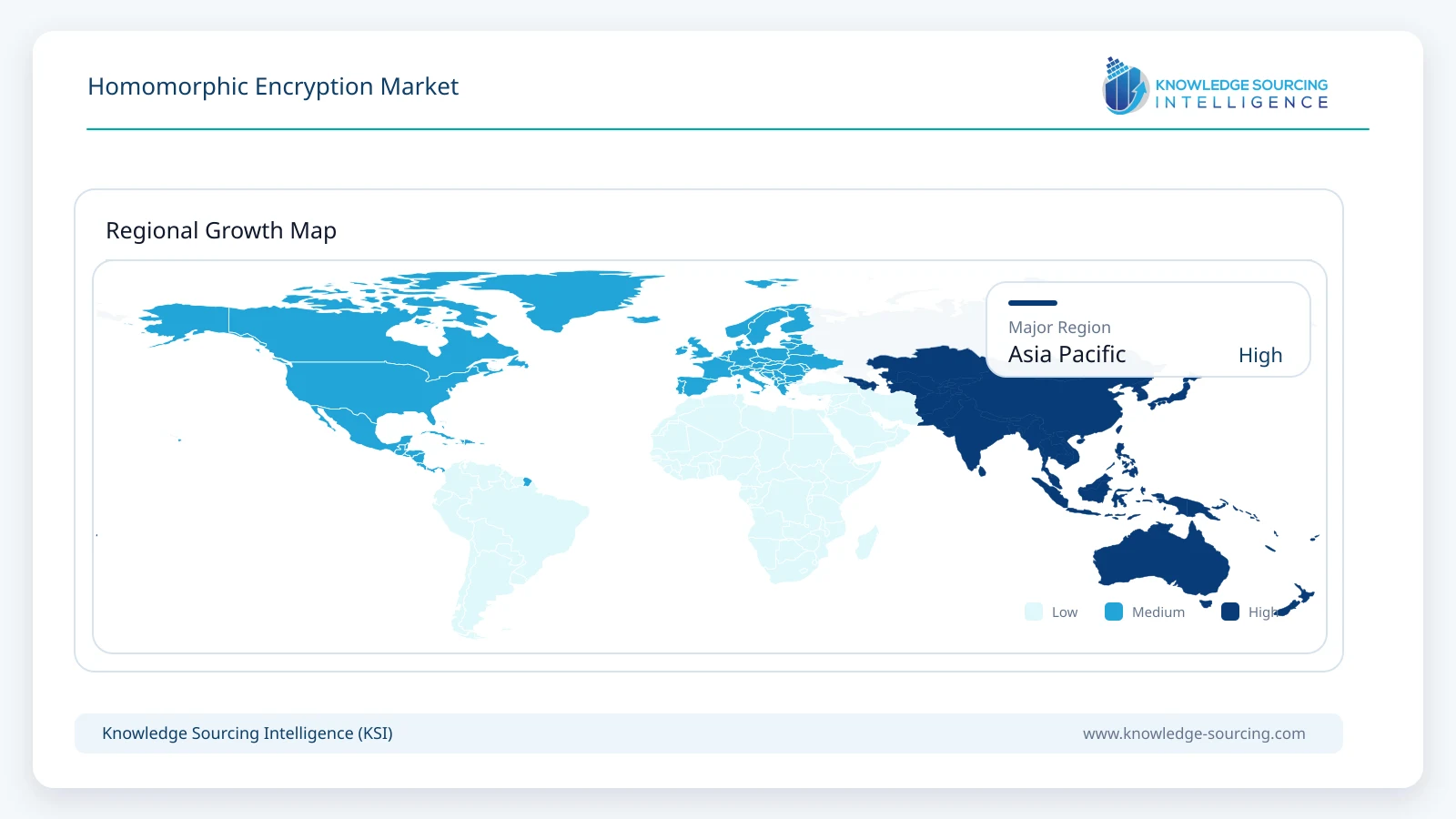
North America holds the largest regional share, led by the United States, which benefits from a dense concentration of large cloud providers, cybersecurity vendors, and research organizations actively advancing encrypted computing technologies.
Europe Market Analysis
Europe's market is shaped by GDPR compliance requirements and active regulator-led testing routes, such as those offered by France's CNIL, that give technology teams a structured path for deploying homomorphic schemes across cloud analytics and sensitive data environments.
Asia-Pacific Market Analysis
Asia-Pacific is expanding steadily, with healthcare cloud integration and newly notified data protection frameworks such as India's Digital Personal Data Protection Rules driving enterprise adoption across the region.
Middle East and Africa Market Analysis
The Middle East and Africa are seeing early-stage investment in homomorphic encryption tied to government digital-transformation and financial-sector modernization initiatives.
South America Market Analysis
South America represents an emerging market for homomorphic encryption adoption, with growing enterprise interest in cryptographically enforced data protection in Brazil and other regional markets.
List of Companies
IBM
Microsoft
Google
Zama
Duality Technologies
Inpher
Enveil
CryptoExperts
Galois
Huawei
Competitive Landscape
IBM
IBM provides homomorphic encryption toolkits and confidential computing services aimed at highly regulated industries, helping organizations analyze sensitive data while preserving cryptographic guarantees of confidentiality.
Microsoft
Microsoft integrates homomorphic encryption and confidential computing capabilities across its Azure cloud platform, supporting enterprise and government workloads that require cryptographically enforced data protection during processing.
Duality Technologies
Duality Technologies specializes in secure computation built on homomorphic encryption and related privacy-enhancing techniques, and jointly enhanced the open-source OpenFHE library with Intel in August 2025 to broaden practical adoption.
Analyst View
The Homomorphic Encryption market is transitioning from a research-grade cryptographic curiosity into a commercially viable data-protection layer, as efficiency improvements, open-source tooling, and standards development from bodies like NIST converge on the same adoption timeline. Computational overhead remains the central constraint shaping near-term deployment toward partial and use-case-specific schemes, but continued hardware acceleration and growing government and BFSI adoption suggest the addressable use-case base will expand steadily. Vendors that combine cryptographic depth, developer-accessible tooling, and cloud-native integration are best positioned to lead the next phase of market growth.
Homomorphic Encryption Market Scope:
| Report Metric | Details |
|---|---|
| Total Market Size in 2026 | USD 423.1 million |
| Total Market Size in 2031 | USD 1,653.0 million |
| Forecast Unit | Million |
| Growth Rate | 31.3% |
| Study Period | 2021 to 2031 |
| Historical Data | 2021 to 2024 |
| Base Year | 2025 |
| Forecast Period | 2026 – 2031 |
| Segmentation | Component, Technique, Deployment, End-User Vertical, Geography |
| Companies |
|
Market Segmentation
By Component
By Technique
By Deployment
By End-user Vertical
By Geography
Table of Contents
1. EXECUTIVE SUMMARY
2. MARKET SNAPSHOT
2.1. Market Overview
2.2. Market Definition
2.3. Scope of the Study
2.4. Market Segmentation
3. BUSINESS LANDSCAPE
3.1. Market Drivers
3.2. Market Restraints
3.3. Market Opportunities
3.4. Porter's Five Forces Analysis
3.5. Industry Value Chain Analysis
3.6. Policies and Regulations
3.7. Strategic Recommendations
4. TECHNOLOGICAL OUTLOOK
4.1. Fully Homomorphic Encryption (FHE) Efficiency Advances
4.2. Hardware Acceleration for Encrypted Computation
4.3. Open-Source Libraries & Developer Tooling (OpenFHE)
4.4. Threshold-FHE and Multi-Party Standardization
5. HOMOMORPHIC ENCRYPTION MARKET BY COMPONENT
5.1. Introduction
5.2. Software
5.3. Hardware
5.4. Services
6. HOMOMORPHIC ENCRYPTION MARKET BY TECHNIQUE
6.1. Introduction
6.2. Partial Homomorphic Encryption
6.3. Somewhat Homomorphic Encryption
6.4. Fully Homomorphic Encryption (FHE)
7. HOMOMORPHIC ENCRYPTION MARKET BY DEPLOYMENT
7.1. Introduction
7.2. Cloud-Based
7.3. On-Premise
8. HOMOMORPHIC ENCRYPTION MARKET BY END-USER VERTICAL
8.1. Introduction
8.2. BFSI
8.3. Healthcare
8.4. Government & Defense
8.5. IT & Telecom
8.6. Retail & E-Commerce
8.7. Others
9. HOMOMORPHIC ENCRYPTION MARKET BY GEOGRAPHY
9.1. Introduction
9.2. North America
9.2.1. USA
9.2.2. Canada
9.2.3. Mexico
9.3. South America
9.3.1. Brazil
9.3.2. Others
9.4. Europe
9.4.1. Germany
9.4.2. France
9.4.3. United Kingdom
9.4.4. Others
9.5. Middle East and Africa
9.5.1. UAE
9.5.2. Saudi Arabia
9.5.3. Others
9.6. Asia Pacific
9.6.1. China
9.6.2. India
9.6.3. Japan
9.6.4. South Korea
9.6.5. Others
10. COMPETITIVE ENVIRONMENT AND ANALYSIS
10.1. Major Players and Strategy Analysis
10.2. Market Share Analysis
10.3. Mergers, Acquisitions, Agreements, and Collaborations
10.4. Competitive Dashboard
11. COMPANY PROFILES
11.1. IBM
11.2. Microsoft
11.3. Google
11.4. Zama
11.5. Duality Technologies
11.6. Inpher
11.7. Enveil
11.8. CryptoExperts
11.9. Galois
11.10. Huawei
12. APPENDIX
12.1. Currency
12.2. Assumptions
12.3. Base and Forecast Years Timeline
12.4. Key Benefits for the Stakeholders
12.5. Research Methodology
12.6. Abbreviations
Navigate
Trusted by the world's leading organizations











