
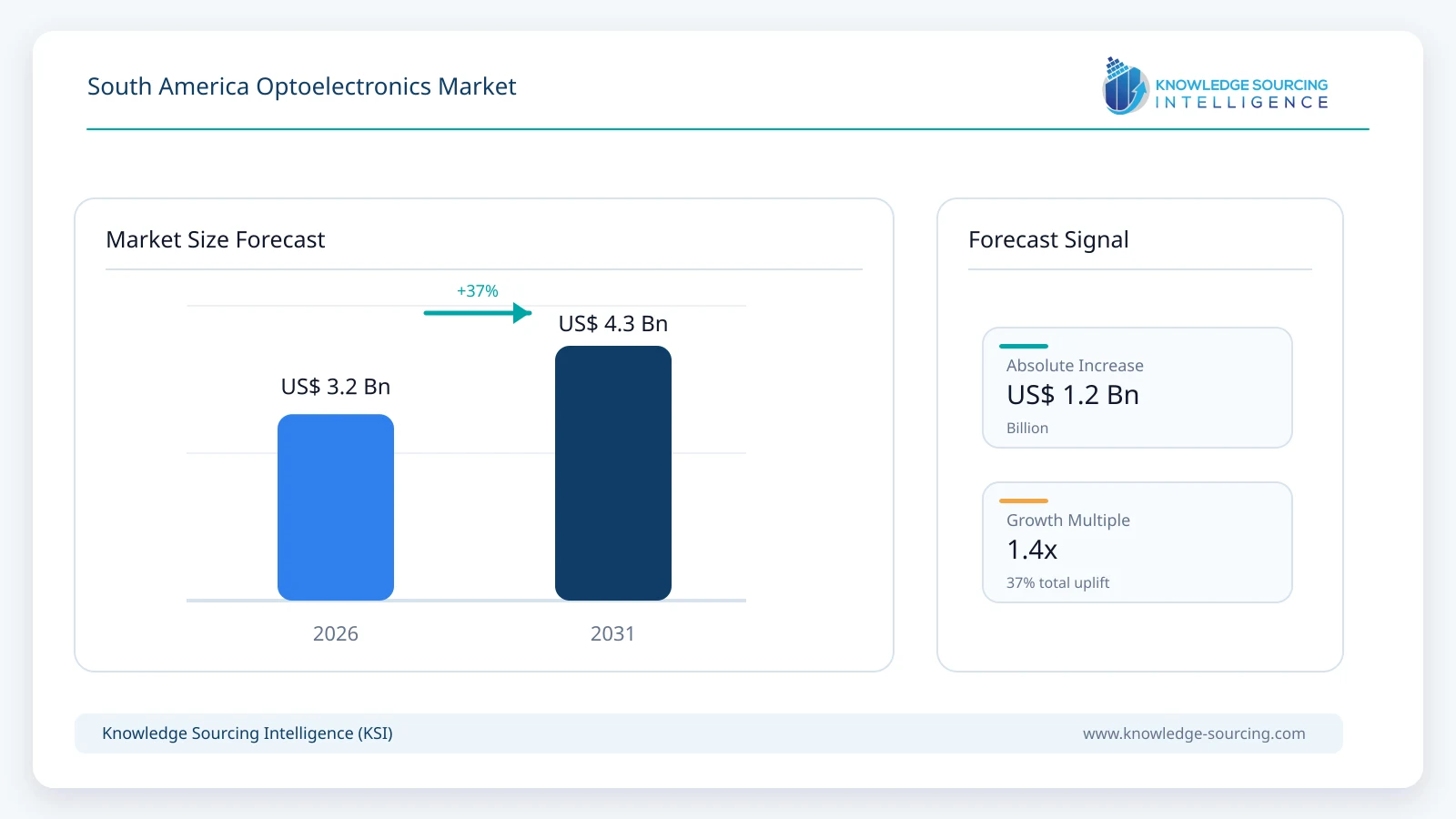
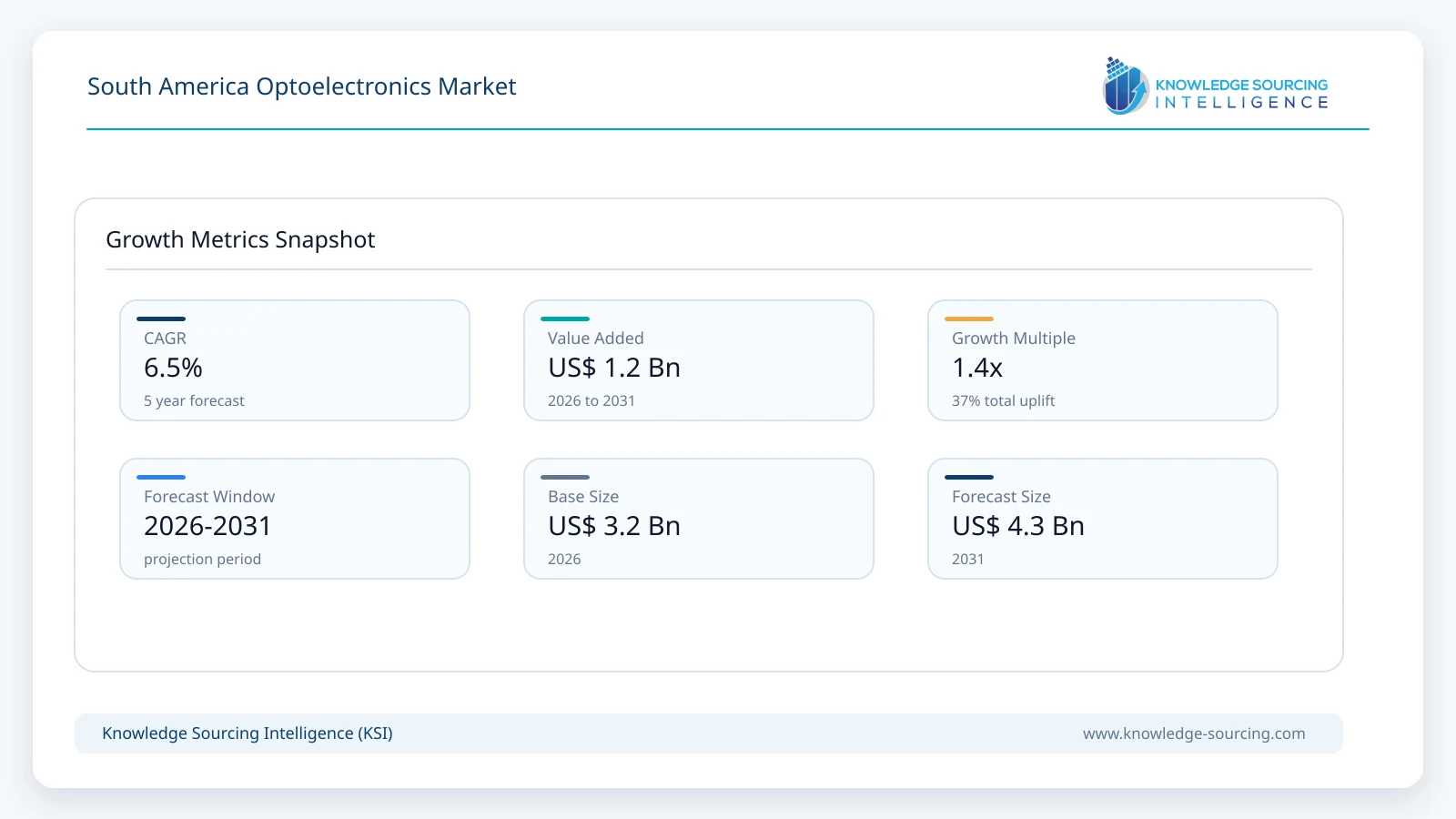
The South America Optoelectronics Market is forecast to grow at a CAGR of 6.5%, reaching USD 4.32 billion in 2031 from USD 3.16 billion in 2026.
Highlights:
- 1Brazil accounts for the largest concentration of optoelectronics demand, supported by telecommunications, industrial automation, healthcare imaging, and automotive electronics investments.
- 2Fibre-optic network expansion, data centre construction, and 5G deployment continue to increase procurement of optical transceivers and photonic components.
- 3Automotive manufacturers are adopting image sensors, infrared components, LEDs, and laser-based sensing technologies to improve vehicle safety and lighting efficiency.
- 4Healthcare providers are expanding the use of optoelectronic components in diagnostic imaging, laboratory instruments, and minimally invasive medical equipment.
- 5Supply chains remain dependent on imported semiconductor and photonic components, making procurement costs sensitive to exchange-rate movements and global production constraints.
- 6Product differentiation increasingly depends on optical performance, energy efficiency, reliability, regulatory compliance, and long-term supply assurance rather than price alone.
The market encompasses semiconductor devices that generate, detect, transmit, or control light, including CMOS image sensors, optical transceivers, LEDs, laser diodes, infrared components, photodiodes, VCSELs, displays, and optocouplers. Although most manufacturing capacity remains concentrated outside the region, South American demand has become increasingly diversified as telecommunications operators, industrial manufacturers, healthcare institutions, utilities, and automotive assemblers invest in equipment requiring higher optical performance and reliable electronic sensing.
Brazil remains the largest commercial market because of its sizeable telecommunications sector, expanding data centre investments, diversified manufacturing base, and extensive automotive production. Argentina, Chile, Colombia, and Peru contribute through mining automation, renewable energy projects, industrial digitalisation, and continued fibre broadband expansion. Demand patterns differ across countries, with telecommunications and industrial applications representing larger procurement volumes than consumer-oriented markets in several economies.
Purchasing decisions increasingly extend beyond component pricing. Buyers evaluate optical efficiency, power consumption, operating lifetime, thermal stability, compliance with international standards, product availability, technical support, and long-term supplier reliability. Equipment manufacturers also seek components that simplify system integration while reducing maintenance requirements over extended operating cycles.
Investment across the value chain increasingly reflects long-term infrastructure planning rather than short replacement cycles. Fibre-optic communication networks, cloud infrastructure, intelligent manufacturing equipment, medical imaging systems, and advanced automotive electronics continue to create demand for higher-value optoelectronic components that support improved performance and lower operating costs.
Key Market Indicators
Indicator | Latest Evidence | Commercial Meaning |
Mobile broadband coverage in Latin America | More than 95% population coverage (2024) | Expanding wireless networks require higher-capacity optical transport infrastructure supporting transceiver demand. |
Regional internet users | Over 460 million users (ITU, latest available) | Sustained data traffic increases investment in fibre backbone and optical communication equipment. |
Brazil vehicle production | More than 2.5 million vehicles (2024) | Automotive manufacturing supports demand for LEDs, image sensors, infrared components and optical isolators. |
Brazil electricity transmission expansion | Continuous high-voltage grid investment (EPE latest planning documents) | Utility modernisation supports industrial sensing, optical monitoring and communication equipment procurement. |
Healthcare diagnostic equipment investment | Ongoing public and private hospital modernisation across major economies | Expands demand for imaging sensors, photodiodes and laser-based medical devices. |
Key indicator: Mobile broadband coverage exceeded 95% of the Latin American population according to GSMA's latest regional assessments.
Commercial meaning: Higher traffic volumes require continuous upgrades of fibre transport networks, increasing procurement of optical communication components.
Market Drivers
Expansion of fibre-optic communications and data infrastructure
Telecommunications operators continue expanding fibre backbones and metropolitan networks to accommodate higher data traffic generated by cloud computing, enterprise connectivity, video streaming, and 5G services. The International Telecommunication Union reports continued increases in internet connectivity across Latin America, while national regulators such as Brazil's National Telecommunications Agency (Anatel) continue supporting network expansion through spectrum management and infrastructure oversight. Optical transceivers, laser diodes, photodiodes, and optical isolators benefit directly because higher-capacity transmission equipment requires increasingly sophisticated photonic components. Suppliers are responding through broader product portfolios designed for higher transmission speeds, lower power consumption, and improved thermal performance to meet evolving carrier requirements.
Automotive electronics requiring higher optical sensing capability
Vehicle manufacturers operating across Brazil and neighbouring countries continue increasing the integration of optical components within passenger and commercial vehicles. Image sensors support driver monitoring systems, parking assistance, surround-view cameras, and advanced driver assistance functions, while LEDs replace conventional lighting because of longer operating life and improved energy efficiency. Infrared devices are increasingly incorporated into occupant monitoring and safety applications. Production statistics published by the Brazilian Automotive Industry Association (ANFAVEA) indicate sustained vehicle manufacturing activity, encouraging automotive suppliers to source components capable of meeting increasingly demanding reliability and environmental specifications. Manufacturers therefore continue investing in automotive-qualified optoelectronic product families that comply with stringent safety and durability standards.
Industrial automation and smart manufacturing investments
Manufacturers across mining, food processing, chemicals, logistics, and energy industries continue modernising production facilities through automation technologies requiring reliable optical sensing and communication. Laser diodes, photodetectors, infrared sensors, optocouplers, and industrial LEDs support machine vision, robotic positioning, process monitoring, factory safety, and equipment diagnostics. Industrial operators increasingly prioritise predictive maintenance and operational efficiency, creating demand for sensors that deliver higher accuracy with lower maintenance requirements. Semiconductor suppliers have expanded industrial-grade product offerings with improved resistance to vibration, temperature variation, and harsh operating environments, reflecting customer requirements for longer service intervals and reduced production downtime.
Healthcare imaging and diagnostic equipment modernisation
Hospitals, diagnostic laboratories, and medical equipment manufacturers continue adopting advanced imaging technologies that depend on precise optoelectronic components. CMOS image sensors, photodiodes, laser diodes, and infrared detectors support digital pathology, endoscopy, ophthalmology, dental imaging, patient monitoring, and laboratory automation. Public healthcare investment programmes and private hospital expansion across larger South American economies continue to support procurement of modern diagnostic systems. Equipment manufacturers increasingly require components offering high image quality, low noise characteristics, compact form factors, and dependable long-term operation. This demand encourages suppliers to prioritise product quality, regulatory compliance, and application-specific engineering support rather than competing primarily on component pricing alone.
Market Restraints and Challenges
Dependence on imported semiconductor and photonic components. Most optoelectronic devices deployed across South America are sourced from manufacturing facilities in Asia, North America, and Europe because regional semiconductor fabrication capacity remains limited. This dependence exposes equipment manufacturers and distributors to currency fluctuations, international freight costs, customs procedures, and longer procurement lead times. Annual reports from semiconductor suppliers, including STMicroelectronics, Infineon Technologies, Broadcom, and ams-OSRAM, consistently identify supply-chain resilience and geopolitical uncertainty as operational risks requiring supplier diversification and inventory management. These pressures primarily affect pricing stability, inventory planning, and project delivery schedules rather than long-term demand.
Lengthy qualification and certification requirements for industrial and automotive applications. Automotive manufacturers, industrial automation suppliers, and healthcare equipment producers require extensive qualification before introducing new optoelectronic components into commercial production. Devices must demonstrate consistent optical performance, thermal stability, electromagnetic compatibility, and long operating life under demanding environmental conditions. These validation processes increase product development costs and often extend procurement cycles by several months. Larger suppliers generally possess the engineering resources and certification experience to support customers throughout qualification, whereas smaller manufacturers may experience longer commercialisation timelines and higher customer acquisition costs.
Cost pressures associated with high-performance photonic technologies. Advanced CMOS image sensors, VCSELs, laser diodes, and optical transceivers require sophisticated semiconductor fabrication processes, specialised packaging technologies, and precision optical testing. These manufacturing requirements increase production costs compared with conventional electronic components. Buyers operating under constrained capital budgets, particularly in public healthcare institutions and smaller industrial enterprises, frequently prioritise lifecycle cost and return on investment before adopting premium optoelectronic solutions. Suppliers increasingly respond by introducing broader product portfolios covering multiple performance and price categories rather than relying exclusively on premium offerings.
Limited regional semiconductor manufacturing ecosystem. South America possesses growing electronics assembly capabilities but comparatively limited semiconductor wafer fabrication, advanced packaging, and photonic manufacturing infrastructure. Equipment manufacturers therefore remain dependent on overseas suppliers for many critical components used in telecommunications, industrial automation, automotive electronics, and healthcare systems. Global capacity constraints or export restrictions can therefore influence component availability within regional supply chains. Several international semiconductor manufacturers continue expanding regional distribution networks and technical support operations to improve supply continuity, although local production remains comparatively limited.
Major Segment Analysis
CMOS Image Sensors
CMOS image sensors represent one of the most commercially important product categories because they support demand across automotive electronics, industrial automation, healthcare diagnostics, consumer electronics, and security applications. Improvements in image resolution, power efficiency, low-light performance, and processing capability have expanded their use well beyond traditional digital imaging equipment. Automotive manufacturers increasingly integrate multiple cameras for driver assistance, parking systems, driver monitoring, and vehicle safety functions, while industrial users rely on machine vision systems for inspection, quality control, and robotic guidance.
Purchasing decisions increasingly emphasise image quality, reliability, operating temperature, integration flexibility, and long product availability rather than sensor resolution alone. Healthcare equipment manufacturers require sensors capable of producing accurate diagnostic images with minimal electronic noise, whereas industrial buyers prioritise durability and continuous operation in demanding environments. Suppliers including Hamamatsu Photonics, STMicroelectronics, Infineon Technologies, and ams-OSRAM continue investing in sensor architectures that improve sensitivity while reducing power consumption, enabling equipment manufacturers to incorporate higher imaging performance without materially increasing overall system complexity or operating costs.
Regional Analysis
Country | Primary Demand Signals | Principal Constraint |
Brazil | Expansion of fibre-optic networks, 5G deployment, automotive production, industrial automation, healthcare equipment upgrades | Dependence on imported semiconductor components and exchange-rate volatility |
Argentina | Industrial digitalisation, telecommunications upgrades, energy infrastructure investment, healthcare modernisation | Economic uncertainty affecting capital expenditure and procurement cycles |
Chile | Mining automation, renewable energy projects, fibre connectivity expansion | Harsh operating environments and dependence on imported high-value components |
Colombia | Fibre broadband expansion, manufacturing automation, healthcare investment | Limited domestic semiconductor manufacturing and extended procurement lead times |
Peru | Mining modernisation, industrial automation, broadband infrastructure development | Geographic deployment challenges and logistics costs for specialised components |
Rest of South America | Gradual expansion of digital infrastructure, utility modernisation, manufacturing upgrades | Smaller market size, fragmented demand, and reliance on international distribution networks |
Brazil
Brazil represents the largest market for optoelectronic components in South America owing to its diversified industrial base, extensive telecommunications infrastructure, sizeable automotive manufacturing sector, and expanding healthcare equipment market. Fibre broadband expansion, 5G deployment, cloud infrastructure investment, and increasing automation across manufacturing industries continue supporting procurement of optical transceivers, LEDs, image sensors, infrared components, and industrial photonic devices. The country also hosts the region's largest automotive production base, increasing demand for optical sensing, intelligent lighting, and vehicle imaging technologies. Public investment in electricity transmission, industrial digitalisation, and healthcare modernisation further broadens application opportunities across multiple end-user industries.
Argentina
Industrial automation, energy infrastructure, healthcare equipment upgrades, and telecommunications network improvements continue supporting optoelectronic demand in Argentina. Manufacturing companies increasingly deploy optical sensors and machine vision systems to improve production efficiency while reducing operational downtime. Telecommunications operators continue expanding fibre connectivity to improve broadband performance, increasing demand for optical communication components. Economic volatility and exchange-rate pressures can delay capital expenditure decisions, encouraging buyers to prioritise component reliability, lifecycle cost, and dependable supplier support when evaluating procurement options.
Chile
Mining remains the principal commercial driver for optoelectronic adoption in Chile. Copper producers increasingly employ optical sensing, laser-based measurement systems, industrial imaging equipment, and fibre communication networks to improve operational safety and productivity in remote mining environments. Renewable energy development and expanding digital infrastructure further strengthen demand for industrial optical communication equipment and sensing technologies. Buyers generally prioritise equipment durability, resistance to harsh operating conditions, and long maintenance intervals because mining operations require continuous system availability and reliable field performance.
Colombia
Colombia continues expanding fibre-optic infrastructure, enterprise digital connectivity, industrial automation, and healthcare services, supporting demand for multiple optoelectronic product categories. Industrial manufacturers increasingly integrate optical sensors and automated inspection technologies to improve manufacturing efficiency and product consistency. Healthcare institutions continue replacing ageing diagnostic equipment with digital imaging platforms incorporating advanced image sensors and photonic technologies. Telecommunications infrastructure projects remain an important source of demand for optical communication equipment, particularly in urban commercial centres.
Peru
Mining, utilities, industrial processing, and telecommunications represent the primary sources of optoelectronic demand in Peru. Mining operators continue investing in optical monitoring systems, industrial sensors, laser measurement equipment, and communication infrastructure to improve equipment reliability and worker safety. Expanding broadband connectivity and digital government initiatives also contribute to higher procurement of optical networking equipment. Capital investment decisions frequently emphasise equipment reliability, maintenance requirements, and operating cost because projects are often deployed in geographically challenging environments where service interruptions can be costly.
Rest of South America
Other South American countries continue generating demand through gradual improvements in broadband connectivity, industrial automation, healthcare infrastructure, and public utility modernisation. Although individual national markets remain comparatively smaller, continued investment in telecommunications, renewable energy, transportation infrastructure, and manufacturing automation supports steady procurement of LEDs, optical communication components, infrared sensors, photodiodes, and industrial imaging technologies. International suppliers increasingly serve these markets through regional distributors and application engineering partners, enabling broader product availability despite the absence of extensive local semiconductor manufacturing capacity.
Competitive Landscape
Competition in the South America optoelectronics market is technology driven rather than volume driven because most suppliers compete through specialised product portfolios, application expertise, manufacturing quality, and long-term customer support. International manufacturers dominate component supply, while regional distributors and system integrators provide technical assistance, inventory management, and after-sales services tailored to local customers. The market therefore remains characterised by strong dependence on global semiconductor supply chains combined with local application engineering capabilities.
ams-OSRAM AG, Hamamatsu Photonics K.K., Infineon Technologies AG, STMicroelectronics, ROHM Semiconductor, TE Connectivity, Broadcom Inc., Coherent Corp., Lumentum Holdings Inc., and Vishay Intertechnology, Inc. compete across different product categories rather than identical portfolios. Product differentiation increasingly depends on optical efficiency, miniaturisation, power consumption, thermal performance, reliability, and compliance with automotive, industrial, medical, and telecommunications standards. Companies are expanding research and development activities, strengthening regional distribution partnerships, improving technical support, and diversifying manufacturing footprints to reduce supply-chain risks while meeting customer requirements for shorter delivery times and dependable long-term component availability.
Recent Developments
May 2026 – Huawei launches upgraded F5G-A all-optical portfolio across Latin America: Huawei introduced upgraded F5G-A all-optical networking products and optical sensing solutions in Brazil for Latin America, supporting AI-driven industrial connectivity, enterprise campuses, ISPs and digital infrastructure expansion throughout South America.
May 2026 – Ciena optical technology powers Cirion’s on-demand NaaS launch: Cirion launched its initial Network-as-a-Service platform across Latin America using Ciena's programmable optical networking technology, enabling enterprises to provision, scale and manage high-capacity optical connectivity through automated digital infrastructure.
January 2026 – INFiLED launches direct operations in Brazil: LED display manufacturer INFiLED officially entered Brazil, opening a São Paulo Experience Centre to showcase advanced LED display technologies and strengthen local customer support for South America's professional audiovisual and optoelectronics markets.
December 2025 – Actis launches TERRANOVA hyperscale data-centre platform: Actis launched the TERRANOVA platform to develop AI-ready hyperscale data centres across Brazil and Chile, expanding optical networking infrastructure supporting cloud computing, high-speed interconnects and advanced optoelectronic communications technologies.
Regulatory and Policy Environment
Regulatory frameworks across South America increasingly influence procurement decisions for optoelectronic components through telecommunications policies, automotive safety standards, medical device regulations, energy efficiency requirements, and industrial safety legislation. Rather than regulating optoelectronic devices directly, governments establish performance, safety, electromagnetic compatibility, and environmental standards that equipment manufacturers must satisfy before commercial deployment.
Brazil remains the region's most influential regulatory market because of its extensive industrial base and telecommunications sector. The National Telecommunications Agency (Anatel) continues supporting expansion of broadband and 5G infrastructure through spectrum management and equipment certification, encouraging continued investment in fibre-optic communication systems. Medical devices incorporating optoelectronic technologies must comply with regulatory requirements administered by the Brazilian Health Regulatory Agency (ANVISA), while automotive electronics increasingly align with internationally recognised vehicle safety requirements.
Other South American countries continue strengthening telecommunications infrastructure, digital government programmes, industrial modernisation, and healthcare investment. Although regulatory procedures differ between jurisdictions, manufacturers increasingly design products to satisfy internationally recognised standards, including IEC, ISO, and automotive AEC qualification requirements. Compliance has therefore become an important competitive factor, particularly for suppliers serving healthcare, automotive, aerospace, industrial automation, and communication applications where certification directly influences purchasing decisions.
Outlook and Strategic Implications
Demand across the South America optoelectronics market is expected to strengthen during the 2026–2031 forecast period as telecommunications infrastructure, industrial automation, healthcare diagnostics, automotive electronics, and digital infrastructure continue expanding across the region. While local semiconductor manufacturing capacity is likely to remain limited, continued investment in fibre broadband, cloud computing, intelligent manufacturing, renewable energy infrastructure, and connected mobility will sustain demand for higher-value photonic components. Procurement decisions are also expected to place greater emphasis on component reliability, energy efficiency, system compatibility, and long-term supplier support as end users seek to reduce lifecycle operating costs.
International manufacturers are expected to reinforce regional distribution networks, application engineering capabilities, and customer support services rather than establishing extensive semiconductor fabrication capacity within South America. Diversified sourcing strategies, inventory optimisation, and closer collaboration with equipment manufacturers are likely to remain priorities as companies seek to improve supply-chain resilience against geopolitical uncertainty and component shortages. Suppliers capable of offering broad product portfolios covering communications, automotive, industrial, healthcare, and energy applications will be better positioned to capture opportunities arising from diversified regional demand.
For equipment manufacturers, distributor networks, and technology providers, competitive success will increasingly depend on application-specific engineering support, regulatory compliance, and reliable product availability rather than component pricing alone. Buyers are expected to prioritise suppliers capable of delivering consistent optical performance, extended product lifecycles, dependable technical assistance, and secure long-term supply arrangements. These factors are likely to shape purchasing behaviour across the South America optoelectronics market throughout the forecast period, supporting continued adoption of photonic technologies across both established and emerging end-user industries.
South America Optoelectronics Market Scope:
| Report Metric | Details |
|---|---|
| Total Market Size in 2026 | USD 3.16 billion |
| Total Market Size in 2031 | USD 4.32 billion |
| Forecast Unit | Billion |
| Growth Rate | 6.5% |
| Study Period | 2021 to 2031 |
| Historical Data | 2021 to 2024 |
| Base Year | 2025 |
| Forecast Period | 2026 – 2031 |
| Segmentation | Type, End-User Industries, Country |
| Companies |
|
Market Segmentation
By Type
CMOS Image Sensors
Optical Transceivers
Light Emitting Diodes (LEDs)
Laser Diodes
Infrared Components
Displays
Optocouplers / Optical Isolators
Photodetectors / Photodiodes
VCSELs (Vertical-Cavity Surface-Emitting Lasers)
Others
By End-User Industry
Communication
Consumer Electronics
Automotive
Healthcare
Aerospace and Defense
Industrial
Energy and Utilities
By Country
Brazil
Argentina
Chile
Colombia
Peru
Rest of South America
Table of Contents
1. INTRODUCTION
1.1. Market Overview
1.3. Market Definition
1.4. Market Segmentation
2. RESEARCH METHODOLOGY
2.1. Research Data
2.2. Assumptions
3. EXECUTIVE SUMMARY
3.1. Research Highlights
4. MARKET DYNAMICS
4.1. Market Drivers
4.2. Market Restraints
4.3. Porter’s Five Forces Analysis
4.3.1. Bargaining Power of Suppliers
4.3.2. Bargaining Power of Buyers
4.3.3. The Threat of New Entrants
4.3.4. Threat of Substitutes
4.3.5. Competitive Rivalry in the Industry
4.4. Industry Value Chain Analysis
5. SOUTH AMERICA OPTOELECTRONICS MARKET ANALYSIS, BY TYPE
5.1. Introduction
5.2. CMOS Image Sensors
5.3. Optical Transceivers
5.4. LEDs
5.5. Laser Diodes
5.6. Infrared Components
5.7. Displays
5.8. Optocouplers / Optical Isolators
5.9. Photodetectors / Photodiodes
5.10. VCSELs (Vertical-Cavity Surface-Emitting Lasers)
5.11. Others
6. SOUTH AMERICA OPTOELECTRONICS MARKET ANALYSIS, BY END-USER INDUSTRIES
6.1. Introduction
6.2. Communication
6.3. Consumer Electronics
6.4. Automotive
6.5. Healthcare
6.6. Aerospace and Defense
6.7. Industrial
6.8. Energy and Utilities
7. SOUTH AMERICA OPTOELECTRONICS MARKET ANALYSIS, BY COUNTRY
7.1. Introduction
7.2. Brazil
7.3. Argentina
7.4. Chile
7.5. Colombia
7.6. Peru
7.7. Rest of South America
8. COMPETITIVE ENVIRONMENT AND ANALYSIS
8.1. Major Players and Strategy Analysis
8.2. Emerging Players and Market Lucrativeness
8.3. Mergers, Acquisitions, Agreements, and Collaborations
8.4. Vendor Competitiveness Matrix
9. COMPANY PROFILES
9.1. ams-OSRAM AG
9.2. Hamamatsu Photonics K.K.
9.3. Infineon Technologies AG
9.4. STMicroelectronics
9.5. ROHM SEMICONDUCTOR
9.6. TE Connectivity
9.7. Broadcom Inc.
9.8. Coherent Corp.
9.9. Lumentum Holdings Inc.
9.10. Vishay Intertechnology, Inc.
Navigate
Trusted by the world's leading organizations











