
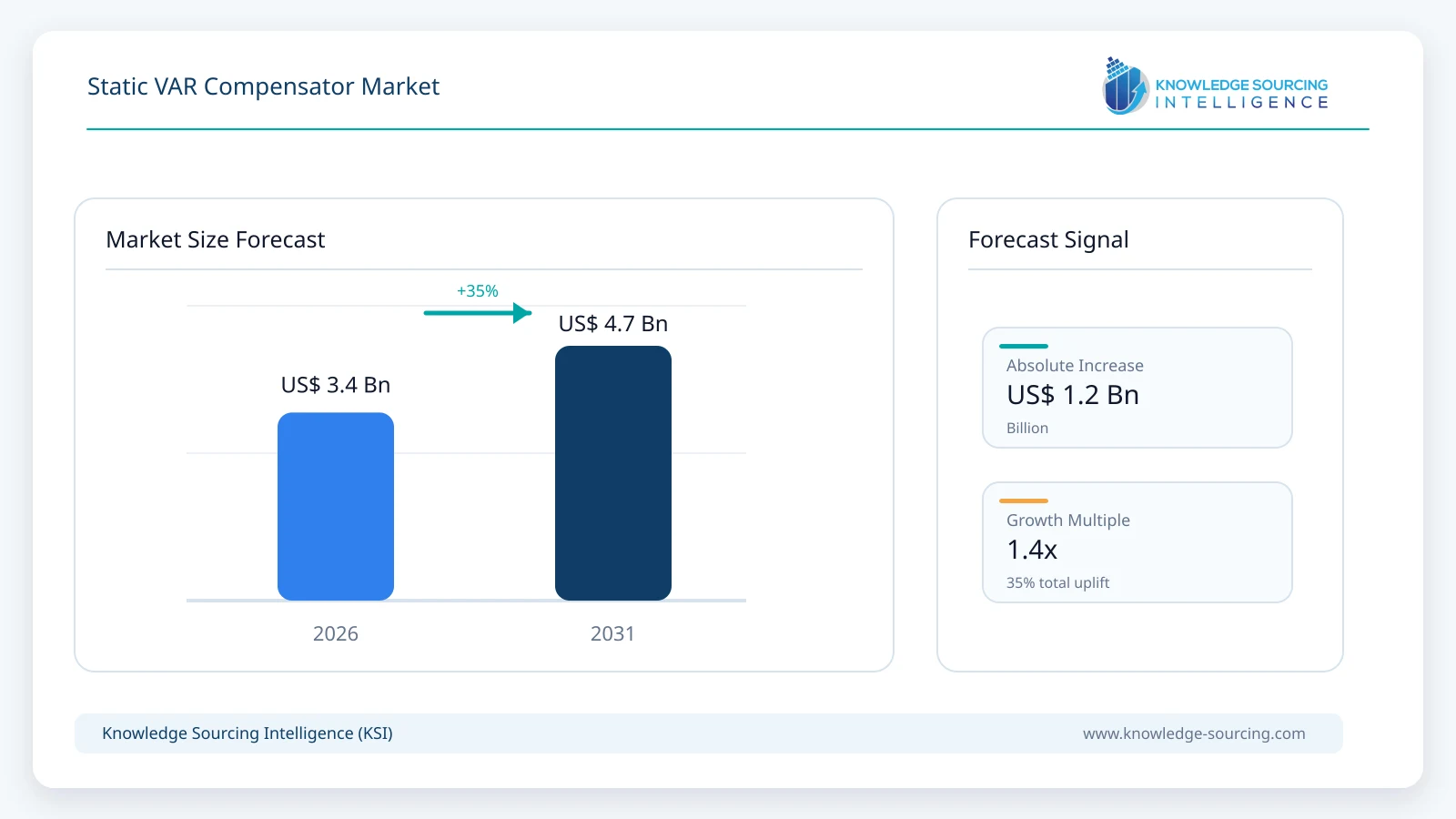
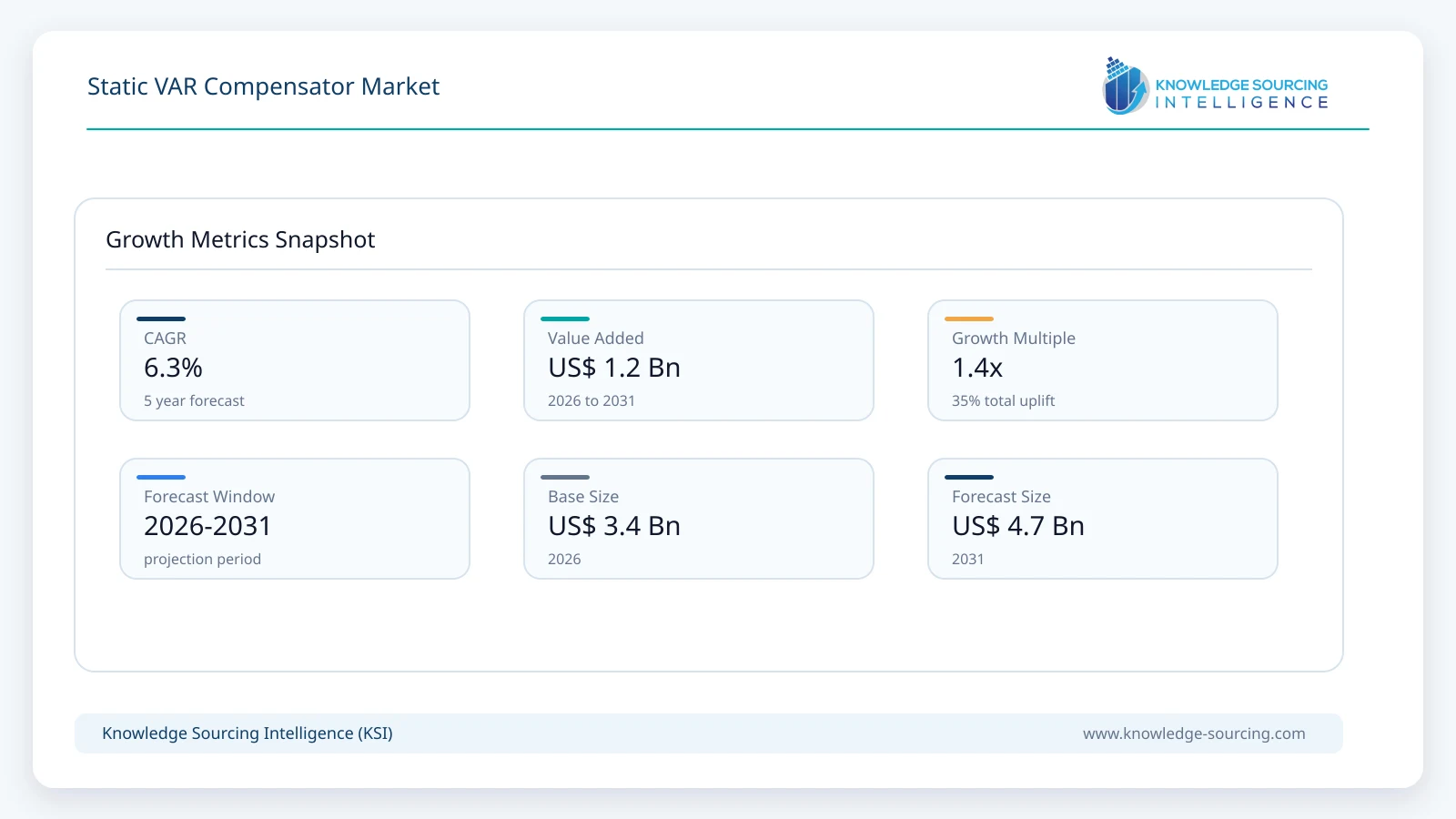
The Static VAR Compensator Market is forecast to grow at a CAGR of 6.3%, reaching USD 4.66 billion in 2031 from USD 3.44 billion in 2026.
Highlights:
- 1SVC systems have mainly been employed for voltage control in transmission and distribution networks under variable loading conditions.
- 2Wind and solar projects are the growing causer to get more reactive power compensation needs, especially in weak-grid environments.
- 3Thyristor-Controlled Reactor (TCR) configurations often give robust dynamic reactive power control for utility and industrial applications.
- 4SVC systems solve issues with voltage fluctuations and power factor, as well as reduce disturbances from large dynamic loads in industrial facilities.
- 5Modern SVC systems employ digital control for better operational oversight and can support a variety of monitoring, diagnostic, and communication interfaces.
- 6SVC installations enhance voltage stability and enable utilities to operate existing transmission infrastructure closer to their effective limits.
Static Var Compensators (SVC) are electrical devices that provide dynamic reactive power management for an AC network. They typically utilize thyristor-controlled reactors and thyristor-switched or controlled capacitors to absorb or supply reactive power contingent on conditions on the grid.
This technology is more relevant in transmission networks when power increases, and systems under heavy loading conditions may face voltage stability issues, especially relating to long transmission lines. They provide immediate compensation to keep voltage limits in check.
Industrial facilities are another large field of application. Fluctuating loads such as large motors, arc furnaces, rolling mills, welding equipment, compressors, and others are responsible for poor power factors and voltage disturbances. SVC systems use this compensation to enhance stability and efficiency.
SVCs are being adopted more by renewable energy facilities to regulate voltage variations, in order to stay within grid-code limits. In some solar and wind projects connected to relatively weak networks, the operation is only stable through reactive power compensation.
Market Dynamics
Market Drivers
Increasing Renewable Energy Integration: In the rapid increase phase of wind and solar generation, power compensation is receiving significant traction. Renewable energy plants are hardly predictable and vary their power output. This can have a major influence on voltage stability along with reactive power flows. SVC units offer reactive power compensation in a steady state for all renewable plants, thereby assisting them in complying with utility requirements for stable operation along with maintaining power quality at the grid interface point.
Growing Need for Voltage Stability: Electricity networks are now being run under changing loading conditions. Voltage and power quality issues can be caused by peak electricity demand, distributed generation, electric vehicle (EV) charging, industrial electrification, and renewable intermittency. SVCs dynamically react to such conditions with reactive power control. They learn to respond quickly to fluctuations in voltage and must always be installed at transmission substations and major industrial users.
Expansion of Industrial Electrification: High-power electrical equipment is more widely used in industrial processes. Steel mills, cement plants, electric furnaces, and other mining operations and manufacturing facilities can have very high demand for reactive power and voltage dips. SVC systems help to achieve power factor correction and stabilization of voltage, enabling industrial users to run large electrical loads in an effective manner.
Aging Transmission Infrastructure: Virtually all transmission networks rely upon factories and infrastructure that were purchased decades ago. With the rise in demand for electricity, utilities need to improve existing infrastructure better SVC system implies that it can offer voltage support and reactive power compensation without a full replacement of transmission lines.
Increasing Electricity Demand: Electricity demand burden of data centers, AI computing infrastructure, EV charging, electrified heating, and industrial expansion. High electricity loads may require local voltage and reactive-power margins. SVCs give utilities and large consumers a technology to manage the situation. This is particularly salient given the density of high-density data centers, as raw computing equipment is sensitive to stable power quality.
Market Restraints & Opportunities
One of the major factors constraining the market has continued to be the high product cost involved in SVC installation. Thyristor valves, reactors, capacitors, harmonic filters, and transformers are required for the system. Additionally, one cooling system requires some protection equipment to overcome this issue, and a special control system called real-time control is needed.
In addition to this, SVC systems are well engineered since harmonic current is generated due to the switching of thyristor have to be filtered.
Further, SVC technology is well-established due to its maturity and suitability for large-scale reactive compensation. However, new opportunities are emerging with hybrid solutions that combine SVCs with STATCOMs, energy storage, digital controls, and advanced monitoring.
Emerging markets provide the growth potential that transmission infrastructure allows, and renewable energy projects will need voltage support.
Key Developments
June 2026: CoEpower identified SVGs as an intelligent reactive-power compensation approach to support the mining industry. The technology offered the ability to deliver rapid payback, optimum accuracy, and dynamic power factor correction to enhance overall power quality by mitigating voltage disturbances and harmonics, stabilizing voltages, and aiding in flicker mitigation. Along this, it eliminates costly voltage-related shutdowns and ultimately increases available electrical capacity within the rigors of mining environments.
October 2025: Siemens Energy unveiled its E-STATCOM system as the world's first supercapacitor-based STATCOM in this configuration at Mehrum, Germany. The SVC PLUS FS is a combination of reactive-power compensation with supercapacitors that can provide active power for milliseconds at a time and offers artificial inertia, voltage support, frequency stabilization, enhanced renewable-energy integration, and improved blackout support.
Market Segmentation
The market is segmented by configuration, component, voltage range, application, end-user industry, and geography.
By Configuration – Thyristor-Controlled Reactor (TCR)
Thyristor-Controlled Reactor (TCR) configuration is expected to contribute significantly to the market as it offers rapid, continuous reactive power control via thyristor-based switching.
A TCR uses thyristors to adjust the firing angle to regulate the reactive power absorbed by a reactor. This adaptive capability is the result of an automatic state feedback controller and allows the SVC system to instantly respond to voltage variations as well as load changes associated with reactive power.
TCR configurations are widely used in transmission substations, industrial facilities, renewable energy installations, and power-quality applications. For instance, Hitachi Energy SVC Classic is a thyristor-based SVC technology for dynamic voltage and reactive power management.
TCR systems can further be integrated with fixed capacitors in a TCR-Fixed Capacitor configuration, where the reactor compensates dynamically to voltage or frequency variations while the capacitor delivers a constant reactive power
By Component – Reactors
The reactors segment is expected to remain a key component segment as they provide the dynamic inductive reactance required for continuous regulation of reactive power in SVC systems.
The reactor itself is inductive and absorbs reactive power, while thyristor valves control the positive current through the reactor. Contemporary reactors are increasingly incorporated with highly advanced control and protection systems that continuously measure voltage, current, frequency, and reactive power.
This is especially critical for electric power systems that incorporate SVC devices for applications such as transmission voltage regulation, industrial power-factor correction, and renewable energy integration. For instance, the Siemens Energy SVC product family offers SVC PLUS, which is a power-electronics-based reactive power control technology for transmission systems.
By Application: Voltage Control
Voltage control will continue to be a major SVC application, as voltage dependant plant is central to stable and reliable electricity systems.
High voltages are also used in long-distance transmission systems to prevent voltage drop, as electric demand increases when some part of the system along this route needs power. SVC systems provide reactive power support to mitigate voltage level issues at important sites in the network.
Additionally, the integration of renewable energies increases the necessity for voltage regulation as wind and solar generation are weather-dependent. SVC systems are additionally being developed near commercial loads, renewable energy interconnections, and weak-grid areas where voltage fluctuations could be markedly higher.
Regional Analysis
North America Market Analysis
North America is a mature SVC market owing to the aging transmission infrastructure, renewable energy integration, industrial electrification, and escalating electricity demand. Along with this, the United States is investing in transmission modernization, with the demand for electricity growing from data centers, semiconductor manufacturing, EVs, and industrial reshoring.
South America Market Analysis
South America has been seen as an emerging SVC market due to ever-increasing renewable generation and being covered by large interconnected transmission networks. The largest regional opportunity is Brazil, whose electricity system features sizeable hydropower resources with quickly growing wind and solar generation. Argentina, Colombia, and Peru also offer prospects through the development of electric power infrastructure expansion or renewable energy sources.
Europe Market Analysis
Europe is an advanced SVC market in renewables integration, inter-country power transfer, offshore wind, and grid modernization. Germany, France, Italy, and the United Kingdom are adding increased quantities of variable renewable generation to interconnected electricity networks.
Middle East and Africa Market Analysis
Middle East & Africa region is becoming a key SVC market due to the expansion of renewable energy and industrialization, large-scale infrastructure development, and electricity-network modernization, in particular regions. Saudi Arabia and the UAE are among those building big solar plants as part of their wider energy transition plans. Further, these installations necessitate active power management and voltage support for creating a stable grid.
Asia Pacific Market Analysis
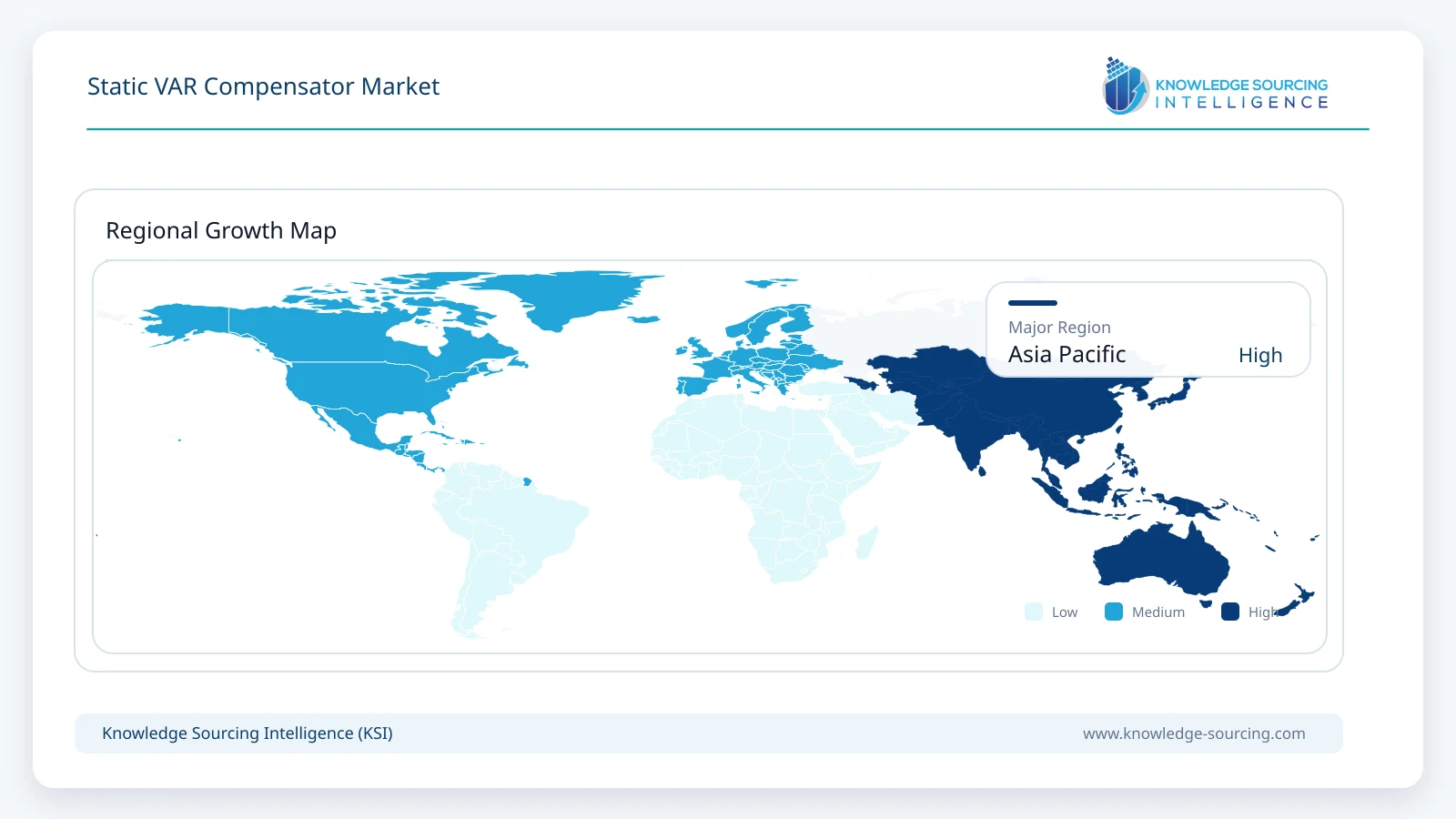
The most rapid growth in terms of demand will be seen in Asia-Pacific, which is anticipated to continue to account for the largest regional market in the world owing to soaring electricity demand growth, deployment of renewable energy generation capacity, growing industrialization, and high investment in transmission. China offers the biggest potential given its huge power system and massive renewable energy integration. Voltage regulation and reactive power compensation are in growing demand with the booming of large-scale wind and solar projects.
List of Companies
Siemens Energy
Hitachi Energy
Elco Power
Mitsubishi Electric
GE Vernova
Nidec Group
NISSIN ELECTRIC
NR Electric
Merus Power
Sieyuan Electric
Siemens Energy
Siemens Energy is one of the global leaders in FACTS and SVC technologies for applications in transmission, distribution, industrial, and renewable energy installations. The SVC PLUS platform uses power-electronics technology that delivers both dynamic reactive power compensation and voltage stabilization.
Hitachi Energy
Hitachi Energy has vast experience in FACTS and reactive power compensation. This includes its SVC Classic technology for thyristor-based dynamic reactive power compensation, voltage stabilization, improvements in power quality, and transmission applications.
Elco Power
Elco Power specializes in power-quality and reactive-power compensation solutions. Its technologies are focused on voltage regulation, power-factor correction, harmonic mitigation, and electrical-system optimization. Its focus on power-quality solutions gives it some exposure to industrial and utility customers that have varying needs for dynamic compensation.
Analyst View
The Static VAR Compensator market is transitioning from traditional reactive-power compensation to digitally-controlled grid-support infrastructure, with the need for dynamic voltage management bolstered by renewable energy integration, transmission congestion, the powering up of industrial users, and an increase in electricity demand. Thyristor-Controlled Reactor (TCR) configurations will remain a major segment as they can deliver consistently reliable and adjustable reactive-power control service to medium-to-large system users. Voltage control will remain the leading application as utilities continue to expand the operation of transmission networks with variable renewable generation and changing load profiles. Moreover, digital controls, advanced harmonic filtering, remote diagnostics, and hybrid compensation architectures will define the competitive landscape, along with integration with renewable-energy and grid-automation systems over the forecast period.
Static VAR Compensator Market Scope:
| Report Metric | Details |
|---|---|
| Total Market Size in 2026 | USD 3.44 billion |
| Total Market Size in 2031 | USD 4.66 billion |
| Forecast Unit | Billion |
| Growth Rate | 6.3% |
| Study Period | 2021 to 2031 |
| Historical Data | 2021 to 2024 |
| Base Year | 2025 |
| Forecast Period | 2026 – 2031 |
| Segmentation | Configuration, Component, Voltage Range, Application, End User, Geography |
| Companies |
|
Market Segmentation
By Configuration
By Component
By Voltage Range
By Application
By End User
By Geography
Table of Contents
1. EXECUTIVE SUMMARY
2. MARKET SNAPSHOT
2.1. Market Overview
2.2. Market Definition
2.3. Scope of the Study
2.4. Market Segmentation
3. MARKET DYNAMIC
3.1. Market Drivers
3.2. Market Restraints
3.3. Market Opportunities
3.4. Porter’s Five Forces Analysis
3.5. Industry Value Chain Analysis
4. BUSINESS LANDSCAPE
4.1. Regulatory, Grid Codes & Technical Standards Landscape
4.2. Transmission & Distribution Grid Investment Landscape
4.3. Renewable Energy Integration & Reactive Power Management Landscape
4.4. Input–Output Landscape
4.5. Strategic Recommendations
5. TECHNOLOGICAL OUTLOOK
5.1. Thyristor-Controlled Reactor & Thyristor-Switched Capacitor Technologies
5.2. SVC Control, Regulation & Compensation Technologies
5.3. SVC Protection, Cooling & Electrical System Technologies
5.4. Digital Monitoring, Automation & Grid Integration Technologies
6. STATIC VAR COMPENSATOR MARKET BY CONFIGURATION
6.1. Introduction
6.2. Thyristor-Controlled Reactor (TCR)
6.3. Thyristor-Switched Capacitor (TSC)
6.4. TCR- Fixed Capacitor
6.6. TSC-TCR
6.7. Others
7. STATIC VAR COMPENSATOR MARKET BY COMPONENT
7.1. Introduction
7.2. Reactors
7.3. Capacitors
7.4. Harmonic Filters
7.5. SVC Transformers
7.6. Thyristor Valves
7.7. Control & Protection Systems
7.8. Others
8. STATIC VAR COMPENSATOR MARKET BY VOLTAGE RANGE
8.1. Introduction
8.2. Low-to-Medium Voltage
8.3. High Voltage
8.4. Extra High Voltage
9. STATIC VAR COMPENSATOR MARKET BY APPLICATION
9.1. Introduction
9.2. Voltage Control
9.3. Power Factor Correction
9.4. Grid Stabilization
9.5. Renewable Energy Integration
9.6. Power Transmission & Power Distribution
9.7. Others
10. STATIC VAR COMPENSATOR MARKET BY END USER
10.1. Introduction
10.2. Electric Utilities
10.3. Railways & Electric Traction
10.4. Renewable Energy
10.5. Steel & Metallurgy
10.6. Oil & Gas
10.7. Others
11. STATIC VAR COMPENSATOR MARKET BY GEOGRAPHY
11.1. Introduction
11.2. North America
11.2.1. USA
11.2.2. Canada
11.2.3. Mexico
11.3. South America
11.3.1. Brazil
11.3.2. Argentina
11.3.3. Others
11.4. Europe
11.4.1. United Kingdom
11.4.2. Germany
11.4.3. France
11.4.4. Others
11.5. Middle East and Africa
11.5.1. Saudi Arabia
11.5.2. UAE
11.5.3. Others
11.6. Asia Pacific
11.6.1. China
11.6.2. Japan
11.6.3. India
11.6.4. South Korea
11.6.5. Others
12. COMPETITIVE ENVIRONMENT AND ANALYSIS
12.1. Major Players and Strategy Analysis
12.2. Market Share Analysis
12.3. Mergers, Acquisitions, Agreements, and Collaborations
12.4. Competitive Dashboard
13. COMPANY PROFILES
13.1. Siemens Energy
13.2. Hitachi Energy
13.3. Elco Power
13.4. Mitsubishi Electric
13.5. GE Vernova
13.6. Nidec Group
13.7. NISSIN ELECTRIC Co., Ltd.
13.8. NR Electric Co. Ltd
13.9. Merus Power
13.10. Sieyuan Electric
14. APPENDIX
14.1. Currency
14.2. Assumptions
14.3. Base and Forecast Years Timeline
14.4. Key benefits for the stakeholders
14.5. Research Methodology
14.6. Abbreviations
Navigate
Trusted by the world's leading organizations











