
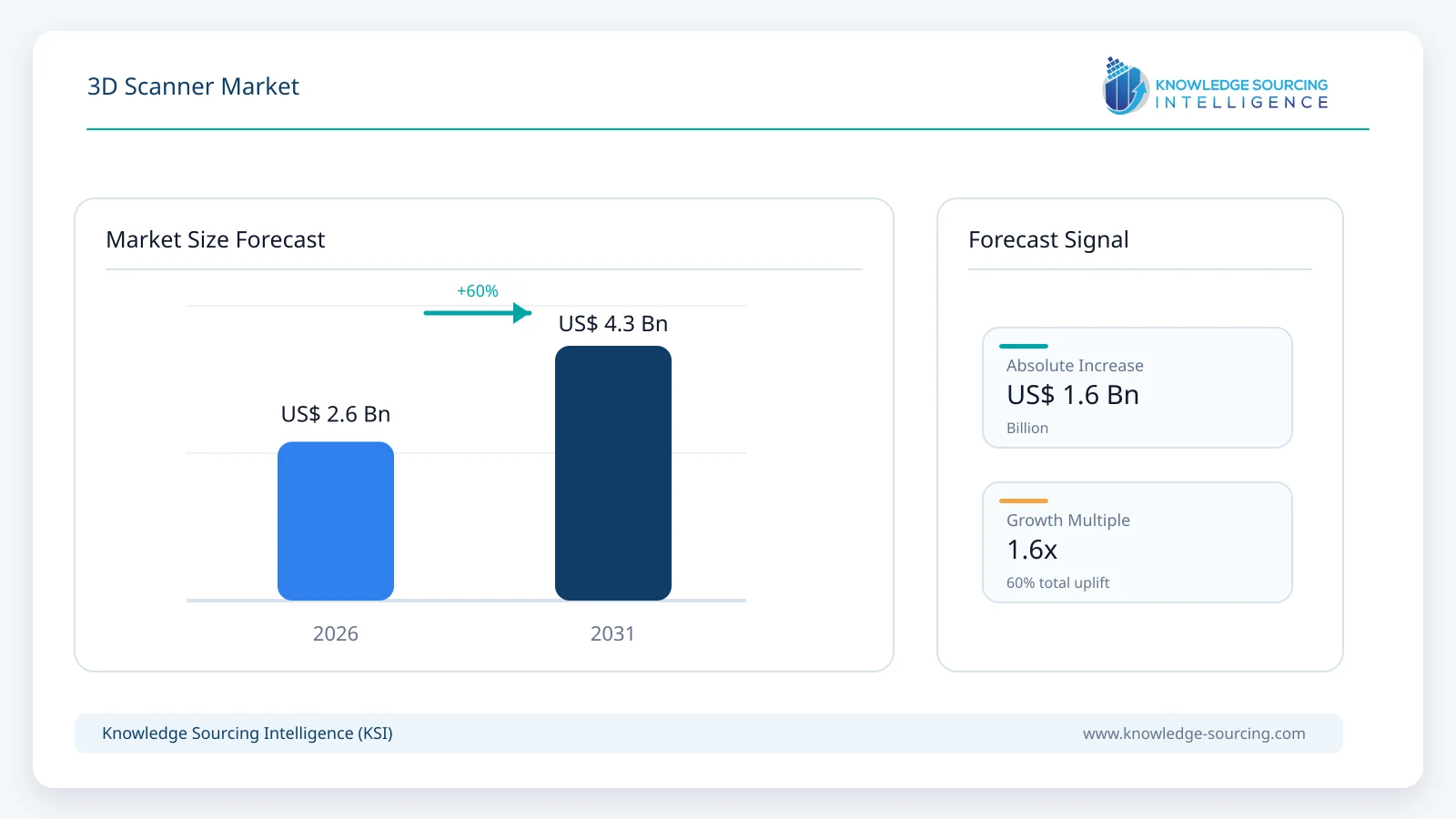
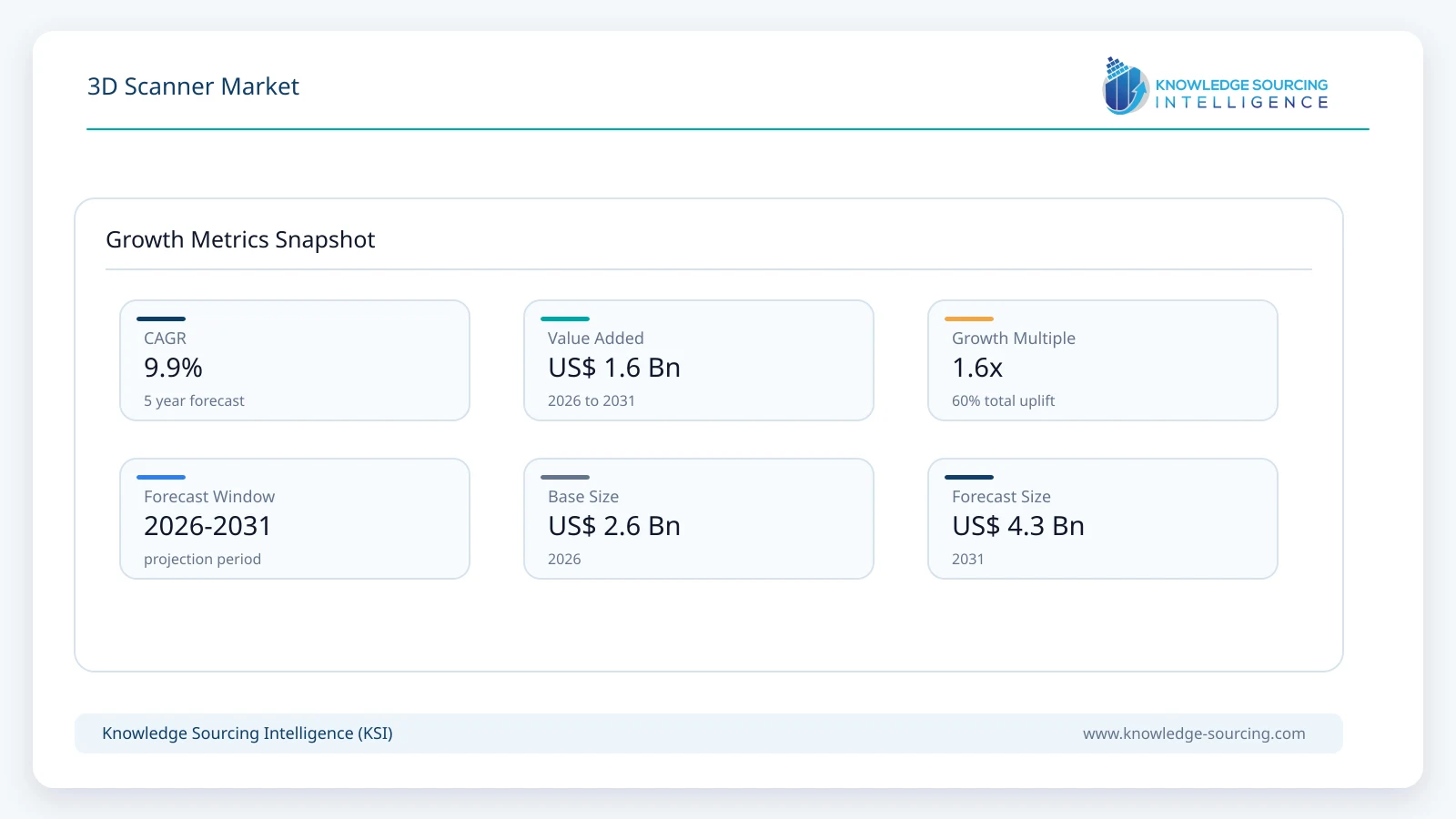
The global 3D scanner market is forecast to grow from USD 2.65 billion in 2026 to USD 4.25 billion in 2031, representing a CAGR of 9.9% across the forecast period.
Highlights:
- 1Laser-based scanners are estimated to account for approximately 53.0% of global market revenue in 2026.
- 2Handheld and portable scanners are estimated to represent approximately 39.0% of 2026 market revenue.
- 3Industrial inspection and reverse engineering are estimated to account for approximately 37.0% of global 3D scanner revenue in 2026.
- 4Short-range metrology systems are estimated to represent approximately 55.0% of 2026 market revenue, reflecting broad use in industrial inspection and dimensional measurement.
- 5North America is estimated to account for approximately 36.0% of global market revenue in 2026, supported by aerospace, automotive, industrial metrology, AEC and public-safety applications.
- 6Product innovation remains active across handheld metrology, terrestrial scanning, mobile reality capture and automated inspection workflows.
Professional 3D scanners are increasingly used across industrial inspection, reverse engineering, construction reality capture, surveying, digital twins, forensic documentation and field measurement. Portable hardware, faster registration and automated scan-to-CAD workflows are reducing setup time and extending adoption beyond specialist metrology teams.
AMETEK now owns FARO Technologies and Creaform, while Hexagon, ZEISS, Nikon Metrology, Trimble, Topcon, RIEGL, Artec 3D, SHINING 3D and Scantech maintain active professional scanning portfolios across metrology and geospatial applications.
3D Scanner Market Trends
Automated quality inspection expands industrial use
Manufacturers increasingly capture full-surface geometry rather than relying only on point measurements. Automotive, aerospace, tooling, energy, and precision manufacturing use portable or robotic scanners for first-article inspection, deviation analysis, fixture verification, and in-process quality control.
Digital twins and reality capture support terrestrial scanning
Construction, infrastructure, industrial facilities, mines, and public-safety teams use terrestrial and mobile LiDAR to create accurate spatial records. FARO Focus and Orbis, Trimble X9, RIEGL VZ systems, and similar platforms serve these workflows.
Portability lowers the barrier to metrology
Handheld laser scanners such as Hexagon ATLASCAN and Creaform HandySCAN allow measurement directly on large parts or in field environments without moving the component to a fixed CMM. Wireless operation, optical tracking, and improved algorithms continue to reduce setup friction.
Software automation raises scanner productivity
AI-assisted alignment, automated meshing, inspection templates, scan-to-CAD, cloud sharing, and robotic integration reduce the labor required to convert point clouds into engineering decisions. This increases the economic value of professional scanners beyond raw measurement speed.
3D Scanner Market Segmentation Analysis
By Technology
Laser-Based Scanners
Laser-based scanners are estimated at approximately USD 1.40 billion in 2026. The segment leads the market because laser technology is used across handheld metrology, terrestrial scanning, laser-line inspection and long-range measurement.
Continued improvements in portability, scan speed, range and automated registration are widening adoption across industrial and field applications.
By Form Factor
Handheld and Portable Scanners
Handheld and portable scanners are estimated at approximately USD 1.03 billion in 2026. They are increasingly used for direct measurement of large parts, reverse engineering, maintenance inspection and in-field quality control.
Wireless operation, optical tracking and lighter system designs are reducing setup requirements and improving productivity.
By Application
Industrial Inspection and Reverse Engineering
Industrial inspection and reverse engineering are estimated at approximately USD 0.98 billion in 2026. Automotive, aerospace, tooling, energy and precision manufacturing use 3D scanning for first-article inspection, deviation analysis, fixture verification and dimensional control.
The segment benefits from growing integration between scanning hardware and automated quality, CAD and robotic inspection workflows.
By Accuracy and Range
Short-Range Metrology Systems
Short-range metrology systems are estimated at approximately USD 1.46 billion in 2026. These systems compete primarily on sub-millimeter accuracy, repeatability, point density and ease of use in inspection and engineering applications.
Demand is supported by higher quality requirements and the shift from point measurement toward full-surface inspection.
Market Drivers
Automated Quality Inspection Expands Industrial Use
Manufacturers increasingly capture full-surface geometry rather than relying only on point measurements. Automotive, aerospace, tooling, energy, and precision manufacturing use portable or robotic scanners for first-article inspection, deviation analysis, fixture verification, and in-process quality control.
Digital Twins and Reality Capture Support Terrestrial Scanning
Construction, infrastructure, industrial facilities, mines, and public-safety teams use terrestrial and mobile LiDAR to create accurate spatial records. FARO Focus and Orbis, Trimble X9, RIEGL VZ systems, and similar platforms serve these workflows.
Portability Lowers the Barrier to Metrology
Handheld laser scanners such as Hexagon ATLASCAN and Creaform HandySCAN allow measurement directly on large parts or in field environments without moving the component to a fixed CMM. Wireless operation, optical tracking, and improved algorithms continue to reduce setup friction.
Software Automation Raises Scanner Productivity
AI-assisted alignment, automated meshing, inspection templates, scan-to-CAD, cloud sharing, and robotic integration reduce the labor required to convert point clouds into engineering decisions. This increases the economic value of professional scanners beyond raw measurement speed.
Market Restraints
High professional-system pricing
Metrology-grade and terrestrial scanners remain expensive relative to consumer depth cameras and photogrammetry. Smaller users may choose lower-cost scanning or outsourced measurement services when accuracy requirements are modest.
Operator and workflow requirements
Accuracy depends on calibration, target strategy, surface reflectivity, environmental conditions, registration, and software processing. High-end systems still require trained users and disciplined measurement procedures.
Substitution by photogrammetry and integrated sensors
For some construction, mapping, and visualization tasks, camera-based photogrammetry or embedded LiDAR in mobile devices can provide adequate outputs at lower cost, limiting demand for dedicated scanners in lower-accuracy use cases.
Regional Outlook
North America
North America is estimated at approximately USD 0.95 billion in 2026. The region has a large installed base across aerospace, automotive, industrial metrology, AEC, surveying and public safety, supporting demand for both portable metrology and reality-capture systems.
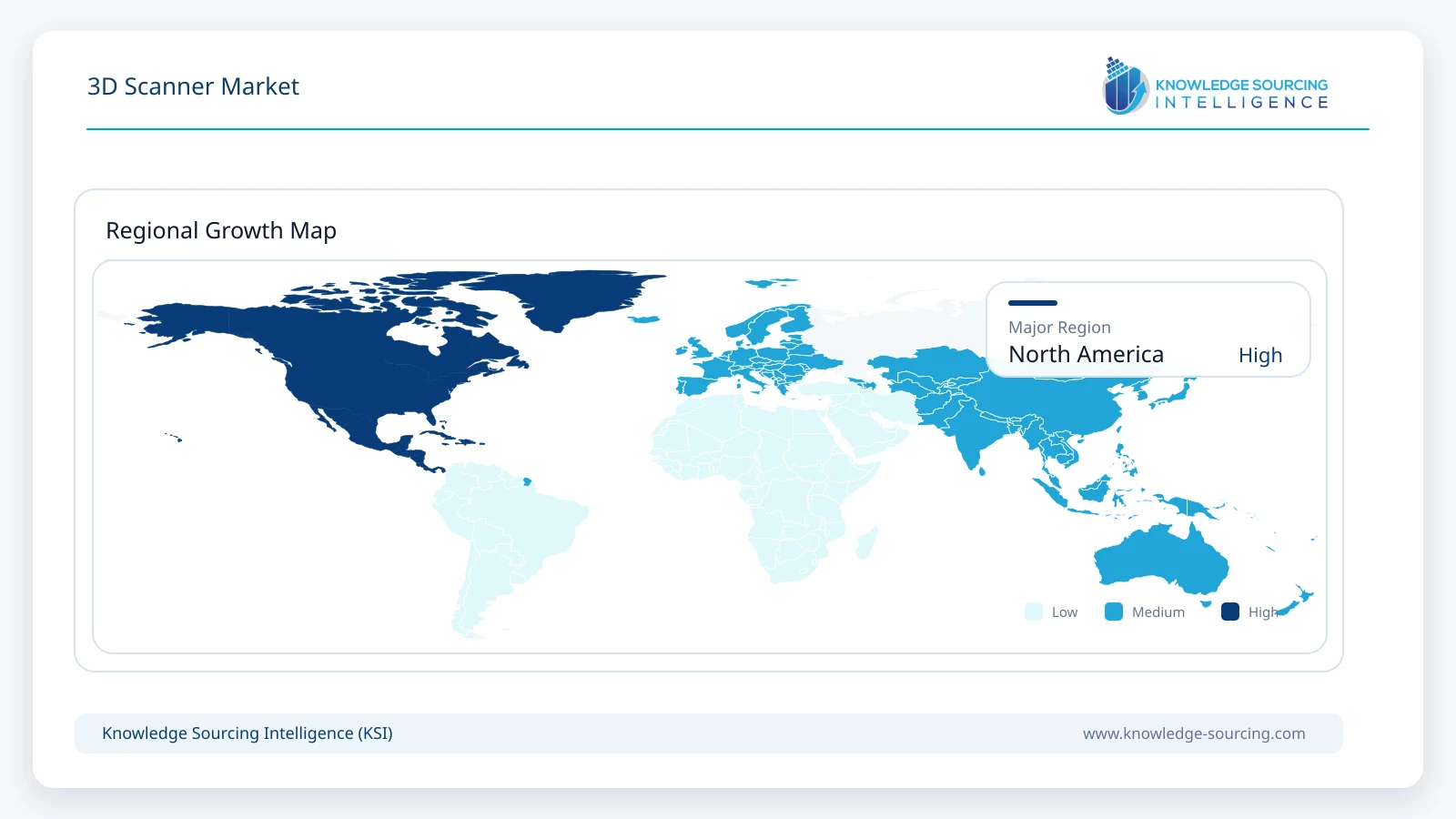
The region also benefits from strong supplier and channel presence, including AMETEK-owned FARO and Creaform, alongside major global metrology and geospatial vendors.
Competitive Landscape
The competitive structure changed materially when AMETEK completed its acquisition of FARO in July 2025. AMETEK already owned Creaform, so FARO and Creaform now operate as separate commercial brands under one parent.
Competition spans industrial metrology and geospatial reality capture. Hexagon and ZEISS are strong in industrial measurement; FARO/Creaform bridge industrial and reality-capture applications; Trimble, RIEGL and Topcon emphasize surveying and geospatial; Artec 3D, SHINING 3D, Scantech and other specialists compete in handheld systems.
Recent Developments
July 2025: AMETEK completed its approximately USD 920 million acquisition of FARO Technologies; FARO had annual sales of approximately USD 340 million.
August 2026: FARO released current firmware for the Focus Premium/Core laser-scanner family and continued support for its active reality-capture portfolio.
September 2026: FARO INSIGHT introduced Focus i.1 and Focus i.1 X terrestrial laser scanners with enhanced measurement performance and a 400-meter range on the i.1 X.
2026: RIEGL launched/marketed its latest VZ-6000i generation with scanning range up to 6,000 meters for specialized long-range applications.
October 2025: Hexagon expanded its handheld offering with ATLASCAN Pro, targeting more accessible professional reverse-engineering and inspection workflows.
Market Outlook
Professional 3D scanners are expected to remain a high-growth industrial measurement category through 2031. The fastest expansion should come from handheld metrology, robotic inspection, mobile reality capture, construction digital twins, and workflows in which scanning is integrated directly with CAD, quality, or cloud platforms.
Hardware will remain important, but competitive differentiation increasingly depends on the full workflow: setup time, registration, automated inspection, scan-to-CAD, connectivity, cloud collaboration, and recurring software. The market includes scanner-linked software where inseparable from the system and excludes broad downstream software categories.
3D Scanner Market Scope:
| Report Metric | Details |
|---|---|
| Total Market Size in 2026 | USD 2.65 billion |
| Total Market Size in 2031 | USD 4.25 billion |
| Forecast Unit | Billion |
| Growth Rate | 9.9% |
| Study Period | 2021 to 2031 |
| Historical Data | 2021 to 2024 |
| Base Year | 2025 |
| Forecast Period | 2026 – 2031 |
| Segmentation | Technology, Form Factor, Application, Geography |
| Companies |
|
Market Segmentation
By Technology
Laser Triangulation
Structured Light
Time-of-Flight and Phase Shift
SLAM/Mobile LiDAR
By Form Factor
Handheld and Portable
Fixed and Automated
Terrestrial
Mobile Mapping
By Application
Industrial Inspection and Reverse Engineering
AEC and Geospatial
Automotive
Aerospace and Defense
Healthcare/Dental and Other
By Geography
North America
South America
Europe
Middle East and Africa
Asia Pacific
Table of Contents
1. INTRODUCTION
1.1 Market Definition and Scope
1.2 Professional Scanner Boundary
1.3 Exclusions
2. RESEARCH METHODOLOGY
2.1 Secondary and Primary Research
2.2 Market Estimation and Forecasting
3. EXECUTIVE SUMMARY
3.1 Market Size and Growth
3.2 Key Findings
4. MARKET DYNAMICS
4.1 Drivers
4.2 Restraints
4.3 Technology Trends
5. 3D SCANNER MARKET BY TECHNOLOGY
5.1 Laser Triangulation
5.2 Structured Light
5.3 Time-of-Flight and Phase Shift
5.4 SLAM/Mobile LiDAR
6. MARKET BY FORM FACTOR
6.1 Handheld and Portable
6.2 Fixed and Automated
6.3 Terrestrial
6.4 Mobile Mapping
7. MARKET BY APPLICATION
7.1 Industrial Inspection and Reverse Engineering
7.2 AEC and Geospatial
7.3 Automotive
7.4 Aerospace and Defense
7.5 Healthcare/Dental and Other
8. MARKET BY GEOGRAPHY
8.1 North America
8.2 South America
8.3 Europe
8.4 Middle East and Africa
8.5 Asia Pacific
9. COMPETITIVE ENVIRONMENT AND ANALYSIS
9.1 Industrial Metrology Vendors
9.2 Reality Capture and Geospatial Vendors
9.3 Recent Developments
10. COMPANY PROFILES
10.1 AMETEK, Inc. (FARO Technologies and Creaform)
10.2 Hexagon AB
10.3 Carl Zeiss AG
10.4 Nikon Corporation / Nikon Metrology
10.5 Trimble Inc.
10.6 Topcon Corporation
10.7 RIEGL Laser Measurement Systems GmbH
10.8 Artec 3D
10.9 SHINING 3D Tech Co., Ltd.
10.10 Scantech (Hangzhou) Co., Ltd.
10.11 Evatronix S.A.
10.12 Zoller + Froehlich GmbH
10.13 Polyga Inc.
11. APPENDIX
Navigate
Trusted by the world's leading organizations











