
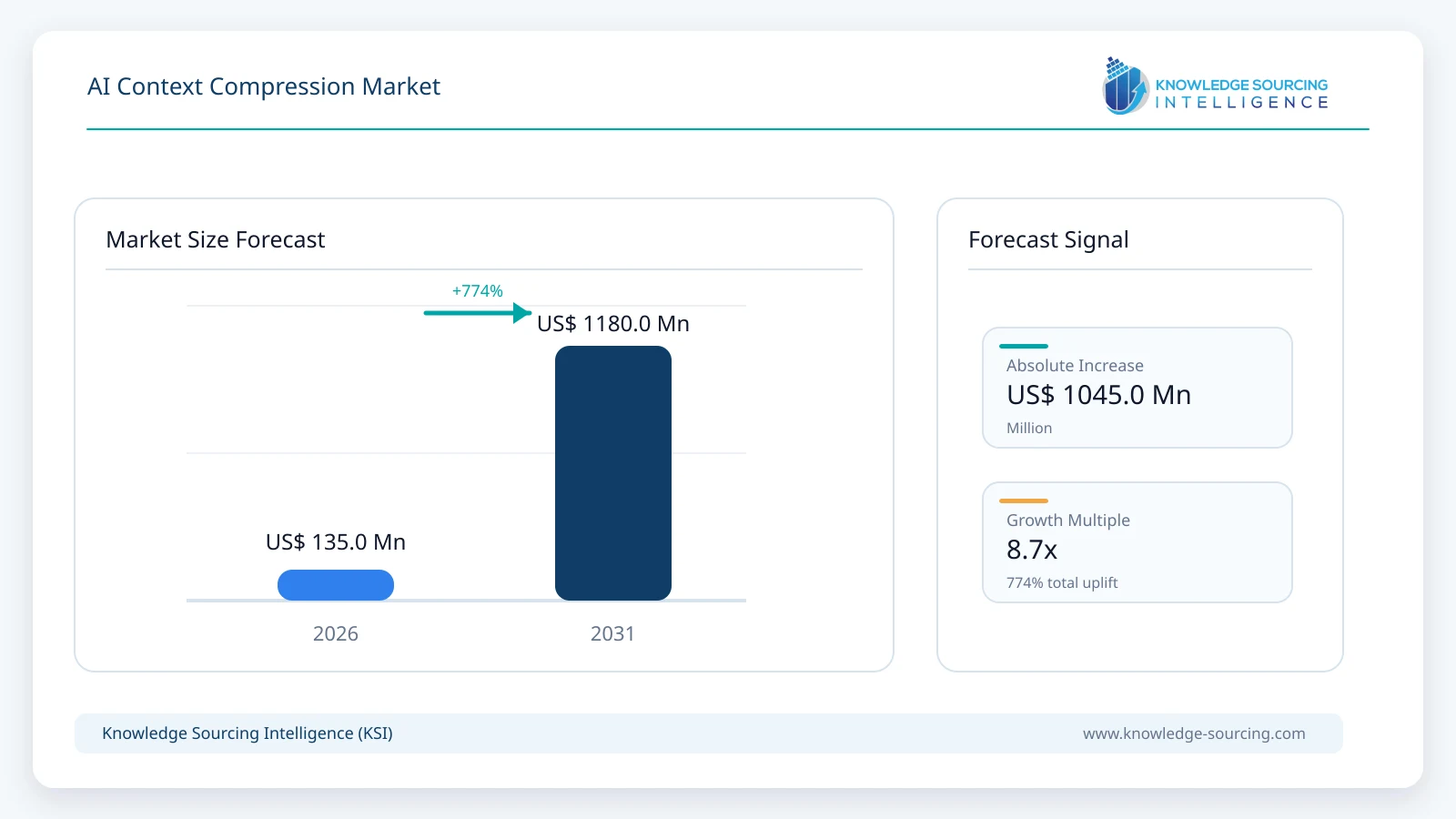
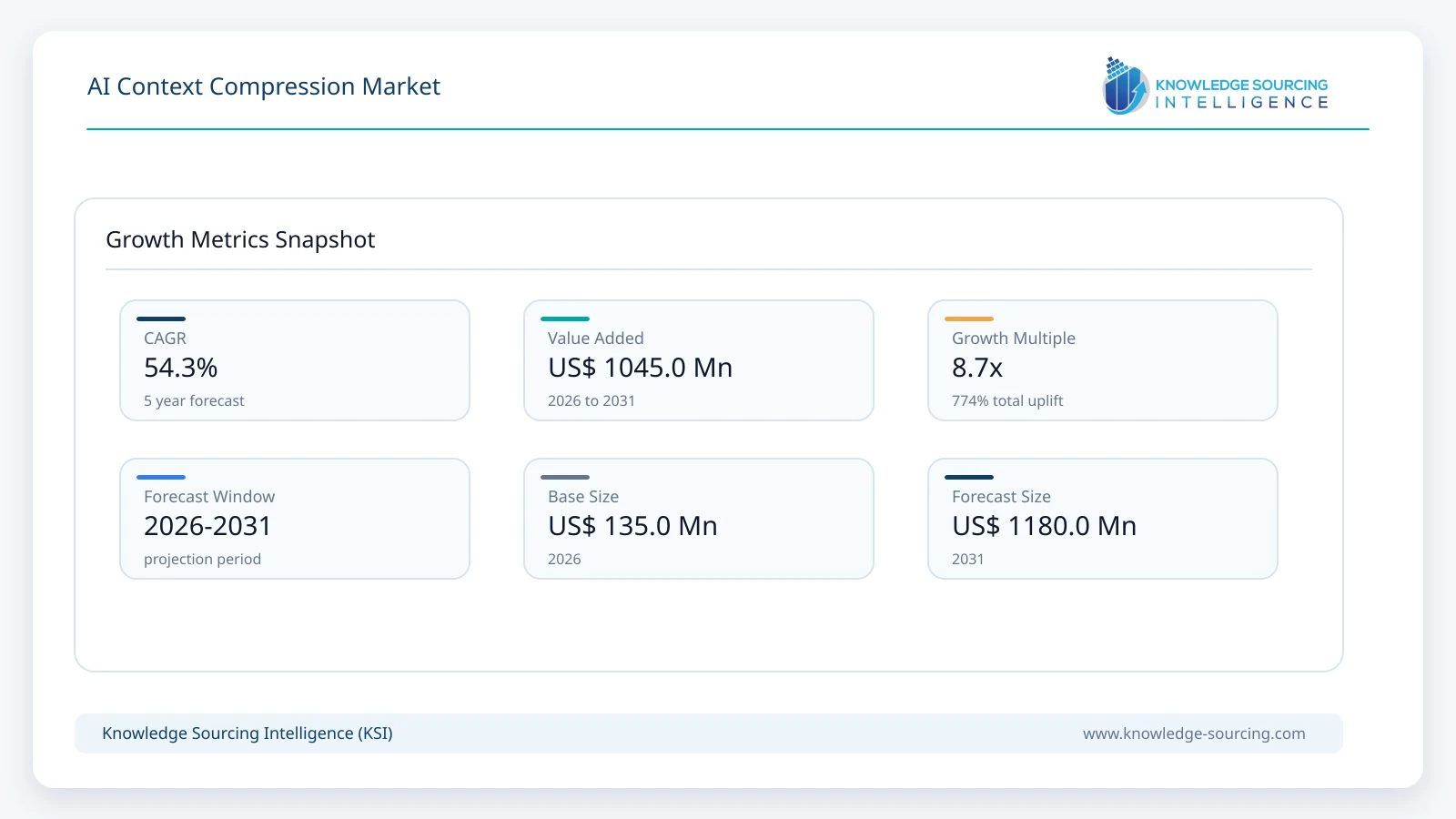
The AI Context Compression Market is projected to grow from USD 135 million in 2026 to USD 1,180 million by 2031, registering a CAGR of 54.28% during the forecast period.
Highlights:
- 1The market is projected to expand from USD 135 million in 2026 to USD 1,180 million by 2031 at 54.28% CAGR.
- 2Managed compression API charging and dedicated context-reduction middleware provide separate purchasing routes for production agent builders.
- 3Conversation and session histories remain the largest compression input in 2026, while tool-output and execution-trace optimization becomes more important.
- 4North America leads revenue, while Asia Pacific grows fastest through higher production agent adoption and cloud API usage.
- 5OpenAI, Anthropic, Oracle, Microsoft, Mastra and specialist agent-framework providers support an increasingly diversified context-compression ecosystem.
Growth reflects the rising cost of repeatedly processing large context windows as enterprises operate persistent, tool-using AI applications. Compression services summarize or selectively reduce accumulated history while preserving practical state for the next model call.
The market covers commercially attributable compaction operations, context-reduction middleware, enterprise quality and governance features, and compression-specific integration. It excludes ordinary foundation-model inference, prompt caching, vector storage, general memory persistence and entire agent runtime contracts. Compression may be triggered by token limits, invoked explicitly by developers or run continuously as an agent executes.
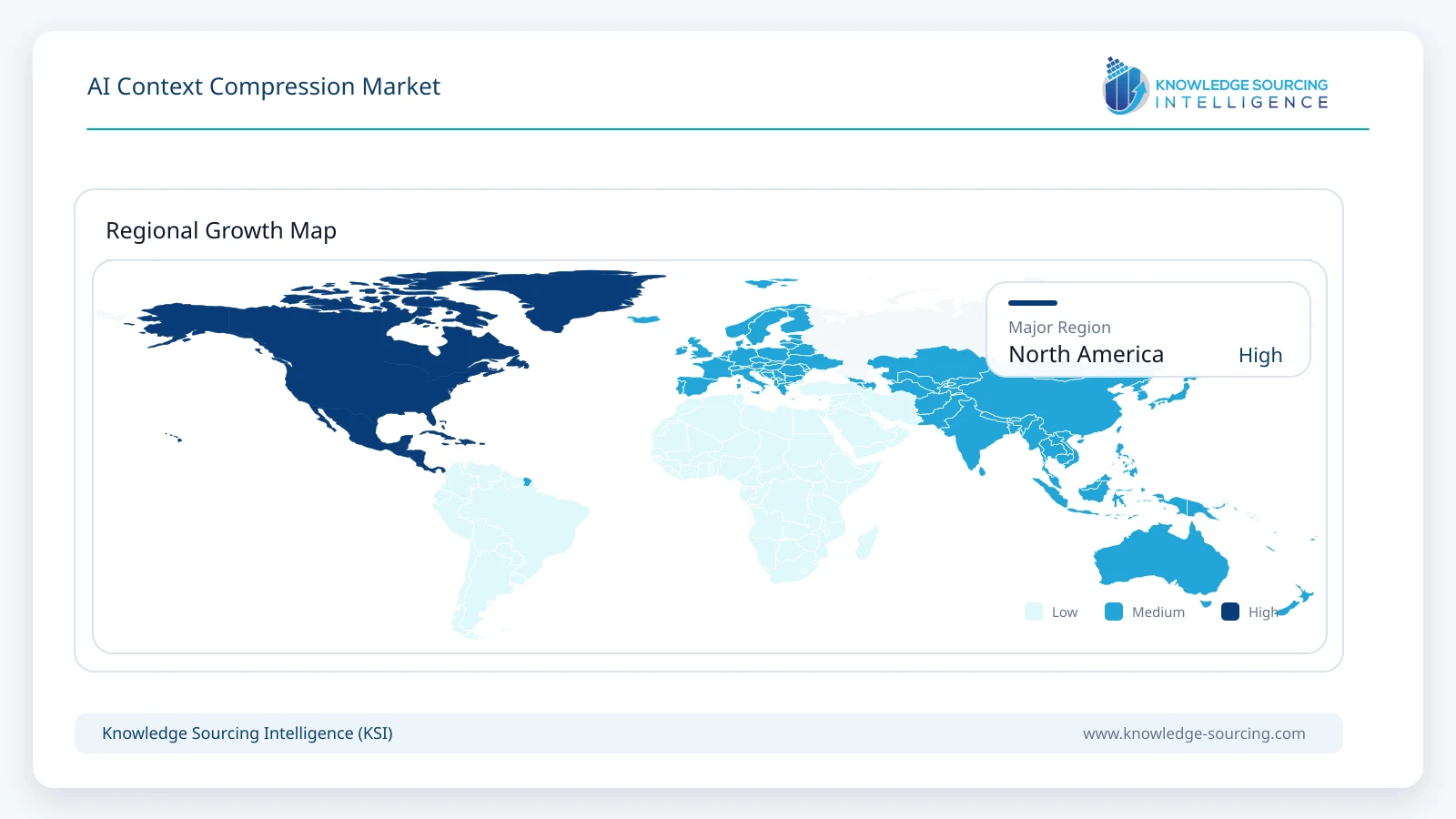
North America represents the largest regional opportunity because cloud model providers, agent-framework suppliers and enterprise developers concentrate paid deployments there. Asia Pacific is expected to grow most rapidly as organizations seek lower inference costs and longer task continuity across multilingual applications. Providers that preserve evidence, permissions and exact task requirements while reducing tokens should command stronger adoption than simple truncation tools.
Long-running AI agents accumulate conversational turns, retrieved files, tool outputs and intermediate analysis as they execute tasks. The resulting token load can raise latency, increase serving costs and displace useful earlier instructions from the model’s active attention. Context compression addresses this problem by retaining task-critical information and condensing content that has become repetitive or no longer relevant. Unlike simple truncation, the process should preserve open constraints, decisions and evidence needed to continue the workflow.
Commercial implementations differ in their treatment of history. Anthropic introduced threshold-driven context compaction for Claude, while OpenAI exposes both server-side and explicit compaction through the Responses API. Microsoft’s Agent Framework defines compaction strategies, and Letta supports summarization through a conversation API. These developments expand availability but also make commodity compression harder to monetize separately.
The growth opportunity is concentrated in workflows where reduced tokens must be balanced with reliable continuity. Coding agents need to preserve file changes and unresolved defects, research assistants need evidence lineage, and customer-facing agents need up-to-date rules and transaction state. Enterprise buyers are likely to evaluate compression based on successful task completion, recoverability and cost per completed workflow rather than the highest advertised reduction ratio.
Market Trends
Managed Compaction Moves into Model and Cloud APIs
Oracle added explicit and automatic compaction to its OCI Responses API in October 2026, following native capabilities introduced by OpenAI and Anthropic. This expansion allows developers to compact conversation history within an existing inference workflow rather than independently operating an extra processing service.
Managed compaction gives buyers a simpler operational model but narrows standalone vendors’ differentiation. Dedicated providers must offer stronger cross-model consistency, quality controls, enterprise reporting or industry-specific preservation policies to justify incremental charges beyond a native platform feature. Procurement teams will increasingly compare whether the same application can resume reliably after compaction across two providers, because a compacted state designed for one model may be unusable in another. Providers with portable, readable task summaries and evaluation logs can therefore address an integration need that is not solved by a single vendor’s opaque compacted representation.
Structured Compression and Context Recovery Gain Attention
Mastra’s observational memory illustrates how session history can be transformed into structured observations and condensed again as interactions accumulate. The architecture is different from a single bulk summary because it prioritizes specific events, decisions and task state during ongoing work.
Production implementations increasingly combine compression with reversible access to original data. LangChain’s Deep Agents retains older context through accessible storage, while Redis describes staged compaction and offloading of verbose tool outputs. Such designs make it easier to recover a detail that was not included in the shortened active context. Recovery becomes especially valuable in financial reconciliation, software debugging and scientific research, where precise figures or evidence citations may be needed after an extended chain of tool calls. An enterprise-grade compressor must also track which source material was removed, retained or linked for later retrieval and allow administrators to test retention outcomes before deployment.
AI Context Compression Market Segment Analysis
By Commercial Offering
Attributable Managed Compaction and Optimization APIs
Attributable managed compaction and optimization APIs increase from USD 38 million in 2026 to USD 435 million in 2031, supported by developers integrating explicit and threshold-triggered compaction into production agents. This offering is forecast to expand faster than dedicated middleware as model-serving platforms embed compaction directly in their APIs.
The model counts only identifiable compression service value rather than the underlying model calls used before or after compression. This distinction is commercially material because enterprises may receive basic compaction within a platform’s existing price rather than purchase a separate software subscription.
By Compression Technique
Structured Observation and State Distillation
Structured observation and state distillation rise from 15% of modeled 2026 revenue to 23% in 2031, representing USD 271.4 million at the forecast endpoint. The approach preserves a compact record of events, decisions and state transitions instead of substituting one undifferentiated summary for a complete agent history.
Providers applying structured compression will compete on evidence retention, ability to recover omitted records and repeated-step correctness. Mastra’s observation and reflection model provides one implementation example, while enterprises building regulated agents may require additional audit fields and controlled access to the source history.
By Primary Context Input
Tool Outputs and Execution Traces
Compression of tool outputs and execution traces accounts for 23% of market revenue in 2026 and 27% by 2031, equal to USD 318.6 million. Web searches, code execution logs, retrieval results and data-processing operations can add large volumes of text that are necessary for one decision but redundant in later reasoning steps.
Task-aware pruning can remove repeated output after a result has been captured in structured state, while keeping pointers to the original evidence. Adoption should favor developer agents and multi-step enterprise assistants that call tools frequently and can demonstrate reduced total input tokens without a measurable decline in task completion.
By Compression Trigger
Continuous or Background Compression
Continuous or background compression expands from 17% of modeled revenue in 2026 to 26% in 2031, or USD 306.8 million. Instead of waiting until the context window is nearly exhausted, these systems build compact intermediate representations while the agent continues working.
Background processing requires controls over summary freshness, additional compute and synchronization with active instructions. The technology is commercially promising for long-running coding and research tasks, but buyers will need evidence that background compression improves reliability enough to justify its operating cost.
By Primary Application
Multi-Agent Operational and Analytical Workflows
Multi-agent operational and analytical workflows grow from 18% of 2026 revenue to 24% in 2031, reaching USD 283.2 million. A coordinating agent often receives long outputs from specialized agents, making concise, faithful handoff artifacts valuable for limiting the context passed between steps.
Commercial demand will depend on preserving authority boundaries, unresolved dependencies and detailed findings when work is delegated. Compressing each sub-agent result can lower coordinator token demand, although the same workflow may require persistent memory or retrieval services that must be counted separately. Successful products will preserve who made each decision, which evidence supported it and what task remains open, so the coordinating agent does not confuse a suggestion with an approved action. These controls matter when workflows distribute analysis across regional or functional teams.
Market Drivers
Growing Token and Latency Burden in Long Agent Workflows
Long-running agent deployments repeatedly send prior tool results, decisions and conversations to models. Compression reduces repeated context without requiring the buyer to shorten the task, creating a clear economic motive for paid compaction services. The purchasing case is strongest for operations with repeated model calls and large tool returns because a single compaction step can reduce tokens sent in many subsequent turns.
Productization of Managed Context Compaction APIs
OpenAI, Anthropic and Oracle expose compaction in model-serving environments, while Letta exposes explicit conversation compaction endpoints. Enterprises can integrate compression without maintaining custom summary logic for each model family. Contract owners must distinguish separately billed compression from inference already included in platform usage to avoid recording the same spend twice.
Rising Need for Faithful Multi-Step Task Handoffs
Coding and research agents must preserve decisions, constraints and unresolved work through context resets. A compression layer that retains evidence and state can reduce missed requirements and repeated tool calls in complex business workflows. Buyers also require compacted context to retain pending approvals, exact configuration values and evidence pointers needed for resuming interrupted work.
Expansion of Structured Observational Compression
Mastra shows a commercial route beyond one-off conversation summaries by transforming raw interactions into dense observations. The approach supports recurring optimization and control of background processing rather than an occasional emergency reset. Monitoring becomes commercially important when an automated compressor may preserve an outdated instruction or lose a constraint that only matters later.
Enterprise Demand for Governed Context Efficiency
Organizations need to inspect what is removed, retained and retrieved after compression, particularly where source provenance and access rights matter. Premium policies, quality evaluations and audit trails create an attributable market beyond free open-source summarizers. Governance modules can expose reduction ratios, lineage and retention decisions by application, helping customers test a compressor before authorizing sensitive workflows.
Market Restraints
Bundled Compaction and Open-Source Tools Limit Capture
Automatic compaction is already embedded in some model APIs, agent frameworks and developer products, leaving little room to charge separately for basic message summarization. A supplier must therefore prove measurable paid value beyond an easily configured framework middleware or native provider setting.
Loss of Critical Facts During Aggressive Reduction
Compression can remove exact quantities, legal wording or intermediate constraints that later become essential, requiring careful testing and often reversible access to original records. Enterprise validation should use downstream tasks containing numerical constraints, approvals and contradictory evidence, rather than only similarity to the original text.
Hard-to-Measure Standalone Savings and Quality
Lower context tokens do not always yield lower total cost because compaction consumes compute and may reduce downstream quality. Buyers need task-level results, not compression ratios alone.
Privacy and Security Exposure in Summary Pipelines
Compressors processing sensitive conversations and tool outputs need data controls, retention policies and tenant isolation that match the original application. Private deployments and redaction policies may be necessary for regulated customers that prohibit raw customer or patient data from external compression endpoints.
Compatibility and Model-Specific Compaction Behavior
Opaque compacted items, provider-specific context schemas and token accounting make interoperability difficult; changes in model serving APIs can undermine third-party middleware economics.
Regional Outlook
North America
North America holds an estimated USD 59.4 million in 2026 and is projected to reach USD 448.4 million by 2031. The United States has a dense concentration of commercial model API suppliers, software engineering agent teams and enterprise AI infrastructure buyers. OpenAI, Anthropic, Microsoft, AWS and agent-tool vendors establish broad access to context compaction mechanisms and associated developer workflows.
Demand is strongest where enterprises operate long sessions with substantial tool usage and need measurable reductions in paid model inputs. Financial services, software and healthcare organizations will increasingly evaluate whether compressed state preserves regulated evidence and task constraints, while vendor bundling is expected to pressure prices for ordinary summarization.
Asia Pacific
Asia Pacific is estimated at USD 31.05 million in 2026 and USD 365.8 million in 2031, representing the fastest-growing major region in the scenario. Agent development in China, India, Japan and South Korea creates demand for maintaining reliable conversational context within latency and budget targets. Multilingual workflows also increase the importance of preserving exact source meaning during reduction.
As application developers adopt more managed model APIs, compression may become a standard part of long-running services rather than an optional developer utility. Hybrid infrastructure, local data residency and cost-conscious deployment models favor providers offering configurable policies, testing and interoperability across cloud and private model stacks.
Competitive Landscape
The competitive environment combines model developers offering integrated compaction, cloud platforms exposing APIs and specialist frameworks building compression into agent workflows. OpenAI, Anthropic and Oracle provide managed approaches, while AWS and Microsoft connect compaction with enterprise application development. Mastra, LangChain, Redis, Letta and LlamaIndex address developer workflows and adjacent context-control infrastructure.
Competitive advantage is expected to move beyond the number of tokens removed. Providers must preserve critical decisions, support optional recovery of original content, maintain permissions and demonstrate cost per successful agent task. Integration simplicity will matter, but separately paid solutions will need a clear operational benefit over built-in API compaction and low-cost open-source tools.
Recent Developments
October 2026: Oracle introduced explicit and automatic context compaction for OCI Responses API workflows, allowing developers to reduce conversation state through an endpoint or an automatic token threshold.
October 2026: Mastra released its Agent Controller with observational memory integration, supporting compressed structured observations within agent execution workflows.
May 2026: Redis published a context compaction framework for AI agents, distinguishing staged, reversible tool-output offloading from lossy conversation summarization.
May 2026: Redis introduced Iris, combining context retrieval, agent memory, integration and caching in a managed context infrastructure product.
March 2026: OpenAI released GPT-5.4 primarily highlighting native computer-use capabilities and a Tool Search feature to support for longer-running agent workflows.
February 2026: Anthropic introduced Claude Opus 4.6 and announced configurable automatic context compaction in beta for extended agent conversations.
Market Outlook
AI context compression is expected to become a routine control in agents that operate over long sessions, use multiple external tools and repeat model calls against accumulated history. The ability to retain high-value task state with a smaller input window can improve both responsiveness and unit economics, especially when workflows extend beyond a single model context limit.
Commercial value will shift toward task-aware, quality-measured compression rather than simple history summaries. Managed API features can bring compaction to a broader base of developers, while premium policies, structured observations and controlled recovery of original records can support additional software revenue in complex enterprise deployments.
Enterprises choosing context compression providers will need to compare actual task outcomes, preservation of decision history and total compute expense. Vendors that demonstrate consistent accuracy across models and maintain strong audit and privacy controls should be better positioned than products competing only on headline compression ratios.
AI Context Compression Market Scope:
| Report Metric | Details |
|---|---|
| Total Market Size in 2026 | USD 135 million |
| Total Market Size in 2031 | USD 1,180 million |
| Forecast Unit | USD Million |
| Growth Rate | 54.28% |
| Study Period | 2021 to 2031 |
| Historical Data | 2021 to 2024 |
| Base Year | 2025 |
| Forecast Period | 2026 – 2031 |
| Segmentation | Commercial Offering, Compression Technique, Primary Context Input, Deployment Model, Compression Trigger, Primary Application, End-User Industry, Geography |
| Companies |
|
| Customization Scope | 15% Free Customization included with purchase — Request Custom Breakdown → |
| Sample & Data Access | PDF Sample, Excel Databook & Analyst Briefing — Download Free Sample → |
Market Segmentation
By Commercial Offering
Dedicated Context Compression Middleware Subscriptions
Attributable Managed Compaction and Optimization APIs
Enterprise Quality Assurance and Policy Modules
Private Domain Compression Integration Services
By Compression Technique
Generative Summarization and Compaction
Selective and Task-Aware Pruning
Structured Observation and State Distillation
Learned Token and Representation Compression
By Primary Context Input
Conversation and Agent Session Histories
Tool Outputs and Execution Traces
Retrieved Documents and RAG Evidence
Code, Knowledge Records and Multimodal Context
By Deployment Model
Managed Cloud APIs and Platforms
Hybrid Cloud
Private Cloud
On-Premises and Edge
By Compression Trigger
Token-Threshold Automatic Compaction
Continuous or Background Compression
On-Demand Explicit Compression
Workflow Checkpoint and Event Driven
By Primary Application
Coding and Software Engineering Agents
Enterprise Knowledge and Research Assistants
Customer Service and Commerce Agents
Multi-Agent Operational and Analytical Workflows
By End-User Industry
Technology, Cloud and Software
Banking and Financial Services
Retail and Business Services
Healthcare and Life Sciences
Manufacturing and Logistics
Government, Education and Others
By Geography
North America
United States
Canada
Mexico
South America
Brazil
Argentina
Rest of South America
Europe
Germany
United Kingdom
France
Netherlands
Italy
Spain
Rest of Europe
Middle East and Africa
United Arab Emirates
Saudi Arabia
Israel
South Africa
Rest of Middle East and Africa
Asia Pacific
China
Japan
India
South Korea
Australia
Singapore
Rest of Asia Pacific
Table of Contents
1. EXECUTIVE SUMMARY
1.1. Research Highlights
1.2. Market Size and Growth Outlook, 2026–2031
1.3. Strategic Market Perspective
2. MARKET SNAPSHOT
2.1. Market Overview
2.2. Market Definition
2.3. Scope of the Study
2.4. Market Segmentation
3. BUSINESS LANDSCAPE
3.1. Market Drivers
3.1.1. Growing Token and Latency Burden in Long Agent Workflows
3.1.2. Productization of Managed Context Compaction APIs
3.1.3. Rising Need for Faithful Multi-Step Task Handoffs
3.1.4. Expansion of Structured Observational Compression
3.1.5. Enterprise Demand for Governed Context Efficiency
3.2. Market Restraints
3.2.1. Bundled Compaction and Open-Source Tools Limit Capture
3.2.2. Loss of Critical Facts During Aggressive Reduction
3.2.3. Hard-to-Measure Standalone Savings and Quality
3.2.4. Privacy and Security Exposure in Summary Pipelines
3.2.5. Compatibility and Model-Specific Compaction Behavior
3.3. Market Opportunities
3.4. Porter’s Five Forces Analysis
3.5. Industry Value Chain Analysis
3.6. Policies and Regulations
3.7. Strategic Recommendations
4. TECHNOLOGICAL OUTLOOK
4.1. Threshold and On-Demand History Compaction
4.2. Structured Observations and State Distillation
4.3. Tool-Output Pruning and Recoverable Offloading
4.4. Quality Controls and Context Fidelity Tests
4.5. Cross-Model Integration and Context Privacy
5. AI CONTEXT COMPRESSION MARKET BY COMMERCIAL OFFERING
5.1. Introduction
5.2. Dedicated context compression middleware subscriptions
5.3. Attributable managed compaction and optimization APIs
5.4. Enterprise quality assurance and policy modules
5.5. Private domain compression integration services
6. AI CONTEXT COMPRESSION MARKET BY COMPRESSION TECHNIQUE
6.1. Introduction
6.2. Generative summarization and compaction
6.3. Selective and task-aware pruning
6.4. Structured observation and state distillation
6.5. Learned token and representation compression
7. AI CONTEXT COMPRESSION MARKET BY PRIMARY CONTEXT INPUT
7.1. Introduction
7.2. Conversation and agent session histories
7.3. Tool outputs and execution traces
7.4. Retrieved documents and RAG evidence
7.5. Code, knowledge records and multimodal context
8. AI CONTEXT COMPRESSION MARKET BY DEPLOYMENT MODEL
8.1. Introduction
8.2. Managed cloud APIs and platforms
8.3. Hybrid cloud
8.4. Private cloud
8.5. On-premises and edge
9. AI CONTEXT COMPRESSION MARKET BY COMPRESSION TRIGGER
9.1. Introduction
9.2. Token-threshold automatic compaction
9.3. Continuous or background compression
9.4. On-demand explicit compression
9.5. Workflow checkpoint and event driven
10. AI CONTEXT COMPRESSION MARKET BY PRIMARY APPLICATION
10.1. Introduction
10.2. Coding and software engineering agents
10.3. Enterprise knowledge and research assistants
10.4. Customer service and commerce agents
10.5. Multi-agent operational and analytical workflows
11. AI CONTEXT COMPRESSION MARKET BY END-USER INDUSTRY
11.1. Introduction
11.2. Technology, cloud and software
11.3. Banking and financial services
11.4. Retail and business services
11.5. Healthcare and life sciences
11.6. Manufacturing and logistics
11.7. Government, education and others
12. AI CONTEXT COMPRESSION MARKET BY GEOGRAPHY
12.1. North America
12.1.1. United States
12.1.2. Canada
12.1.3. Mexico
12.2. South America
12.2.1. Brazil
12.2.2. Argentina
12.2.3. Rest of South America
12.3. Europe
12.3.1. Germany
12.3.2. United Kingdom
12.3.3. France
12.3.4. Netherlands
12.3.5. Italy
12.3.6. Spain
12.3.7. Rest of Europe
12.4. Middle East and Africa
12.4.1. United Arab Emirates
12.4.2. Saudi Arabia
12.4.3. Israel
12.4.4. South Africa
12.4.5. Rest of Middle East and Africa
12.5. Asia Pacific
12.5.1. China
12.5.2. Japan
12.5.3. India
12.5.4. South Korea
12.5.5. Australia
12.5.6. Singapore
12.5.7. Rest of Asia Pacific
13. COMPETITIVE ENVIRONMENT AND ANALYSIS
13.1. Major Players and Strategy Analysis
13.2. Market Share Analysis
13.3. Mergers, Acquisitions, Agreements, and Collaborations
13.4. Competitive Dashboard
14. COMPANY PROFILES
14.1. OpenAI, L.L.C.
14.2. Anthropic PBC
14.3. Oracle Corporation
14.4. Amazon Web Services, Inc.
14.5. Microsoft Corporation
14.6. Mastra
14.7. LangChain, Inc.
14.8. Redis Ltd.
14.9. Letta, Inc.
14.10. LlamaIndex
15. APPENDIX
15.1. Currency
15.2. Assumptions
15.3. Base and Forecast Years Timeline
15.4. Key Benefits for Stakeholders
15.5. Research Methodology
15.6. Abbreviations





Frequently asked questions
What is the projected AI Context Compression market size by 2031?
The AI Context Compression Market is projected to reach USD 1,180 million by 2031.
What is the Compound Annual Growth Rate (CAGR) for 2026-2031?
The AI Context Compression Market will grow at a 54.28% CAGR from 2026 to 2031.
Which region currently leads the AI Context Compression market revenue?
North America represents the largest regional revenue opportunity.
Which region is projected to grow fastest in this market?
Asia Pacific is expected to grow most rapidly.
What are the main drivers of AI Context Compression market growth?
Rising costs of large context windows and persistent AI applications.
What was the largest compression input in 2026?
Conversation and session histories were the largest input.
Cite this report
Knowledge Sourcing Intelligence. (Oct 2026). AI Context Compression Market Size, Share & Growth Forecast (2026-2031). https://www.knowledge-sourcing.com/report/ai-context-compression-market