
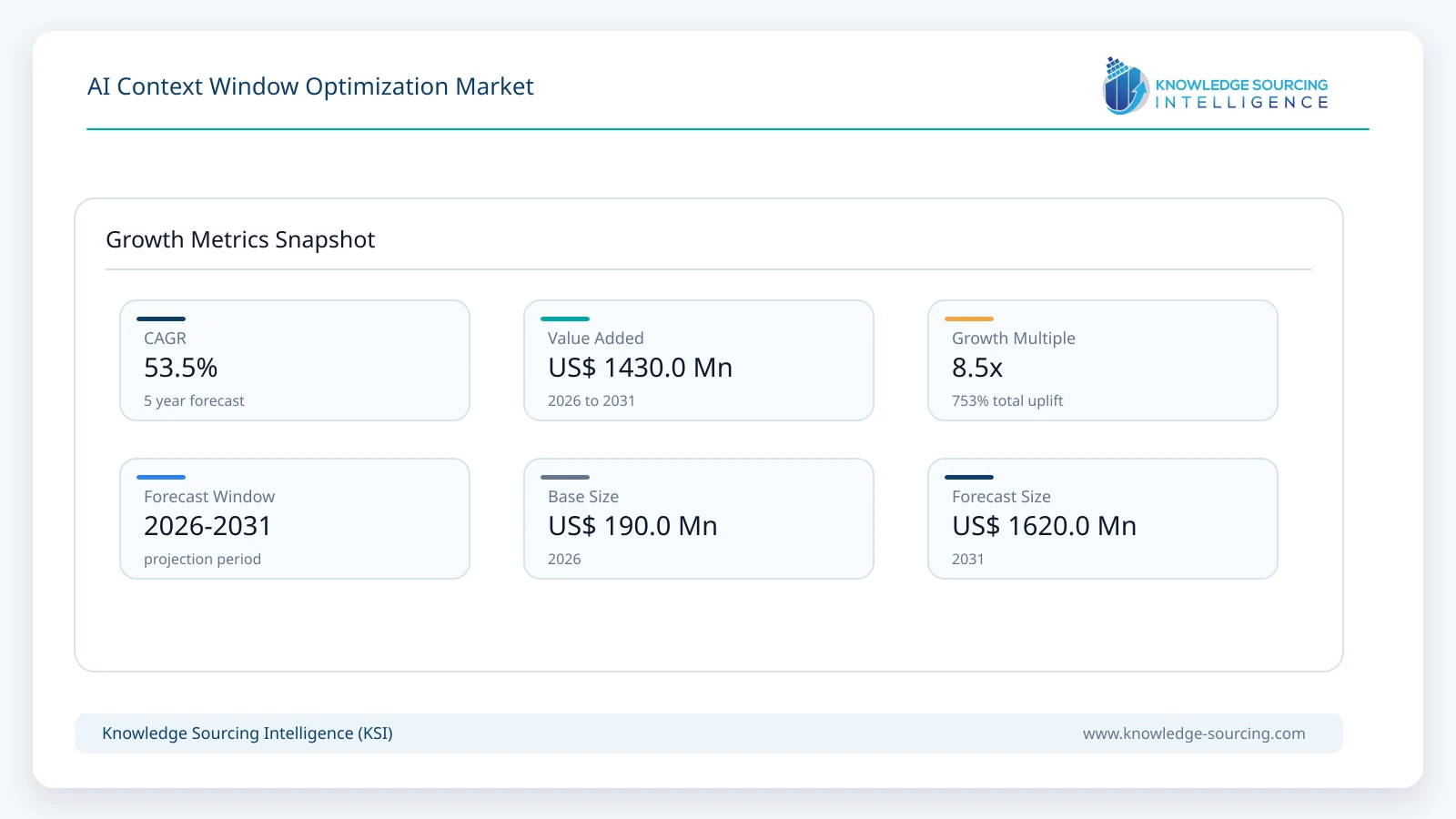
The AI Context Window Optimization Market is estimated at USD 190 million in 2026 and is projected to reach USD 1,620 million by 2031, growing at a CAGR of 53.52% during the forecast period.
Highlights:
- 1Global modeled revenue increases from USD 190 million in 2026 to USD 1,620 million in 2031 at 53.52% CAGR.
- 2Dedicated window-optimization software and paid agent-platform modules provide distinct routes to monetization.
- 3Adaptive token allocation and relevance-based assembly are the principal optimization capabilities, with event-driven policies expanding in importance.
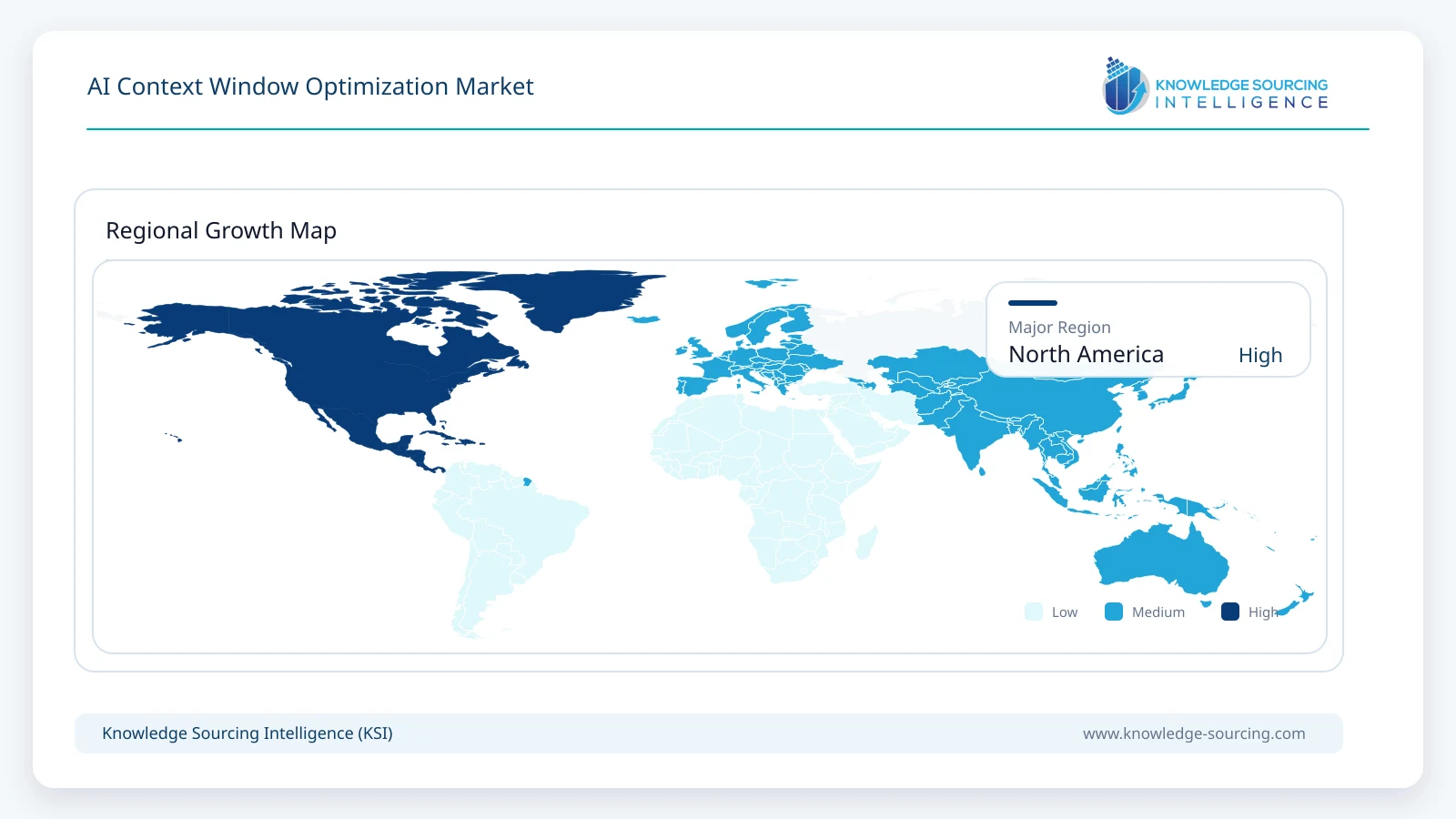
- 4North America leads the base-year market while Asia Pacific expands fastest as production agent adoption grows.
- 5Microsoft, Anthropic, Google, AWS, Redis, LangChain and retrieval specialists support the emerging competitive landscape.
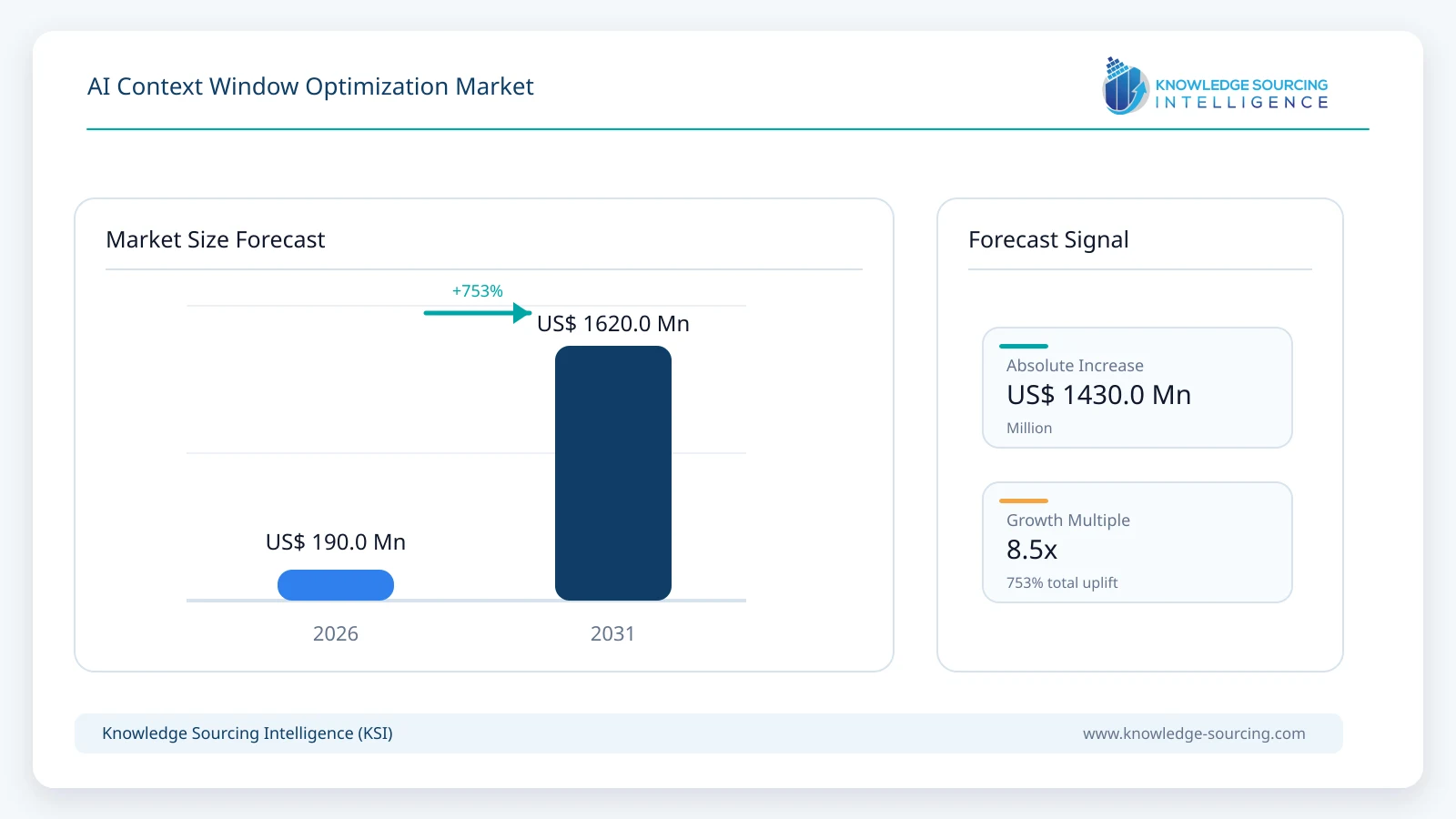
Growth reflects production use of AI agents that retrieve multiple sources and perform successive tool calls, making the quality and size of each model input increasingly important to operating costs and task outcomes.
The market includes attributable optimization middleware, premium controls within paid agent platforms, metered selection and reranking operations, and dedicated policy or integration services. It excludes foundation-model tokens, undifferentiated caching, full retrieval-platform subscriptions, persistent memory storage and context compression services. Optimization assembles and prioritizes the active window rather than generating a shortened replacement of historical content.
North America remains the largest regional opportunity because model providers, cloud vendors and enterprises running long agent workflows are concentrated there. Asia Pacific is forecast to grow fastest as companies deploy multilingual assistants and cost-sensitive enterprise automation. Providers that offer strong evidence selection, measurable task-level evaluation and consistent performance across model families should gain commercial traction.
Long input windows do not automatically guarantee that AI agents use the correct evidence. A model may receive outdated tool output, duplicated retrieval passages and low-relevance history alongside the instructions needed to complete a task. Context window optimization responds by allocating a token budget, selecting authoritative material and arranging the resulting context so that a model can work with high-signal information. The goal is better output per unit of model input, not simply a smaller prompt.
The technology combines several existing functions that are converging in production systems. Microsoft Agent Framework uses context providers to inject relevant information, Google documents long-context caching and its cost implications, and Anthropic supports selective context editing. Redis Iris routes among cached responses, retained knowledge and live data. Specialist relevance providers can rank candidate retrieval passages before expensive model processing, but a paid optimizer must provide more than an ordinary search service.
The strongest business use cases involve repeated or tool-heavy inference where context choices affect both costs and accuracy. Software engineering agents need source files, error traces and recent changes, while regulated research and enterprise assistants need trustworthy citations and explicit access controls. Buyers will favor tools that demonstrate lower context waste without losing material facts, breaking cache reuse or increasing latency through excessive selection steps.
Market Trends
Adaptive Context Assembly Becomes a Runtime Control
Microsoft Agent Framework describes context providers that supply user information, conversation history, knowledge retrieval and dynamic instructions before each model invocation. These controls make context assembly a repeatable software operation rather than manually concatenating prompt blocks. Production demand grows as applications combine private records, tool outputs and model-specific system instructions.
The practical challenge is allocating token space across competing sources without displacing material required for the next decision. Enterprises will increasingly configure priority rules, minimum evidence quotas and model-aware budgets, creating a paid opportunity for runtime policies, monitoring and task-level evaluation rather than simple prompt templates.
Cache-Aware Selection and Long-Context Economics Converge
Google Cloud has documented the financial value of cached inputs for long-context Gemini workflows, while October 2026 Gemini API guidance explains implicit caching and reusable-prefix behavior. As more model families support large windows, developers must decide when to reuse a stable prefix and when to inject newly retrieved data. A context optimizer can improve cache-hit potential while preserving freshness for changing operational records.
Caching by itself does not constitute a new optimization-service sale. Commercial differentiation depends on deciding which common instructions can remain stable, selecting records that justify a fresh model input and reconciling response quality with total workflow cost. This favors independent evaluation and routing tools capable of working across multiple inference providers.
AI Context Window Optimization Market Segment Analysis
By Commercial Offering
Dedicated Context-Window Optimization Software
Dedicated context-window optimization software increases from USD 68 million in 2026 to USD 515 million in 2031. The segment includes identifiable licenses for prompt assembly policies, adaptive token budgeting, context selection and performance measurement across several model APIs. Enterprise customers are most likely to pay when one centrally managed service can replace bespoke context code distributed across multiple applications.
Specialist suppliers face competition from native model settings and open-source context providers. Contract value should therefore depend on demonstrated cost per successful task, governance features and model interoperability rather than the number of contexts processed. The modeled segment excludes model inference tokens and charges already attributable to retrieval databases.
By Optimization Function
Adaptive Token-Budget Allocation
Adaptive token-budget allocation rises from 23% of modeled 2026 revenue to 27% in 2031, equivalent to USD 437.4 million at the forecast endpoint. The function assigns different portions of the window to instructions, retrieval passages, recent activity and operational state based on task complexity and model limits.
Model-aware budgeting can reduce unnecessary retrieval volume and preserve reserved capacity for tool responses or final output. Enterprises will need safeguards against dropping rare requirements and evaluation of downstream task outcomes before permitting automatic allocation in regulated workflows.
By Context Source
Tool Outputs and Execution Records
Tool outputs and execution records increase from 19% of market revenue in 2026 to 24% in 2031, equal to USD 388.8 million. Coding, analytics and research agents commonly return verbose search, file, database and execution results that compete for limited prompt space. Context selection can prioritize the subset relevant to the next decision while retaining original results outside the active window.
The business case strengthens as agents complete multi-stage workflows that repeatedly reassemble context. Providers able to identify stale tool results, preserve the latest authoritative values and honor user permissions should create more value than products that simply retain the last fixed number of messages.
By Optimization Trigger
Event or Tool-Result Driven
Event or tool-result driven optimization grows from 18% of revenue in 2026 to 22% in 2031, reaching USD 356.4 million. The optimizer reassesses context when a search completes, a database record changes or an agent moves to a new task phase rather than waiting for a fixed token threshold.
This model can improve freshness and lower unnecessary context reconstruction, provided applications use practical rules to avoid repeated selection calls. Buyers should assess latency, evidence continuity and the reliability of the update trigger rather than prioritizing context reduction alone.
By Application
Multi-Agent and Autonomous Workflows
Multi-agent and autonomous workflows account for 8% of 2026 modeled revenue and 14% in 2031, corresponding to USD 226.8 million. Coordinator agents must select relevant messages from several specialist agents while maintaining a consistent account of task priorities, source evidence and pending decisions.
As delegation becomes more common, context-window optimizers may serve as a shared control plane for handoff payloads. Their commercial value is distinct from storing long-term memory or compressing every agent history, and purchase decisions are likely to reflect cross-agent reliability and governance requirements.
Market Drivers
Rapid Growth in Long-Running Agent Context Demand
Enterprise assistants increasingly process numerous tool results, documents and task updates within a single workflow. Selecting the highest-value inputs before each model call reduces needless tokens and preserves attention for decisions that directly influence task completion. Demand is highest where agents revisit the same projects repeatedly and must balance response times against accuracy.
Rising Costs of Unnecessary Input Tokens
Repeatedly injecting entire document collections or verbose execution logs increases model inference bills. Google Cloud documents context caching and prompt reduction as routes to lower traffic and cost. Commercial optimizer controls can combine relevance screening, token budgeting and reusable prefixes to improve the expense of a completed workflow rather than merely cut a single prompt.
More Complex Retrieval and Tool-Use Pipelines
Production agent systems draw from documents, knowledge graphs, APIs and live business systems. Redis Iris and Microsoft context providers show how multiple sources can be assembled dynamically. Buyers increasingly require a control layer that selects which records enter the window and in what order while avoiding stale, redundant or inaccessible evidence.
Operationalization of Adaptive Context Budgets
Model providers now offer differing context capacities, latency profiles and cached-token economics. Optimization software can allocate input space based on task type, model selection, recent tool events and retrieval confidence. Adaptive budgeting becomes commercially valuable when the same enterprise fleet operates multiple model families with different price and capacity structures.
Demand for Auditable Context Quality
Regulated enterprises need assurance that optimized context retains critical instructions, cited evidence and permissions. Quality tests that compare task outcomes against the unfiltered context can justify enterprise governance subscriptions. Vendors able to trace which inputs were selected, rejected and reused are positioned to win higher-value production deployments.
Market Restraints
Bundled Model and Framework Features Reduce Standalone Spending
Cloud platforms, model APIs and open-source frameworks already provide configurable context controls. Basic trimming, prompt caching and document ranking may be available without a separate fee, making independent optimizer revenue difficult to isolate. Standalone vendors must demonstrate measurable improvements beyond what buyers receive from their existing software.
Risk of Discarding Necessary Evidence
Aggressive selection can remove a decisive but infrequently mentioned fact, causing an agent to miss a requirement or overlook contradictory information. The risk becomes more serious in financial, healthcare and software maintenance tasks. Customers need task-based evaluations, safe fallbacks and access to original records before trusting automatic filters.
Interoperability and Model-Specific Token Accounting
Tokenizer rules, cache-hit behavior, context-window sizes and tool-message formats differ across model providers. A strategy that works for one API may produce inconsistent costs or degraded outcomes with another. Supporting several models and fast-changing inference APIs raises maintenance expense and can slow customer adoption.
Fragmented Attribution within Broader AI Infrastructure
Context selection often sits alongside retrieval, vector databases, reranking, compression and agent memory in one contract. This bundling complicates budget ownership and may limit customers’ willingness to buy another feature. Supplier revenue attribution requires a defensible incremental license, usage fee or implementation line rather than allocation of entire platform revenue.
Privacy and Latency Constraints on Dynamic Selection
Sending sensitive retrieved documents to an external reranker or optimizer may violate data restrictions. Additional selection calls can also increase end-to-end latency and erase some efficiency gains. Enterprise users need private processing, access control and clear thresholds for invoking expensive quality checks.
Regional Outlook
North America
North America is estimated at USD 85.5 million in 2026 and is projected to reach USD 615.6 million by 2031. The United States anchors regional demand through model-platform suppliers, enterprise agent software, cloud infrastructure and mature developer ecosystems. Microsoft, Anthropic, Google, AWS and specialized retrieval companies provide a range of technologies used to assemble and prioritize active context.
Banks, technology providers, healthcare enterprises and research-intensive businesses increasingly need reliable context construction across many workflows. Procurement is expected to focus on demonstrable inference-cost reductions, source-access controls and audited task quality. Bundled context features will constrain prices for basic configuration, while cross-platform optimization and governance can support premium spending.
Asia Pacific
Asia Pacific is estimated at USD 39.9 million in 2026 and USD 469.8 million in 2031, giving the region the fastest modeled growth. China, India, Japan and South Korea are expected to expand production uses of AI assistants, software agents and automated enterprise knowledge workflows. Multilingual content, varying model deployments and budget-conscious cloud consumption support demand for selective retrieval and adaptive input management.
Organizations may combine regional cloud services, private enterprise information and locally deployed models, requiring context controls that adapt to different token limits and data policies. The most relevant suppliers will be those that support mixed infrastructure without forcing enterprises to replace retrieval platforms or buy duplicate memory services.
Competitive Landscape
Competition in context window optimization crosses model-platform suppliers, agent runtime vendors, retrieval specialists and context infrastructure providers. Microsoft, Google, AWS and Anthropic provide important developer features, while LangChain and LlamaIndex offer integration frameworks. Redis contributes managed context pathways; Cohere, Pinecone and Databricks provide relevance or retrieval components that can improve which evidence reaches a model. OpenAI supports context handling at the model API level.
Supplier positioning depends on ownership of an incremental paid decision layer. Entire model subscriptions and databases cannot be assigned to this market simply because they include context controls. Commercial competitors will differentiate through token-budget analytics, ranking quality, stable cache reuse, authorization safeguards and ability to measure results across heterogeneous models.
Recent Developments
October 2026: Google updated Gemini API context-caching guidance, documenting implicit caching behavior and model-specific conditions for reusable prompt prefixes.
August 2026: AWS announced support for OpenAI models with million-token windows on Amazon Bedrock in India, extending the production environment for managing extensive active context.
August 2026: Redis published guidance on context-aware agent memory, emphasizing selective recall and memory scopes rather than replaying complete history.
June 2026: Microsoft Research presented ACON at ICML 2026, evaluating optimized agent context processing and token-use reductions while preserving task outcomes.
May 2026: AWS published an AgentCore method for processing documents beyond model context windows through recursive access and persistent code execution.
May 2026: Redis introduced Iris, combining real-time context retrieval, caching, integration and memory components for enterprise agents.
Market Outlook
AI context window optimization will become more important as enterprise agents draw simultaneously on internal records, external retrieval, recent history and tool execution results. Larger model context limits increase available capacity, but they do not guarantee relevance, accuracy or affordable operation. Buyers will increasingly measure the quality of the information sent to a model and the cost of completing a task rather than the maximum number of tokens supported.
Commercial growth is expected to center on adaptive assembly policies, independently attributable paid optimization modules and metered relevance controls. Model APIs and open-source frameworks will supply many standard functions without incremental charges, placing pressure on specialist vendors to prove cross-model efficiency and stronger production reliability.
Enterprises selecting context optimization software should test retrieval relevance, preservation of critical constraints, latency, privacy and cache efficiency against unoptimized baselines. Vendors that document task-level benefits and avoid double counting memory, compression or underlying inference charges are better positioned for sustainable enterprise adoption.
AI Context Window Optimization Market Scope:
| Report Metric | Details |
|---|---|
| Total Market Size in 2026 | USD 190 million |
| Total Market Size in 2031 | USD 1,620 million |
| Forecast Unit | USD Million |
| Growth Rate | 53.52% |
| Study Period | 2021 to 2031 |
| Historical Data | 2021 to 2024 |
| Base Year | 2025 |
| Forecast Period | 2026 – 2031 |
| Segmentation | Commercial Offering, Primary Optimization Function, Context Source, Optimization Decision Trigger, Deployment Model, Primary Application, End-User Industry, Geography |
| Companies |
|
| Customization Scope | 15% Free Customization included with purchase — Request Custom Breakdown → |
| Sample & Data Access | PDF Sample, Excel Databook & Analyst Briefing — Download Free Sample → |
Market Segmentation
By Commercial Offering
Dedicated Context-Window Optimization Software
Attributable Paid Agent-Platform Optimization Modules
Metered Relevance, Reranking and Context-Selection APIs
Enterprise Policy, Evaluation and Deployment Services
By Primary Optimization Function
Relevance-Based Context Selection
Adaptive Token-Budget Allocation
Context Ordering and Evidence Prioritization
Cache-Aware Reuse and Prefix Planning
Conversation and Tool-History Pruning Control
By Context Source
Retrieved Knowledge and RAG Evidence
Agent Conversation and Task History
Tool Outputs and Execution Records
Codebase and Developer Workspace Data
Structured Records and Multimodal Inputs
By Optimization Decision Trigger
Per-Request Context Assembly
Token-Budget and Utilization Thresholds
Event or Tool-Result Driven
Cache Availability and Model-Routing Event
Feedback-Driven Periodic Tuning
By Deployment Model
Managed Cloud and API Services
Hybrid Cloud
Private Cloud
On-Premises and Edge
By Primary Application
Coding and Software Engineering Agents
Enterprise Research and Knowledge Assistants
Customer Experience and Service Agents
Analytics and Operational Copilots
Multi-Agent and Autonomous Workflows
By End-User Industry
Technology, Cloud and Software
Banking and Financial Services
Retail and Professional Services
Healthcare and Life Sciences
Manufacturing and Logistics
Government, Education and Others
By Geography
North America
United States
Canada
Mexico
South America
Brazil
Argentina
Rest of South America
Europe
Germany
United Kingdom
France
Netherlands
Italy
Spain
Rest of Europe
Middle East and Africa
United Arab Emirates
Saudi Arabia
Israel
South Africa
Rest of Middle East and Africa
Asia Pacific
China
Japan
India
South Korea
Australia
Singapore
Rest of Asia Pacific
Table of Contents
1. EXECUTIVE SUMMARY
1.1. Research Highlights
1.2. Market Size and Growth Outlook, 2026–2031
1.3. Strategic Market Perspective
2. MARKET SNAPSHOT
2.1. Market Overview
2.2. Market Definition
2.3. Scope of the Study
2.4. Market Segmentation
3. BUSINESS LANDSCAPE
3.1. Market Drivers
3.1.1. Rapid Growth in Long-Running Agent Context Demand
3.1.2. Rising Costs of Unnecessary Input Tokens
3.1.3. More Complex Retrieval and Tool-Use Pipelines
3.1.4. Operationalization of Adaptive Context Budgets
3.1.5. Demand for Auditable Context Quality
3.2. Market Restraints
3.2.1. Bundled Model and Framework Features Reduce Standalone Spending
3.2.2. Risk of Discarding Necessary Evidence
3.2.3. Interoperability and Model-Specific Token Accounting
3.2.4. Fragmented Attribution within Broader AI Infrastructure
3.2.5. Privacy and Latency Constraints on Dynamic Selection
3.3. Market Opportunities
3.4. Porter’s Five Forces Analysis
3.5. Industry Value Chain Analysis
3.6. Policies and Regulations
3.7. Strategic Recommendations
4. TECHNOLOGICAL OUTLOOK
4.1. Context Relevance Scoring and Retrieval Prioritization
4.2. Model-Aware Token Budgeting and Context Allocation
4.3. Document Ordering, Evidence Packing and Provenance
4.4. Prefix Reuse, Caching and Active Window Freshness
4.5. Runtime Policy Evaluation and Cross-Model Quality Testing
5. AI CONTEXT WINDOW OPTIMIZATION MARKET BY COMMERCIAL OFFERING
5.1. Introduction
5.2. Dedicated context-window optimization software
5.3. Attributable paid agent-platform optimization modules
5.4. Metered relevance, reranking and context-selection APIs
5.5. Enterprise policy, evaluation and deployment services
6. AI CONTEXT WINDOW OPTIMIZATION MARKET BY PRIMARY OPTIMIZATION FUNCTION
6.1. Introduction
6.2. Relevance-based context selection
6.3. Adaptive token-budget allocation
6.4. Context ordering and evidence prioritization
6.5. Cache-aware reuse and prefix planning
6.6. Conversation and tool-history pruning control
7. AI CONTEXT WINDOW OPTIMIZATION MARKET BY CONTEXT SOURCE
7.1. Introduction
7.2. Retrieved knowledge and RAG evidence
7.3. Agent conversation and task history
7.4. Tool outputs and execution records
7.5. Codebase and developer workspace data
7.6. Structured records and multimodal inputs
8. AI CONTEXT WINDOW OPTIMIZATION MARKET BY OPTIMIZATION DECISION TRIGGER
8.1. Introduction
8.2. Per-request context assembly
8.3. Token-budget and utilization thresholds
8.4. Event or tool-result driven
8.5. Cache availability and model-routing event
8.6. Feedback-driven periodic tuning
9. AI CONTEXT WINDOW OPTIMIZATION MARKET BY DEPLOYMENT MODEL
9.1. Introduction
9.2. Managed cloud and API services
9.3. Hybrid cloud
9.4. Private cloud
9.5. On-premises and edge
10. AI CONTEXT WINDOW OPTIMIZATION MARKET BY PRIMARY APPLICATION
10.1. Introduction
10.2. Coding and software engineering agents
10.3. Enterprise research and knowledge assistants
10.4. Customer experience and service agents
10.5. Analytics and operational copilots
10.6. Multi-agent and autonomous workflows
11. AI CONTEXT WINDOW OPTIMIZATION MARKET BY END-USER INDUSTRY
11.1. Introduction
11.2. Technology, cloud and software
11.3. Banking and financial services
11.4. Retail and professional services
11.5. Healthcare and life sciences
11.6. Manufacturing and logistics
11.7. Government, education and others
12. AI CONTEXT WINDOW OPTIMIZATION MARKET BY GEOGRAPHY
12.1. North America
12.1.1. United States
12.1.2. Canada
12.1.3. Mexico
12.2. South America
12.2.1. Brazil
12.2.2. Argentina
12.2.3. Rest of South America
12.3. Europe
12.3.1. Germany
12.3.2. United Kingdom
12.3.3. France
12.3.4. Netherlands
12.3.5. Italy
12.3.6. Spain
12.3.7. Rest of Europe
12.4. Middle East and Africa
12.4.1. United Arab Emirates
12.4.2. Saudi Arabia
12.4.3. Israel
12.4.4. South Africa
12.4.5. Rest of Middle East and Africa
12.5. Asia Pacific
12.5.1. China
12.5.2. Japan
12.5.3. India
12.5.4. South Korea
12.5.5. Australia
12.5.6. Singapore
12.5.7. Rest of Asia Pacific
13. COMPETITIVE ENVIRONMENT AND ANALYSIS
13.1. Major Players and Strategy Analysis
13.2. Market Share Analysis
13.3. Mergers, Acquisitions, Agreements, and Collaborations
13.4. Competitive Dashboard
14. COMPANY PROFILES
14.1. Microsoft Corporation
14.2. Anthropic PBC
14.3. Google LLC
14.4. Amazon Web Services, Inc.
14.5. Redis Ltd.
14.6. LangChain, Inc.
14.7. LlamaIndex
14.8. Cohere Inc.
14.9. Pinecone Systems, Inc.
14.10. Databricks, Inc.
14.11. OpenAI, L.L.C.
15. APPENDIX
15.1. Currency
15.2. Assumptions
15.3. Base and Forecast Years Timeline
15.4. Key Benefits for Stakeholders
15.5. Research Methodology
15.6. Abbreviations





Frequently asked questions
What is the projected market size for AI Context Window Optimization by 2031?
The AI Context Window Optimization Market is projected to reach USD 1,620 million by 2031.
What is the growth rate (CAGR) of the AI Context Window Optimization market?
The AI Context Window Optimization Market is growing at a 53.52% CAGR from 2026 to 2031.
Which region currently leads the AI Context Window Optimization market?
North America leads the base-year market, representing the largest opportunity.
Which region is projected to experience the fastest market growth?
Asia Pacific is forecast to grow fastest with increasing production agent adoption.
What are the main drivers for AI Context Window Optimization market growth?
Growth reflects production use of AI agents performing multiple source retrievals.
Who are the key players in the AI Context Window Optimization market?
Microsoft, Anthropic, Google, AWS, Redis, and LangChain are key players.
Cite this report
Knowledge Sourcing Intelligence. (Oct 2026). AI Context Window Optimization Market Size, Share & Growth Forecast (2026-2031). https://www.knowledge-sourcing.com/report/ai-context-window-optimization-market