
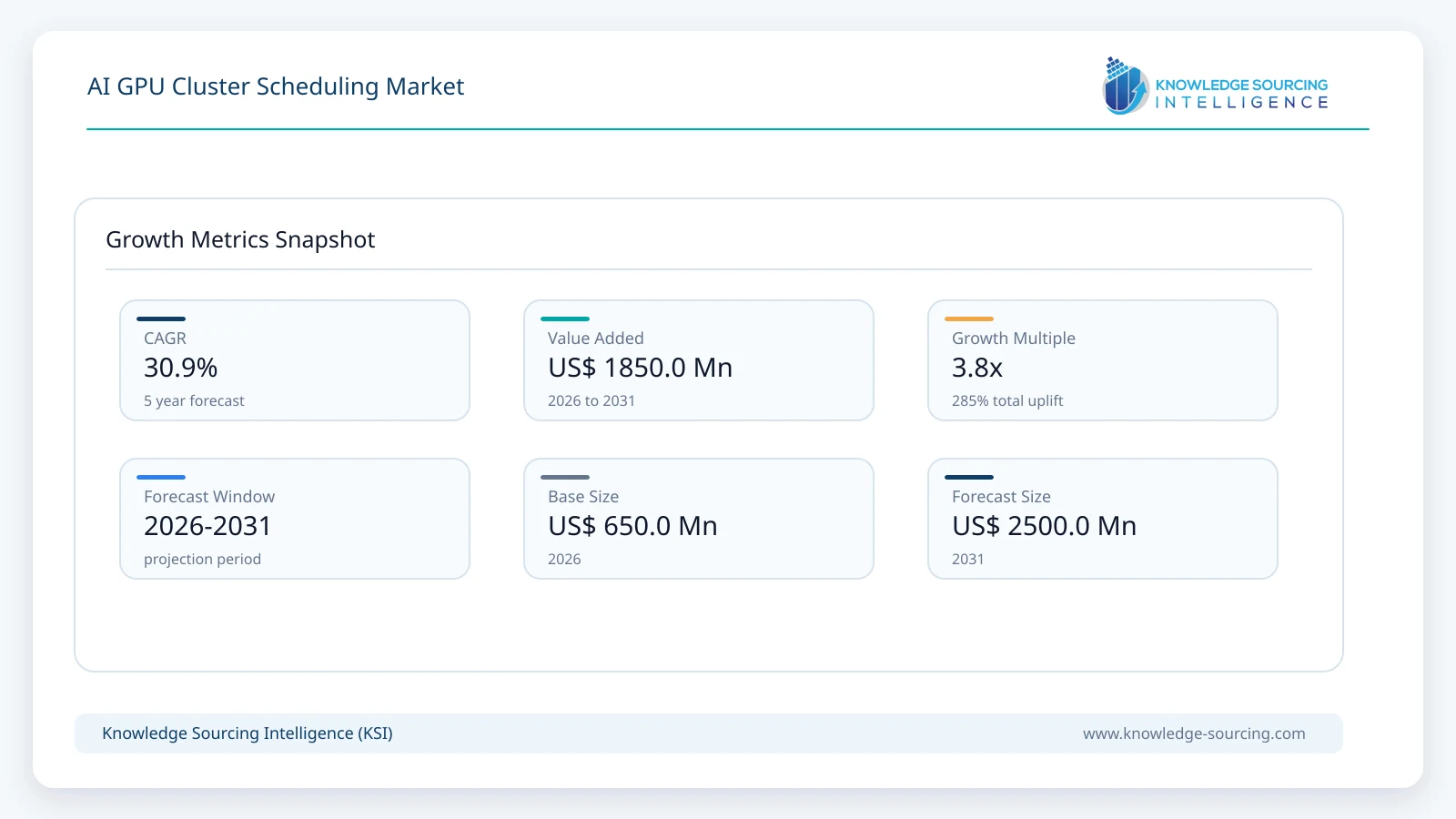
The AI GPU Cluster Scheduling Market is projected to expand at a CAGR of 30.9%, increasing from USD 650.0 million in 2026 to USD 2,500.0 million by 2031.
Highlights:
- 1Kubernetes-native scheduling platforms represent approximately 55% of 2026 revenue, reflecting widespread deployment of container-based AI workloads.
- 2North America contributes approximately 43% of 2026 market value; Asia Pacific is expected to expand most rapidly through 2031.
- 3Clusters with at least 1,024 GPUs account for roughly 39% of 2026 spending and are forecast to represent about 49% by 2031.
- 4Production inference is expected to increase its share from 22% in 2026 to 34% in 2031, as always-on services compete for the same GPU pools as training.
- 5The open-source release of NVIDIA Runai in October 2026 increases the emphasis on paid support, integration and managed operations rather than access to scheduling code alone.
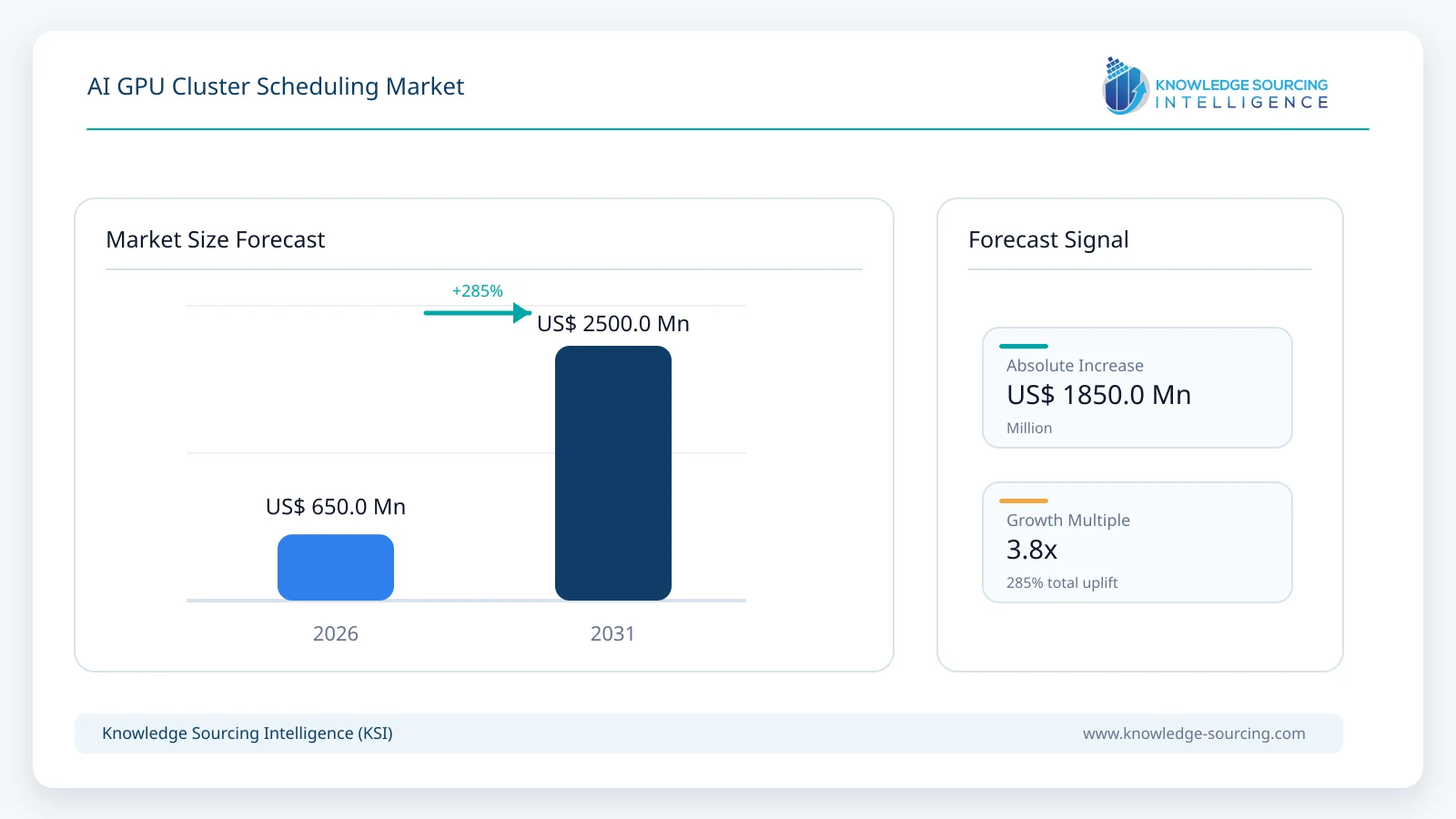
The market covers software and attributable managed services that control how training, fine-tuning, and inference jobs obtain compute across shared accelerator pools. Advanced products add multi-node gang scheduling, topology-aware placement, GPU sharing, priority queues and team-level quotas to the underlying orchestration platform. Buyers include enterprise AI teams, GPU cloud operators, model developers and publicly funded research facilities.
Commercial offerings range from dedicated scheduler subscriptions and supported cluster managers to managed scheduling capabilities packaged within AI platforms. NVIDIA Run: ai, Amazon SageMaker HyperPod, Google Kubernetes Engine and CoreWeave SUNK illustrate distinct approaches to the same operating requirement. As GPU installations extend across clouds and private facilities, purchase decisions increasingly depend on reliability, policy enforcement, and workload throughput rather than basic job submission.
Market Overview
AI training clusters must reserve multiple GPUs and network paths together for synchronous model execution. Scheduling only individual containers can leave portions of a distributed job waiting while other allocated devices remain underused. GPU-aware systems address that problem through gang admission, device and interconnect awareness, priority enforcement, and coordinated resource release when jobs fail or finish.
NVIDIA Run: ai brings dynamic GPU allocation and policy-driven governance to Kubernetes environments, while CoreWeave SUNK combines Slurm's established batch controls with Kubernetes operations. Amazon SageMaker HyperPod supports resource borrowing and gang scheduling for distributed jobs; Google's MultiKueue offers cross-region queues where GPU availability varies. These products address different workload and operating models, but all improve control over shared accelerator infrastructure.
Cluster operators also require clear allocation records for chargeback, security isolation, and service-level governance. The economic value of scheduling is linked to fewer idle GPU-hours, shorter job queues, and predictable access for production users. As upstream schedulers become more capable and widely available, customers increasingly pay for deployment assurance, enterprise controls and integrated lifecycle management.
Market Trends
Kubernetes-Native GPU Scheduling Is Becoming a Standard Layer
Kubernetes device scheduling has advanced beyond assigning whole GPUs to individual pods. Dynamic Resource Allocation now lets device drivers expose richer accelerator attributes, giving cluster operators more control over partitioning and placement. NVIDIA's KAI Scheduler complements this approach with gang scheduling, quota management, and topology-sensitive decisions for AI workloads.
The October 2026 open-source release of Run: ai makes advanced scheduler capabilities more accessible to infrastructure vendors and enterprise platform teams. Commercial suppliers must therefore differentiate through tested deployments, observability, enterprise policies, and reliable support rather than assuming the scheduler engine itself remains proprietary.
Shared GPU Pools Are Replacing Fixed Departmental Allocations
Departments running fine-tuning, experimentation, and production inference rarely have identical GPU demand throughout the day. Rigid reservations can leave costly devices unused while another team faces a growing queue. Amazon SageMaker HyperPod introduced idle resource borrowing in March 2026, allowing teams to use capacity beyond guaranteed quotas when it is available.
Quota borrowing, preemption and fractional allocations can improve utilization in multi-tenant AI clusters, but they require controls that prevent resource contention from harming critical applications. Enterprise buyers increasingly evaluate schedulers for predictable priorities and tenant separation, not simply for the number of jobs admitted.
Slurm and Kubernetes Are Converging on Large Training Systems
Slurm remains established in tightly coupled research and AI training clusters because it supports batch queues, fair-share scheduling, and topology-aware allocation. At the same time, Kubernetes offers standardized deployment, container management, and modern cloud operations. CoreWeave's SUNK allows Slurm training jobs and Kubernetes workloads to draw on a shared GPU estate.
Hybrid scheduling architectures help organizations avoid maintaining separate hardware pools for researchers and application teams. Their adoption should increase in larger AI factories where training operations require predictable multi-node reservations but model serving benefits from elastic containers and faster release cycles.
Inference Scheduling Is Moving Closer to Service-Level Governance
Production AI inference has distinct operating requirements from batch training because user-facing applications must maintain response times during demand spikes. GPU allocation policies increasingly differentiate inference priorities from lower-urgency experimentation, with resource sharing applied selectively when service levels can be maintained.
ClearML's integration with NVIDIA Dynamo and HyperPod's Ray support illustrate the convergence of serving operations with cluster control. The scheduler's role is expanding from launching jobs to protecting memory, capacity, and placement conditions for multi-node inference services.
Multi-Region GPU Placement Is Becoming More Important
AI cloud operators may hold different GPU types and available capacities across regions, creating waiting times when workloads insist on one location. Google Cloud's MultiKueue integration coordinates jobs across clusters and works with Dynamic Workload Scheduler to provision capacity where it becomes available.
Enterprises with private and cloud GPU estates face additional decisions on data movement, security, and job portability. Commercial schedulers that combine policy controls with capacity visibility across environments can reduce manual intervention, although cross-region networking and data locality continue to limit fully automatic placement.
Segment Analysis
By Scheduling Architecture: Kubernetes-Native GPU Schedulers
Kubernetes-native GPU schedulers represent around 55% of 2026 market revenue as enterprises build AI platforms around containers and existing Kubernetes skills. Specialized extensions add gang scheduling, accelerator topology policies, GPU fractioning, and quotas that a general container scheduler does not always provide at the required level of maturity.
Kubernetes-native scheduling revenue is projected to reach approximately USD 1.525 billion by 2031, supported by wider commercial deployments built around KAI Scheduler, Kueue and Kubernetes DRA. Vendors will capture revenue from supported distributions, operational integrations and policy management, while Slurm will retain an important role in tightly synchronized training and traditional research environments.
By Deployment: Public Cloud Scheduling
Public-cloud installations represent approximately 49% of 2026 scheduling revenue, supported by direct accelerator access and managed cluster services offered by AWS, Google Cloud and specialized GPU clouds. Customers are increasingly seeking queues that account for both device availability and the time needed to obtain a complete allocation for distributed workloads.
Public-cloud scheduling revenue is projected to reach approximately USD 1.275 billion by 2031, supported by wider use of managed AI compute environments. Private deployments will remain important for regulated data and research facilities, whereas hybrid configurations are expected to gain share as enterprises connect existing GPU servers with additional cloud capacity. The commercial opportunity centers on governance that works consistently across capacity owned by different operators.
By Workload: Production Inference
Production inference is expected to grow faster than other scheduling workloads as enterprises deploy more persistent model endpoints and AI applications. Revenue associated with production inference scheduling is projected to reach approximately USD 850 million by 2031, or 34% of the market, compared with 22% in 2026. This expansion reflects increased demand for priority enforcement, autoscaling, and fine-grained GPU allocation.
Schedulers supporting inference must account for memory limits, model placement, traffic sensitivity, and conflicts with training activity. This favors offerings that connect infrastructure scheduling to workload health and serving policies rather than treating every GPU request as interchangeable batch capacity.
By Cluster Size: Deployments With 1,024 GPUs and Above
Very large managed clusters contribute around 39% of 2026 revenue, because a scheduling failure or fragmented allocation can affect hundreds of expensive accelerators simultaneously. Such operators need resilient control planes, hierarchical queues, gang placement and cluster-wide usage reporting that extend beyond small-team experimentation.
Deployments managing at least 1,024 GPUs are projected to generate approximately USD 1.225 billion in 2031, representing 49% of market revenue as AI training and serving infrastructure becomes more concentrated in large installations. Mid-sized enterprise clusters remain commercially important, particularly where multiple teams can share GPUs through quotas and fractional-device policies.
Market Drivers
Rising Costs of Underutilized Accelerators
GPU servers carry substantial capital or rental costs, making idle capacity expensive for enterprises and AI cloud operators. Scheduling platforms can improve effective throughput by consolidating small jobs, borrowing unused allocations, and avoiding partial reservations that cannot complete a distributed run.
Organizations with several AI teams have a stronger incentive to buy scheduling controls when unmanaged queues cause visible delays and wasted capacity. These gains support commercial software and services even where the underlying orchestration engine is open source.
Expansion of Multi-Node Model Training
Large model-training jobs require groups of GPUs and network resources to become available together, with communication topology affecting performance. Amazon SageMaker HyperPod's April 2026 gang scheduling update demonstrates an operational response to partial job starts and deadlocks in distributed training.
As organizations train and tune increasingly complex models, placement reliability and recovery behavior influence both compute efficiency and project timelines. This increases demand for production-tested schedulers capable of handling multi-node workloads under resource contention.
Growing Enterprise Demand for Multi-Tenancy
Enterprise AI infrastructure often serves several business units with different permissions, project budgets, and workload priorities. Without quota and policy controls, one team's jobs can monopolize capacity or delay production services that have more urgent requirements.
Rafay, Run: ai and HyperPod address these operational demands with tenant governance, resource allocation policies, and shared pools. Commercial demand grows as more enterprise buyers replace isolated project clusters with centrally managed accelerator estates.
Increasing Production Inference Workloads
AI applications operating continuously need available GPUs, predictable latency, and the ability to expand capacity when traffic increases. Scheduling systems that prioritize inference and release low-priority experimental resources can reduce contention between application serving and development work.
Specialist providers are adding serving-aware features and links to inference runtimes, making scheduling part of the ongoing application operations budget. This demand is less dependent on occasional large training runs and can support recurring software revenue.
Hybrid AI Infrastructure and Capacity Fragmentation
Enterprises increasingly operate accelerators across on-premises sites, public cloud regions and specialist GPU providers. Hardware generations, interconnect topologies and available capacity can differ significantly, leaving platform teams to make difficult placement decisions.
Google Cloud's cross-cluster queueing and Microsoft's Slurm-oriented cloud tooling illustrate solutions for fragmented capacity. Buyers value coordination that keeps job execution aligned with capacity, security boundaries, and data locality without rebuilding the workload stack.
Market Restraints
Open-Source Alternatives Limit Standalone License Pricing
Open-source projects provide increasingly capable admission control, GPU placement and batch orchestration. NVIDIA's October 2026 release of the full Run: ai platform opens another important source of advanced scheduler functionality to platform teams and competing vendors.
Commercial providers must justify recurring fees through managed operations, enterprise integrations, security, and support. Customers with strong engineering teams may choose to operate free scheduler components internally, limiting direct license pricing even as managed GPU capacity grows.
Topology and Resource Fragmentation Reduce Scheduling Flexibility
Distributed training performance depends on compatible GPUs, fast interconnects, and placement within suitable network domains. A scheduler cannot treat all free accelerators as equivalent when the job requires closely connected devices or consistent GPU memory capacity.
Capacity fragmentation can leave clusters with idle GPUs that cannot satisfy pending high-priority jobs. Advanced scheduling mitigates the problem but cannot remove physical topology and infrastructure limitations, constraining achievable efficiency improvements.
Security and Tenant Isolation Complicate GPU Sharing
Multi-tenant clusters must separate user permissions, datasets, model artifacts, and hardware access while still allowing shared capacity. Fractional GPU allocation adds control requirements around memory limits, workload interference, and accurate chargeback.
Regulated enterprises and sovereign AI operators often require stronger auditability and explicit access policies before combining workloads on common accelerators. Additional validation and configuration can slow scheduling platform deployments and increase integration costs.
Integration Across Diverse AI Software Stacks
GPU scheduling operates alongside container runtimes, device drivers, storage systems, networking, training frameworks and inference engines. Differences in workload APIs and versions can make a scheduler upgrade operationally disruptive, especially across hybrid estates.
Organizations using Slurm, Kubernetes and proprietary orchestration in parallel may need custom adapters and job-policy changes. Such integration work lengthens deployment cycles and can offset some of the cost savings expected from higher GPU utilization.
Uncertain Return on Investment for Smaller Clusters
Small AI teams with predictable workloads may achieve acceptable results from basic Kubernetes scheduling, cloud-native queues or open-source Slurm. The additional operational complexity of an enterprise scheduling layer may not be justified when competition for devices is limited.
Software procurement becomes more attractive as cluster size, workload diversity and user contention increase. Providers serving smaller customers must offer simpler onboarding and managed delivery to avoid losing opportunities to free tools or bundled cloud functionality.
Regional Outlook
North America
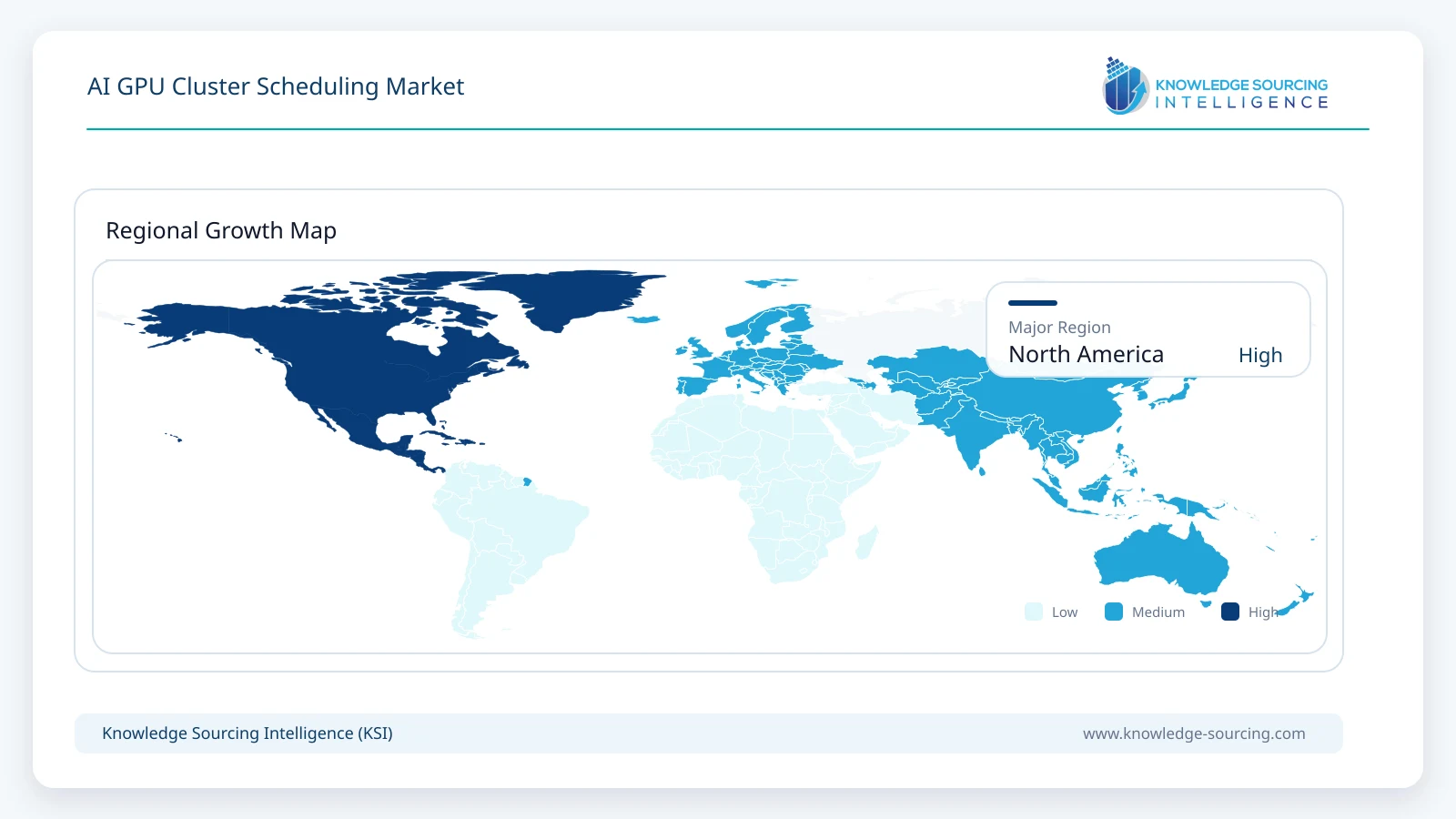
North America is estimated to account for 43% of 2026 market revenue, supported by extensive commercial AI cloud infrastructure and high concentrations of enterprise AI developers. US hyperscalers, GPU cloud operators and model companies are active users of multi-node training clusters where scheduling reliability directly affects accelerator economics.
AWS, Google Cloud, Microsoft, NVIDIA and CoreWeave are headquartered in the United States and influence both proprietary and open scheduling architectures. North American scheduling revenue is projected to reach approximately USD 1.00 billion by 2031 as larger training and inference estates increase demand for integrated policy controls and supported services alongside maturing open-source capabilities.
Asia Pacific
Asia Pacific is projected to be the fastest-growing regional market as China, Japan, India, South Korea and Taiwan expand AI compute infrastructure and build local enterprise ecosystems. Demand includes national research facilities, commercial AI clouds and enterprises seeking shared accelerator platforms for development and inference.
Asia Pacific scheduling revenue is projected to reach approximately USD 850 million by 2031, reflecting a 35.15% CAGR from 2026. The region's mix of sovereign compute investment, advanced electronics ecosystems, and local cloud operators supports adoption of workload managers across Kubernetes and HPC installations. Procurement requirements for data location, hardware compatibility and operational support will influence the balance between self-managed open-source tools and commercial scheduling services.
Competitive Landscape
Competition is split among specialist GPU scheduling platforms, hyperscale cloud services, HPC workload managers, and providers of broader AI infrastructure control planes. NVIDIA combines Run:ai with the Slurm engineering capability obtained through SchedMD, while AWS and Google integrate queue management and GPU admission into their managed AI cloud offerings. CoreWeave specializes in operating Slurm and Kubernetes together on large GPU clusters.
ClearML and Rafay compete through infrastructure management, resource quotas and enterprise workflows, while IBM and Siemens maintain established HPC scheduling portfolios. The open-source direction increases pressure on suppliers that rely only on scheduler licensing, favoring companies able to deliver supported deployments, policy management, operational dashboards and workload reliability at scale.
Recent Developments
October 13, 2026: NVIDIA announced the open-source release of the full Run:ai platform, retaining commercially supported options. The change broadens access to GPU scheduling and shifts differentiation toward managed operations.
September 3, 2026: The Kubernetes project documented expanded generally available Dynamic Resource Allocation capabilities in v1.37, strengthening device-aware scheduling foundations for AI workloads.
August 2026: AWS extended SageMaker HyperPod support for Ray, integrating distributed AI workload operation, observability and task governance.
April 8, 2026: AWS added gang scheduling to SageMaker HyperPod task governance, addressing partial starts and deadlocks in distributed training jobs.
March 16, 2026: AWS introduced idle-resource borrowing in SageMaker HyperPod task governance, enabling teams to access otherwise unused accelerator capacity.
December 15, 2025: NVIDIA acquired SchedMD, combining its AI software portfolio with expertise in the open-source Slurm workload manager.
Market Outlook
AI GPU scheduling will become more closely integrated with accelerator governance, inference service management and infrastructure automation as cluster sizes and workload diversity increase. Large deployments will require predictable multi-node placement, resilient queues and visibility across different GPU generations, while enterprise users will place greater emphasis on fair access and auditable resource use.
Open-source infrastructure is likely to keep basic scheduler functionality widely available, but commercial opportunities will expand in integrated operational platforms and supported environments. Between 2026 and 2031, public and hybrid cloud installations and production inference workloads should contribute a growing share of attributable scheduling revenue, with Asia Pacific expanding faster than the established North American base.
AI GPU Cluster Scheduling Market Scope:
| Report Metric | Details |
|---|---|
| Total Market Size in 2026 | USD 650.0 million |
| Total Market Size in 2031 | USD 2,500.0 million |
| Forecast Unit | USD Million |
| Growth Rate | 30.9% |
| Study Period | 2021 to 2031 |
| Historical Data | 2021 to 2024 |
| Base Year | 2025 |
| Forecast Period | 2026 – 2031 |
| Segmentation | Primary Scheduling Architecture, Deployment Environment, Primary Workload, Purchasing Customer |
| Companies |
|
| Customization Scope | 15% Free Customization included with purchase — Request Custom Breakdown → |
| Sample & Data Access | PDF Sample, Excel Databook & Analyst Briefing — Download Free Sample → |
Market Segmentation
By Primary Scheduling Architecture
Kubernetes-native GPU schedulers
Slurm and HPC batch schedulers
Proprietary managed schedulers
By Deployment Environment
Public cloud
Private or on-premises
Hybrid and multi-cloud
By Primary Workload
Model pre-training and large-scale training
Fine-tuning and experimentation
Production inference
Data processing and mixed AI jobs
By Purchasing Customer
Hyperscalers and GPU cloud operators
Enterprise organizations
AI model and application developers
Government, academia and research
By Managed Cluster Size
16–127 GPUs
128–1,023 GPUs
1,024 GPUs and above
By Revenue Model
Paid platform subscriptions and licensing
Attributable managed scheduling fees
Specialist integration and commercial support
By Geography
North America
United States
Canada
Mexico
South America
Brazil
Argentina
Rest of South America
Europe
Germany
United Kingdom
France
Italy
Spain
Netherlands
Nordic countries
Rest of Europe
Middle East and Africa
Israel
United Arab Emirates
Saudi Arabia
South Africa
Rest of Middle East and Africa
Asia Pacific
China
India
Japan
South Korea
Taiwan
Australia
Indonesia
Thailand
Rest of Asia Pacific
Table of Contents
1. EXECUTIVE SUMMARY
1.1. Market Opportunity and Key Findings
1.2. Forecast and Regional Positioning
2. MARKET SNAPSHOT
2.1. Market Overview
2.2. Market Definition
2.3. Scope of the Study
2.4. Market Segmentation
3. BUSINESS LANDSCAPE
3.1. Market Drivers
3.1.1. High Costs of Underutilized Accelerators
3.1.2. Expansion of Multi-Node Model Training
3.1.3. Growing Enterprise Demand for Multi-Tenancy
3.1.4. Increasing Production Inference Workloads
3.1.5. Hybrid AI Infrastructure and Capacity Fragmentation
3.2. Market Restraints
3.2.1. Open-Source Alternatives Limit Standalone License Pricing
3.2.2. Topology and Resource Fragmentation Reduce Scheduling Flexibility
3.2.3. Security and Tenant Isolation Complicate GPU Sharing
3.2.4. Integration Across Diverse AI Software Stacks
3.2.5. Uncertain Return on Investment for Smaller Clusters
3.3. Market Opportunities
3.4. Porter’s Five Forces Analysis
3.5. Industry Value Chain Analysis
3.6. Cloud, Data Security and AI Infrastructure Policies
3.7. Strategic Recommendations
4. TECHNOLOGICAL OUTLOOK
4.1. Gang Scheduling and Topology-Aware GPU Placement
4.2. Hierarchical Queues, Fair Share and Quota Borrowing
4.3. GPU Fractioning and Kubernetes DRA
4.4. Slurm and Kubernetes Scheduling Integration
4.5. Inference-Aware Scheduling and Elastic Deployment
4.6. Multi-Cluster and Cross-Region GPU Admission
5. AI GPU CLUSTER SCHEDULING MARKET BY PRIMARY SCHEDULING ARCHITECTURE
5.1. Kubernetes-native GPU schedulers
5.2. Slurm and HPC batch schedulers
5.3. Proprietary managed schedulers
6. AI GPU CLUSTER SCHEDULING MARKET BY DEPLOYMENT ENVIRONMENT
6.1. Public cloud
6.2. Private or on-premises
6.3. Hybrid and multi-cloud
7. AI GPU CLUSTER SCHEDULING MARKET BY PRIMARY WORKLOAD
7.1. Model pre-training and large-scale training
7.2. Fine-tuning and experimentation
7.3. Production inference
7.4. Data processing and mixed AI jobs
8. AI GPU CLUSTER SCHEDULING MARKET BY PURCHASING CUSTOMER
8.1. Hyperscalers and GPU cloud operators
8.2. Enterprise organizations
8.3. AI model and application developers
8.4. Government, academia and research
9. AI GPU CLUSTER SCHEDULING MARKET BY MANAGED CLUSTER SIZE
9.1. 16–127 GPUs
9.2. 128–1,023 GPUs
9.3. 1,024 GPUs and above
10. AI GPU CLUSTER SCHEDULING MARKET BY REVENUE MODEL
10.1. Paid platform subscriptions and licensing
10.2. Attributable managed scheduling fees
10.3. Specialist integration and commercial support
11. AI GPU CLUSTER SCHEDULING MARKET BY GEOGRAPHY
11.1. North America
11.1.1. United States
11.1.2. Canada
11.1.3. Mexico
11.2. South America
11.2.1. Brazil
11.2.2. Argentina
11.2.3. Rest of South America
11.3. Europe
11.3.1. Germany
11.3.2. United Kingdom
11.3.3. France
11.3.4. Italy
11.3.5. Spain
11.3.6. Netherlands
11.3.7. Nordic countries
11.3.8. Rest of Europe
11.4. Middle East and Africa
11.4.1. Israel
11.4.2. United Arab Emirates
11.4.3. Saudi Arabia
11.4.4. South Africa
11.4.5. Rest of Middle East and Africa
11.5. Asia Pacific
11.5.1. China
11.5.2. India
11.5.3. Japan
11.5.4. South Korea
11.5.5. Taiwan
11.5.6. Australia
11.5.7. Indonesia
11.5.8. Thailand
11.5.9. Rest of Asia Pacific
12. COMPETITIVE ENVIRONMENT AND ANALYSIS
12.1. Major Players and Strategy Analysis
12.2. Market Share Analysis
12.3. Mergers, Acquisitions, Agreements and Collaborations
12.4. Competitive Dashboard
13. COMPANY PROFILES
13.1. NVIDIA Corporation
13.2. Amazon Web Services, Inc.
13.3. Google LLC
13.4. Microsoft Corporation
13.5. International Business Machines Corporation
13.6. CoreWeave, Inc.
13.7. Siemens AG
13.8. ClearML
13.9. Rafay Systems, Inc.
13.10. Anyscale, Inc.
13.11. Hewlett Packard Enterprise Company
14. APPENDIX
14.1. Currency
14.2. Assumptions
14.3. Base and Forecast Years Timeline
14.4. Key Benefits for Stakeholders
14.5. Research Methodology
14.6. Abbreviations





Frequently asked questions
What is the projected market size for AI GPU cluster scheduling?
The AI GPU Cluster Scheduling Market is forecast to reach $2,500.0 million by 2031, with 30.9% CAGR.
Which technology platform dominates AI GPU cluster scheduling revenue?
Kubernetes-native scheduling platforms represent 55% of 2026 revenue.
Which regions lead and grow fastest in the market?
North America holds 43% of 2026 value; Asia Pacific is expanding most rapidly.
What is a key growth area in AI GPU cluster workload types?
Production inference's share is forecast to increase from 22% to 34% by 2031.
How are large GPU clusters evolving within the market?
Clusters with 1,024+ GPUs will represent 49% of spending by 2031.
What is the impact of NVIDIA Run: ai on the market?
Its open-source release shifts focus to paid support and managed services.
Cite this report
Knowledge Sourcing Intelligence. (Oct 2026). AI GPU Cluster Scheduling Market Size, Share & Growth Forecast (2026-2031). https://www.knowledge-sourcing.com/report/ai-gpu-cluster-scheduling-market