
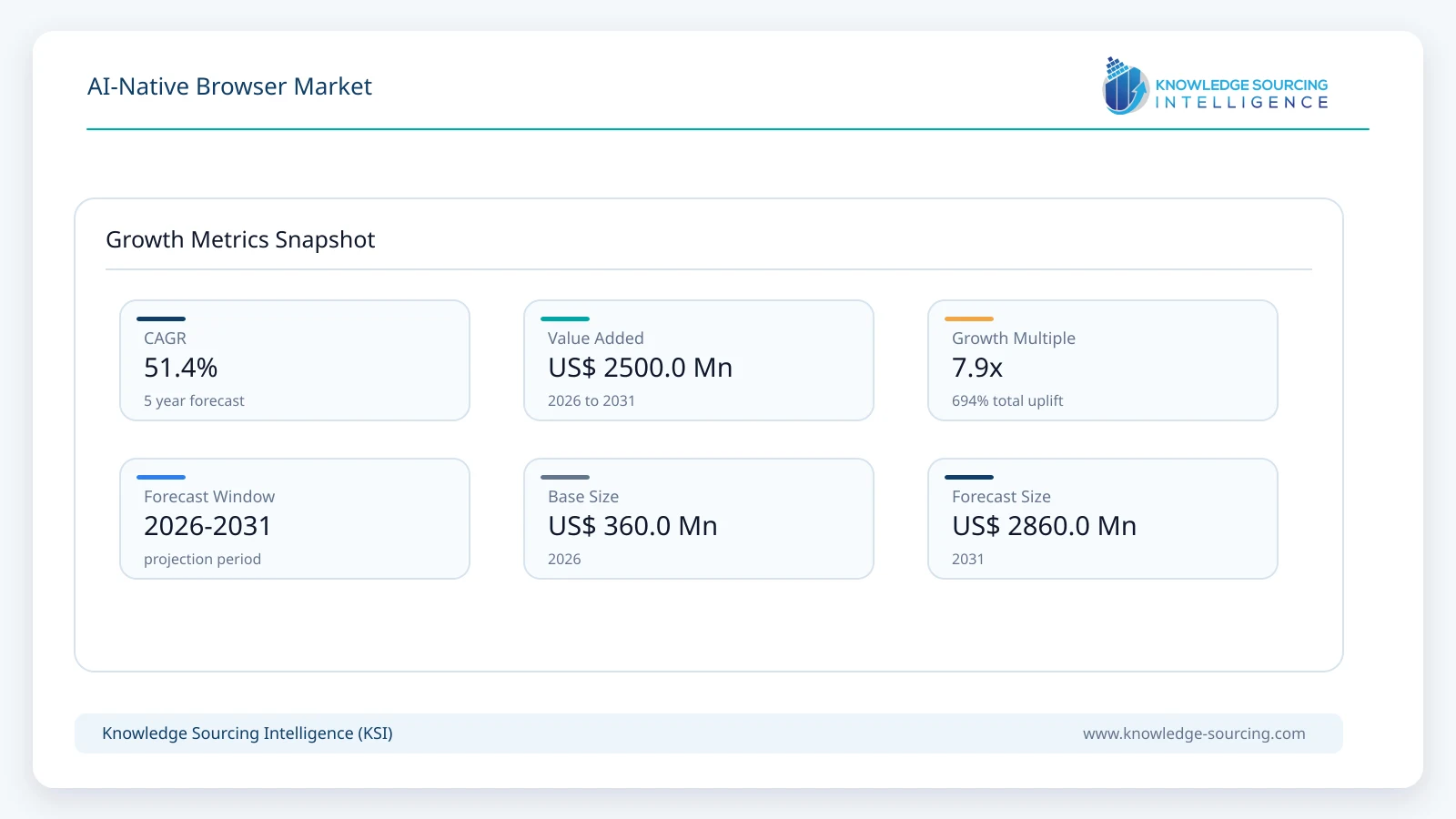
The AI-native browser market is estimated at USD 360 million in 2026 and is projected to reach USD 2,860 million by 2031, expanding at a CAGR of 51.4% during the forecast period.
Highlights:
- 1Agent-first autonomous browser experiences account for approximately 34.72% of estimated 2026 market revenue and are projected to reach USD 1.20 billion in 2031.
- 2Consumer AI browser subscriptions are estimated at USD 155 million in 2026, with enterprise seat licenses contributing USD 65 million.
- 3Autonomous multistep web tasks represent a USD 140 million primary-use revenue category in 2026, rising to USD 1.36 billion by 2031.
- 4North America contributes an estimated USD 154 million in 2026, supported by paid AI subscriptions and early enterprise use.
- 5Asia Pacific is projected to grow faster than North America and reach USD 900 million in 2031 as browser-based AI expands across multiple major economies.
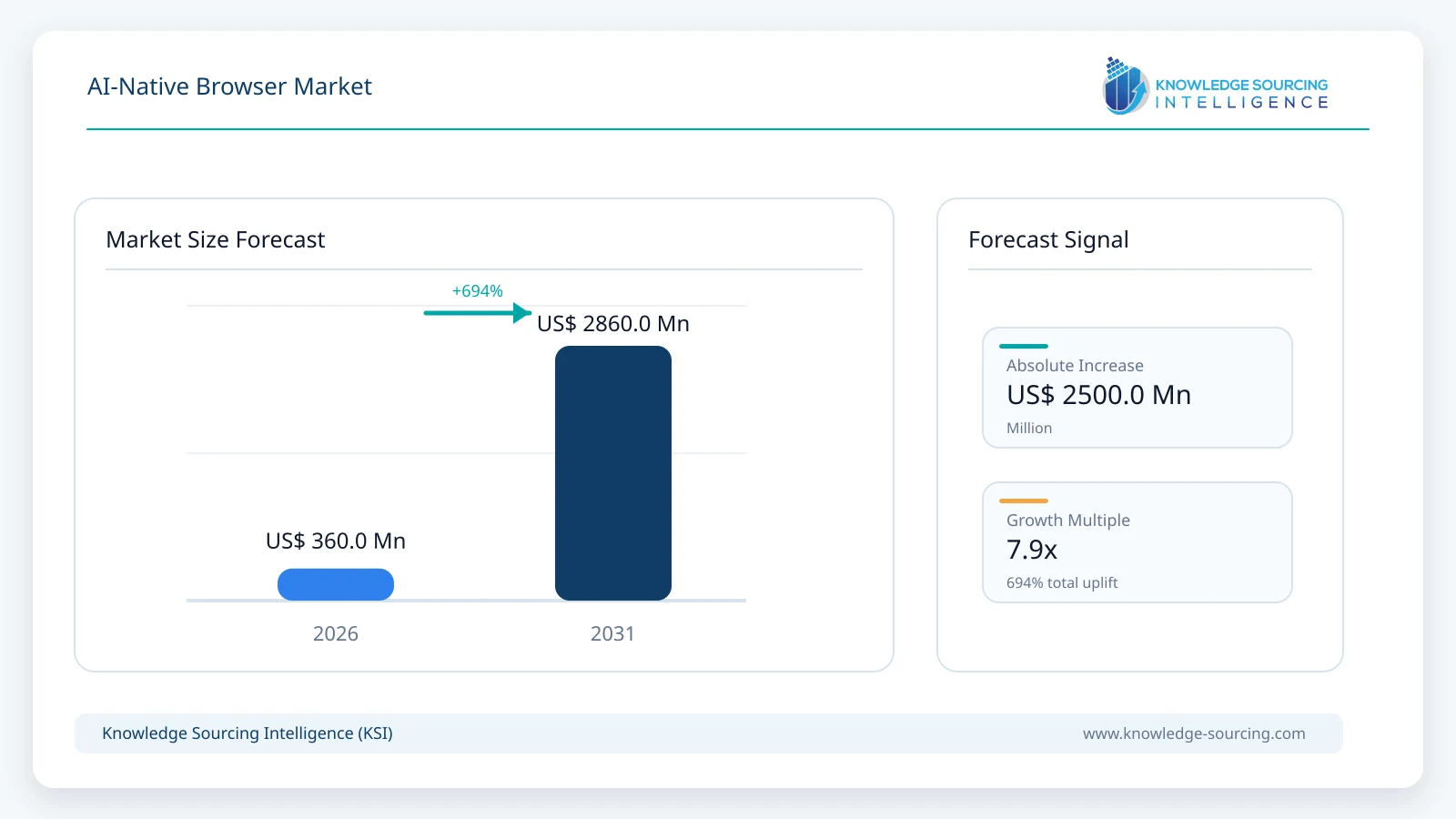
Revenue covers attributable AI browser subscriptions, enterprise-seat access, embedded paid browser capabilities and metered browser-native agent use. The valuation excludes conventional search advertising, generic standalone chatbot packages, unmonetized free browsing and agent infrastructure sold without a browser experience.
Browser-native AI changes the economics of digital productivity because the application can see relevant webpages and, with permission, operate the browsing interface. Comet links conversational search with a task-capable assistant; Opera Neon offers paid AI agents alongside a free browser-connectivity tier; Dia connects browser context to workplace tools. Chrome Gemini and Edge Copilot extend similar capabilities to existing browser audiences, although only the demonstrably attributable AI-browser portion of broader account subscriptions belongs within the market.
Adoption will depend on the reliability of web actions, privacy protections and the practical benefit of replacing repeated manual tab and form operations. Standalone AI browsers must convert free users into subscriptions, while established platforms must establish how much of broader AI subscription value comes from browser interactions. Subscription retention will depend on repeated value from complex tasks rather than on browser downloads alone.
Market Overview
AI-native browsers combine website rendering and conventional navigation with mechanisms for collecting page context, selecting model tools and performing actions through browser controls. Cross-tab reading helps analysts compare documents without repeating searches, while task agents can move across multiple sites, populate forms and compile results. Commercial differentiation rests on useful task completion, contextual accuracy, permission boundaries and the ability to retrieve information from connected enterprise applications.
The installed browser base creates a sharp competitive difference between AI-first entrants and incumbents. Statcounter reported Chrome controlling about 65% of worldwide desktop browser usage in September 2026, but that statistic measures overall browsing, not willingness to pay for agent functions. New entrants must earn switching behavior and subscription retention; Chrome and Edge can distribute AI features through existing accounts, creating considerable reach while making revenue attribution and subscription overlap less transparent.
Browser economics include model inference expenses, web-action orchestration, operating-system integration and the cost of protecting authenticated user sessions. Free tools can establish awareness but sustained agent usage consumes compute and requires safety review. Suppliers therefore use a mix of free introductory capability, premium subscription limits and enterprise contracts.
Market Trends
Autonomous Browsing Is Extending Beyond Search and Summarization
Browser agents are moving from retrieving answers toward executing tasks that span several webpages and authenticated applications. Perplexity Comet supports cross-tab intelligence and web automation, while Opera Neon offers agents for research and task execution. Fellou and Genspark have promoted browser-native automated workflows, emphasizing the ability to plan actions and produce consolidated output.
Browser AI Is Becoming a Controlled Workplace Interface
Enterprise browser procurement increasingly requires identity controls, auditability, management policies and safeguards against unauthorized actions. Atlassian describes Dia enterprise capabilities including single sign-on, managed Chromium deployment and layered protection against prompt injection. Microsoft positions Edge for Business around policy enforcement and existing workplace permissions.
Connected enterprise context can strengthen productivity when a browser assistant can reference work items, calendars and collaboration tools without manual copying. However, browser permissions cross the boundary between trusted applications and untrusted websites. Enterprise adoption will depend on clear visibility into information access, administrator policy design and the ability to intervene before a sensitive action is completed.
Paid AI Tiers Coexist With Free Browser Distribution
AI browser suppliers are using different monetization routes that should not be treated as equivalent. Opera Neon launched public paid access at USD 19.90 per month and later introduced a free option for connecting external agents, reserving its own advanced AI functions for subscribers. Brave offers Leo Premium at USD 14.99 monthly, while Dia has separate free-browser and paid-AI tiers.
Existing account bundles complicate the pricing landscape because Google and Microsoft distribute selected browser AI tools through broader premium services. Revenue allocation therefore requires separating paid browser-specific value from unrelated model chat, storage, productivity or cloud features. As free capabilities improve, providers may need to justify paid plans through execution volume, better model access, persistent context, speed and enterprise governance instead of simple summarization functionality.
Safety and On-Device Processing Are Becoming Product Differentiators
Browser agents can encounter malicious instructions placed inside webpages that are outside the user’s trust boundary. Brave has documented prompt-injection risks affecting agentic browsers and emphasizes careful design of permissions and execution. Norton Neo combines AI assistance with browser security controls, while Sigma Browser promotes local AI processing. These approaches target customer concerns that arise when software can interact with authenticated sessions and sensitive documents.
Segment Analysis
By Browser Experience Architecture: Agent-First Autonomous Browsers
Agent-first autonomous browsers concentrate their value proposition on completing web tasks through a native browser interface. This segment is estimated at USD 125 million in 2026 and is projected to reach USD 1.20 billion in 2031 as task execution improves and more users adopt paid limits for research, shopping support and workflow automation. Comet, Opera Neon and Fellou exemplify variants of the model, although adoption levels, customer spend and independently disclosed revenue differ substantially.
By Monetization Model: Consumer AI Browser Subscriptions
Consumer AI browser subscriptions represent the leading directly identifiable monetization category, with USD 155 million estimated in 2026 and USD 1.12 billion projected in 2031. Users pay for higher AI usage limits, advanced agents, longer context or specialized capabilities. Opera Neon, Brave Leo and Dia demonstrate the presence of browser-specific subscription tiers, while the market excludes generic chatbot charges that cannot be attributed to actual browser functionality.
By Primary Paid Function: Autonomous Multistep Web Tasks
Paid autonomous web-task execution is expected to increase from USD 140 million in 2026 to USD 1.36 billion in 2031 as browsers move beyond asking questions into taking directed action. The relevant workload includes multi-source research, form completion, tab navigation, information transfer and selected administrative workflows executed within the browser. A provider that sells both browser subscriptions and agent credits is counted only once at the contract or task-purchase level.
Market Drivers
Growing Demand for Research and Web Workflow Automation
Knowledge workers routinely move among search results, documents, customer systems and web forms, creating repeatable tasks that can be shortened by cross-tab AI assistance. Browser-native agents reduce the need to export content into another application and can assemble sources, extract structured information and produce reports within the browsing workflow. The value is measurable when the tool reliably saves time on a task rather than adding a conversational layer to ordinary browsing.
Expansion of Paid Consumer AI Usage
Demand for premium AI assistance creates an upgrade route for browsers offering advanced agents, contextual understanding and higher usage allowances. Opera Neon, Dia and Brave Leo provide identifiable subscription products that support a market separate from general web-browser advertising. Retention will depend on practical gains in daily work and on providers controlling inference expense as usage increases.
Enterprise Adoption of Governed Browser Agents
Managed browsers can place AI task execution within familiar corporate identity and compliance boundaries. Dia and Edge for Business show how vendors are adding centralized policies, security features and controlled access to work applications. These capabilities support commercial deployments where an unsecured consumer agent could not be approved to handle internal information or cross-application tasks.
Improvements in Multimodal and Context-Aware Models
Advances in page interpretation, long-context processing and tool use allow browsers to read visual interfaces and work across changing webpage structures. More capable models can reduce manual prompt repetition and improve the consistency of extracted or summarized information. Suppliers that combine model performance with browser state and structured action systems can deliver features difficult to replicate through an isolated chatbot window.
Access Through Established Browser Ecosystems
The integration of Gemini into Chrome and Copilot into Edge broadens awareness of browser AI among people who may never install a new specialist product. These ecosystems can distribute contextual research and selected agentic features through existing accounts, reducing user acquisition costs. Their participation also raises baseline expectations, compelling independent browser vendors to compete on specialized workflows, privacy and execution quality.
Market Restraints
Prompt Injection and Authenticated-Session Security
Browser agents may encounter adversarial instructions hidden in web content, potentially causing unintended actions or inappropriate use of an authenticated session. Security researchers have identified prompt-injection problems in agentic browser approaches. Developers must isolate page content from higher-trust instructions and require explicit authorization for sensitive operations, adding engineering cost and limiting unattended automation in high-risk workflows.
Uncertain Conversion From Free Users to Paid Plans
Several of the most visible AI browsers provide free entry-level access, while mainstream platforms offer contextual AI within broader accounts. Browser downloads and active users therefore do not equal paying subscribers. Forecast revenue can underperform user adoption when providers subsidize agents for distribution, reduce plan prices or bundle browser features into subscriptions that customers already hold for other reasons.
Inconsistent Website Automation Reliability
Websites vary in layout, authentication, dynamic content, bot restrictions and application behavior, causing multi-step workflows to break despite accurate natural-language instructions. Automated form filling and navigation require reliable state tracking, recovery and user intervention. These challenges can increase support expense and weaken subscription renewal when the product fails during time-sensitive work.
High Model-Serving and Execution Costs
Heavy agentic browsing can involve several model calls, website interactions and long-running jobs within a single user request. Higher inference and infrastructure expense can erode margins for flat-price subscriptions, especially when customers use unrestricted automation extensively. Vendors must balance usage limits, task pricing, smaller specialized models and selective local execution without making the product difficult to understand.
Browser Incumbency and Enterprise Change Management
Chrome, Edge and Safari have established distributions, account synchronization, extensions and enterprise management, making switching to a specialist browser costly. Corporate information-security reviews can further delay deployment of products that request access to multiple internal websites and services. Even when AI-native competitors offer superior workflow features, customer migration may be slowed by familiarity, compatibility requirements and procurement controls.
Regional Outlook
North America
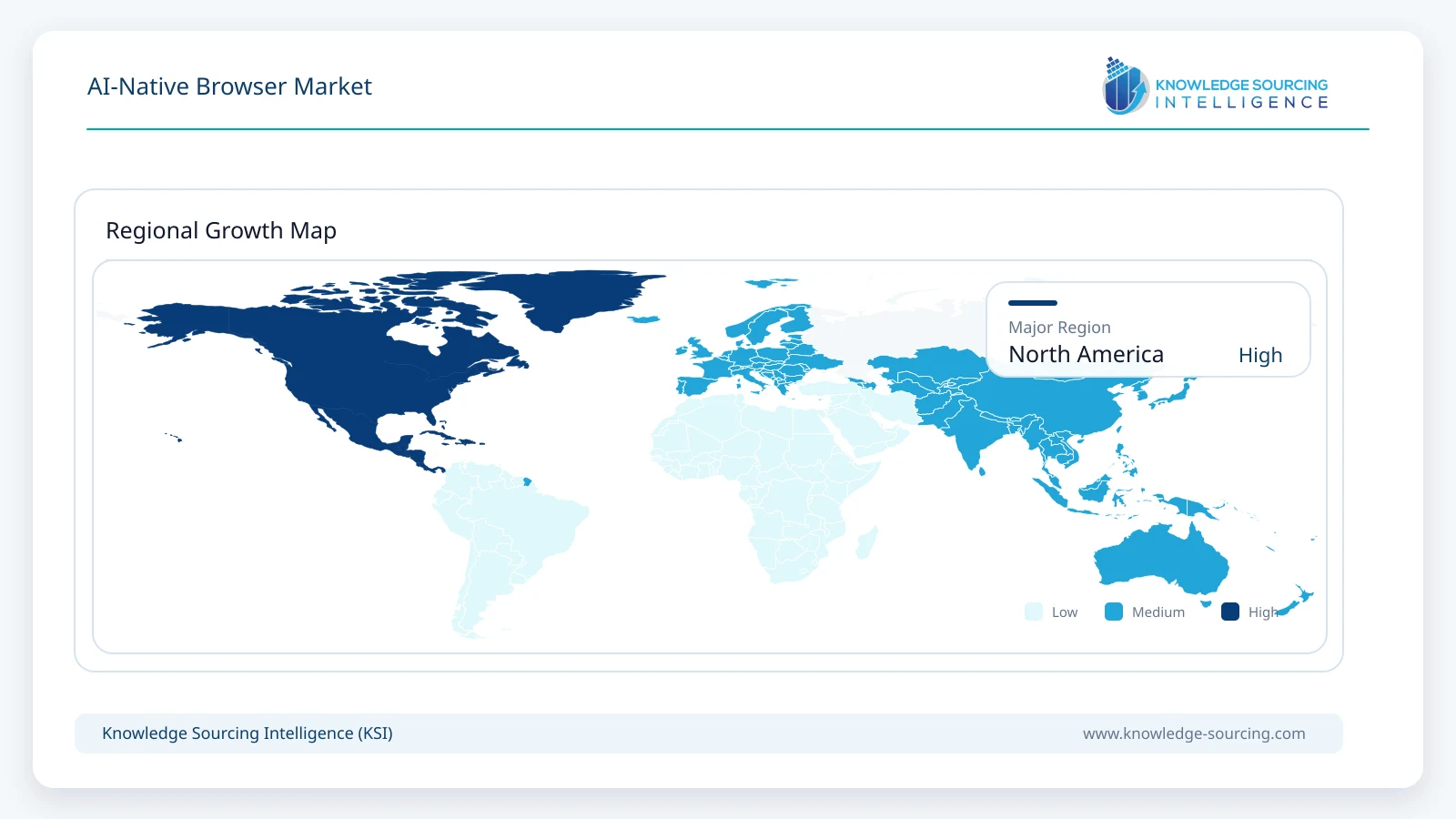
North America represents the largest AI-native browser market in 2026 at USD 154 million and is projected to reach USD 1.01 billion by 2031. The United States combines many of the category’s developers, major enterprise software buyers and early professional users willing to test paid browser agents. Perplexity, Atlassian, Google, Microsoft and Brave are important participants in establishing how conversational browsing, enterprise permissions and task execution reach customers.
The regional outlook depends on how successfully providers convert demonstrations of agentic workflows into repeatable paid use. Professional services, technology businesses and teams that manage information across several web applications are natural early audiences. North American spending is likely to favor managed enterprise agents and high-usage subscriptions, while longstanding use of Chrome and Edge creates a substantial adoption advantage for incumbents.
Asia Pacific
Asia Pacific is expected to be the fastest-growing major region, rising from USD 82 million in 2026 to USD 900 million in 2031. Expansion reflects large digital-user bases, growing enterprise AI adoption and increasing availability of contextual browsing on mobile devices. Google has expanded Gemini auto browse to India, while Samsung provides browsing assistance in its own mobile browser; such distribution can accelerate trial even where the paid portion is relatively small initially.
China, India, Japan, South Korea, Singapore and Australia differ in local AI service access, platform preferences, payment willingness and privacy requirements. The fastest monetization opportunities may emerge in knowledge-intensive work, research, small-business operations and enterprise environments that can quantify recurring time savings. Local-language support and regional data rules will influence the paid product mix, while widespread free browser AI is likely to restrain average revenue per user.
Competitive Landscape
AI-native browser competition spans dedicated entrants, incumbent browser platforms and privacy-focused specialists. Perplexity Comet and Opera Neon have emphasized autonomous browsing; Atlassian Dia combines a work-oriented browser interface with organizational context; Brave Leo and SigmaOS offer premium in-browser assistance. Google Chrome and Microsoft Edge benefit from large distributions and wider paid AI services, but that scale is not equivalent to independently identified AI-browser sales.
Norton Neo, Genspark AI Browser, Fellou and Sigma Browser extend the competitive landscape through security, research automation, locally processed AI or more specialized autonomous workflows. Some vendors distribute products entirely free, while others earn AI subscriptions or sell related products. Buyer decisions increasingly reflect browser-specific task quality, governance controls and recurring usage rather than the visibility of a parent company.
Recent Developments
October 2026: Google expanded Gemini in Chrome and the auto browse function in India, including subscriber-controlled agentic browser tasks on supported desktop and Android devices.
August 2026: Opera introduced free connectivity from Opera Neon to external agents using MCP and its Browser CLI, while retaining paid access to Neon’s proprietary AI services.
June 2026: Brave published additional research on indirect prompt-injection risks in agentic browsing, underscoring the need to separate untrusted webpage instructions from agent permissions.
May 2026: Brave expanded early agentic browsing tests into its main release channels, beyond the original experimental Nightly availability.
December 2025: Opera opened public paid access to Neon at USD 19.90 per month, giving early users integrated conversational and task-focused AI agents.
Market Outlook
AI-native browsers are expected to generate an expanding but still relatively small share of total browser-related economic activity through 2031, as autonomous web workflows become more dependable and premium AI features move into business processes. The strongest monetization will be associated with repeated task completion, deeper application context and controlled use in managed enterprise environments. Basic webpage summarization and chat are likely to become widely available at little or no incremental browser price.
Specialist developers will need to demonstrate productivity benefits substantial enough to overcome switching costs and subscription fatigue, while established browser platforms must translate large free user bases into identifiable AI service revenue. Security, consent, local data handling and resilience across difficult websites will remain important competitive factors. Revenue forecasts should be evaluated against paying users and realized product prices rather than the number of browser installations.
AI-Native Browser Market Scope
| Report Metric | Details |
|---|---|
| Total Market Size in 2026 | USD 360 million |
| Total Market Size in 2031 | USD 2,860 million |
| Forecast Unit | Million |
| Growth Rate | 51.4% |
| Study Period | 2021 to 2031 |
| Historical Data | 2021 to 2024 |
| Base Year | 2025 |
| Forecast Period | 2026 – 2031 |
| Segmentation | Browser Experience Architecture, Primary Paid Function, Monetization Model, Customer Type, Browser Deployment Mode, AI Interaction Category, End-User Industry, Geography |
| Companies |
|
| Customization Scope | 15% Free Customization included with purchase — Request Custom Breakdown → |
| Sample & Data Access | PDF Sample, Excel Databook & Analyst Briefing — Download Free Sample → |
Market Segmentation
By Browser Experience Architecture
Agent-First Autonomous Browsers
Contextual AI-Assistant Browsers
Search-Centric AI Browsers
Privacy-First and Local-AI Browsers
By Primary Paid Function
Autonomous Multistep Web Tasks
Contextual Search and Research
Writing and Knowledge Work
Cross-Tab Memory and Organization
Privacy and Enterprise Controls
By Monetization Model
Consumer AI Browser Subscriptions
Enterprise Seat Licenses
Attributable Bundled AI Browser Access
Browser-Native Metered Agent Tasks
By Customer Type
Individual Consumers and Prosumers
Small and Medium Businesses
Large Enterprises
Education and Research Users
Public-Sector Organizations
By Browser Deployment Mode
Desktop and Laptop Consumer Browsers
Mobile AI Browser Experiences
Enterprise-Managed Browser Environments
By AI Interaction Category
Assistive Page Summarization and Questioning
Agentic Navigation and Workflow Execution
Persistent Context and Cross-Tab Knowledge
Privacy-Preserving and Local AI Assistance
By End-User Industry
Technology and Professional Services
Retail and E-Commerce
Banking and Financial Services
Education and Academia
Healthcare and Life Sciences
Media and Creative Industries
Other Sectors
By Geography
North America
United States
Canada
Mexico
South America
Brazil
Argentina
Chile
Colombia
Rest of South America
Europe
United Kingdom
Germany
France
Netherlands
Ireland
Spain
Sweden
Rest of Europe
Middle East and Africa
United Arab Emirates
Saudi Arabia
Israel
South Africa
Rest of Middle East and Africa
Asia Pacific
China
India
Japan
South Korea
Singapore
Australia
Taiwan
Rest of Asia Pacific
Table of Contents
1. EXECUTIVE SUMMARY
1.1. Research Highlights
1.2. Market Size and Forecast, 2026-2031
1.3. Strategic Market Outlook
2. MARKET SNAPSHOT
2.1. Definition and Scope
2.2. Market Dynamics
2.3. Commercialization and Adoption
3. BUSINESS LANDSCAPE
3.1. Market Drivers
3.1.1. Growing Demand for Research and Web Workflow Automation
3.1.2. Expansion of Paid Consumer AI Usage
3.1.3. Enterprise Adoption of Governed Browser Agents
3.1.4. Improvements in Multimodal and Context-Aware Models
3.1.5. Access Through Established Browser Ecosystems
3.2. Market Restraints
3.2.1. Prompt Injection and Authenticated-Session Security
3.2.2. Uncertain Conversion From Free Users to Paid Plans
3.2.3. Inconsistent Website Automation Reliability
3.2.4. High Model-Serving and Execution Costs
3.2.5. Browser Incumbency and Enterprise Change Management
3.3. Market Opportunities
3.4. Porter’s Five Forces Analysis
3.5. Industry Value Chain Analysis
3.6. Policies and Regulations
3.7. Strategic Recommendations
4. TECHNOLOGICAL OUTLOOK
4.1. Agentic Browsing and Task Orchestration
4.2. Cross-Tab Context and Browser Memory
4.3. Website Interpretation and Browser Actions
4.4. Identity, Permissions and Prompt-Injection Defense
4.5. Cloud and On-Device AI Models
4.6. Browser and Enterprise Application Integrations
5. AI-NATIVE BROWSER MARKET BY BROWSER EXPERIENCE ARCHITECTURE
5.1. Agent-First Autonomous Browsers
5.2. Contextual AI-Assistant Browsers
5.3. Search-Centric AI Browsers
5.4. Privacy-First and Local-AI Browsers
6. AI-NATIVE BROWSER MARKET BY PRIMARY PAID FUNCTION
6.1. Autonomous Multistep Web Tasks
6.2. Contextual Search and Research
6.3. Writing and Knowledge Work
6.4. Cross-Tab Memory and Organization
6.5. Privacy and Enterprise Controls
7. AI-NATIVE BROWSER MARKET BY MONETIZATION MODEL
7.1. Consumer AI Browser Subscriptions
7.2. Enterprise Seat Licenses
7.3. Attributable Bundled AI Browser Access
7.4. Browser-Native Metered Agent Tasks
8. AI-NATIVE BROWSER MARKET BY CUSTOMER TYPE
8.1. Individual Consumers and Prosumers
8.2. Small and Medium Businesses
8.3. Large Enterprises
8.4. Education and Research Users
8.5. Public-Sector Organizations
9. AI-NATIVE BROWSER MARKET BY BROWSER DEPLOYMENT MODE
9.1. Desktop and Laptop Consumer Browsers
9.2. Mobile AI Browser Experiences
9.3. Enterprise-Managed Browser Environments
10. AI-NATIVE BROWSER MARKET BY AI INTERACTION CATEGORY
10.1. Assistive Page Summarization and Questioning
10.2. Agentic Navigation and Workflow Execution
10.3. Persistent Context and Cross-Tab Knowledge
10.4. Privacy-Preserving and Local AI Assistance
11. AI-NATIVE BROWSER MARKET BY END-USER INDUSTRY
11.1. Technology and Professional Services
11.2. Retail and E-Commerce
11.3. Banking and Financial Services
11.4. Education and Academia
11.5. Healthcare and Life Sciences
11.6. Media and Creative Industries
11.7. Other Sectors
12. AI-NATIVE BROWSER MARKET BY GEOGRAPHY
12.1. North America
12.1.1. United States
12.1.2. Canada
12.1.3. Mexico
12.2. South America
12.2.1. Brazil
12.2.2. Argentina
12.2.3. Chile
12.2.4. Colombia
12.2.5. Rest of South America
12.3. Europe
12.3.1. United Kingdom
12.3.2. Germany
12.3.3. France
12.3.4. Netherlands
12.3.5. Ireland
12.3.6. Spain
12.3.7. Sweden
12.3.8. Rest of Europe
12.4. Middle East and Africa
12.4.1. United Arab Emirates
12.4.2. Saudi Arabia
12.4.3. Israel
12.4.4. South Africa
12.4.5. Rest of Middle East and Africa
12.5. Asia Pacific
12.5.1. China
12.5.2. India
12.5.3. Japan
12.5.4. South Korea
12.5.5. Singapore
12.5.6. Australia
12.5.7. Taiwan
12.5.8. Rest of Asia Pacific
13. COMPETITIVE ENVIRONMENT AND ANALYSIS
13.1. Major Players and Strategy Analysis
13.2. Market Share Analysis
13.3. Mergers, Acquisitions, Agreements and Collaborations
13.4. Competitive Dashboard
14. COMPANY PROFILES
14.1. Perplexity AI, Inc.
14.2. Atlassian Corporation (Dia)
14.3. Opera Limited
14.4. Google LLC (Alphabet Inc.)
14.5. Microsoft Corporation
14.6. Brave Software, Inc.
14.7. Gen Digital Inc. (Norton Neo)
14.8. Fellou (ASI X Inc.)
14.9. SigmaOS
14.10. Genspark
14.11. Samsung Electronics Co., Ltd.
14.12. Sigma Browser
15. APPENDIX
15.1. Currency
15.2. Assumptions
15.3. Market Estimation Methodology
15.4. Research Sources
15.5. Abbreviations





Frequently asked questions
What is the projected AI-native browser market size by 2031?
The AI-Native Browser Market is projected to reach USD 2,860 million by 2031.
What is the growth forecast (CAGR) for the AI-native browser market?
The AI-Native Browser Market is projected to grow at a 51.4% CAGR from 2026 to 2031.
What are the key revenue categories within AI-native browsers?
Agent-first experiences and autonomous multistep web tasks are major revenue contributors.
What types of revenue are included in the AI-native browser market valuation?
The AI-Native Browser Market covers subscriptions, enterprise seats, embedded capabilities, and metered agent use.
What factors will drive AI-native browser market adoption?
Reliability of web actions, privacy, and practical benefit drive adoption.
Cite this report
Knowledge Sourcing Intelligence. (Nov 2026). AI-Native Browser Market Size, Share & Growth Forecast (2026-2031). https://www.knowledge-sourcing.com/report/ai-native-browser-market