
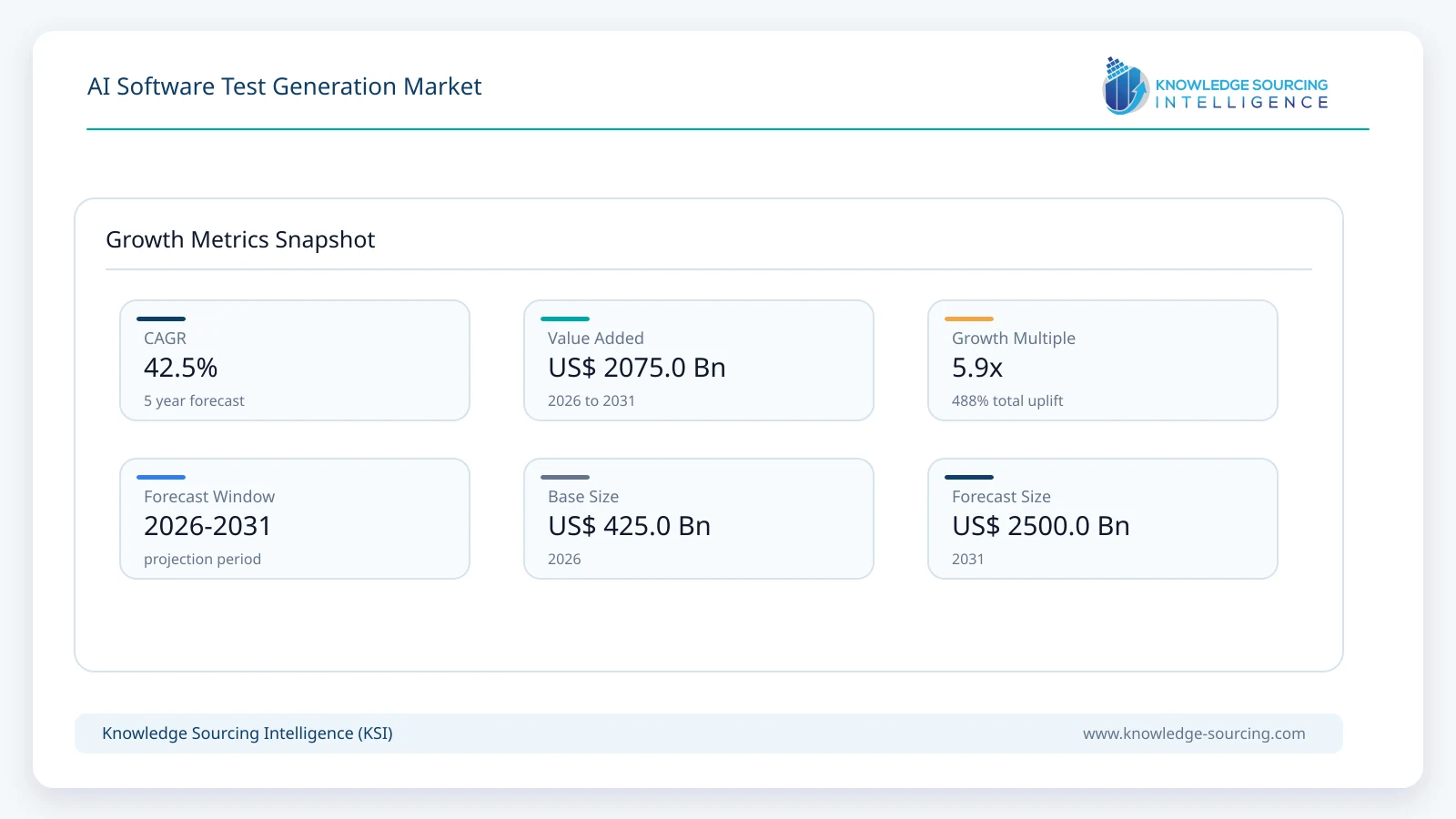
The AI software test generation market is estimated at USD 425 million in 2026 and is forecast to reach USD 2,500 million in 2031, growing at a CAGR of 42.5% during the forecast period.
Highlights:
- 1Dedicated AI test-generation platforms and enterprise authoring products are projected to generate USD 855.5 million in 2031, reflecting demand for repository-aware and maintained test suites.
- 2Developer-assistant test generation is expected to reach USD 826.5 million by 2031 as enterprises assign a larger share of coding-assistant expenditure to test creation.
- 3Unit and component test code remains a leading output group, while browser and mobile automation scripts gain share as quality teams expand end-to-end workflows.
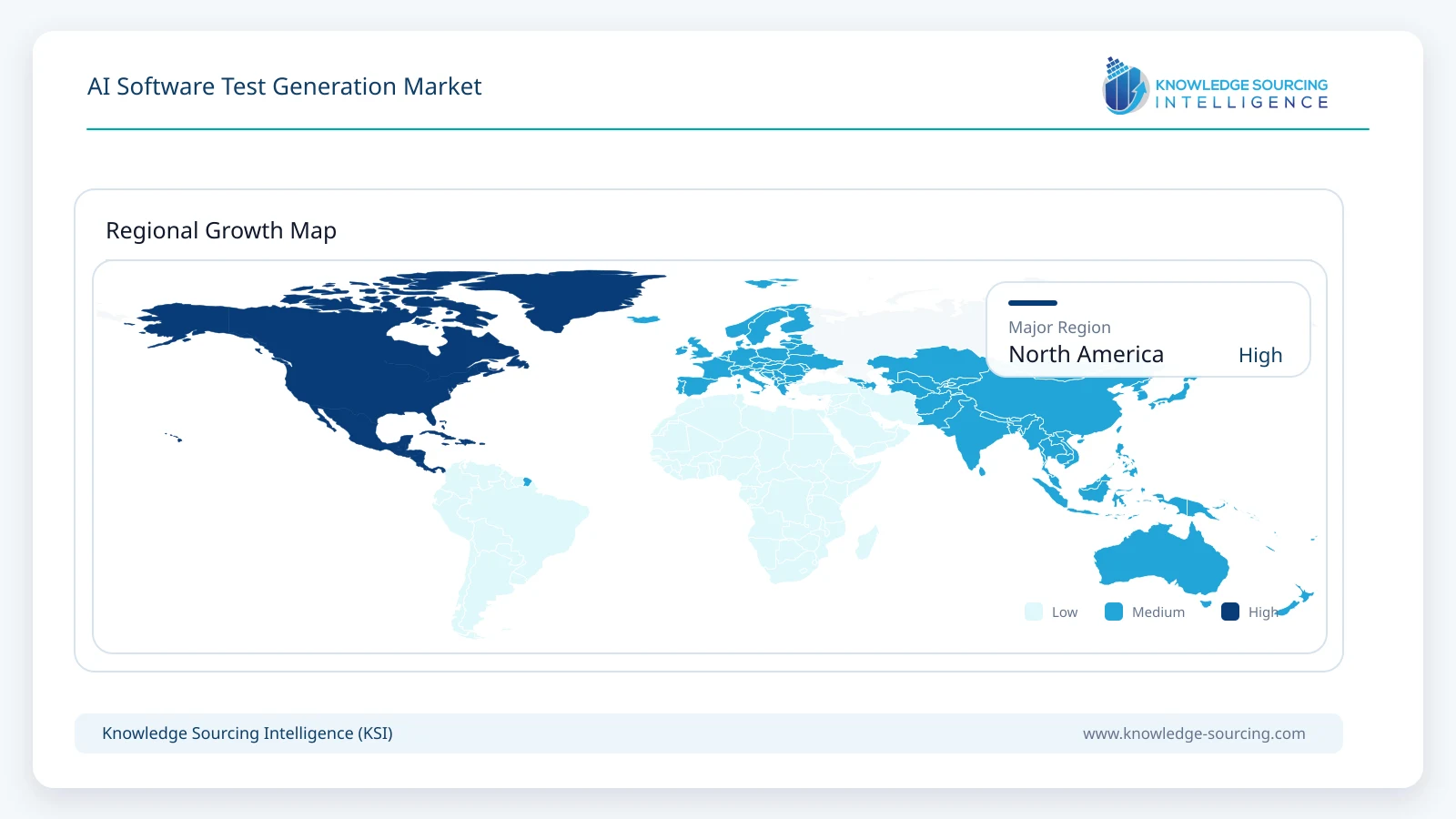
- 4North America is forecast to reach USD 945 million by 2031, supported by advanced developer-tool adoption and enterprise software-quality budgets.
- 5Asia Pacific is projected to reach USD 780 million by 2031, growing faster as technology services providers, digital businesses and large product-engineering teams expand AI-assisted test authoring.
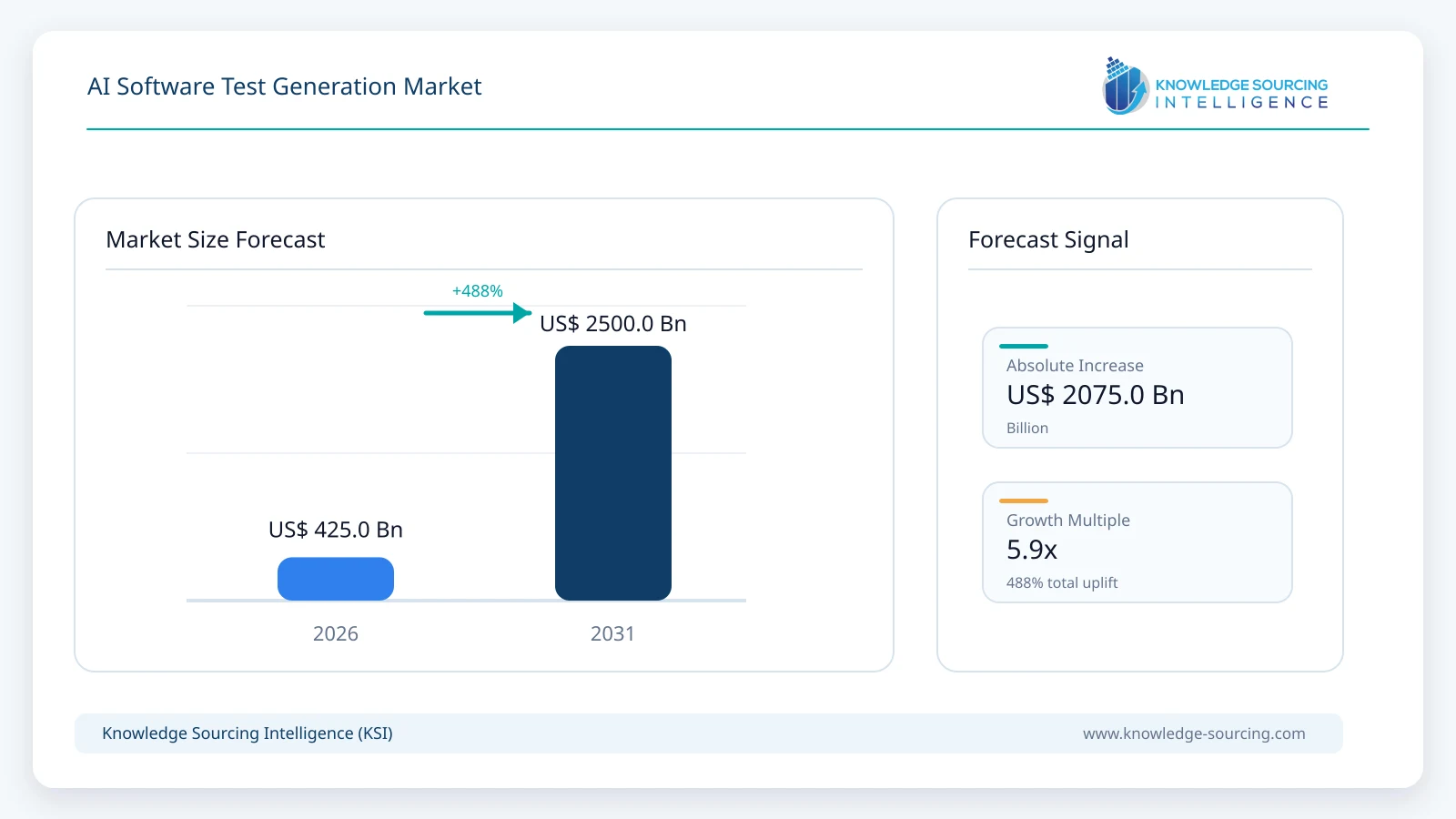
Revenue includes dedicated test-generation software, paid AI authoring capabilities within quality platforms, the attributable testing portion of developer-assistant subscriptions and metered generation services. Demand is being shaped by enterprise pressure to validate growing volumes of application changes without increasing test-writing workloads at the same rate.
Modern AI test authoring uses repository knowledge, requirement descriptions, API contracts and observed user interactions to create candidates that quality engineers can execute or approve. In March 2026, GitHub described a Copilot @Test workflow for .NET unit tests, while SmartBear introduced AI-generated API tests in ReadyAPI in May 2026. These offerings demonstrate two buying paths: engineering teams authoring tests inside their IDEs and centralized QA organizations adding AI capabilities to established testing platforms.
Commercial expansion depends on converting suggested tests into maintainable assets with useful assertions and reliable execution. Tricentis has built review and coverage controls into qTest, while BrowserStack positions Test Companion around existing Playwright, Cypress and mobile frameworks.
Market Overview
AI software test generation comprises tools that translate business requirements, program structure, API specifications or observed application behavior into test assets. Source-aware generators typically propose assertions, fixtures and edge cases for unit or integration frameworks, while requirement-based systems produce structured scenarios with preconditions, actions and expected results. Browser-oriented products can assemble executable workflow scripts from recorded journeys or natural-language instructions, with human review and execution feedback used to improve suitability.
AI-native coding has increased the commercial importance of test preparation because faster code production does not remove the need to demonstrate reliable behavior. GitHub Copilot and Amazon Q Developer can produce tests inside the development environment, whereas Diffblue focuses on regression suites for existing codebases and SmartBear addresses API quality. TestRail and Tricentis also connect generated cases to test management, helping organizations preserve requirements coverage, approval history and the relationship between a test and the feature it is meant to validate.
Enterprise buyers evaluate these platforms according to the quality of assertions, the rate of executable tests, duplicate prevention, integration with CI/CD and the effort needed to maintain assets after application changes. AI-generated cases that compile but assert the wrong behavior create additional review work, so leading providers are adding coverage planning, validation feedback and contextual retrieval. As customers move toward governed deployment, private hosting, secure repository access and traceability can carry as much weight as generation speed.
Market Trends
Repository-Aware Generation Is Replacing Isolated Prompts
Developer teams increasingly expect test-generation systems to understand existing fixtures, mocks, framework conventions and project dependencies rather than producing generic snippets. GitHub Copilot provides configurable test prompts and a purpose-built Visual Studio @Test workflow, while Amazon Q Developer can generate unit tests in the IDE and place proposed changes into project files. Repository grounding improves the likelihood that test scripts can be reviewed and executed within established pipelines.
Code-context retrieval also changes procurement decisions: a developer assistant may be sufficient for individual contributors, whereas larger teams may pay for dedicated suite construction and maintenance.
Requirements-to-Test Authoring Is Expanding Beyond Unit Tests
Quality teams are using AI to translate user stories, structured requirements and API descriptions into cases before a complete implementation is available. Tricentis made Agentic Test Creation available in qTest in February 2026, while Katalon documents AI-assisted test case and step generation from integrated requirements. These products extend AI test authoring to business analysts and QA managers who may not work directly with source code.
Vendors with links to Jira, Azure DevOps, test repositories and review workflows can differentiate by showing which requirement each generated case addresses and by identifying duplicates before they are saved.
Specialist Agents Are Closing the Generation-to-Execution Gap
Specialist test-generation agents are increasingly designed to run candidate tests, inspect failures and revise weak assertions rather than stopping after a draft is produced. Diffblue introduced an enterprise Testing Agent in March 2026 for regression unit-test suites, and BrowserStack positioned Test Companion around test authoring, debugging and maintenance inside familiar IDEs. Both approaches place executable usefulness ahead of output volume.
Feedback-enabled generation supports larger legacy systems and browser journeys where test setup, timing and environment configuration make single-pass results unreliable. Vendors that combine generation with existing runners can demonstrate value through accepted test coverage, developer time saved and lower manual preparation costs, while pure text-generation features face greater pricing pressure.
Quality Controls and Private Deployment Are Becoming Purchasing Criteria
Organizations handling sensitive source code and regulated workflows are placing greater emphasis on controllable AI services and review records. SmartBear provides customer control over enabling its ReadyAPI AI generation capability, and Tricentis introduced coverage-plan review before creating cases in qTest during 2026. Such features give test owners a chance to approve intended scope and manage AI consumption before new assets enter a controlled repository.
Private-cloud and hybrid options are therefore expected to gain revenue share where application IP, data access and audit requirements constrain use of shared services.
Segment Analysis
By Commercial Offering: Dedicated AI Test-Generation Platforms
Dedicated AI test-generation platforms are forecast to reach USD 855.5 million by 2031, representing the largest commercial offering group in the modeled market. Enterprise demand centers on multi-project test creation, legacy suite expansion, agentic feedback loops and integration with existing testing standards. Diffblue, BrowserStack and specialist testing providers address use cases where teams need more than an individual coding assistant to produce and manage durable tests.
By Commercial Offering: Developer-Assistant Test Generation
The attributable test-generation functionality embedded in developer assistants is forecast at USD 826.5 million in 2031. GitHub Copilot and Amazon Q Developer reduce the distance between application code and test authoring, making test creation accessible during ordinary development work. The measured segment excludes the remaining subscription value associated with code completion, refactoring and unrelated agent tasks, preserving a distinct testing revenue boundary.
By Generated Artifact: Browser and Mobile Automation Scripts
Browser and mobile automation scripts are expected to represent 27% of the market, or USD 675 million, by 2031. The segment expands as product teams seek realistic testing of customer journeys, authentication flows and cross-device behavior. BrowserStack Test Companion reflects this direction through support for mainstream web frameworks and real-device mobile testing, although framework compatibility and brittle locators remain major execution considerations.
By Generation Architecture: Execution-Feedback Agentic Generation
Execution-feedback agentic generation is projected to reach USD 925 million in 2031, equal to 37% of the global model. These systems use feedback from test execution, compilation, coverage or failure analysis to refine candidate cases rather than returning a single proposed script. The higher growth assumption reflects enterprise willingness to pay for accepted, maintainable coverage, not simply for more generated test text.
By Deployment Model: Multi-Tenant Cloud SaaS
Multi-tenant cloud SaaS is forecast at USD 1.30 billion in 2031 and remains the largest deployment model because subscriptions and hosted AI features can be introduced without maintaining dedicated infrastructure. Private-cloud deployment is also gaining share among enterprises that require tighter control of source-code exposure, credentials and audit workflows. Providers offering both delivery modes can address centralized quality teams and individual developers without replacing existing test tools.
Market Drivers
Rising Software Change Volume and Test Backlogs
Faster application development and coding-agent adoption increase the number of code changes that must be verified before release. Manual test authoring can become a bottleneck when teams maintain many services, interfaces and user journeys. AI generators give engineering organizations a way to prepare candidate cases alongside implementation work and allocate human reviewers to high-risk behavior. The commercial opportunity depends on measurable reductions in accepted-test preparation time rather than simply generating larger suites.
Demand for Coverage in Existing Enterprise Codebases
Large enterprises often operate mature applications whose regression suites do not fully reflect current behavior or planned modernization. Diffblue’s enterprise regression-focused work demonstrates demand for generating unit coverage in Java systems without writing every test by hand. Repository-aware generation can help teams protect existing features during refactoring, migration and dependency changes, particularly when software knowledge is distributed across long-lived engineering teams.
Broader Access to Requirements-Driven Testing
Tricentis qTest and Katalon expose AI generation through requirement and test-management workflows, allowing quality professionals to request structured cases without writing automation code. This broadens potential buyers beyond developers and supports more consistent mapping between business requirements, planned validation and execution artifacts. Suppliers that add approvals and duplicate detection can sell authoring capabilities into organizations already committed to established QA systems.
Expansion of API and Connected Application Testing
Enterprise applications increasingly depend on APIs and distributed services whose interactions must be validated across releases. SmartBear’s 2026 ReadyAPI AI launch illustrates efforts to generate API cases from natural-language intent while preserving QA oversight. Schema-aware generation and contract validation are commercially valuable because API changes can affect multiple downstream applications, and tests must address both expected and invalid inputs across connected systems.
Improved End-to-End Agentic Testing Economics
Specialist agents can combine candidate generation, test execution, diagnosis and revision in one workflow, reducing the number of repetitive steps handled by quality engineers. BrowserStack and mabl are extending testing assistants closer to IDEs and application workflows. Greater automation should improve customer willingness to fund recurring platform contracts when vendors can demonstrate reliable test acceptance, coverage outcomes and lower ongoing maintenance expenditure.
Market Restraints
Weak Assertions and Unreliable Generated Tests
Generated tests may compile or pass without checking the behavior that matters, particularly when the specification is vague or the generator copies current implementation assumptions. Review, mutation testing and coverage checks add cost, and organizations can reject tools that create maintenance burdens rather than reducing them.
Limited Access to Sensitive Source Code
Banking, healthcare and government customers may restrict sending proprietary repositories, credentials or test data to external AI services. Private deployment, policy controls and secure context retrieval can address these concerns, but they raise setup costs and slow purchasing decisions.
Bundling and Attribution Pressure on Pricing
GitHub Copilot, Amazon Q Developer and broader QA suites can package test generation within subscriptions purchased for other purposes. Specialist vendors must show incremental value, while market revenue should include only the attributable authoring portion of bundled licenses to avoid inflating category size.
Integration Complexity Across Frameworks
Test generation must work with existing Java, .NET, JavaScript, API and mobile frameworks, along with runners, fixtures and CI/CD conventions. Unsupported dependencies, environment-specific authentication and unstable browser locators can prevent plausible generated scripts from becoming usable tests.
Uncertain Return on Automation Investment
A high volume of suggested tests does not guarantee fewer defects or better release decisions. Buyers must consider review time, execution cost, flaky tests and continual updates, which can delay large contracts until providers demonstrate accepted coverage and lower lifecycle effort.
Regional Outlook
North America
North America is the largest regional market, valued at USD 185 million in 2026 and forecast to reach USD 945 million by 2031. The United States accounts for the majority of regional expenditure through its concentration of enterprise software buyers, developer-tool providers, cloud platforms and regulated digital services. Large engineering organizations are adopting repository-aware generation and specialist QA agents to expand regression coverage without proportionate increases in manual test-writing teams.
North American demand is reinforced by a supplier ecosystem that includes GitHub, Amazon Web Services, SmartBear, mabl and test-management platforms selling to enterprise customers. Deployment options increasingly reflect customer governance needs, with privacy controls, test review histories and integration into established CI/CD workflows influencing procurement. Canada contributes adoption among financial, telecom and software teams, while Mexico adds demand from technology services and nearshore engineering operations.
Asia Pacific
Asia Pacific is expected to be the fastest-growing market, increasing from USD 95 million in 2026 to USD 780 million by 2031, an implied CAGR of approximately 52.36%. China, India, Japan and South Korea combine sizable development workforces with large domestic digital-service markets, while Australian and Singaporean enterprises contribute demand for cloud-managed testing and governed software releases. AI-assisted generation can be particularly attractive where distributed teams maintain multiple applications and need consistent coverage.
India’s product-engineering and technology-services base supports adoption across both internal QA teams and outsourced software delivery, while Japan’s enterprise modernization needs create opportunities for generating tests around established systems. China and South Korea are expected to expand use within digital platforms, electronics and connected services. Regional growth will remain dependent on data-handling policies, local-language requirements, acceptable model quality and the ability of test-generation tools to integrate with customers’ chosen frameworks.
Competitive Landscape
The AI software test generation market brings together specialist testing vendors, test-management suites and developer-assistant platforms with differing approaches to pricing and deployment. Tricentis and TestRail emphasize requirements-linked cases and approval workflows, while Diffblue focuses on generated unit-test coverage and SmartBear concentrates on API testing. BrowserStack, mabl and other agentic platforms connect authoring with execution feedback, making their commercial positioning closer to end-to-end quality engineering than standalone text generation.
Developer platforms such as GitHub Copilot and Amazon Q Developer can distribute test generation through existing engineering subscriptions at relatively low incremental acquisition cost. Specialist vendors therefore compete on context quality, supported frameworks, coverage analysis, private deployment and the ability to maintain tests after application changes. Market leadership is more likely to depend on trusted, executable output and enterprise integration than broad claims about AI-generated test volumes.
Recent Developments
21 October 2026: mabl introduced an agentic testing harness for independent checks of coding-agent changes, including coverage-gap analysis, developer-workflow verification and test creation within its platform.
29 July 2026: BrowserStack introduced Test Companion for IDE-based test authoring, execution, debugging and maintenance across popular automation frameworks.
18 May 2026: SmartBear launched AI test generation for ReadyAPI, focusing on natural-language-driven API tests with configurable enablement and oversight.
24 March 2026: Diffblue announced a Testing Agent to generate regression unit-test suites for enterprise application modernization and legacy code coverage.
4 March 2026: GitHub detailed the @Test workflow in Visual Studio Copilot for creating and refining C# unit tests across xUnit, NUnit and MSTest.
19 February 2026: Tricentis made Agentic Test Creation available through qTest AI Chat, generating test cases using requirement and existing-test context.
Market Outlook
AI software test generation is expected to expand as developers and quality engineers adopt workflows that create tests while applications are being built and changed. By 2031, stronger demand is anticipated for governed authoring, repository-aware regression suites and feedback-enabled generation rather than one-off prompts. Enterprises will increasingly measure vendors by usable test coverage, release confidence and maintenance effort, linking software spending to accepted outcomes.
Dedicated testing platforms should retain a meaningful share of revenue by serving complex enterprises that require shared governance and multi-project quality engineering. At the same time, embedded generation within developer assistants will become a larger competitive influence and may constrain standalone pricing for basic unit-test drafts. Products supporting API contracts, web journeys and private source-code workflows can differentiate through specialized integration and verification capabilities.
The pace of adoption will depend on improvements in assertion quality, environment compatibility and the cost of reviewing AI-produced tests. Vendors that combine test creation with traceable requirements, execution feedback and practical security controls are better positioned to convert trials into recurring contracts.
AI Software Test Generation Market Scope
| Report Metric | Details |
|---|---|
| Total Market Size in 2026 | USD 425 million |
| Total Market Size in 2031 | USD 2,500 million |
| Forecast Unit | Billion |
| Growth Rate | 42.5% |
| Study Period | 2021 to 2031 |
| Historical Data | 2021 to 2024 |
| Base Year | 2025 |
| Forecast Period | 2026 – 2031 |
| Segmentation | Commercial Offering, Generated Test Artifact, Testing Level, Primary Generation Input, Generation Architecture, Deployment Model, End-User Industry, Geography |
| Companies |
|
| Customization Scope | 15% Free Customization included with purchase — Request Custom Breakdown → |
| Sample & Data Access | PDF Sample, Excel Databook & Analyst Briefing — Download Free Sample → |
Market Segmentation
By Commercial Offering
Dedicated AI test-generation platforms
Testing-management AI authoring add-ons
Developer-assistant test generation allocation
Metered generation APIs and batch jobs
By Generated Test Artifact
Unit and component test code
Structured manual and acceptance test cases
Browser and mobile automation scripts
API and contract test assets
By Testing Level
Unit and component testing
Integration and API testing
System and end-to-end testing
Business-process acceptance testing
By Primary Generation Input
Source code and repository context
Requirements, tickets, and user stories
API specifications and schema
Recorded workflows and observed sessions
By Generation Architecture
Prompt-driven generation
Retrieval/context-grounded generation
Rules-constrained hybrid generation
Execution-feedback agentic generation
By Deployment Model
Multi-tenant cloud SaaS
Dedicated private cloud/VPC
Self-hosted/on-premises
Hybrid managed deployment
By End-User Industry
Information Technology and Software
Banking and Financial Services
Retail and Digital Commerce
Healthcare and Life Sciences
Manufacturing and Engineering
Telecommunications and Media
Government and Other Industries
By Geography
North America
United States
Canada
Mexico
South America
Brazil
Argentina
Chile
Rest of South America
Europe
Germany
United Kingdom
France
Italy
Spain
Netherlands
Nordic Countries
Rest of Europe
Middle East and Africa
United Arab Emirates
Saudi Arabia
Israel
South Africa
Rest of Middle East and Africa
Asia Pacific
China
India
Japan
South Korea
Australia
Singapore
Rest of Asia Pacific
Table of Contents
1. EXECUTIVE SUMMARY
1.1. Key Findings
1.2. Market Size and Forecast, 2026–2031
1.3. Strategic Market Outlook
2. MARKET SNAPSHOT
2.1. Definition and Scope
2.2. Market Dynamics
2.3. Commercial Pricing and Demand
2.4. Market Segmentation
3. BUSINESS LANDSCAPE
3.1. Market Drivers
3.1.1. Rising Software Change Volume and Test Backlogs
3.1.2. Demand for Coverage in Existing Enterprise Codebases
3.1.3. Broader Access to Requirements-Driven Testing
3.1.4. Expansion of API and Connected Application Testing
3.1.5. Improved End-to-End Agentic Testing Economics
3.2. Market Restraints
3.2.1. Weak Assertions and Unreliable Generated Tests
3.2.2. Limited Access to Sensitive Source Code
3.2.3. Bundling and Attribution Pressure on Pricing
3.2.4. Integration Complexity Across Frameworks
3.2.5. Uncertain Return on Automation Investment
3.3. Market Opportunities
3.4. Porter’s Five Forces Analysis
3.5. Industry Value Chain Analysis
3.6. Policies and Regulations
3.7. Strategic Recommendations
4. TECHNOLOGICAL OUTLOOK
4.1. Source and Requirement Grounding
4.2. Generative Test Planning and Assertions
4.3. Execution and Feedback Loops
4.4. Integration with Test Runners and CI/CD
4.5. Coverage Measurement and Traceability
4.6. Secure and Governed Test Authoring
5. AI SOFTWARE TEST GENERATION MARKET BY COMMERCIAL OFFERING
5.1. Dedicated AI test-generation platforms
5.2. Testing-management AI authoring add-ons
5.3. Developer-assistant test generation allocation
5.4. Metered generation APIs and batch jobs
6. AI SOFTWARE TEST GENERATION MARKET BY GENERATED TEST ARTIFACT
6.1. Unit and component test code
6.2. Structured manual and acceptance test cases
6.3. Browser and mobile automation scripts
6.4. API and contract test assets
7. AI SOFTWARE TEST GENERATION MARKET BY TESTING LEVEL
7.1. Unit and component testing
7.2. Integration and API testing
7.3. System and end-to-end testing
7.4. Business-process acceptance testing
8. AI SOFTWARE TEST GENERATION MARKET BY PRIMARY GENERATION INPUT
8.1. Source code and repository context
8.2. Requirements, tickets, and user stories
8.3. API specifications and schema
8.4. Recorded workflows and observed sessions
9. AI SOFTWARE TEST GENERATION MARKET BY GENERATION ARCHITECTURE
9.1. Prompt-driven generation
9.2. Retrieval/context-grounded generation
9.3. Rules-constrained hybrid generation
9.4. Execution-feedback agentic generation
10. AI SOFTWARE TEST GENERATION MARKET BY DEPLOYMENT MODEL
10.1. Multi-tenant cloud SaaS
10.2. Dedicated private cloud/VPC
10.3. Self-hosted/on-premises
10.4. Hybrid managed deployment
11. AI SOFTWARE TEST GENERATION MARKET BY END-USER INDUSTRY
11.1. Information Technology and Software
11.2. Banking and Financial Services
11.3. Retail and Digital Commerce
11.4. Healthcare and Life Sciences
11.5. Manufacturing and Engineering
11.6. Telecommunications and Media
11.7. Government and Other Industries
12. AI SOFTWARE TEST GENERATION MARKET BY GEOGRAPHY
12.1. North America
12.1.1. United States
12.1.2. Canada
12.1.3. Mexico
12.2. South America
12.2.1. Brazil
12.2.2. Argentina
12.2.3. Chile
12.2.4. Rest of South America
12.3. Europe
12.3.1. Germany
12.3.2. United Kingdom
12.3.3. France
12.3.4. Italy
12.3.5. Spain
12.3.6. Netherlands
12.3.7. Nordic Countries
12.3.8. Rest of Europe
12.4. Middle East and Africa
12.4.1. United Arab Emirates
12.4.2. Saudi Arabia
12.4.3. Israel
12.4.4. South Africa
12.4.5. Rest of Middle East and Africa
12.5. Asia Pacific
12.5.1. China
12.5.2. India
12.5.3. Japan
12.5.4. South Korea
12.5.5. Australia
12.5.6. Singapore
12.5.7. Rest of Asia Pacific
13. COMPETITIVE ENVIRONMENT AND ANALYSIS
13.1. Major Participants and Positioning
13.2. Product and Commercial Differentiation
13.3. Market Share Analysis
13.4. Competitive Developments
14. COMPANY PROFILES
14.1. Tricentis GmbH
14.2. SmartBear Software, Inc.
14.3. BrowserStack
14.4. Diffblue Limited
14.5. mabl, Inc.
14.6. Katalon, Inc.
14.7. TestRail (Sembi Group)
14.8. GitHub, Inc. (Microsoft)
14.9. Amazon Web Services (Amazon)
14.10. GitLab Inc.
14.11. Qodo
14.12. testRigor
15. APPENDIX
15.1. Research Methodology
15.2. Currency and Forecast Conventions
15.3. List of Abbreviations





Frequently asked questions
What is the projected market size for AI software test generation by 2031?
The AI Software Test Generation Market is forecast to reach USD 2,500 million by 2031.
What is the compound annual growth rate (CAGR) for this market?
The AI Software Test Generation Market is growing at a 42.5% CAGR during the forecast period.
Which AI test generation segments will drive significant revenue by 2031?
Dedicated platforms and developer-assistant generation will lead revenue by 2031.
Which regions are expected to lead in AI software test generation by 2031?
North America leads, with Asia Pacific showing fastest growth by 2031.
What are the primary drivers for AI software test generation market growth?
Validating increasing application changes without escalating test-writing workloads.
What are the leading test output groups for AI software test generation?
Unit and component test code leads, browser/mobile scripts gain share.
Cite this report
Knowledge Sourcing Intelligence. (Oct 2026). AI Software Test Generation Market Size, Share & Growth Forecast (2026-2031). https://www.knowledge-sourcing.com/report/ai-software-test-generation-market