
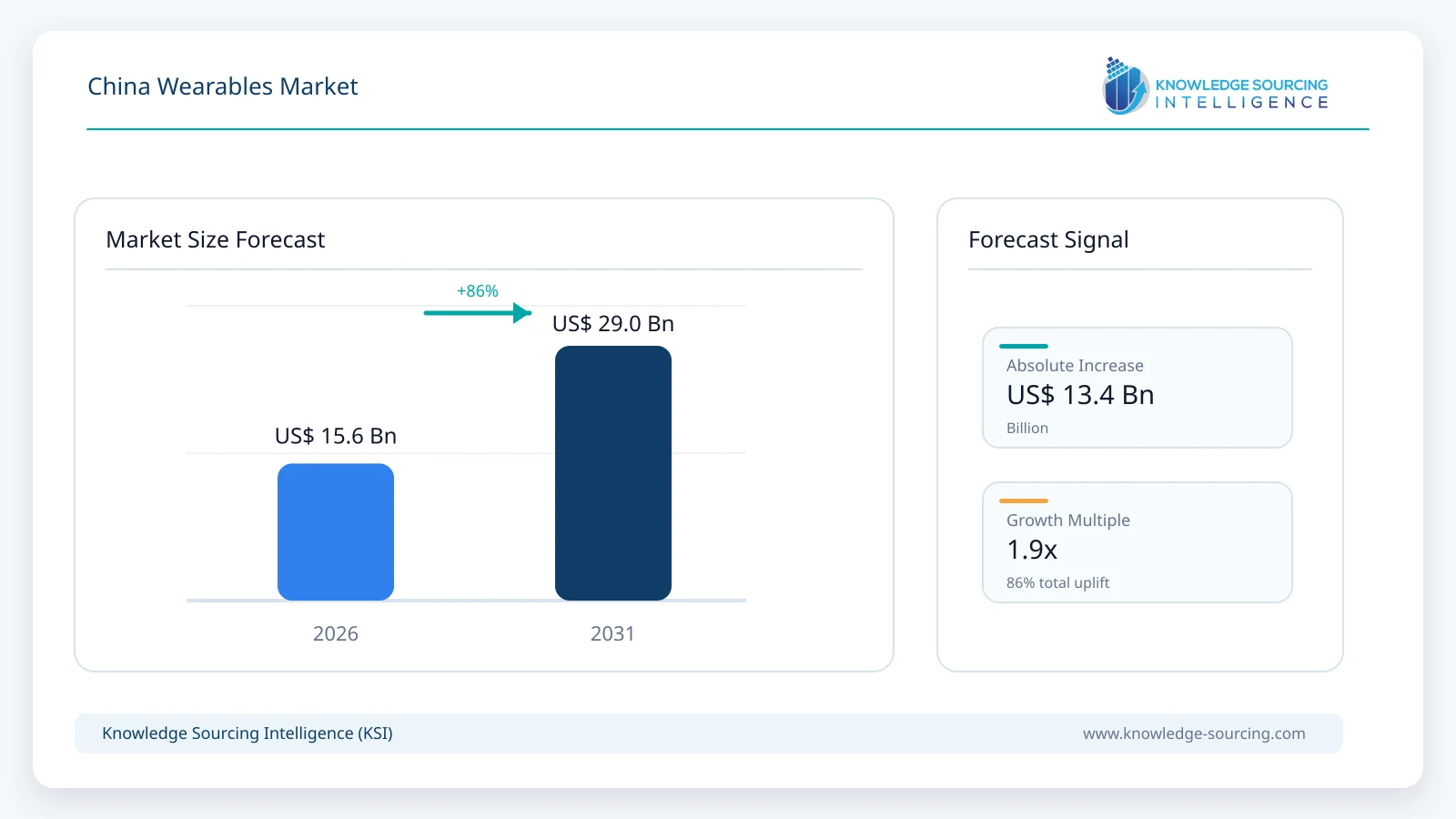
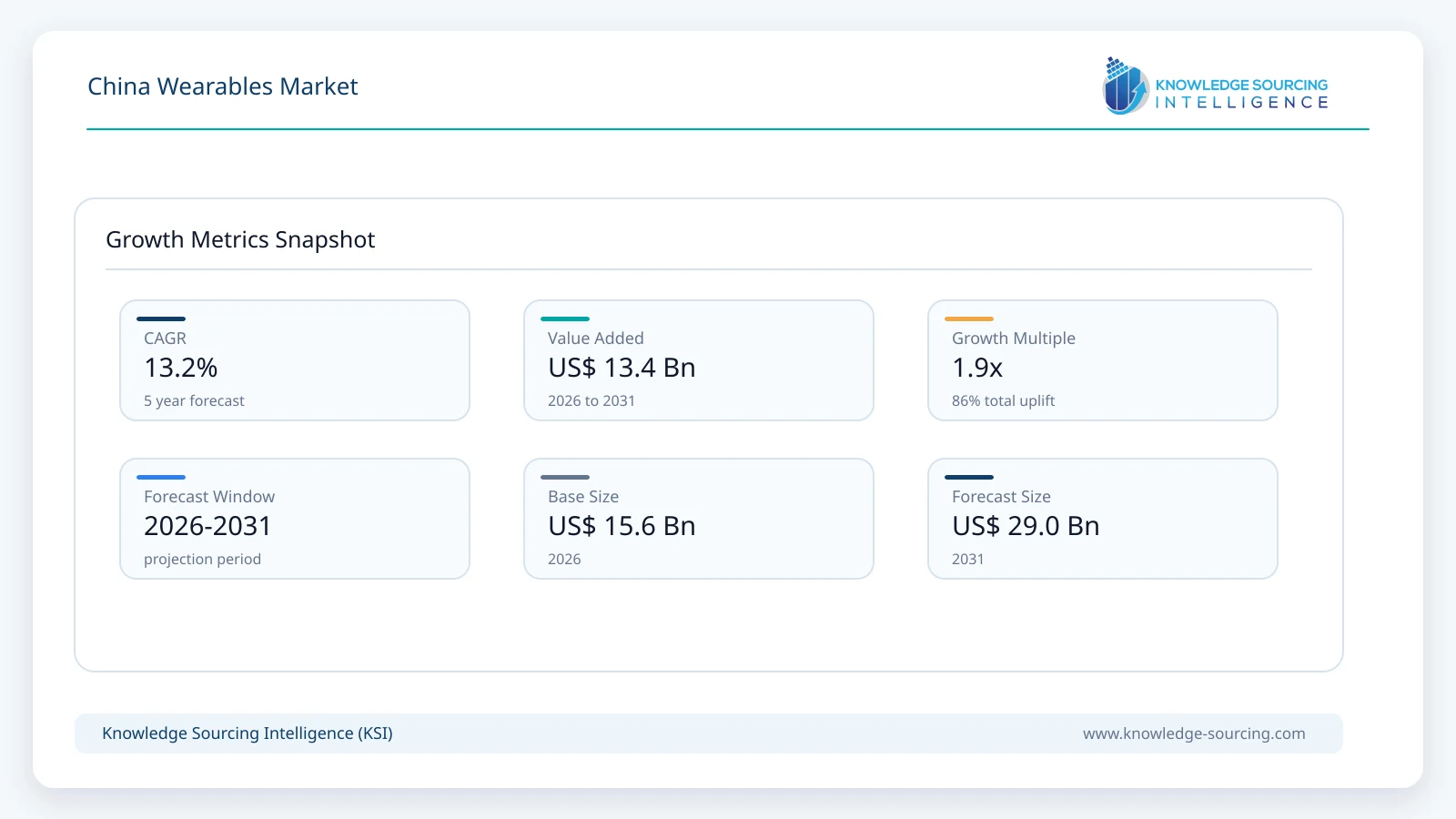
The China Wearables Market is projected to increase from USD 15.6 billion in 2026 to USD 29.0 billion in 2031, representing a CAGR of 13.2% during the forecast period.
Highlights:
- 1Smartwatches account for approximately 42% of China wearables revenue in 2026.
- 2China shipped 73.9 million wrist-worn devices in 2025, up 20.8% year over year.
- 3Smart glasses are the fastest-growing product group as AI-enabled eyewear moves toward commercialization.
- 4Online channels remain central to launches, promotions and rapid inventory turnover across major brands.
- 5Government purchase subsidies materially strengthened smartwatch and smart-band demand during 2025.
- 6Health monitoring, battery life and ecosystem integration increasingly determine premium-device differentiation.
China is one of the world's largest and most competitive markets for connected wearable devices. International Data Corporation (IDC) reported 73.9 million wrist-worn device shipments in 2025, up 20.8% year over year, including 50.61 million smartwatches and 23.29 million smart bands. The acceleration was helped by national purchase subsidies and platform promotions, but it also reflected stronger product depth across premium watches, children's watches and value-oriented bands. Huawei led wrist-worn shipments, while Xiaomi, Apple, BBK's Xiaotiancai and Honor remained important competitors across different price tiers.
The market is also broadening beyond the wrist. IDC reported 2.46 million smart-glasses shipments in China in 2025, an increase of 87.1%, while the State Administration for Market Regulation reported that the number of barcode-registered smart-wearable product varieties reached 181,000 by September 2025. Smart earphones represented the largest number of registered wearable product varieties, showing the importance of hearables within the wider device ecosystem. This combination of large installed categories and emerging form factors gives China a diversified growth profile even as unit growth in established smartwatches and bands gradually normalizes.
Health functionality is becoming a larger part of the value proposition. Huawei Watch 5 integrates electrocardiogram (ECG), photoplethysmography (PPG) and artificial-intelligence-assisted health interpretation, while Honor, OPPO, Xiaomi and Apple continue to expand cardiovascular, sleep, fitness and wellness features. Chinese regulators are also placing greater emphasis on measurement accuracy and personal-data practices. In November 2025, the State Administration for Market Regulation announced new smartwatch calibration research covering heart rate, blood oxygen, step counting and other measurements, reinforcing the transition from lifestyle gadgets toward more structured personal-health tools.
Selected Segment Estimates
Dimension | Selected Subsegment | 2026 Indicator | Forecast Interpretation |
Product | Smartwatches | ~42% share; ~USD 6.55 billion | Largest value pool, supported by premiumization, health monitoring and children's watches. |
Product | Hearables | ~34% share; ~USD 5.30 billion | Large installed consumer base; AI audio, translation and health features increase device value. |
Product | Smart Bands | ~8% share; ~USD 1.25 billion | High unit volumes but lower average selling prices than smartwatches. |
Product | Smart Glasses | ~5% share; ~USD 0.78 billion | Fastest-growing product group as AI, camera and display functions improve. |
Distribution | Online Channels | ~64% share; ~USD 10.0 billion | Major launch and promotion channel, especially for domestic brands and mid-price devices. |
Price Positioning | Mid-Premium Devices | Rising share through 2031 | Consumers trade up for better sensors, materials, battery life, eSIM and AI functionality. |
Market Dynamics
Health Monitoring Is Increasing the Value of Smartwatches
Continuous heart-rate measurement, blood-oxygen monitoring, sleep analysis, electrocardiogram functions and more advanced cardiovascular screening are moving smartwatches closer to daily health-management tools. Huawei has linked recent watch generations with clinical research programs using ECG and PPG sensors, while OPPO Watch X2 introduced a 60-second health check and Honor Watch 5 Ultra emphasized heart-health functions. These features support higher average selling prices and more frequent replacement among health-conscious consumers, although vendors must clearly distinguish wellness functions from regulated medical diagnosis.
AI Is Expanding the Role of Wearables Beyond Passive Tracking
Artificial intelligence is becoming embedded across watches, earbuds and glasses. Huawei Watch 5 integrates system-level AI functions, Honor has added AI-based assistance across its device ecosystem, and smart glasses increasingly incorporate large-model voice assistants and camera-based interaction. IDC reported that 50.5% of China's smart glasses shipped in 2025 supported large-model voice assistants. This changes the commercial proposition from a device that records activity to one that interprets information, provides contextual assistance and acts as a persistent interface to the user's digital ecosystem.
Purchase Subsidies and E-Commerce Promotions Accelerate Replacement Demand
China's 2025 national digital-product subsidy program included smartwatches and smart bands priced at no more than CNY 6,000, with a subsidy equal to 15% of the final selling price and capped at CNY 500 per device. IDC identified the subsidy program and platform promotions as important contributors to the 20.8% rise in wrist-worn shipments during 2025. The effect is likely to normalize over the forecast period, but the program accelerated replacement cycles, lowered the effective price of mid-premium products and encouraged manufacturers to align launches and channel inventory more closely with major promotional periods.
Maturing Wrist-Worn Penetration Moderates Long-Term Unit Growth
China already has a large installed base of smartwatches and smart bands, meaning future growth cannot rely indefinitely on first-time buyers. Mature users increasingly compare battery endurance, sensor accuracy, operating-system integration, payment support, cellular connectivity and design quality before replacing an existing device. This favors vendors that can improve product value without pushing prices beyond the most active consumer bands. It also makes services and ecosystem stickiness more important because switching brands can disrupt health-history continuity, app integration and device-to-device workflows.
Privacy and Measurement Accuracy Increase Compliance Requirements
Wearables collect continuous and sometimes sensitive information about location, activity and health. Chinese authorities included smartwatches and smart bands in the 2025 personal-information protection enforcement program, targeting excessive collection and insufficient disclosure. Measurement quality is also receiving greater attention as consumers rely on watches for heart rate, blood oxygen and sleep information. Stronger calibration, consent and data-governance requirements raise development and compliance costs but can also improve user trust and differentiate established brands from low-cost devices with weaker software support.
Segment Analysis
By Product - Smartwatches
Smartwatches remain the largest product category by value, generating approximately USD 6.55 billion in 2026. IDC reported 50.61 million smartwatch shipments in China during 2025, up 17.2%, and the category spans premium general-purpose watches, children's communication watches and lower-priced fitness-oriented products. Huawei leads the domestic wrist-worn market, Apple retains a strong premium position, and Xiaomi is expanding further into higher-end full-smartwatch products. Through 2031, smartwatch growth is expected to come more from value per device and ecosystem services than from another prolonged period of 20% annual unit expansion.
By Product - Smart Glasses
Smart glasses are a much smaller category but have the strongest growth potential. China shipped 2.46 million smart glasses in 2025, up 87.1%, supported by lighter hardware, improving optical designs and widespread integration of AI assistants. Online channels accounted for more than 68% of 2025 smart-glasses shipments, although offline optical retail is beginning to expand. The category remains volatile: IDC reported that second-quarter 2026 shipments fell 8.0% year over year as audio-glasses demand weakened. This reinforces the view that sustained growth will depend on clear consumer use cases rather than hardware novelty alone.
By Distribution Channel - Online
Online channels are central to China's wearable-device market because major vendors coordinate product launches, price promotions and subsidy eligibility across e-commerce platforms. The channel is especially effective for smart bands, earbuds and mainstream watches where specifications are standardized and consumers are familiar with the brands. Offline retail remains important for premium watches and emerging smart glasses because fit, display quality and comfort benefit from hands-on experience. Over time, the most successful vendors are likely to use an integrated channel model rather than treating online and offline distribution as substitutes.
Technology and Demand Indicators
Indicator | Latest Development | Market Impact |
Wrist-worn shipments | 73.9 million units in China in 2025, up 20.8% year over year. | Confirms a large installed base and strong recent replacement demand. |
Smartwatch shipments | 50.61 million units in 2025, up 17.2%. | Supports premium health, communication and ecosystem-led revenue growth. |
Smart-band shipments | 23.29 million units in 2025, up 29.4%. | Shows continued volume demand at lower price points. |
Smart-glasses shipments | 2.46 million units in 2025, up 87.1%. | Creates the fastest-growing new wearable category despite early volatility. |
National purchase subsidy | 15% subsidy on eligible watches/bands, capped at CNY 500. | Reduced effective purchase prices and accelerated 2025 replacement demand. |
Product ecosystem depth | 181,000 barcode-registered smart-wearable product varieties by Sep. 2025. | Highlights broad device supply and intense competition across form factors. |
Competitive Landscape
China's wearable market is led by domestic consumer-electronics ecosystems with broad smartphone, audio and connected-device portfolios. Huawei holds the strongest position in wrist-worn shipments and differentiates through HarmonyOS integration, health research and premium watch design. Xiaomi competes across bands, mainstream watches, premium watches, earbuds and smart audio glasses, giving it one of the broadest price ladders in the market. BBK's Xiaotiancai remains particularly strong in children's watches, while Honor, OPPO and vivo use wearables to deepen loyalty around their smartphone ecosystems.
Apple remains a major premium competitor and benefited from stronger China smartwatch demand in 2025, while Zepp Health's Amazfit brand, Garmin and Samsung address sport, health and premium niches. Competition is becoming more fragmented in smart glasses, where Rokid, XREAL, RayNeo/TCL and newer AI-device entrants are attempting to establish use cases around audio, cameras, display, translation and digital assistants. The competitive advantage is shifting toward integrated hardware-software experiences, reliable health sensing, battery efficiency and channels that can support both high-volume e-commerce and hands-on retail experience.
Recent Developments
Second quarter 2026: IDC reported China smart-glasses shipments of 611,000 units, down 8.0% year over year as audio-glasses demand softened.
March 2026: IDC reported that China shipped 73.9 million wrist-worn devices in 2025, an increase of 20.8%.
March 2026: IDC reported 2.46 million China smart-glasses shipments in 2025, up 87.1%, with AI assistants increasingly standard across leading products.
February 2026: Xiaomi showcased the Xiaomi Watch 5 alongside its broader connected-device portfolio for international commercialization.
November 2025: China's State Administration for Market Regulation announced new calibration research for smartwatch heart-rate, blood-oxygen and activity measurements.
October 2025: The State Administration for Market Regulation reported 181,000 registered smart-wearable product varieties across China.
China Wearables Market Scope
| Report Metric | Details |
|---|---|
| Total Market Size in 2026 | USD 15.6 billion |
| Total Market Size in 2031 | USD 29.0 billion |
| Forecast Unit | Billion |
| Growth Rate | 13.2% |
| Study Period | 2021 to 2031 |
| Historical Data | 2021 to 2024 |
| Base Year | 2025 |
| Forecast Period | 2026 – 2031 |
| Segmentation | Product, End User, Connectivity, Distribution Channel |
| Companies |
|
Market Segmentation
By Product
Smartwatches
Smart Bands
Hearables
Smart Glasses
Smart Rings and Other Wearables
By End User
Consumer
Healthcare and Wellness Programs
Enterprise and Industrial
By Connectivity
Bluetooth / Wi-Fi
Cellular / eSIM
Other Connectivity
By Distribution Channel
Online
Offline
Table of Contents
1. EXECUTIVE SUMMARY
2. MARKET SNAPSHOT
2.1. Market Overview
2.2. Market Segmentation
3. BUSINESS LANDSCAPE
3.1. Market Drivers
3.1.1. Health Monitoring Is Increasing the Value of Smartwatches
3.1.2. AI Is Expanding the Role of Wearables Beyond Passive Tracking
3.1.3. Purchase Subsidies and E-Commerce Promotions Accelerate Replacement Demand
3.2. Market Restraints
3.2.1. Maturing Wrist-Worn Penetration Moderates Long-Term Unit Growth
3.2.2. Privacy and Measurement Accuracy Increase Compliance Requirements
3.3. Market Opportunities
3.4. Porter's Five Forces Analysis
3.5. Industry Value Chain Analysis
3.6. Regulatory and Data-Protection Landscape
4. TECHNOLOGICAL OUTLOOK
4.1. Advanced Health Sensors and Continuous Monitoring
4.2. On-Device and Cloud Artificial Intelligence
4.3. Low-Power Displays and Battery Technologies
4.4. eSIM, Bluetooth and Multi-Device Connectivity
4.5. Smart-Glasses Optics and Human-Machine Interaction
5. CHINA WEARABLES MARKET BY PRODUCT
5.1. Smartwatches
5.2. Smart Bands
5.3. Hearables
5.4. Smart Glasses
5.5. Smart Rings and Other Wearables
6. CHINA WEARABLES MARKET BY END USER
6.1. Consumer
6.2. Healthcare and Wellness Programs
6.3. Enterprise and Industrial
7. CHINA WEARABLES MARKET BY CONNECTIVITY
7.1. Bluetooth / Wi-Fi
7.2. Cellular / eSIM
7.3. Other Connectivity
8. CHINA WEARABLES MARKET BY DISTRIBUTION CHANNEL
8.1. Online
8.2. Offline
9. COMPETITIVE ENVIRONMENT AND ANALYSIS
9.1. Major Players and Strategy Analysis
9.2. Market Share Analysis
9.3. Product Launches, Partnerships and Ecosystem Development
9.4. Competitive Dashboard
10. COMPANY PROFILES
10.1. Huawei Device Co., Ltd.
10.2. Xiaomi Corporation
10.3. Apple Inc.
10.4. BBK Electronics
10.5. Honor Device Co., Ltd.
10.6. OPPO
10.7. vivo
10.8. Zepp Health Corporation
10.9. Samsung Electronics Co., Ltd.
10.10. Garmin Ltd.
10.11. Shokz Holding Limited
10.12. Edifier Technology Co., Ltd.
10.13. Rokid Corporation
10.14. XREAL
10.15. TCL Electronics
10.16. LifeSense Group
10.17. Lenovo Group
10.18. Goertek Inc.
11. RECENT DEVELOPMENTS
12. APPENDIX
12.1. Currency
12.2. Assumptions
12.3. Base and Forecast Years Timeline
12.4. Research Methodology
12.5. Abbreviations
Navigate
Trusted by the world's leading organizations











