
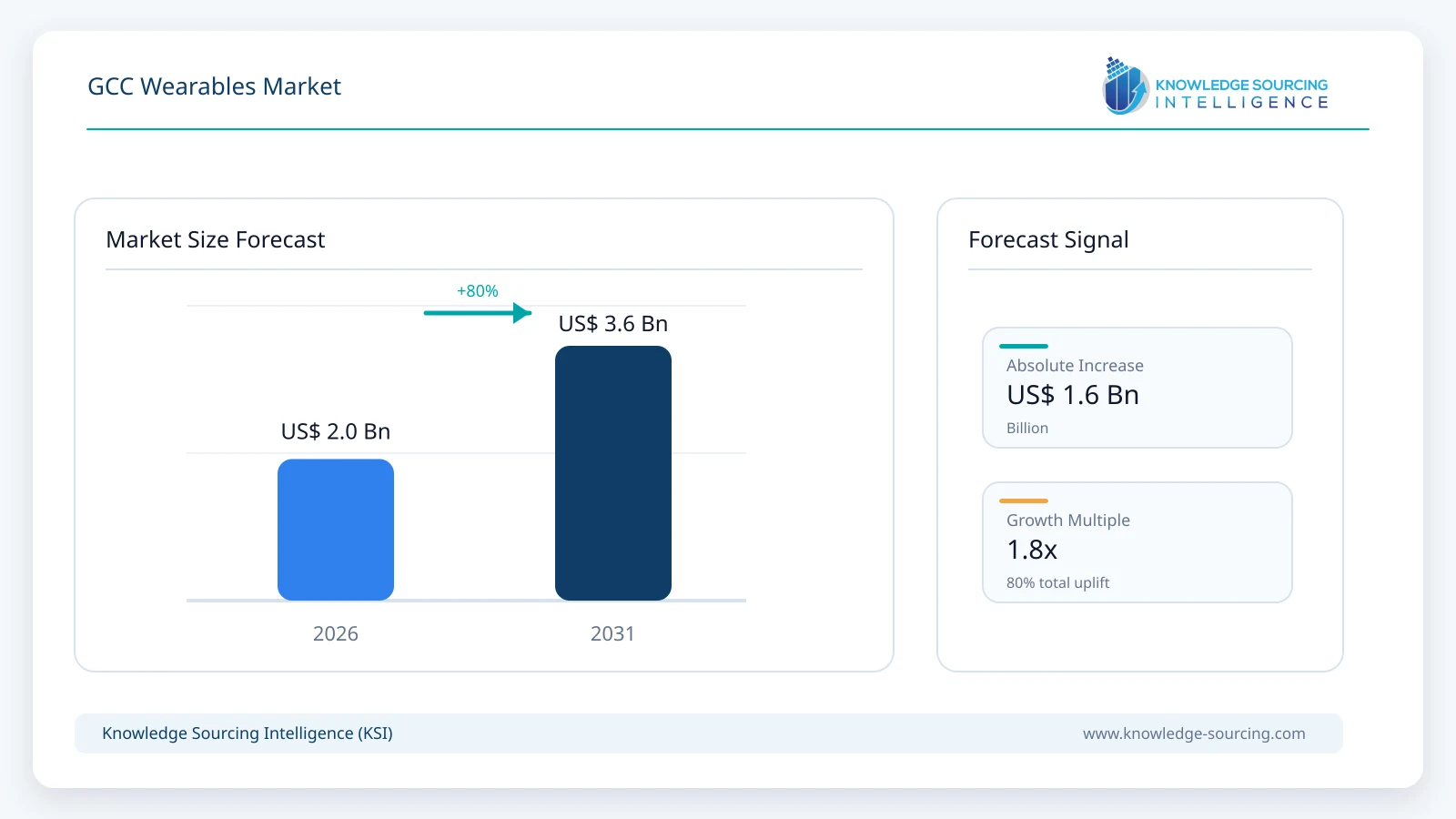
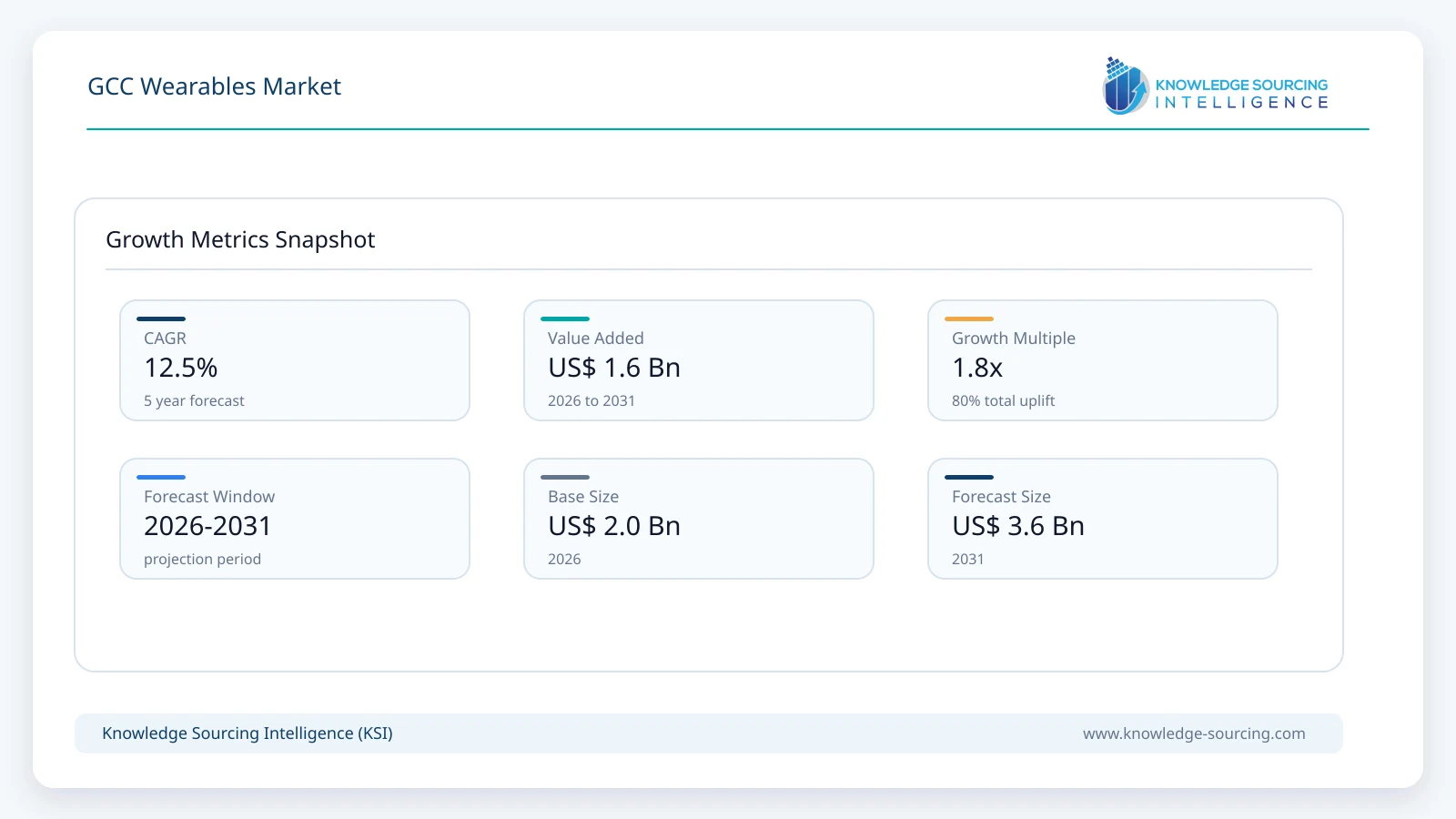
The GCC wearables market is projected to increase from USD 2.00 billion in 2026 to USD 3.60 billion in 2031, representing a CAGR of 12.5% during the forecast period.
Highlights:
- 1Smartwatches account for approximately 57% of GCC wearable-device revenue in 2026.
- 2Saudi Arabia contributes approximately 45% of GCC wearable-device revenue in 2026.
- 3The UAE represents approximately 31% of regional revenue, supported by premium-device adoption.
- 4Smart rings and smart glasses record the fastest growth from smaller 2026 revenue bases.
- 5Saudi internet penetration reached 99.6% in 2025, supporting connected-device adoption.
- 6Wearables are moving into preventive-health programs, remote monitoring and AI-assisted wellness.
Market Overview
The GCC combines a relatively small population with high per-capita consumer-electronics spending, strong mobile connectivity and a large expatriate workforce that frequently adopts global device ecosystems. Saudi Arabia reported internet penetration of 99.6% in 2025, while mobile phones were used by 99.6% of internet users. The same Saudi Internet Report indicated that 30.7% of users accessed the internet through other connected devices such as smartwatches, gaming platforms, and e-book readers. These indicators do not measure wearable ownership directly, but they demonstrate a digital environment in which always-connected accessories can scale quickly alongside smartphones. Online shopping is also well established, reducing distribution friction for premium and niche wearable brands.
Product competition is moving toward health intelligence and device independence. Apple, Samsung and Huawei continue to add cardiovascular, sleep, recovery, navigation and safety functions, while specialist brands such as Garmin, Oura, WHOOP, Polar, Suunto and COROS compete around sports performance or continuous wellness. Cellular connectivity, global navigation satellite system (GNSS) accuracy, longer battery life and richer sensor stacks make premium devices more useful without constant smartphone interaction. At the same time, smart rings are creating a more discreet form factor for sleep and recovery tracking, and smart glasses are opening new categories around hands-free communication, cameras, AI assistance, and field productivity.
Selected Segment Estimates
Dimension | Selected Subsegment | 2026 Indicator | Forecast Interpretation |
Product | Smartwatches | ~57% share | Largest revenue pool; premium health and cellular features sustain upgrades. |
Product | Smart rings | ~6% share | Fast growth from a small base as sleep, recovery and preventive-health use expands. |
End User | Personal / Consumer | ~89% share | Consumer electronics remain dominant, with healthcare and enterprise use growing faster. |
Distribution | Online | ~54% share | Brand stores and major e-commerce platforms support broad product access and price comparison. |
Country | Saudi Arabia | ~45% share | Largest GCC market due to population scale, digital adoption and premium-device demand. |
Country | United Arab Emirates | ~31% share | High per-capita spending and early adoption support a disproportionate revenue contribution. |
Market Dynamics
High Digital Penetration and Premium Consumer-Electronics Spending Support Device Upgrades
The core consumer market benefits from strong smartphone ownership, high-speed mobile networks and frequent replacement of connected devices. Saudi Arabia's 2025 internet penetration reached 99.6%, while 76.9% of internet users reported online shopping. The UAE similarly operates a highly digital consumer economy with strong premium-electronics channels. These conditions lower adoption barriers for smartwatches, rings and glasses because consumers already use mobile applications, digital payments, cloud services and health platforms. Revenue growth therefore comes from both new users and migration toward higher-value devices with better displays, cellular connectivity, advanced positioning, longer battery life and richer health sensing.
Health Monitoring Is Moving From Fitness Tracking Toward Preventive Care
Wearables are gaining relevance as health-data sources rather than only lifestyle accessories. In May 2026, the Department of Health - Abu Dhabi and Oura announced a research program using continuous wearable data to study women's health and cardiometabolic risk. Saudi health authorities also deployed smartwatches during the 2026 Hajj season to monitor heart rate, electrocardiogram (ECG), blood oxygen, blood pressure and activity, linking patients with virtual clinics and digital monitoring rooms. These programs remain targeted rather than mass-market reimbursement schemes, but they expand the commercial credibility of medical-grade sensors, secure health-data integration and remote monitoring services.
AI and Sensor Improvements Increase the Value of Premium Wearables
Artificial intelligence is becoming a visible software layer across major wearable ecosystems. New watches increasingly convert raw sleep, heart-rate variability, exercise and recovery data into readiness scores, coaching recommendations and personalized health summaries. Hardware development is occurring in parallel through improved optical sensors, ECG capability, multi-frequency positioning, temperature sensing and longer-duration batteries. The combination raises average selling prices at the premium end of the market and gives consumers more reasons to replace older devices even when basic timekeeping and activity-tracking functions remain adequate.
Mature Smartwatch Adoption and Longer Replacement Cycles Moderate Unit Growth
The leading GCC markets are no longer early-stage smartwatch markets. Many affluent consumers already own an Apple Watch, Galaxy Watch, Huawei Watch, Garmin device, or lower-priced tracker, which shifts future demand toward replacement rather than first-time ownership. Newer watches also last longer and receive software updates for multiple years, allowing users to postpone upgrades when feature improvements are incremental. This limits unit-volume acceleration and makes revenue growth increasingly dependent on premiumization, new form factors, and expansion into health, sports, and professional use cases.
Feature Availability and Health-Regulatory Requirements Create Regional Differences
Not every health feature can be activated simultaneously across all GCC markets. Electrocardiogram, blood-pressure, hypertension-notification, and other health functions can require local regulatory clearance, and availability may differ by device generation and country. Apple, for example, states that some health features on its 2026 watch models require additional clearance in Saudi Arabia. These differences can affect product positioning and reduce the immediate value of certain global feature launches, particularly when consumers purchase premium hardware primarily for advanced health monitoring.
Segment Analysis
By Product - Smartwatches
Smartwatches remain the largest product category, accounting for approximately 57% of GCC wearable-device revenue in 2026. Apple, Samsung and Huawei dominate the premium mainstream, while Garmin, Suunto and COROS address sports and outdoor users and Xiaomi competes strongly at lower price points. The segment benefits from a broad feature set that combines notifications, payments, music, navigation, fitness, health tracking and emergency functions in a single device. Through 2031, smartwatch revenue continues to grow but loses modest share to rings, glasses and other specialized wearables as consumers add multiple wearable form factors rather than relying on one wrist device.
By Product - Smart Rings and Emerging Health Wearables
Smart rings are a smaller but faster-growing category because they provide continuous sleep, recovery, and cardiovascular metrics in a compact form factor that can be worn overnight more comfortably than a watch. Oura's 2026 partnership with the Department of Health - Abu Dhabi increases regional visibility for ring-based biometric data in preventive healthcare. Competition is also expanding as smartphone and consumer-electronics ecosystems add ring products and health platforms. The commercial opportunity is strongest among wellness-focused consumers, endurance athletes, executives and users interested in passive monitoring without another screen on the wrist.
By Distribution Channel - Online
Online channels account for slightly more than half of regional wearable revenue in 2026. Brand-owned stores, major electronics retailers and e-commerce marketplaces allow consumers to compare device generations, colors, straps and prices while providing access to specialist brands that have fewer physical stores. Offline retail remains important for premium watches because customers often want to test size, fit and materials before purchase, and telecom operators can support cellular-watch activation. The channel split therefore remains balanced, but online gains share as direct-to-consumer brands and cross-border assortment expand.
Technology and Demand Indicators
Indicator | Latest Development | Market Impact |
Saudi digital access | 99.6% internet penetration in 2025; mobile phones used by 99.6% of internet users. | Creates a near-universal connected-device foundation for wearable adoption. |
Connected-device usage | 30.7% of Saudi internet users accessed via other connected devices including smartwatches and gaming platforms. | Shows meaningful use of non-phone connected hardware in a mature digital market. |
Preventive health | Abu Dhabi DoH and Oura launched a wearable-data research program in May 2026. | Strengthens the role of continuous biometric data in preventive-care programs. |
Remote monitoring | Saudi health authorities used smartwatches for real-time cardiac monitoring during Hajj 2026. | Demonstrates clinical and public-health use beyond consumer fitness. |
Premium launches | Apple Watch Series 12 / Ultra 4 and Samsung Watch9 / Ultra2 reached GCC markets in 2026. | Supports premium replacement demand and higher health-feature expectations. |
Regional Outlook:
Saudi Arabia Market Analysis
Saudi Arabia is the largest GCC wearables market, accounting for approximately 45% of regional revenue in 2026. Its advantage comes from population scale, near-universal internet access, strong smartphone ecosystems, and a consumer market that spans both premium global brands and aggressively priced Asian devices. Communications, Space and Technology Commission data show 99.6% internet penetration in 2025, 53 GB of average monthly mobile-data consumption per person and a median mobile download speed of 216 Mbps. The country therefore provides an unusually strong connectivity base for watches and other wearables that rely on continuous synchronization, cloud analytics, navigation, and mobile applications.
Healthcare use is becoming an additional demand layer. During the 2026 Hajj season, Madinah Health Cluster used smartwatches to monitor vital signs in real time and connect pilgrims directly with medical teams, while Makkah Health Cluster provided medical smartwatches to cardiac patients after treatment. These programs are not equivalent to broad consumer adoption, but they demonstrate institutional confidence in continuous wearable monitoring and create opportunities for device vendors, health-data platforms and remote-care providers. Premium consumer demand remains important at the same time: Apple's 2026 Watch Ultra 4 launched in Saudi Arabia from SAR 3,599, illustrating the market's ability to support high-value sports and health devices alongside mid-range alternatives.
Competitive Landscape
Competition is concentrated around ecosystem strength rather than hardware specifications alone. Apple benefits from deep iPhone integration, premium positioning and a growing set of health and safety features. Samsung combines Galaxy smartphones, Samsung Health and a broad Android ecosystem, while Huawei has built a strong regional position through long-battery-life watches, sports functionality and the TruSense health platform. Xiaomi competes heavily on price and feature density. Garmin, Suunto, COROS and Polar are more specialized around endurance sports, outdoor navigation and training analytics, which gives them relevance among runners, cyclists, triathletes and adventure users in the GCC.
New form factors are broadening competition. Oura is developing the smart-ring category around continuous wellness and recovery data, WHOOP focuses on subscription-led performance and recovery analytics, and Meta with EssilorLuxottica is expanding smart glasses as an AI and hands-free computing platform. The strongest companies increasingly combine hardware, apps, cloud analytics, coaching and paid services. This favors brands able to maintain long-term software support and trusted health-data ecosystems rather than competing only on one-time device sales.
Companies Profiled
Apple Inc.
Samsung Electronics Co., Ltd.
Huawei Technologies Co., Ltd.
Xiaomi Corporation
Garmin Ltd.
Oura Health Oy
Google LLC
WHOOP, Inc.
Zepp Health Corporation
HONOR Device Co., Ltd.
Recent Developments
September 2026: Apple introduced Apple Watch Series 12 and Apple Watch Ultra 4, with Saudi and UAE availability beginning September 18.
August 2026: Samsung began the Middle East rollout of Galaxy Watch9 and Galaxy Watch Ultra2 alongside its new foldable-device generation.
May 2026: Department of Health - Abu Dhabi and Oura launched a research partnership using continuous wearable data for preventive health.
May 2026: Madinah Health Cluster deployed smartwatches for real-time cardiac and vital-sign monitoring of pilgrims during Hajj.
May 2026: Makkah Health Cluster provided medical smartwatches for post-treatment remote monitoring of cardiac pilgrims.
2026: Huawei expanded its GCC wearable portfolio with Watch GT 6, Watch 6 and Watch Fit 5 series featuring upgraded health, sports and positioning capabilities.
GCC Wearables Market Scope:
| Report Metric | Details |
|---|---|
| Total Market Size in 2026 | USD 2.00 billion |
| Total Market Size in 2031 | USD 3.60 billion |
| Forecast Unit | Billion |
| Growth Rate | 12.5% |
| Study Period | 2021 to 2031 |
| Historical Data | 2021 to 2024 |
| Base Year | 2025 |
| Forecast Period | 2026 – 2031 |
| Segmentation | Product, End User, Distribution Channel, Country |
| Companies |
|
| Customization Scope | 15% Free Customization included with purchase — Request Custom Breakdown → |
| Sample & Data Access | PDF Sample, Excel Databook & Analyst Briefing — Download Free Sample → |
Market Segmentation
By Product
Smartwatches
Fitness Trackers and Bands
Smart Rings
Smart Glasses
Other Wearables
By End User
Personal / Consumer
Healthcare
Enterprise and Industrial
Sports and Professional Users
By Distribution Channel
Online
Offline
By Country
Saudi Arabia
United Arab Emirates
Kuwait
Qatar
Oman
Bahrain
Do you like this personality?
Table of Contents
1. EXECUTIVE SUMMARY
2. MARKET SNAPSHOT
2.1. Market Overview
2.2. Market Segmentation
3. BUSINESS LANDSCAPE
3.1. Market Drivers
3.1.1. High Digital Penetration and Premium Consumer-Electronics Spending Support Device Upgrades
3.1.2. Health Monitoring Is Moving From Fitness Tracking Toward Preventive Care
3.1.3. AI and Sensor Improvements Increase the Value of Premium Wearables
3.2. Market Restraints
3.2.1. Mature Smartwatch Adoption and Longer Replacement Cycles Moderate Unit Growth
3.2.2. Feature Availability and Health-Regulatory Requirements Create Regional Differences
3.3. Market Opportunities
3.4. Porter’s Five Forces Analysis
3.5. Industry Value Chain Analysis
3.6. Regulatory and Digital-Health Landscape
4. TECHNOLOGICAL OUTLOOK
4.1. Advanced Optical and Electrical Health Sensing
4.2. AI-Based Health and Recovery Insights
4.3. eSIM and Standalone Connectivity
4.4. Multi-Band GNSS and Outdoor Navigation
4.5. Smart Rings and Screenless Wearables
4.6. Smart Glasses and Hands-Free AI
5. GCC WEARABLES MARKET BY PRODUCT
5.1. Smartwatches
5.2. Fitness Trackers and Bands
5.3. Smart Rings
5.4. Smart Glasses
5.5. Other Wearables
6. GCC WEARABLES MARKET BY END USER
6.1. Personal / Consumer
6.2. Healthcare
6.3. Enterprise and Industrial
6.4. Sports and Professional Users
7. GCC WEARABLES MARKET BY DISTRIBUTION CHANNEL
7.1. Online
7.2. Offline
8. GCC WEARABLES MARKET BY COUNTRY
8.1. Saudi Arabia
8.2. United Arab Emirates
8.3. Kuwait
8.4. Qatar
8.5. Oman
8.6. Bahrain
9. COMPETITIVE ENVIRONMENT AND ANALYSIS
9.1. Major Players and Strategy Analysis
9.2. Market Share Analysis
9.3. Product Launches, Partnerships and Collaborations
9.4. Competitive Dashboard
10. COMPANY PROFILES
10.1. Apple Inc.
10.2. Samsung Electronics Co., Ltd.
10.3. Huawei Technologies Co., Ltd.
10.4. Xiaomi Corporation
10.5. Garmin Ltd.
10.6. Oura Health Oy
10.7. Google LLC
10.8. WHOOP, Inc.
10.9. Zepp Health Corporation
10.10. HONOR Device Co., Ltd.
10.11. Suunto Oy
10.12. Polar Electro Oy
10.13. COROS Wearables Inc.
10.14. Meta Platforms, Inc. / EssilorLuxottica
10.15. Withings SA
11. RECENT DEVELOPMENTS
12. APPENDIX
12.1. Currency
12.2. Assumptions
12.3. Base and Forecast Years Timeline
12.4. Research Methodology
12.5. Abbreviations





Frequently asked questions
What is the projected GCC wearables market CAGR?
The GCC Wearables Market is projected to grow at 12.5% CAGR from 2026 to 2031.
What is the GCC wearables market size by 2031?
The GCC Wearables Market is forecasted to reach USD 3.60 billion by 2031.
Which product segment leads GCC wearable device revenue in 2026?
Smartwatches account for approximately 57% of 2026 GCC revenue.
Which country dominates GCC wearable device revenue in 2026?
Saudi Arabia contributes approximately 45% of 2026 GCC revenue.
What are the fastest-growing product segments in GCC wearables?
Smart rings and smart glasses record the fastest growth.
What factors drive the GCC wearables market?
Digital adoption, high spending, and preventive health initiatives drive growth.
Cite this report
Knowledge Sourcing Intelligence. (Sep 2026). GCC Wearables Market - Strategic Insights and Forecasts (2026-2031). https://www.knowledge-sourcing.com/report/gcc-wearables-market