
The consumer robotics market is predicted to witness steady growth during the projected period.
Highlights:
- 1Consumers are increasingly adopting robotic vacuum cleaners and floor-cleaning devices for convenient household maintenance.
- 2Manufacturers are integrating artificial intelligence to improve robotic navigation, object recognition, and autonomous decision-making.
- 3Households are increasingly using robotic lawn mowers and window-cleaning robots to reduce manual effort.
- 4Companies are developing interactive companion robots to support entertainment, education, and everyday personal assistance.
As the price of smart home devices continues to decrease, making them more available and more functional, the consumer robotics market continues to grow. The adoption of robots designed to perform household chores, including vacuum cleaning, lawn mowing, and pool maintenance, is growing in popularity in urban homes. More and more users are choosing these robots primarily for convenience and time saving, especially younger users. Smart home devices have made consumer robotics better for users through the introduction of AI-based, voice-assisted robots and autonomous robots with navigation. Although some humanoid robots exist as companions, fully functional robots remain a strong work in progress and a potential source of discomfort for most consumers. However, allowing devices to transition from novelty to added value tool with legitimate capabilities and utility does place robots in the sights of consumer awareness. With better batteries, smarter sensors, and more efficient manufacturing, robots can bring convenience and practical functionality to our daily lives.
Consumer Robotics Market Overview & Scope:
The consumer robotics market is segmented by:
Type: The market is segmented into domestic robots, entertainment and leisure robots, and social or companion robots. Robot vacuums, robot floor moppers, and robot lawnmowers have led the market in robot sales with growing demand for convenience and a desire to automate cleaning and lawn mowing in urban homes. Entertainment robots have their place, including educational kits, robotic pets, and other curious devices for kids and tech enthusiasts. Social robots are working their way into dementia care and companionship, but have yet to break into the same situation and/or place of utility value.
Component: The market is segmented into hardware, software, and services. The hardware segment includes the physical elements of the robot, such as sensors, actuators, control systems, batteries, and the robot's structure. For many robotics applications, hardware innovations are crucial because they are establishing better mobility, vision, and physical interaction. Listening to customers, the robotic vacuum stage is in a state quickly change, and modern devices now utilise LiDAR and 3D mapping sensors to navigate consumer homes efficiently. As the range of tasks that consumer robots engage in within the home environment becomes sore involved (e.g., tasks associated with folding laundry and tending to pets), the expectation is for enhanced hardware demands.
End User: End users include households, educational institutions, and individual consumers. The consumer robotics market is expected to be dominated by household applicability, especially household chores involving cleaning or mowing lawns. Educational robots have recently been adopted in schools and are becoming popular for teaching coding and STEM skills.
Region: Geographically, the market is expanding at varying rates depending on the location. North America continues to grow because there is considerable disposable income and a high rate of smart home incorporation. However, Asia-Pacific is currently the fastest growing region, led by China, Japan, and South Korea - all countries regarded as having significant robotics innovation and a tech-savvy consumer base.
Top Trends Shaping the Consumer Robotics Market:
Growing Integration with Smart Home Ecosystems: More consumer robots are designed to work with voice assistants (Auto, Google Assistant, Apple HomeKit, etc.), which gives consumers the ability to manage their robots with voice commands or through one app from anywhere in their home! Lately, automating tasks has never been easier.
Rising Demand for Personal Assistance Robots: There is increased interest in robots that do more than just clean, such as robotic companion-forming robots for old people or task management and health monitoring with an AI companion-type robot.
Consumer Robotics Market Growth Drivers vs. Challenges:
Drivers:
Increasing Adoption of Automation in Daily Life: Urban consumers are adopting (and demanding in some cases) automation tools for menial or repeated tasks (vacuuming, mopping, and lawn moving), along with increasing disposable income, increasing time constraints, and for convenience. This is particularly relevant in countries like the United States, China, and Germany. Millions of homes have trialled these products, and many certifiable smart robotic vacuum cleaners and floor scrubbers are fully adopted. Continued acceptance of automation solutions is expected as reliability improves and products become cheaper. Even middle-income households are using these products in developing economies.
Educational Focus on Robotics and STEM Learning: Given the global digital literacy focus, schools and parents are spending increasing amounts on programmable robots and coding kits that are made to be engaging and boring! As robotic platforms, they are in classrooms and homes, and we can see children experimenting creatively, using logic, and developing problem-solving skills at a young age.
Challenges:
High Cost of Advanced Robots: Despite the increase in cost for increased features for most people in developed economies, these fully featured robots can cost a lot to the majority of consumers, especially the fully featured ones with AI navigation, object recognition, and interactive/proactive interaction.
Consumer Robotics Market Regional Analysis:
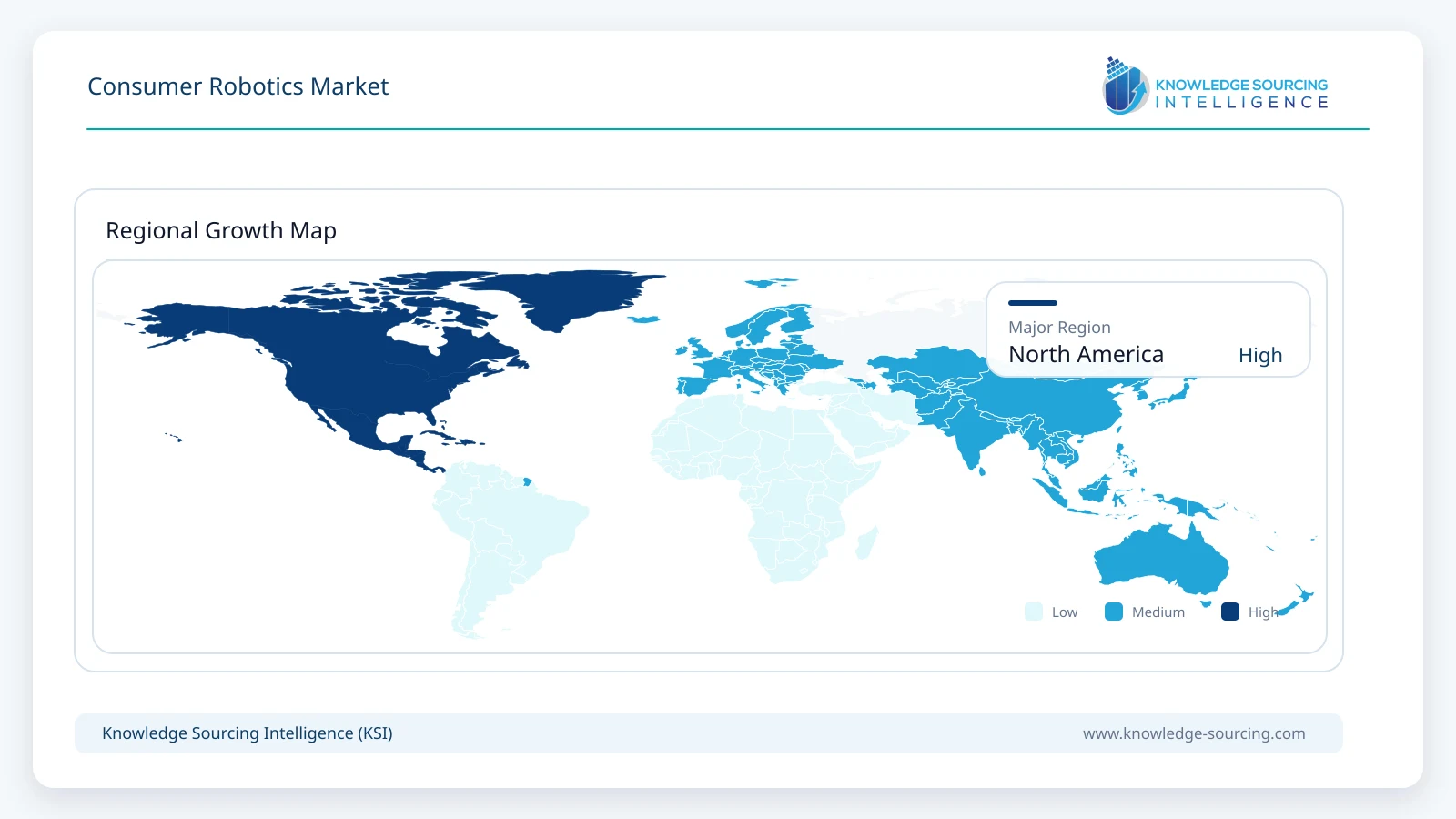
North America: Consumer robotics is emerging in North America. Wealth, spontaneous technology adoption, and key consumer robotics companies, including iRobot and Amazon, are driving growth in this market. The U.S. will continue to be a captive market for consumer robotics, led by demand for robotic vacuums, robotic lawn mowers and robotic personal assistants. Europe develops as a market, but Germany, the UK and France are making strides in smart homes. The Asia Pacific is growing the fastest, which is led by China, Japan and South Korea. Urbanisation, ageing population and government context for robots and automations in the home-based context will continue to advance demand in these contexts. In particular, home care.
Recent Developments
September 2026: Flourish Robots launches Flourish 1 home robot. On September 29, Flourish Robots introduced its $3,555 household robot, which users can teach repetitive chores through a mobile app and physical demonstrations without coding.
September 2026: iRobot unveils Roomba Duo at IFA. On September 4, iRobot introduced its dual-unit robotic vacuum and mop system, combining a main cleaning robot with a compact companion unit for hard-to-reach spaces.
July 2026: Dreame Technology launches D30 Ultra robot vacuum in India. On July 27, Dreame announced the D30 Ultra, featuring 25,000 Pa suction, MopExtend technology and an automated maintenance station for hands-free floor cleaning.
March 2026: SharkNinja launches PowerDetect UV Reveal. On March 3, SharkNinja introduced a robot vacuum and mop combining ultraviolet stain detection, camera-based sensing and automated mopping to identify and clean hidden household messes.
January 2026: LG Electronics unveils CLOiD home robot. On January 4, LG announced CLOiD, an AI-powered home robot designed to coordinate household tasks, including laundry and food preparation, through connected appliances.
Consumer Robotics Market Scope
| Report Metric | Details |
|---|---|
| Forecast Unit | Billion |
| Study Period | 2021 to 2031 |
| Historical Data | 2021 to 2024 |
| Base Year | 2025 |
| Forecast Period | 2026 – 2031 |
| Segmentation | Robot Type, Component, End-User, Geography |
| Companies |
|
| Customization Scope | 15% Free Customization included with purchase — Request Custom Breakdown → |
| Sample & Data Access | PDF Sample, Excel Databook & Analyst Briefing — Download Free Sample → |
Market Segmentation
By Robot Type
Domestic Robots
Entertainment and Leisure Robots
Social and Companion Robots
By Component
Hardware
Software
Services
By End-User
Household
Personal Care
Education
Others
By Geography
North America
United States
Canada
Mexico
South America
Brazil
Argentina
Others
Europe
United Kingdom
Germany
France
Italy
Others
Middle East & Africa
Saudi Arabia
UAE
Others
Asia Pacific
Japan
China
India
South Korea
Taiwan
Others
Table of Contents
1. EXECUTIVE SUMMARY
2. MARKET SNAPSHOT
2.1. Market Overview
2.2. Market Definition
2.3. Scope of the Study
2.4. Market Segmentation
3. BUSINESS LANDSCAPE
3.1. Market Drivers
3.2. Market Restraints
3.3. Market Opportunities
3.4. Porter’s Five Forces Analysis
3.5. Industry Value Chain Analysis
3.6. Policies and Regulations
3.7. Strategic Recommendations
4. TECHNOLOGICAL OUTLOOK
5. CONSUMER ROBOTICS MARKET BY ROBOT TYPE
5.1. Introduction
5.2. Domestic Robots
5.3. Entertainment and Leisure Robots
5.4. Social and Companion Robots
6. CONSUMER ROBOTICS MARKET BY COMPONENT
6.1. Introduction
6.2. Hardware
6.3. Software
6.4. Services
7. CONSUMER ROBOTICS MARKET BY END-USER
7.1. Introduction
7.2. Household
7.3. Personal Care
7.4. Education
7.5. Others
8. CONSUMER ROBOTICS MARKET BY GEOGRAPHY
8.1. Introduction
8.2. North America
8.2.1. United States
8.2.2. Canada
8.2.3. Mexico
8.3. South America
8.3.1. Brazil
8.3.2. Argentina
8.3.3. Others
8.4. Europe
8.4.1. United Kingdom
8.4.2. Germany
8.4.3. France
8.4.4. Italy
8.4.5. Others
8.5. Middle East & Africa
8.5.1. Saudi Arabia
8.5.2. UAE
8.5.3. Others
8.6. Asia Pacific
8.6.1. Japan
8.6.2. China
8.6.3. India
8.6.4. South Korea
8.6.5. Taiwan
8.6.6. Others
9. COMPETITIVE ENVIRONMENT AND ANALYSIS
9.1. Major Players and Strategy Analysis
9.2. Market Share Analysis
9.3. Mergers, Acquisitions, Agreements, and Collaborations
9.4. Competitive Dashboard
10. COMPANY PROFILES
10.1. Robot Corporation
10.2. LG Electronics
10.3. Samsung Electronics
10.4. Sony Corporation
10.5. Ecovacs Robotics
10.6. Neato Robotics
10.7. Xiaomi Corporation
10.8. Dyson Ltd
10.9. Honda Motor Co., Ltd.
10.10. Amazon (through Astro and other AI-based initiatives)
10.11. Anki (legacy influence despite discontinuation)
10.12. LEGO Group (educational robotics kits)
11. APPENDIX
11.1. Currency
11.2. Assumptions
11.3. Base and Forecast Years Timeline
11.4. Key benefits for the stakeholders
11.5. Research Methodology
11.6. Abbreviations





Frequently asked questions
What is the forecast for the Consumer Robotics Market (2026-2031)?
The Consumer Robotics Market is predicted to witness steady growth during the projected period.
Which robot types are leading consumer adoption?
Household robots, especially vacuums and lawnmowers, lead consumer adoption.
Which region is the fastest-growing for consumer robotics?
Asia-Pacific is becoming the fastest-growing region for purchases.
What are the main growth drivers for consumer robotics?
Convenience, time-saving, decreasing smart home device prices, and urbanization drive growth.
How is the Consumer Robotics Market segmented by type?
The Consumer Robotics Market is segmented into domestic, entertainment, and social or companion robots.
How do smart home devices enhance consumer robotics?
Smart home devices introduce AI, voice assistance, and autonomous navigation.
Cite this report
Knowledge Sourcing Intelligence. (Oct 2026). Consumer Robotics Market - Strategic Insights and Forecasts (2026-2031). https://www.knowledge-sourcing.com/report/consumer-robotics-market