
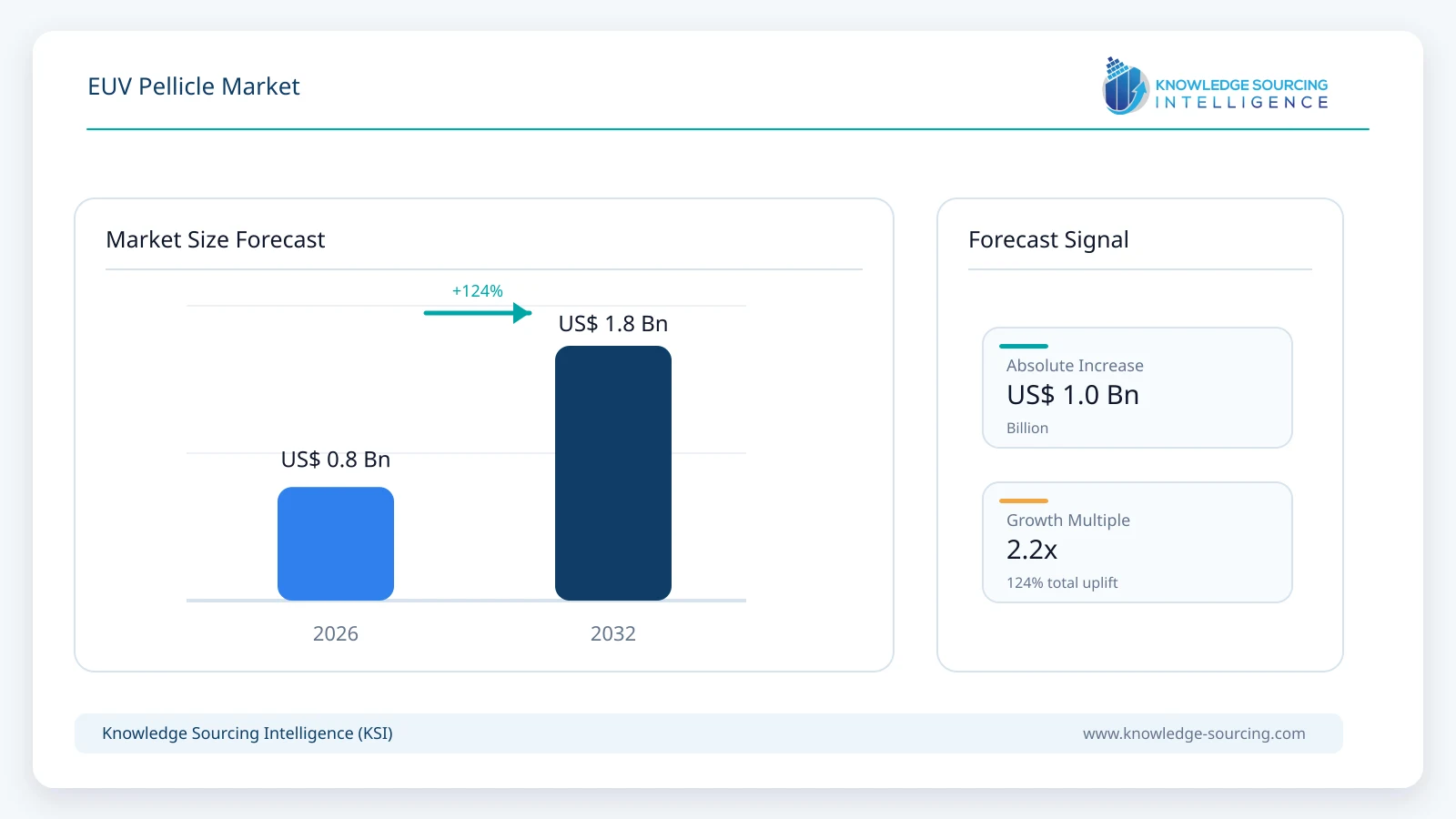
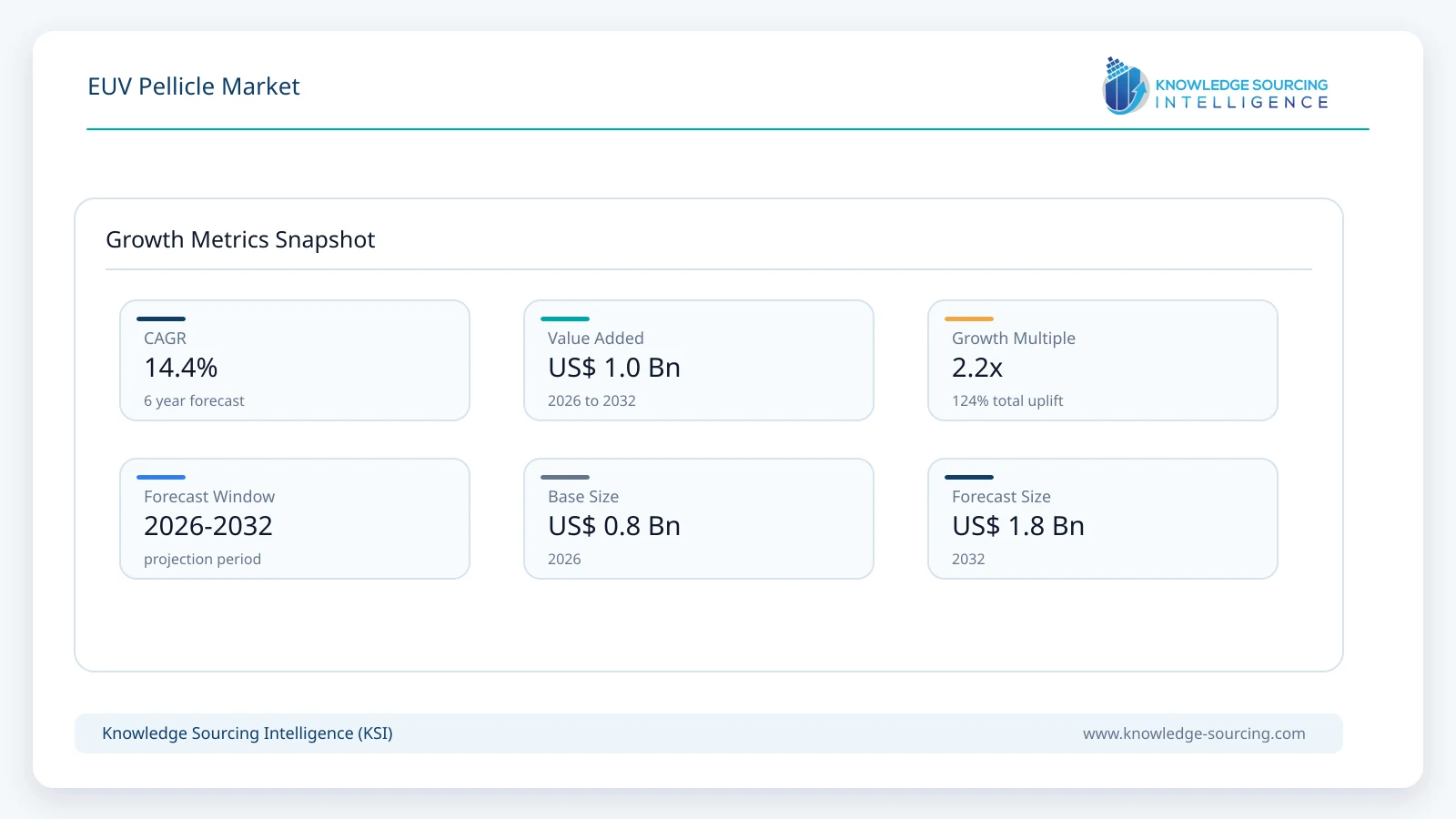
The EUV Pellicle Market is estimated at USD 0.78 billion in 2026 and is projected to reach USD 1.75 billion by 2032, representing a CAGR of 14.4% during the forecast period.
Highlights:
- 1Qualified silicon-based pellicles remain the principal commercial platform for current EUV production.
- 2Carbon nanotube pellicles move toward commercialization as source power rises beyond 600W.
- 3Higher EUV transmittance becomes increasingly valuable because every transmission loss reduces scanner throughput.
- 4High NA EUV increases requirements for pellicle flatness, heat resistance and mechanical stability.
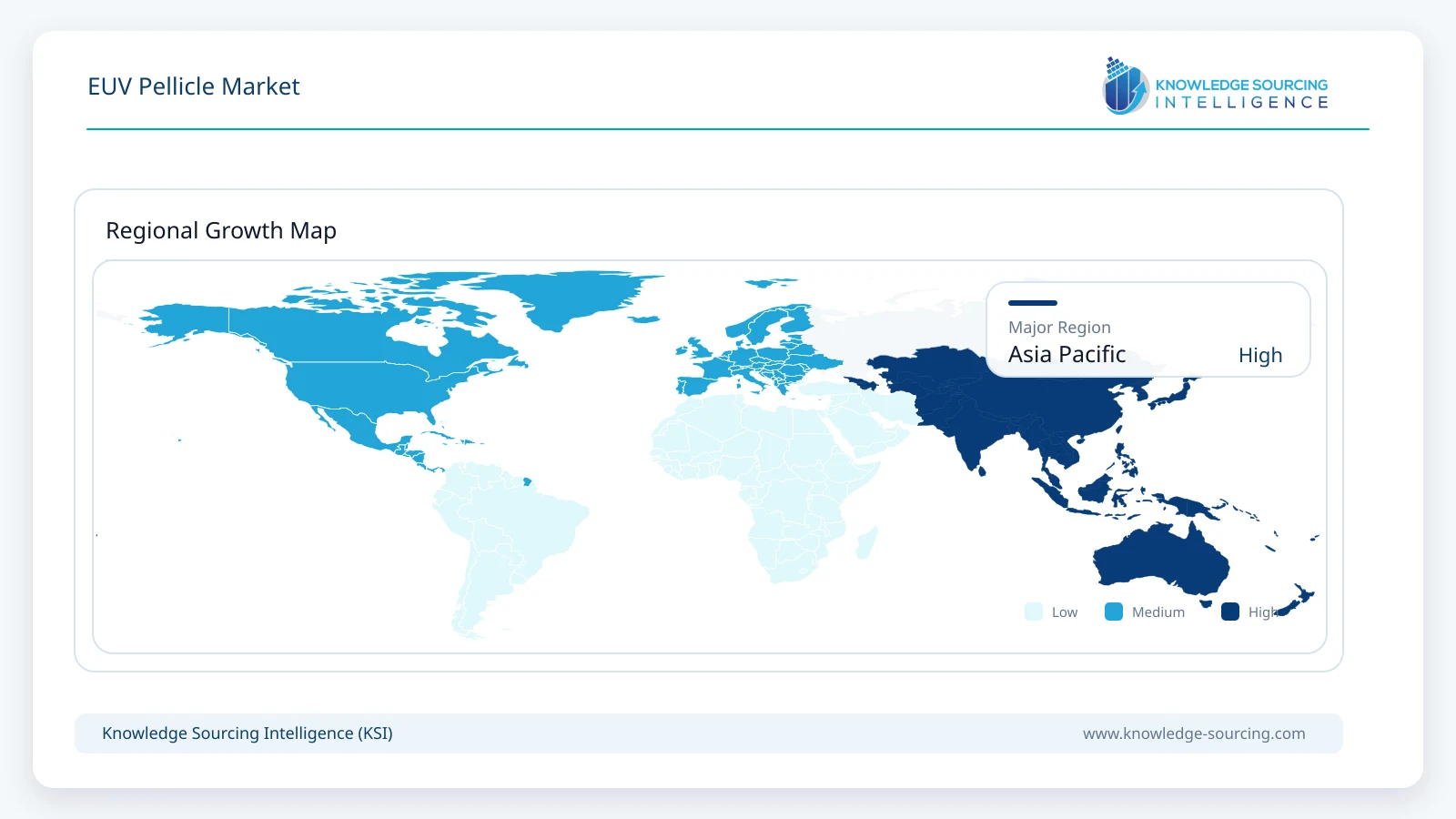
- 5Asia Pacific leads demand through advanced logic, memory and pellicle manufacturing concentration.
Market Overview
The economic role of an EUV pellicle is straightforward: it protects an extremely expensive photomask from particle contamination without materially degrading exposure performance. A particle landing directly on the patterned surface can print defects onto wafers, while a particle on the pellicle is held sufficiently far from the focal plane that it does not reproduce sharply on the wafer. The technical difficulty is that the protective membrane itself absorbs part of the EUV beam. Pellicle design therefore involves a direct trade-off between protection, optical transmission, thermal durability and mechanical strength.
Current low-NA EUV production relies on highly engineered thin membranes that can operate inside ASML scanners while preserving imaging quality. As lithography moves toward higher source power and more aggressive process nodes, pellicle heating becomes more severe. The membrane must dissipate absorbed energy without sagging, rupturing or contaminating the reticle environment. This is pushing the market toward higher-transmittance structures and new material systems. Mitsui Chemicals has commercialized conventional EUV pellicles under license from ASML and is adding CNT products to address the next generation of high-power exposure. Its roadmap places commercial CNT pellicles alongside conventional silicon-based membranes rather than assuming an immediate full replacement.
Carbon nanotubes are attractive because a sparse CNT network can combine high EUV transmission with strong thermal stability. However, a laboratory membrane is not automatically a commercial pellicle. Production requires uniform CNT deposition, defect control, stable coating, robust frame attachment, cleanroom manufacturing, particle performance and scanner qualification. The market therefore remains concentrated among a limited number of companies with the ability to qualify both the membrane and the complete pellicle assembly.
Market Drivers
Higher EUV source power raises the value of low-absorption pellicles
Scanner productivity depends on delivering enough EUV photons to the wafer. When a pellicle absorbs part of the beam, the scanner must compensate through higher source power or longer exposure time. This penalty becomes more visible as semiconductor manufacturers seek higher wafers-per-hour throughput. Mitsui Chemicals has described a roadmap from conventional pellicles toward CNT and next-generation CNT platforms with transmittance above 94%, while its 2026 NEDO-supported program targets at least 95% transmission and durability at 1,000W. The commercial opportunity therefore shifts toward membranes that protect the mask while consuming less of the available photon budget.
Advanced logic increases recurring pellicle use across more EUV layers
Leading-edge logic processes use EUV across a growing number of critical layers. This increases both the number of masks that may require protection and the operational value of reliable pellicles. Artificial intelligence and high-performance-computing demand is supporting investment in 2nm-class and smaller process technologies, where yield loss from mask contamination is particularly costly. ASML shipped 48 EUV systems in 2025 and expects EUV revenue to increase significantly in 2026, expanding the installed production base that supports recurring pellicle demand.
High NA EUV creates a new qualification cycle
High NA EUV increases numerical aperture from 0.33 to 0.55 and introduces new imaging, mask and reticle-handling requirements. Intel Foundry and ASML reported in 2026 that High NA EUV was being used for selected Intel 18A production layers, while imec installed an EXE:5200 in Leuven to accelerate ecosystem development. Pellicles for this environment must maintain transmission and dimensional stability under tighter process margins. High NA therefore creates a new qualification cycle even where the basic function of the pellicle remains unchanged.
Memory manufacturers are evaluating broader pellicle adoption
Memory has historically used EUV differently from leading-edge logic, but the number of EUV steps is rising in advanced dynamic random-access memory (DRAM). Mitsui Chemicals has indicated that memory manufacturers are considering greater use of next-generation CNT pellicles as miniaturization progresses. This can expand demand beyond the foundry and logic customer base because high-value DRAM masks increasingly face the same contamination, throughput and lifetime constraints as logic masks.
Restraints and Adoption Challenges
Qualification remains the largest barrier to rapid supplier expansion. A pellicle must satisfy optical, thermal, particle, outgassing and mechanical requirements simultaneously and must be accepted within the lithography ecosystem before high-volume use. Higher transmittance alone is not sufficient if a membrane has poor lifetime or unstable coating behavior. The small number of customers operating EUV fabs also concentrates purchasing power and raises the commercial consequences of qualification failure. CNT pellicles face an additional scale-up challenge because CNT synthesis and coating uniformity must remain tightly controlled across a large, extremely thin membrane. Finally, pellicles themselves impose some transmission loss, so fabs can selectively operate pellicle-free on specific masks when contamination risk and handling practices permit, limiting the addressable market for some applications.
Technology and Product Analysis
Conventional silicon-based pellicles remain the established production platform because they have already passed the demanding scanner and fab qualification process. They are expected to remain important through 2032, particularly on installed 0.33NA systems. CNT pellicles are expected to gain the strongest technology momentum because their high thermal tolerance and higher achievable EUV transmission better fit 600W-plus source-power roadmaps. The transition is likely to be gradual, with next-generation CNT products entering specific high-value layers and high-power tools first before broader adoption.
Pellicle Platform | Commercial Position | Technical Direction | Primary Use Case |
Silicon-based EUV pellicles | Established / qualified | Proven mask protection with mature fab qualification | Current 0.33NA EUV production |
CNT pellicles | Early commercialization / ramp | Higher transmission and improved high-power durability | 600W-class EUV and advanced-node production |
Next-generation coated CNT | Development / qualification | Targeting >95% transmission and longer operating life | High NA and future 1kW-class EUV |
Dual-density / reinforced CNT | Development | Localized reinforcement for durability without broadly increasing absorption | High-cycle and demanding exposure environments |
Market and Technology Indicators
Indicator | 2026 Evidence | Market Implication |
EUV installed-base expansion | ASML sold 48 EUV systems in 2025 and expects significant EUV revenue growth in 2026. | Expands recurring demand for qualified mask-protection consumables. |
High-power pellicle program | Mitsui Chemicals / NEDO target ?95% transmission and >10,000-wafer durability at 1,000W. | Raises the performance ceiling for next-generation pellicles. |
CNT manufacturing capacity | Mitsui planned 5,000-sheet annual CNT pellicle capacity at Iwakuni-Ohtake. | Moves CNT technology from R&D toward commercial supply. |
CNT reactor scale-up | Canatu received a second CNT100 SEMI reactor order from FST in August 2026. | Adds an independent path for CNT membrane manufacturing. |
Durability improvement | LINTEC reported new coatings and a dual-density CNT design in February 2026. | Addresses lifetime and robustness barriers to broader qualification. |
High NA production progress | Intel and ASML reported High NA use on selected Intel 18A production layers in 2026. | Creates a new qualification cycle for pellicles and mask infrastructure. |
Regional Opportunity
Asia Pacific
Asia Pacific is the largest commercial market for EUV pellicles because the region combines the highest concentration of leading-edge foundry and memory production with a substantial share of the pellicle and photomask supply chain. Taiwan is central through Taiwan Semiconductor Manufacturing Company (TSMC), where successive advanced logic nodes increase the number and value of EUV masks in production. South Korea adds demand from Samsung Electronics and SK hynix across advanced logic and DRAM, while Korea is also becoming more important on the supply side through companies such as Fine Semitech Corporation (FST). Japan contributes disproportionately through materials, photomask and pellicle manufacturing, including Mitsui Chemicals and LINTEC.
The region is also where qualification and volume-production feedback cycles are shortest. Pellicle suppliers need direct technical access to fabs, mask shops and lithography ecosystems because seemingly small changes in membrane thickness, coating, particle behavior or frame design can affect scanner performance. Mitsui Chemicals commercialized EUV pellicles in Japan and is expanding into CNT technologies, while its partnership with imec supports qualification against future High NA requirements. FST is scaling CNT membrane production using Canatu reactor technology, providing an additional manufacturing route in South Korea.
North America is strategically important through Intel, advanced semiconductor R&D and growing leading-edge manufacturing investment in the United States. Intel’s 2026 High NA production milestone is particularly important because it provides real production feedback for the next generation of mask and pellicle infrastructure. Europe is essential to the ecosystem through ASML in the Netherlands and imec in Belgium, even though the majority of commercial wafer production remains concentrated in Asia. Europe therefore has an outsized role in pellicle specification, scanner qualification and High NA development relative to its direct pellicle consumption.
Competitive Landscape
The EUV pellicle market is highly concentrated because successful suppliers must combine advanced membrane materials, cleanroom manufacturing, frame assembly, contamination control and lithography qualification. Mitsui Chemicals has the strongest established commercial position among independent pellicle manufacturers, having commercialized EUV pellicles in 2021 under license from ASML. Its strategy now extends to CNT pellicles, supported by dedicated production capacity, collaboration with imec and a 2026 NEDO-backed high-power development program.
Canatu participates differently by supplying CNT synthesis technology and manufacturing reactors rather than complete pellicles. Its collaboration with FST provides a scalable path for CNT membrane production and creates a potential second commercial supply chain. FST combines pellicle and semiconductor cleanroom capabilities with the licensed Canatu CNT manufacturing route. LINTEC is developing CNT pellicles and specialized coatings, with emphasis on durability and production readiness. Additional ecosystem participants include S&S Tech, SKC, Shin-Etsu Chemical, Sumitomo Chemical, FUJIFILM and other photomask or contamination-control suppliers that may contribute membrane, frame, coating or related mask-protection technologies.
Competitive differentiation is increasingly defined by transmission at operating conditions, membrane lifetime, particle adders, thermal deformation, coating stability and qualification speed rather than by nominal material performance alone. Suppliers that can support both current 0.33NA production and future High NA requirements are better positioned to capture the transition without forcing customers to requalify entirely separate supply chains.
Major companies and ecosystem participants covered: Mitsui Chemicals, ASML, Fine Semitech Corporation (FST), Canatu, LINTEC, S&S Tech, SKC, Shin-Etsu Chemical, Sumitomo Chemical, FUJIFILM, AGC and Entegris.
Recent Developments
August 2026: Canatu received an order from FST for an additional CNT100 SEMI reactor to expand CNT pellicle membrane manufacturing capacity, with delivery expected in 2027.
July 2026: Intel Foundry and ASML reported High NA EUV use on selected Intel 18A production layers, demonstrating production readiness for the next lithography generation.
April 2026: Mitsui Chemicals was selected for a NEDO program targeting pellicles with at least 95% EUV transmission and durability for more than 10,000 wafers at 1,000W source power.
March 2026: Mitsui Chemicals’ investment schedule placed its dedicated CNT pellicle facility at 5,000 sheets of annual production capacity.
February 2026: LINTEC announced a durability-enhancing CNT pellicle coating and a dual-density CNT structure aimed at mass-production applications.
EUV Pellicle Market Scope:
| Report Metric | Details |
|---|---|
| Total Market Size in 2026 | USD 0.78 billion |
| Total Market Size in 2032 | USD 1.75 billion |
| Forecast Unit | USD Billion |
| Growth Rate | 14.4% |
| Study Period | 2021 to 2032 |
| Historical Data | 2021 to 2024 |
| Base Year | 2025 |
| Forecast Period | 2026 – 2032 |
| Segmentation | Pellicle Material, Lithography Platform, Semiconductor Application, Pellicle Function and Design, Geography |
| Companies |
|
Market Segmentation
By Pellicle Material
Silicon-Based EUV Pellicles
Carbon Nanotube Pellicles
Coated and Reinforced CNT Pellicles
Other Emerging Membrane Materials
By Lithography Platform
0.33NA EUV
High NA 0.55NA EUV
Future High-Power EUV Platforms
By Semiconductor Application
Leading-Edge Logic
DRAM and Advanced Memory
Foundry Production
Photomask Qualification and R&D
By Pellicle Function and Design
Membrane and Optical Transmission
Frame and Mechanical Support
Coating and Surface Treatment
Complete Pellicle Assembly
Qualification and Lifetime Testing
By Geography
Asia Pacific
Taiwan
South Korea
Japan
China
North America
Europe
Rest of World
Table of Contents
1. EXECUTIVE SUMMARY
1.1. Market Opportunity and Key Findings
1.2. EUV Lithography and Pellicle Outlook
1.3. Commercialization Path for Next-Generation Pellicles
2. MARKET OVERVIEW
2.1. Role of Pellicles in EUV Lithography
2.2. EUV Transmission and Photon-Loss Economics
2.3. Thermal Loading and Membrane Durability
2.4. Particle Protection and Mask Yield
2.5. Pellicle Qualification within the EUV Ecosystem
3. MARKET SIZE AND FORECAST, 2026-2032
3.1. Global Market Revenue
3.2. Annual Growth Analysis
3.3. Pellicle Demand per EUV Lithography Installed Base
4. MARKET BY PELLICLE MATERIAL
4.1. Silicon-Based EUV Pellicles
4.2. Carbon Nanotube Pellicles
4.3. Coated and Reinforced CNT Pellicles
4.4. Other Emerging Membrane Materials
5. MARKET BY LITHOGRAPHY PLATFORM
5.1. 0.33NA EUV
5.2. High NA 0.55NA EUV
5.3. Future High-Power EUV Platforms
6. MARKET BY SEMICONDUCTOR APPLICATION
6.1. Leading-Edge Logic
6.2. DRAM and Advanced Memory
6.3. Foundry Production
6.4. Photomask Qualification and R&D
7. MARKET BY PELLICLE FUNCTION AND DESIGN
7.1. Membrane and Optical Transmission
7.2. Frame and Mechanical Support
7.3. Coating and Surface Treatment
7.4. Complete Pellicle Assembly
7.5. Qualification and Lifetime Testing
8. REGIONAL MARKET
8.1. Asia Pacific
8.1.1. Taiwan
8.1.2. South Korea
8.1.3. Japan
8.1.4. China
8.2. North America
8.3. Europe
8.4. Rest of World
9. MARKET DYNAMICS
9.1. Drivers
9.1.1. Higher EUV Source Power
9.1.2. Growth in EUV Layer Counts
9.1.3. High NA EUV Qualification
9.1.4. Memory Adoption of EUV Pellicles
9.2. Restraints
9.2.1. Long Qualification Cycles
9.2.2. Transmission versus Durability Trade-Off
9.2.3. Limited Qualified Supplier Base
9.2.4. Pellicle-Free Operation on Selected Masks
10. TECHNOLOGY ROADMAP
10.1. Conventional Silicon-Based Pellicles
10.2. CNT Commercialization
10.3. 600W-Class EUV Requirements
10.4. 1,000W-Compatible Pellicles
10.5. High NA and Large-Format Mask Implications
11. COMPETITIVE LANDSCAPE
11.1. Market Structure and Competitive Intensity
11.2. Qualified Commercial Pellicle Suppliers
11.3. CNT Membrane Manufacturing Strategies
11.4. Coating, Frame and Assembly Capabilities
11.5. ASML and Imec Qualification Ecosystem
11.6. Capacity Expansion and Supply Security
12. COMPANY PROFILES
12.1. Mitsui Chemicals
12.2. ASML
12.3. Fine Semitech Corporation (FST)
12.4. Canatu
12.5. LINTEC
12.6. S&S Tech
12.7. SKC
12.8. Shin-Etsu Chemical
12.9. Sumitomo Chemical
12.10. FUJIFILM
12.11. AGC
12.12. Entegris
13. RECENT DEVELOPMENTS
14. APPENDIX
Navigate
Trusted by the world's leading organizations











