
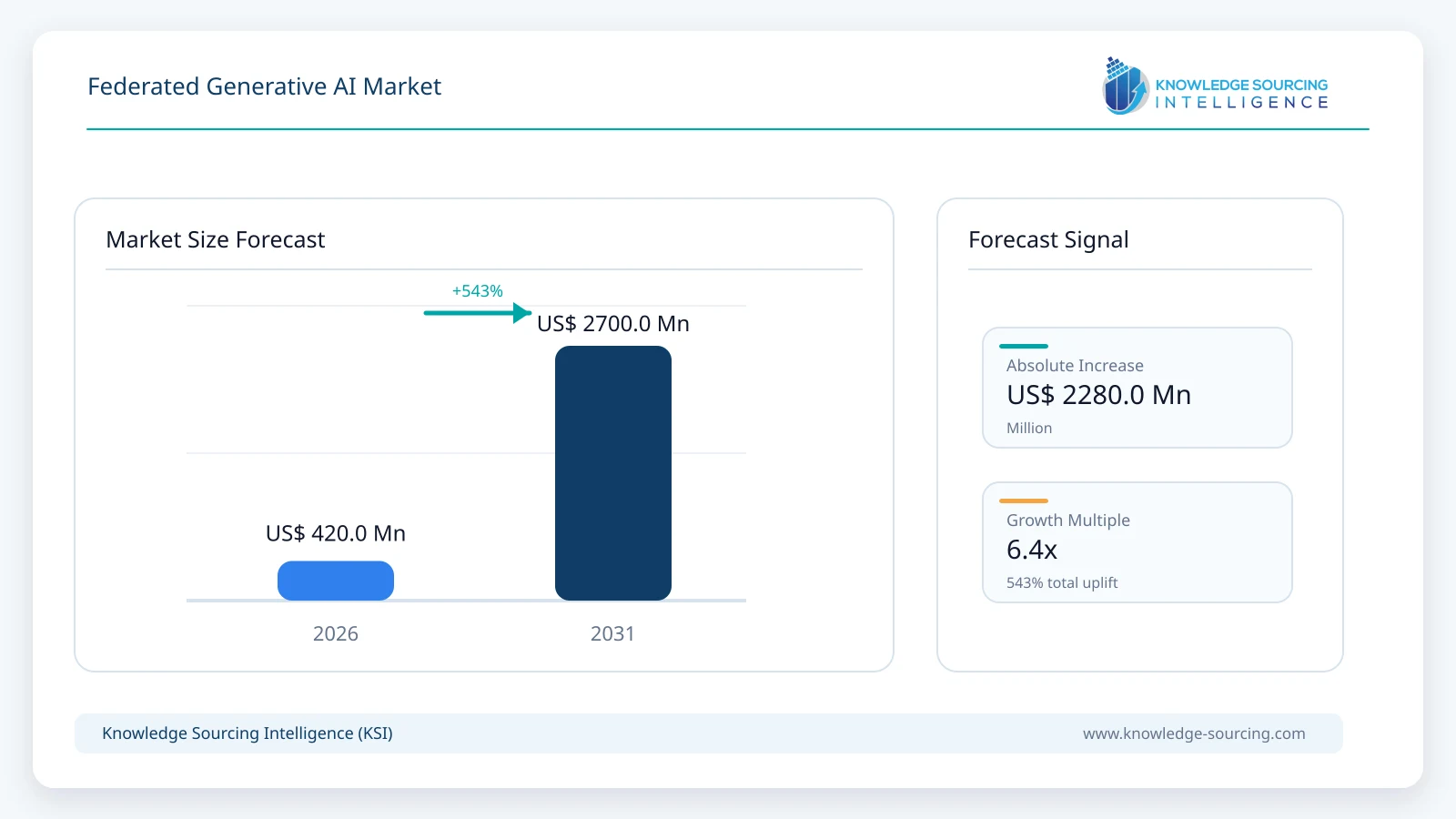
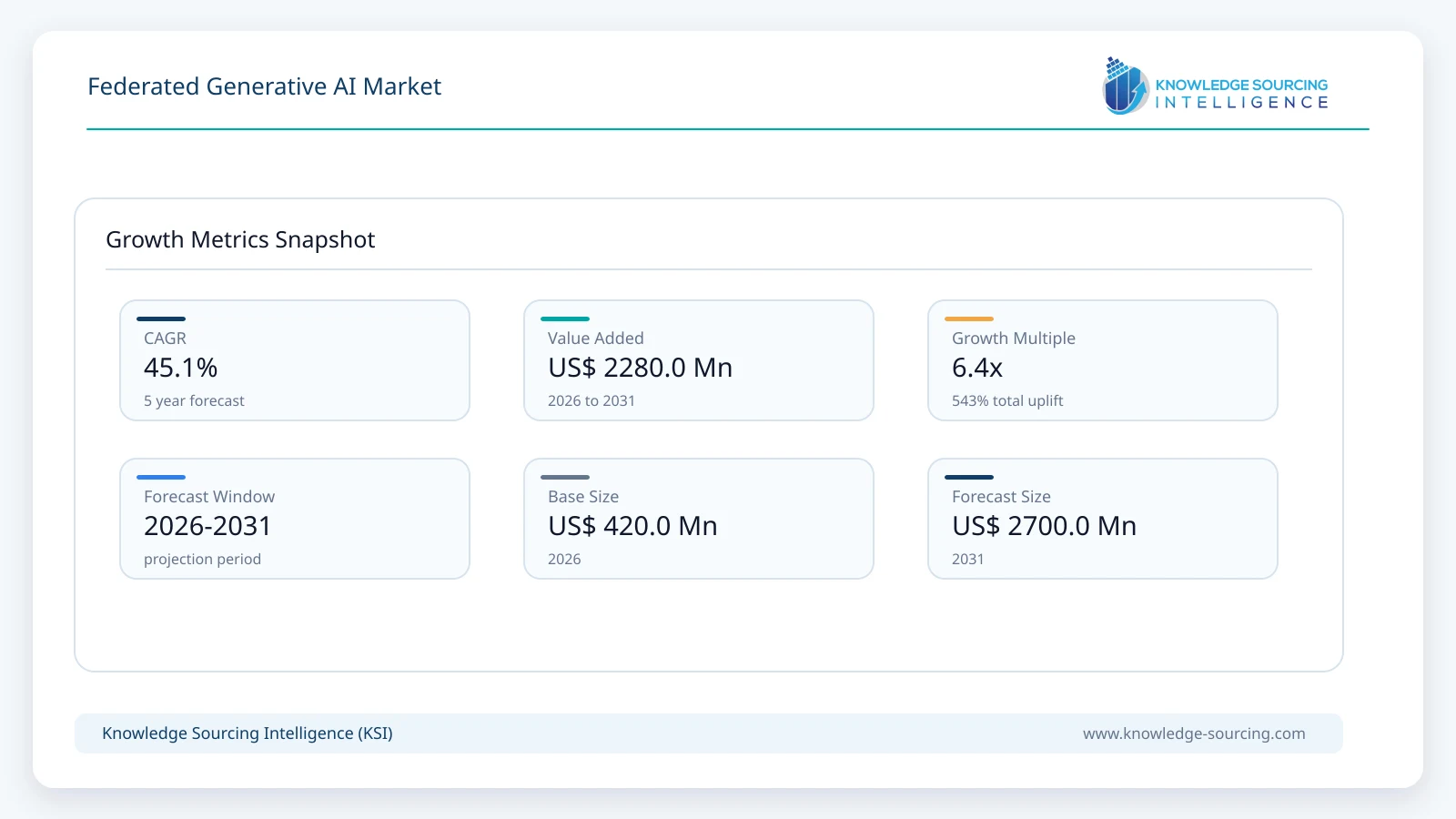
The Federated Generative AI Market is forecast to grow at a CAGR of 45.1%, reaching USD 2,700 million in 2031 from approximately USD 420 million in 2026.
Highlights:
- 1Federated generative model fine-tuning accounts for approximately 50.0% of 2026 market revenue because adapting existing foundation models is less capital intensive than federated pre-training.
- 2Cross-silo enterprise federation contributes approximately 60.7% of the market in 2026, reflecting demand for governed collaboration between institutional data repositories.
- 3Text and code generation models account for approximately 56.0% of 2026 revenue, supported by private business documents, domain instructions and localized language models.
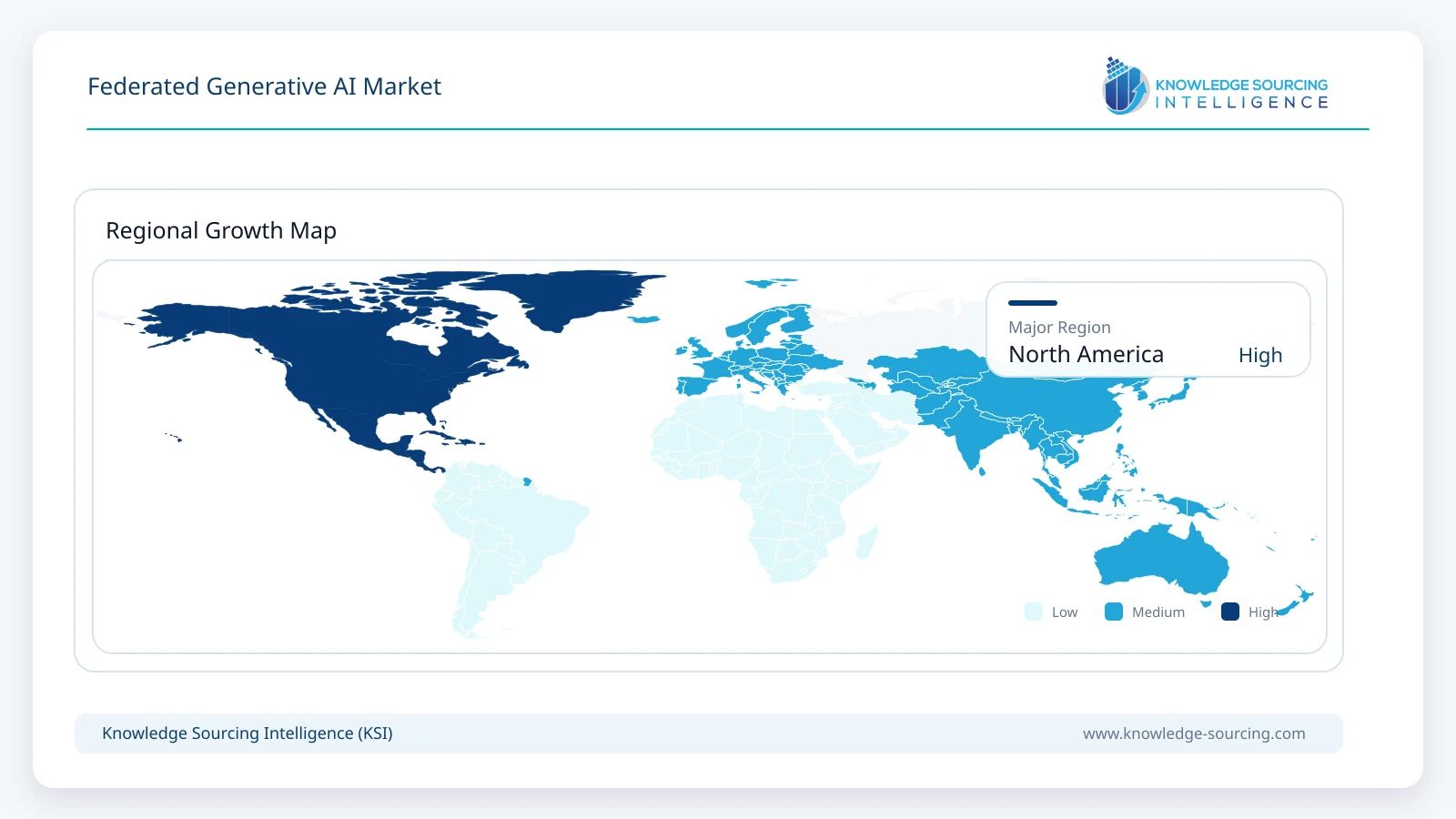
- 4North America represents approximately 40.2% of the global market in 2026, supported by enterprise AI development, cloud infrastructure and specialized federated software.
- 5Asia Pacific is projected to expand more rapidly than North America through 2031 as sovereign AI, localized models and institutional AI cooperation increase across the region.
The market includes paid software platforms, managed federation orchestration and implementation services used to train, fine-tune or improve generative models across decentralized data environments. Relevant workflows cover large language models, multimodal architectures, distributed adapter training, parameter aggregation, participant governance and secure cross-site collaboration.
Federated approaches differ from conventional distributed training because the data owners retain control over local records and operating environments rather than pooling datasets under one infrastructure operator. NVIDIA FLARE supports federated supervised and parameter-efficient fine-tuning using Hugging Face and NVIDIA NeMo. Flower Labs provides development frameworks and a managed federation route through SuperGrid, while TensorOpera offers cross-silo and cross-device federated operations. These implementations demonstrate growing technology maturity but differ in the privacy guarantees and commercial arrangements they provide.
Market Overview
Private enterprise datasets are often fragmented across hospitals, financial institutions, subsidiary companies and government departments that cannot freely combine their underlying records. Federated generative AI addresses this problem by sending model code or parameters to approved computing environments, conducting local optimization, and combining permitted updates into a shared or coordinated model. For generative workloads, this approach is especially useful where text documents, images, clinical material or confidential source code must remain under separate custody.
NVIDIA FLARE documents federated LLM fine-tuning with supervised training and LoRA-based parameter-efficient methods. Only selected model parameters need to move among participants, helping reduce transfer requirements relative to full-weight exchanges. Flower Labs demonstrated federated foundation-model pre-training through Photon and provides examples of federated legal-language fine-tuning in which only LoRA adapters are exchanged. Such methods support the practical use of larger models while respecting local operational boundaries.
Enterprise deployment introduces challenges beyond training algorithms. Data owners must authorize each job, assess code packages, allocate local compute resources, verify model-update handling and decide whether collaborators can use shared model outputs. Flower SuperGrid aims to simplify federation management, while NVIDIA FLARE has expanded support for Docker, Kubernetes and Slurm deployments. Commercial opportunity therefore spans platform subscriptions, workload coordination, technical assurance and integration with existing MLOps processes rather than the price of underlying GPU hardware alone.
Market Trends
Parameter-Efficient Fine-Tuning Is Lowering Coordination Costs
Federated LoRA and other adapter-based approaches let participants customize pretrained language models by exchanging a smaller set of trainable parameters instead of transmitting every foundation-model weight. NVIDIA FLARE supports PEFT for LLM workloads and Flower publishes reproducible instruction-tuning examples using LoRA. These developments can make repeated collaboration more affordable for banks, hospital groups and enterprises that share a business problem but cannot share the full documents used for training.
Reduced update size also changes platform design. Aggregation services must validate which adapters are compatible, preserve participant-level evaluation, manage model versioning and enforce rules for combining contributions. Lower data transfer does not remove privacy risk, since model updates can still leak information under some attack conditions. Buyers consequently evaluate secure aggregation, differential privacy and audit controls alongside training efficiency.
Multimodal Collaboration Is Expanding Beyond Text Models
Federated image-text and vision-language development is becoming more practical as training frameworks improve management of large multimodal parameter updates. NVIDIA reported in August 2026 that its FLARE multimodal workflows could federate adapter updates over a vision-language model while reducing client communications substantially versus exchanging the entire model. This progress is relevant to medical imaging with narrative reports, industrial inspections and public-sector record collections that combine visual and textual information.
Multimodal demand increases integration work because participants may have different image formats, annotation standards, modality coverage and accelerator capacities. Commercial platforms need to coordinate local preprocessing and eligibility checks while avoiding movement of restricted source assets. Providers able to handle uneven data quality and heterogeneous model updates should have an advantage over solutions designed for uniform datasets.
Enterprise Federations Are Becoming Operational Platforms
Federated AI projects increasingly require reliable operation across organizations rather than a short-lived research experiment. Flower introduced SuperGrid in September 2025 to connect SuperNodes and simplify federation management, and NVIDIA FLARE added deployment choices spanning Docker, Kubernetes and Slurm during 2026. These capabilities allow existing site administrators to keep local scheduling, secrets and data-access policies while collaborating on model development.
Commercial buyers are likely to place greater weight on support obligations, operational monitoring, model release approval and recoverability as projects move into production. Service providers also need to distinguish true federated training from simple remote inference or centralized multi-cloud training. The ability to demonstrate repeatable runs across governed nodes will be central to procurement decisions.
Sovereign and Cross-Institutional Development Is Gaining Attention
Hospitals, research networks and public-sector AI programs are exploring collaborative development methods that preserve the authority of individual data custodians. Flower’s March 2026 collaboration with Aridhia demonstrated how its SuperNodes can operate inside healthcare digital research environments, while its November 2025 work with Red Hat improved options for deployment across OpenShift clusters. These arrangements reduce some of the institutional effort needed to establish approved collaboration environments.
Sovereign programs may adopt federation to build models aligned with regional languages, legal obligations and institutional knowledge. Nevertheless, local data retention alone is not a complete privacy guarantee: contracts, output evaluation and model-update protection still matter. Demand should therefore favor technology that combines practical local execution with governance controls rather than promoting federation as a substitute for legal or technical risk assessment.
Segment Analysis
By Training Function: Federated Generative Model Fine-Tuning
Federated generative model fine-tuning is the largest training-function segment because organizations can begin with an established model and improve it for internal instructions, regulated documents or domain-specific reasoning. This segment is projected to reach approximately USD 1.24 billion in 2031. NVIDIA FLARE and Flower both support parameter-efficient distributed adaptation, helping institutions run repeatable cross-site fine-tuning without undertaking the significantly greater infrastructure commitment associated with full foundation-model pre-training.
Healthcare and banking buyers benefit where different sites hold complementary examples but cannot transfer full records. The commercial requirement extends to validating update quality, managing client differences, preventing unauthorized parameter access and evaluating models across participating institutions. Long-term purchasing decisions should depend on reproducible performance improvements rather than the number of nominal participating nodes.
By Offering: Federated Model Development Platform Licenses
Federated model development platform licenses are projected to generate approximately USD 1.32 billion in revenue by 2031, reflecting demand for reusable orchestration, controlled model execution and commercial support across multiple projects. Flower Enterprise and SuperGrid illustrate a route from an open-source framework to operational federation services; other platform suppliers support secure scheduling, aggregation and model coordination. Enterprise buyers generally prefer repeatable, centrally governed operations rather than rebuilding node management for each collaboration.
Platform value lies in workflow controls that remain useful regardless of the selected foundation model. Authentication, participant eligibility, failure recovery, model versioning and experiment audit records can be reused across projects. Providers still face price pressure from capable free frameworks, making service quality, integration effort and support response important areas of differentiation.
By End User: Healthcare and Life Sciences
Healthcare and life sciences are expected to generate approximately USD 670 million in market revenue by 2031. Hospital networks and research consortia can draw on separately governed clinical notes, pathology images and scientific datasets to improve domain-focused generative applications while retaining records inside approved research environments. Flower’s integration with Aridhia illustrates how approved local computing infrastructure can reduce the operational burden of cross-site collaborations.
Clinical model development remains sensitive to inconsistent labels, site-specific patient populations, output safety and local governance requirements. Organizations need to demonstrate that shared model updates are appropriate, that generated medical content is evaluated locally and that a participating site can withdraw or restrict its involvement. These needs support spending on federated engineering and validation services in addition to platform software.
Market Drivers
Enterprise Demand for Private Domain-Specific Models
Financial institutions, healthcare providers and technology companies hold internal documents and transactions that can materially improve domain-specific generative AI but cannot be freely transferred to a central model developer. Federated fine-tuning provides a way to coordinate local training, making private knowledge more useful while preserving ownership boundaries. This encourages purchases of model coordination software, participant controls and managed training services.
Growing Availability of Federated LLM Toolchains
NVIDIA FLARE supports Hugging Face and NeMo fine-tuning workflows, while Flower offers LoRA-based examples and collaboration infrastructure. Developers can adapt familiar model training code instead of designing federation mechanisms from the beginning. Reducing the engineering burden can turn additional enterprise proof-of-concepts into recurring supported deployments, particularly for teams without specialized distributed-systems expertise.
Data Residency and Sovereign AI Requirements
Public agencies and multinational enterprises often operate across jurisdictions with restrictions on how sensitive datasets may be accessed. Federation enables authorized local processing and can keep institutional records within approved boundaries while shared models incorporate information from multiple participants. Demand will be strongest when platform controls are combined with enforceable contracts, update protections and evidence of model quality.
Expansion of Multi-Institutional Healthcare Research
Healthcare networks frequently need broader patient and modality diversity than a single hospital can supply. Flower and Aridhia have demonstrated a route for federated studies inside managed secure research environments. These operating models reduce the need to negotiate bulk dataset transfers and create demand for reusable federation deployment, study management and local model evaluation services.
Advances in Adapter and Multimodal Training
Parameter-efficient fine-tuning, smaller model-update payloads and improved multimodal aggregation allow more organizations to participate without matching the computing resources of a large foundation-model laboratory. NVIDIA FLARE has documented adapter-based multimodal workflows and heterogeneous execution support. Lower coordination and communication requirements expand the range of commercially feasible federated generative projects.
Market Restraints
High Computational and Coordination Costs
Large generative models impose substantial accelerator requirements, and each federated round can require multiple participants to complete local work before effective aggregation. Uneven site hardware, unreliable networks and synchronization delays increase project duration and operating cost. The economics can be inferior to centralized fine-tuning when data can legally and securely be consolidated, limiting adoption outside use cases with a strong reason to preserve distributed custody.
Privacy Leakage from Model Updates
Federated learning reduces raw-data transfers but does not automatically prevent sensitive information from leaking through gradients, adapters or final model outputs. Secure aggregation, differential privacy, update filtering and careful model evaluations may be required. Additional protections can increase implementation complexity or reduce model accuracy, forcing buyers to make explicit trade-offs between utility, security and cost.
Nonuniform Data and Model Performance
Participating institutions frequently differ in language distributions, document formats, annotation policies and business objectives. Aggregating inconsistent updates can produce a model that performs well at some sites but poorly at others. Enterprises must test participant fairness, catastrophic forgetting and cross-domain generalization before deploying a common generative system in important workflows.
Open-Source Pricing Pressure
Flower, NVIDIA FLARE and OpenFL provide free software foundations that organizations can deploy without paying per-user licenses for the core framework. Commercial suppliers must demonstrate added value in enterprise support, managed orchestration, governance and integration. Bundling with cloud and MLOps products can further reduce the separately identifiable revenue available to dedicated federation providers.
Complex Governance and Liability Allocation
Cross-organization model development requires agreement on intellectual property, update ownership, security incident response, training permissions and withdrawal rights. Federated processing does not resolve copyright issues or establish that model outputs are compliant with local rules. Lengthy negotiations and differentiated approval processes may delay production deployments, especially in healthcare and government consortia.
Regional Outlook
North America
North America is projected to remain the largest market for federated generative AI, reaching approximately USD 950 million by 2031. The region benefits from established enterprise AI spending, foundation-model engineering expertise and large groups of healthcare, financial and technology organizations holding proprietary training material. United States adoption is supported by specialist platform developers and customers able to fund both distributed model experimentation and the operational infrastructure needed for repeatable deployment.
Federal and enterprise research collaborations add demand for workflows that leave records within approved institutions. Platform selection is increasingly linked to model validation, identity and access management and compatibility with existing cloud or on-premises GPU environments. Canadian healthcare and financial organizations contribute additional demand, while Mexico remains a smaller market centered on major enterprise adoption.
Asia Pacific
Asia Pacific is expected to be the fastest-growing regional market and reach approximately USD 820 million in 2031. China, India, Japan and South Korea are increasing investment in domestic-language models, specialized enterprise AI and data-local development practices. Regional demand is also supported by large technology services industries, hospital networks and government programs that want to develop shared capabilities across institutions without transferring all source datasets into one jurisdiction.
Growth will depend on reliable access to accelerators, strong local engineering capabilities and organizational agreement on model-update sharing. India and Southeast Asian markets present opportunities for multilingual adaptation across distributed enterprises, while Japan, South Korea and Australia offer more established regulated-sector procurement environments. Suppliers that support mixed cloud and local training arrangements should be positioned to serve a larger range of country-specific infrastructure and governance requirements.
Competitive Landscape
Competition combines specialized federated AI providers, infrastructure vendors and organizations that support secure multi-site model development. Flower Labs supplies a widely used open-source framework alongside enterprise federation offerings, while NVIDIA FLARE brings federated training integration to established AI development environments. TensorOpera provides commercial federated-learning capabilities across organizations and devices, and Intel OpenFL contributes a framework used for privacy-preserving collaborative training. These offerings differ in the strength of their generative-model support, commercial packaging and available managed operations.
Red Hat and Aridhia participate through deployment and secure research infrastructure, rather than proving that all container or research-platform revenue should be counted as federated generative AI. Other firms in private computation and healthcare collaboration provide adjacent capabilities whose revenue attribution requires care. Buyers increasingly compare integration with existing GPU schedulers, support for large adapter updates, node-level approval, privacy safeguards and post-training model quality. The breadth of open-source tooling means enterprise support and dependable operational control are central sources of differentiation.
Recent Developments
October 2026: Flower Labs released Flower 1.42, continuing runtime and federation engineering enhancements relevant to its enterprise deployment ecosystem.
September 2026: NVIDIA documented FLARE execution across Docker, Kubernetes and Slurm, expanding the deployment options available to multi-institutional model-training teams.
August 2026: NVIDIA published federated multimodal workflow techniques using FLARE, including adapter-only collaboration that reduces model-update transfers.
July 2026: Flower Labs introduced FlowerBench to benchmark AI agents on private enterprise work through federated evaluation; the initiative is adjacent to, but not the same as, federated generative training.
March 2026: Flower Labs launched Flower Hub for sharing and deploying collaborative AI applications across heterogeneous environments.
March 2026: Flower Labs and Aridhia presented an integration enabling federated workloads inside secure digital research environments used by healthcare collaborators.
Market Outlook
Federated fine-tuning is expected to account for a substantial portion of market expansion as organizations adapt existing generative models to private operating environments without pooling every source dataset. Commercial platforms should benefit from greater demand for reusable participant controls, secure aggregation, federated evaluation and supported integrations with enterprise MLOps. Multimodal and foundation-model pre-training will create longer-term opportunities but require greater technical coordination and capital resources than adapter-based customization.
North America is expected to maintain the largest revenue base, while Asia Pacific gains share as institutional AI collaboration, multilingual model development and sovereign infrastructure spending expand. The competitive outlook favors suppliers that demonstrate measurable model improvements, straightforward local deployment and clear accountability among participants. Open-source alternatives will remain influential, requiring commercial providers to earn revenue through operational reliability, governance features and specialist support rather than protocol access alone.
Federated Generative AI Market Scope
| Report Metric | Details |
|---|---|
| Total Market Size in 2026 | USD 420 million |
| Total Market Size in 2031 | USD 2,700 million |
| Forecast Unit | Million |
| Growth Rate | 45.1% |
| Study Period | 2021 to 2031 |
| Historical Data | 2021 to 2024 |
| Base Year | 2025 |
| Forecast Period | 2026 – 2031 |
| Segmentation | Offering, Training Function, Model Modality, Federation Architecture, Deployment Model, Organization Size, End User, Geography |
| Companies |
|
| Customization Scope | 15% Free Customization included with purchase — Request Custom Breakdown → |
| Sample & Data Access | PDF Sample, Excel Databook & Analyst Briefing — Download Free Sample → |
Market Segmentation
By Offering
Federated model development platform licenses
Managed federation orchestration and operations
Implementation, security and model engineering services
By Training Function
Federated generative model fine-tuning
Federated foundation-model pre-training
Federated multimodal model development
Federated agent and prompt adaptation
By Model Modality
Text and code generation models
Vision-language and multimodal models
Generative image and vision models
Speech, audio and other generative models
By Federation Architecture
Cross-silo enterprise federation
Multi-organization and sovereign consortium
Cross-device and distributed edge participation
By Deployment Model
On-premises and private infrastructure
Hybrid managed federation
Cloud-managed federation services
By Organization Size
Large enterprises and public institutions
Small and medium enterprises and research teams
By End User
Healthcare and life sciences
Banking, financial services and insurance
Technology and software companies
Government and public research
Industrial, telecom and other industries
By Geography
North America
United States
Canada
Mexico
South America
Brazil
Argentina
Chile
Rest of South America
Europe
Germany
United Kingdom
France
Italy
Spain
Netherlands
Sweden
Rest of Europe
Middle East and Africa
Saudi Arabia
United Arab Emirates
Israel
South Africa
Rest of Middle East and Africa
Asia Pacific
China
India
Japan
South Korea
Australia
Singapore
Indonesia
Rest of Asia Pacific
Table of Contents
1. EXECUTIVE SUMMARY
1.1. Key Findings
1.2. Federated Generative AI Market Size, 2026-2031
1.3. Segment and Regional Outlook
2. MARKET SNAPSHOT
2.1. Market Overview
2.2. Market Definition
2.3. Scope of the Study
2.4. Market Segmentation
3. BUSINESS LANDSCAPE
3.1. Market Drivers
3.1.1. Enterprise Demand for Private Domain-Specific Models
3.1.2. Growing Availability of Federated LLM Toolchains
3.1.3. Data Residency and Sovereign AI Requirements
3.1.4. Expansion of Multi-Institutional Healthcare Research
3.1.5. Advances in Adapter and Multimodal Training
3.2. Market Restraints
3.2.1. High Computational and Coordination Costs
3.2.2. Privacy Leakage from Model Updates
3.2.3. Nonuniform Data and Model Performance
3.2.4. Open-Source Pricing Pressure
3.2.5. Complex Governance and Liability Allocation
3.3. Market Opportunities
3.4. Porter’s Five Forces Analysis
3.5. Industry Value Chain Analysis
3.6. Policies and Regulations
3.7. Strategic Recommendations
4. TECHNOLOGICAL OUTLOOK
4.1. Federated LLM Supervised Fine-Tuning
4.2. Parameter-Efficient Training and Adapter Exchange
4.3. Federated Pre-training and Foundation Models
4.4. Federated Vision-Language and Multimodal Learning
4.5. Secure Aggregation and Participant Governance
4.6. Cross-Silo Orchestration and GPU Scheduling
5. FEDERATED GENERATIVE AI MARKET BY OFFERING
5.1. Introduction
5.2. Federated model development platform licenses
5.3. Managed federation orchestration and operations
5.4. Implementation, security and model engineering services
6. FEDERATED GENERATIVE AI MARKET BY TRAINING FUNCTION
6.1. Introduction
6.2. Federated generative model fine-tuning
6.3. Federated foundation-model pre-training
6.4. Federated multimodal model development
6.5. Federated agent and prompt adaptation
7. FEDERATED GENERATIVE AI MARKET BY MODEL MODALITY
7.1. Introduction
7.2. Text and code generation models
7.3. Vision-language and multimodal models
7.4. Generative image and vision models
7.5. Speech, audio and other generative models
8. FEDERATED GENERATIVE AI MARKET BY FEDERATION ARCHITECTURE
8.1. Introduction
8.2. Cross-silo enterprise federation
8.3. Multi-organization and sovereign consortium
8.4. Cross-device and distributed edge participation
9. FEDERATED GENERATIVE AI MARKET BY DEPLOYMENT MODEL
9.1. Introduction
9.2. On-premises and private infrastructure
9.3. Hybrid managed federation
9.4. Cloud-managed federation services
10. FEDERATED GENERATIVE AI MARKET BY ORGANIZATION SIZE
10.1. Introduction
10.2. Large enterprises and public institutions
10.3. Small and medium enterprises and research teams
11. FEDERATED GENERATIVE AI MARKET BY END USER
11.1. Introduction
11.2. Healthcare and life sciences
11.3. Banking, financial services and insurance
11.4. Technology and software companies
11.5. Government and public research
11.6. Industrial, telecom and other industries
12. FEDERATED GENERATIVE AI MARKET BY GEOGRAPHY
12.1. North America
12.1.1. United States
12.1.2. Canada
12.1.3. Mexico
12.2. South America
12.2.1. Brazil
12.2.2. Argentina
12.2.3. Chile
12.2.4. Rest of South America
12.3. Europe
12.3.1. Germany
12.3.2. United Kingdom
12.3.3. France
12.3.4. Italy
12.3.5. Spain
12.3.6. Netherlands
12.3.7. Sweden
12.3.8. Rest of Europe
12.4. Middle East and Africa
12.4.1. Saudi Arabia
12.4.2. United Arab Emirates
12.4.3. Israel
12.4.4. South Africa
12.4.5. Rest of Middle East and Africa
12.5. Asia Pacific
12.5.1. China
12.5.2. India
12.5.3. Japan
12.5.4. South Korea
12.5.5. Australia
12.5.6. Singapore
12.5.7. Indonesia
12.5.8. Rest of Asia Pacific
13. COMPETITIVE ENVIRONMENT AND ANALYSIS
13.1. Major Players and Strategy Analysis
13.2. Market Share Analysis
13.3. Mergers, Acquisitions, Agreements and Collaborations
13.4. Competitive Dashboard
14. COMPANY PROFILES
14.1. Flower Labs
14.2. NVIDIA Corporation
14.3. TensorOpera AI
14.4. Intel Corporation
14.5. Red Hat, Inc.
14.6. Aridhia Informatics Limited
14.7. Owkin, Inc.
14.8. Rhino Health, Inc.
14.9. Sherpa.ai
14.10. Duality Technologies
15. APPENDIX
15.1. Research Methodology
15.2. Currency and Units
15.3. Assumptions
15.4. Base and Forecast Years
15.5. Abbreviations





Frequently asked questions
What is the projected market size and growth for Federated Generative AI?
Reaches $2,700M in 2031 from $420M in 2026, growing at 45.1% CAGR.
Which market segment contributes most to revenue in 2026?
Cross-silo enterprise federation accounts for 60.7% of the market in 2026.
What generative model type dominates Federated Generative AI revenue?
Text and code generation models account for 56.0% of 2026 revenue.
Which region holds the largest share of the global market in 2026?
North America represents approximately 40.2% of the global market.
Which region is forecast for faster growth through 2031?
Asia Pacific is projected to expand more rapidly than North America.
What is the primary driver for Federated Generative AI adoption?
The Federated Generative AI Market addresses fragmented private datasets, maintaining data custody and governance.
Cite this report
Knowledge Sourcing Intelligence. (Oct 2026). Federated Generative AI Market Size, Share & Growth Forecast (2026-2031). https://www.knowledge-sourcing.com/report/federated-generative-ai-market