
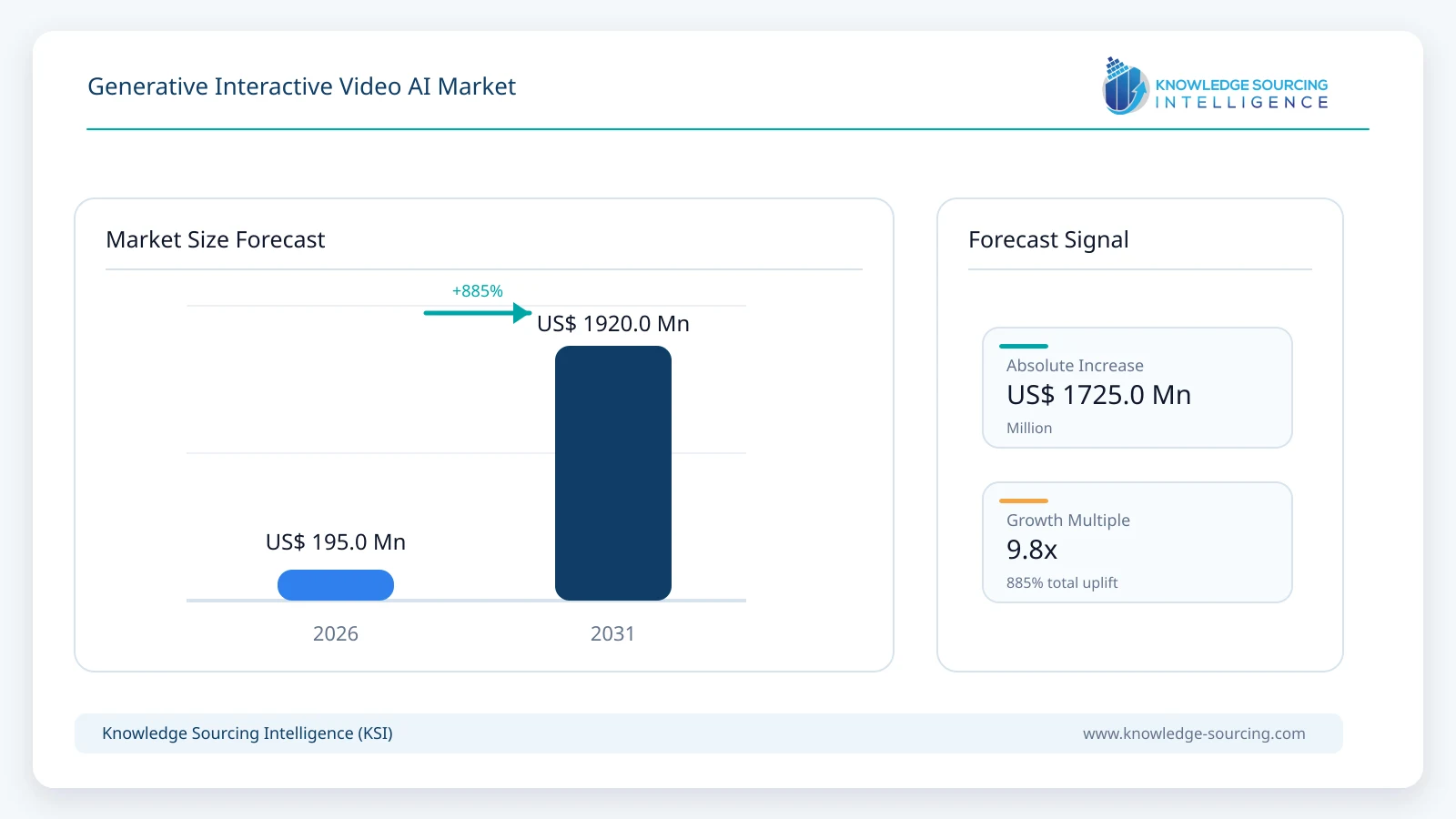
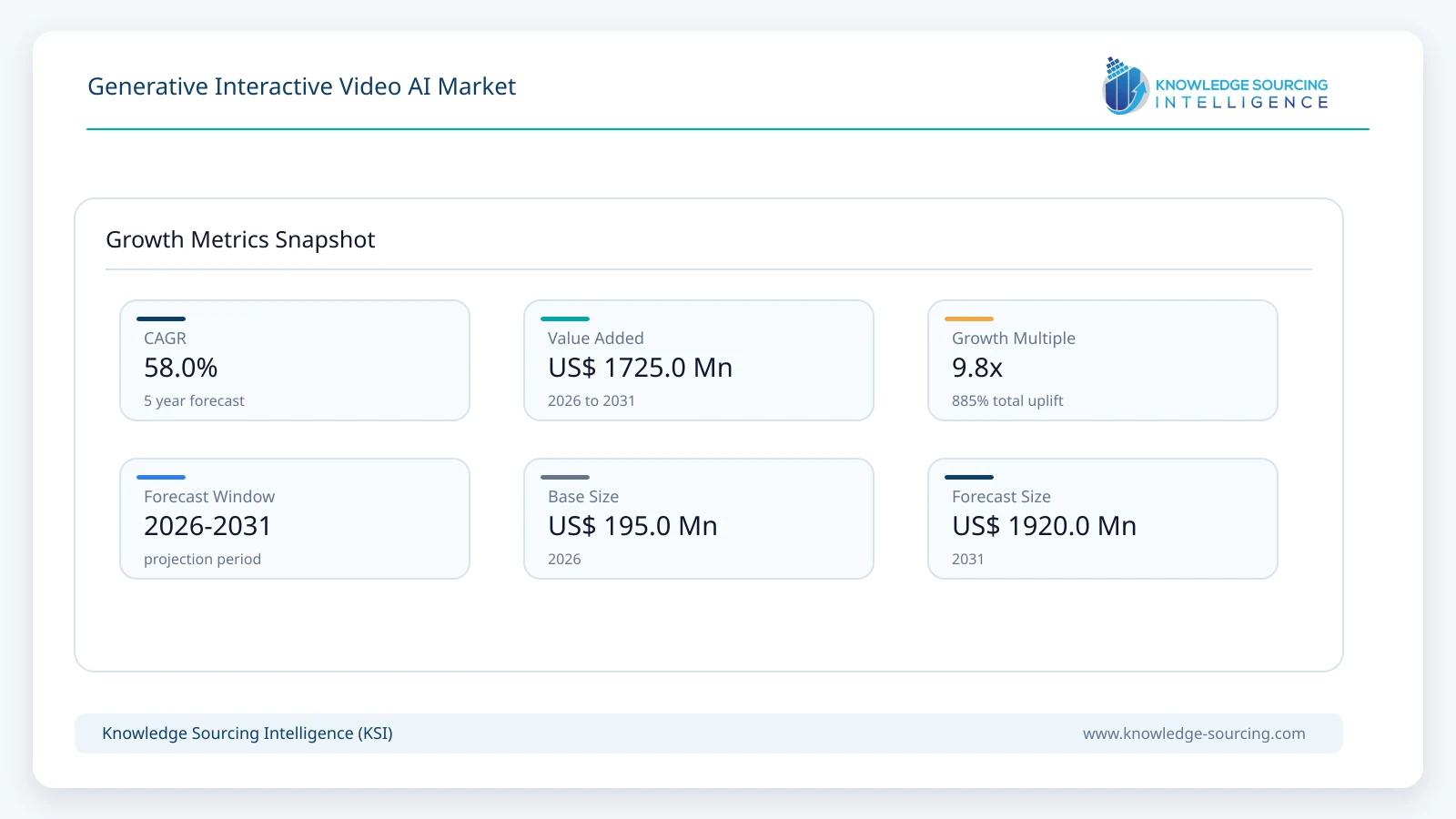
The Generative Interactive Video AI Market is projected to grow from USD 195 million in 2026 to USD 1,920 million by 2031, at a CAGR of 58.00% during the forecast period.
Highlights:
- 1Live conversational video APIs account for the largest share of early commercial revenue.
- 2Interactive world simulation is expected to expand more quickly as access and session reliability improve.
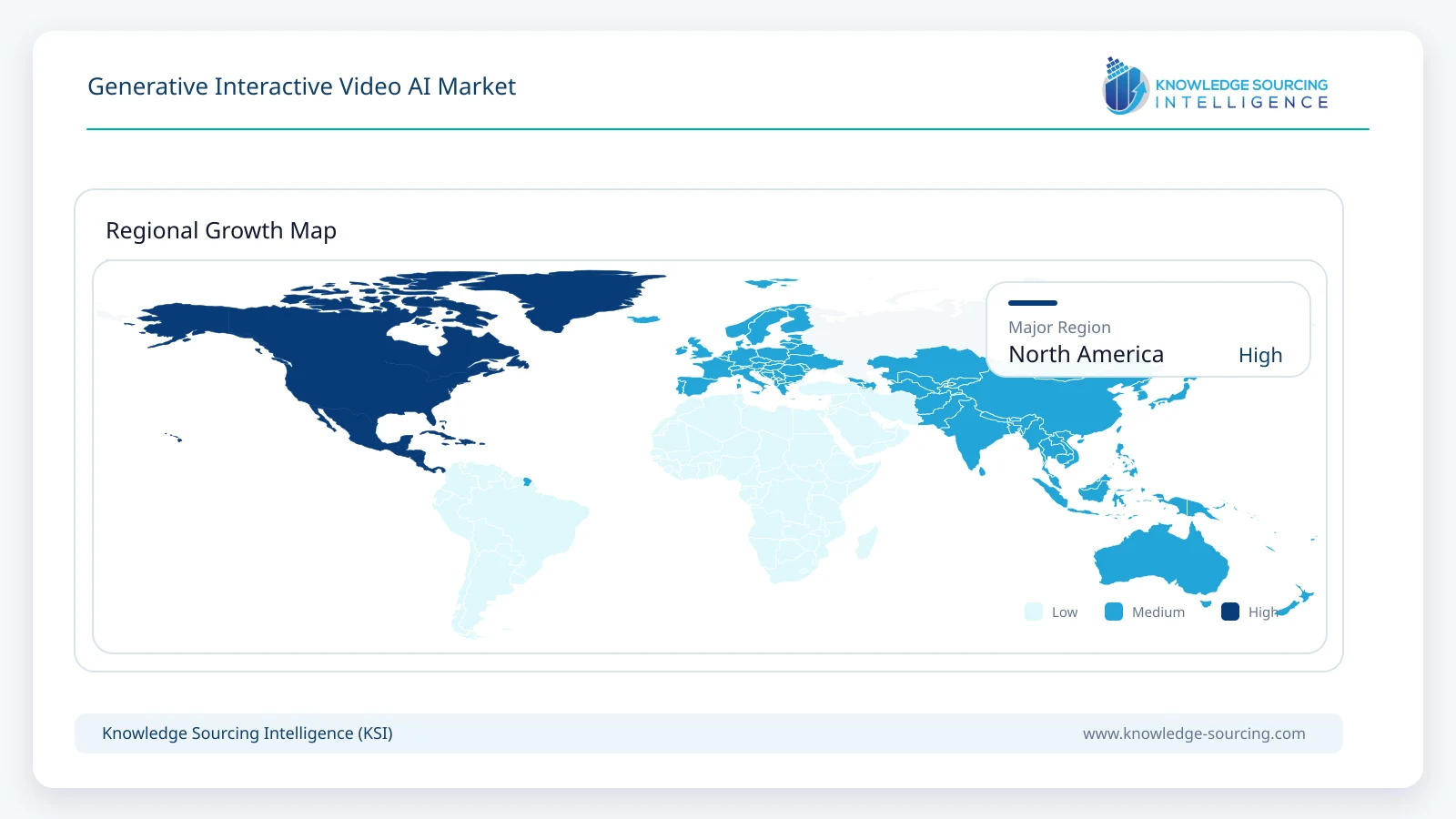
- 3North America represents the largest 2026 regional market, while Asia Pacific records the fastest modeled expansion.
- 4Per-minute video API billing and enterprise contracts create distinct commercialization routes.
- 5Visual consistency, real-time inference cost, user consent and latency remain major purchase criteria.
The study covers the continuous generation of video or audiovisual environments that change in response to live speech, user controls, scene instructions and simulation actions.
Commercial activity ranges from real-time AI character APIs used in enterprise applications to interactive world models that render an explorable environment as the user moves through it. The market includes billable live-video generation, interactive world streaming, customized enterprise deployments and subscriptions for interactive experiences. Finished, non-interactive video clips, conventional game graphics engines and standalone voice-assistant processing are outside the scope.
The report evaluates seven distinct segmentation dimensions, including commercial offering, interactive experience type, generation architecture, interaction input, deployment model, application and end-user industry. Regional coverage encompasses North America, South America, Europe, the Middle East and Africa, and Asia Pacific, with country-level market estimates and a competitive review of suppliers developing live generated-video capabilities.
Interactive video generation changes the relationship between a viewer and a digital scene because the next frame is influenced by an action taken during the experience. A user may ask a generated instructor a question, direct a character to react or navigate a synthetic environment without waiting for a completed new clip. The system must therefore produce video frames rapidly while maintaining continuity across turns, scenes and changes in viewpoint.
Commercial deployments in 2026 are more mature in live conversational video than in unrestricted world simulation. Runway Characters supports generated personas through APIs, Tavus offers metered conversational video, and D-ID and Synthesia provide enterprise-oriented interactive agents. These services may connect to an existing language model and speech stack or offer a more complete interaction pipeline. They create recurring revenue from live session usage rather than only offline rendering credits.
Real-time world simulation represents a second and technically demanding opportunity. Google DeepMind introduced Genie 4 as a preview with audio and live world control in October 2026, while Runway GWM Worlds 2 and Decart Oasis demonstrate controllable environments. For commercial scaling, providers must preserve spatial identity, plausible action consequences and sufficient frame rates under variable workloads. Research previews indicate future directions, but broad deployment depends on pricing, access and production reliability.
Market Trends
From Fixed Clips to Continuously Generated Streams
The most important technology shift is from a finished video artifact to a stream that is synthesized as a user interacts. In a fixed-generation workflow the user edits a prompt before production; in an interactive stream, the system must accept new instructions while still generating frames and audio. This raises the relevance of latency budgets, persistent world state and session controls.
Runway Characters provides a commercial example of the shift through video agents that respond to conversation. GWM Worlds 2 extends continuous synthesis to navigable environments, while Decart Oasis focuses on user controls that change the generated world. These offerings are related but differ in the complexity of the state that must remain coherent.
Real-Time Video Agents Become Enterprise Interfaces
Interactive generated faces are being embedded into customer support, educational tutoring, brand engagement and onboarding, where a visual agent can answer questions and adjust expressions immediately. Vendors increasingly provide APIs, identity customization and integrations with an enterprise knowledge system rather than only a fixed character creation tool.
Tavus, D-ID, Anam, HeyGen LiveAvatar and Synthesia each support live conversational video interfaces. The products vary between complete conversational pipelines and video-rendering layers that connect to a customer’s existing speech and language systems. The revenue analysis distinguishes the chargeable video component from unrelated LLM and speech services.
World Models Add Audio, Camera and Action Control
Real-time scene generation is progressing from directional navigation to text-based changes, speech, physical actions and integrated audio. Multi-modal control enables simulations that can react to unexpected events, which is important to game design, robotics training and previsualization workflows.
Genie 4 introduces native audio, interactive dialogue and live steering during world generation, while Runway GWM Worlds 2 produces both video and audio under real-time actions. Odyssey Starchild-1 demonstrates synchronized audio-video output as a research preview. The commercial opportunity is promising, but capacity and paid access remain restricted for some systems.
More Selective Billing and Infrastructure Deployment
API-based streaming encourages buyers to measure generated minutes, concurrent sessions, time-to-first-frame and response performance. Dedicated installations may appeal to enterprise or simulation customers needing predictable capacity, while per-minute plans support variable visitor traffic.
Runway publishes credit-based Characters usage and Tavus, Anam and Simli disclose minute-linked pricing. Lower unit rates may widen access, but providers must offset those rates through efficient inference, higher utilization and differentiation in responsiveness and fidelity.
Generative Interactive Video AI Market Segment Analysis
By Commercial Offering
Commercial conversational-video APIs form the largest revenue stream in 2026 because their session pricing and production deployments are more developed than general-purpose interactive world models. Runway Characters and Tavus represent direct developer-facing offerings.
The live conversational video apis segment is projected to reach USD 880.00 million by 2031. World-model streaming APIs gain a larger share as research systems develop developer access, enterprise deployments and stable session economics. Branded installations support custom controls and governed content, while creator subscriptions remain a smaller but growing route to adoption.
By Interactive Experience Type
Conversational characters lead early use because developers can attach an animated visual front end to existing voice agents and knowledge systems. World exploration and robotics simulation grow from a smaller commercial base as high-fidelity live-world models improve.
The conversational synthetic characters segment is projected to reach USD 825.60 million by 2031. Navigable environments broaden the market beyond face-to-face avatars, but a video stream controlled by the user must preserve object, location and action continuity. Enterprise training and interactive learning favor structured scenarios over unconstrained visual novelty.
By Generation Architecture
Audio-driven character systems account for the largest modeled 2026 architecture share because many services first synthesize head, face and gesture motion from live speech. Autoregressive world and video models expand as continuously navigable scenes gain broader availability.
The audio-conditioned facial and scene generation segment is projected to reach USD 326.40 million by 2031. Causal streaming video models can respond to changing navigation and scene directives without rerendering a completed clip. Hybrid models combine structured world state with generated frames, creating different cost and reliability profiles across applications.
By Primary Interaction Input
Voice drives the majority of initial live-video consumption in education, support and brand interaction because users can communicate without learning a controller. Camera actions and natural-language scene directives become more significant in interactive world simulations.
The voice and conversational input segment is projected to reach USD 806.40 million by 2031. Physical controls and sensor signals gain relevance in robotics, autonomous driving and interactive training. Text and camera navigation remain important for designer-led previsualization and exploratory gaming environments.
By Deployment Model
Managed APIs are the largest modeled deployment segment as vendors provide accelerator inference, session orchestration, media transport and developer integrations. Dedicated deployments capture workloads requiring reliability, predictable capacity and enterprise-level control.
The managed cloud real-time apis segment is projected to reach USD 902.40 million by 2031. Dedicated and private deployments may increase as business buyers seek data handling safeguards, service-level guarantees and bounded latency. Embedded consumer applications compete on a lower cost per generated minute and simple session starts.
By Application
Customer experience currently produces measurable commercial minute usage from support, sales enablement and onboarding. Gaming and interactive world exploration increase in absolute value, while robotics simulation has one of the fastest modeled application growth paths.
The customer engagement and brand agents segment is projected to reach USD 480.00 million by 2031. Learning and coaching use conversational demonstrations, whereas training simulations need causal action-response behavior over longer sessions. Interactive entertainment requires higher session continuity and broad content controls to justify recurring spending.
By End-User Industry
Software and AI developers lead the base-year buying ecosystem because interactive video capability is frequently embedded in third-party applications through APIs. Media, gaming and industrial simulation expand as the technology is integrated with design and training workflows.
The software platforms and ai developers segment is projected to reach USD 441.60 million by 2031. Entertainment and game development gain value from controllable worlds, while education and industrial users evaluate measurable training outcomes. Healthcare and financial deployments remain smaller where identity and model-output risks require additional safeguards.
Market Drivers
Commercialization of Low-Latency Generative Video
Commercial APIs now combine speech interaction with continuously synthesized faces and scenes, making generated video useful in live support, customer service and guided learning. Runway Characters, Tavus CVI, Anam and Synthesia provide developer interfaces rather than only studio creation tools.
Broader Demand for Interactive Digital Experiences
Brands, software platforms and media producers are testing two-way video interfaces that respond to a visitor while the experience is running. Embedded characters can answer questions, demonstrate products and adapt a training conversation without switching to a prerecorded clip.
Progress in Streaming Models and Inference Engineering
Causal frame generation, cache management and concurrent video decoding reduce response delay and make high-frame-rate generation feasible. Runway reports live 24 fps rendering for Characters, while LemonSlice and Simli sell low-latency avatar streaming capabilities.
Expansion of World Simulation and Agent Training
Interactive world models create controllable environments for game prototyping, digital simulation and autonomous-system testing. Genie 4, GWM Worlds 2 and Decart Oasis show how live controls can change scene evolution rather than selecting from fixed assets.
API-Based Access and Usage-Linked Monetization
Per-minute streaming and developer API plans provide buyers a measurable route from small pilots to commercial deployment. Contracts can be sized by minutes, concurrency, dedicated capacity or enterprise integrations, making usage and service quality more visible than one-time video exports.
Market Restraints
High Continuous Inference Cost
A live generated stream consumes compute over the duration of an active session and can be materially more costly than a completed video file. Low utilization, expensive accelerator capacity and high simultaneous-user peaks can weaken provider margins.
Scene Consistency and Long-Horizon Reliability
Real-time world models can drift in object permanence, geometry and action continuity as interactions accumulate. DeepMind identifies long-session consistency and spatial accuracy among Genie 4 limitations, restricting high-stakes uses.
Latency, Bandwidth and Device Compatibility
Interactive video must combine recognition, decision-making, video synthesis and network transmission within a tolerable response window. Unstable connectivity or high concurrency can cause visible stalls and reduce the value of live immersion.
Identity, Consent and Synthetic-Media Misuse
Generated human likenesses and responsive characters raise consent, impersonation and disclosure issues. Enterprise deployments require controls over source images, voice rights, identity verification, watermarking and the ability to audit outputs.
Uncertain Production Readiness of World Models
Several frontier systems remain previews, and commercial pricing is not public or deployment rights are restricted. Buyers may limit spending to experiments until vendors demonstrate repeatable physics, integration reliability, security and service-level commitments.
Regional Outlook
North America
North America is estimated to account for USD 93.60 million in 2026 and is forecast to reach USD 748.80 million in 2031. The region benefits from US-based development of commercial real-time character APIs, world-model research and early enterprise adoption. Developers can combine cloud inference, voice systems and streaming interfaces to launch branded video agents in customer service, education and sales experiences.
The United States remains the principal regional market because several direct suppliers and early developer ecosystems are based there, including Runway, Tavus, Decart and major AI research organizations. Canada contributes through AI software and media production, while Mexico adds a smaller base of localized interactive customer experience. Commercial growth depends on verified use cases and lower per-minute delivery costs.
Asia Pacific
Asia Pacific is estimated at USD 35.10 million in 2026 and is expected to reach USD 556.80 million by 2031, making it the fastest-growing regional market in this forecast. Demand is associated with interactive entertainment, digital commerce, mobile-first applications, language-learning interfaces and the wider adoption of AI developer services across China, Japan, India, South Korea and Southeast Asia.
China has active world-model research and digital character ecosystems, while Japan and South Korea provide substantial gaming, media and simulation demand. India and Southeast Asia offer opportunities for multilingual video agents and lower-cost API usage. The region’s growth also depends on high-volume inference economics, telecommunications performance and local requirements for synthetic-media disclosure and user data handling.
Competitive Landscape
The market combines commercial real-time video-character providers with frontier world-model developers. Runway, Tavus, D-ID, Anam, Synthesia, LemonSlice, Simli and HeyGen compete for enterprise video-agent applications through latency, avatar expressiveness, integration methods, concurrency and cost per generated minute. Google DeepMind, Decart and Odyssey contribute to the development of general interactive worlds and simulation capabilities.
Commercial differentiation is increasingly tied to reliable streaming, live instruction handling, consent management and the ability to connect generated visuals to a trusted enterprise workflow. Buyers compare managed video APIs with private or tailored deployments, while platform providers seek partnerships around speech, customer-data systems, media distribution and real-time transport. Research-stage world models face a longer path to standardized commercial contracts than mature conversational video services.
Recent Developments
October 2026: Google DeepMind unveiled Genie 4 as a research preview, adding native generated audio, real-time speech interaction and user-controlled world simulation.
October 2026: Anam launched Cara-4.1 Express with improved real-time animation and interactive avatar rendering controls.
September 2026: Runway unveiled GWM Worlds 2, a research preview producing continuous, interactive video and audio controlled through scene actions.
July 2026: Synthesia introduced its Interactive Avatar API for enterprise applications that render live, interruptible visual agents.
May 2026: Odyssey previewed Starchild-1, a real-time multimodal world model that generates synchronized audio and video from continuous input.
April 2026: D-ID released Agentic Videos, combining conventional recorded content with live conversational video agents for two-way viewer interaction.
Market Outlook
Generative interactive video AI is expected to move from early demonstrations and conversational avatars toward broader live visual services across customer experiences, learning environments and entertainment. The most immediate market expansion comes from per-minute streaming APIs and enterprise video agents because customers can already integrate these services into websites, applications and existing contact-center workflows.
Interactive world models are likely to become a larger component of spending as live control, audio generation and sustained scene consistency improve. Simulation and interactive game prototyping may create demand for controllable synthetic environments, but broad deployment will require production access, dependable performance and transparent cost structures beyond restricted research previews.
Over the forecast period, cost-efficient inference, low response latency and responsible use of personal likenesses will influence market leadership. Vendors that demonstrate a measurable benefit from live interaction while supporting permissions, continuity and reliable scale will be better positioned than providers limited to visually impressive but short-lived demos.
Generative Interactive Video AI Market Scope:
| Report Metric | Details |
|---|---|
| Total Market Size in 2026 | USD 195 million |
| Total Market Size in 2031 | USD 1,920 million |
| Forecast Unit | USD Million |
| Growth Rate | 58.00% |
| Study Period | 2021 to 2031 |
| Historical Data | 2021 to 2024 |
| Base Year | 2025 |
| Forecast Period | 2026 – 2031 |
| Segmentation | Commercial Offering, Interactive Experience Type, Generation Architecture, Primary Interaction Input, Deployment Model, Application, End-User Industry, Geography |
| Companies |
|
| Customization Scope | 15% Free Customization included with purchase — Request Custom Breakdown → |
| Sample & Data Access | PDF Sample, Excel Databook & Analyst Briefing — Download Free Sample → |
Market Segmentation
By Commercial Offering
Live Conversational Video APIs
Interactive World-Model Streaming APIs
Enterprise Branded Experience Deployments
Creator and Application Subscriptions
By Interactive Experience Type
Conversational Synthetic Characters
Navigable Generated Environments
Action-Driven Simulation and Training
Interactive Education and Narrative Experiences
By Generation Architecture
Autoregressive Video and World Models
Diffusion-Based Streaming Character Models
Hybrid Simulation and Generative-Video Models
Audio-Conditioned Facial and Scene Generation
By Primary Interaction Input
Voice and Conversational Input
Keyboard, Camera and Navigation Controls
Text-Based Scene and Subject Directives
Physical Sensor, Robotics and Action Signals
By Deployment Model
Managed Cloud Real-Time APIs
Enterprise-Hosted Managed Environments
Private or Dedicated Inference Deployments
Embedded Consumer and Creator Applications
By Application
Customer Engagement and Brand Agents
Gaming and Creative World Exploration
Education, Coaching and Training
Robotics, Autonomous Systems and Simulation
Interactive Media, Storytelling and Entertainment
By End-User Industry
Media, Gaming and Entertainment
Software Platforms and AI Developers
Retail, Marketing and Customer Service
Education and Professional Training
Manufacturing, Mobility and Robotics
Healthcare, BFSI and Other Industries
By Geography
North America
United States
Canada
Mexico
South America
Brazil
Argentina
Rest of South America
Europe
United Kingdom
Germany
France
Netherlands
Italy
Spain
Rest of Europe
Middle East and Africa
United Arab Emirates
Saudi Arabia
Israel
South Africa
Rest of Middle East and Africa
Asia Pacific
China
Japan
India
South Korea
Australia
Singapore
Rest of Asia Pacific
Table of Contents
1. EXECUTIVE SUMMARY
1.1. Research Highlights
1.2. Market Size and Growth Outlook, 2026–2031
1.3. Strategic Market Perspective
2. MARKET SNAPSHOT
2.1. Market Overview
2.2. Market Definition
2.3. Scope of the Study
2.4. Market Segmentation
3. BUSINESS LANDSCAPE
3.1. Market Drivers
3.1.1. Commercialization of Low-Latency Generative Video
3.1.2. Broader Demand for Interactive Digital Experiences
3.1.3. Progress in Streaming Models and Inference Engineering
3.1.4. Expansion of World Simulation and Agent Training
3.1.5. API-Based Access and Usage-Linked Monetization
3.2. Market Restraints
3.2.1. High Continuous Inference Cost
3.2.2. Scene Consistency and Long-Horizon Reliability
3.2.3. Latency, Bandwidth and Device Compatibility
3.2.4. Identity, Consent and Synthetic-Media Misuse
3.2.5. Uncertain Production Readiness of World Models
3.3. Market Opportunities
3.4. Porter’s Five Forces Analysis
3.5. Industry Value Chain Analysis
3.6. Policies and Regulations
3.7. Strategic Recommendations
4. TECHNOLOGICAL OUTLOOK
4.1. Real-Time Causal Video Generation and Streaming Inference
4.2. Interactive World-Model Scene Continuity and Action Control
4.3. Audio-Conditioned Generative Characters and Turn Taking
4.4. Low-Latency Media Transport and Dedicated Inference
4.5. Identity, Watermarking and Content Safety Controls
5. GENERATIVE INTERACTIVE VIDEO AI MARKET BY COMMERCIAL OFFERING
5.1. Introduction
5.2. Live conversational video APIs
5.3. Interactive world-model streaming APIs
5.4. Enterprise branded experience deployments
5.5. Creator and application subscriptions
6. GENERATIVE INTERACTIVE VIDEO AI MARKET BY INTERACTIVE EXPERIENCE TYPE
6.1. Introduction
6.2. Conversational synthetic characters
6.3. Navigable generated environments
6.4. Action-driven simulation and training
6.5. Interactive education and narrative experiences
7.GENERATIVE INTERACTIVE VIDEO AI MARKET BY GENERATION ARCHITECTURE
7.1. Introduction
7.2. Autoregressive video and world models
7.3. Diffusion-based streaming character models
7.4. Hybrid simulation and generative-video models
7.5. Audio-conditioned facial and scene generation
8. GENERATIVE INTERACTIVE VIDEO AI MARKET BY PRIMARY INTERACTION INPUT
8.1. Introduction
8.2. Voice and conversational input
8.3. Keyboard, camera and navigation controls
8.4. Text-based scene and subject directives
8.5. Physical sensor, robotics and action signals
9. GENERATIVE INTERACTIVE VIDEO AI MARKET BY DEPLOYMENT MODEL
9.1. Introduction
9.2. Managed cloud real-time APIs
9.3. Enterprise-hosted managed environments
9.4. Private or dedicated inference deployments
9.5. Embedded consumer and creator applications
10. GENERATIVE INTERACTIVE VIDEO AI MARKET BY APPLICATION
10.1. Introduction
10.2. Customer engagement and brand agents
10.3. Gaming and creative world exploration
10.4. Education, coaching and training
10.5. Robotics, autonomous systems and simulation
10.6. Interactive media, storytelling and entertainment
11. GENERATIVE INTERACTIVE VIDEO AI MARKET BY END-USER INDUSTRY
11.1. Introduction
11.2. Media, gaming and entertainment
11.3. Software platforms and AI developers
11.4. Retail, marketing and customer service
11.5. Education and professional training
11.6. Manufacturing, mobility and robotics
11.7. Healthcare, BFSI and other industries
12. GEOGRAPHY
12.1. North America
12.1.1. United States
12.1.2. Canada
12.1.3. Mexico
12.2. South America
12.2.1. Brazil
12.2.2. Argentina
12.2.3. Rest of South America
12.3. Europe
12.3.1. United Kingdom
12.3.2. Germany
12.3.3. France
12.3.4. Netherlands
12.3.5. Italy
12.3.6. Spain
12.3.7. Rest of Europe
12.4. Middle East and Africa
12.4.1. United Arab Emirates
12.4.2. Saudi Arabia
12.4.3. Israel
12.4.4. South Africa
12.4.5. Rest of Middle East and Africa
12.5. Asia Pacific
12.5.1. China
12.5.2. Japan
12.5.3. India
12.5.4. South Korea
12.5.5. Australia
12.5.6. Singapore
12.5.7. Rest of Asia Pacific
13. COMPETITIVE ENVIRONMENT AND ANALYSIS
13.1. Major Players and Strategy Analysis
13.2. Market Share Analysis
13.3. Mergers, Acquisitions, Agreements, and Collaborations
13.4. Competitive Dashboard
14. COMPANY PROFILES
14.1. Runway AI, Inc.
14.2. Google DeepMind (Google LLC)
14.3. Decart AI
14.4. Tavus
14.5. D-ID
14.6. HeyGen (LiveAvatar)
14.7. Anam AI
14.8. Synthesia
14.9. LemonSlice
14.10. Simli
14.11. Odyssey
15. APPENDIX
15.1. Currency
15.2. Assumptions
15.3. Base and Forecast Years Timeline
15.4. Key Benefits for Stakeholders
15.5. Research Methodology
15.6. Abbreviations





Frequently asked questions
What is the Generative Interactive Video AI market size and growth forecast?
Projected to grow from $195M (2026) to $1,920M (2031) at 58.00% CAGR.
Which segment accounts for the largest early commercial revenue?
Live conversational video APIs hold the largest early commercial revenue share.
What interactive video AI segment is expected to expand most quickly?
Interactive world simulation is expected to expand more quickly.
Which region dominates the 2026 market, and which grows fastest?
North America is largest in 2026; Asia Pacific records fastest expansion.
What are the major purchase criteria for this market?
Visual consistency, real-time inference cost, user consent, and latency.
What does the report cover regarding interactive video AI generation?
Continuous video generation changing with live speech, controls, and simulation actions.
Cite this report
Knowledge Sourcing Intelligence. (Oct 2026). Generative Interactive Video AI Market Size, Share & Growth Forecast (2026-2031). https://www.knowledge-sourcing.com/report/generative-interactive-video-ai-market