
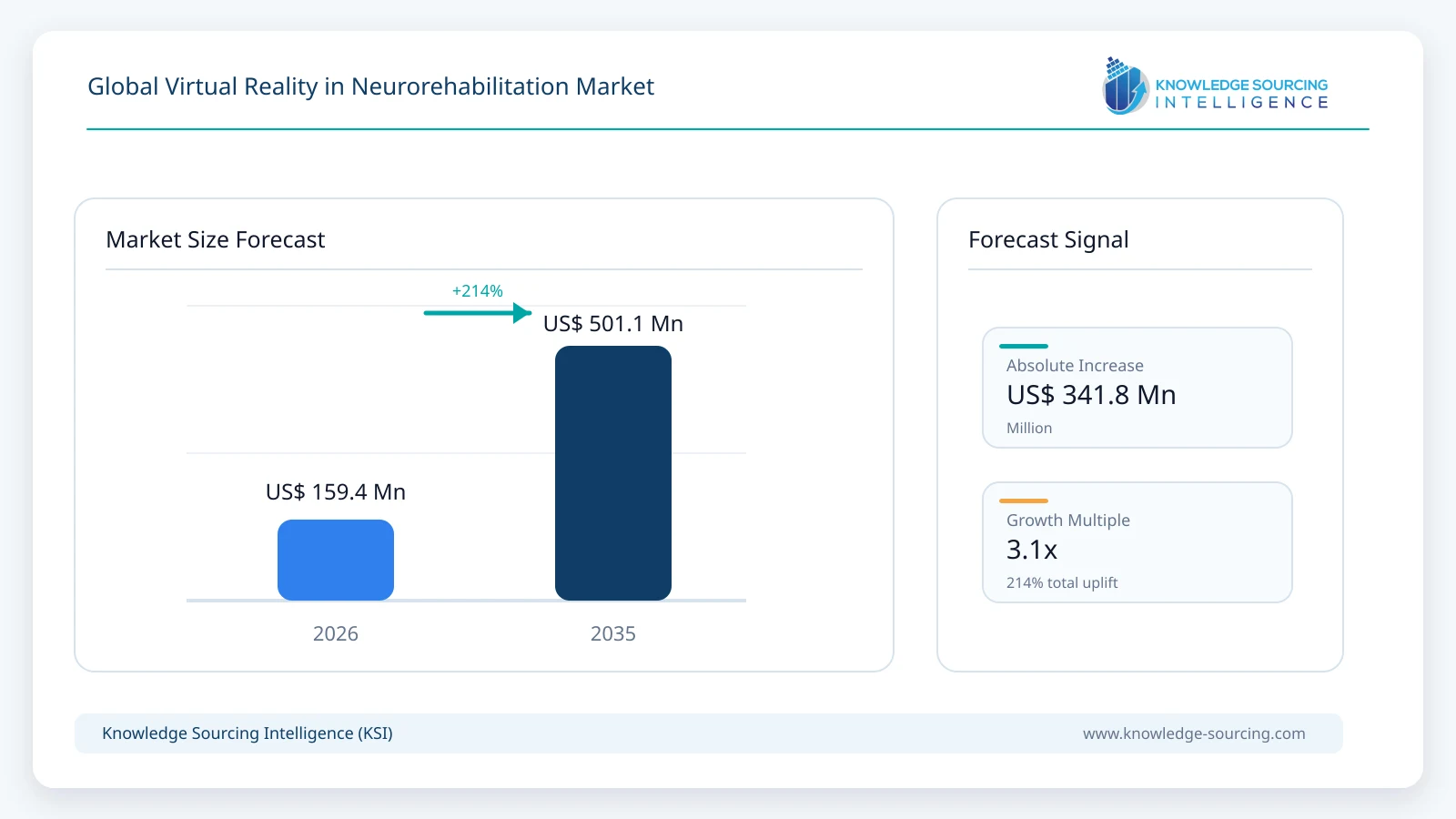
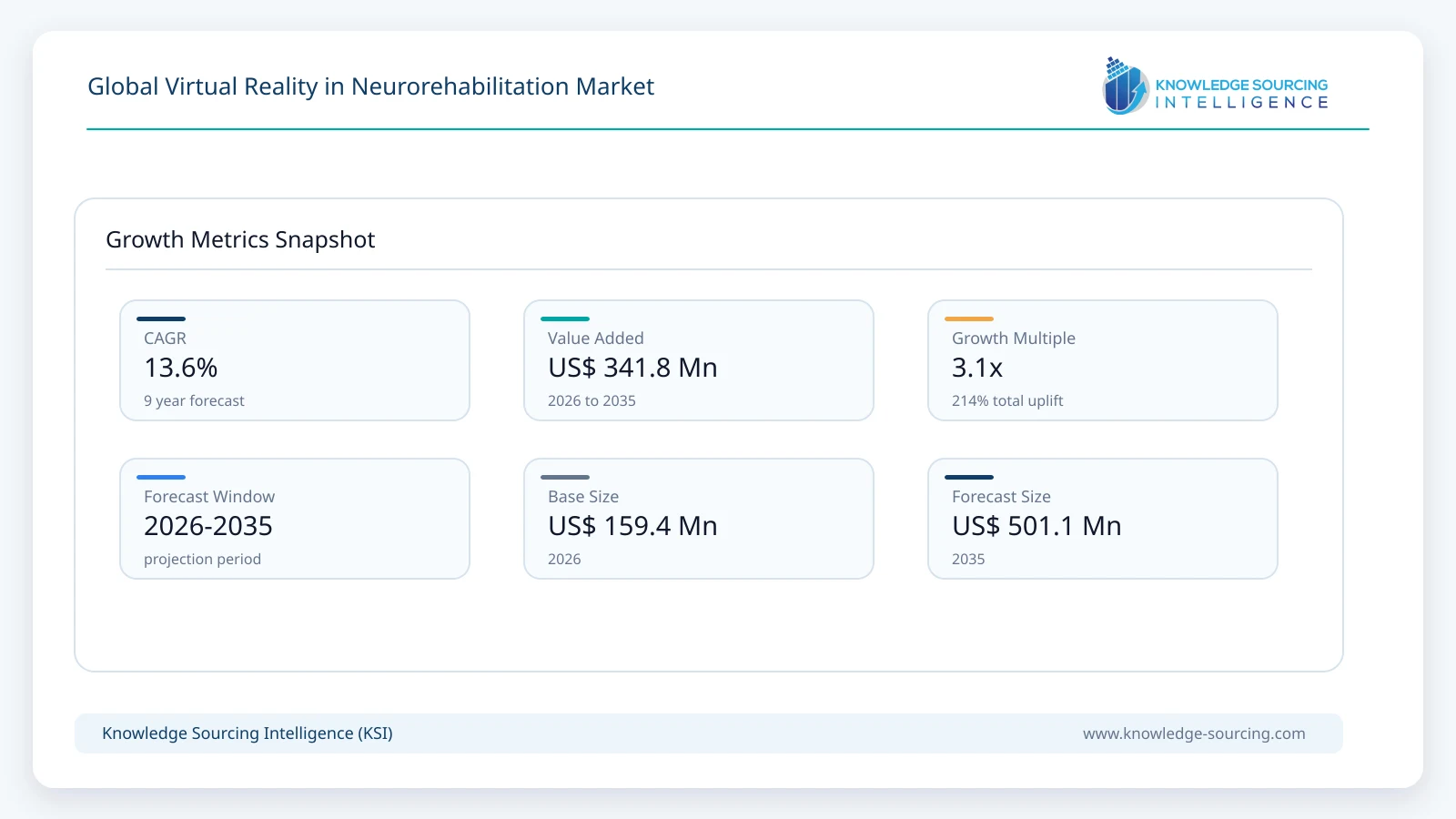
The Global Virtual Reality in Neurorehabilitation Market is set to reach USD 501.13 million in 2035, growing at a CAGR of 13.6% from USD 159.37 million in 2026.
Highlights:
- 1Rising neurological disability prevalence is increasing demand for advanced rehabilitation technologies.
- 2Healthcare providers are expanding virtual rehabilitation programs because patient engagement remains critical for therapeutic success.
- 3Artificial intelligence integration is improving rehabilitation personalization and outcome measurement.
- 4Home-based neurorehabilitation models are expanding because healthcare systems seek scalable care delivery solutions.
Virtual reality in neurorehabilitation utilizes immersive, semi-immersive, and non-immersive digital environments to support neurological recovery and functional restoration. Healthcare providers deploy these technologies because neurological rehabilitation often requires intensive, repetitive exercises that can become difficult to sustain using traditional approaches alone.
Neurological care increasingly focuses on functional outcomes because patients require meaningful improvements in mobility, cognition, coordination, and independence. VR rehabilitation platforms address this need because interactive environments increase patient participation and therapy engagement.
Healthcare organizations are adopting virtual rehabilitation technologies because neurological disease prevalence continues to increase globally. Technology developers are advancing rehabilitation software and sensor-based systems because objective performance tracking enhances treatment optimization.
Strategic importance continues increasing because digital rehabilitation platforms support remote care delivery, personalized therapy pathways, and data-driven clinical management across multiple neurological conditions.
Market Dynamics
Market Drivers
Growing Burden of Neurological Disorders
Neurological conditions continue to create significant rehabilitation needs because stroke, traumatic brain injury, Parkinson’s disease, and multiple sclerosis affect millions of patients worldwide. Healthcare providers are adopting VR rehabilitation solutions because long-term functional recovery requires sustained therapeutic intervention. This trend drives market growth.
Increasing Demand for Personalized Rehabilitation
Neurological recovery varies substantially among patients because disease severity, functional impairment, and rehabilitation responses differ significantly. Clinicians are implementing adaptive VR platforms because personalized therapy improves rehabilitation outcomes. This factor supports technology adoption.
Expansion of Remote Rehabilitation Models
Healthcare systems increasingly prioritize remote care delivery because access to specialized neurological rehabilitation remains limited in many regions. Providers are deploying cloud-connected VR rehabilitation platforms because home-based therapy improves treatment accessibility. This development strengthens market expansion.
Technological Advancements in Virtual Reality
Virtual reality hardware and software capabilities continue improving because digital health innovation remains a strategic priority. Developers are integrating advanced analytics and motion capture technologies because objective rehabilitation measurement enhances clinical value. This trend accelerates market development.
Market Restraints
High implementation costs limit adoption among smaller healthcare providers.
Limited reimbursement support restricts utilization in several healthcare markets.
Clinical validation requirements remain extensive for emerging rehabilitation technologies.
Market Opportunities
Growth of Home-Based Neurorehabilitation
Home rehabilitation demand continues to increase because healthcare systems seek cost-effective long-term care models. Technology companies are developing remote monitoring platforms because patients require ongoing therapeutic support outside clinical facilities. This opportunity supports future growth.
Integration of Artificial Intelligence
Artificial intelligence is improving rehabilitation precision because adaptive algorithms personalize therapeutic exercises based on patient performance. Developers are expanding AI-enabled rehabilitation capabilities because outcome optimization remains a key market objective. This trend creates substantial opportunities.
Expansion of Cognitive Rehabilitation Applications
Cognitive rehabilitation is gaining greater attention as neurological disorders often impair memory, attention, and executive functioning. Providers are increasingly adopting VR-based cognitive therapies, as immersive and interactive environments can enhance patient engagement and participation. This trend is expanding the market’s growth opportunities.
Development of Multisensory Rehabilitation Platforms
Advanced rehabilitation technologies increasingly incorporate visual, auditory, and tactile feedback because multisensory stimulation enhances neurological recovery. Manufacturers are strengthening haptic and immersive capabilities because comprehensive rehabilitation experiences improve treatment effectiveness. This development supports innovation.
Disease & Epidemiology Analysis
Neurological disorders remain major contributors to long-term disability because many conditions result in persistent motor, sensory, and cognitive impairments. Healthcare providers increasingly emphasize rehabilitation because functional recovery significantly influences quality of life and healthcare outcomes.
Stroke represents one of the largest rehabilitation indications because neurological deficits frequently require extensive post-acute therapy. Clinicians are expanding VR rehabilitation utilization because repetitive, task-oriented training improves motor recovery outcomes.
Traumatic brain injury continues generating significant rehabilitation demand because cognitive and physical impairments often persist long after the initial injury. Rehabilitation specialists are incorporating immersive technologies because patient engagement remains essential for sustained recovery.
Parkinson’s disease, multiple sclerosis, cerebral palsy, and spinal cord injury continue to support market demand because these conditions frequently require long-term rehabilitation interventions. Researchers are advancing VR-based therapies because neurological plasticity remains a critical target for functional restoration.
Treatment Guidelines Landscape
Clinical Area | Rehabilitation Focus | Demand Impact |
Stroke Rehabilitation | Motor recovery and neuroplasticity | Expands VR rehabilitation utilization |
Traumatic Brain Injury | Cognitive and functional restoration | Increases immersive therapy adoption |
Parkinson’s Disease | Balance and movement training | Supports motion tracking technologies |
Multiple Sclerosis | Mobility and coordination improvement | Drives rehabilitation platform demand |
Spinal Cord Injury | Functional independence enhancement | Strengthens advanced rehabilitation adoption |
Market Segmentation
By Product Type
Immersive virtual reality systems account for significant demand because fully interactive environments maximize patient engagement and therapy participation. Non-immersive systems maintain utilization because healthcare providers seek cost-effective rehabilitation solutions. Semi-immersive systems continue expanding because they balance therapeutic effectiveness and implementation flexibility. Virtual reality rehabilitation software platforms are gaining importance because healthcare organizations increasingly prioritize scalable and data-driven rehabilitation ecosystems.
By Application
Stroke rehabilitation represents the largest application segment because stroke remains a leading cause of neurological disability globally. Traumatic brain injury rehabilitation continues expanding because long-term recovery often requires sustained therapeutic intervention. Parkinson’s disease rehabilitation supports growing demand because movement disorder management increasingly incorporates digital therapies. Multiple sclerosis, cerebral palsy, spinal cord injury, and cognitive rehabilitation applications continue generating opportunities because neurological recovery remains a long-term clinical priority.
By Technology
Head-mounted display systems dominate technological adoption because immersive experiences improve patient engagement. Motion tracking systems continue expanding because objective movement analysis enhances rehabilitation precision. Haptic feedback technologies support growing utilization because tactile stimulation improves therapeutic realism. Artificial intelligence-enabled rehabilitation platforms are gaining momentum because adaptive treatment personalization improves outcomes. Cloud-based rehabilitation solutions continue expanding because remote monitoring and therapy delivery remain strategic priorities.
Regional Analysis
North America
North America leads the virtual reality neurorehabilitation market because advanced healthcare infrastructure supports rapid adoption of innovative rehabilitation technologies. Healthcare providers increasingly implement VR-based therapy programs because neurological disease burden continues to increase. Research institutions strengthen digital rehabilitation initiatives because neuroplasticity-focused therapies remain important clinical priorities. Technology companies expand artificial intelligence and immersive platform development because healthcare systems increasingly emphasize outcome-based rehabilitation. These factors sustain regional market leadership.
Europe
European healthcare systems continue integrating virtual rehabilitation technologies because neurological disability management remains a major public health priority. Rehabilitation centers increasingly adopt immersive therapy solutions because patient engagement significantly influences recovery outcomes. Academic institutions strengthen clinical research programs because evidence-based rehabilitation approaches remain central to neurological care. Technology developers expand regional commercialization activities because healthcare systems continue supporting digital health innovation. These developments support market expansion.
Asia Pacific
Asia Pacific demonstrates strong growth potential because healthcare modernization and neurological disease awareness continue increasing. Hospitals are expanding neurorehabilitation services because aging populations contribute to rising neurological disability prevalence. Governments support rehabilitation innovation because long-term disability generates significant healthcare costs. Technology providers strengthen regional partnerships because access to specialized rehabilitation services continues improving. These trends create substantial opportunities across the region.
Rest of the World
Healthcare systems across Latin America, the Middle East, and Africa continue strengthening rehabilitation capabilities because neurological disorders increasingly affect healthcare resources. Providers adopt virtual rehabilitation platforms because specialist rehabilitation infrastructure remains limited in several regions. Technology companies expand digital rehabilitation initiatives because remote care delivery improves treatment accessibility. These developments support gradual market growth.
Regulatory Landscape
Regulatory authorities increasingly evaluate virtual reality rehabilitation technologies because digital therapeutic solutions are becoming more integrated into neurological care pathways. Agencies focus on clinical effectiveness, software validation, cybersecurity, and patient safety because rehabilitation outcomes depend on reliable technology performance.
The U.S. Food and Drug Administration continues supporting digital health innovation while maintaining regulatory oversight for software-based medical technologies.
European regulatory frameworks emphasize clinical evidence generation and post-market monitoring because virtual rehabilitation systems increasingly influence patient treatment decisions. These requirements support technology adoption while ensuring safety and effectiveness.
Pipeline Analysis
Developers continue advancing next-generation neurorehabilitation platforms because healthcare providers seek more effective and scalable recovery solutions. Research programs increasingly focus on adaptive rehabilitation technologies because individualized therapy improves neurological outcomes.
Artificial intelligence integration remains a major innovation area because real-time performance analysis enables personalized rehabilitation pathways. Companies are developing predictive rehabilitation models because continuous monitoring improves treatment optimization.
Advanced motion tracking, cloud connectivity, and multisensory stimulation technologies continue progressing through clinical validation because neurological rehabilitation increasingly depends on objective performance measurement. These innovations are expanding future commercialization opportunities across rehabilitation care settings.
Reimbursement Landscape
Healthcare payers increasingly recognize the value of neurorehabilitation technologies because improved recovery outcomes may reduce long-term healthcare utilization and disability-related costs. Coverage pathways continue expanding for selected rehabilitation technologies because evidence supporting digital rehabilitation effectiveness is growing.
Reimbursement variability nevertheless remains a challenge because virtual rehabilitation technologies continue evolving rapidly. Technology developers are generating clinical and economic evidence because broader reimbursement support depends on demonstrated value and measurable patient outcomes.
Competitive Landscape
MindMaze SA
MindMaze maintains a leading position through advanced neurotechnology platforms that combine virtual reality, neuroscience, and rehabilitation science. The company strengthens neurological recovery programs because personalized digital rehabilitation remains a strategic focus area.
Penumbra, Inc.
Penumbra expands its rehabilitation technology presence through immersive rehabilitation solutions supporting neurological recovery. The company advances digital therapeutic capabilities because rehabilitation effectiveness increasingly depends on patient engagement.
XRHealth USA Inc.
XRHealth specializes in virtual healthcare delivery platforms supporting neurological rehabilitation and remote therapy programs. The company strengthens telehealth integration because healthcare systems increasingly prioritize accessible rehabilitation services.
Neuro Rehab VR
Neuro Rehab VR focuses on specialized virtual reality rehabilitation solutions designed for neurological recovery applications. The company advances immersive therapeutic technologies because personalized rehabilitation remains a critical market requirement.
Virtualware Group PLC
Virtualware develops virtual reality platforms supporting healthcare and rehabilitation applications. The company strengthens simulation-based rehabilitation capabilities because digital therapeutic environments continue gaining clinical acceptance.
Rehametrics S.L.
Rehametrics provides rehabilitation software solutions supporting personalized neurological recovery programs. The company expands data-driven rehabilitation capabilities because objective therapy monitoring remains increasingly important.
C2Care SAS
C2Care develops immersive healthcare technologies supporting neurological and cognitive rehabilitation applications. The company advances therapeutic virtual reality solutions because patient engagement significantly influences treatment success.
Eodyne Systems S.L.
Eodyne Systems focuses on artificial intelligence-enabled rehabilitation platforms supporting neurological recovery. The company strengthens adaptive rehabilitation technologies because individualized therapy improves functional outcomes.
Motek Medical B.V.
Motek Medical specializes in advanced rehabilitation technologies that integrate virtual reality and motion analysis. The company expands neurological rehabilitation capabilities because objective performance measurement enhances treatment optimization.
Bioness Inc.
Bioness develops rehabilitation technologies supporting mobility restoration and neurological recovery. The company strengthens neurorehabilitation innovation because functional independence remains a major healthcare objective.
Key Developments
January 2026: MindMaze expanded digital neurorehabilitation capabilities supporting neurological recovery programs.
December 2025: Penumbra strengthened rehabilitation technology initiatives through continued development of immersive rehabilitation platforms.
November 2025: XRHealth expanded virtual therapeutic services supporting neurological rehabilitation applications.
October 2025: Eodyne Systems advanced AI-driven rehabilitation technologies focused on neurological recovery.
Strategic Insights and Future Market Outlook
Virtual reality is becoming a core component of modern neurorehabilitation because healthcare providers increasingly require engaging, measurable, and scalable therapeutic solutions. Rehabilitation programs continue incorporating immersive technologies because patient participation directly influences recovery outcomes.
Artificial intelligence-enabled rehabilitation, cloud-connected therapy ecosystems, advanced motion tracking, and multisensory stimulation technologies will remain major competitive differentiators because personalized rehabilitation increasingly depends on continuous performance monitoring. Technology developers are accelerating innovation because neurological disability remains a major global healthcare challenge.
Healthcare systems will continue integrating virtual rehabilitation into standard neurological care pathways because remote therapy capabilities improve treatment accessibility and long-term patient engagement. Providers increasingly deploy hybrid rehabilitation models because home-based care supports continuity of treatment beyond specialized facilities.
The virtual reality in neurorehabilitation market will continue evolving toward intelligent, adaptive, and connected rehabilitation ecosystems. Advances in immersive computing, artificial intelligence, cloud infrastructure, haptic technologies, and digital therapeutics will drive sustained demand across stroke recovery, movement disorder management, cognitive rehabilitation, and neurological disability care worldwide.
Global Virtual Reality in Neurorehabilitation Market Scope:
| Report Metric | Details |
|---|---|
| Total Market Size in 2026 | USD 159.37 million |
| Total Market Size in 2035 | USD 501.13 million |
| Forecast Unit | USD Million |
| Growth Rate | 13.6% |
| Study Period | 2021 to 2035 |
| Historical Data | 2021 to 2024 |
| Base Year | 2025 |
| Forecast Period | 2026 – 2035 |
| Segmentation | Product Type, Application, Technology, End User |
| Companies |
|
Market Segmentation
By Product Type
- Immersive Virtual Reality Systems
- Non-Immersive Virtual Reality Systems
- Semi-Immersive Virtual Reality Systems
- Virtual Reality Rehabilitation Software Platforms
By Application
- Stroke Rehabilitation
- Traumatic Brain Injury Rehabilitation
- Parkinson’s Disease Rehabilitation
- Multiple Sclerosis Rehabilitation
- Cerebral Palsy Rehabilitation
- Spinal Cord Injury Rehabilitation
- Cognitive Rehabilitation
By Technology
- Head-Mounted Display Systems
- Motion Tracking Systems
- Haptic Feedback Technologies
- Artificial Intelligence-Enabled Rehabilitation Platforms
- Cloud-Based Rehabilitation Solutions
By End User
- Hospitals
- Rehabilitation Centers
- Neurology Clinics
- Home Care Settings
- Academic and Research Institutes
By Geography
- North America
- Europe
- Asia-Pacific
- Latin America
- Middle East & Africa
Table of Contents
1.EXECUTIVE SUMMARY
1.1 Global Virtual Reality in Neurorehabilitation Market Scope and Objectives
1.2 Key Market Insights and Strategic Highlights
1.3 Neurorehabilitation Adoption Trends
1.4 Market Growth Outlook and Revenue Forecast
1.5 Strategic Conclusions
2.GLOBAL VIRTUAL REALITY IN NEUROREHABILITATION MARKET OVERVIEW
2.1 Definition and Scope of Global Virtual Reality in Neurorehabilitation Market
2.2 Global Virtual Reality in Neurorehabilitation Market Size Analysis 2021–2024
2.3 Global Virtual Reality in Neurorehabilitation Market Size Forecast 2025–2035
2.4 Market Drivers
2.4.1 Rising Incidence of Neurological Disorders and Disabilities
2.4.2 Growing Demand for Innovative Rehabilitation Solutions
2.4.3 Technological Advancements in Virtual Reality Platforms
2.4.4 Increasing Adoption of Digital Therapeutics and Remote Care Models
2.5 Market Restraints
2.5.1 High Initial Technology and Implementation Costs
2.5.2 Limited Clinical Standardization and Reimbursement Coverage
2.5.3 User Adaptation and Motion Sickness Concerns
2.6 Market Opportunities
2.6.1 AI-Integrated Rehabilitation Programs
2.6.2 Expansion of Home-Based Neurorehabilitation Solutions
2.6.3 Growth of Personalized Rehabilitation Therapies
2.7 Global Virtual Reality in Neurorehabilitation Market Segmentation
2.7.1 By Product Type
2.7.1.1 Immersive Virtual Reality Systems
2.7.1.2 Non-Immersive Virtual Reality Systems
2.7.1.3 Semi-Immersive Virtual Reality Systems
2.7.1.4 Virtual Reality Rehabilitation Software Platforms
2.7.2 By Application
2.7.2.1 Stroke Rehabilitation
2.7.2.2 Traumatic Brain Injury Rehabilitation
2.7.2.3 Parkinson’s Disease Rehabilitation
2.7.2.4 Multiple Sclerosis Rehabilitation
2.7.2.5 Cerebral Palsy Rehabilitation
2.7.2.6 Spinal Cord Injury Rehabilitation
2.7.2.7 Cognitive Rehabilitation
2.7.3 By Technology
2.7.3.1 Head-Mounted Display Systems
2.7.3.2 Motion Tracking Systems
2.7.3.3 Haptic Feedback Technologies
2.7.3.4 Artificial Intelligence-Enabled Rehabilitation Platforms
2.7.3.5 Cloud-Based Rehabilitation Solutions
2.7.4 By End User
2.7.4.1 Hospitals
2.7.4.2 Rehabilitation Centers
2.7.4.3 Neurology Clinics
2.7.4.4 Home Care Settings
2.7.4.5 Academic and Research Institutes
3.NEUROLOGICAL DISEASE EPIDEMIOLOGY AND REHABILITATION DEMAND ANALYSIS
3.1 Global Burden of Neurological Disabilities
3.2 Stroke Epidemiology
3.3 Parkinson’s Disease Epidemiology
3.4 Traumatic Brain Injury Epidemiology
3.5 Spinal Cord Injury Burden Analysis
3.6 Forecast of Virtual Reality Neurorehabilitation Utilization
4.DISEASE AND UNMET NEED ANALYSIS
4.1 Need for Intensive and Engaging Rehabilitation Solutions
4.2 Challenges in Long-Term Neurological Recovery
4.3 Need for Personalized Neurorehabilitation Programs
4.4 Limitations of Conventional Rehabilitation Approaches
4.5 Unmet Need in Home-Based Rehabilitation Services
5.TECHNOLOGY AND INNOVATION LANDSCAPE
5.1 Evolution of Virtual Reality Neurorehabilitation Technologies
5.2 Immersive Virtual Reality Platform Innovations
5.3 Motion Tracking and Sensor Integration Technologies
5.4 Haptic Feedback and Interactive Rehabilitation Systems
5.5 Artificial Intelligence and Adaptive Therapy Applications
5.6 Digital Therapeutics and Tele-Rehabilitation Trends
5.7 Comparative Clinical Effectiveness Analysis
6.CLINICAL AND COMMERCIAL INTELLIGENCE
6.1 Clinical Guideline Positioning
6.2 Virtual Reality Neurorehabilitation Utilization Trends
6.3 Comparative Effectiveness Benchmarking
6.4 Pricing Trends and Reimbursement Dynamics
6.5 Market Share Analysis by Product Type
6.6 Provider Adoption Trends
6.7 Lifecycle Management Strategies
6.8 Regulatory Approval and Compliance Analysis
7.PRODUCT BENCHMARKING
7.1 Immersive Virtual Reality System Benchmarking
7.2 Rehabilitation Software Platform Benchmarking
7.3 Motion Tracking Technology Benchmarking
7.4 Home-Based Neurorehabilitation Solution Benchmarking
7.5 AI-Enabled Rehabilitation Platform Benchmarking
7.6 Competitive Differentiation Analysis
8.MARKET FORECAST AND RISK ANALYSIS
8.1 Revenue Forecast Modeling
8.2 Technology Adoption Forecast
8.3 End User Adoption Forecast
8.4 Pricing and Reimbursement Sensitivity Analysis
8.5 Key Risk Factors
8.5.1 Regulatory and Compliance Risks
8.5.2 Technology Adoption Risks
8.5.3 Reimbursement Risks
8.5.4 Clinical Validation Risks
8.6 Sensitivity and Scenario Analysis
9.COMPETITIVE LANDSCAPE
9.1 Market Share Analysis by Company
9.2 Competitive Positioning of Virtual Reality Neurorehabilitation Solutions
9.3 Innovation and Patent Landscape Analysis
9.4 Product Portfolio Breadth Analysis
9.5 Strategic Collaborations and Partnerships
9.6 Mergers, Acquisitions, and Investment Activity
10.GEOGRAPHIC ANALYSIS
10.1 North America
10.2 Europe
10.3 Asia-Pacific
10.4 Latin America
10.5 Middle East and Africa
11.KEY COUNTRIES ANALYSIS
11.1 United States
11.2 Canada
11.3 Germany
11.4 United Kingdom
11.5 France
11.6 Italy
11.7 Spain
11.8 China
11.9 Japan
11.10 India
11.11 South Korea
11.12 Australia
11.13 Brazil
11.14 Mexico
11.15 Saudi Arabia
11.16 South Africa
12.COMPANY PROFILES
12.1 MindMaze SA
12.1.1 Overview
12.1.2 Financials
12.1.3 Product Portfolio
12.1.4 Recent Developments
12.2 Penumbra, Inc.
12.2.1 Overview
12.2.2 Financials
12.2.3 Product Portfolio
12.2.4 Recent Developments
12.3 XRHealth USA Inc.
12.3.1 Overview
12.3.2 Financials
12.3.3 Product Portfolio
12.3.4 Recent Developments
12.4 Neuro Rehab VR
12.4.1 Overview
12.4.2 Financials
12.4.3 Product Portfolio
12.4.4 Recent Developments
12.5 Virtualware Group PLC
12.5.1 Overview
12.5.2 Financials
12.5.3 Product Portfolio
12.5.4 Recent Developments
12.6 Rehametrics S.L.
12.6.1 Overview
12.6.2 Financials
12.6.3 Product Portfolio
12.6.4 Recent Developments
12.7 C2Care SAS
12.7.1 Overview
12.7.2 Financials
12.7.3 Product Portfolio
12.7.4 Recent Developments
12.8 Eodyne Systems S.L.
12.8.1 Overview
12.8.2 Financials
12.8.3 Product Portfolio
12.8.4 Recent Developments
12.9 Motek Medical B.V.
12.9.1 Overview
12.9.2 Financials
12.9.3 Product Portfolio
12.9.4 Recent Developments
12.10 Bioness Inc.
12.10.1 Overview
12.10.2 Financials
12.10.3 Product Portfolio
12.10.4 Recent Developments
13.FUTURE OUTLOOK AND STRATEGIC INSIGHTS
13.1 Expansion of AI-Powered Neurorehabilitation Platforms
13.2 Growth of Home-Based Virtual Reality Rehabilitation Programs
13.3 Increasing Adoption of Digital Therapeutics in Neurology
13.4 Opportunities in Personalized and Data-Driven Rehabilitation Solutions
13.5 Strategic Recommendations
14.METHODOLOGY AND DATA FRAMEWORK
14.1 Data Sources
14.2 Epidemiology and Utilization Modeling Approach
14.3 Market Sizing and Forecasting Methodology
14.4 Competitive Benchmarking Framework
14.5 Assumptions and Limitations
Navigate
Trusted by the world's leading organizations











