
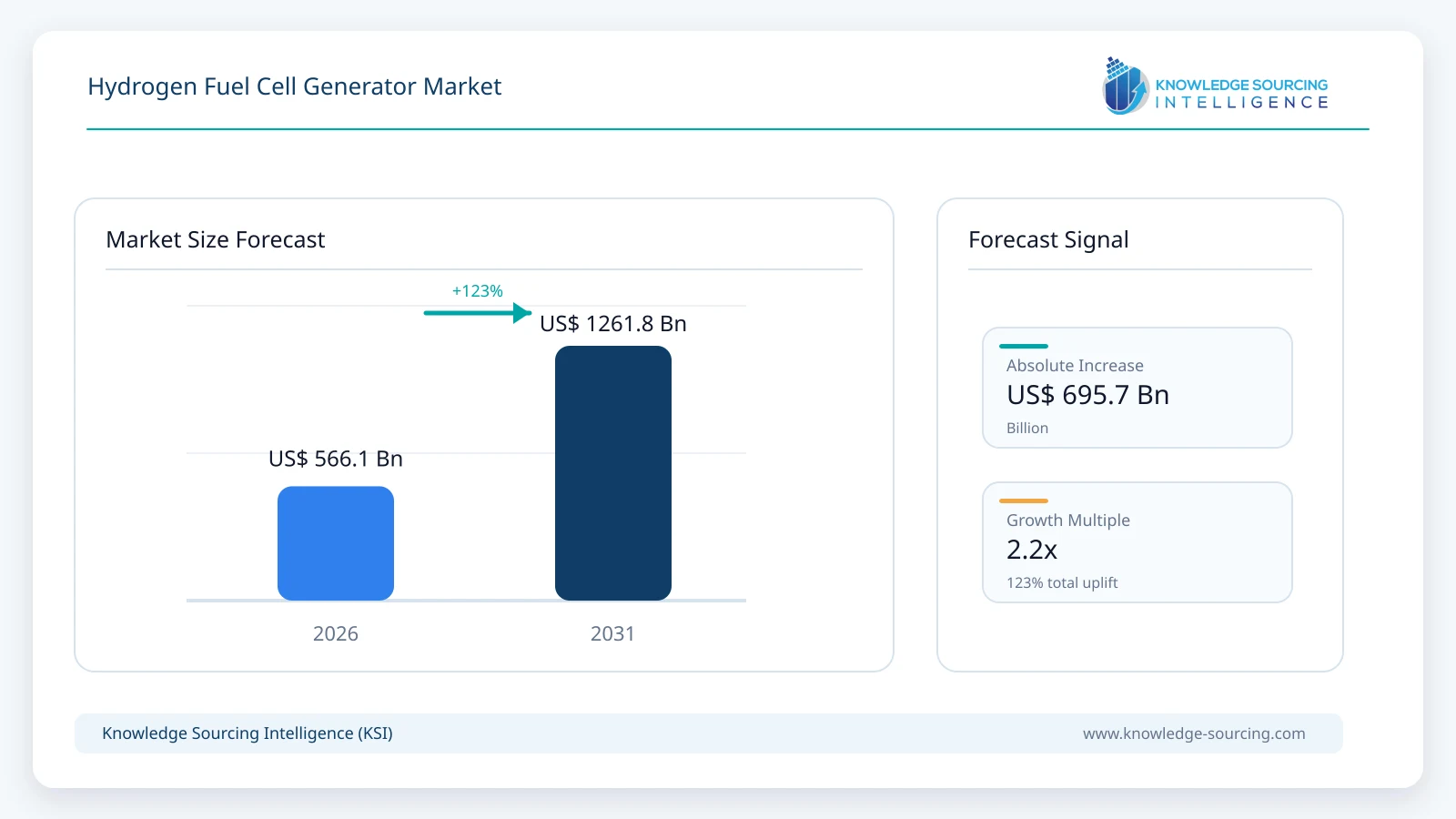
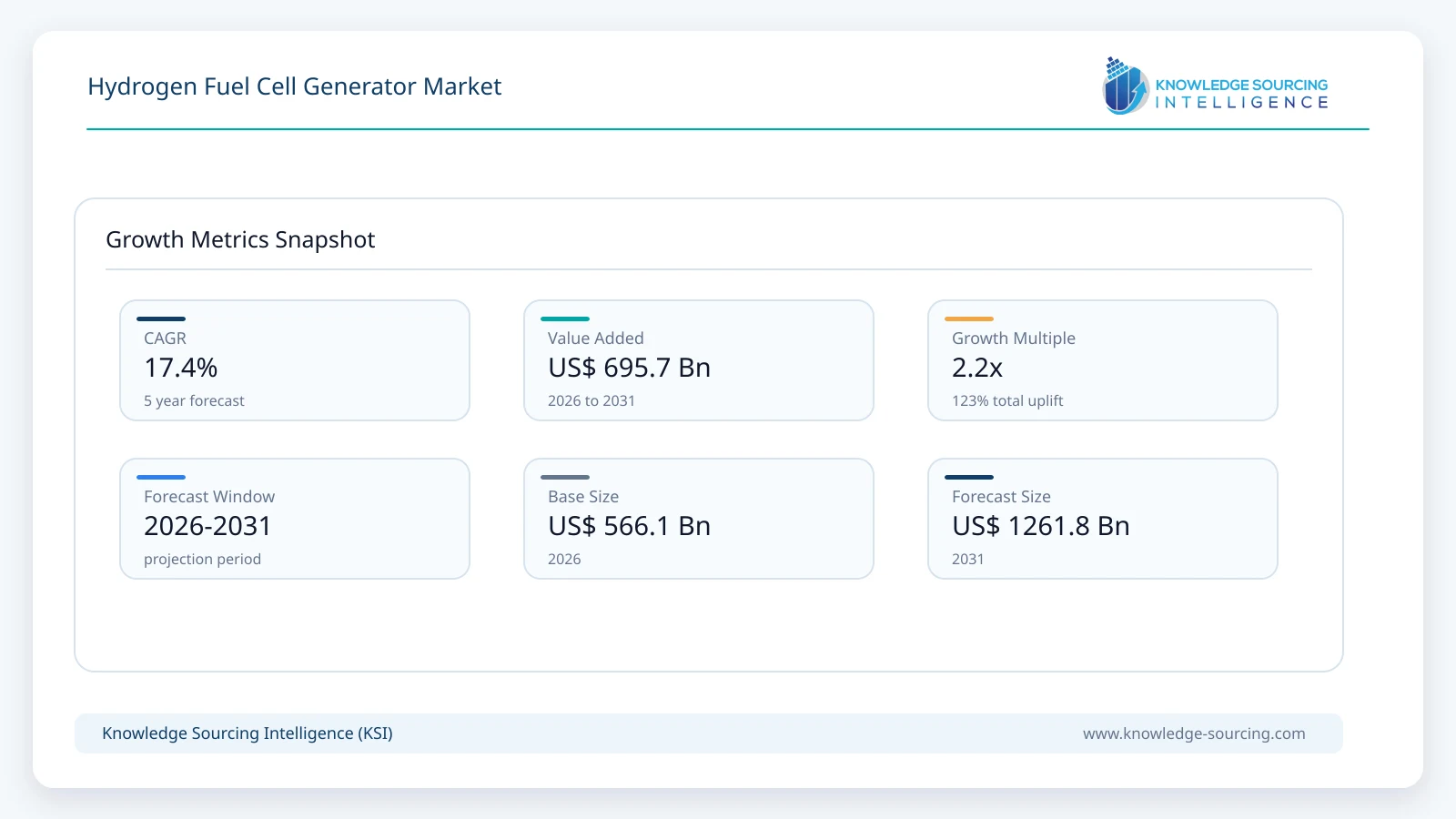
The Hydrogen Fuel Cell Generator Market is forecast to grow at a CAGR of 17.4%, reaching USD 1,261.80 million in 2031 from USD 566.10 million in 2026.
Highlights:
- 1New stationary systems are being installed and tested in backup, prime, distributed, microgrid, telecom, data-center, and critical-infrastructure applications.
- 2PEM systems are ideal for backup and load-following applications due to their fast-response nature.
- 3SOFC systems have attracted special interest for their continuous stationary power capabilities due to their operation at high temperatures and high electrical efficiency.
- 4Rising data-center electricity demand and the need to cut emissions from backup generators are making hydrogen fuel-cell–based backup systems gain traction.
The hydrogen fuel cell generator market is emerging as a mature alternative to the conventional engine-based generator systems for providing backup, prime, distributed, and temporary electricity generation. Fuel cell systems create electrochemically generated electricity instead of using combustion, which means they can operate with significantly lower local air pollutants and noise compared to combustion generators.
The PEM fuel-cell generators are particularly of interest for power applications that require very fast response and flexible operation. The GenSure product portfolio from Plug Power offers low-power and megawatt-scale hydrogen fuel-cell systems. The MW-scale platform is based on 125 kW ProGen modules in arrays and targets data centers, microgrids, and power-intensive facilities. Moreover, the market is converging with distributed energy, microgrids, renewable-energy storage, data-center backup power, EV charging, telecom infrastructure, and emergency power systems.
Market Dynamics
Market Drivers
Rising Need for Low-Emission Backup Power: Since conventional generators emit carbon dioxide, nitrogen oxides, particulate matter, and noise emissions, many organizations are seeking alternatives to diesel generators as backup electricity. Using pure hydrogen, hydrogen fuel-cell generators can generate electricity with no local carbon emissions, while reducing local NOx, SOx, and particulate emissions as well.
Growing Data-Center Power Requirements: The cloud, artificial intelligence, hyperscale data centers, and digital infrastructure are all on the rise, and with that is demand for reliable backup electricity. Traditional diesel backups are still the mainstay; however, data-centre operators are looking at cleaner technologies that can deliver reliable availability with little in terms of local pollutant emissions.
Increasing Renewable integration and other Grid-Resilience Applications: The intermittency of solar and wind fuels a need for dispatchable resources that can produce electricity in the event the output of renewables falters. Hydrogen is like a carrier of energy: renewable electricity is used to generate hydrogen, and the fuel cell reconverts the stored hydrogen back into electricity when needed.
Remote and Off-Grid Power Demand: Remote construction sites, mining extremities, telecommunications grids, emergency response, islands, and rural infrastructure often require dispatchable power in the absence of dependable grid electricity. Hydrogen fuel-cell generators can provide electricity without the local air pollution and noise from diesel-powered engines.
Increasing Need for Long-Duration Backup: While battery energy-storage systems are ideal for backup of short duration, long-duration applications are much more capacity-demanding. This means that fuel-cell generators can supply their uptime as long as hydrogen is accessible for conversion, so runtime can be improved through expanded hydrogen storage.
Market Restraints & Opportunities
High prices associated with hydrogen fuel-cell generators are the major restraint. Fuel-cell stacks involve specific materials, catalysts, membranes, bipolar plates, as well as power electronics and cooling systems, and hydrogen-management equipment.
The availability of hydrogen is another very significant limiting factor. A reliable hydrogen supply chain needs to include production, transportation, storage, and dispensing for deploying generators.
However, the market does provide ample opportunities around modular generator designs, mass-manufactured fuel-cell modules, integrated hydrogen storage solutions, renewable-hydrogen generation technologies such as the forthcoming availability of off-solar, hybrid energy-storage/TFCS solutions, and containerized power systems.
Data centers are an especially important market opportunity because fuel-cell generators could serve as either backup or prime power, and displace diesel systems.
Additionally, there is a high potential for mobile hydrogen-generator units which can be transported from construction sites to emergency needs, events with several power requirements as well as mines and temporary energy installations.
Key Developments
November 2025: Toyota Industries started selling an 8 kW hydrogen fuel-cell module intended for stationary/portable generators. According to the company, it all combined into a compact package, allowing the fuel-cell stack, air compressor, and hydrogen-circulation pump, along with related equipment, in an effort to reduce customer integration complexity.
March 2025: Ballard and Vertiv conducted system-level testing of the hydrogen-powered backup electricity solution for data centers powered by two H2 Power Modules integrated with two 200 kW Ballard FCwave modules.
Market Segmentation
The market is segmented by fuel cell type, generator type, application, end user, and geography.
By Fuel Cell Type: Proton Exchange Membrane Fuel Cells
Proton Exchange Membrane Fuel Cells (PEMFCs) predominate as the fuel-cell type for hydrogen generator applications that can offer fast response, small form-factor, and variable output.
PEM fuel cells use lower temperatures and have higher start-up times, as well as slower response to changes in power demand, than high-temperature fuel-cell technologies.
That makes them ideal fits for things like backup generators, telecom systems, mobile generators, microgrids, EV charging support, and data-center-upgrade replacement.
FCwave is a PEM-based platform offered in 200 kW modules that can be upscaled for megawatt-level applications from Ballard. Likewise, Plug Power leverages PEM technology in its GenSure stationary-power systems, from backup systems to MW-scale power generation applications.
Consequently, PEMFCs are firmly positioned in applications where fast startup and dynamic response are of greater importance than high-temperature heat utilization because of their compactness and modular scalability.
By Generator Type: Stationary Generator
Stationary generators account for the largest generator-type segment, as critical infrastructure needs guaranteed access to reliable power and organizations are seeking alternatives to diesel backup systems.
Hydrogen fuel-cell generators for stationary applications are configured as backup, prime, distributed, and microgrid power. Plug's GenSure MW-scale system serves data centers, microgrids, and other heavy-duty applications with parallel 125 kW ProGen modules to boost output and deliver redundancy.
Stationary systems are more accessible and increasingly being integrated with renewable generation, batteries, hydrogen storage, microgrids, as well as digital energy-management systems.
By Application: Transportation
Commercial applications are a significant segment of the market and offer strong growth potential as businesses look for secure backup and low-emission local power.
Fuel-cell generators can be used for backup or continuous power in commercial buildings such as data centers, retail and warehouse facilities, telecom networks, EV charging stations, and office campuses.
Data centers have become especially attractive because reliability in electricity is critical, and traditional diesel backup systems are under increasing scrutiny when it comes to emissions, noise, and permitting.
Doosan has a portfolio of fuel cells for buildings and data centres, with its stationary fuel-cell systems providing stable power generation and load-following operation. Likewise, Plug Power points to data centers, EV charging, microgrids, telecom infrastructure, and government facilities as other stationary-power applications.
At a commercial level, facilities can further use fuel cell generators alongside solar PV systems and batteries to create resilient microgrids.
Regional Analysis
North America Market Analysis
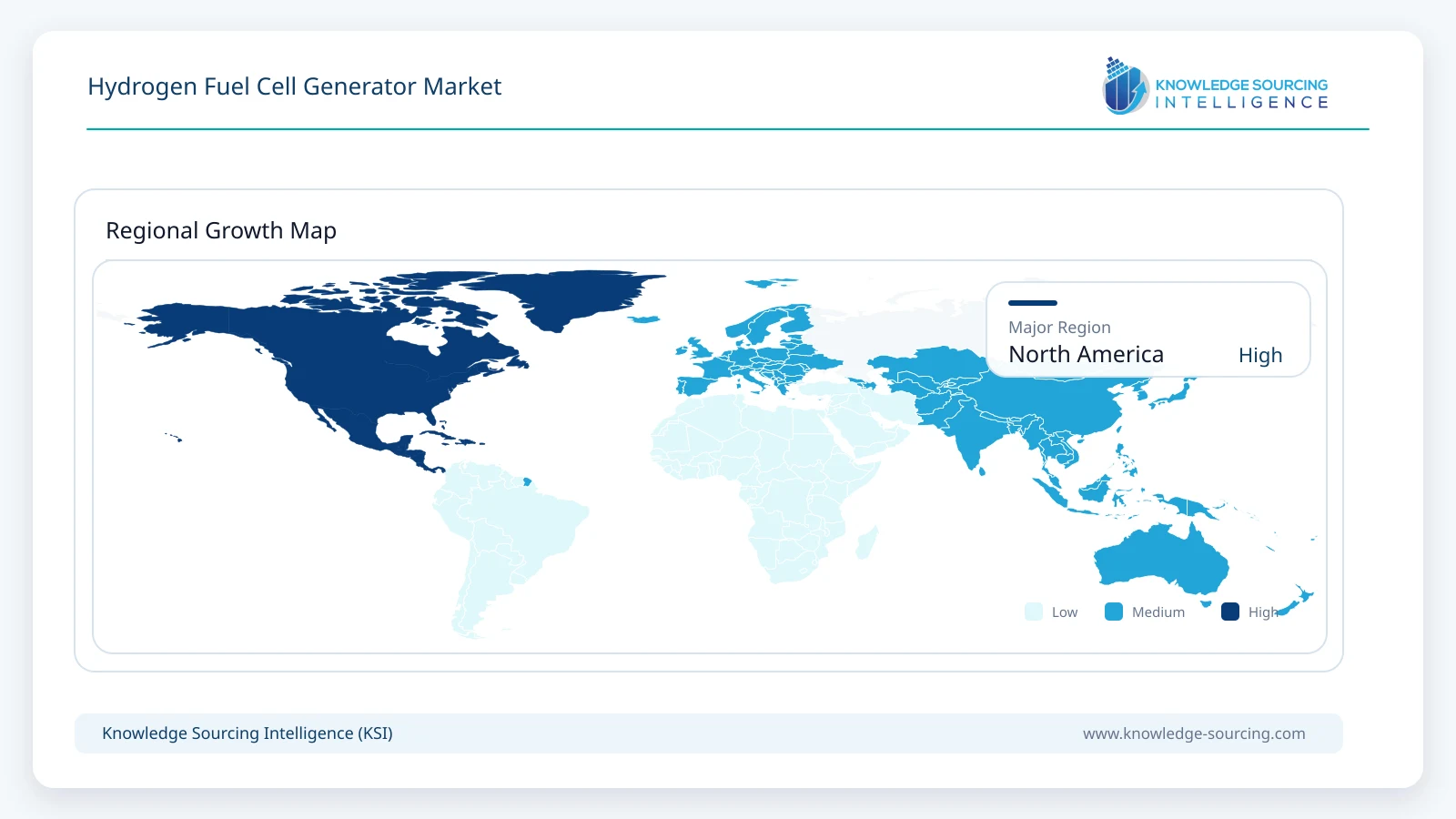
Increasing investment in hydrogen infrastructure, data centers, distributed generation, critical infrastructure, and clean-energy technologies makes North America one of the significant regional markets for hydrogen fuel-cell generators. The United States is the largest regional market, driven by ongoing hydrogen development trends and strong demand for resilient backup power.
South America Market Analysis
South America hydrogen fuel cell generator market is growing steadily as the region provides very large renewable-energy resources, and there is increasing interest in green hydrogen. Brazil is a large opportunity with its massive electricity system, industrial capacity, renewable energy generation, and hydrogen economy under development.
Europe Market Analysis
Europe is a mature market for hydrogen fuel-cell generation, due to declining carbon footprint policies, its hydrogen strategies, blossoming renewable-emission targets, and security targets with growing energy independence. Germany, France, the Netherlands, the UK, and Nordic countries are setting hydrogen infrastructure and distributed-energy acts.
Middle East and Africa Market Analysis
The Middle East & Africa (MEA) region is emerging as an early growth market, driven by significant renewable-hydrogen projects, favourable solar resources, industrial demand, and the need for power reliability in remote regions. Countries such as Saudi Arabia, the UAE and Oman are making significant investments in hydrogen production and infrastructure around it.
Asia Pacific Market Analysis
Asia Pacific is a key driver of the market, with the growing demand for hydrogen development and generation like Japan's hydrogen strategy, along with South Korea's fuel-cell power industry, China's abundance in hydrogen development, India's nascent hydrogen economy, and Australia's potential as a major renewable-hydrogen generator, also boosting the market. The stationary hydrogen fuel cells found in cities of Japan are one of the most technologically advanced and matured technology.
List of Companies
Toyota Motor Corporation
Ballard Power Systems
Plug Power Inc.
Cummins Inc.
Bloom Energy Corp.
Doosan Corporation
Toshiba Corporation
ZeroAvia Inc.
PowerCell Sweden AB
General Electric
Toyota Motor Corporation
Toyota Motor Corporation has specialized in developing fuel-cell technology for mobility-related applications. Toyota upgraded its hydrogen fuel-cell system developed for the Mirai and installed a 100-kW stationary generator at its Honsha Plant in Japan.
Ballard Power Systems
Ballard Power Systems is a large manufacturer of PEM fuel cells that can be used for stationary power, transportation, marine systems, as well as backup generation and peaking plants. The FCwave stationary platform is offered in 200 kW modules and can be scaled for MW-level power systems. It is a platform for decentralized generation, backup power, EV charging, and grid balancing applications.
Plug Power Inc.
Plug Power Inc. is among the most vertically integrated hydrogen and fuel-cell companies in the economy. Its GenSure portfolio includes low-power systems for telecom and critical infrastructure, as well as MW-scale generators for data-center and microgrid applications.
Analyst View
The Hydrogen Fuel Cell Generator Market is transitioning from niche demonstrations in the lab to modular commercial off-the-shelf power-generation systems particularly suited for data centers, telecom infrastructure, microgrids, remote sites and other industrial facilities as well as critical infrastructure for backup-power applications. PEM fuel cells are likely to be the dominant type of fuel cell due to rapid responsiveness and scalability. Stationary generators will dominate the generator type, driven by demand for durable backup and cleaner alternatives to diesel. Increasing commercialisation is shown by systems like Plug Power's GenSure, Ballard's FCwave, Toshiba's H2Rex, Doosan's hydrogen fuel-cell platforms, and PowerCell's modular generator systems. By geography, investment in critical-power and hydrogen infrastructure is narrowing for North America and Europe, while technology and manufacturing are augmented in Asia Pacific, particularly led by Japan for the highest level of penetration.
Hydrogen Fuel Cell Generator Market Scope:
| Report Metric | Details |
|---|---|
| Total Market Size in 2026 | USD 566.10 million |
| Total Market Size in 2031 | USD 1,261.80 million |
| Forecast Unit | USD Billion |
| Growth Rate | 17.4% |
| Study Period | 2021 to 2031 |
| Historical Data | 2021 to 2024 |
| Base Year | 2025 |
| Forecast Period | 2026 – 2031 |
| Segmentation | Fuel Cell Type, Generator Type, Application, End User, Geography |
| Companies |
|
Market Segmentation
By Fuel Cell Type
Proton Exchange Membrane Fuel Cells
Solid Oxide Fuel Cells
Alkaline Fuel Cells
Others
By Generator Type
Portable Generators
Stationary Generators
Others
By Application
Residential
Commercial
Industrial
By End User
Data Centers
Telecommunications
Utilities & Power Generation
Healthcare
Agriculture
Others
By Geography
North America
USA
Canada
Mexico
South America
Brazil
Argentina
Others
Europe
United Kingdom
Germany
France
Others
Middle East and Africa
Saudi Arabia
UAE
Others
Asia Pacific
China
Japan
India
South Korea
Others
Table of Contents
1. EXECUTIVE SUMMARY
2. MARKET SNAPSHOT
2.1. Market Overview
2.2. Market Definition
2.3. Scope of the Study
2.4. Market Segmentation
3. MARKET DYNAMIC
3.1. Market Drivers
3.2. Market Restraints
3.3. Market Opportunities
3.4. Porter’s Five Forces Analysis
3.5. Industry Value Chain Analysis
4. BUSINESS LANDSCAPE
4.1. Regulations & Standard Landscape
4.2. Generator Manufacturing Capacity, Project Pipeline & Deployment Landscape
4.3. Raw Material Landscape
4.4. Input–Output Analysis
4.5. Strategic Recommendations
5. TECHNOLOGICAL OUTLOOK
5.1. Fuel Cell Stack, Membrane Electrode Assembly & Catalyst Technologies
5.2. Hydrogen Storage, Supply & Fuel Processing Technologies
5.3. Power Electronics, Inverter & Energy Management Technologies
5.4. Hybridization, Modularization, Remote Monitoring & Intelligent Generator Technologies
6. HYDROGEN FUEL CELL GENERATOR MARKET BY FUEL CELL TYPE
6.1. Introduction
6.2. Proton Exchange Membrane Fuel Cells
6.3. Solid Oxide Fuel Cells
6.4. Alkaline Fuel Cells
6.5. Others
7. HYDROGEN FUEL CELL GENERATOR MARKET BY GENERATOR TYPE
7.1. Introduction
7.2. Portable Generators
7.3. Stationary Generators
7.4. Others
8. HYDROGEN FUEL CELL GENERATOR MARKET BY APPLICATION
8.1. Introduction
8.2. Residential
8.3. Commercial
8.5. Industrial
9. HYDROGEN FUEL CELL GENERATOR MARKET BY END USER
9.1. Introduction
9.2. Data Centers
9.3. Telecommunications
9.4. Utilities & Power Generation
9.5. Healthcare
9.6. Agriculture
9.7. Others
10. HYDROGEN FUEL CELL GENERATOR MARKET BY GEOGRAPHY
10.1. Introduction
10.2. North America
10.2.1. USA
10.2.2. Canada
10.2.3. Mexico
10.3. South America
10.3.1. Brazil
10.3.2. Argentina
10.3.3. Others
10.4. Europe
10.4.1. United Kingdom
10.4.2. Germany
10.4.3. France
10.4.4. Others
10.5. Middle East and Africa
10.5.1. Saudi Arabia
10.5.2. UAE
10.5.3. Others
10.6. Asia Pacific
10.6.1. China
10.6.2. Japan
10.6.3. India
10.6.4. South Korea
10.6.5. Others
11. COMPETITIVE ENVIRONMENT AND ANALYSIS
11.1. Major Players and Strategy Analysis
11.2. Market Share Analysis
11.3. Mergers, Acquisitions, Agreements, and Collaborations
11.4. Competitive Dashboard
12. COMPANY PROFILES
12.1. Toyota Motor Corporation
12.2. Ballard Power Systems
12.3. Plug Power Inc.
12.4. Cummins Inc.
12.5. Bloom Energy Corp
12.6. Doosan Corporation
12.7. Toshiba Corporation
12.8 ZeroAvia Inc.
12.9. PowerCell Sweden AB
12.10. General Electric
13. APPENDIX
13.1. Currency
13.2. Assumptions
13.3. Base and Forecast Years Timeline
13.4. Key benefits for the stakeholders
13.5. Research Methodology
13.6. Abbreviations
Navigate
Trusted by the world's leading organizations











