
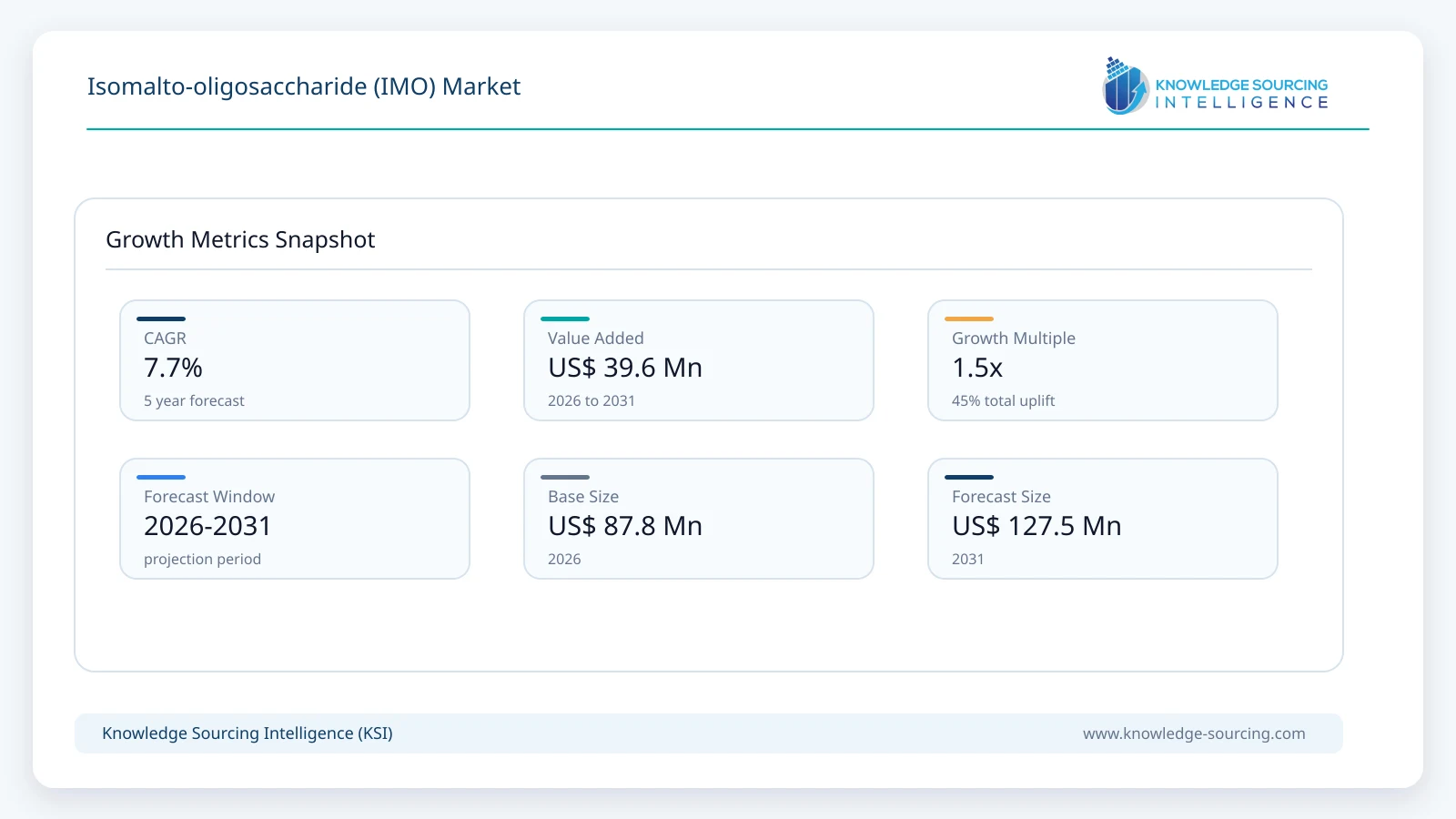
The Isomalto-oligosaccharide (IMO) Market is forecast to grow at a CAGR of 7.73%, reaching USD 127.49 million by 2031 from USD 87.85 million in 2026.
Highlights:
- 1Growing consumer demand for digestive health products and reduced-sugar foods continues to strengthen commercial demand for IMO-based functional ingredients.
- 2Food & Beverages remains the largest application segment due to extensive product reformulation across bakery, dairy, confectionery, beverages, and nutrition products.
- 3Asia Pacific represents the principal manufacturing base, supported by integrated starch processing capacity, large-scale fermentation infrastructure, and established export networks.
- 4Advances in enzyme processing technology are improving conversion efficiency, product purity, and consistency while reducing manufacturing costs.
- 5Regulatory emphasis on nutrition labeling, dietary fiber intake, and sugar reduction policies is encouraging greater incorporation of prebiotic ingredients into packaged foods.
- 6Competition increasingly centers on production efficiency, quality certification, application support, supply reliability, and customized ingredient formulations rather than price alone.
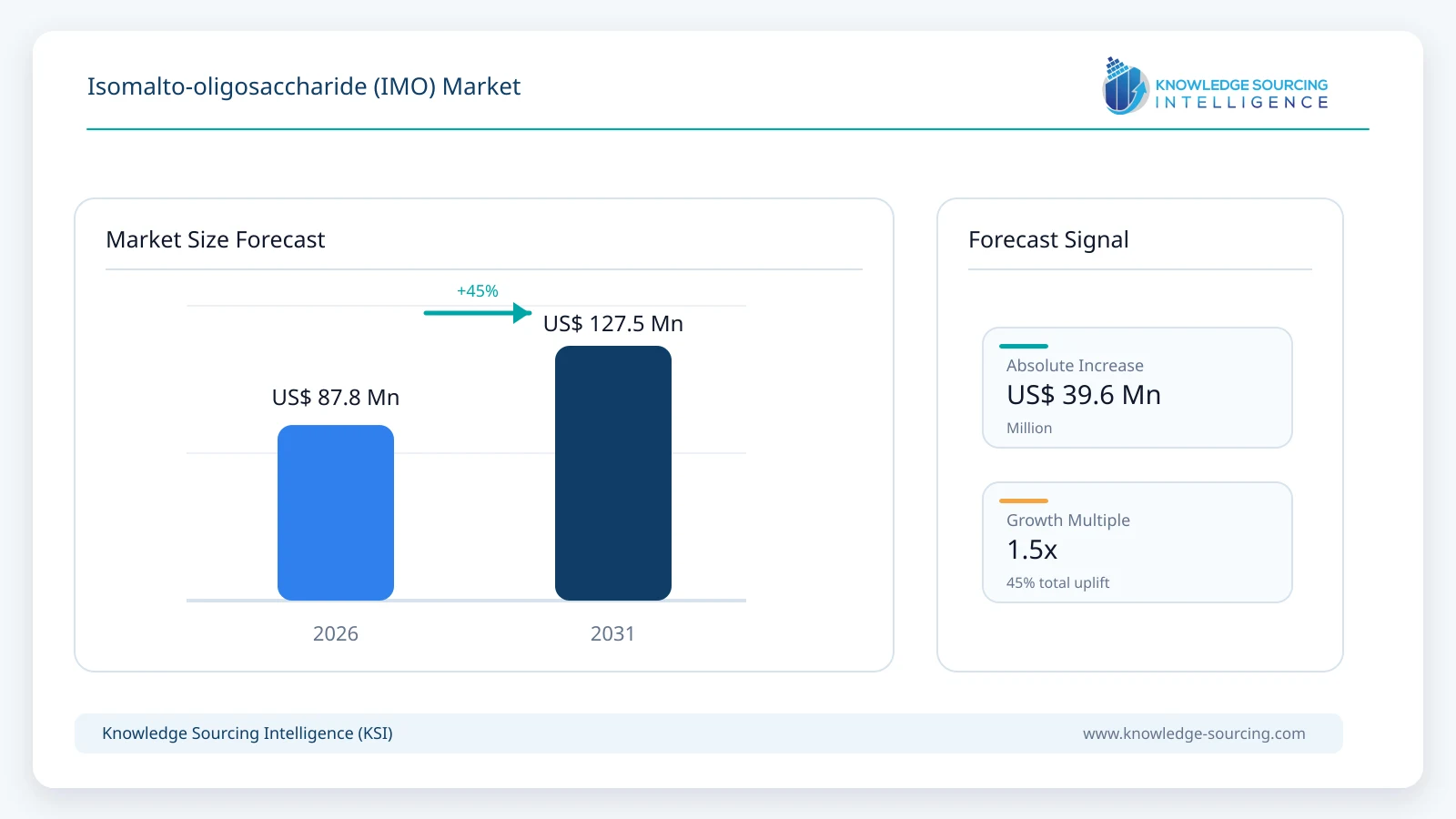
The Isomalto-oligosaccharide (IMO) market serves a specialized position within the functional carbohydrate and prebiotic ingredients industry, supplying low-calorie sweetening and dietary fiber solutions for food manufacturers, nutraceutical producers, and pharmaceutical formulators. Isomalto-oligosaccharide (IMO) is produced through the enzymatic conversion of starch into short-chain carbohydrates containing alpha-1,6 glycosidic linkages, allowing selective fermentation by beneficial intestinal microorganisms. Unlike conventional sweeteners that primarily contribute sweetness, IMO combines technological functionality with digestive health benefits, making it attractive for manufacturers developing products with nutritional claims and reduced sugar formulations.
Commercial demand for IMO is closely linked to changing consumer purchasing behavior. Food and beverage companies are reformulating products to reduce added sugars while maintaining texture, sweetness, and shelf stability. At the same time, consumers are seeking products that support digestive wellness without sacrificing taste. This convergence has positioned IMO as a multifunctional ingredient suitable for bakery products, confectionery, dairy alternatives, beverages, nutrition bars, infant nutrition, and specialized dietary products.
Buyer priorities differ across end-use industries but generally emphasize ingredient consistency, regulatory compliance, digestive tolerance, sweetness profile, moisture retention, and formulation compatibility. Large multinational food manufacturers typically require suppliers capable of providing standardized specifications, documented quality management systems, and reliable global logistics. Smaller functional food brands often prioritize clean-label positioning, technical formulation support, and flexibility in procurement volumes.
The industry's supply chain begins with starch-based raw materials, including corn, tapioca, wheat, and other carbohydrate feedstocks, followed by enzymatic processing, purification, concentration, and drying. Production economics are influenced by feedstock availability, enzyme efficiency, energy costs, and downstream purification technologies. Manufacturers that operate integrated starch processing facilities generally benefit from greater cost control and supply stability than independent ingredient processors.
Demand patterns also reflect broader nutrition trends supported by scientific research on dietary fiber consumption and gut microbiota. Health professionals and nutrition organizations continue to recommend increased dietary fiber intake, encouraging manufacturers to incorporate prebiotic ingredients into mainstream food categories rather than limiting their use to specialty health products. As a result, procurement decisions increasingly consider clinical evidence, labeling eligibility, and compatibility with regional food regulations alongside pricing considerations.
Commercial adoption remains strongest where food manufacturers actively invest in sugar reduction strategies and functional ingredient innovation. Procurement contracts increasingly include requirements for traceability, food safety certification, allergen management, and sustainability documentation. Consequently, competition extends beyond ingredient pricing toward technical support, formulation expertise, production reliability, and regulatory documentation.
Market Drivers
Rising demand for digestive health and prebiotic nutrition
Scientific understanding of gut microbiota has expanded the commercial relevance of prebiotic ingredients across multiple food categories. Consumers increasingly associate digestive wellness with broader health outcomes, including immune function and metabolic health, encouraging food manufacturers to incorporate functional carbohydrates into everyday products.
Food manufacturers respond by expanding portfolios that contain dietary fiber claims, digestive health positioning, and reduced sugar formulations. Procurement teams increasingly evaluate IMO suppliers based on ingredient purity, documented scientific evidence, formulation stability, and regulatory acceptance. This shift supports long-term purchasing relationships between ingredient suppliers and multinational food companies while expanding opportunities within private-label manufacturing.
Sugar reduction initiatives are accelerating ingredient substitution
Government nutrition policies and consumer awareness regarding excessive sugar intake have encouraged manufacturers to reformulate products without compromising taste or product quality. Isomalto-oligosaccharide (IMO) contributes moderate sweetness while simultaneously functioning as a dietary fiber ingredient, allowing formulators to address multiple product objectives using a single ingredient.
Commercial demand is particularly evident in cereal products, nutrition bars, confectionery, dairy alternatives, beverages, and baked goods where moisture retention and texture are equally important purchasing criteria. Manufacturers therefore view IMO not simply as a sweetener substitute but as a multifunctional formulation ingredient capable of supporting product differentiation and nutritional positioning.
Expansion of functional food and nutraceutical manufacturing
The functional nutrition industry continues to diversify into sports nutrition, healthy aging, children's nutrition, meal replacements, and personalized wellness products. These product categories require ingredients with documented physiological benefits, manufacturing consistency, and compatibility with multiple processing conditions.
Ingredient buyers increasingly favor suppliers capable of delivering application-specific IMO grades tailored for powders, syrups, tablets, capsules, gummies, and nutritional beverages. This trend encourages manufacturers to expand technical support capabilities alongside production capacity, strengthening customer retention and increasing value-added sales.
Improved manufacturing technologies support commercial competitiveness
Continuous improvements in enzymatic conversion processes, purification technologies, and drying systems have enhanced production yields while improving product consistency. Higher conversion efficiency reduces raw material consumption and operating costs, allowing manufacturers to remain competitive despite fluctuations in agricultural commodity prices.
Technology investments also improve batch consistency, reduce impurities, and enable production of customized IMO specifications for specialized applications. These capabilities strengthen supplier positioning among multinational food manufacturers that maintain stringent quality requirements and global procurement standards.
Market Restraints and Challenges
Scientific interpretation of prebiotic claims varies across jurisdictions
Although numerous studies support the digestive benefits of prebiotic carbohydrates, regulatory authorities apply different standards when evaluating health claims. This variation creates uncertainty for manufacturers seeking consistent product positioning across international markets.
Food companies often adapt labeling strategies to comply with regional regulations, increasing product development costs and extending commercialization timelines. Suppliers therefore invest heavily in scientific documentation, regulatory expertise, and application support to facilitate market access for customers operating across multiple jurisdictions.
Competition from alternative functional fibers
Isomalto-oligosaccharide (IMO) competes with a broad portfolio of functional carbohydrate ingredients including inulin, fructooligosaccharides (FOS), galactooligosaccharides (GOS), resistant dextrins, soluble corn fiber, and resistant starches. Procurement decisions frequently depend on formulation objectives, ingredient pricing, digestive tolerance, sweetness contribution, and approved labeling claims.
This competitive environment places pressure on pricing while encouraging continuous product differentiation through improved functionality, technical support, and customized ingredient development rather than commodity-based competition.
Agricultural feedstock price volatility
Commercial production depends primarily on starch-derived raw materials whose pricing is influenced by crop yields, weather conditions, international trade policies, transportation expenses, and energy markets. Feedstock cost fluctuations directly affect manufacturing margins, particularly for producers operating without vertically integrated starch processing facilities.
Manufacturers mitigate this exposure through diversified sourcing strategies, long-term procurement contracts, inventory management, and operational efficiency improvements. Nevertheless, sustained raw material inflation can influence contract pricing and purchasing decisions throughout the value chain.
Consumer awareness remains uneven across developing markets
Although digestive health has become an established purchasing consideration in mature economies, consumer understanding of prebiotic ingredients remains limited in several emerging markets. Many consumers recognize probiotic products more readily than prebiotic carbohydrates, reducing immediate demand for IMO-containing products.
Food manufacturers address this challenge through educational marketing, simplified nutritional messaging, collaboration with healthcare professionals, and product innovation that integrates functional ingredients into familiar food formats rather than niche wellness products.
Major Segment Analysis
The Food & Beverages segment represents the most commercially important application within the Isomalto-oligosaccharide (IMO) market because it combines high production volumes with continuous product innovation. Manufacturers increasingly incorporate IMO into bakery products, confectionery, dairy products, beverages, breakfast cereals, nutrition bars, and meal replacement formulations to satisfy consumer demand for healthier packaged foods.
Purchasing decisions within this segment extend beyond ingredient cost. Food manufacturers evaluate moisture retention, sweetness intensity, processing stability, solubility, viscosity, shelf-life performance, and compatibility with existing manufacturing processes. These technical requirements make formulation expertise a critical competitive advantage for ingredient suppliers.
Product reformulation initiatives are also expanding the addressable market. As manufacturers reduce added sugar and increase dietary fiber content, multifunctional ingredients capable of delivering several formulation benefits become commercially attractive. Isomalto-oligosaccharide (IMO) contributes sweetness, bulking properties, texture enhancement, and prebiotic functionality within a single ingredient system, reducing formulation complexity for product developers.
Competition within the Food & Beverages segment therefore centers on consistent product quality, application-specific technical support, regulatory compliance, and supply reliability. Suppliers capable of offering customized powder and syrup grades, supported by comprehensive food safety certifications and stable global supply chains, are better positioned to secure long-term commercial agreements with multinational food manufacturers. As consumer demand continues to favor products combining nutritional value with sensory appeal, this segment is expected to remain the primary revenue contributor to the Isomalto-oligosaccharide (IMO) market over the forecast period.
Regional Analysis
North America
North America represents a mature demand center for isomalto-oligosaccharides, supported by well-established functional food, dietary supplement, and sports nutrition industries. Food manufacturers in the United States and Canada continue to reformulate products in response to consumer demand for reduced sugar, higher fiber, and digestive wellness claims. Buyers typically require ingredients with documented regulatory compliance, consistent quality specifications, and traceable supply chains, making supplier credibility an important procurement criterion.
The region also benefits from a strong research ecosystem involving universities, ingredient manufacturers, and nutrition scientists studying gut microbiota and dietary fiber. This scientific foundation supports product innovation and encourages broader commercial use of prebiotic ingredients. However, suppliers must navigate evolving labeling requirements and ensure that health-related marketing claims remain consistent with applicable regulatory standards.
Europe
European demand is shaped by stringent food safety regulations, growing consumer preference for clean-label products, and public health initiatives encouraging lower sugar consumption. Manufacturers across bakery, dairy, confectionery, and infant nutrition categories increasingly evaluate multifunctional ingredients that can improve nutritional profiles while maintaining product quality.
Procurement decisions in Europe often emphasize sustainability, documented quality management systems, allergen control, and transparent sourcing. Buyers also place considerable importance on supplier technical support during formulation and product reformulation projects. Although regulatory compliance increases product development costs, it also creates higher entry barriers that favor established ingredient manufacturers capable of meeting demanding quality expectations.
Asia Pacific
Asia Pacific is the largest production and consumption region for Isomalto-oligosaccharide (IMO) due to its extensive starch-processing industry, competitive manufacturing costs, and expanding functional food sector. China remains the leading manufacturing base, supported by integrated carbohydrate processing infrastructure and strong export capabilities. Japan and South Korea continue to contribute through technological innovation and advanced functional food development, while India and Southeast Asian countries are witnessing rising demand as urbanization and disposable incomes support increased consumption of packaged nutrition products.
Food manufacturers across the region are investing in healthier product portfolios as consumers become more attentive to digestive health and sugar intake. The availability of agricultural feedstocks, experienced enzyme-processing capabilities, and established ingredient manufacturing clusters strengthens regional competitiveness. Export-oriented production also allows Asian manufacturers to serve customers across North America, Europe, Latin America, and the Middle East.
Middle East & Africa and South America
South America and the Middle East & Africa remain emerging markets with growing commercial opportunities. Expansion of modern food retail, increasing health awareness, and gradual adoption of functional foods are creating new demand for prebiotic ingredients. Brazil represents the largest opportunity in South America due to its sizeable food processing industry and growing investment in healthier packaged foods.
In the Middle East, premium nutrition products, dietary supplements, and functional beverages are gaining traction among urban consumers. Nevertheless, adoption across both regions is influenced by purchasing power, limited consumer awareness of prebiotics, and dependence on imported specialty ingredients. Suppliers seeking expansion in these markets often collaborate with regional distributors and food manufacturers to strengthen market access while providing formulation support and technical education.
Competitive Landscape
The Isomalto-oligosaccharide (IMO) market is moderately consolidated, with competition centered on production capability, product quality, regulatory compliance, and application expertise rather than purely on manufacturing scale. Established producers compete by supplying standardized and customized IMO formulations that meet the technical requirements of food, nutraceutical, and pharmaceutical manufacturers operating across multiple regions.
Companies including Baolingbao Biology Co., Ltd., Shandong Bailong Chuangyuan Bio-Tech Co., Ltd., Nihon Shokuhin Kako Co., Ltd., BioNeutra North America, Inc., Van Wankum Ingredients, Shandong Shine Health Co., Ltd., Guangzhou Hisoya Biological Science & Technology Co., Ltd., Anhui Elite Industrial Co., Ltd., COFCO Rongshi Biotechnology Co., Ltd., Jiangxi E&C Sugar Alcohol Co., Ltd., Longlive Biotechnology Co., Ltd., and Zhucheng Dongxiao Biotechnology Co., Ltd. compete through investments in enzymatic processing efficiency, product purity, food safety certification, and international distribution networks.
Product differentiation increasingly focuses on application-specific performance. Suppliers develop powder and syrup grades with varying sweetness profiles, fiber content, viscosity characteristics, and processing stability to address diverse formulation requirements across bakery, confectionery, beverages, dairy products, nutritional supplements, and pharmaceutical preparations.
Strategic partnerships with food manufacturers, ingredient distributors, and formulation specialists enable suppliers to expand commercial reach while supporting customer product development. Geographic expansion remains an important competitive strategy as producers strengthen export capabilities and establish regional distribution networks to improve delivery reliability and customer service.
Investment priorities increasingly include manufacturing automation, quality assurance systems, enzyme optimization, sustainability initiatives, and supply chain resilience. These investments enhance production efficiency while supporting long-term customer relationships with multinational food manufacturers seeking dependable ingredient partners.
Recent Developments
June 2026: CSIR–Central Food Technological Research Institute (CFTRI), India updated the commercialization status of its enzymatic Process for Production of Isomalto-Oligosaccharides using Triglucosylating ?-glucosidase, confirming the technology is licensed and awaiting commercialization for food and nutraceutical ingredient production.
April 2026: Bailong Chuangyuan announced it would showcase its Isomalto-oligosaccharide (IMO) prebiotic ingredient portfolio for human and pet nutrition at the Human & Pet Nutrition Technology Linkage Conference in Shanghai, highlighting expanded application opportunities in functional pet food and nutritional supplements.
Regulatory and Policy Environment
The regulatory framework governing IMO varies by jurisdiction but consistently emphasizes food safety, ingredient quality, labeling accuracy, and substantiation of nutrition or health claims. Manufacturers supplying international markets must comply with applicable food safety legislation while maintaining documented quality management systems and product traceability.
Food safety authorities require manufacturers to implement comprehensive hazard analysis and preventive control systems throughout production. Compliance with internationally recognized food safety standards has become a commercial necessity, particularly for suppliers serving multinational food manufacturers with extensive supplier qualification programs.
Nutrition labeling regulations also influence commercial adoption. Many jurisdictions encourage higher dietary fiber intake through public health guidance, supporting the incorporation of functional carbohydrate ingredients into mainstream food products. However, the eligibility of IMO for dietary fiber declaration and health-related claims may differ depending on national regulatory definitions and scientific assessment procedures. Consequently, suppliers invest in analytical validation and scientific documentation to support customer labeling requirements.
Government initiatives addressing obesity, diabetes prevention, and excessive sugar consumption indirectly support the adoption of alternative functional ingredients. Food manufacturers responding to reformulation targets increasingly evaluate ingredients capable of reducing added sugars while maintaining product functionality. At the same time, environmental regulations concerning manufacturing emissions, wastewater treatment, and resource efficiency encourage producers to adopt cleaner production technologies and optimize energy consumption throughout starch processing operations.
Outlook and Strategic Implications
The commercial outlook for the Isomalto-oligosaccharide (IMO) market will be shaped by continued expansion of functional nutrition, sustained product reformulation efforts, and growing consumer preference for ingredients that provide multiple nutritional and technological benefits. Manufacturers are expected to prioritize investments that improve production efficiency, strengthen scientific validation, and expand application-specific product portfolios.
Procurement strategies among food manufacturers are likely to emphasize long-term supplier partnerships capable of ensuring supply continuity, regulatory compliance, and technical formulation support. Buyers increasingly evaluate suppliers using broader criteria that include sustainability practices, traceability, quality certifications, and responsiveness to evolving formulation requirements rather than considering ingredient price alone.
Technology development will continue to focus on enzyme optimization, process automation, improved purification techniques, and enhanced product consistency. These advances can reduce manufacturing costs while enabling production of specialized IMO grades designed for emerging applications in personalized nutrition, medical nutrition, and premium functional foods.
Competition is expected to evolve toward solution-oriented business models that combine ingredient supply with formulation expertise, regulatory assistance, and collaborative product development. Suppliers capable of integrating these capabilities with efficient global logistics and consistent manufacturing quality are likely to strengthen customer retention and expand international market presence.
Despite positive long-term fundamentals, the industry remains exposed to agricultural feedstock price fluctuations, evolving regulatory interpretations of nutrition claims, and competition from alternative prebiotic fibers. Companies that diversify raw material sourcing, invest in research, strengthen regulatory capabilities, and maintain close collaboration with downstream manufacturers will be better positioned to capitalize on expanding opportunities across food, nutraceutical, and pharmaceutical applications during the forecast period.
Isomalto-oligosaccharide (IMO) Market
Market Segmentation
By Form
By Application
By Geography
Table of Contents
1. EXECUTIVE SUMMARY
2. MARKET SNAPSHOT
2.1. Market Overview
2.2. Market Definition
2.3. Scope of the Study
2.4. Market Segmentation
3. BUSINESS LANDSCAPE
3.1. Market Drivers
3.2. Market Restraints
3.3. Market Opportunities
3.4. Porter’s Five Forces Analysis
3.5. Industry Value Chain Analysis
3.6. Policies and Regulations
3.7. Strategic Recommendations
4. TECHNOLOGICAL OUTLOOK
5. ISOMALTO-OLIGOSACCHARIDE (IMO) MARKET BY FORM
5.1. Introduction
5.2. Powder
5.3. Liquid (Syrup)
6. ISOMALTO-OLIGOSACCHARIDE (IMO) MARKET BY APPLICATION
6.1. Introduction
6.2. Food & Beverages
6.3. Dietary Supplements & Nutraceuticals
6.4. Pharmaceuticals
6.5. Others
7. ISOMALTO-OLIGOSACCHARIDE (IMO) MARKET BY GEOGRAPHY
7.1. Introduction
7.2. North America
7.2.1. United States
7.2.2. Canada
7.2.3. Mexico
7.3. South America
7.3.1. Brazil
7.3.2. Argentina
7.3.3. Others
7.4. Europe
7.4.1. Germany
7.4.2. France
7.4.3. United Kingdom
7.4.4. Spain
7.4.5. Others
7.5. Middle East and Africa
7.5.1. Saudi Arabia
7.5.2. United Arab Emirates
7.5.3. Israel
7.5.4. Others
7.6. Asia Pacific
7.6.1. China
7.6.2. India
7.6.3. Japan
7.6.4. South Korea
7.6.5. Indonesia
7.6.6. Thailand
7.6.7. Others
8. COMPETITIVE ENVIRONMENT AND ANALYSIS
8.1. Major Players and Strategy Analysis
8.2. Market Share Analysis
8.3. Mergers, Acquisitions, Agreements, and Collaborations
8.4. Competitive Dashboard
9. COMPANY PROFILES
9.1. Baolingbao Biology Co., Ltd.
9.2. Shandong Bailong Chuangyuan Bio-Tech Co., Ltd.
9.3. Nihon Shokuhin Kako Co., Ltd.
9.4. BioNeutra North America, Inc.
9.5. Van Wankum Ingredients
9.6. Shandong Shine Health Co., Ltd.
9.7. Guangzhou Hisoya Biological Science & Technology Co., Ltd.
9.8. Anhui Elite Industrial Co., Ltd.
9.9. COFCO Rongshi Biotechnology Co., Ltd.
9.10. Jiangxi E&C Sugar Alcohol Co., Ltd.
9.11. Longlive Biotechnology Co., Ltd.
9.12. Zhucheng Dongxiao Biotechnology Co., Ltd.
10. APPENDIX
10.1. Currency
10.2. Assumptions
10.3. Base and Forecast Years Timeline
10.4. Key Benefits for Stakeholders
10.5. Research Methodology
10.6. Abbreviations
LIST OF FIGURES
LIST OF TABLES
Navigate
Trusted by the world's leading organizations











