
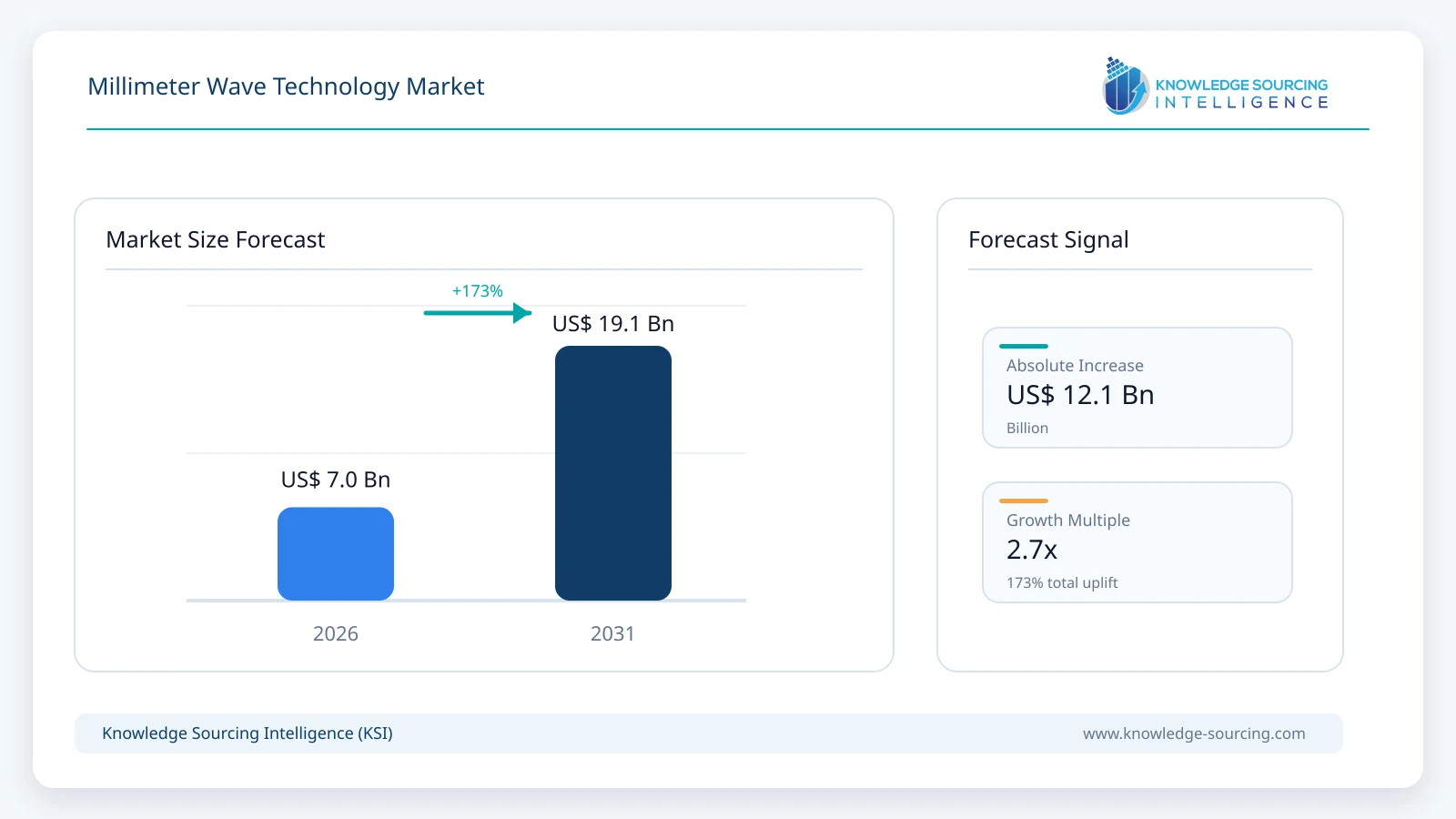
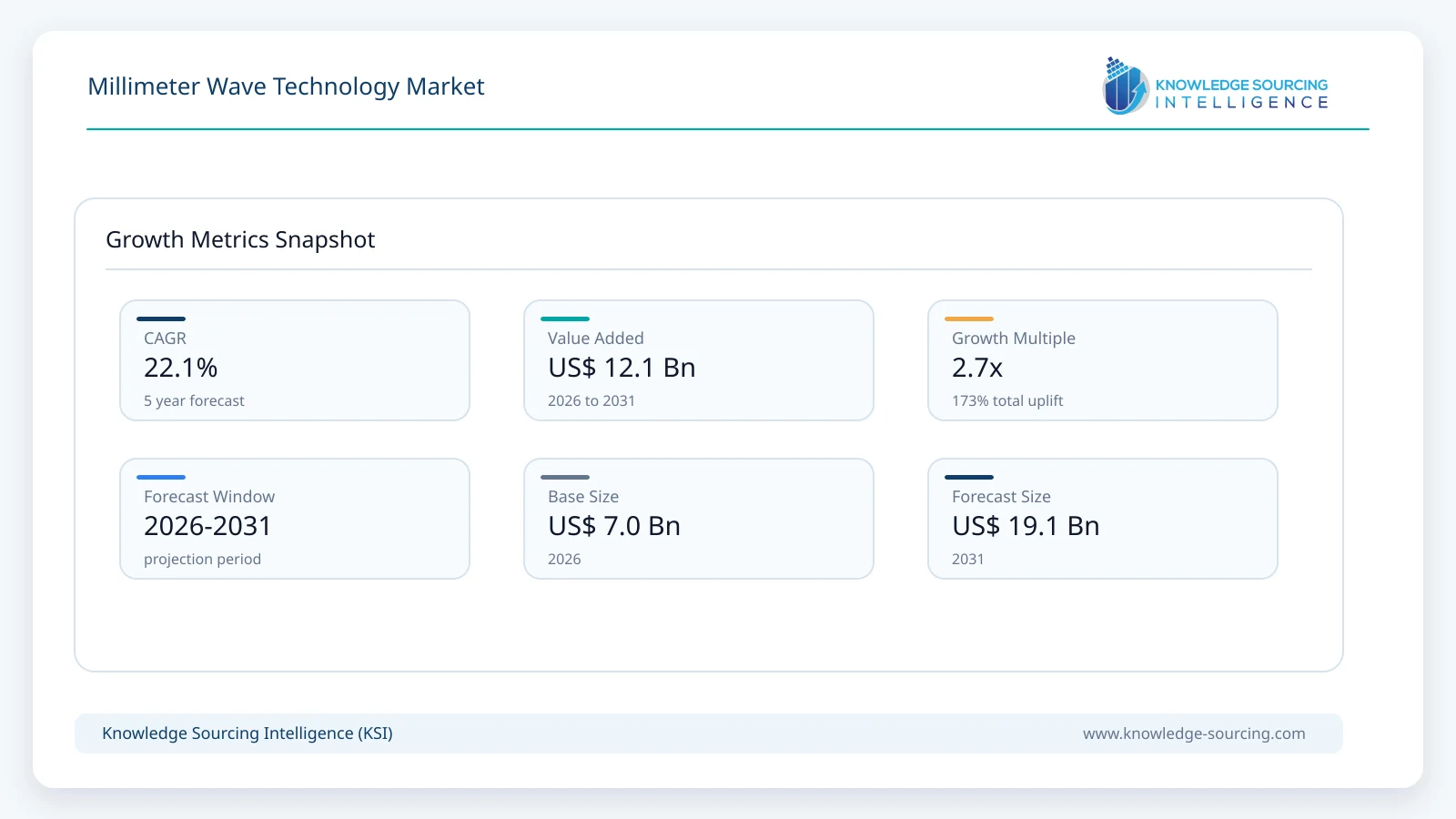
The Millimeter Wave Technology Market is forecast to grow at a CAGR of 22.1%, reaching USD 19.1 billion in 2031 from USD 7.0 billion in 2026.
Highlights:
- 1Asia-Pacific is the biggest regional share of the millimeter wave technology market, accounting majority of the region's revenue in 2025, and is anticipated to see the fastest regional growth rate, through 2031.
- 2The automotive industry is expected to experience the fastest application-level growth, as more high-resolution imaging radar is needed in automotive advanced driver-assistance (ADAS) and autonomous-driving applications.
- 3The near-term revenue opportunity lies in the 57-95 GHz frequency band, which has the best combination of propagation performance, bandwidth and short-range, high capacity wireless backhaul applications.
- 4With field trials conducted in China, the United States and India proving mmWave wireless backhaul's multi-gigabit throughput, it has become a more cost-effective and faster alternative to fiber trenching for dense urban deployments.
The 57-95 GHz frequency band has been recognized as the most promising near-term revenue opportunity due to its ability to accommodate a significant amount of bandwidth, coupled with favorable propagation characteristics for backhaul and short-range high-capacity applications, and lower mmWave bands are still being steadily deployed in licensed 5G access networks.
By product, telecoms equipment remains a significant portion of market revenues, as operators invest in mmWave-based access networks and wireless backhaul solutions, especially in dense urban markets where the cost of deploying fiber and the time required for permits make wireless solutions more feasible. The market is split by component, with antennas and transceivers making up a major portion of the market, with each mmWave deployment, such as in telecommunications infrastructure, automotive radar or imaging equipment, requiring special high-frequency antenna and transceiver hardware.
In application, automotive ADAS and V2X communication is expected to see the highest growth rate, due to the need for the high-resolution imaging radar used in advanced collision-avoidance and autonomous-driving features. Other application categories, such as healthcare imaging and security screening, are also growing steadily, with mmWave's capacity to penetrate clothing and other materials being used non-invasively for imaging, and wireless backhaul for high-density small-cell 5G networks is one of the largest and oldest application categories in terms of current revenue.
Market Dynamics
Market Drivers
The robust spectrum-liberalization programmes in the 26 GHz, 28 GHz and 39 GHz bands have broken millimetre wave technology out of the pilot phase and into city-wide commercial deployments, providing peak downlink capacity in excess of 6 Gbps in limited commercial areas and boosting the confidence of operators in larger-scale deployment.
The technologies' ability to deliver a wide bandwidth remains outmatched by the fast-rising demand for high-bandwidth applications, such as cloud gaming, AR/VR devices and dense urban 5G small-cell networks, which is fueling ongoing investment in mmWave infrastructure.
As ADAS and V2X are gaining traction in the automotive sector, so is the demand for imaging radar with mmWave technology, with automakers seeking to advance driving automation to a new level that calls for mmWave technology's high-resolution object detection.
Market Restraints & Opportunities
Limits inherent in physical propagation mechanisms of millimeter wave signals, such as low penetration power through walls and other obstacles, and atmospheric attenuation still limit deployment range and force deployment of more network infrastructure than lower-frequency solutions.
However, ongoing progress in beamforming technology with AI, streamlined urban rooftop permitting, and SD-BS technology will significantly diminish the practical constraints that have so far limited mmWave's addressable coverage, offering real opportunity for both equipment vendors and network operators.
Key Developments
August 2026: Advanced Communications and Electronic Systems Company (ACES) and Movandi, the semiconductor and systems connectivity company powering intelligent wireless infrastructure, announced a strategic partnership, formalized through a Memorandum of Understanding (MoU) during LEAP 2026 in Riyadh, to advance the development, validation and commercialization of next-generation 5G and future 6G wireless technologies.
February 2026: Richardson Electronics, Ltd. announced a global technology partner agreement with Nxbeam, a leading millimeter-wave fabless semiconductor company. Under this agreement, Richardson Electronics will partner with Nxbeam to supply customers with a range of high-power microwave MMICs, with frequencies ranging from 12.5 to 76 GHz and output power up to 46 dBm.
Market Segmentation
The market is segmented by component, frequency band, product, application, and geography.
By Frequency Band: 57-95 GHz
The near-term revenue opportunity lies within the 57 - 95 GHz band owing to its combination of propagation characteristics and available propagation bandwidth for both wireless backhaul and short-range, high-capacity, applications, such as indoor wireless networking.
Keysight Technologies Inc. provides test and measurement solutions for wireless telecommunication and automotive component and system design and validation in the millimeter wave frequency range.
By Product: Telecommunications Equipment
Sustained investment in 5G access networks and wireless backhaul infrastructure in dense urban small cells continue to drive telecommunications equipment revenue, which accounts for a significant portion of the overall market revenue.
Ericsson supplies millimeter wave radio access network equipment supporting 5G mmWave deployments for telecommunications operators globally.
Huawei Technologies Co., Ltd. develops millimeter wave telecommunications infrastructure and components, with significant deployment share across Asia-Pacific markets.
By Application: Automotive ADAS & V2X
Automotive ADAS and V2X communication is forecast to experience the fastest application-level growth, as automakers increasingly rely on mmWave-based imaging radar to deliver the high-resolution object detection required for advanced collision-avoidance and higher levels of driving automation.
Analog Devices, Inc. supplies mmWave radar chipsets and signal-processing components widely used in automotive ADAS and industrial sensing applications.
Regional Analysis
North America Market Analysis
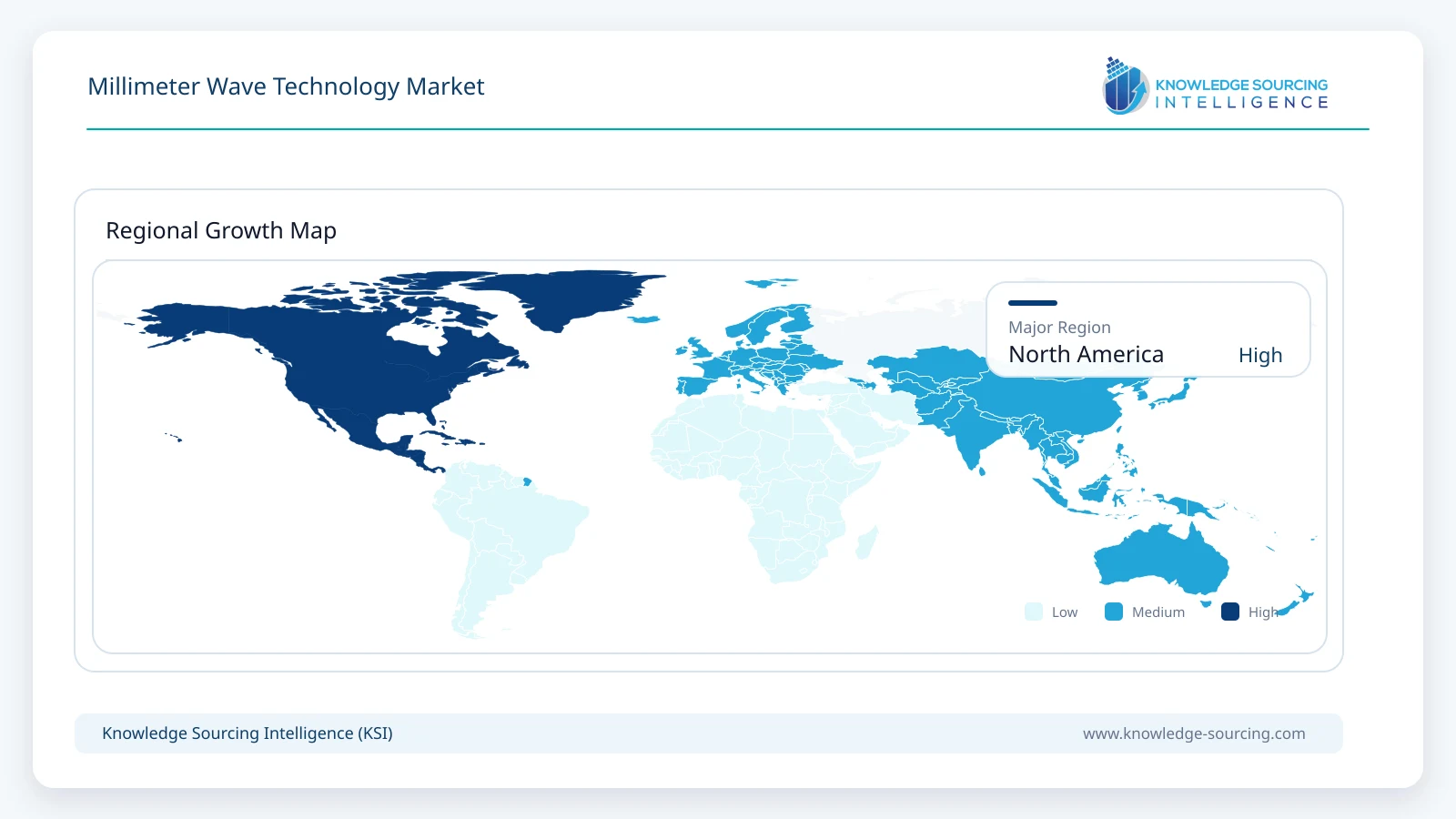
North America holds a substantial share of the millimeter wave technology market, supported by early 5G mmWave commercial deployment, strong operator investment in urban small-cell densification, and a concentration of leading equipment and semiconductor vendors.
Europe Market Analysis
The market in Europe is progressing steadily, aided by the increasing 5G mmWave spectrum licensing and the increasing adoption of mmWave radar in the automotive sector for ADAS applications by the automotive giants.
Asia-Pacific Market Analysis
Asia-Pacific is anticipated to be the fastest-growing market region from 2025 to 2031 due to its Aggressive 5G network densification in China, South Korea and Japan and Rapidly growing automotive ADAS adoption across the region.
Middle East and Africa Market Analysis
The Middle East and Africa are seeing emerging investment in millimeter wave technology tied to 5G network rollouts and smart-city infrastructure initiatives across the Gulf states.
South America Market Analysis
South America represents a developing market for millimeter wave technology, with telecommunications operators in Brazil gradually expanding 5G mmWave trials and deployments in dense urban centers.
List of Companies
Qualcomm Incorporated
Huawei Technologies Co., Ltd.
Ericsson
Analog Devices, Inc.
Keysight Technologies Inc.
Intel Corporation
NEC Corporation
L3Harris Technologies, Inc.
Anritsu Corporation
Rohde & Schwarz GmbH & Co KG
Competitive Landscape
Qualcomm Incorporated
Qualcomm leads the millimeter wave technology market with over 11% share in 2025, supplying mmWave chipsets and modem technology that underpin a significant share of global 5G mmWave smartphone and infrastructure deployments.
Huawei Technologies Co., Ltd.
Huawei is a leading supplier of millimeter wave telecommunications infrastructure, with substantial deployment share across Asia-Pacific markets supporting the region's position as the largest mmWave technology market globally.
Ericsson
Ericsson supplies millimeter wave radio access network equipment for 5G deployments, serving telecommunications operators globally with infrastructure supporting both access and backhaul mmWave use cases.
Analyst View
The Millimeter Wave Technology market is transitioning from pilot-stage 5G trials into a mature, multi-application commercial technology spanning telecommunications, automotive, healthcare and security-screening use cases. Dense urban 5G small-cell deployment remains the market's largest established application, but automotive ADAS and V2X communication is emerging as its most consequential growth vector, reflecting the automotive industry's increasing reliance on mmWave-based imaging radar to support higher levels of driving automation. Asia-Pacific's combination of aggressive 5G densification and rapidly expanding automotive electronics adoption positions the region to both lead in current revenue share and outpace all other regions in growth through the forecast period. The resolution of mmWave's historic non-line-of-sight propagation limitations through AI-enabled beamforming marks a genuine technical inflection point, meaningfully expanding the technology's practical deployment range and addressable use-case base beyond the constrained line-of-sight scenarios that defined its earlier commercial phase. Vendors that combine strong chipset and component technology with the software-defined beam-steering capability needed to simplify field deployment are best positioned to capture the next phase of market growth.
Millimeter Wave Technology Market Scope:
| Report Metric | Details |
|---|---|
| Total Market Size in 2026 | USD 7.0 billion |
| Total Market Size in 2031 | USD 19.1 billion |
| Forecast Unit | USD Billion |
| Growth Rate | 22.1% |
| Study Period | 2021 to 2031 |
| Historical Data | 2021 to 2024 |
| Base Year | 2025 |
| Forecast Period | 2026 – 2031 |
| Segmentation | Component, Frequency Band, Application, Geography |
| Companies |
|
Market Segmentation
By Component
Antennas & Transceivers
Frequency Sources
Other Components
By Frequency Band
24-57 GHz
57-95 GHz
By Application
Telecommunications & Wireless Backhaul
Automotive ADAS & V2X
Healthcare Imaging
Security Screening
Others
By Geography
North America
USA
Canada
Mexico
South America
Brazil
Others
Europe
Germany
France
United Kingdom
Others
Middle East and Africa
UAE
Saudi Arabia
Others
Asia Pacific
China
India
Japan
South Korea
Others
Table of Contents
1. EXECUTIVE SUMMARY
2. MARKET SNAPSHOT
2.1. Market Overview
2.2. Market Definition
2.3. Scope of the Study
2.4. Market Segmentation
3. BUSINESS LANDSCAPE
3.1. Market Drivers
3.2. Market Restraints
3.3. Market Opportunities
3.4. Porter's Five Forces Analysis
3.5. Industry Value Chain Analysis
3.6. Policies and Regulations (Spectrum Licensing & Allocation)
3.7. Strategic Recommendations
4. TECHNOLOGICAL OUTLOOK
4.1. AI-Enabled Beamforming
4.2. Software-Defined Beam Steering
4.3. mmWave Wireless Backhaul
4.4. Imaging Radar for Automotive ADAS
5. MILLIMETER WAVE TECHNOLOGY MARKET BY COMPONENT
5.1. Introduction
5.2. Antennas & Transceivers
5.3. Frequency Sources
5.4. Other Components
6. MILLIMETER WAVE TECHNOLOGY MARKET BY FREQUENCY BAND
6.1. Introduction
6.2. 24-57 GHz
6.3. 57-95 GHz
7. MILLIMETER WAVE TECHNOLOGY MARKET BY APPLICATION
7.1. Introduction
7.2. Telecommunications & Wireless Backhaul
7.3. Automotive ADAS & V2X
7.4. Healthcare Imaging
7.5. Security Screening
7.6. Others
8. MILLIMETER WAVE TECHNOLOGY MARKET BY GEOGRAPHY
8.1. Introduction
8.2. North America
8.2.1. USA
8.2.2. Canada
8.2.3. Mexico
8.3. South America
8.3.1. Brazil
8.3.2. Others
8.4. Europe
8.4.1. Germany
8.4.2. France
8.4.3. United Kingdom
8.4.4. Others
8.5. Middle East and Africa
8.5.1. UAE
8.5.2. Saudi Arabia
8.5.3. Others
8.6. Asia Pacific
8.6.1. China
8.6.2. India
8.6.3. Japan
8.6.4. South Korea
8.6.5. Others
9. COMPETITIVE ENVIRONMENT AND ANALYSIS
9.1. Major Players and Strategy Analysis
9.2. Market Share Analysis
9.3. Mergers, Acquisitions, Agreements, and Collaborations
9.4. Competitive Dashboard
10. COMPANY PROFILES
10.1. Qualcomm Incorporated
10.2. Huawei Technologies Co., Ltd.
10.3. Ericsson
10.4. Analog Devices, Inc.
10.5. Keysight Technologies Inc.
10.6. Intel Corporation
10.7. NEC Corporation
10.8. L3Harris Technologies, Inc.
10.9. Anritsu Corporation
10.10. Rohde & Schwarz GmbH & Co KG
11. APPENDIX
11.1. Currency
11.2. Assumptions
11.3. Base and Forecast Years Timeline
11.4. Key Benefits for the Stakeholders
11.5. Research Methodology
11.6. Abbreviations
Navigate
Trusted by the world's leading organizations











