
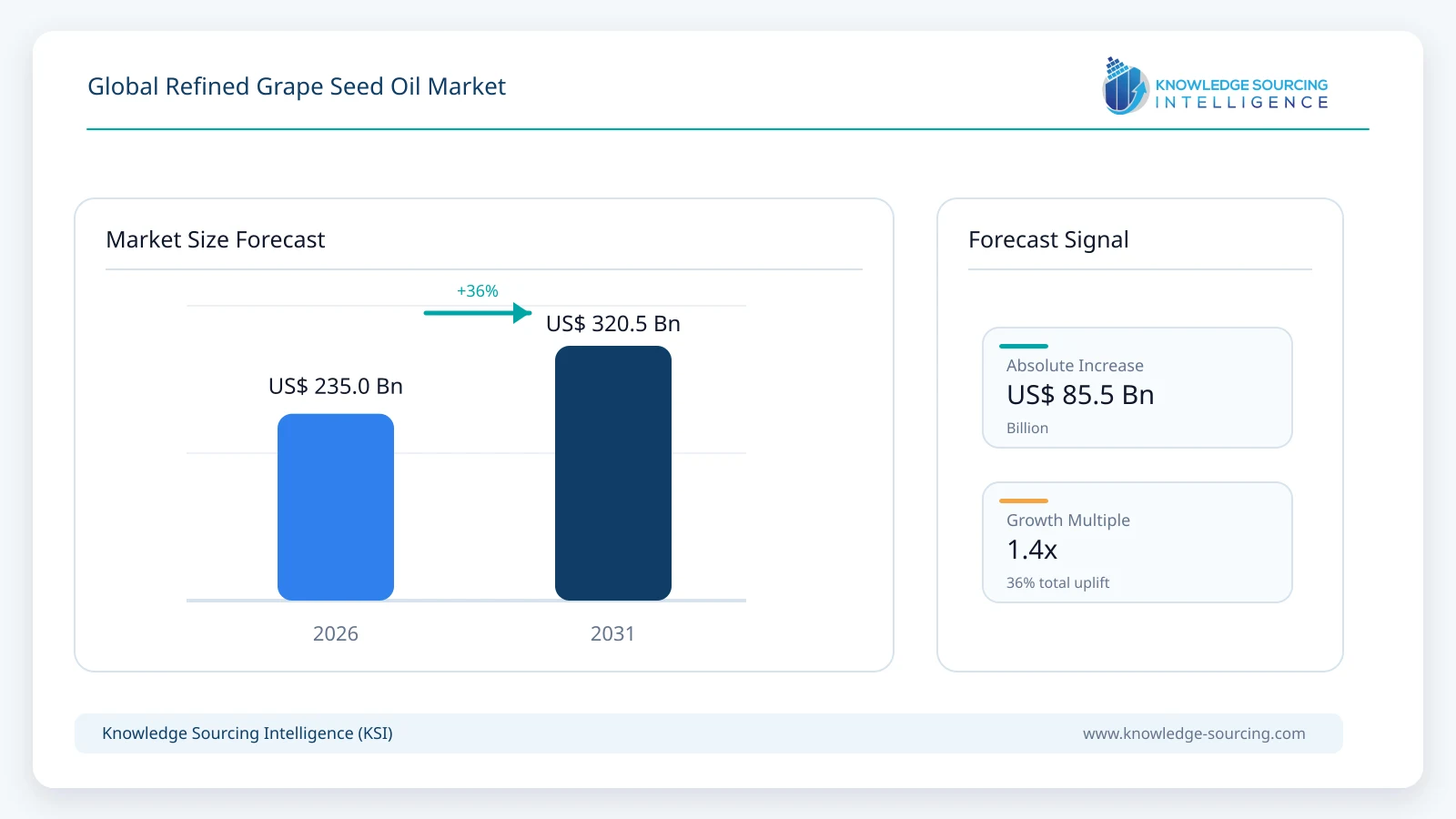
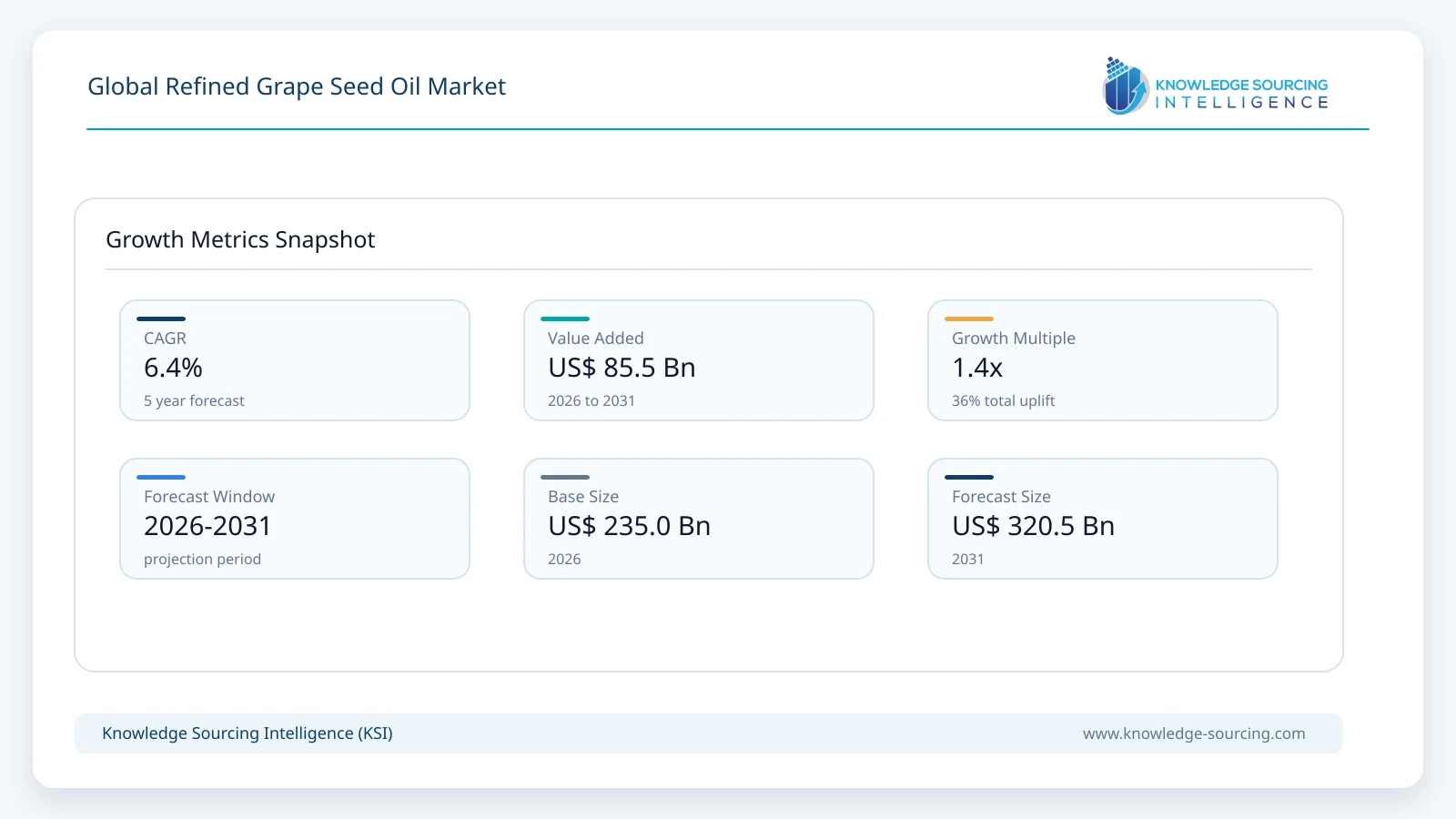
The global refined grape seed oil market is forecast to grow from USD 235.0 million in 2026 to USD 320.5 million in 2031, representing a CAGR of 6.4% during the forecast period.
Highlights:
- 1Food and beverage applications account for approximately 63.0% of global refined grape seed oil revenue in 2026.
- 2Conventional refined grape seed oil represents approximately 92.0% of global 2026 market revenue.
- 3B2B and wholesale channels account for approximately 68.0% of global refined grape seed oil revenue in 2026.
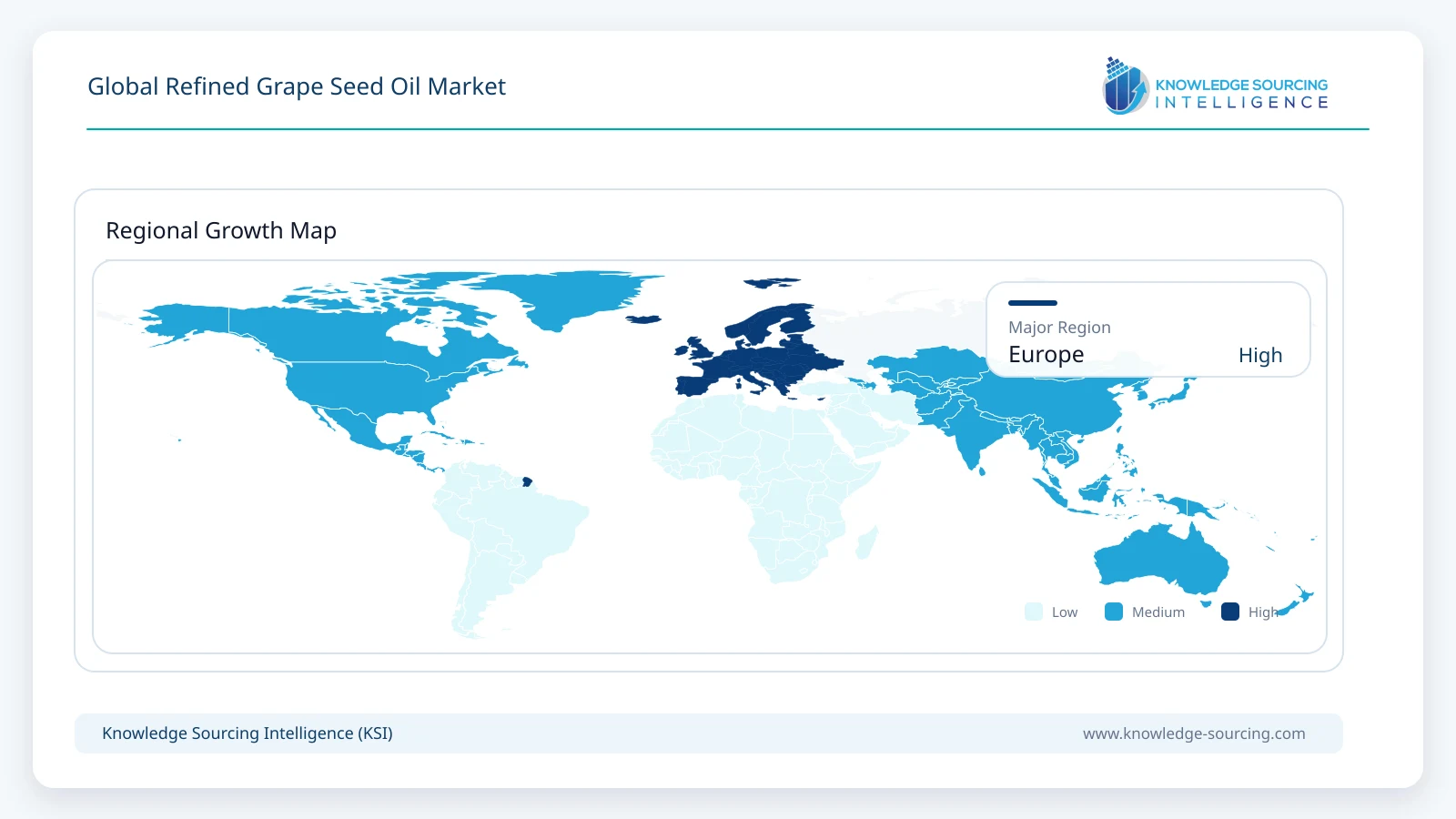
- 4Europe represents approximately 47.0% of global refined grape seed oil revenue in 2026.
- 5Tampieri commercializes about 10,000 tonnes of grape seed oil annually and states that this represents roughly 30% of the global market.
- 6The market is supported by wine-industry upcycling, food use, cosmetic formulation demand and growing interest in traceable plant-based ingredients.
Market Overview
The refined grape seed oil market covers oil produced from Vitis vinifera seeds recovered from grape pomace and subsequently refined for food, cosmetic, nutraceutical, pharmaceutical and related industrial applications. The scope includes conventional and certified-organic refined grades sold in bulk, foodservice, industrial and packaged formats. Cold-pressed virgin oil that is not subsequently refined, grape-seed extract, grape polyphenols and other wine-industry co-products are excluded.
The market is closely tied to the wine and juice industries because grape seeds are recovered from pomace after grape processing. The International Organisation of Vine and Wine reported approximately 227 million hectolitres of global wine production in 2025, with Italy, France and Spain remaining the three largest producers. This creates a substantial feedstock base, but only a portion of pomace is economically collected, dried, separated and processed into oil.
A current producer-volume anchor indicates a materially smaller market than older broad estimates. Tampieri states that it commercializes about 10,000 tonnes of grape seed oil annually and accounts for roughly 30% of the global market. This implies global commercial volume in the low-30,000-tonne range. The value estimate therefore reflects a mix of lower-priced bulk edible oil and higher-value cosmetic, nutraceutical and packaged formats rather than assuming retail pricing across all volume.
Refining is important because crude grape seed oil can contain color, odor, waxes and other components that limit consistency across food and cosmetic applications. Industrial suppliers such as Tampieri, Gustav Heess, Borges, Alvinesa, SOPHIM and O&3 offer refined or refined-grade products for culinary, formulation and professional use. The refined format is especially important for food manufacturers and cosmetic formulators that require predictable color, odor, fatty-acid composition and shelf stability.
The market is expected to expand steadily through 2031 as food manufacturers diversify specialty oils, cosmetic formulators increase use of light emollient plant oils and buyers place greater value on upcycled ingredients. Growth is moderated by limited seed recovery, variable wine harvests, competition from larger vegetable-oil categories and price sensitivity in food applications.
Refined Grape Seed Oil Market Trends
Upcycling Becomes a Core Commercial Proposition
Grape seed oil is increasingly positioned as a circular-economy ingredient because the raw material originates from grape pomace that would otherwise have lower-value uses. Gustav Heess describes refined grape seed oil production as an example of food-industry upcycling, while Alvinesa builds its broader ingredient portfolio around recovery of wine-industry co-products. This positioning is commercially relevant for food and personal-care companies seeking traceable plant-based ingredients with a clear waste-reduction narrative.
Food Applications Remain the Volume Base
Refined grape seed oil retains a strong food-use proposition because of its mild flavor, high linoleic-acid content and suitability for cooking, frying, dressings and sauces. Borges markets refined grape seed oil specifically for high-temperature cooking, while Alvinesa promotes it across dressings, sauces, baked goods and other food applications. Food demand supports the majority of global volume because the required quantities are much larger than in cosmetic formulations.
Cosmetics Increase the Value per Kilogram
Cosmetic and personal-care demand is smaller in tonnage but supports higher-value specifications and distribution. Clariant positions Plantasens Grape Seed Oil as an emollient for face, body and hair care, SOPHIM markets refined grape seed oil for lightweight skin and hair formulations, and O&3 supplies refined cosmetic grades including an EP9 specification. These applications reward consistency, documentation, traceability and formulation performance rather than food-oil economics alone.
Traceability and Quality Documentation Become More Important
B2B buyers increasingly require detailed specifications covering fatty-acid composition, peroxide value, acid value, origin, allergens and regulatory status. Gustav Heess maintains formal refined grape seed oil specifications and multiple industrial pack sizes, while O&3 provides application and technical documentation for cosmetic and food-grade variants. This favors established suppliers able to provide repeatable quality across harvest cycles.
European Supply Remains Central
Europe remains the core production and processing region because Italy, France and Spain are major wine producers and host several leading grape seed oil processors. Tampieri operates in Italy, Alvinesa in Spain, Borges in Spain, and multiple German ingredient distributors and refiners supply refined grades across food, cosmetic and pharmaceutical markets. European origin also supports traceability and proximity to the largest wine-industry feedstock pools.
Segment Analysis
By Application - Food and Beverage
Food and beverage applications are estimated at approximately USD 148.1 million in 2026. The segment is the largest revenue pool because refined grape seed oil is consumed in substantially higher volumes in cooking oils, frying, sauces, dressings, marinades and food manufacturing than in cosmetic or nutraceutical formulations. Borges actively markets refined grape seed oil for high-temperature cooking, while Alvinesa positions the oil across dressings, sauces and baked goods. The neutral sensory profile of refined oil broadens its food use compared with more strongly flavored cold-pressed grades, and bulk formats are well suited to restaurants, foodservice and manufacturers. Growth through 2031 is expected to remain steady rather than rapid because grape seed oil competes with larger and generally lower-cost oils such as sunflower, canola, olive and avocado oil.
By Source - Conventional
Conventional refined grape seed oil is estimated at approximately USD 216.2 million in 2026. The segment dominates because most global grape pomace originates from conventional vineyards and large-scale food and cosmetic buyers prioritize availability, consistent specifications and competitive pricing. Organic refined grape seed oil is commercially available, including products from suppliers such as SanaBio, but certified supply is structurally smaller and more expensive because the feedstock must be segregated through grape cultivation, pomace collection, seed recovery and refining. Conventional production therefore remains the practical volume base for food manufacturers, foodservice distributors and large cosmetic formulators, while organic grades are concentrated in premium applications.
By Distribution Channel - B2B and Wholesale
B2B and wholesale channels are estimated at approximately USD 159.8 million in 2026. The segment is the largest route to market because a significant share of refined grape seed oil is sold as an ingredient rather than as a finished consumer product. Gustav Heess offers bulk formats ranging from canisters and drums to IBCs and tank trucks, while Tampieri, Alvinesa, SOPHIM, O&3 and other suppliers sell directly to food manufacturers, cosmetic formulators, distributors and professional users. Large-volume B2B transactions carry lower per-kilogram prices than small retail packs, but they account for the majority of commercial tonnage and provide the most stable demand base across food, cosmetics and industrial formulations.
By Geography - Europe
Europe is estimated at approximately USD 110.4 million in 2026. The region combines the largest concentration of major wine-producing countries with established grape-pomace processing, refining and specialty-oil distribution. OIV data show Italy, France and Spain as the three largest wine producers in 2025, while Tampieri, Alvinesa and Borges operate within this European feedstock base. Tampieri alone states that its grape seed oil output accounts for about 30% of the global market. Europe also contains a dense network of cosmetic and food ingredient distributors such as Gustav Heess, SOPHIM, O&3, SanaBio and J.H. Müller, supporting both production and downstream formulation demand.
Market Drivers
Wine-Industry Upcycling
Grape seed oil converts a by-product of wine and juice production into a higher-value food and cosmetic ingredient. This circular-economy profile supports demand from manufacturers seeking to reduce waste and increase the share of upcycled raw materials in finished products.
Growth in Natural Personal-Care Ingredients
Cosmetic formulators use refined grape seed oil as a lightweight emollient in creams, lotions, serums, body oils and hair products. Its fatty-acid profile and relatively light sensory properties make it suitable for products positioned around natural-origin ingredients.
Specialty Culinary Oil Demand
Refined grape seed oil is marketed for frying, sauteing, sauces, dressings and gourmet cooking. Its mild flavor and high-temperature suitability create a distinct culinary proposition compared with stronger-tasting oils.
Expansion of B2B Ingredient Distribution
Large ingredient suppliers offer refined grape seed oil in drums, IBCs, tankers and smaller industrial formats, improving availability for manufacturers. Broader distribution supports adoption outside traditional wine-producing regions.
Traceability and Sustainability Requirements
Food and personal-care brands increasingly evaluate raw materials on origin, waste reduction, certifications and documentation. Grape seed oil benefits from a clear link to agricultural by-product recovery and established European supply chains.
Market Restraints
Limited Recoverable Feedstock
Although global grape production is large, only a portion of pomace is collected and processed economically. Seeds must be separated, dried and handled before oil extraction, which limits recoverable volume.
Dependence on Wine Harvests
Grape seed availability is linked to wine and juice production. OIV reported a third consecutive below-average global wine vintage in 2025, illustrating the agricultural variability affecting the upstream supply base.
Competition from Larger Vegetable Oils
Sunflower, canola, olive, soybean and other edible oils have much larger production bases and often lower unit costs. Grape seed oil therefore competes primarily in specialty rather than commodity applications.
Price Sensitivity in Food Applications
Food buyers frequently evaluate specialty oils against lower-cost substitutes. Refining, seed recovery and relatively small production scale can make grape seed oil less competitive for highly price-sensitive mass-market products.
Consumer Confusion Around Seed Oils
Negative consumer discussion around seed oils can affect retail positioning even though grape seed oil is derived from a wine-industry by-product and has a different supply profile from large commodity seed crops. Suppliers increasingly emphasize provenance, processing method and composition to differentiate the category.
Competitive Landscape
The refined grape seed oil market is relatively concentrated at the upstream processing level because economically recovering grape seeds requires access to wine-industry by-products, drying capacity and specialized oil processing. Tampieri is the clearest scale leader and states that it commercializes about 10,000 tonnes annually, representing roughly 30% of the global market. Alvinesa has also expanded its grape-derived ingredient footprint through operations in Europe and South America.
Competition broadens substantially at the ingredient-distribution and formulation level. Gustav Heess, SOPHIM, Clariant, O&3, SanaBio, J.H. Müller and Th. Geyer supply refined grades for food, cosmetic or pharmaceutical applications, while Borges and Salute Santé participate more directly in branded food channels. This mix creates different competitive criteria by application: food buyers prioritize price, sensory consistency and bulk availability, while cosmetic buyers place greater weight on documentation, origin and formulation performance.
The strongest suppliers are positioned around traceability, reliable grape-pomace sourcing and the ability to serve multiple end markets. Because total global tonnage is relatively small, expanding value through higher-specification cosmetic, nutraceutical and branded food applications is strategically more important than competing solely on commodity volume.
Recent Developments
February 2026: Clariant updated the commercial edition of Plantasens Grape Seed Oil, positioning the ingredient for face care, body care, shampoo, conditioner and color-cosmetic formulations.
2026: Gustav Heess retained refined grape seed oil in its current 2026 product portfolio for food, cosmetic and pharmaceutical customers, alongside a separate organic cold-pressed grade.
2026: O&3 maintained multiple refined grape seed oil grades, including a European Pharmacopoeia-aligned EP9 grade and a refined cosmetic/food-grade offering for professional formulators.
October 2025: Alvinesa showcased grape seed oil at Anuga 2025 in Cologne as part of its portfolio of natural ingredients produced through circular-economy processing of wine-industry co-products.
May 2025: Alfa Laval published an operational case study on Tampieri's grape seed oil production, reporting approximately 10,000 tonnes of annual output and continued process investment to improve efficiency and sustainability.
Market Outlook
The refined grape seed oil market is expected to reach approximately USD 320.5 million by 2031 as demand grows across food, cosmetics and specialty ingredient applications. The market should expand faster in value than in physical volume because higher-specification cosmetic and traceable grades gradually increase the value mix.
Food and beverage applications will remain the largest segment, supported by cooking, foodservice and manufacturing uses. Cosmetics and personal care are expected to increase their contribution to value because formulators use refined grape seed oil as an emollient and carrier oil in higher-margin formulations.
Europe will remain the principal production and commercial hub because it combines large wine-industry feedstock pools with established processors. Growth outside Europe will depend on import distribution, branded culinary products and adoption by cosmetic manufacturers. The market is likely to remain specialized rather than becoming a large commodity-oil category.
Refined Grape Seed Oil Market Scope:
| Report Metric | Details |
|---|---|
| Total Market Size in 2026 | USD 235.0 million |
| Total Market Size in 2031 | USD 320.5 million |
| Forecast Unit | USD Billion |
| Growth Rate | 6.4% |
| Study Period | 2021 to 2031 |
| Historical Data | 2021 to 2024 |
| Base Year | 2025 |
| Forecast Period | 2026 – 2031 |
| Segmentation | Application, Source, Distribution Channel, Geography |
| Companies |
|
| Customization Scope | 15% Free Customization included with purchase — Request Custom Breakdown → |
| Sample & Data Access | PDF Sample, Excel Databook & Analyst Briefing — Download Free Sample → |
Market Segmentation
By Application
Food and Beverage
Cosmetics and Personal Care
Healthcare and Supplements
Others
By Source
Conventional
Organic
By Distribution Channel
B2B and Wholesale
Offline Retail
Online Retail
By Geography
North America
United States
Canada
Mexico
South America
Argentina
Chile
Brazil
Others
Europe
Italy
France
Spain
Germany
United Kingdom
Others
Middle East and Africa
UAE
Saudi Arabia
South Africa
Others
Asia Pacific
China
Japan
India
South Korea
Australia
Others
Table of Contents
1. INTRODUCTION
1.1. Market Overview
1.2. Market Definition
1.3. Scope of the Study
1.4. Market Segmentation
1.5. Currency
1.6. Assumptions
1.7. Base and Forecast Years Timeline
1.8. Key Benefits to Stakeholders
2. RESEARCH METHODOLOGY
2.1. Research Design
2.2. Secondary Research
2.3. Primary Validation
2.4. Market Estimation and Forecasting
2.5. Data Triangulation and Quality Control
3. EXECUTIVE SUMMARY
3.1. Key Findings
3.2. Global Market Size, 2026-2031
3.3. Segment Summary
3.4. Regional Summary
4. MARKET DYNAMICS
4.1. Market Drivers
4.1.1. Wine-Industry Upcycling
4.1.2. Growth in Natural Personal-Care Ingredients
4.1.3. Specialty Culinary Oil Demand
4.1.4. Expansion of B2B Ingredient Distribution
4.1.5. Traceability and Sustainability Requirements
4.2. Market Restraints
4.2.1. Limited Recoverable Feedstock
4.2.2. Dependence on Wine Harvests
4.2.3. Competition from Larger Vegetable Oils
4.2.4. Price Sensitivity in Food Applications
4.2.5. Consumer Confusion Around Seed Oils
4.3. Porter’s Five Forces Analysis
4.4. Industry Value Chain Analysis
5. REFINED GRAPE SEED OIL MARKET BY APPLICATION
5.1. Introduction
5.2. Food and Beverage
5.3. Cosmetics and Personal Care
5.4. Healthcare and Supplements
5.5. Others
6. REFINED GRAPE SEED OIL MARKET BY SOURCE
6.1. Introduction
6.2. Conventional
6.3. Organic
7. REFINED GRAPE SEED OIL MARKET BY DISTRIBUTION CHANNEL
7.1. Introduction
7.2. B2B and Wholesale
7.3. Offline Retail
7.4. Online Retail
8. REFINED GRAPE SEED OIL MARKET BY GEOGRAPHY
8.1. North America
8.1.1. United States
8.1.2. Canada
8.1.3. Mexico
8.2. South America
8.2.1. Argentina
8.2.2. Chile
8.2.3. Brazil
8.2.4. Others
8.3. Europe
8.3.1. Italy
8.3.2. France
8.3.3. Spain
8.3.4. Germany
8.3.5. United Kingdom
8.3.6. Others
8.4. Middle East and Africa
8.4.1. UAE
8.4.2. Saudi Arabia
8.4.3. South Africa
8.4.4. Others
8.5. Asia Pacific
8.5.1. China
8.5.2. Japan
8.5.3. India
8.5.4. South Korea
8.5.5. Australia
8.5.6. Others
9. COMPETITIVE ENVIRONMENT AND ANALYSIS
9.1. Major Players and Strategy Analysis
9.2. Product and Application Positioning
9.3. Supply and Feedstock Positioning
9.4. Distribution and Certification
9.5. Recent Developments
9.6. Competitive Dashboard
10. COMPANY PROFILES
10.1. Tampieri Group
10.2. Alvinesa Natural Ingredients, S.A.
10.3. Borges Agricultural & Industrial Edible Oils
10.4. Gustav Heess Oleochemische Erzeugnisse GmbH
10.5. Clariant AG / Plantasens
10.6. SOPHIM
10.7. O&3
10.8. SanaBio GmbH
10.9. J.H. Müller GmbH
10.10. Th. Geyer Ingredients GmbH & Co. KG
10.11. Food & Vine, Inc. / Salute Santé!
11. APPENDIX
11.1. Currency
11.2. Assumptions
11.3. Base and Forecast Years Timeline
11.4. Abbreviations





Frequently asked questions
What is the projected growth of the refined grape seed oil market?
Market grows from $235.0M (2026) to $320.5M (2031), CAGR 6.4%.
What are the primary growth drivers for this market?
Wine upcycling, food/cosmetic demand, and traceable plant-based ingredients drive growth.
Which application segment dominates the refined grape seed oil market?
Food and beverage applications account for 63.0% of revenue in 2026.
What type of refined grape seed oil holds the largest market share?
Conventional refined grape seed oil represents approximately 92.0% of revenue.
Which region is the largest market for refined grape seed oil?
Europe represents approximately 47.0% of global revenue in 2026.
Which sales channel accounts for most refined grape seed oil revenue?
B2B and wholesale channels account for 68.0% of revenue in 2026.
Cite this report
Knowledge Sourcing Intelligence. (Oct 2026). Global Refined Grape Seed Oil Market - Strategic Insights and Forecasts (2026-2031). https://www.knowledge-sourcing.com/report/refined-grape-seed-oil-market